
Animal
35th installment to my philosophical system.

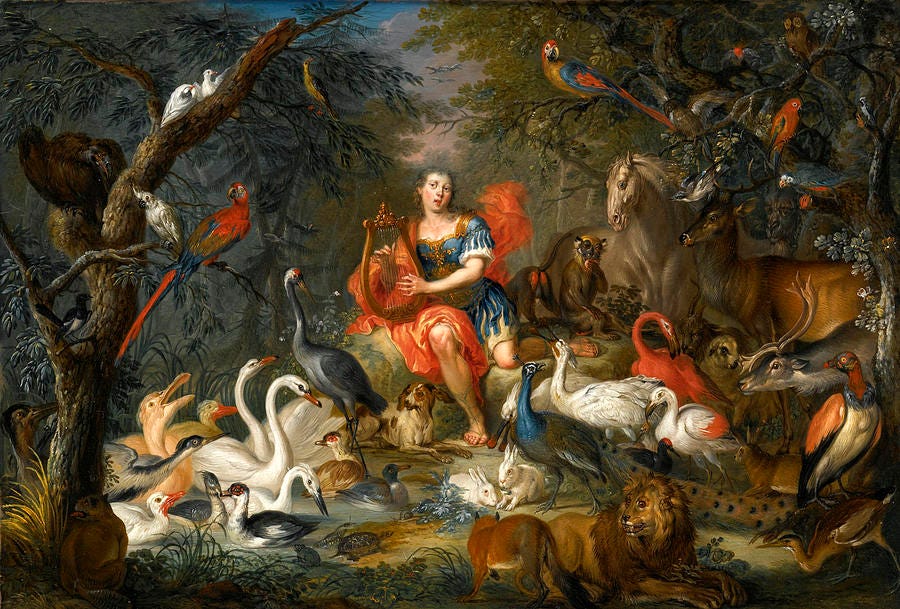
It has never been doubted that man was an animal. Even the ancients, whom we moderns today like to think of as superstitious or given to vain speculations for the sake of easing their minds, admitted that man, though a creation of the gods, is closer to animal than any divine thing.
It was man who first came up with the concept of “animal” after all, was it not? Did man not deliberately distinguish himself from the beasts of the field in order to place himself higher atop the pecking order—the summit of nature, higher than all things below it on account of our genius? I, for one, find it an extremely presumptuous thing we do: to assume ourselves the center of the world—for some, even the creators of it (idealists)—and prance about it with an air of pomp and circumstance that should rarely be seen, or even expressed.
No. Man reveals his true nature all too often; and it is enough to accept the truth of it alone, were we honest and far from vain. But alas, it is difficult to get man to see what he feels he could never become, because man is ignorant of his real nature so long as he does not have to confront it, so long as he is spared from the realities of life: of misfortune, anxiety, choice, chance, misery, and death.
It is an incomparable fact, when recognized, that life hardly presents itself to us today as something interesting or as a task to be done. What, if anything, is there to truly differentiate life today and life tomorrow? Does anyone have even the slightest idea what makes every day different, or unique, or interesting, or even worth living? One does not have to go far to consider the basic questions of life and instantly find themselves in the depths of a darkness so immense no light can escape it. The event horizon of man’s ignorance with respect to life has seemingly always been constant; whether the advancement in man’s material conditions justifies an expanding circumference is difficult to say, for the matter has not changed, merely the form. Man’s ignorance with respect to himself is like a ball that is in one instance dipped in white paint, followed by black paint, completely covered and unable to know whether it was always black or whether it was once another color.
Nature necessitates change, and if any absolute claim can actually be affirmed with certainty, that would be the one I bet on. Man may change, but he is still an animal; the whole taxonomy of man bears this out—the law of monophyly practically necessitates it. It was for that reason that “animal,” after Carl Linnaeus, was no longer used as a scientific classification for man proper (ignoring his kingdom classification—Animalia—of course); there was no trait in man, aside from reason and perhaps consciousness, that distinguished him from his simian ancestors. Man has never not been Hominidae, nay further still, Eukaryota. The proper taxonomical name for man today lies in our vanity, as everything under the sun seemingly does in reference to man, for we gave ourselves the moniker sapiens (the one who is wise/discerning) from the Latin sapĕre—originally meaning “to taste,” but over time it became “to know”; as if man was able to know anything, or as if his judgment was good enough to be considered wise by others. It is shocking how ignorant we have seemingly always been as a species.
There is no clearer sign of maturity in a mind than to see the majority of mankind for what it really is: a band of ignorant savages who have always been ready to sell themselves to an authority, so far as their lives are not inconvenienced by whatever decision that authority makes. The very conception of what it is to be man, as we have it today, is a relatively recent innovation. There was no such thing as the “individual” before Rousseau, really; the very concept of individuality would have been completely foreign to, say, the erudite scholars of the Italian Renaissance—let alone the ancient Greeks, Muslims during the Umayyad Caliphate, Japanese during the Heian period, or Chinese during the Tang dynasty. Everyone living in those societies would have considered themselves only in respect to the community, or as subjects to the lords whom they worked under; there was no internal recognition of individual identity—what I call interiority—but rather a type of collective identity with respect to those who were “above” you in the social hierarchy. The only thing a person then could identify with was their own family legacy or, if they were lucky, their leader. The very framework by which we consider ourselves, and view ourselves through, was a byproduct of man becoming conscious of his own place within the world. Anyone who has studied history will know that most human beings lived lives almost identical to their ancestors; there was very little in the way of social mobility, just like today, and there were rigid structures in place to maintain that status hierarchy—a thing we also still cling to today.
With the breakdown of monarchical order and with the restructuring of civil society, combined with the rapid advancements made in technology, medicine, and science, along with countless progressive ideals being pushed to the front of public consciousness, the average person gradually became aware of their status as individuals—their place in the world and what they contribute to society. The decline of the old order had been in play since the Protestant Reformation, for religion held massive influence on the majority and was for the first time being spoken in the common vernacular, the language of the people, rather than Latin. Just imagine: you go to a Sunday service only to hear a whole sermon in a language you can’t understand—ABSURD. The Bible was for the first time being liberated from the scholarly stranglehold it had been under since the Patristics; the word of the “good” book was no longer subject to church authority but rather left to the common people to listen to and interpret on their own, and thus came every sect and division we have today.
But, in truth, these religious uprisings were only the prelude to the real destroyer of the old order—capital. To the king or emperor, the peasants, even in revolt, proved little threat, for the army was too strong, too vast, and too well-fed to be in any danger of defeat from a few thousand feeble, backward, malnourished serfs; to say nothing of the nigh impossibility of uprising in the first place. Anyone thought to pose a true threat to the crown was either killed or banished from the land, and this stronghold of austerity led to dependence and compliance out of a practical necessity: survival. The first real threat to the established order was capital—the birth of the bourgeois class, right below the aristocracy itself. When subjects grew private fortunes as large as, or larger than, the king’s, it was the king who was subject to the whims of his creditors, rather than the bourgeois being subject to his ruler.
The dictatorship of the aristocracy was on its last legs, and the dictatorship of the bourgeoisie was on its way. This was cemented with the Dutch East India Company, the first joint-stock company, which effectively acted on behalf of the Netherlands, advancing its interest—imperialism—and making null the concept of a king by showing a state (for at the time “nation,” a collection of independent, autonomous lands, did not exist as a concept) could be run without top-down authority. This was the beginning of what is today called classical liberalism, made famous by arguments from John Locke mainly, that supported, among other things, property rights and the ability for landowners to have a say in how the state should be run—essentially making the direction of a state subject to the desires of the ruling classes.
If it isn’t already obvious from what has just been said, let me make it clearer: this is where modernity comes from—the birth of Western modernity is liberalism. The notion of modern man, free and able to pursue what he will, was born out of the idea of being able to own something which the ruler of the state had no claim over. It should be noted that this remains only true in theory but false in practice, for most are unable to own anything at all; the barrier to entry into the ownership class is kept artificially high by those already in power in order to exert dominance and maintain order on the majority, while simultaneously ensuring that they maintain their power and make it impossible for the majority to rise up in their social standing. The very hands which made modernity are also slowly strangling it, because it cannot keep up this power charade forever; sooner or later there must be reforms, or revolution is all but certain.
Throughout history, every working-class group—plebs, shudras, serfs, slaves, and members of the Third Estate—have always resented their impoverished state, but it was only in modernity where the commoner could, again in theory, advance beyond the status or class they were born in in order to live a life of their own design. It all leads back to capital and the ability to acquire and enlarge it beyond all necessity; it is through that lens that most people today see themselves. It is their ticket to live as individuals rather than animals, or so they’re told, and so they make it the central part of their identity and subjugate nearly every action for its end. It is for this reason that modern man is so lost, and why he really is no different from his ancestors, who worked and lived not much differently from beasts of burden—domesticated animals whose sole purpose was to tread out grain to make bread for the sake of eating it. Harvesting was the primary trade, and we moderns are merely reaping every seed we didn’t sow.
Modern men cannot find themselves in the world because they are doomed to live after the demands of another rather than their own. To call that life is really a tragicomedy—for it is comedic to take seriously, but tragic because it must be taken seriously in order to live. This newfound consciousness within man, which I just spent a great deal of time explaining the origin of, is really a kind of nightmare: for at least during the Middle Ages there was no concept of social mobility, or freedom, or choice in the matter of how one was to live their life—all to obsess and depress oneself over. In such a case, I do, in fact, believe it would have been better to remain in great ignorance of our true power than have the responsibility of making one’s way through life and putting oneself out there for the sake of making a living. This indomitable feeling of being in constant strife and conflict with ourselves as we move through the world is nearly too much to handle responsibly; there is, perhaps, too much freedom today and too many potential avenues one can go down for their life.
Everyone living today knows this feeling intuitively: knows the world is large and uncaring, and rigged against us, and organized for the sake of humiliating us and making us feel like failures because all we’re shown outside ourselves is other “successful” people that society at large tells us to admire and be like. And worse still, the potential of becoming successful is made to seem as if it were certain so long as we work hard enough at it—this lie has to die. We need to be more realistic, more conservative, more restrained and pragmatic when it comes to formulating what we think the “good life” is. Most people today only seek the good life in money, because money is sold to everyone as the only way to achieve happiness—again, because our culture, and our values more generally, are inherently materialistic, egoistic, self-defeating, and meaningless in the grand scheme of things. Man is an animal because he is led to live like one, after the manner of his ancient African ancestors—Y-chromosomal Adam and Mitochondrial Eve.
Man is man; he is what he is, but the moment he considers what he is aside from himself, what is outside him that is… —————. Nothing. Blank. No one dares to consider what lies beyond himself, for if he does, he will revolt at the madness caused by it. There is nothing scarier to man than himself, for his self is the ultimate mystery, a blindness that is immense. This fear makes him subject himself to material conditions he hates but, because he fears uncertainty and death more, endures for the sake of his peace of mind and life. It is our modern condition. Man is at all times made to think things which are not from himself, and time and again he destroys himself in attempting to become more, to be more, to see himself as more—all this stemming from his self-conscious state of reflection about himself, which he never really had before: it is absurd.
The world has always been absurd, and man has always been ignorant of his true purpose, but what we face today is unlike anything in history before, precisely because we moderns are unlike every generation which has come before. I made the argument that modernity was born with the Dutch East India Company at the start of the 17th century, and I feel that’s true, especially considering the historical evidence, but I did not venture deep into the existential implications of that. The reason for that is because they are not the same as they would have been for, say, a Dutch merchant in 1637 who lost his life savings over tulips. Since then, the progress of man’s condition and the rapid maturity of his consciousness with respect to himself, alongside all the advancements made in living standards, have caused a new crisis in man the animal to emerge—what René Guénon dubbed La Crise du Monde Moderne (The Crisis of the Modern World). This is man’s inability to see himself spiritually, to become himself without turning to evil (money), without forcing himself to play on the terms of corrupt forces (occupations), to play a rigged game that makes it nigh impossible for him to actually live decently—and all this, compounded, to make it beyond difficult for him to live in a dignified manner which actually fulfills him.
Man is lost to himself because the conditions of the modern world—both materially and intellectually (spiritually and emotionally)—are not conducive to his well-being or for his benefit. Modern amenities are not the problem. Work is not the problem. Bills are not the problem. And money is, in an absolute sense, not the problem. Man is the problem, and always has been the problem, because man has the ability to change everything he or she is subjected to by other people but chooses not to, because it is easier to accept being trampled upon by those more powerful than you than it is to put up a fight for your newly discovered and accepted rights and dignities. Until you see how trivial everything in the world really is, you will always feel incapable of doing anything to change it, because you feel yourself subject to, rather than actually being above, it—which you are.
Every barrier to man’s liberation is placed upon him by himself, because he lets others—those unforeseen forces that control things—make him believe he is incapable of overthrowing them. This is the first thing which has to be overcome if modern man is to get beyond crisis and actually start living authentically, genuinely, and ethically. You are subject to your material conditions, for sure; but the goal is not to play within that framework, that artificial construct which limits your self-potential (as most people do today), but to get beyond it. To change the world: that is what must be done. To meet the needs of the majority: that is what must be fought for. Until then, there will always be class warfare—with the few holding indigence over the many like a Sword of Damocles. Friedrich Engels famously said:
Tears do not give power. Power does not shed tears. The bourgeoisie shows you no gentleness and you won’t conquer it with kindness.
And so we have it. Power does not shed tears. Power only acts, and it acts like an animal (violently) for the sake of maintaining and propagating itself among the few. If the people’s appeals are not heard by their representatives, then what use is government? What use is “freedom” or a vote if nothing changes, and the few continue to batter the many into submission on pain of misery and death? I ask more directly, again: what use is freedom if you cannot use it to further your freedom and the freedom of others, or, better yet, to extend it beyond what the ruling classes want us to consider as freedom? For we all know deep down their freedom and our freedom are completely separate things: they get luxury and we get a social class with little mobility; they get tax write-offs while we get tax hikes; they get the freedom to pursue their passions without worrying about the bills, while everyone else is forced to compete and to look upon each other as competition, when in truth we’re all allies and friends in this great class struggle. Until we as individuals collectively rise up and fight for the values we wish to see spread throughout the world, we will never be able to live as true people, only animals.
Solid exploration of how consciousness itself became the trap. The link you draw between capital and modern identity crisis is spot on, especialy how we're told to see ourselves through an ownership lens. I've noticed in my own work how people genuinely can't imagine liberation outside the market framwork. The part about power not shedding tears is brutal bc it's true.