
Art
51st installment to my philosophical system.

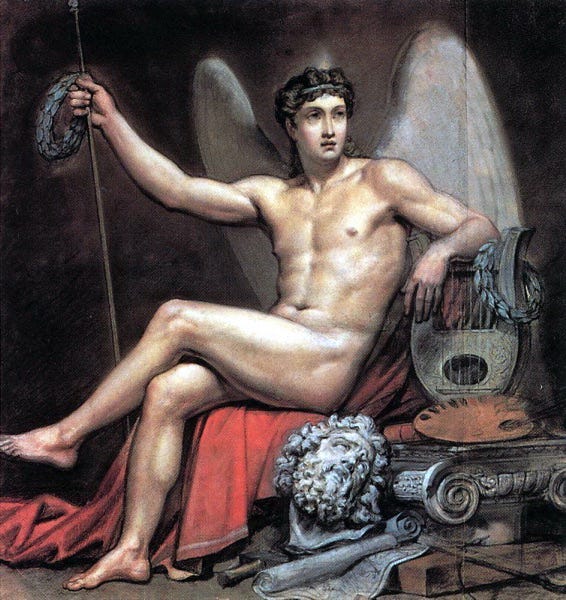
Art for the sake of life is the greatest kind of art. If art is not existential, then it is not human, and if it’s not human, then what is the point of creating it at all? Without the passion which the heart imbues in every act of creation, there would be no human sentiment implied in the expression, and so, all things which man expresses would be as dead as stone. Where the man is lacking, so too is the meaning.
Art finds a place in everyone’s heart, but it is felt particularly strongly in those whose intelligence is directed solely and singularly to its comprehension. What art means to the artist proper (painter, sculptor, or architect) is something different from the writer, musician, poet, or philosopher; all of them, however, are connected in one aspect: expression!—that of creating something with the intention of communicating its sentiments to another.
Every kind of art is really a kind of exposé into the mind of its author. A poet may write a poem on spring, but a musician may write a concerto on it. Now, could it be determined in some redundant, hackneyed fashion that one mode is superior to the other? Perhaps, but the point of art, for me at least, is not to reduce the expression to an option of “better,” but rather to impart to the recipient of the art the sentiments which the author held when creating it. Art is really a conduit for creativity—it’s a way of channeling the creative energies within its creator in order to produce something which will accurately convey what the author felt in the moment of inspiration.
Nothing is harder for the aspiring artist than to move past their own influences. Unless the person be a natural genius, it will normally follow that one who is inclined to art will become attached to a particular genus of the subject that they feel an attraction to, and from there attempt to develop their skills after the manner of their influences; this, however, makes it so that the artist will find themselves imitating mostly at first, until they feel they have exhausted all they could from their respective idols. This is—and I speak here from my own experience—a very dangerous thing, however: for how is the young artist to know when they have surpassed their masters?
My dear reader, as a writer myself—more specifically as someone thoroughly interested in the well-being of mankind, and who wishes to produce a philosophy that best allows for one to discover who they are—it is almost an insuperable task to find just when the threshold has been passed, and where one can finally decide on their own that they have, indeed, outdone the model which they have studied so vigorously for, in some cases, years on end.
Nearly every artist needs a bit of inspiration before they develop the germ of a creative idea on their own. Even if an individual of singular genius is fortunate enough to develop their creative powers without any influence from another artist, they still need a source from which to draw. Hence why, in the case of every natural genius, the source of all inspiration is love—love for wine, women, song, nature, learning, God, or life itself: everything in art demands love, for where there is no love there is no man, and without man, no expression of any kind.
In general, the artist should start from the particular impression that gave rise to the creative impulse in the first place; from there, find ways of expanding your particular impression in order to more fully flesh out the original impression—in this, the greatest care is required, lest the initial idea be totally bogged down and laden with false sentiments that were not present in the initial inspiration.
One should weave a broader narrative into their creations, for in that you expand on what was at first small, and in doing so create a larger and stronger picture that allows for more people to connect with it. The more niche an art is, the smaller the audience it will find, but the more general and human it is—there is where immortality resides. Without a broader narrative, there is only the act of creation itself; and while many artists—especially writers—defended the notion of art for art’s sake, I’ve always been one to remind such folk that self-expression and creativity—while useful and even necessary in their own right—fall short of the full grandeur they deserve if they are meant only for their author.
What would art be if it were done for strictly personal reasons? I would say no different from a scrapbook that is only meant for the writer of it, or, better still, no different from a canvas which the painter hides out of fear of having judgment passed on the unfinished work too early. No! Art must be done singularly, in the moment, for the author’s purpose alone—but, when finished, should be released out into the world in order to inspire others, perhaps even uplift them and provide them with a new vigor for life.
Art is never without a moral connotation to it; everything existential must concern itself with morals, for without the subjective which morality implies, there is no possibility of the objective being actualized in the piece of art made on behalf of the author’s own subjectivity and moral interpretation. In the context of art, nothing in it is worth doing if it is not pursued for its own sake and devoted to entirely for itself, on pain of anguish for having let slip a great sentiment or thought that could have resulted in a creation that changed history. Now that may be a bit of an exaggeration, but the fact of the feeling is there—and anyone who feels the innate urge to create art knows exactly the feeling I refer to.
There’s an immense sense of guilt that comes with being a competent artist; in much the same way I suspect an experienced doctor feels when they do not instantly cure their sick patient, the artist must undergo some misgiving, doubt, and even shame for not having taken the time to use their experience for the sake of creating their art. Every moment that is missed as an experienced, and even well-accomplished, artist must feel like a total waste; and with that comes the regret felt only by a hurt heart that has not beat with the pulse of love, but rather merely for the sake of pumping blood. Any creative impulse that is missed is forever gone, and so can hardly ever be recovered again unless by some miracle—aside from that, however, the thought is forever a “has-been” and never an “is,” and thus is like foam that rises to the surface of the sea only to be splashed away by another incoming wave.
Another crucial aspect of art that one must never forget is patience. If one strives too hard to develop a perfect thought ex nihilo, they will find that they shall halt for it; for while we feel in command of our thoughts, the right thought which we strive for in the process of creating art seems always two steps ahead of where we are in the act of creation. If such is the case, one might wonder why a man labors so, when a brief moment of thought should suffice; but this man forgets that thought is not a faculty of the will—it is an arrival. Like a phantom, it cannot be summoned at pleasure; it emerges only from a rare, harmonious collision of external stimulus and internal temper.
Even in our own affairs, we find ourselves unable to command a resolution. The mind wanders, perhaps out of a deep-seated aversion to its own truth. We must wait for the right frame of mind to return, unbidden, illuminating the matter from fresh angles until a decision finally “ripens.” To force the mind is to find nothing. This truth governs the life of the intellect as well. Even the greatest mind is not always capable of its own essence. Reading, in the case of a writer, may offer a temporary substitute—allowing an alien consciousness to think in our stead—but it is a perilous refuge. To read too much is to become a stranger to one’s own soul, walking in well-worn paths carved by others. Ultimately, the impulse for original thought springs not from the safety of books, but from the raw, primary grit of reality.
Patience in the act of creation is what allows one to find the idea they’re looking for that allows them to capture most perfectly what it is they intend to convey. The sentiment is always there, the matter is always at hand and can be called on at any moment—the question is, how will it form itself, and how will we as its authors make it into something for everybody, rather than just ourselves?
I don’t think anyone can call themselves an artist until they’ve been humbled by their own soul. Until one truly understands what it is to suffer for not having the time or opportunity to make themselves tangible to themselves, they will never understand what it is like to create art.
The hardest thing to do in all the world is being open to love, for to be open is to be vulnerable, and thus, to have the potential of being hurt. Life is hurtful, and it is more difficult than it should be most of the time; but in that time of difficulty, there is a greater opportunity to feel love, and to extend that love outside yourself and spread it to others in need of it. There’s more than enough love to go around in the world; the human spirit is infinite so long as man continues to live and endure while being subject to innumerable pricks and kicks from the fickle fortune of existence. It cannot be helped: the artist must love, must be open to pain, must have a penchant for suffering, and must desire, above all else, to create what is human, holy, and everything in between.
A man’s ideas are largely subject to his environment, as well as how good he is at making do with silence in the face of innumerable dead ends. Regarding ideas, as said earlier, a man must wait, must listen, must be still, must hear himself, must slow his breathing, must calm his mind, and must empty himself of any egoism that may arise in thinking for himself. We cannot force ourselves to think but rather must be one with the process of our struggles with thought. Every art is really a kind of overcoming that is unseen to the audience, and thus gives them the impression that the artist was able to create such a masterpiece without effort or labor expended in the process—but this is wrong; they do not know how long it took to acquire that skill in the first place, how long it took to develop the idea that went on to become that masterpiece, how long it took to execute that masterpiece, and, overall, how much doubt was overcome while creating that masterpiece.
We artists, we wanderers, we free spirits, we seekers of ourselves: don’t we all know implicitly the difficulty that comes with making the art we do, the feelings we must overcome in order to create them, the strain on our souls while making them, the anguish in our hearts after completing them; all this, and nevermore.
We are but moments in time, made to interpret and devise various schemes in order to live, and on top of that overcome all the stresses and strains which the external world places on us while we endure them. There is in living a kind of art too. Gagner sa vie—to earn one’s life, to keep a roof over one’s head, and to keep a full belly; is not all this the most ridiculous racket ever devised by man? If I were a truly brave man, I would devise for myself a way of life so rugged and impossible every second of my existence would be a kind of art, for it would require a kind of ingenuity and creativity found only in prophets and inspired poets.
Everything in life can be a kind of art, provided one is willing to see the art within it. That’s actually a reason why I’m grateful to have studied literature and philosophy as much as I have: not only did it allow me to improve as a writer—and a human being in general, I think—but it increased my sympathy for others, it made me a more compassionate person, it allowed me to see things from others’ perspectives, and it allowed me to more accurately comprehend the motives, desires, decisions, and actions of other people.
The greatest thing art can give you is the ability to understand another person; you can, at once, determine where the love derives from, and how it eventually led to where the person is today. A person without love can be spotted miles away, for in their attitude you can see a kind of restrained bitterness towards everything; while for a person with love, you know them by their deeds—in their compassion and honesty you see the fruits of all their labors instantly; that is not to say they’re perfect, but it is to say their hearts are good, their spirits are noble, and their desires for everyone are more love than they themselves can offer up.
A child is always a happy sight for one without one because you see only their innocence while they play and have fun, without the slightest care in the world—taking no notice of how much they trouble their parents behind the scenes, or how badly (potentially) their parents actually treat them.
The play of life is such that we assume ourselves to be the protagonist, and the world itself acts as the antagonist. Art bridges this gap, however, and allows one to more truthfully consider themselves in the face of their role as potentially both; humans are not all good and not all bad, but we are animals nonetheless, and so must be treated with the dignity our consciousness deserves. A man can never exhaust art, for love is infinite; and while we live our lives we’re exposed to enough struggles and difficulties that make the well of our love bottomless.
Love is born in suffering in the same way hatred is—and what determines which one a person ultimately chooses is their individual temperament: revenge or forgiveness, greed or philanthropy, sadness or happiness, hatred or love—in short, good or evil. Which one, though? I say beyond either. I say we must transcend everything, and only overcome, only affirm, only create. One must adopt a kind of heroic pessimism in our day and age; there has never been a time more ripe than now for feeling utterly hopeless with respect to the world: but in much suffering is much potential, for he that suffers greatly also loves greatly.
An artist is nothing without his struggles; in fact, it’s become a trope in literature. The starving artist (just one example) is one who is supposed to represent the ideal form of suffering for all creative spirits; one is reminded of Romanticism here—back when the whole purpose of literature was seemingly to torture a character with agonies to the point of feeling sorry for them, all while being couched in a sentimental, almost realist-like prose style. The Romantics said many pretty things, but they’re not existential (philosophical) enough for me: their prose is beautiful, but the substance is hit or miss; the form is excellent but the matter is lacking in depth—I find they make individual suffering the whole driving force of the character, rather than what it honestly is: a mix of emotions that culminate in sadness not from the suffering itself, but from not understanding the “why” behind the suffering.
Such is why Goethe’s Faust is far superior to his Werther:—Werther is a tragic human being whose doom was really all but settled from the start; whereas with Faust, the whole panoply of humanity is opened up before us, and the doubt we as readers feel regarding the possibility of his reuniting with Gretchen in heaven is the epitome of man—for the simple fact that man is a bundle of doubts and contradictions which he can never overcome intellectually, but which he can fully embody and move beyond, for a moment, in action.
The truest art, in that sense, is the one that represents the whole of man. What the present needs more of is a kind of Gesamtkunstwerk (total work of art) that holds man, contradiction and all, before himself. Without the recognition of the self, there is no truth to any art, only a simulacrum of what is supposed to be human. It is never enough, however. Nothing ever seems to be enough when it comes to art; even if we were to exhaust all our powers and display the whole of life before us as we did the human genome, there would still be words to say on the matter. Nothing is ever final. Nothing ever lasts. Nothing is eternal. When the truth of all this is fully admitted, and man confronts himself totally as an unknown individual to himself—then maybe we may say all has been said: but until the ocean of love runs itself dry, there will never come a time where the artist can no longer find ways to express what he feels in his heart.
Life is art. Where there is no art, no culture, no humanity, no love, there is no life, no creation, no sentiment or feeling at all—just a dead, dull nothingness. If it were possible to create art with as much effort as breathing takes, then everyone would do it; but because art is so abstract, and only good art is existential—which requires a great deal of time to thoroughly consider, to touch your own heart so to say, and contemplate how you overall view your existence—very few are capable of producing anything even remotely worthy of the name. A fine line must always be drawn and balanced upon if one is to make something of note in art; for in that balancing and considering comes the thinking which is a necessary prerequisite to fully understand yourself.
Wherever love is, art is. Wherever you are, art is not far behind. If we may ask along with Tolstoy “What is Art?”, we may say it is nothing but feeling and sentiment made tangible, expressed in an act or process of creativity that transcends our own understanding: an action that eludes our reasons and justifications for it, for it arises not from within but only from without (externally), but is something which can only be expressed from within (internally); and so you see, one may perform art, but never fully comprehend it, for in order to comprehend art one must first comprehend love—and this I scarce think possible for the mind of man.
One thing is certain, however: art will save us all.
I haven’t read this fully, but I was going to say a lot of times I feel that adults give young people a lot of opportunities, but don’t consider a constant pattern in feeling that people may decline them because some want to keep doing their hobby with their heart. Instead of trading their heart in for a contest.
I think you could apply this to fields like teaching, a teacher could follow someone’s advice into what they might be thinking is passion or teaching. Turns out that it’s the opposite effect I’m pretty sure that there’s plenty of people who have encouraged teachers to be less of themselves. When in that lifestyle you aren’t able to necessarily connect with your students, like you lead them to a version of yourself that isn’t you.
So, you end up connecting them towards a “robot” that might not even be you in the first place. It might just be someone else and I think that’s what makes such a thing between a teacher relatable. Despite the power imbalances and power dynamic is that they can be human too. They might not be able to push the exact power dynamic away, but some of them can treat you, like you are on the same level in some way.