
Beauty
49th installment to my philosophical system.

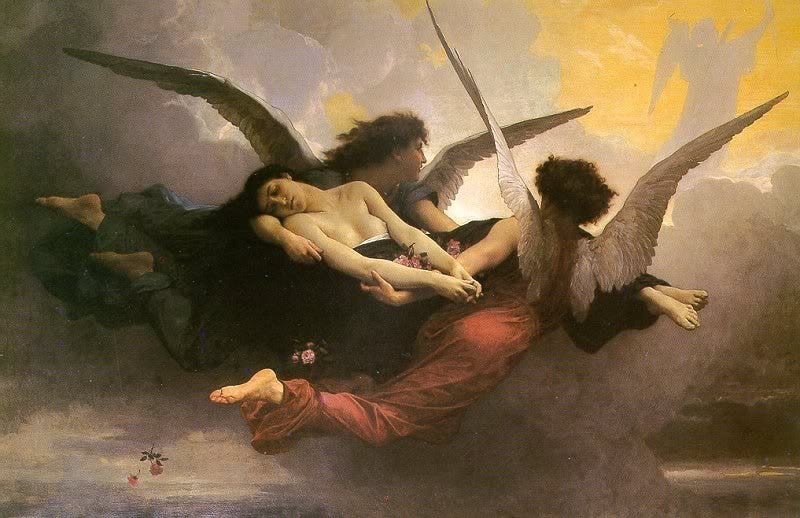
As much as it pains me to admit it (for I am not one to go along with the consensus of mankind on anything), I agree with that most traditional piece of wisdom: beauty is in the eye of the beholder. I should, however, like to make a small addendum to it: for the beholder, beauty is something which transcends his eyes—his subjectivity—and is something more akin to the objective, the final, and the omnipotent.
While beauty only strikes a man truly and honestly a few times in his life, he will find that were he able to look upon all things in the world with more generality and less prejudice, everything would be more readily open to him, and thus, much easier to see the immensity and beauty of. Nature hides her secrets from us, but her beauty is open for us to enjoy at any moment; so long as man has his wits about him, he will never be in want of a beautiful sight.
The whole construction of the world through our senses is the only necessary prerequisite to see beauty; without such sensations, there would be no material from which to draw, and so, no intellectual activity the mind could conjure up in order to provide some structure or framework. The sight of the sun, the sound of the birds, the feeling of the wind, the tasting of fresh honey, and the scent of blooming flowers—isn’t all this enough to paint a beautiful picture in your head about the world?
Beauty is solely man’s to enjoy, and the older a man gets—being less confused about the world and in a greater position to actually look at nature and appreciate it—the more he enjoys having endured his life, if only to be able to experience this most sacred of human actions: gazing into the infinitude of beauty.
Beauty calls out to man every second he lives. Man is obsessed, in fact, with beauty, for without it there would be very little worth living for. What we find in life normally is drab and mundane, totally at odds with the very concept of beauty; but, to go back to that timeless maxim, the beholder holds within them the true source of perception, and so, the entire spring through which beauty flows.
Our perceptions, if we are to agree with the subjective idealist, are responsible for creating the whole world before us, and nothing more; however—and I think the empiricists were right on this—there had to have been a time in which the world was not perceived by man and yet did exist objectively before him. If this be the case, then our reality is not of our own making, but rather the construction of it from our experience, interpreted in our minds.
Now, funnily enough, while the idealists and realists (or rationalists and empiricists) of the 17th and 18th centuries were battling it out—fighting over whether the world was a product of the mind or merely an excitation of it—it never occurred to them that it could potentially be both. The problem with dichotomous thinking is that it fails to make connections between differing interpretations; it rather only seeks to validate those sources which can be made sense of under its view, disregarding the other as false outright. I could never abide by this reasoning, for I always found ideas more powerful when mingled together, rather than separated and made to stand without support from neighboring ideas.
In the context of the old debates regarding how the world is to be known, the rationalists and empiricists spoke past each other for centuries, and it wasn’t until the pervasive skepticism of David Hume that one Thomas Reid—long before Kant—made arguments on behalf of common sense: that reality is neither an experience only nor an idea of the mind only, but rather a harmony of both. According to Reid, sense is our experience of reality, but perception is the true reality which we perceive—a necessary distinction that allows one to see that reality is both hard-wired in us from the start, but also subjectively understood by us to the end. I think Reid is to be praised, for while he lacked the systematic treatment Kant gave the question, and had no concept of the mental categories, he was still able to bridge the gap between raving subjectivity and sterile objectivity. The ability to affirm everything and affirm nothing, given light in the synthesis of both, allowed future thinkers to conceive the world in more ways than one.
Of course, one could argue that Reid arbitrarily asserted perception as the objective ground while making sensation the subjective—in the same way Schopenhauer affirmed the will as objective and made representation “for the subject,” as he would say—but in many ways, that attitude is precisely what philosophy needs more of. Readers this far into this book should already know how much I hate the self-imposed limits placed upon the minds of men: usually out of deference to conformity, or out of the desire to remain consistent in doubting, or, most of all, out of fear of contradiction. But I must say, all these doubts get a man nowhere, and you would scarce find a man better for all his doubting, for most are unable to truly wrestle with doubt in the same manner a Kierkegaard or a Pascal did.
The only option available for most is a simple conformity: an internalized weakness born in decadence, born out of a denial of life, a fear of reality, a self-made construct designed to restrict all independent thoughts. If a person is to truly live, they must see to it that their constitution is strong, that their will is their own, and that the necessity to be who they are is paramount in their mind; they must overcome their doubt by not fearing the consequences of whatever they affirm. The only path to beauty is one carved out by a person’s willingness to see it for themselves, on their own terms, out of a desire born within their hearts.
Beauty is striking to us because it has no ground, no why, no rhyme or reason; it is what it is, and in that fact is everything which we hold dear in life. The more I think about the world and reflect on everything in it, doing my best to give it an honest interpretation, the more I find how true that statement of Heraclitus is: “The only thing that is constant is change.” From day to day, I find myself either despairing at the fact that I cannot get a final answer to life, or happy to live in ignorance of whether it has one or not. Some days, it matters to me more than others. One day I may say it doesn’t matter in the slightest, only to say in the next that all things in life are empty if they cannot be grounded outside my subjectivity. This is the essence of all existential doubt; it is found here, in this very kernel of being, in the immensity of our subjective lives, cast into the light of the world, only to be swallowed whole by the darkness of uncertainty.
It is here that dialectics becomes such an indispensable tool, for, without it, one would be lost in the sea of confusion without a life raft. Change is implicit in all things; one cannot go through life and not notice how much their attitudes with respect to everything change based on the most innocuous and circumstantial events possible—all out of our control, yet in the moment of experiencing them made to seem like the most foundational and necessary things imaginable. Dialectics is simply the recognition of change, and the more one sees in life its necessity, the more they will be able to tolerate the confusion which seemingly always surrounds it.
This begs the question, however: what is the dialectic of beauty? That beauty changes with respect to time and the individual is a certainty no one need doubt, but what is obscure in it is precisely where this sense of beauty derives from: I say nature itself. I find in nature all that beauty can afford to give us—from the simplest leaf to the mightiest tree, everything lives after its own manner, uniquely its own, not caring in the slightest what the thoughts of its observer are.
There is no pretension in nature, no need to obfuscate what is already there. Everything the world reveals to us is interpreted through us, but also is a very clear product of its time and place. If reality were perfect, there would be a justification for everything in its place, but since man has always been behind in this respect, and unable to comprehend the complexity of existence through first principles alone, man must begrudgingly accept his ignorance, become one with it, in fact, and anticipate the time of the world (his age) after his own manner if it is to make sense to him at all.
Beauty is like a star which everyone sees the bright light of, but nobody knows the true size of. The more one tries to offer explanations for it, the more one finds how little they comprehend it. Beauty, as an aspect of the world, may be said to be a prerequisite to any aesthetic creation. Aesthetics is life made tangible. Everything can be viewed through an aesthetic or artistic lens. All things are beautiful because beauty can be breathed into them via our perspectival eye.
Beauty is nothing more than the capacity to be receptive to life and to hear the call of it as one walks out into the world; one must be willing to receive into their life the sentiments of nature if they are to be uplifted by it and, in that sense, vivified by beauty. A personal, existential dimension exists to it, and must adhere to it, because if not, then all is lost with respect to the subject’s perspectival eye. Without the subject, there is no object. Without affirmation, there is no negation. Every “yes” is really a reaction against an implicit “no” which reality—bound in contradiction and negation—is forced into. Each time we see reality, we really take a leap of faith, hoping that we land on solid ground. There’s little hope in life if one cannot be sure of what they see; doubt makes all things unholy and drives out any ethical impulse that existed within man for the sake of his own security.
The dialectic of beauty is simply the continuous overcoming of a negation that says reality is only a representation, an illusion, and nothing more. The desire for finality, an end to misery, a stoppage of the deluge of doubt—all this and a little more are all we want, and yet, they are things which we cannot have, for in spite of all our efforts of overcoming them through the dialectical movement, we are ultimately without certainty in any of it. Beauty, however, has a way of making us remember that it doesn’t matter whether reality is grounded or not, whether it has finality to it or not. When we are confronted by it, we forget all our philosophical pretexts, all our desire to appear knowledgeable on it, and exist as one with it.
Beauty makes us remember that the “now” is the only thing there is, and that anything beyond it is merely a distraction from what lies before you presently. Nothing is more assuring than forgetting the absurdities of philosophy—all those mindless sophistries that, in actual life, play very little in terms of the outcomes of our affairs.
I am spurred on by beauty to forget everything that doesn’t matter to me. To live my life honestly after my own manner, and to recall all those things that deeply affect me and me alone—that is the art of beauty. Its dialectic is the dialectic of life, for in overcoming the preliminary doubts which confront us when first thinking about the subject, we are suddenly able to truly peer into the core of nature and extract from it the most beautiful thing imaginable: life itself.
Yes, beauty inspires life, for it lives in each individual. The soul of man feels the pull of it whenever close to something intuited as beautiful. This metaphysical aspect of perception, if I may speak of it philosophically, is responsible for all the sensations and enjoyments possible in life; if it were impossible to perceive anything, there would be no experience by which to distinguish the abstract from the concrete. To my understanding, the abstract is a byproduct of the concrete—the subject-object divide once again shining through—and in that concreteness, the idea corresponds to the experience.
Those who have an eye for the beautiful understand all that I have just said. Within beauty is the subject’s ideal object—all qualities which are interpreted as best for a given quantity (object) are what go to make up all our notions regarding beauty. In the land of beauty, the subject is king, and in his kingdom he reigns beneficently. All artists, creative souls, and free spirits are born in beauty and find in it a life which they didn’t think possible in the real world.
All creations are really an act of love and beauty, for what is not beautiful is not loved, and where there is no love there is no creation. Beauty is what holds our attention in the world, and is also what allows us to forget the world entirely—forget that we willed anything at all—and temporarily forget that suffering was ever a thing. Such is the way of the world: to be lived in fear, but to be cherished in courage—born in our perception of beauty.
I gotta admit everytime I’m excited to read these because I like your writing. It’s so detailed and it leaves a mark on my soul.