
Biographical and Autobiographical Writings on Erasmus: A Translation with a (rare) Dialogue
translated from the original Latin (originally done 10/3/2023)

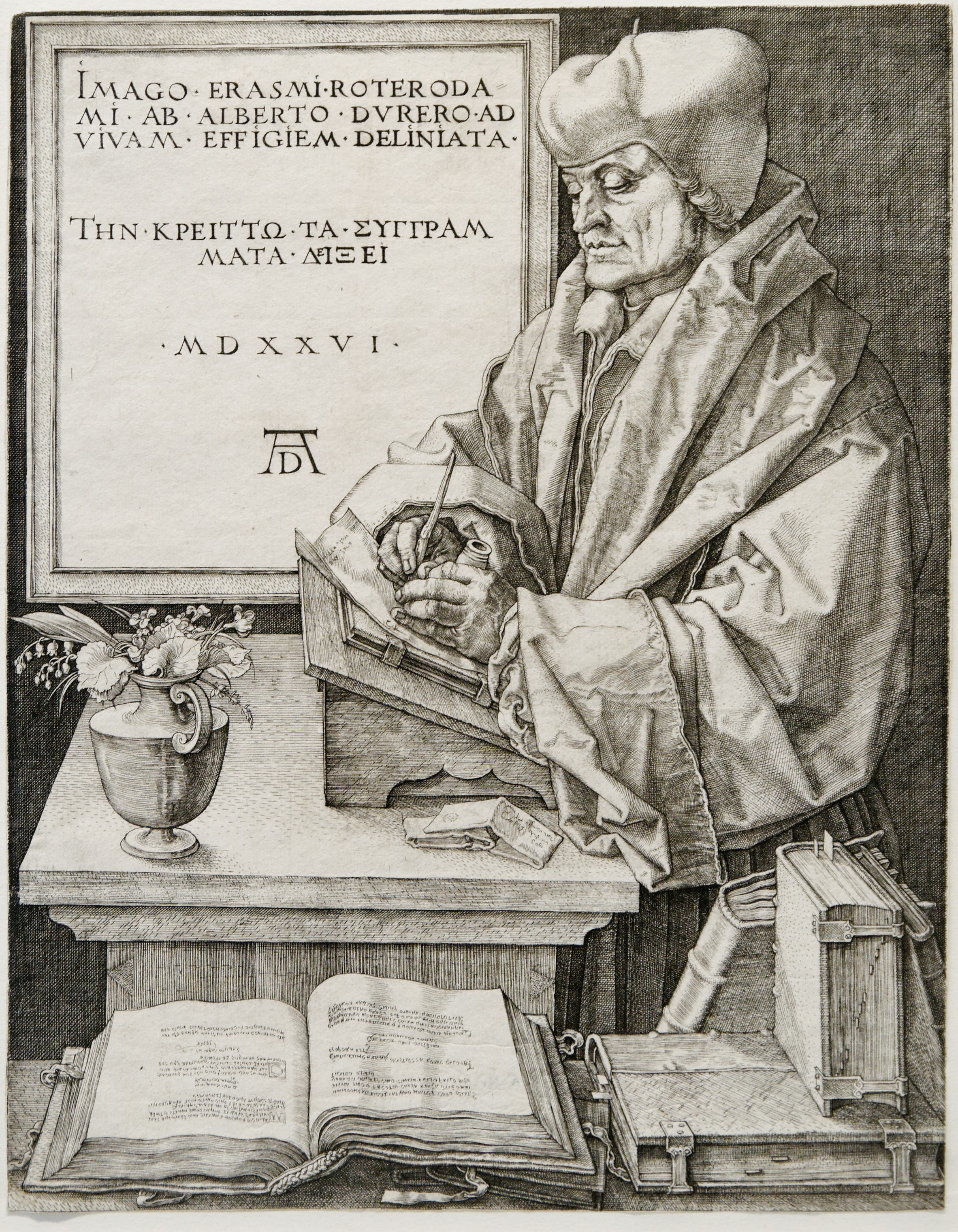
Conflict OF THALIA AND BARBARISM By D. Erasmus
That is,
STRUGGLE
between
THALIA
[one of the Muses]
AND
BARBARISM
[Wildness, or Bastardy.]
BY
D. ERASMUS.
A writing that has never been printed before.
[Emblem: I struggle and emerge]
At ROTTERDAM,
By Joannes Borstius, Bookseller at the corner of the main Market. In the year 1684.
To the Reader:
Let no one doubt whether that truly great Erasmus is the author of the following dialogue; not only does the title (which displays Erasmus' name) and the style itself clearly demonstrate it, but also his letter to Cornelius Gaudanus, which in the editions by Paul Merula is the seventeenth in the second book, and in the editions at London in 1642 is the seventeenth in the thirty-first book. There, one can read: "Then the most illiterate ones, who had never learned, began to teach what they did not know; teaching, indeed, for great reward, to know nothing; making their disciples more foolish than they had received them, and even reducing them to the point of not knowing themselves. Then, having discarded the old precepts, they proceeded to certain recent precepts of ignorance, such as modes of signifying, verbose commentaries, and ridiculous rules of grammar, and countless absurdities. And when they had already learned everything with the greatest effort, they had reached such a pinnacle of literature and eloquence that they could not even utter a single sentence in Latin. Indeed, as far as I can see, if that barbaric race of people had continued in the course it had begun, I do not know into what new form of language they would have transformed our Thalia. Where, in the manuscript that belonged to Peter Opmerus, I found written in the margin, 'Thalia, a little work by Erasmus.' Moreover, from the very words of the letters we have quoted, it is clear to anyone that this is a genuine offspring of Erasmus, and therefore it bears the very features and words that are inserted in the letter.
I wanted you to be aware of this matter, Reader.
Conflict
OF
THALIA
AND
BARBARISM.
By
D. ERASMUS.
PREFACE:
Let no one think that the poet has been unaware of how much Comedy and Tragedy differ, what befits the former, what the latter. For Comedy delights in gravity; Tragedy is a friend of seriousness. For when he applied his mind to writing, since he perceived that neither Comic characters nor the tragic theme were clear enough, he arranged them according to his own judgment: his only aim being that the audience should laugh. Approach with calm minds: be favorable, prick up your ears: restrain your clamor.
Plot:
Thalia, accompanied by the sacred choirs of the sisters, heads towards Castalia. Barbarism, also attended by barbaric cohorts, confronts her. A conflict ensues.
ACT I
Thalia, Calliope, Melpomene.
Thalia: Good gods, what is this creature I see rising from afar? Please observe.
Calliope: By the Pope! What a mass of a body! It's almost as if it could touch the stars with its head. I truly don't know what it is.
Thalia: It approaches. Behold, a new creation. Do you see? A woman's face, but what lies beneath the chest is very much like a donkey.
Calliope: It is so, by the gods who love me. But look at the forehead, mistress, how large its horns are lifting themselves!
Thalia: Enormous. Also, do you notice the ears next to the horns?
Calliope: I do. Donkey's ears, indeed, white and mobile. And now I see it getting closer and closer, ignorant of what awaits. Ah, I fear it might gaze upon something sinister.
Thalia: May Jupiter turn it away, I pray.
Melpomene: I know this beast (if I remember correctly from what I've heard).
Thalia: Please tell me.
Melpomene: There's no danger.
Thalia: Look, I hear it's our enemy. Is it true?
Melpomene: Yes. It is. This one is our sole and fiercest rival.
Thalia: May the gods destroy her.
Melpomene: She never ceases to envy us, never stops tearing us apart. They say she dwells in the western regions, there to subjugate everything, to be worshipped, loved, and honored. In short, to be placated like a goddess with supplicant offerings.
Thalia: I had heard as much, if I am not mistaken. What is the name of the city she rules?
Melpomene: Zwolle, if I remember correctly.
Thalia: Correctly. And her very self?
Melpomene: They call her Barbarism.
Thalia: It is indeed her. I know her well. But look, she hastens this way. Let's prepare ourselves for her.
ACT II
Barbarism. Thalia.
Barbarism: Is that Thalia, my companions, whom I see nearby and whom I believed to be long gone? It must be her: I see the laurel. She revives. She dares to present herself shamelessly before our eyes, fearing nothing from me. I will approach her and make her realize who I am. May the most shameless gods destroy you!
Thalia: Your greeting is not kind. How easily you offer greetings to others as compared to me, lady.
Barbarism: Are you not ashamed, Thalia, to present yourself again to my eyes, having been rejected earlier?
Thalia: You ask? You, who are unworthy to see me? I am worthier than you, a filthy beast.
Barbarism: Ha, poor thing, and insults too? Don't you yet know what I am? Beware of provoking me.
Thalia: Kind words, please. You're barking up the wrong tree; no one is listening. I fear you, of course, you hideous and filthy monster.
Barbarism: Look, I am being slandered, I tell you.
Thalia: Thanks to those who slander you.
Barbarism: These?
Thalia: Only them.
Barbarism: What do I owe to them? Tell me.
Thalia: Their estimation, or rather, their mistake, has made you a goddess, not your lineage.
Barbarism: Could I (if time allows) demonstrate my descent to you, derived from divine seed?
Thalia: Indeed, excellent. But please tell me. Time allows, and the sun will stand still for such a remarkable narrator as you.
Barbarism: You delight in Jupiter as your parent, triumph under Apollo's leadership; my father was one who yielded neither to his virtue nor to this one, whether in archery or in playing the lyre. Whenever he used to play and sing with his mouth, he, in the manner of Orpheus, dragged forests and mountains behind him; in short, he was swift in running, swifter than the east wind.
Thalia: I have heard these things a thousand times. Stop.
Barbarism: What? Do you hold back what I desire?
Thalia: You signify a half-man like Chiron as soon as you began.
Barbarism: Can you be silent while I finish my sentence?
Thalia: I can, only if you speak the truth. But if you fabricate, I won't lend an ear.
Barbarism: What? Do you call me a liar?
Thalia: Not at all, but if you wish, nothing truer.
Barbarism: Do you call yourself truthful?
Thalia: Truthful.
Barbarism: Where do you say I was born to Chiron as a parent?
Thalia: There are witnesses.
Barbarism: Where, pray tell?
Thalia: This enormous thing, which hangs below, the tail. These hairy backs. These ears whitening around the temples proclaim you to be Chiron's offspring in all things. He mixed you from a she-ass, a race you can boast of, a race fitting for a goddess.
Barbarism: I see, you contend about appearances with false accusations. Let's come to Virtue. Argue about this. About reputation, about glory, about clientage. What about your body?
Thalia: Nothing, except that a deformed soul usually accompanies this deformity of yours. But come, let's focus on Virtue herself.
Barbarism: Take this first of all. Those who worship you are rare; the whole world celebrates me. You hide in obscurity; my name has been spread to every region of the world. I am famous everywhere, most well-known.
Thalia: I admit it.
Barbarism: You wouldn't do that if you had something to respond with.
Thalia: I do have something to respond with. You know Cacus.
Barbarism: Who doesn't know Cacus?
Thalia: The one Virgil speaks of.
Barbarism: I know him.
Thalia: I believe you, for he is famous. But just like him, you are known. Then you attribute to yourself the praise that the entire world follows you. You don't think rightly. I consider it more of a disgrace. For everything that is cherished is rare.
Barbarism: Nothing is difficult that is common among the common people. Even if I am worshipped by few, I am esteemed and respected. But you, why is it beautiful for you to be accompanied by a rustic and plebeian crowd?
Thalia: You don't understand, madwoman. It's a long story. For the common people I find, I don't leave them common; instead, I elevate them and educate them. I make them honorable and respectable.
Barbarism: Ha, ha, he. Actually, you burden them with scrolls, not with skill; not so much adorned by learning as weighed down by books.
Thalia: Ah, ridiculous. Can I not make them as grave as you make yours?
Barbarism: They are very similar to you. For since you are barbaric, you make others barbaric. What else could you do?
Thalia: Now I see what I've heard long ago, that you are garrulous and talkative. Stop, madwoman. You know nothing at all. For I am certain of one thing. If you knew even a little bit, your impudence wouldn't be so loud.
Barbarism: In my gymnasium at Zwolle, what glory, what rigor, what vitality it has, if I begin to describe it to you, you burst immediately with envy.
Thalia: Certainly. And you can shatter pillars with your bombastic words. But go ahead. Shatter them if you can.
Barbarism: It's a long story.
Thalia: Make it short, as you know.
Barbarism: I'll summarize. So, to that which I mentioned earlier, the most noble gymnasium, how people flock there from all the vast regions of the world, no one can easily explain to you.
Thalia: Ah, it's astonishing how that donkey of Zwolle (I mean the bell of the gymnasium) can bellow so loudly and attract everyone in droves.
Barbarism: Foolish woman. Refrain from insults and listen.
Thalia: I'm listening.
Barbarism: There, they are immediately instructed and educated.
Thalia: Remarkable indeed.
Barbarism: The best glosses, vocabularies, arguments, countless noteworthy things.
Thalia: Very rightly.
Barbarism: Why are you wrinkling your nose? I even lead them to the point where they know nothing.
Thalia: That's new.
Barbarism: Meanwhile, their horns grow along with their bodies, so that being highly educated, they now take charge of others. Then you allow them to relax so they can live happily and die happily?
Thalia: Ha, ha, he. I was almost bursting into laughter; I envy them so much, you see.
Barbarism: What are you laughing at, fool?
Thalia: I can describe those things to you more accurately.
Barbarism: You?
Thalia: Yes. If you like, you will hear it now.
Barbarism: Begin, then.
Thalia: That's how it is. Countless people flock to you, I admit. Those who had learned something right in schools, they have to unlearn immediately. Moreover, with the very expenses you've mentioned, they are not so much imbued as overwhelmed; in the end, they know nothing. You take it to such an extent that they don't even know themselves. Meanwhile, their temporal horns grow, so they seem wise to themselves, as if they are fit to rule rather than to serve. Then you allow them to relax, so they can live happily and die happily.
Barbarism: You, I see, don't hold back your tongue from insults. But be careful not to stir up my bile. If you don't refrain from hurling such words at me, I will throw them back at you: I have some insults that I can return.
Thalia: Only a few.
Barbarism: Indeed, insults (if you don't know, most miserable one) that your poets, not even with their verses (which you triumph with most), can outdo.
Thalia: I admit the number. However, we value not so much the quantity of verses, but virtue. But as for you, the quantity matters, not the quality. You count the pages, ignore the barbarisms. What matters most in everything that they agree on is the one thing that is sought: virtue is neglected.
Barbarism: Are you talking about virtue, madwoman? I consider nothing more empty than your poems: what else are they but deceitful lies, full of old women's tales?
Thalia: You praise enough.
Barbarism: Me, so ridiculous?
Thalia: You praise without knowing.
Barbarism: So false? Why not play instead of praising.
Thalia: You praise unwillingly.
Barbarism: How? While I tear at you with envy. For it displeases the wicked to please, to be praised.
Barbarism: Indeed, what great lies people envy!
Thalia: You manifest your ignorance even more brightly. Unfortunate one, you don't realize how skilled the poets are in their foolish talk; considering it unfit for pigs, mud, and dirt, they throw roses, they cover up and distort the truth itself with the foreign appearance of fables and a kind of riddle in words, so that everyone can read but not understand. They read and leave as ignorant as if they had never seen. A scholar reads and penetrates the very images of words (for they are transparent), discovers the immense treasure of the soundest truth hidden beneath, which they had overlooked.
Barbarism: Bravo, bravo. What a clever crime, to mix falsehood with truth! to corrupt truth with fabricated stories? Is this what you praise so highly?
Thalia: Do you want me to respond to these few points? You respond to me first. What do you consider more beautiful, to pick gems out of dung or to admire those interwoven with gold?
Barbarism: The latter is preferable.
Thalia: You answer yourself. Exactly. If there is any truth in your poetry, you obscure it with such ineptitude in speech that it becomes sordid rather than shining. On the contrary, we do not corrupt the truth with the elegance of words (as you falsely accuse); we embellish it, like a gem woven with gold, we make it more beautiful. We do not remove its appearance but enhance it; not to conceal it, but to make it shine more brightly. In the end, we do this so that truth, useful by its very nature, becomes even more pleasing with artifice. These things that you, ignorant of, tear apart, bite, envy. If you were wise, how much more highly you would praise me... I made a mistake. I'll break this silence.
Barbarism: I would have said that about yours more accurately.
Thalia: I broke it.
Barbarism: For those who do not know our poems, all they know is to laugh and mock.
Thalia: These are the things that neither knowledge makes known nor ignorance makes unknown.
Barbarism: Words are unnecessary; let the matter itself prove it.
Thalia: Indeed, the matter. I'd like to hear.
Barbarism: I mean these men whom those sciences have made most famous.
Thalia: Is there anyone?
Barbarism: Countless.
Thalia: Ah! Very rightly; as if indeed anyone could count them. For what is either one or nothing, no one can count. But still, even if you start counting, if you cannot enumerate them all.
Barbarism: The foremost of them all is Florist, who derived his name from Flowers.
Thalia: But not fragrant ones.
Barbarism: Then Papias.
Thalia: The most learned; and whom you would call the first.
Barbarism: Then Huguiton.
Thalia: Excellent.
Barbarism: Then Michael Modist.
Thalia: Remarkable.
Barbarism: Then Ebraerd.
Thalia: Outstanding.
Barbarism: Then James the Glossarist.
Thalia: Amazing.
Barbarism: And the one I would prefer above all, John of Garland, who possesses such elegance of words, such majesty of ideas, that very few are capable of understanding him.
Thalia: Indeed, no one, unless they are barbarians themselves.
Barbarism: This argument is endless; you win in verbosity, but I don't think the victory lies in that. If you like, let's see what both of us can do, let's compete with each other in verses. Don't be afraid, don't yield; I'm ready. Whichever of us wins will become apparent.
Thalia: Agreed. Let's try. But you, the poet, start first.
Barbarism: These are the things I used to sing in the presence of very learned men, not without the admiration of all.
Thalia: I believe you. But start already.
Barbarism: Zwollians such, that wherever their Germanic
Names and arts are approved in parts,
And as if known throughout the whole world round,
Their clerics learn to speak Latin solely from Zwolle's soil,
Words too new for the little clerics.
These two verses in my poems show how eloquent I am.
Thalia: Ha, ha, he. As many Barbarisms as words. This word certainly is Chiron's, meaning it belongs to him. What well-arranged poems! I won't delay in returning their praises to them.
Thalia: Your songs sound insipid to me, poet,
Like the braying of an insolent wild ass in the woods,
Like the bellowing of a fierce bull among the rustic cattle,
And like the crowing of a cock deprived of his generative organs.
This is not a human voice, but a bestial one, I say.
Muses: Men of renown, praise this, and most learned Florus,
Come forth; pluck the graceful flowers inserted here,
And weave a crown for the deserving goddess.
Join the stinging nettle with the strong-smelling hemlock,
For such rewards are owed to such a poet.
Barbarism, nod your approval, and let laurels without horns
Encircle your ears among the fair maidens.
Barbarism: My soul is now nauseated; I do not wish to hear these absurdities. I cease from visiting Zwolle; what will become of me here?
Thalia: Go on quickly and visit the ignorant with your ignorance. Your arrival will be very welcome to them. It is in vain, as I see, to talk with you. You will never change. I rightly say of you what Virgil said, "Our labors cannot change her."
Melpomene: From the beginning of this altercation, while we see this monster, we all suffer from great disgust.
Thalia: Indeed, I believe so.
Calliope: Let's go, my lady, and leaving this beast behind, let's seek the sunny slopes of Pamassus and the Heliconian fountain.
Thalia: Let's do that.
End.
COMPENDIUM OF LIFE
Erasmus was born in Rotterdam on the eve of St. Simon and St. Jude, the Apostles. [He lived for about fifty-seven years.] His mother was named Margaret, the daughter of a certain Peter, who was a physician. She was from Sevenbergen, commonly known as Zevenberge. Erasmus saw his two brothers almost reaching the age of ninety in Dordrecht. His father was named Gerard. He had a secret affair with Margaret, hoping for marriage. There are those who say that words were exchanged. Both Gerard's and Margaret's parents and brothers took offense at this affair. His father was Elias, his mother Catherine: both lived to an extreme old age, Catherine almost reaching the age of ninety-five. He had ten brothers, no sisters, all married, from the same father and mother. Gerard was the youngest, except for one. It seemed to everyone that one should be consecrated to God from such a large number. You know the desires of the elderly. His brothers did not want the matter to diminish, but to have someone with whom they could dine.
Gerard, seeing himself excluded from marriage in every way, did what the desperate usually do: he secretly fled and sent letters to his parents and brothers from his journey, ending with the words, 'Farewell, I will never see you again,' and a handshake. Meanwhile, the hoped-for bride was left pregnant with a child. The boy was raised by his grandmother.
Gerard went to Rome. There, by writing (for the art of printers had not yet appeared), he prepared abundantly for his case. He had a very fortunate hand. And he lived as a young man. Soon he applied his mind to noble studies. He excelled in Greek and Latin. He also made significant progress in legal knowledge. For at that time Rome flourished greatly with learned men. He heard Guarinus. He copied all authors with his own hand.
When his parents found out he was in Rome, they wrote to him, saying that the girl he had courted had died. He, believing this from grief, became a priest and devoted his whole mind to religion. When he returned home, he discovered the deception. However, she never wanted to marry afterward, and he never touched her. He took care to have the boy liberally educated and sent him to a grammar school when he was barely four years old. In the first years, he made little progress in those unpleasant letters to which he was not born.
When he was nine, he was sent to Deventer; his mother followed as his guardian and caretaker in his tender years. At that time, the school was still barbaric. 'Pater meus' was being taught, tenses were required. Ebrardus and Johannes de Garlandia were taught, except that Alexander Hegius and Zinthius had started to introduce something of better literature. Finally, among the older boys who listened to Zinthius, he first caught the scent of better learning. After several times, he also heard Hegius, but only on holidays when he read to everyone. He reached the third class there; then, while a plague was raging there, it took away his mother, leaving the son in his thirteenth year. As the plague intensified day by day, his entire household where he lived was devastated, and he returned to his homeland. Gerard received the sad news and began to fall ill and died shortly after. They both died just over forty years old.
He appointed three tutors whom he trusted. The chief of them was Peter Winckel, then the teacher of the Gaudae grammar school. He left a moderate sum, provided the tutors managed the estate in good faith. So he was sent to 's-Hertogenbosch when he was old enough for university. But his tutors feared the university because they had decided to nurture the boy's religious faith.
There he lived, that is: he wasted almost three years in the Friars' house, as they are called, where Romboldus was then teaching. This kind of people was already spreading widely throughout the world, as it is the bane of good talents and the breeding ground of Monks. Romboldus, who greatly admired the boy's talent, began to persuade him to join his flock. The boy pleaded ignorance due to his age. Here, a plague arose, and after a long struggle with quartan fever, he returned to his tutors, now with a quite prepared pen from several good authors.
One tutor had died of the plague; the other two began to act from the Monastery with not very good intentions. The young man, weak from fever, did not abhor piety; however, he did abhor the Monastery. So they allowed him a day to think it over. Meanwhile, a tutor was suborned to entice him, threaten him, and persuade his feeble mind. And in the meantime, he found a place in the Monastery of the Canons Regular, commonly called the Regulars, in the college near Delft, called Sion: which house is the principal one of that chapter.
Where the day had come for him to give an answer, the young man responded wisely, saying that he did not yet know what the world was, what the Monastery was, or what he himself was; therefore, it seemed wiser for him to spend several more years in schools until he knew himself better. When Peter heard this consistently said by the young man, he immediately became furious. 'So,' he said, 'I have labored in vain to prepare such a place for you with great prayers. You are a scoundrel, you have no good spirit. I renounce my guardianship over you. See where you will fly.' The young man replied that he accepted the renunciation and that he was of an age where he did not need tutors. When he saw that his threats were of no use, he suborned his brother, who was also a tutor, as a negotiator. He used flattery.
Instigators came from all sides. He had a friend who betrayed him. And the fever was pressing, but the Monastery did not please him until fortune happened to take him to a Monastery of the same order in Emaus or Steyne near Gouda. There he found Cornelius, who had been his roommate in Deventer. He had not yet accepted that sacred way of life; he had seen Italy, but he had returned scarcely learned. He, minding his own business, began to depict with wonderful eloquence the most holy way of life, the abundance of books, peace, tranquility, and angelic companionship. What not? That boyish affection drew him to his old friend. Some enticed him, others repelled him. The fever weighed heavily on him.
He chose this place after being disgusted with another. Meanwhile, he was delighted until he had the sacred vestment. Meanwhile, although still young, he realized how there was no true piety there. And yet, he roused the whole flock to study. Partly human shame, partly threats, partly necessity, prevented him from leaving before taking his vows. He professed.
Finally, through an opportunity, he became known to the Bishop of Cambrai, Henry of Bergen. He hoped for a cardinal's hat, and he would have had it if there had been enough money at hand. He wanted a man learned in Latin for this journey. So he was called through him with the authority of the Bishop of Utrecht, which was sufficient. Yet he added the authority of the prior and the general. He entered the bishop's household, but keeping his own habit.
When the bishop was deprived of hope for the cardinal's hat, and he felt that this man was not very constant in love toward all, he arranged for him to go to Paris for the sake of study. An annual stipend was promised: nothing was sent. So princes do. There, in the College of Montaigu, he contracted a disease from rotten eggs and a foul-smelling room, that is, an illness previously foreign to his very pure health. So he returned to the bishop. He was honorably received. He recovered from his illness in Bergen, revisited Holland, intending to stay with his own people. But they, urging him, returned to Paris. There, deprived of the help of a Maecenas, he lived more truly than he studied, and because of the plague, he had to return to his homeland every year for many years. He abhorred the study of theology because he felt that his mind was not inclined to overturn all their foundations; then, it would happen that he would be branded with the name of heretic. Finally, when the plague raged for a whole year, he was forced to move to Louvain.
Before, he had visited England, displeased with Montjoy, then a disciple, now a Maecenas, but more a friend than kind. At that time, he gained the favor of all good people among the English, especially because he, having been robbed on the coast of Dover, not only did not avenge the injury but immediately published a pamphlet in praise of the king and all of England. Finally, he was recalled to England with great promises from France, at which time he gained the friendship of the Archbishop of Canterbury. When the promises did not appear, he desired to go to Italy, which he had always longed to visit.
He stayed in Bologna a little over a year, now almost forty years old. From there, he went to Venice and published the Adages; from there, he went to Padua, where he spent the winter, then to Rome where his famous and well-received reputation had preceded him. He was particularly dear to Cardinal Raphael of Saint George. He would have had ample fortune if he had not been called back to England by the letters of his friends, promising the greatest wealth, after the death of King Henry VII and the succession of Henry VIII. There, he had resolved to spend the rest of his life: but when even then the promises were not kept, he withdrew to Brabant, invited to the court of Charles, now Emperor, where he became the counselor of John Silvagius, the grand chancellor. The rest is known to you.
He explained his change of attire in the first booklet, where he responded to Leicestershire sycophants. You will describe his form. His health was always delicate; therefore, he was often troubled by fevers, especially in Lent because of eating fish, the smell of which alone used to offend him. His intellect was simple, so averse to lying that as a boy, he even hated boys who lied and in old age, he was moved even in body by their appearance. Among friends, he was more outspoken than necessary, and sometimes even too much; and he often could not distrust his friends even though they were false. He was unattractive, nor did he ever write anything that pleased himself; and he did not even delight in his own face, and it was hardly possible to obtain his consent to have himself painted, even at the prayers of his friends. He was a perpetual despiser of honors and wealth, nor did he have anything earlier than leisure and freedom. He was a candid judge of others' learning, and a unique supporter of talents if fortune had allowed. In promoting good literature, no one made greater progress and endured bitter envy for this from barbarians and monks. Until his fiftieth year, he had not attacked anyone, nor was he attacked by anyone in writing. He had resolved to keep his pen completely bloodless. He was first attacked by Faber, for the Dorpian matters were suppressed. Yet in responding, he was always more civil. The Lutheran tragedy had loaded him with intolerable envy; torn apart from both sides, he strove to please both.
End.
Brief Content of the life of DESIDERIUS ERASMUS OF ROTTERDAM.
In: Colloquia Familiaria, that is, common conversations of Erasmus of Rotterdam translated from Latin. At Utrecht, By Dirck van Ackersdyck and Gysbert van Zyl, in the year 1654.
DESIDERIUS ERASMUS, expressing the kindness and sincerity of his Fatherland, and an eternal wonder of Nature, was born in the city of Rotterdam in the year 1466, on October 28th. He changed his name due to his proficiency in the Greek and Latin languages, as he was originally named Gerrit Gerritsen in Holland. His father was Gerard, and his mother was named Margrite, born in Zevenbergen from an honorable and good family. He began his studies in Deventer when he was nine years old. After the death of his mother, his father followed shortly thereafter, and this child was placed under three guardians who sought to exploit him more for profit than for education. Thus, he was taken to 's-Hertogenbosch to the Frater-huys, where he spent nearly three years in vain exercises, even though he was capable enough to be sent to the higher schools. With the plague raging there, he returned to his guardians, suffering from a four-day fever. When one guardian died, the other two began to pressure the young man to join the monastery, not out of piety but for the monastic life. However, he had a strong aversion to it. He was threatened and finally entered a monastery of the Regulars, called Syon, near Delft. When the trial period ended, he told the monastery's superior that he still did not know what the world was, what monastic life was, or what he himself was. Therefore, it would be better for him to spend some more time in school to better understand himself. This answer greatly angered his guardian, Petrus, who threatened him and withdrew his friendship. Nevertheless, Erasmus persuaded others who used supplications and alluring enticements to convince the young man. His fever persisted, and a fellow student led him astray. This student had previously shared a room with him in Deventer, so he was persuaded to enter another monastery called Emaus or Steene, near Gouda, seduced by beautiful words extolling the sanctity of monastic life, the abundance of books, the opportunity for study, the tranquility of life, angelic companionship, and more. Finally, he was not at peace until they made him don the cowl. Still, he could not understand that true piety lay in it, yet he stirred the entire monastery to diligent study. If it were not for his honorable shame, the great threats, and poverty holding him back, he would have left the monastery, unprofessed. By the authority of the Bishop of Utrecht, he left the monastery to accompany the Bishop of Camerik, who sought a young man well-versed in Latin and Greek, in which Erasmus excelled. He then stayed in Paris to continue his studies, where he fell seriously ill at the College of Montaigu due to rotten eggs and a foul-smelling room. He returned to the bishop and was received honorably. He recovered from his illness at Bergen. He desired to return to Holland but was persuaded by many friends to return to Paris. After the death of his chief friend there and the ongoing plague for many years, he returned once more. He seemed to have a fear of theology because, as soon as someone investigates many things more boldly, they are immediately branded as heretics. Later, he moved to Leuven due to the plague. Before, he had visited ungrateful England, where he gained many admirers and friends due to his great learning and praise. When he left Cambrai for Bologna, he received great honors. Finally, he earned a doctorate in theology in Turin, but he did not remain in this profession for long. He planned to visit all the academies in Italy, France, and Germany. In a short time, the news of his incomparable learning in the liberal arts, his astonishing intellectual vigor, his abundant spirit, and his agreeable character spread throughout the Christian world. His name was esteemed so highly that he was called by the most excellent academies in Europe, by Popes, Emperors, Kings, and Princes, with magnificent rewards. However, he preferred to be a free man and subject to no one's authority so that he could be useful and beneficial to posterity through his diligence and vigilance. It is said that the Pope offered him the Cardinal's hat, and when he refused, the other clergy said that Erasmus was a clever fool to have shamelessly declined such magnificent and profitable titles, while others run after them and buy them with so much money. He came to Venice to have his Adages or Proverbs printed in the year 1508 by Aldus and spent the winter in Padua. If he had wanted to seize his opportunity, Henry VII and his successor Henry VIII would have elevated him very high. He then returned to Brabant and became a councilor of Emperor Charles V at the advice of the Great Chancellor Johannes Sylvagius. He left this position, as explained in a certain booklet.
His appearance was average, weak, and sickly by nature, as he was often plagued by fever, especially during Lent due to his aversion to fish. He was simple and sincere in nature, peaceful, and so averse to lies that even as a child, he despised liars. In his old age, he detested the company of liars. Among friends, he was somewhat outspoken, which was not always interpreted in the best way. He could often be deceived without mistrusting his friends. He took so little pleasure in his writings that he could never satisfy himself with them. It was with great difficulty that his friends convinced him to have his portrait painted, although he had already been depicted by Albert Durer and Holbein. He strongly despised high offices and wealth, valuing nothing more than lawful rest and freedom. He was around fifty years old before he wrote against anyone or anyone wrote against him. However, he had always intended never to treat anyone rudely or discourteously, but to moderate his style and manner of writing so that they did not deviate from reason and dignity. He was very scrupulous in religious matters and hesitant to decide on anything. He wished to see the Roman Church purified of its gross abuses but had a different approach than some others, which led him to be criticized as being too mild. He had written many things against the abuses of the papacy even before the Reformation began, which led him to be called the hen that laid the eggs from which all heretics were hatched. However, he did not openly oppose the Roman Church. In Cologne, he met Duke Frederick of Saxony after Charles V was crowned, who wanted to know Erasmus's honest opinion about the religious upheaval. Erasmus jokingly said to the Elector, "Dr. Luther has committed two great sins: the first is that he attacked the fat bellies of the monks, and the second is that he challenged the Pope's crown." Afterward, he expressed his opinion to the Elector, stating that Luther was right to seek to improve the errors and abuses of the Church, which was indeed necessary. He added that the content of Luther's teaching was true, but he wished he had more moderation in him.
Henry VIII earnestly desired to speak with Erasmus about the religious changes in England and wrote him many letters. Erasmus went to England, where he was received with great respect by the King. They held private conversations for several days on the subject of religious reform. When Erasmus was about to leave, the King presented him with fifty angels. He arrived in Gravesend, where this money was found on him. According to the laws, this money was confiscated because only a small amount of money could be taken out of the country. Erasmus was advised to request a release from the King. He went to London, where he was seen by the King, who jokingly said, "Well, what news is this, my good Erasmus? Can you travel so quickly to Holland without stopping once?" Erasmus told the King about his experiences, and the King, laughing, praised the fidelity of his servants. He was again honored with fifty other angels and, along with them, received a passport for safe conduct and the restoration of his confiscated money. Erasmus returned to Holland more richly loaded. No one was his equal in advancing studies and arts, and no one would have surpassed him if he had the power and means. Consequently, he received great ingratitude from the uncouth monks. His sharp intellect in advancing learning can generally be seen in how he first brought Latin and Greek writers out of obscurity, releasing them from Hercules' slavery, and published them with his corrections and explanations. He read, corrected, and presented Jerome, Augustine, Ambrose, Cyprian, Hilary, Basil, Irenaeus, Origen, and many other Latin Fathers with incomparable labor to future generations, showing in an unmatched way how those same Fathers were tarnished and corrupted by unwashed and filthy hands. Indeed, this judgment belongs solely to a wise and learned man. His other common books are printed in nine large volumes in folio at Basel, by Nicolaus Episcopius and Hieronymus Frobenius, in the year 1540. Besides these, he has so many other books in theology, philosophy, and the liberal arts that are not included here that they could easily be considered wonders of learning on their own. These can be found in Gesner's Bibliotheca or Bookstore.
In his later years, he mostly stayed in Freiburg and Basel. He suffered greatly from gout and kidney stones and had suffered from dysentery for a long time. He lay in bed seriously ill for about a month, full of pain and torment. He cried out in his language, "O dear God! O Lord of Mercy! Lord, hasten! Have mercy on me, Lord!" and thus showed sincere signs of Christian patience and a godly spirit towards Christ, in whom he placed all his hope. He passed away at Frobenius's house in Basel around midnight on July 11, 1536, at the age of 70. He made a will in which he appointed B. Amerbach, a jurist, Hieronymus Frobenius, and Nicolaus Episcopius, printers, as heirs and executors to distribute his goods to poor and helpless men and women, to honorable and virtuous poor daughters for marriage, and to young men of good hope and aptitude for study, etc. He was buried in the great church in Basel with great pomp and honor, leaving an immortal praise to posterity.
In Basel, a magnificent epitaph was erected for him by the aforementioned men and executors of his will.
Also, the people of Rotterdam, in honor of their city and to glorify learning, erected a copper statue of Erasmus to show posterity that such an ornament of the world had sprung from their city.
Thus, this worthy man, who, as Zwingerus, Bullingerus, and Gesnerus, etc., say, was a phoenix, not only of Germany but of all of Europe, has passed away from this world.
End.
THE LIFE OF DESIDERIUS ERASMUS
Compilation of biographical and autobiographical writings, published in 1615 by the Rotterdam bookseller Matthys Bastiaensz.
With a facsimile of the copy in the Library of Rotterdam.
Published by A. Rutgers.
Dr. A.J.E. Harmsen, University of Leiden.
Obvious typographical errors in this edition have been corrected and marked with an asterisk.
The Life of the Learned Erasmus of Rotterdam, partly written by himself, partly by others, and now first translated and published in Dutch.
Proverbs 7:7
The memory of the righteous is blessed, but the name of the wicked shall rot.
[Typographical ornament]
AT ROTTERDAM.
For Matthys Bastiaensen, Bookseller residing on the Steygher.
Christian Reader,
We present to you here the life of the Learned Erasmus of Rotterdam, not compiled in such an order and arrangement as you might desire. However, as we have focused more on truth than on pedantic arrangements, we have wanted to present it as Erasmus partly revealed it himself in some of his letters and partly diligently researched and described by others, which excel in scholarship and credibility. With these, you will have to content yourself: Therefore, read diligently and attentively, and we will tell you whose words you are reading each time.
Farewell.
A Brief Account of the Life of Erasmus of Rotterdam, Written by Himself. [Where He Was Born. His Mother.] He was born in Rotterdam on the day of Saint Simon and Saint Jude. His mother was named Margriet, the daughter of a physician named Pieter. She was from Zevenbergen and had seen two of her brothers in Dordrecht who were nearly ninety years old. [Uncle and Father.] His father was named Gerrit. He had secretly been involved with Margriet, hoping to marry her. Some say they had made promises to each other. Gerrit's parents and brothers disapproved of this. [Grandfather and Grandmother.] His father's name was Elias, his mother's name was Catharijne. Both of them lived to old age, and Catharijne almost reached the age of ninety-five. They were among ten brothers, without a sister, all from the same father and mother and all married. Gerrit was the second youngest. It seemed good to them that one of them should be dedicated to God. You know how older people think. The brothers did not like the idea that their possessions would be diminished, but they wanted someone among them who could occasionally live lavishly. Seeing that he was being prevented from marriage by unanimous agreement of all his family, Gerrit, in despair as is common, secretly left and departed. On his way, he sent a letter to his parents and brothers, in which two hands were folded together, adding these words, Farewell, I will not see you again. In the meantime, his intended wife became pregnant. The child was raised by its grandmother. Gerrit traveled to Rome. There, he earned his living by writing (since the art of printing had not yet been invented). He had a very beautiful handwriting. He remained a young man and unmarried. He immediately devoted himself to honorable pursuits and studies. He also knew Greek and Latin well and had made considerable progress in the study of law. Because Rome was flourishing with learned men at that time, he attended lectures by Guarino. He copied all the authors with his own hand. As soon as his parents learned that he was in Rome, they wrote to him that the girl he had wanted to marry had died. Believing this, he became a priest out of sorrow, and he turned his attention to religion. However, when he returned home, he found that it was a deception. She never wanted to marry, and he never touched her. He generously had the child brought up, and when it was barely four years old, he sent it to school. In the early years, it made little progress in those unpleasant basics it was not born for. When it reached its ninth year, he sent it to Deventer. The mother followed to look after and care for the boy. In school, only a lot of bad old Latin was taught at that time. My father (I do not understand what this means; it might be that Erasmus's father had written a little book on Latin basics that was used there) was read. They wasted their time needlessly. Evrardus and Johannes de Garlandia were read. Then Alexander Hegius and Zinthius had started teaching somewhat better Latin and Greek. At last, from his playmates, who, being older, heard Zinthius, he first acquired a taste for somewhat better and more refined learning. A while later, he himself heard Hegius. But only on Sundays, when he read for everyone. The boy advanced to the third class. However, as the plague was rampant there, his mother died when he was thirteen years old. And since the plague kept increasing every day, and the whole house where he lived was terribly infected, he returned to his homeland.
Gerard, upon receiving this sad news, fell ill and shortly after died. Thus, both his parents passed away, not being much older than forty years. The father appointed three guardians, whom he considered the most trustworthy. The principal among these was Petrus Winckel, then the Rector of the school in Gouda. He left Gerard a considerable sum of money in his will, had the guardians acted in good faith and looked after his interests. Thus, Gerard was sent to 's-Hertogenbosch, where he was certainly intelligent enough to attend a university or a higher school. However, they didn't dare send him to a university because they intended to make him a clergyman. There, he lived, or rather wasted nearly three years, in the Frater house, as it was called. Romboldus was teaching there, a type of person that now roams the entire world, although it is nothing but the downfall of all good minds and breeding ground for monks. Romboldus, who had profoundly assessed the young man's intelligence, tried to persuade him to join their order. The young man excused himself due to his youth. During the onset of the plague, after suffering from a four-day fever, he returned to his guardians. One of his guardians had died from the plague, and the other two, not having fared well, began plotting to put him in a monastery. The young man, weakened by the fever, which he had had for more than a year, was indifferent to godliness, but he didn't want to hear about a monastery. So, they gave him a day to think about it, and in the meantime, the Guardian convinced some people to approach him sweetly, threatening him and touching his tender, despondent heart. Meanwhile, he had found a place in the Canon Regulars' monastery, called the Sion college near Delft: this house was the principal one in that chapter. When the appointed day came for the young man to give his answer, he wisely replied that he still didn't know what the world, the monastery, or even himself was. Therefore, he thought it best and most advisable to continue his studies for some more years until he understood himself better. When he saw that the young man steadfastly held this view, Petrus became angry, saying, "So I have done useless work; I worked hard to obtain such a place for you, beseeching God fervently: You are a scoundrel. You have no good spirit. I relinquish my guardianship. See where you will get your sustenance." The young man replied that he accepted that relinquishment of guardianship, and now he was old enough that he didn't need guardians. Since he saw that he made no progress with threats, his brother, who was also a guardian, came forward, intending to resume the matter. This one approached him sweetly. And from all sides, more persuaders came. He had a playmate who betrayed his friend. The fever also contributed significantly. Nevertheless, he had no desire for monasteries until he happened to visit a monastery of the same aforementioned order in Emaus or Steine, near Gouda. There, he found Cornelius, with whom he had lived in a room in Deventer. This one had not yet professed. He had been to Italy and returned, being not very educated. Seeking himself, he started describing with many wonderful words what a holy life they led there, what books they had, what a peaceful and quiet life they led, and what an angelic company they were. And I don't know what else. The young man's heart leaned towards his old playmate. Some attracted him, others urged him. The fever was quite mild. He chose this place, leaving the other one. He was pampered until he entered the holy hood. In the meantime, although he was young, he realized how little true godliness resided there. Yet, he inspired the entire convent to pursue studies. Although he had intended to leave before he took his vows, he partly didn't dare to do so out of shame, partly because of the threats, partly because of necessity. Finally, due to certain circumstances, he became known to Henry of Bergen, Bishop of Cambrai.
He hoped for a Cardinal's hat, and he would have obtained it if the ready cash had not failed him. To make this journey, he wished for a man skilled in Latin. Therefore, he was summoned by the authority of the Bishop of Utrecht, who alone had enough power for this. Besides, he also used the authority of the Prior and the General. He placed himself in the bishop's retinue but retained his manner of dress. After the bishop was disappointed in his hope of getting the hat, and Erasmus became aware that his affection was not very strong, he managed to depart for Paris to study there. They had promised him an annual pension and allowance, but they did not send it. Such is the way of princes. He contracted a disease there in the College of Montaigu, a suffering and contamination of the body, which was previously clean and healthy. Therefore, he returned to the Bishop. He was received honorably and recovered from his illness in Bergen. He visited Holland again, intending to stay with his family. However, as they themselves advised him against it, he traveled back to Paris. Having no help from any of his patrons, he lived rather than studied, and due to the plague that had been prevalent there for many years, he had to return home that year. He had contemplated studying Theology, but he found that his mind was not suited or inclined towards it, especially to overturn all its foundations, and it would eventually lead to being labeled a heretic. Finally, as the plague was raging for a whole year, he was forced to move to Leuven. He had visited England before, at Montjoy's request, who was then his disciple and now his patron and supporter, even more his friend than one who might just be favorably inclined towards him. During that time, he had won the kindness and friendship of all the virtuous people in England, primarily because, when the licentiate masters in Dover had taken all his money, he not only did not take revenge but immediately published a little book there in honor of the King and all England. Eventually, he was called to England from France with many beautiful promises. In that time, he gained the friendship of the Archbishop of Canterbury. But since the promises did not materialize, he traveled to Italy, something he had always had a great desire and inclination for. He lived for a little more than a year in Bologna, now almost forty years old. From there, he moved to Venice and published his Adagia. Later, he went to Padua, where he spent the winter. Afterwards, he went to Rome, where his fame was already well-known and appreciated. He was a great friend of Raphael, Cardinal of St. George. He would have acquired great wealth there if King Henry VII and his offspring, Henry VIII, had not died. Through letters from his friends, who promised marvelous things, he was again called back to England. He had intended to spend the rest of his life there. However, as the promises were not kept, he secretly moved to Brabant, being summoned to the court of Charles, who was now the Emperor, whose counselor he became with the help of John Sylvagius, the Chancellor. You know the rest. He described the reason why he changed his cap in his first book, where he responded to the slanders that Leus had spread about him. You can write it down yourself. He had always been delicate in complexion and health, especially during fasting days because the meal he had to eat didn't agree with him even if he just smelled it. He was simple in intellect and disposition, and he detested lies so much that even when he was just a child, he hated the lying children. When he became an old man, he became agitated if he merely saw them. He was open-hearted and free of speech among his friends, even more than was good for him. Although he was often deceived, he couldn't mistrust his friends. He never pleased himself and never wrote what he had a desire for. Indeed, he didn't like his own appearance and could hardly be persuaded, even by begging and pleading, to sit for a portrait. He had always been indifferent to status and wealth, valuing nothing more than leisure and freedom. He greatly admired others' erudition and was a keen promoter of learning, facing much hatred from the illiterate and monks in return. Until his fiftieth year, he had not attacked anyone in writing, nor had anyone attacked him. And his plain intention was not to contend with anyone in writing. Faber was the first to attack him because what Dorpius had written previously had been kept hidden. He was always very polite and courteous in his replies. The Lutheran controversy brought upon him unbearable hatred, as he was being drawn and fought from both sides while trying to advise them both for the best. I will expand my book catalogue, and from this, many things can also be drawn. Gerardus Noviomagus has written to me that some are busy writing Erasmus's life, partly in verses and partly in a flowing style. He wanted to be secretly instructed about it by me, but I did not dare to send it to him. If you happen to meet him, you can inform him about it. However, it is not advisable to mention my life, except very cautiously. But I will elaborate on this another time, perhaps when we will meet each other.
For a closer account of Erasmus's father, mother, and birth in Rotterdam, I will add an excerpt from a certain letter by Dominicus Baudius, written to Paulus Merula.
Although I cannot see for what reasons Erasmus should be ashamed of his descent, for his mother, like the virtuous Dido, could have fallen into this fault once due to misfortune. But in all the rest of her life, she conducted herself in such a way that she was an exceptional mirror of a woman. His father was also born of a noble lineage and of decent learning, according to the standards of that time, and furthermore, he possessed manners so suitable for polite courtesy and delightful jests that some pleasant people named him "Praet." If one must judge the rights of marriage based on the inner inclinations and union of hearts, here only the external ceremonies were lacking, which modesty has introduced, not necessarily required, but between them there was such love that it is hard to find similar examples of maintained fidelity. However, it is not my intention to discuss this matter here, nor to argue with eminent authors and uphold what Euripides says, namely; that many bastards are better than those born in lawful wedlock. Erasmus himself tells us his mother's homeland, but he has kept silent about his father's. We have found that he was certainly a native and inhabitant of the city of Gouda, which, due to its delightful location, adornment of learning, suitability of citizens for all politeness, excellence of the magistrates, and inclination towards all honorable things, is renowned, not among the least cities of Holland. When his mother's time was soon to give birth, it was deemed advisable that she should be sent to Rotterdam, so that everything could proceed more discreetly. The father gave the child his own name and he was named Gerrit Gerrits, as is very common among us, and was also widely used among the Romans and Greeks in ancient times. Furthermore, since this name in our Dutch means the same as the Latin word "desiderium," which means desire or longing, he adopted the title Desiderius as his first name, to which he added a Greek word with the same meaning, and wanted to be called Erasmus, etc.
End.
The Life of Desiderius Erasmus by Beatus Rhenanus, described in a certain letter printed before Erasmus's works, Anno 1540
The invincible Emperor Charles the Fifth, by that name, etc.
Beatus Rhenanus wishes all happiness.
Letter:
What a great honor it has always been for ancient peoples, invincible Charles, to have had distinguished men as natives, is sufficiently evident from the famous battle of the seven cities of Greece, which has come down to the ears of posterity. In this, each city claimed that the excellent Homer was born among them. And not without reason: for what greater adornment can there be for any city or province than when it has produced such a person through whom it has gained excellent and enduring honor among all posterity? And this comes out of nothing more substantial and enduring than learning, which, above all else, endures into eternity itself. Thus, being moved by this, those of Smyrna, Rhodes, Colophon, Salamis, Jovia, Argos, and Athens each held steadfastly to the belief that Homer was theirs, not to mention that the Egyptians claimed he was from their own people. Therefore, if the wise land of Greece esteemed the birth of Homer so highly, being a father and eternal fountain of all learning, why should not Your Majesty rightly boast that Desiderius Erasmus, that Rotterdammer, was certainly born and brought up within your realm, by whose diligent efforts learning began to revive as if anew? Not only in the neighboring lands of Germany and France, where a remarkable ignorance prevailed, but also in that noble Italy, it embraced it more readily and successfully, so that if it might be a bit presumptuous, he can and ought to be called a renewer and chief enlightener of learning. For who, within the past thousand years, has written so much on divine and worldly matters, being adorned with such knowledge of elegant learning, whose books have been transported in heaps to distant lands and so diligently read? And who has been so well taught and esteemed by scholars of all nations? I am not embellishing this; it is a fact known to everyone. For he had a writing style that was subtle, which he wrote spontaneously, which was delightful and pure, and flowed very smoothly, a style he had acquired through constant practice while he was young. He also possessed no lesser intelligence but was exceedingly profound. Scholars were especially amazed by this, and also highly valued it, for it seemed like a miracle that such a keen and firm intelligence was found in such an unlearned age. One must think that it was more due to particular good fortune that such a keen and discerning intellect was in him than due to any teachers, except for those silent teachers.
For he was born in the early years of the reign of your grandfather Emperor Frederick the Third, on the 28th of October, in Rotterdam, Holland, which is a province in your Netherlands, which was once inhabited by the Batavians, and now is more known to all lovers of learning because of the cradle of its native son Erasmus than for the memory and remembrance of its old inhabitants, although they were valiant heroes in war. The city of Rotterdam will always be able to boast about this native son, and it will be respected by all scholars. Deventer claims the next honor for itself, for when he was still a child, they, having brought him from Utrecht where he used to sing as a chorister (because of his fine voice) among the choir masters in the main church, took him to study in their city. At that time, Alexander Hegius Westphaliensis was Rector of the Latin school, a man who was well-educated and reasonably experienced in the Greek language, as is sufficiently testified by the Grammatical Commentaries he wrote and published. He, taking pleasure in Erasmus's progress (for the mitered Conventarians are teachers of some classes in the schools and teach openly), once embracing the young man at a certain time, said, "Go on, Erasmus, in your intelligence and wisdom; you will yet reach the highest level of learning," giving him a kiss and letting him go. Both his parents having died shortly after, so that the guardian would remove all the burden of guardianship from his own shoulders, he was placed by his guardian in a regular monastery. There he had as a fellow student in his studies Wilhelm Herman Vander Goude, whose Odarum Sylva is still available. With the help and encouragement of this fellow student, he read through all the books of Latin authors. Night and day they were busy with their studies. The time that others of his Convent spent in jesting and sleeping, squandering their time in eating and indulging themselves lazily, they spent reading books and practicing their style. Hearing about Erasmus from Hencicus a Bergis, Bishop of Cambrai, he called the young man, who was already professed, to him, ready to travel to Italy and Rome. For he saw that Erasmus was deeply learned, eloquent, and of good and refined manners, as was evident from his well-written letters, so that he could be useful and a credit to him in his journey and companionship when he would have to deal with the Pope of Rome and the Cardinals. However, I do not know what hindered him, why the Bishop did not undertake the journey; but Wilhelmus complained greatly that Erasmus had been taken away from him. For thus he says in a certain Carmen.
"But now fate separates us both,
May the good God guide you;
Ah, fate, how bitterly you strike me,
For here I stay alone, while you travel.
Over the Rhine and the lofty Alps,
You travel alone, I must endure it;
Italy, that beautiful land,
There you now travel on every side, etc."
However, although the Bishop advised him to travel to Rome, he nonetheless kept Erasmus in his court because he took pleasure in the sweetness of his intellect and the excellence and sincerity of the young man. Here this true Erasmian (that is, friendly) acquired the friendship of many, especially the friendship of Anthony, Abbot of St. Albert, who also descended from the lineage of Bergen, and of Jacob Battus, who was the Secretary of the Council of the city of Bergen; many of his letters to whom can still be seen, and who later lived in great honor and esteem for a long time with Anna van Borsele, the Mother of Adolph, Marquis of Vere. But the Bishop of Cambrai, seeing that Erasmus had such a keen intellect, very willingly assigned him the funds with which he could travel to Paris and study Scholastic Theology there. Thus, he became a Scotist there and resided in the Montis Acuti College, for among the theological disputants at that time, John Duns Scotus was praised above all others for his sharp intellect. But when he found that the monastic life was a bit too strict and burdensome for him, he did not willingly live with an English nobleman who had two other young noblemen with him, one of whom I guess was Montioius. For the Englishmen saw that there was no one among all the Professors of the liberal arts in the whole University of Paris who was accustomed to teaching more learnedly or successfully. For Faustus Andrelinus, who otherwise was very diligent in composing poems, did not give special lectures, seeking more to win the favor of his listeners with jokes than with learned things. Caguinus, who was too occupied with legations to foreign Princes, was not very stable in his studies and also did not teach openly. And through this opportunity, Erasmus began to be known in England. In that realm, there were then Guilhelmus Grocinus, Thomas Linacre, and Guilhelmus Latimerus, who had studied in Italy and were renowned for their knowledge of both languages. Also, there were John Colet, Thomas More, Richard Pace, and Gutbert Tonstall, all of whom he liked. Not to mention the Bishops, who were more learned, esteemed Erasmus more highly, and treated him more splendidly. He lectured for a while in the Academy of Canterbury and also at Leuven, where he lived with Peter Peludanus, who was then Rector of the Academy. Finally, his friends having advised him to visit Italy, a place he had always longed to see, he traveled to Bologna with the children of Baptista Boerius of Genoa, the King's Physician in England, namely, with John and Bernard. Not as their pedagogue or supervisor, for he had stipulated that he did not want to be responsible for their conduct and behavior, but as a guide to instill their studies well, as a certain letter he wrote to Botzhemius testifies. There, he had Paulus Bombasius among the Professors as a friend, an honest and learned man who took great delight in Erasmus's intellect and learning. For Beroaldus, who was the foremost among the professors of his time, had already passed away. During his journey with his English companions, he became a Doctor of the Holy Theology at Turin near Mont Cenis. And thus, he brought his degree and learning to Italy, as others usually do from there. While he completed his Adagia at Bologna, which he had begun some years before (for he had published a short and unpolished sample of his upcoming work in Paris), he had to change his Communion clothes, which he had been wearing up to that point, for this reason: In that city, there is a custom, not to be despised, that as soon as someone is suspected of possibly having the plague, the Surgeon (appointed for this purpose) is immediately called.
Because he needed to be more easily recognized by those he would encounter or pass by, to avoid the deadly infection, he had to wear a white, long rectangular garment hanging from one shoulder downwards to the other side, and hold a wand in his hand. It happened on a certain day that Erasmus, not having anything particular to do, was walking down a street in the city that was not very frequented, dressed in his canonical attire as he was accustomed. There, he encountered two or three ignorant young fellows who, upon seeing the white garment, thought he was the Plague Doctor. Consequently, Erasmus, not suspecting anything wrong, continued on his way, but they threatened to throw stones at him and insulted him disgracefully. While they were making threats against him, they even approached him menacingly. Wondering why these young men were so angry with him, he asked for the reason. He was informed by those who had seen from their houses and heard the commotion that they were incensed because of the garment which, hanging by his side with a knot, had deceived them due to its resemblance to the attire worn by a sick person coming from somewhere who refused to avoid them. To avoid such dangers in the future, Erasmus submitted a request to Pope Julius II, asking him to permit and allow him to wear his religious garb or not, as he himself wished. The Pope readily granted him this request due to his exceptional virtues, which well deserved it, on the condition that he would still wear his priestly garb. This permission was later confirmed in a more complete form by Pope Leo X, for other fair and reasonable reasons that concerned not so much his manner of life as his dignity, in order to honor Erasmus.
When he had completed his Adagia, he wrote to Aldus Manutius, asking him if he would accept his book for printing. Aldus replied that he would be happy to do so. Having traveled to Venice, when he entered Aldus's shop, he had to wait for a long time before he could speak with Aldus Manutius, partly because Aldus was busy correcting the plates and adjusting the typefaces, and partly because he believed that there were people who, out of curiosity rather than seeking help or advice, came to greet him every day, and these individuals troubled him quite a bit since he had other things to do. As soon as he learned that it was Erasmus, he apologized and warmly embraced him. He kept him at the house of Andreas Asulamus, the renowned tax collector, his father-in-law. While living there, he had Hieronymus Alexander Montensis, who is very famous for his trilingual scholarship and is now a Cardinal, among others. He also utilized the friendship of Paulus Canalis, a Counsellor, Ambrosius Nolanus, an excellent physician, and Baptista Egnatius. And not for a short time: for during this period, he revised and corrected two tragedies by Euripides, Hecuba and Iphigenia at Aulis, and published them anew. He also improved the comedies of Terence and Plautus, paying attention to the Carmina. Around that time, Alexander, the son of Jacob, King of Scotland, was studying in Padua, attending the lectures of Raphael Rogius, who is now Archbishop of St. Andrews in Scotland. Erasmus took him as his student to be taught and educated in rhetoric, after which he went to live in Siena. He had left the sons of the aforementioned Boerius after living with them for a year, mainly because the father was too rude and troublesome. In Padua, he was very familiar with the most learned men, such as Marcus Musurus of Crete, Scipio Cateromachus of Pistoia, whose exceptional courtesy Erasmus often praised; he had experienced their openness on several occasions when he asked for their opinion on the corrupted and falsified copied editions and books of certain Greek authors, which were in Aldus's library, namely, the interpretations of Pausanias, Eustathius, commentator on Lycophron, Euripides, Pindar, Sophocles, Theocritus, and similar interpretations.
There was nothing so secret that it was not revealed, and nothing so tangled that it was not unraveled by Musurus, that true patron and treasure of scholarship. He had read everything, examining and scrutinizing it all thoroughly. All the new elegant modes of speech, fables, histories, and ancient customs were at his fingertips. This perfect scholarship was further adorned by his excellent piety, as he treated his father (who was a Greek and of great age) with great kindness and fidelity. Both of them died in Rome, but Musurus obtained an archbishopric from Pope Leo. While Erasmus was in Siena, residing at the house of the Bishop of St. Andrews, whom he was then teaching and whose intellect he often praised, it would be clear that he spoke nothing but the truth, unless this noble young man was with his father the King (alongside whom he was in the war, in which the army of King Henry of England (whose sister this young man had married, who was then busy in the Netherlands and had besieged Doornik due to the instigation of Pope Julius II) and the Scots, who had invaded his land and sided with the French (a little later, they were defeated: While, I say, Erasmus was living in Etruria, he obtained permission to visit Rome, which was nearby. It is impossible to describe how joyfully he was received there by all learned men, not only by the mediocre ones but also by the principal Cardinals, among whom the foremost were Johannes Medici, who, succeeding Julius II, was called Leo X, and Dominicus Grimanus from Venice, as well as Egidius from Viterbo, a valiant and experienced man in three languages. Indeed, they were three excellent champions, born and inclined to promote scholarship, in which they were particularly skilled. He also saw, if I am not mistaken, that Thomas Phedra, who was so wonderfully eloquent and could deliver orations extemporaneously, thereby reviving ancient eloquence through plays and comedies. He also utilized other professors. The dignity of penitentiary was offered to him if he wanted to stay in Rome, which would have been a way to advance further: for he could have derived great benefit from it. However, he might return to the Archbishop, with whom he had come to Rome again, as this noble young man desired to see him before he returned to Scotland. Not only in Rome, although he did not make it known that he was an Archbishop, so as not to burden anyone, but he also traveled further to the outermost parts of Italy, as far as Cumae, and went to the cave of the Sibyl, which the inhabitants there still show. After the Archbishop of St. Andrews had departed, Erasmus felt it prudent to hasten back to his homeland, influenced by his old friends whom he had left in England. Therefore, he traveled through the Rhaetian Alps first to Chur, then to Constance, located on Lake Constance, and continuing his journey through the Black Forest, he arrived at Strasbourg, passing through Brisach, where he was brought down the Rhine to Holland. After greeting his friends in Antwerp and Leuven, he went to England. He longed greatly to meet John Colet, the theologian, who was Dean at St. Paul's in London, and also Grocyn, Latimer, Linacre, whom we have spoken of before, and especially Thomas More. William Warham, Archbishop of Canterbury, the foremost in all England and Chancellor of the realm, was his old patron and supporter, who exceeded all the other Bishops of that island in generosity. He gave him money and, in addition, the priesthood of all things located under Canterbury, which Erasmus, for conscience's sake, could not accept, since the goods rightfully belonged to the Pastor, who is busy day and night teaching his people, as can be denied by no one. When the Bishop saw that Erasmus hesitated in this matter, he said: who, then, has a greater right to live off church goods than you, who alone instructs, teaches, and helps all those priests who are placed over the churches with your most useful writings, and not only those churches but also all the churches in the world, each of which has to provide one year's worth. I still remember well that I heard Erasmus say more than once that it was the rightful duty of princes to see that they liberally supported students with their own goods, but that they, to save their costs, resorted to giving benefices, so that lovers of studies are compelled to accept them, thus enabling them to pursue their studies peacefully. Furthermore, just as he had dedicated his Adagia to Montioius, he had attributed to him the works of Jerome that he had revised and corrected, as a perpetual sign of extraordinary reverence. Later, he traveled to the Netherlands for some business, and not long after, having returned to us, he had indeed run from there to here, since your Majesty was triumphantly crowned Emperor in the Holy Roman Empire at Aachen.
Immediately after this, he also went to Cologne, around the time when the Reichstag was held in Worms, under the auspices of your Councilors, very venerable, for wisely long before, you had wisely included him among those you had taken on, when Johannes Silvagius, the chief chancellor, was still alive. The Reichstag having concluded at Waiiblingen, and having taken the city of Doornick, as your Majesty returned from Brabant to Spain, Erasmus traveled back to Basel to publish the Adages (Adagorium Chiliades) again and to complete the Paraphrases on the letters of Paul and the Gospels. It is doubtful whether the world has welcomed them more eagerly and with greater pleasure than he has written them with more vigilance and earnestness. Here, he said, I am on my own territory. And it was true. He studied the ancient Fathers, especially those who had left some explanations behind. From the Latin, he read Ambrose, Jerome, Augustine, Hilary, and from the Greeks, Chrysostom and his follower Theophylactus, only giving the style. He attributed one to Your Majesty, namely, the first, which is the Gospel of Matthew, and the last to your brother Ferdinand, for he had greatly honored him when you were still a young heir to so many kingdoms, how much more could he have held you in higher esteem when you, with the unanimous voices of the princes, had reached the most eminent height of the Holy Roman Empire, and he belonged to your court and was associated with a very excellent office? When you were still young, he made you the instruction of a Christian prince, comprehended in holy but concise articles: a booklet indeed, in which anyone destined for a high governance, as in a mirror, can learn and understand such offices and duties as are allowed to a Christian, or having here a teacher, he can see with what principles of teachings the minds of kings' children, while they are still young and pliable, should be sown and imbued. So Erasmus always intended to adorn the noble house of Austria, from which so many emperors have sprung, whose empire is so great that it is scarcely bounded between the Alps and the North Sea, with all kinds of honors that befit a lover of studies and that serve. This is testified by the panegyric which he dedicated to your father Philip, when he came from Spain, which was very kindly received by him. He thought it good to honor this service with a special gift, as with a lucky premonition, first showing in what esteem this man's writings would still come*, and also setting an example and a precedent to other mighty princes that they too should show similar kindness to him. And it has also not turned out differently. For Erasmus has experienced the favor of many kings and popes, namely, from your illustrious Emperor, and from your brother Ferdinand, and from Henry the eighth, king of England, from whom he (when his father Henry the seventh was still alive) was greeted through letters written with his own hand. Also from Pope Clement the seventh, and Pope Adrian has had the same inclination towards him, if Erasmus had only wanted to accept the offered priesthood and his reward. Furthermore, what could Erasmus have expected from Francis Valois, King of France, if his heart considers, and what he wanted to show him? He condescended to sign a letter with his own hand, declaring that Erasmus's arrival would be most agreeable to him above all things. However, Erasmus kept these letters with him (who was content with his own circumstances) as he had firmly resolved to decline the priesthood, saying, he, when he would die, would have travel expenses soon enough. Should I here go to compile a list of all the princes and bishops who have endowed him, it would be too long. Erasmus was not only honored by the princes but also by the cities in Germany: for wherever he passed through, and the Magistrate learned of it, he was honored with wine, an honor that is bestowed only on the great masters and ambassadors of the cities. This happened in my presence in Basel, situated on Lake Constance, where the excellent Jurist and Mayor Bartholomeus Plaurerus condescended to visit him himself! Likewise in Schafhausen by the Abbot and Magistrate, in Freiburg, Brisach, Strasbourg, and in other places: For it was known to many that he was one of your Majesty's Councilors. Verily, solely due to the excellence of his scholarship, which he demonstrated in his books that he published daily, he was esteemed worthy that he would be honored by everyone with the most eager response, although he himself did not seek it, with gifts and all sorts of honors sent to him. Considering that we see those who are adorned with some noble titles, those who in times of need are ready at the risk of their lives to defend their fatherland: how much more justly is he honored, who not for a short time, but for his whole life in studies, has worn himself out for the common good of the studies, so that, exercising his mind, he has neglected and diminished his own nature and health. He could have been great and powerful and could have become greater every day with your Majesty: for did not Adrian of Utrecht reach the highest degree of ecclesiastical authority? He could have lived with all kings in all grandeur and splendor, for what great princes have not sought him and desired him? He could have spent his life in idleness and pleasures: but he esteemed the common profit of studies above all honors, and the foolish pleasures of this life.
It is likely that, among other reasons, the advancement of growing studies has motivated and kindled the man to endure and bear. In Germany and France, studies were miserably cold: scarcely one or two knew Latin, no one knew Greek. And as soon as his "Adagiorum Chiliades" and the books "De utraque copia" were published, the knowledge of languages emerged from darkness like the sun rising, there were also other small books that were very useful for this purpose, namely, the teachings of Theodore in the art of Grammar, translated into Latin by him, and the writings of many authors in both languages, which were very suitable for learning on one's own, without a teacher. For it is said that Hermolaus Barbarus, the eternal ornament of Venice, had advanced in his own studies alone, through reading and considering the translations of the most learned Gaza. Now, a signal having been given, all the good and devout were busy to be diligent in studies, but most of all, the trilingual College, which was established in the University of Leuven on the advice of Erasmus, contributed to this. Hieronymus Busidius Prost of Arles, and brother of Francis, Archbishop of Besançon, who died abroad in Spain, left a great fortune when he died, and since he had given and arranged everything for the benefit of students, Erasmus managed to persuade the executors to establish a school in Leuven, where the three languages would be openly taught on a certain salary, and from which countless many, like from the Trojan horse, have emerged until now, who are skilled in the knowledge of languages, and with God's help, will continue to emerge. So in your realm, invincible Emperor, there is nothing more magnificent and excellent than this. This has also motivated Francis, King of France, to establish such a college in Paris, to which he summoned Erasmus, so that everything would be arranged according to his advice. And he had already obtained a letter of safe conduct or passport from the King, so that he could travel more freely, but he was prevented by certain intervening causes. However, such lecturers have been appointed there as well. So it is evident that we must especially thank Erasmus for the progress of studies in these provinces and lands. For what labor has he spared so that studies would continue to advance? How clearly has he presented everything, wanting to be understood by everyone, whereas others interpret obscure things even more obscurely. When he was about to publish his proverbs, he had to hear from some scholars, "Erasmus, you are exposing all our mysteries and hidden treasures to everyone," but he wanted everything to be open to everyone, so that they might thereby attain to perfect learning. This openness was not found in that man who once said to Aldus Manutius (who was busy publishing some Greek commentaries on Euripides and Sophocles), "Beware, beware of doing that, so that the unlearned, not having such help, might stay at home, and few might come to Italy." There was nothing so insignificant or base that that excellent man did not concern himself with it out of love for studies. Indeed, he humbled himself to improve and translate the verses of Cato, so that he might not lack anything in great or small matters. Indeed, it cannot be said how exceedingly much one man, who has been conducive to common studies, has done. France does indeed have Budé, a head and prince of studies, who would like to oppose him, as one who has first lucidly and abundantly explained the obscure ancient method of reckoning and has splendidly explained the ancient mode of speaking of the Jurists, having published his Annotations on the Pandects to the greatest honor of his country. Finally, he has also written commentaries on the Greek language, so that there is nothing more profitable for a lover of the Greek language than those. But our Erasmus has done more work in the theological studies. In this part of studies, he dealt somewhat more freely, because he saw (to use his own words written to his friend) that people were holding far too much to that hair-splitting theology and were neglecting the ancient. Moreover, the theologians were so occupied with the subtle subtleties of Scotus that they did not even touch the fount of divine wisdom. Moreover, ecclesiastical discipline had fallen far from evangelical purity. Christians were burdened and oppressed in many ways. People's consciences were entangled with various snares and burdens. And for this reason, he has sometimes struck a freer blow at the haughtiness, ambition, avarice, and superstition of some, not flattering anyone in this, however powerful he might be, although nowadays far too many are involved in it. And it is most harmful for princes, and especially ecclesiastical princes, when we praise what they do without pointing out what their duty requires them to do. In this part, he never stopped. Although I remember that he used to say many times in his life that had he known that such times would arise as we are now experiencing, he would not have written many things or at least not in such a manner. But thanks be to God, we still see some fruits of those admonitions. The theologians have now, at their appointed time, in place of a Halesius or Holcot, taken up Cyprian, Augustine, Ambrose, and Jerome in their hands instead. The study of theology, which had been widely scattered, Peter Lombard sought to systematize it in some order, having gathered together his books of Sentences, as they are called. But some moderation is required in the commentaries of the new writers. Damascenus also tried to do this among the Greeks. From the old books, one can recognize the simple principles of the firstborn churches that have gradually grown to this glory. One who has not read them will discourse and deal with matters without judgment when he has only practiced in the new [studies], for these are the right lines to which holy things ought to be directed. Therefore, reading the ancient Fathers is very necessary for a coming theologian, for which Erasmus has strongly advised the students, having purified their writings from all inserted faults, and having collated and compared them with the old copies. The books are available everywhere, so I do not need to mention them here. In some places, he has added some criticisms, which I must greatly marvel at as a special gift and a clear sign of a sharp and quick judgment. For I believe that there has not been anyone in many hundred years who has been more astute in judgment, which usually comes last of all, after complete learning. Some have thought that he did not follow Cicero closely enough in his style; those who want to bind the manner of construction and words too closely to Cicero are too narrow-minded. But he always had in mind a style that is open and clear, flowing through the pen that is pure, light, full of meaning. He had to use certain words many times that were appropriate for the theological matters he was discussing. And he did not tolerate the pedantry of those who prefer to bring forth a heap of empty ancient words and modes of speaking rather than sharp and excellent opinions. We do indeed acknowledge that in Cicero's time, the purest Latin was spoken, worthy of being imitated, and that it would therefore be a great thing and blessing if someone imitated the genuine ways of speaking that were in use when Latin flourished most. And we also see that it succeeds very well for some. But let them produce as many and as useful writings, as holy and as cleverly written, as the world has received from an Erasmus, and we will praise their piety and sanctity. He has deposited a large part of these books in the house of Frobenius in Basel (situated on St. Peter's Hill), and he also published a large part in Freiburg. After which city (under the rule of your brother Ferdinand), he had to leave it on the advice of Bernard of Gles, Cardinal at Trent, taking his belongings with him, he went back to Basel in his seventh year, living as a welcome guest with his old friend Hieronymus Frobenius. He intended that, as soon as he recovered his health and finished what he had in hand, he would come to the Netherlands, sailing along the Rhine. In the meantime, Phthisis, which had now ceased for a while, came upon the man again, and tormented him miserably, so that he could not move a limb, so that the change of air did not help him. The pain leaving him a little, he first became a quadruped from a biped, raising his body somewhat upright with crutches and crawling forward gently. And as he read the letters he had received from his friends over the past few years, reading one after another to publish I do not know what, and many letters came into his hands from those who had already died, he often said, "This one is also dead." And at last, and I also wish not to live much longer, if it pleases the Lord Christ. So being sick and weak, Dysentery, which is a deadly disease, tormented him almost a whole month, and having gradually consumed him, he brought on death, with all equanimity and patience, often invoking the mercy of Christ. He, who has so sincerely dealt with Christ's teaching within his life, when dead, will undoubtedly receive a great reward from that Supreme Judge. He also made his will, relying on your Majesty's authority, in which he remembered the poor in three different ways, so that his remaining goods would be enjoyed by them, namely, old and infirm people, the daughters who would be married off and had no dowry, and the students to encourage them. Bonifacius Amerbachius, Professor of Law, who was appointed his heir, having collected all his annual salaries and incomes, has faithfully fulfilled the testator's intentions with his assistants, and carefully provided for what he wanted. This same man has been commemorated on a Rhetorical marble in the main church at Basel, as a most faithful patron, on a pillar, next to which a beautiful sarcophagus lay on his grave, on which the figure of Terminus was carved. He was of stature, as your Majesty knows, rather below average height, but nevertheless noticeably short.
Although he was well-built and of a handsome physique, he had a delicate constitution, and even the slightest changes in things, such as wine, food, or air, easily affected him. In his old age, he often suffered from the torment of kidney stones or gravel. Not to mention he was also often troubled by a cough, a common affliction for those who study extensively. His skin and face were pale, his hair turned grey in his youth, he had grey cat-like eyes, a cheerful countenance, a small voice, and clear speech. He dressed honorably and elegantly, resembling an Imperial Councilor, a theologian, and a priest. He was very friendly, and he never changed his titles for any reason. He had a strong memory; in his youth, he had memorized all of Terence and Horace. He was generous to the poor, often giving alms wherever he went, especially to the good-natured young students who showed promise. In his interactions, he was polite and pleasant, without any harshness. In short, he was all that "Erasmius" implies, which means friendly. He regretted not adopting this name from the beginning when he first began to write and become known through his books. He used to say, "Who has ever heard of someone being called 'Love,' which is what Erasmus means in Greek?"
Upon his death, this quiet and humble man did not make any arrangements regarding his books, of which he had written countless on both worldly and divine matters, on how they would be printed and published together. He believed that a time would come when even more refined writings would emerge every day, diminishing the value of his works. However, when Hieronymus Frobenius and Nicolaus Episcopius, printers, heard that there were enthusiasts of learning who wished for all his works to be printed together in a specific order (which Erasmus had sent to Johannes Botzhemius while he was still alive and later to Hector Boeotius in a register of all his written works), they decided to undertake this honorable and praiseworthy task. They spared no effort or expense, not knowing how it would turn out. To complete the printing of Erasmus's writings, they followed the register that he had sent to Hector Boeotius, making some additions where appropriate. Amerbachius also included later works that Erasmus had published. However, they left out the tenth part, which only contained other authors that he had reviewed and corrected. The printers, nonetheless, have promised to print this part separately in Erasmus's name, should they find that readers appreciate it. This edition and printing, praiseworthy for many other reasons, is especially worthy of note because it preserves Erasmus's honor and reputation. Consequently, no one can now publish anything under his name that he did not write himself (as happened even during his lifetime), either to harm him out of malice or for profit, which he did not approve of, or if he did approve, did not deem worthy of publication.
Therefore, gracious Emperor, following the example of ancient emperors and kings who esteemed scholarship and the honorable arts and considered it their duty to support them, kindly take under your protection and patronage this treasure of Erasmus's books. This collection is the most elegant, profitable, and pious contribution to learning among all his contemporary authors. Erasmus, in all respects, belonged to you: in terms of his homeland, Holland, which recognizes you as its Lord; in terms of his role as your councilor, which he served with great success; and in terms of his genuine and upright disposition, through which he has always been inclined towards the noble houses of Austria and Burgundy. It is indeed the work of kings to champion learning, for once it is extinguished, people are plunged into a miserable darkness and are indistinguishable from beasts. M. Vitruvius did not hesitate to dedicate his work on architecture to Octavius Augustus, the second Emperor among you, as he was an heir and successor to Julius. Pollux, a Greek writer, dedicated his Dictionary to the Emperor Commodus. Octavius was not a carpenter consulted for his skills in architecture, nor was Commodus a grammarian, nor was Antonius a naturalist, yet these great rulers remembered that they should be supporters of the liberal arts. They were not only favorably inclined towards arts and learning but also took delight in them since they were well-educated from their youth.
Therefore, take Erasmus's works under your protection and patronage, partly because some of them are particularly dedicated to your Majesty, such as his Instruction of a Christian Prince and his Paraphrase on the Gospel of Matthew. Also, because, as the highest monarch in the world, you must ensure the benefit of all humanity. It will be beneficial for the world that this treasure is preserved. It will prevent some ill-intentioned detractors and enemies of learning from causing harm to this treasure. Not that we have much to fear for Erasmus. Now that he is dead, he is beginning to be loved by those who despised him during his lifetime. As the ancient and widely renowned poet Ovid said, "Envy grows as long as one lives, but it disappears with our death."
But so that the malicious ones, in every way inclined to slander or any evil deed, might be entirely cut off. This will happen when Your Majesty sets your authority against them, proving with actions that they not only offend against Your Majesty, as the Roman Emperor, but also conspire against your councilors, just as was understood and upheld in the times of Honorius and Arcadius. What detractor will not silence his mouth when he sees that Charles undertakes this protection? Who will not flee when they merely behold you? Even the Africans were terrified when you expelled the King of Tunis from his realm, swiftly and successfully resolving a weighty and difficult matter by sea, when you brought peace to Italy and have held this splendid land for so long. You quickly quelled the recent great uprising in Ghent, which greatly threatened all of Flanders. From what hope can we expect that you will restore the old peace and unity in our Germany, settling the discord (having heard both sides) through your wisdom and authority? Oh, if only Erasmus, who is worthy of eternal life, had been able to live longer, he might have described your brave and excellent deeds in his sweet and pleasant style for eternal remembrance. I am sure he would have done nothing dearer. However, I must add this before I conclude. Let all Emperors boast that their rule became glorious and renowned through the fortune of this or that great and enduring deed. The times of Emperor Charles, glorified and adorned by the writings left behind by that pure writer Erasmus, will never be unknown. For it commonly happens that the praise of the learned enhances the ornament and honor of the Princes under whose rule they have lived, and I do not say this about whose protection they have been under. May God grant, invincible Emperor, that Your Majesty prospers well, and may you continually protect the writings entrusted to you by Erasmus. In Strasbourg, this 1st of June, in the year 1540.
Another excerpt drawn from the dedication letter written by Beatus Rhenanus, placed before Erasmus's books, which were revised and improved in the year 1536.
In the past year, Erasmus had returned to Basel from Fribourg, partly because he intended to be present when his Ecclesiastes or manner of preaching was printed and to finish what was still lacking at the end, and partly to dispel the illness that had befallen him in Fribourg due to the change in climate. However, he did not leave with the intention of not returning, especially since he had dwelt there for seven full years, being not only pleasing and delightful to the best of the Academy but also deeply loved and highly esteemed by the authorities and citizens beyond measure. But as he had been summoned many times by the Illustrious Queen Marie of Hungary and the Court of Brabant, and they had sent his travel expenses long in advance, thinking to fulfill his promise, for he had several times promised to return to the Netherlands, he had all his household moved from Fribourg to Basel, intending to proceed from there, as it would be convenient, to sail downstream along the Rhine. As he prepared for this and was reasonably well during the summer, around autumn, an illness seized the man so strongly that he remained bedridden, rarely coming out of his bed, and not more than once out of his chamber. Yet, in such dreadful bodily pains, as long as he had rested a little, he never ceased writing. His little book on the purity of the Church bears witness to this, as do these books by Origen, revised and improved by him. Finally, his strength gradually failing him, for he had taken balm for nearly a month, when he felt that the end of his life was near, always showing clear signs of Christian patience and a religious mind, whereby he testified that he placed all his trust in Christ, constantly calling, 'O Jesus, Mercy, Lord save me, Lord make an end, Lord have mercy on me, dear God,' he passed away on the twelfth of July around midnight. No other words came from his mouth, and he used his understanding until his last breath. To show impatience in what we owe to nature belongs far from a Christian, as the death of the God-fearing is nothing but a passage to a better life, and those who die do not die, but precede us to where we too would desire to go. A few days before his death, as Bonifacius Amerbach, Hieronymus Froben, and Nicolaus Episcopius, his chosen friends, came to visit him together, he said, as they entered the room, that three friends had come to comfort Job, asking where his torn clothes were and the ashes to strew on his head. He had foretold his death many months before, and also predicted his death three and two days beforehand. How eagerly everyone awaited him was testified by all the people's visits, who desired to see him once more for the last time. The students carried him on their shoulders to the high church, and there, near the steps leading to the choir, where our Lady's Chapel used to be, he was honorably buried. For at his burial, not only the Mayor, but almost the entire council was seen, and indeed all the professors and students of the Academy were there too. In his lifetime, he was very generous to impoverished students and others deserving of help, whenever they came to him. And in his last will, the man showed his usual generosity. For he made a will, which was fortified with bulls and letters of authority from Pope Clement, Emperor Charles, and the Magistrate of Basel, in which he appointed the renowned jurist Bonifacius Amerbachius, whom he had made his heir, as executor, to distribute and use his goods to aid the poor, the elderly and infirm, the daughters who would be given in marriage, so that through this means they could maintain their honor, to young students of promise, and also to all the poor deserving of help. Alongside this, he appointed two more executors, namely Hieronymus Frobenius and Nicolaus Episcopius. How could one make a holier or more Christian will? Others give and invest their goods to build grand buildings and churches, but Erasmus preferred to devote his goods that would remain after his death to the living temples of God. Furthermore, he left some legacies to his very best friends, etc.
End.
Erasmus of Rotterdam, Testament and Last Will In the name of the Holy Trinity
I, Desiderius Erasmus of Rotterdam, relying on the letters of authority from the Emperor, Pope, and the Honorable Magistrate of the renowned city of Basel, hereby renew my last will with this present manuscript, which I want to be held as valid and binding, while considering null and of no value anything else I might have made or disposed of. First, being assured that I have no legal heir, I appoint the distinguished man, Dr. Bonifacius Amerbach, as the heir to all my goods. And as executors, Hieronymus Frobenius and Nicolaus Episcopius. I have sold my library to Dr. Johann a Lasco, according to the manuscript that was made about this agreement between us. Nevertheless, the books will not be handed over to him until he first pays the heir two hundred gold guilders. If he assigns or deviates from this contract, or if he dies before I do, then it will be up to the heir to do with it as he pleases. I bequeath my goldsmith work to Dr. Lovicus Berus. To Beatus Rhenanus, a golden spoon with a golden fork. To Petrus Veter, one hundred and fifty gold crowns, and as much to Philippus Montanus. To Lambert, my servant, if he is with me when I pass away, two hundred gold guilders, unless I give him the sum within my lifetime. To Dr. Johannes Brisch, a silver bottle. To Dr. Paulus Volzius, one hundred gold guilders. To Sigismundus Telenius, one hundred and fifty ducats. To Johannes Erasmus Frobenius, two rings, one with a pearl and the other with a turquoise. I bequeath all my clothes and household items made of wool, linen, and wood to Hieronymus Frobenius, along with a cup bearing the coat of arms of the Cardinal of Metz. To his wife, a ring with a woman looking over her shoulder. To Nicolaus Episcopius, a cup with a lid, on which some verses are engraved under the foot. To his wife, Justine, two rings, one with a diamond and the other with a small turquoise. To Mr. Everhardus Goclenius, a silver cup with a fortune above it. If any of these appointed heirs happen to die in the meantime, the bequeathed items will be at the free disposal of the heir. Furthermore, except for the things I have mentioned in this manuscript, the heir will be free to dispose of all cups, bowls, goblets, rings, and similar items that will remain. Also, all coined money, medals, and Portuguese Crusarts, as well as those bearing the images of the King of Poland and Severenius Bonerus. Also, all double and quadruple Ducats. The money that is entrusted to Everardus Goclenius he shall distribute in Brabant, following the instructions I have given him. Whatever remains with Erasmus Schetius, he shall claim, and he shall distribute that money and whatever else is left according to his will and the advice of the executors, for the benefit of the poor weakened by old age and infirmity, as well as to daughters who are to be married. To young men who show promise: in short, to all those whom he deems worthy of help. So that this my last will may be firmer and more trustworthy, I have written it with my own hand and impressed my special mark, the Terminus, on it, at the house of Hieronymus Frobenius on the twelfth of February, in the year of our Lord 1536.
Excerpt from a certain secret letter which Erasmus wrote to Conradus Goclenius, professor of Latin at Leuven, along with which he sent the following brief account of his life, and in which he disposed of some of his goods by testamentary disposition.
Since I have often been in danger of my life, I think it good that I entrust you with something most dear and true to me, namely, the memory and life of myself, which I believe will be subjected to many slanders and accusations. Therefore, I send you a brief account of my entire life, that is, a narration of all my sufferings. For no one in the world has been born as unfortunate as I am, yet perhaps some will be found who will embellish it a little too much. Even so, that might still be respectable. However, if anything of a human nature happens to me, I bequeath you four hundred gold guilders: Jacob Ceratinus will have three hundred Rhenish guilders: Melchior Viandulus one hundred and thirty Philips guilders: Cornelius Grapheus, whom I think has a need, and who is a man more deserving of fortune and status, will have fifty gold guilders and forty-six Rhenish guilders with a half. Concerning the rest of my goods, that is, my household items, rings, and jewels, I have not yet disposed of them, but I will write about them shortly. You must keep this secret, revealing it to no one in the world, so that if anyone else whom you might trust comes to hear of it, no other friend may have the same amount of trust as you have, and this might involve others. This would cause double harm. First, my old friends and companions would assail me for that money, and they are all people who are quite eager for such things. Furthermore, if it happens that I need this money before my death, as might possibly occur, for I see extraordinary changes, they would be saddened, those who would be deceived in their hopes. Now, on the other hand, it will be more certain and a more pleasing favor that comes to those not expecting it. Yet, I arm you against greedy vultures (if they should happen to scent the prey) with a manuscript, which you may show after my death if necessary. Yet that manuscript will have no value until after I am dead. See what I am trusting you with. You might deceive me, yet I have no fear of that. You might ask what favor I request of you. I will not burden you with seven Psalms or yearly commemorations, but I earnestly request that, by dividing the labor among yourselves, you would read all my writings and having arranged them in order, entrusted to Frobenius to be printed. I have known beforehand that, out of your favorable love towards me, you would do this willingly. I wish that you would give Levinus all the Ducats too, if you think they can safely come to him here. Have them sewn into his belt, as Hilarus did. If anything unexpected happens within my lifetime, which may God forbid, then you shall tear this manuscript into pieces and hand the money over to Dorpius, or Egidius Buslidius, or Dr. Martinus, who has been my host, or another friend whom you trust better. I do not want to remind you, my dear friend Goclenius, to search for this paternal affection I have for you, since you have behaved in all matters like a good and honest son. Concerning the goods I will leave elsewhere, others will inform you what disposition I will have made of them, for I will also be mindful of you in that, being confident that I bestow this favor, however great or small it may be, on a person who will remember it and show gratitude for it, etc. And furthermore, at the end of the letter: Levinus has greatly improved in languages, more so than in good morals. Yet I will do good to him, although I do not desire him or anyone else in the world to know anything about it, only we two together. I have no ill trust in you, but if something unexpected should occur then it will be good for you to send Levinus a little manuscript, in which you confess and testify that the manuscript concerning the distribution of the money is of no value as long as I live, but it is arranged for certain reasons. Etc.
End.
EXTRACT, From Jan Jac. Boisardus Vesuntinus' Illustrations.
Desiderius Erasmus, born in Rotterdam, a renowned city in Holland, in the year of our Lord 1466. He laid the first foundations of his studies in Deventer, having Alexander Hegius as his teacher, a well-learned man and famous teacher of the young. Having made considerable progress in his studies there, he moved to Leuven, to the Academy of Brabant. Immersing himself in various studies and sciences, he achieved so much that everyone placed great hope in him. From there, he traveled to Canterbury and Bologna, where he diligently pursued his studies. Finally, turning his attention to Holy Theology, he obtained a Doctorate in Holy Theology at Turin. When he was still young, he joined a monastery, so that he could dedicate himself more freely to studies in monastic seclusion. However, he did not stay long in that profession, thinking that it did not align well with the life he intended to lead, as he had resolved to travel through the academies of Italy. So, it happened in a short time that his fame, due to his exceptionally vast knowledge in all kinds of beautiful and honorable learning, his marvelous keen intellect, overflowing eloquence, and delightful manners, became known and renowned throughout all Christendom. He was called upon everywhere to teach, with promises of rich pensions, by the foremost academies of Europe, by the Popes, Kings, and Princes. However, he preferred to remain at liberty and focus on his private pursuits, devoting himself solely to writing, which could benefit future generations. It is told that the Pope offered him a splendid Cardinalship, which he rejected and declined. Such disdain from the other Church Fathers was regarded as a miracle, and Erasmus was then called a wise beast by them because he rejected such outstanding rank, honor, and splendid and profitable titles, which others pursued with fervent prayers and efforts, and acquired only at great expense. Having spent most of his life in various places, endearing himself to everyone, he moved to Basel, situated on the Rhine in Germany, in his old age, because of the pleasantness of the place and the company of many learned men, with which the city had always been greatly adorned. Becoming the Rector of the Academy and seeking to curb the unruly behavior and licentiousness of the students, it is said that he was ill-treated by them. Provoked by this insult, it is said that he tore apart and burned a part of the privileges of that Academy (which, they say, along with Metz, is the oldest in all of Germany) so that, with these destroyed, the waywardness of the young students might be curbed. I remember having heard this from the mouth of my Master Hugo Babelus, may he rest in peace, who at that time was a great and close friend of Erasmus. Etc.
End.
The End.