
Chance
43rd installment to my philosophical system.

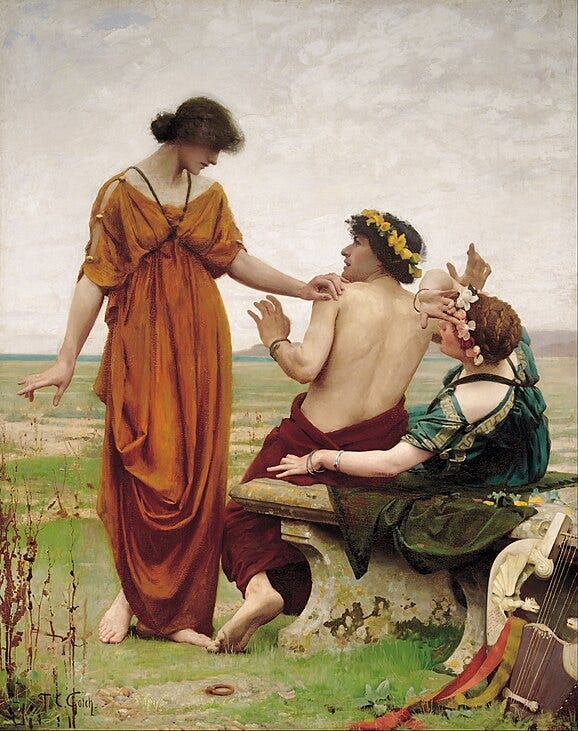
Chance falls upon every man, regardless of whether they be fatalists or not. To suppose things otherwise than what they really are is to write out a condemnation of contingency. Chance is really synonymous with contingency, for all things are contingent on another; but we, in our great ignorance, assume that those same things were always present, and not brought about through the randomness of the cosmos. In all respects, everything in experience is but chance made tangible. The whole flux of life, the implicit dialectic within nature, and the constant reminder of suffering in the world all point to chance ruling and dominating our lives.
Life itself is a chance: a chance to live, a chance to die, a chance to love, a chance to hate. There is no end to the innumerable complexities which surround a human being as they trudge through life. Everything in our subjectivity being subject to the chance occurrences of life—those random events which more often than not prove great inconveniences and difficult drudgeries—is subject also to our temperaments and capacities for enduring them; in that sense, even our ability to live in the world is largely chance—predetermined by how well our descendants were able to do the same. It is unfair to ask the cripple to climb a mountain, in the same way it is unfair to ask the idiot to learn; what chance has wrought upon these individuals is a misfortune, and thus should be considered when striving to crudely objectify them.
No man chooses to live; he is born into a losing struggle which he must fight against every time he is called from slumber. Chance is arduous, for it spares none, and very often strikes down people when they’re at their lowest. Most make themselves subject to chance more than they should by taking on things which they are incapable of overcoming given their present circumstances. Chance makes men with the same rapidity it destroys them, and leaps with alacrity into the arms of everyone, though it be repulsive to all. Life is a misfortune precisely because it is primarily left to chance. A man’s capacity to feel hope in the world is largely dependent on how well he is able to accustom himself to his dreadful conditions; chance, in that sense, really becomes the raft which the shipwrecked cling to, though it was also the cause for the ship’s capsize in the first place.
It is undeniable that everything in life is really meretricious when considered purely from the perspective of chance. It is so disheartening to see the wicked succeed and the poor fail, the hungry starve and the well-fed glut themselves more; everything in the world should really be looked upon as a sort of desengaño (disappointment) if it is to be considered with honesty. It isn’t my intention to turn chance into the devil, but it’s very difficult to speak of randomness—which is all chance really boils down to—and not wish to ascribe to it some autonomy. Usually, I would affirm uncertainty if the only other option was erroneousness, but with chance, even the option of uncertainty becomes uncertain, because how could we be sure that uncertainty is certain? The questions which realism forces us to predicate dichotomously are wrong precisely because they fail to consider the negative; the negative here being merely the negation of what is claimed and concluded. Without the negative, one cannot consider the opposite, and thus cannot account for the chance of things. If one fails to consider chance, one fails to consider the possibility of suffering, and so loses the most fundamental and basic quality of life. As I said, without this, there is no honest framework by which to construct around life. Everything we do in life is done with the hope that whatever chaos the world confronts us with will in some way be mitigated by our actions. Even if everything was determined, as Spinoza thought, the inability of man to comprehend the difference between the effects of his actions and the world which caused him to act in the first place would be enough to forever place the idea of determinism in the dark; nay more, it is something which, if we were trying to be balanced about it, would compel us to adopt the position of agnosticism. The whole divide between believing and knowing is down to chance too, for what we say we know is really saying what we firmly believe on the preponderance of its evidence—assuming we were being rational about it.
Events are no more subject to our will than the sun is subject to the Earth. What happened, happened, and there is no changing the past any more than there is knowing the future. Man’s life is made intelligible to him in proportion to how much he can suffer in it; and so, the more a man suffers, the more he is able to accurately depict what existence really is. It is hard enough to live, let alone paint a cohesive narrative around it that makes sense of it; and so, in the face of so much difficulty, tethered with the inability to correlate it all in a comprehensible manner, it is very common for man to throw himself into religion, or—if he be a secular fellow—to start a family and make the purpose of his life the prosperity of his children. I am, in this regard, however, utterly solitary and devoid of any contact. When I consider my own life in relation to all the chance encounters I had within it, and when I consider how all those events made me—despite my not remembering a single one of them with any clarity—I am surprised to find that no author in history, or piece of worldly advice given me by family, friends, or strangers alike, has in any way enlightened my path or given me guidance regarding the conduct of life. It’s as if, in attempting to understand myself, I attempt to do what no man before me has done; of course, what I just said is ridiculous on its face—for there have been innumerable existentialists before me—but I’m speaking here anecdotally, not factually: what I really mean to imply is that no book or conveyed lived experience from another has been able to show me the way of life, the method of approaching it, or the ability to overcome its chance. In this sea of confusion, I find myself attempting to stay afloat whilst a massive tidal wave approaches. I’m cast at sea on a boat without a rudder. Nothing makes sense to me, and I am forced to make sense of it myself, as if for the first time in history. Every new day is really a new chance to remember how much of your own self you have forgotten; the sun shines upon every earthly misery, and in such a cruel jest adorns with light all the depravity humanity does to occupy itself with. Only a single glance out into the real world would be enough to sober you up to the truth of it: that existence is wicked when you consider how the whole of it is organized and subjugated for the sake of maintaining order and security. Nothing really matters today because everything has been profaned for the sake of some homogeneous, uniform regularity, run on exploitation and the very real threat of hunger and loss of shelter if you even remotely act contrary to the norm.
It doesn’t confuse me, then, why everybody thinks the same, does the same, wants the same, and hates the same. Everyone is so disconnected from their own person, they’ll stake their whole being on a savior figure, or guru, or politician, or even philosopher, long before they believe in themselves. Things at present are organized in order to make the humanity of the individual seem like an unnecessary component, when in truth it is the whole being. Even activist groups are shallow today, since everything they do is really a power play, and not considered with the individuals in mind. All this chance just so happens to be what we humans have concocted for ourselves, and we shall either perish by it, or overcome it by taking chance into our own hands, though it be something we cannot grasp. Our chants for change are like whispers in the ears of chance, but it is in chanting that we find within ourselves enough courage to envision a better world. A better world is possible, so long as there are those few hopeful spirits who uplift a whole class of people through their advocacy. Not everyone can be a Marx, or a Lenin, or a Luxemburg—but everyone can be inspired by them and see to it that the future does not become like the present. Like I’ve been saying, it’s very easy to see the world for what it is and wish to resign instantly from it—and many do—but I’ve never been one to give up when faced with the absurdity of life; my life would be so much easier if I could afford resignation, but that remains a thing only for the few already well-off enough, or dedicated enough, to do so; it is not in my temperament, however—I know not the color of fear when angry, and I’m right about now absolutely furious with everything in this poor, diminishing, quack world. I find life so much more exciting when suffering is the common occurrence each day, for it rewards those looking for it with endless inspiration. The world we live in at present is really only suited for a Schopenhauer (pessimistic philosopher), a Dostoevsky (existential novelist), or a Nietzsche (existential philosopher); everyone else is forced to eat their own bread bitterly, and thus pay dearly for each breath drawn. Nothing seems to get better because hope and change are nonexistent, and the average person—lacking any real critical thinking skills or deductive reasoning—is forced between giving up entirely or placing unreasonable amounts of faith in total incompetence. To expect the people of today to democratically elect a person willing to actually improve their lives is like giving a baby a hammer and nails and expecting it to build a house out of them—you’re better off asking a blind man to land a plane, or a fat man to run a marathon in under four hours.
Nobody likes to deal with the reality of things because reality isn’t a thing to be dealt with without first sacrificing yourself to it. This world requires a pound of flesh from you before you can even enter it. Nobody comes into this world without pain being inflicted upon the mother, and nobody leaves it unscathed from the mental and physical anguish which must be dealt out in order to survive within it. Life, if considered honestly—and everyone knows how scary honesty can be—is more a misfortune than a blessing, for all the sufferings we encounter within it are disproportionate to the number of joys we are lucky enough to experience. You would think one such as myself would get tired of exposing the truth of life, ridiculing it all the while; but, unlike Cioran, I actually find you can never repeat enough times just how barbaric, cruel, unequal, and stupid life really is—I find in it, actually, an inexhaustible well from which to extract essay after essay, aphorism after aphorism: the whole point of my existence at present seems nothing more than turning my thoughts into statues of prose made beautified by their elegance and truth. Besides, I’ve spent too much time in the philosophical systems of others not to attempt to give my own complete analysis of the world. I believe it is something everyone must do, in fact—for without your own standard by which to judge and consider things from, who is to be master, who is to be critic, and who is to be interpreter of your existence? Do not take refuge in the false security of consensus; experience will prove to you that more often than not, everyone acting in their own best interest doesn’t actually lead to the best outcomes as Adam Smith thought, but rather only leads to a majority of mediocrities. Smith’s logic only applies to the market, which is very much run like a monarchy led by philosopher-kings; the whole pretense of democracy is founded on a falsehood, for representatives are still needed, and power, no matter where it spreads, always tends to corrupt even when placed into the hands of an angel. Even America, the supposed freest nation in history, was never really a democracy—if by democracy we mean the ability for a man to choose who he is to be ruled by, while living his life free from government interference, while at the same time being able to execute his rights and liberties without the threat of them being stripped from him. If I may speak about contemporary matters for a second, it shocks me America is celebrating its Semiquincentennial when Americans are the most self-centered, arrogant, ignorant, bigoted, unhealthy, superstitious collection of rubes and knaves this planet has ever seen. I would say I’m proud to be an American if I saw things to be proud of, but when I look out into the world and see nothing but the strong crushing the weak—combined with nonstop justifications by the ruling classes for their own supremacy—and very little in the way of effective mobilization of the populace to change this barbaric, disheartening, retarding system of exploitation, it is only natural I remain silent, or, if asked, say I’m American by accident more than anything else. America is the only nation in history to be founded on an idea rather than an actual historical connection to the lands going back millennia. In my opinion, the only thing admirable about America is the founding fathers; other than that, our history is nothing more than a bunch of immigrant farmers being kicked around by the landed gentry—to which our founding fathers mostly belonged.
This world has always been run by chance, and this manifests itself nowhere clearer than in the study of history; even philosophy cannot be spared from its own material analysis, because every philosophy is a response to some material condition. The fact that slavery was considered natural for as long as humans have been around is proof enough that, by nothing more than chance, the whole history of our species is really governed by a maleficent force of will which we are privy to but which we are also slaves to. I can never get over how nonchalantly people consider their own life; the whole of their being, everything they are and wish to be—a little miserable pile of flesh and bones—turned into nothing more than another entry on some spreadsheet, or some doomer waiting for death, or some degenerate who passes their time lost in some obscure, deranged, perverse corner of the internet. Nietzsche was right; he was always right. The advent of nihilism is upon us. What once seemed like a prophecy from Nostradamus is now coming to pass in our own times, and the scariest thing is—nobody knows what to do when all this darkness shall consume us.
Chance, in all its glory, rules us as a king does his serfs—all while the peasants are still shackled to the lands out of necessity. Chance, great chance, ruler of all contingency, harborer of all events, keeper of all secrets, embodier of all things: we are, compared to you, like a moth to the moon, chasing after your light without realizing how far your rays truly shine. If only it were possible to affirm what is determined; since this remains out of our reach, we must enter life conspicuously with all our ignorance still attached to us. As sad and insignificant as it is, life presents itself as a task—the task, I mean, of subsisting at all. Once survival is secured, life becomes a burden. The first task is to acquire what we need; the second is to endure the result—warding off the boredom that, like a bird of prey, circles any life safe from want. To find no use for what has been won is to be crushed by it. Such are the ways of chance.