
Desire
40th installment to my philosophical system.

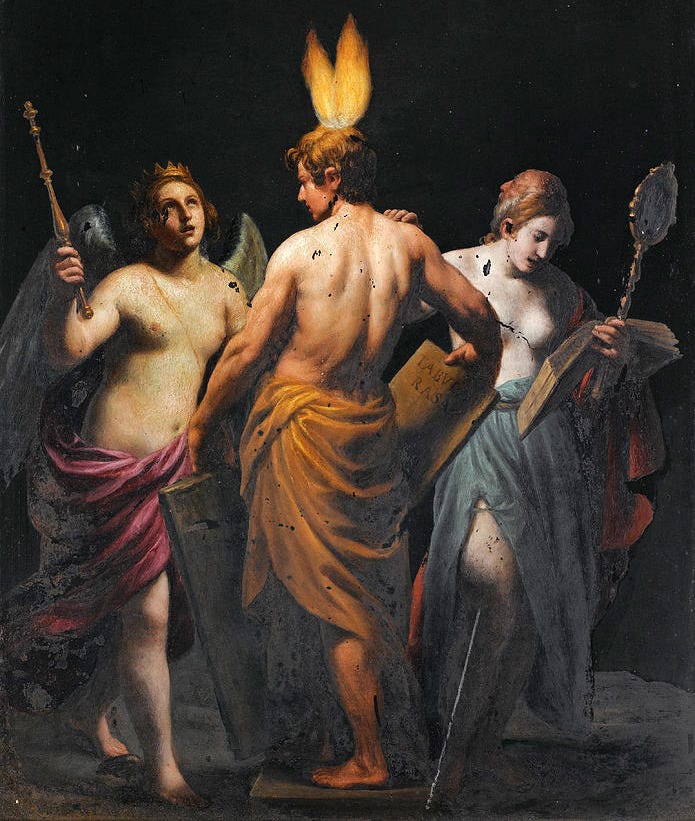
If we must accept Fate, we are not less compelled to affirm liberty, the significance of the individual, the grandeur of duty, the power of character. This is true, and that other is true. But our geometry cannot span these extreme points, and reconcile them. What to do? By obeying each thought frankly, by harping, or, if you will, pounding on each string, we learn at last its power. By the same obedience to other thoughts, we learn theirs, and then comes some reasonable hope of harmonizing them. We are sure, that, though we know not how, necessity does comport with liberty, the individual with the world, my polarity with the spirit of the times. The riddle of the age has for each a private solution. If one would study his own time, it must be by this method of taking up in turn each of the leading topics which belong to our scheme of human life, and, by firmly stating all that is agreeable to experience on one, and doing the same justice to the opposing facts in the others, the true limitations will appear. Any excess of emphasis, on one part, would be corrected, and a just balance would be made. —Ralph Waldo Emerson, The Conduct of Life: Fate.
One key, one solution to the mysteries of human condition, one solution to the old knots of fate, freedom, and foreknowledge, exists, the propounding, namely, of the double consciousness. A man must ride alternately on the horses of his private and his public nature, as the equestrians in the circus throw themselves nimbly from horse to horse, or plant one foot on the back of one, and the other foot on the back of the other. So when a man is the victim of his fate, has sciatica in his loins, and cramp in his mind; a club-foot and a club in his wit; a sour face, and a selfish temper; a strut in his gait, and a conceit in his affection; or is ground to powder by the vice of his race; he is to rally on his relation to the Universe, which his ruin benefits. Leaving the dæmon who suffers, he is to take sides with the Deity who secures universal benefit by his pain. —Ralph Waldo Emerson, The Conduct of Life: Considerations by the way.
Life brings to each his task, and whatever art you select, algebra, planting, architecture, poems, commerce, politics, — all are attainable, even to the miraculous triumphs, on the same terms of selecting that for which you are apt; begin at the beginning, proceed in order, step by step. ‘T is as easy to twist iron anchors and braid cannons as to braid straw; to boil granite as to boil water, if you take all the steps in order. Wherever there is failure, there is some giddiness, some superstition about luck, some step omitted, which Nature never pardons. The happy conditions of life may be had on the same terms. Their attraction for you is the pledge that they are within your reach. Our prayers are prophets. There must be fidelity, and there must be adherence. How respectable the life that clings to its objects! Youthful aspirations are fine things, your theories and plans of life are fair and commendable: — but will you stick? Not one, I fear, in that Common full of people, or, in a thousand, but one: and when you tax them with treachery, and remind them of their high resolutions, they have forgotten that they made a vow. The individuals are fugitive, and in the act of becoming something else, and irresponsible. The race is great, the ideal fair, but the men whiffling and unsure. The hero is he who is immovably centered. —Ibid.
What doesn’t man desire? The strongest of all temptations in life is the temptation to live. I am struck by how far people go to purposely extend their miseries only for the sake of keeping themselves alive. So much labor is expended on behalf of a false desire—a desire born in nothing besides itself; its own perpetuation is the goal, and that is what man follows blindly even though it leads him off a cliff.
Whenever I attempt to give a piece of my mind on things as abstract as metaphysical concepts, I’m forced—perhaps beyond my power—to make amends with existence, to rewrite our past wrongs together, and to make up for what was lost in so much sloth, vanity, and sin. I despise this fact, however, for I would much rather hate honestly than love falsely.
What comfort is there in a world such as ours, where everything is seemingly driven by stupidity, faith, and idealism? I do not hold it against existence that so much misery should be delivered upon creatures as vain and fickle as we, but I reject the invitation I receive from it which proclaims that I should live anyway. For what end, and for whom? Why, and to what purpose? Life almost seems as if it manufactures its own purpose on the spot in order for the individual to continue at all. All lies; false, conniving lies. Even knowledge fails to sustain me now, because I know it to be fundamentally useless existentially.
Should not this ardent woe compel me to the depths of misery? It has, dear reader, more than you can comprehend—and yet, look at how far this misery has taken me; look at the fruits of my desire, and my drive to sustain myself despite not wanting to. All this suffering has renewed my very self, and in that great instauration comes what you see before you: my truth of the world… my philosophy.
Desire as a feeling has its place firmly in my heart; it may even be said of it that my subjectivity is firmly the slave of it, and, in truth, it is, for all my life I’ve made sure to follow it out as correctly, honestly, and consequently as I can. Every breath I take is a defiance against myself. Every sudden awakening from sleep is really a revolt against the universe. However strongly I see the good in life, and make thorough encomiums on its behalf in order to raise it, in my mind, to a light far superior to what it deserves, there still remains in me a strong inclination to decay, death, misery, and, above all else, the desire to extinguish everything along with myself.
It is a common trope amongst us nihilists that our suffering is too complex, too much our own, for anyone to understand, and if they would try to understand, they would turn out like us. This, I believe, has firm foundations in the truths of nature, borne out by how few people truly are nihilists. The everyday person laments life—maybe even sheds tears over it—but they do not despise it, and this is, as Schopenhauer noted so long ago, the result of the average Joe having no intellectual inclination. It is only when one rationalizes their suffering that they begin to believe. Ignorance is bliss not because you’re ignorant of worldly affairs, but precisely because you believe yourself able to endure, or even overcome, worldly affairs; it is a child’s optimism that ultimately separates the common folk from the true deniers of the world.
I have seen it firsthand, in fact, know it firsthand—for I am a nihilist, but not existentially. You see, the dialectical nature of life is so finely tuned to the capacities of the individual that the cunning of reason assumes itself in every presupposition about existence; we delude ourselves into thinking what isn’t the case is the case, and in doing so maintain ourselves with a strong disposition of positivity and willful self-effacement from external affairs. These people, however, have no reflection, and dare not approach repetition—which, in layman’s terms, is merely the ability to go over in your mind some scenario in the world.
They do not reflect on life, and that is why they are ignorant of their true nature and are thus the happier for it; in this, they do a great service to themselves, for they do not worry about the future, only their present, and as a result have no comprehension of the truth regarding the world. Because they do not know the nature of the dialectic, they can only sense it intuitively as they live through life, but not having the requisite background to wrestle with it thoroughly—intellectually, that is—they are instantly swallowed up by the theoretical aspects of life, and so, instead of facing it and researching into it, they retreat into a debasing ignorance which they flatter themselves with, in the same way a person today ignorant of mathematics loves to pave over that disturbing fact with the all-too-common phrase: “I was never good at that.”
Again, to be a nihilist is not merely subscribing to the position that life has no inherent meaning—anybody with a brain not swimming in mystical idealisms or religious fervor will concede to that—rather, to be a nihilist (as I interpret it) is to intellectualize your suffering beyond what is useful, and, as a result, to turn it into a justification for remaining in your already miserable state. Most people who claim to be nihilists are not true nihilists: their desires are not of hate and destruction, but rather of the ability to identify with a label that perfectly describes what they feel: emptiness—meaninglessness.
It is indescribable how much of modern psychology is really born out of the innate human desire to identify with our own subjectivity; if we today cannot feel like we’re a part of some grand narrative, or group that affirms what we feel internally, then we are mere castaways waiting for death to take us and for the world to end. This is a relatively new phenomenon. There was no concept of nihilism before the Enlightenment; in fact, the term originates in the late 18th century with Friedrich Heinrich Jacobi, who coined it as a philosophical concept in order to represent a common custom of philosophers during his day to start their investigations without first accounting for the individual who was carrying them out—in a sense, he was criticizing the concept of philosophizing devoid of subjectivity, which to him necessarily implied being devoid of meaning or existence. One may say it was all downhill from there.
What nihilism identifies is the rejection of innate meaning within existence. As one lives, they develop habits and customs out of instinct, which they follow out of familiarity and prejudice to any alternative. Again, prior to the Enlightenment, the ultimate ground for every custom was religion, for it provided an ethical, spiritual, and cultural foundation on which to see yourself. With the increasing independence from the church, however, and the creation of the individual subject (individuality) out of reason and personal judgment—pioneered by people like Descartes, Pierre Bayle, Benjamin Franklin, and David Hume, and made popular by the French philosophes (Voltaire, Rousseau, Montesquieu, and Diderot)—it was only a matter of time until atheism would arise and people would find themselves suddenly thrown into an uncaring world without the help of their divine savior. It should be noted, too, that this was, at first, a largely bourgeois phenomenon, for the common folk weren’t yet educated enough to see the world through any other lens but a religious one—which was something the Catholic Church wanted, in fact, in order to maintain their influence upon the masses, who in turn were a check on the power of the king… but we need not go into the power-struggles of Caesar and Christ here.
In the modern era, what we see with regards to the growth of mental illness, the overly psychologized (individualized) approaches to mental illness, and the birth of many online “communities” or subcultures built upon shared interests, is a direct result, or perhaps even a direct response, to this lack of religiosity. Whether the modern conservative turn to ‘tradition’ or ‘old values’—always being synonymous with Christianity (especially in America)—is a historical aberration, or something that can be verified conclusively, is not something that I shall investigate here. I merely wished to bring to your attention the history of modernity and why desire is so dead and empty today.
My goal, really, is to psychoanalyze philosophically—in that sense, I’m no different from a medieval chronicler, but instead of recording dates and events, I record mental antipathies. My method is really no different from Nietzsche’s, although explicated not as beautifully, of course, and without as much depth, sadly—very few minds today are capable of innovating in philosophy after Nietzsche, I’m sorry to say; it’s not that there isn’t anything to discuss, or no new innovations occurring in the present which threaten our mental life, but rather that Nietzsche already laid the groundwork for everything and then some with respect to man’s interiority.
It is why my discourses are very terse, personal, and incoherent at times, perhaps even aphoristic: I have no patience with consistency and would rather not write at all than write without fidelity to how my thoughts first arrived in my head; all my explanations are long asides, already determined in how indeterminate and contradictory they are. That is my secret power… extemporal exposition, and I will not let it die for anything; to write any other way is anathema to my creative spirit and has no place in my heart. Indeed, my philosophy is a rejection of formalism and finality: it is dialectical and contradictory, in clear imitation of how nature truly is.
The desire to feel at home within one’s self is the quintessential problem which existentialism concerns itself with. It is, necessarily, a problem of desire—because desire is a value born either in want of a new tradition or a return to an old one. What one feels in life is nothing short of their entire being, and in the confusion of being, depending on the individual’s temperament, one is very likely to do one of two things: return to what worked in the past, or innovate and create new modes of being for today. This here is one of the many fundamental distinctions between a conservative-reactionary thinker and a liberal-progressive thinker, and which one you fall under is largely dependent on what presuppositions you hold regarding human nature.
See here though, how I label once again, how I can never escape the dread of concepts, how I must always refer back to abstractions rather than concrete realities whenever I explain anything to do with existence; words fail and can never be true aids in the search for the self. It goes back to what I said earlier: the innate desire to feel connected to something higher than yourself—the religious impulse has never really died in man; it still shines through when life brings us to our weakest moments, and such is why nihilism can never be an answer to life: it lacks existential affirmation; it is, rather, a rejection of what is in the heart for what is outside it, for the feelings of the heart mean nothing to one who sees it only as an organ for circulating blood. The spiritual challenge for man today is born in his inability to see what lies outside him as something more than mere matter.
The nihilistic individual who clings to life like a newborn babe does its mother does so out of fear or laziness; just like a baby, they know nothing but believe themselves to be smarter than everyone they encounter because they believe they’ve thought a lot more, or perhaps more deeply, on the “true” state of things. But this kind of intellectualization is no more help existentially than shooting yourself out of despair of not knowing what to do in life.
The greatest intellectual defense mechanism to avoid thinking existentially is to throw a sea of concepts at a personal problem with the hope that after such an onslaught the problem would run in fear—this does nothing; what one ultimately discovers in such a display is that no amount of erudition will ever save you from yourself. You are, in your own person, a mystery which is itself mysterious, unknown to nearly everything else but yourself, and even in that, unknown. What cannot be undone is that you are born; your existence is now present, and in you lies the truth of what your life shall become—the question only remains: how far are you willing to search for it, and are you willing to search for it should you find in the end that there was no end to the searching? Desire plays a role here because it is ultimately that sensation which chooses for you.
The sheer contingency of life is almost unbelievable. To think, everything which occurs to us feels necessary, but in a fuller view was only accidental. It cannot possibly help one on the edge of despair to turn to them and say, “it is better to jump now than later, for all roads lead to death.” I’m of the opinion that life’s absurdity is what makes it endurable in the first place. A placid life, lived among perfectly happy individuals, in which everything went your way and you were sure of every good fortune, would be an utter abhorrence to anyone who lives in actual reality—because it is something that appears impossible in the real world and is something one could only imagine because they do not live in such a perfect world. The world one finds themselves in is very much the world they reflect (not counting the neurotics, of course, who find even happiness a hell). Happiness is not the main desire of life. Most people today assume it to be and, as a result, subordinate every wish to the acquisition of money in order to make it a reality; but as I expressed in my last essay, even if Earth were a utopia, there would still be existential quandaries which remain. One can never truly outgrow life because they are bound in it, imbued with its will, and are made to serve it until natural causes take their course.
It requires a very powerful will to even maintain life, let alone continue it for decades; I would have no qualms enduring it were it only my decision to live, but life is more than merely what I think of it; I have relations and responsibilities to others, and I am so made as to endure it in order to make good on every responsibility I have. It would be easy for me if I were the kind of person to live without responsibility, but I know all too well that were I to live without it, I would feel more than I really am and thus lose the call to action in the world, because I would see myself above everyone and not wish to deal with them as a result. I already feel a call to inaction, but this is out of no ill will towards others, rather, only out of an ill will towards myself—my own life is what I suffer, and so I feel it passionately, overly so, and prefer, as a result, to ruminate upon it than make something out of it.
You see, dear reader, how much I suffer and endure even to write these words? You, for sure, now see why I can never feel at home within myself; why all my discourses for upliftment may help you existentially but are only done out of the necessity of life for me. I am stretched out on the rack of life, and my torture is the only meaning it presently holds. I am impaled by a spear which simultaneously upholds me. I can get no break from life, for my every waking second is spent in contemplation of why I even continue it. Emil Cioran famously said that, “A book is a suicide postponed.” And also, perhaps more morosely:
Only optimists commit suicide, optimists who no longer succeed at being optimists. The others, having no reason to live, why would they have any to die?
This echoes what Thales famously said 2,600 years earlier. It is recorded by Diogenes Laërtius in his life of Thales as the following:
He said also that there was no difference between life and death. “Why, then,” said someone to him, “do you not die?” “Because,” said he, “it does make no difference.”
And not far after this immortal saying, Diogenes records a few more sayings of the great Thales which I think posterity ought to read:
When he was asked what was very difficult, he said, “To know one’s self.” And what was easy, “To advise another.”
What was most pleasant? “To be successful.”
To the question, “What is the divinity?” he replied, “That which has neither beginning nor end.”
When asked what hard thing he had seen, he said, “An old man a tyrant.”
When the question was put to him how a man might most easily endure misfortune, he said, “If he saw his enemies more unfortunate still.”
When asked how men might live most virtuously and most justly, he said, “If we never do ourselves what we blame in others.”
To the question, “Who was happy?” he made answer: “He who is healthy in his body, easy in his circumstances, and well-instructed as to his mind.”
He said that men ought to remember those friends who were absent as well as those who were present, and not to care about adorning their faces, but to be beautified by their studies.
“Do not,” said he, “get rich by evil actions, and let not any one ever be able to reproach you with speaking against those who partake of your friendship. All the assistance that you give to your parents, the same you have a right to expect from your children.”
All of them are great, but the one that strikes me particularly strongly is the first one. I find that my whole philosophical system is really one long letter of advice to my younger self, given everything I’ve learned since then. It’s so easy for me to sit on high, kick my feet up, and override the sounds of the real world with my own advice, but does any of this constitute ‘knowing myself’? I suppose if one is smart enough they could pose as a great sage, but that’s merely acting, playing the role, being something you’re not—but to actually embody every experience you speak of, and to actually know the lived lessons of life rather than merely receiving them in print, is much different.
I would suspect, as Schopenhauer rightly did, that those who know life only through books can write out a discourse on par with Plato or Aristotle, but in an absolute sense, it would all be empty platitudes not worth the pages they’re written on. It is better, then, to write honestly what you think rather than what you’ve received from others; and that is why my writing style is so enjoyable and natural, because everything writ is from the heart and only occasionally passes through the brain when making an analytical point or finding fault in the structure while editing. My approach to writing is, above everything else, Schopenhauerian. Let me end by quoting him on this point:
My works are a succession of essays, in which I am possessed with one idea I wish to determine for its own sake by writing it down. They are put together with cement, therefore they are not shallow and dull, like the works of people who sit down to write a book page by page, according to some preconceived plan. —Arthur Schopenhauer, His Life and Philosophy, Chapter 3, by Helen Zimmern.
And on the approach to an idea to be written out more generally, he says:
If I faintly perceive an idea which looks like a dim picture before me, I am possessed with an ineffable longing to grasp it; I leave everything else, and follow my idea through all its tortuous windings, as the huntsman follows the stag; I attack it from all sides and hem it in until I seize it, make it clear, and having fully mastered it, embalm it on paper. Sometimes it escapes, and then I must wait till chance discovers it to me again. Those ideas which I capture after many fruitless chases are generally the best. —Ibid.
In the next chapter of Zimmern’s biography, he further says:
A work forms itself under my hands, or rather in my mind, a philosophy uniting ethics and metaphysics, which till now have been as wrongly dissociated as men have been separated into body and soul. The work grows, takes substance gradually and slowly, like the child in the womb. I do not know what originated first, what last. I discern one member, one vessel, one part after another; that is to say, I write them down without troubling myself about the unity of the whole, for I know that all has sprung from one source. Thus arises an organic whole, and only such an one can live. —Arthur Schopenhauer, His Life and Philosophy, Chapter 4, by Helen Zimmern.
And why not quote the man at his most honest regarding life and genius:
In order that man may preserve a lofty frame of mind, turning his thoughts from the temporal to the eternal; in one word, to keep a higher consciousness alive in him; pain, suffering, and failure are as needful as ballast to a ship, without which it does not draw enough water, becomes a plaything for the winds and waves, travels no certain road, and easily overturns.
Suffering is a condition of the efficacy of genius. Do you believe that Shakespeare and Goethe would have written, Plato philosophized, Kant criticized Pure Reason, if they had found satisfaction and contentment in the actual world surrounding them; if they had felt at home in it, and it had fulfilled their desires? —Ibid.