
Emotion
41st installment to my philosophical system.

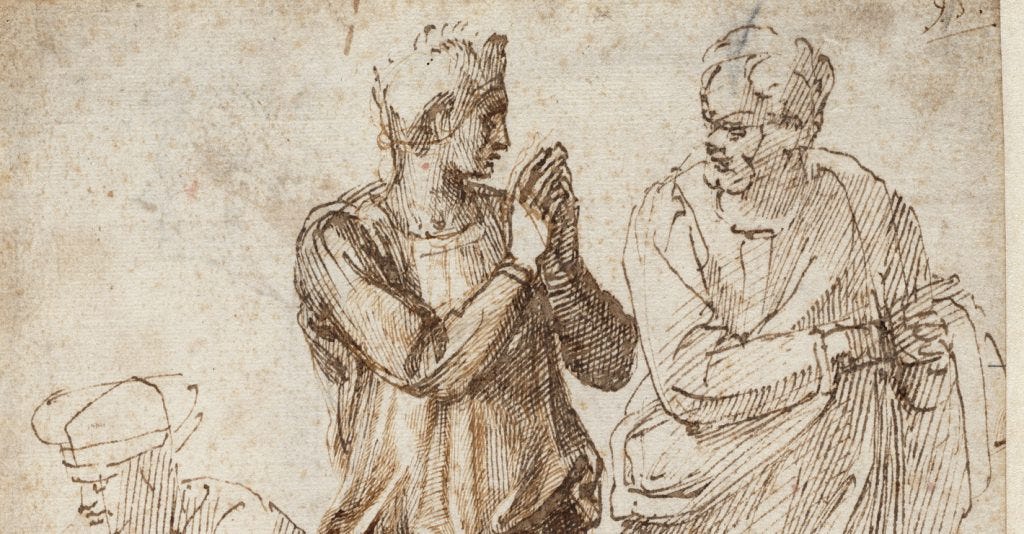
I would gladly give myself completely to emotion were it not an unwise thing to do today. Everything about which I think regarding the world always comes to me in two forms: a practical one and an emotional one; a divide made only because modernity is steeped in division and categorization made from abstractions, rather than real experience or honest hermeneutics.
Emotion is derided because it is not felt honestly. The whole world today is drawn out from the accountant’s scrapbook rather than the painter’s canvas. There is a war of ideas currently underway; a war of values—those who wish to give up and give in, and those who wish to reject and renew. The whole panoply of the present age is fought in the shadows between these two forces, and is played out behind the scenes from the prying eyes of the public—that ignorant mass who is willing to change with the winds the moment it suits them.
Every conflict which the world encounters is really the result of opposing values. Every problem is the same but the methods to there solutions are different. Even individually, we feel this constant tension and opposition play out between ideologies we can’t even understand, let alone sympathize with. The whole libretto is written long before the music is put to it, and likewise, the world was decided long before we had our say in how it should be fought out. People today can’t even agree to disagree, to let bygones be bygones—everything has to be a constant dialectical struggle with the intention of maximizing casualties in ideological warfare.
Ideas today are not our own, but rather someone else’s, who themselves took them from somewhere else. It may be said that nothing new is under the sun—and in that way nothing worth talking about—but I would like to believe that the human spirit is vast enough to take old material and breathe into it fresh life, in order that there shall be a continuance of old ideas in new garbs, which in a sense makes them new.
I care very little for the antiquity of an idea; only what it brings me, and what, within it, fulfills me, that I concern myself with. It’s very hard to feel like we’re capable of innovating in the world presently, and this is because, as I said, everything is subjected, first, to an analytical treatment which strips from it all the creativity and emotion that went into its creation. The way in which we devise our schemes is hardly new, but this does not imply that nothing innovative may come out of it: one merely needs to glance at the history of art in order to see the clear evolution in approaches, and the new responses to old traditions, in order to see culture born from the womb of ideas so to say.
Everything has its urphänomen (archetypal or primordial phenomenon) which we as observers are made to acknowledge, and from which we are forced, by the very nature of it, to draw upon, in order to resuscitate it from a deadly stasis. Nature is a dialectic; it requires an observer to notice it in order for its beauty to have an enchanting effect upon us, and from that sight comes new worlds of abstraction which can be made tangible in the world through action. Nature and life are co-eternal because they’re both ideal and material—without objectivity there is no subjectivity, and without subjectivity no truth of what the object is. We are as dependent on nature as we are independent of it, which is to say, totally dependent on it, for we are both nature and non-nature—and the sooner man recognizes this, the sooner he will see the importance of emotion.
Nature, and by extension life, has emotion implicit in it, but it is only man that can bring this emotion into perspective, and thus give life to it—something which one who only seeks to objectify nature, mathematizing it and reducing it to line, number, and figure, can never truly appreciate. Abstraction to a reductionist is the whole point of observation, for they believe that the observation itself is meaningless unless it can further their knowledge of the thing being viewed; they take all things to their logical conclusion, and wish to find in simplicity the kernel of truth they believe to be there—never asking why it’s there in the first place. This point cannot be emphasized enough: these reductionists presume the simplest form of a thing is all that thing is, rejecting subjectivity completely, and thus turn existence and the cosmos into factoids and trivia—as if the glory of life were simply the answer to it, rather than the journey and experiences from it. I cannot hate more strongly than I already do those who despise life by turning against it in order to feel master of it; they would speak in the language of Leibniz’s characteristica universalis (universal characteristic) and end each period with a Q.E.D. if it meant remaining totally consistent and logically coherent. They condemn what they do not understand, or rather, what they cannot put in logical terms, and so use reason to justify itself in order to ensure emotion cannot get a foothold within the analysis of reality.
I’m an existentialist, however, and cannot help but notice how bankrupt that approach to reality is when it comes to real life—when it comes to actually living amongst irrational beings with passions as deep as the Earth. What good does this kind of thinking bring anyone if it cannot relate back to their own person personally? Where is the subject at the heart of every experience if you treat each moment as a camera does time—snapped, forever eternal, but made so only momentarily? No. What is necessary is subjectivity. Without that, all you have is your deductions without personality, and are no different from a calculator doing arithmetic. It doesn’t help that these reductionists are the most insufferable people to be around, always trying to find fault with what you say as if you were in a debate with them, rather than hearing you out first and then commenting on what you said. But, sadly for them, they’re on their way out, for the world at present doesn’t need people making the futility of life that much more apparent; it is already clear to every feeling heart just how debauched the world is, and how impossible the prospect of lasting happiness remains. What is needed here are new ideas, but ideas of an ethical, sympathetic, even impractical kind; the world needs more dreamers, because for far too long have we let the Enlightenment run roughshod right over everything which we artists and free-spirits hold dear—turning the point of art into truth, and the end of all activities profit.
There is a kind of absolute truth in the statement “art will save us all.” It will never be accepted by those who shun the emotional, but these are people already obsessed with ideas, not things which are abstract and have no limit to their conceptualizations. You cannot teach a blind man to see, and, similarly, you cannot open a man’s heart to things if he is unwilling to become vulnerable to them, and potentially transformed by them, in the first place. It is absolute because art is the one subject which man can truly feel himself to be totally free in; there are no limits to what he can create because what he creates is only limited by his will which, if we are to agree with Schopenhauer, is indomitable, veracious, and unlimited in its desire to acquire more. It is also true because it necessarily connects with the emotions—the one aspect which our whole subjectivity is embedded in; the heart does not feign its movements when it encounters something beyond it, and the spirit within does not progress without first coming to terms with the thing which moved it—the prime mover, in this case, is we: we are the music makers, and we are the dreamers of dreams.
Art sustains and art persists, because in all its gloriousness we are made that much higher by it, and so stumble over it in order to know what it is like to taste life twice, thrice, nay, forever after to infinity and beyond. No concept bounds what mere abstractions provide. The point of art is to see ourselves within it, and to transcend what mere flesh and mind find as only material; it cannot be just material when it exists in both the brain and heart—organs of our knowledge, extensions of our humanity, turned into cold, dead things when the spark of life is not driven into them by emotion. My words would have no meaning whatsoever were they only to be considered tactilely; it is necessary to visualize what the objects relate to in order to grasp what the words themselves are trying to convey. Were there no objects in the universe aside from a solitary, disembodied subject, there would be no external perception from which thought could arise, and thus everything would remain as solitary as our imaginary Boltzmann brain could possibly be. If I may be allowed to quote Robert G. Ingersoll on this point, he says, very rightly:
Is it possible to imagine an infinite intelligence dwelling for an eternity in infinite nothing? How could such a being be intelligent? What was there to be intelligent about? There was but one thing to know, namely, that there was nothing except this being. How could such a being be powerful? There was nothing to exercise force upon. There was nothing in the universe to suggest an idea. Relations could not exist—except the relation between infinite intelligence and infinite nothing. —Why Am I an Agnostic? Part I.
The beauty of emotion is that it is the whole of art embodied in human expression; it is not something from nothing, but rather a something from an everything—all things around us excite our curiosity, and we are baffled at how our world came to be, while thinking also why it cannot be something other than it is. This great mystery which lies at the heart of human existence—in much the same way the meaning of our lives stands motionless in the infinite abyss of ignorance which our minds conjure up in order to answer it—can only be approached artistically, emotionally, spiritually, ethically, and passionately. It is a question that demands the whole of our being in order to properly answer fully.
To analyze nature in an emotional way is to connect with it spiritually, and to see yourself as part of it, and alive within it. We cannot merely gaze upon a star and think of it as nothing more than a speck of light in the sky; to be emotional about a star is to see the grandeur in it, though it be a lifetime away—it is to engage with it beyond its mere stellar classification. One must see the life in the inanimate in order to vivify your own anima (soul).
Without emotion, there can be no originality, because everything would find itself being subject to past feelings which offer no new insight. Everything not considered practically today—which is really to say not considered with respect to your wallet—is the subject of coarse criticism done out of spite by those who cannot take their minds off of the constraints the world places upon their imagination.
All my life, I’ve been told to place my intellect over my emotion—and I tried as best I could to manage that stoic disposition with respect to every event, be it grand or miserable, in my life; but I found after keeping that up for decades, that the strategy has more negatives than positives. I found myself while in that state less than human. I was unable to connect with people on a deep level—for I more often than not made them into abstractions rather than treating them as living, breathing human beings with feelings and emotions. I was always told my problems are my own, and are best solved independently; and while I still hold some reserve, and even reverence, for that kind of approach (for my introverted nature makes that very appealing), I now know that even if that is the best for me, it is not for most—and if I’m to better myself, I must open myself up to the potential of being hurt or misunderstood by another.
One cannot open themselves up to love without also opening themselves up to loss. Hate and pain are among the strongest emotions for that reason: they destroy reason, and allow passion to override what the mind knows intuitively as wrong—hence comes revenge and the cycle of hatred which has engulfed the world several times over. If human beings were not emotional there would be no war—for envy, lust, and greed would not exist—but at the same time there would be no concept of art, love, philosophy, and passion. All the things which make life worth living are those things which also allow for suffering to enter into it; the price of admission to enter humanity is two things: suffering and death—but from these two necessities of being also come joy and life; indeed, it may be said that every consummation is born in joy, and every life which enters the world is that sensation taken to its ultimate conclusion.
Emotions know no bounds, and are the bulwark of every comedy and tragedy which man is blessed or cursed to encounter. In pain we endure through pain, but overcome with joy—and so it is with joy, we endure through pleasure, but suffer the pain of its gradual decline, to say nothing of all those fun memories which we can never live again, but must suffer and endure in times of sadness. I am reminded of a poem by my God-brother in this instance:
21 Novembre 2022
There are no wounds graver and deeper than the ones we inflict upon ourselves for the sake and love of others.
~
Gentle tears can fall heavier than feathers, petals, and stones.
The first line is great enough, but the second is what makes it immortal. I find in tears the whole story of a person’s being, for one who is able to cry is able to comprehend life. We may shed them in all emotional states, and thus find ourselves with all emotions at once when we cry. There is in those little droplets more gravity (importance) than anything which the comings and goings of daily life suggest to me; I am more moved at the sight of a person beside themselves, gracing the ground with their tears, than any show, movie, anime, or book can possibly give me. Art is born in tears, because one has to first empathize with the facets of existence before they can express what they think existence is.
Emotions are simultaneous: they occur abstractly (in the mind) and physiologically (in the body) at the same time, and in the simultaneity comes what we are—human. Man is that rational beast, that confident wimp, that dramatic stone, whose life is predicated on the inability to know what the point of it is.
The present age makes the point of the individual something final, or rather attempts to—which I think it ultimately fails at doing; what modernity lacks is, as I said earlier, dreamers. There are very few people today actually willing to incur suffering for the sake of growth, even if it was guaranteed to them that at the end of it they would become more than they are.
It’s easy to criticize others for criticism’s sake, or drama’s sake—especially when those others are doing things derided by the masses as impractical, or wishful dreaming, but what would there be in life without that—without that sense of impossibility and futility? I would argue nothing but stagnant, boring, uneventful progress which has no implications at all existentially. If people cannot get excited about their lives, how do you expect them to produce great art, or make way for the next culture? It cannot be done unless emotions are considered in their totality. Without emotions there is no art, and without art, there is no life.