
Eternity
46th installment to my philosophical system.

Eternity makes fools out of men, for what the notion of it implies is something which can never be fully apprehended in the mind. Like infinity, eternity is what we wish we could command, but which we must forever be subject to. Out of all the possible things to conceive of in the world, eternity is the one thing where all our concepts converge, but in converging become totally confused. Nowhere is this clearer than in merely describing eternity; like whenever discussing life, words fail to do complete justice, for the concept of eternity is so vast that nobody can ever descriptively exhaust all the possible interpretations of it.
The colloquial definition of eternity is temporal: something which is everlasting, implying infinite or unending time, from the Latin aeternitās (”eternity”), from aeternus (”eternal”), which came to English from the Old French eternité (”eternity, perpetuity”), though the original Old English form of the word (as translated from the Latin aeternum) was ecnisse, as in, on ecnesse (forever).
Infinity is to space what eternity is to time; both indicate something which is, in magnitude, scope, or comprehensiveness, far beyond the reaches of our mind—where no mortal soul dares to go, lest they be swept by its enormity and find themselves in a sea of infinity. Where one speaks of magnitudes, quantities, and compounds (infinity), the other speaks of beginnings, origins, and persistence through time (eternity).
The lengths men would go to give order to the world is astonishing. Every concept born from the mind of man is really an attempt to place himself above the world, and in doing so give order to what was otherwise a chaotic mess of images and associations drawn from experience. When the first syllable was uttered, it must have frightened man, for here was the first evidence of his own intelligence.
When we speak of things far above us, we must remember that they are only so because they are immutable to us. No amount of denoting or affixing some definition to a thing will ever make that thing more comprehensible; merely placing in logical form a concept that is still unknown doesn’t suddenly make it known; it merely ascribes a label to it which eases our fragile minds. Nothing is explained by semantics, in the same way nothing is explained by saying God made it that way. A noun is no different from a sound syllogism, in that both merely repeat what is already implied; they make formal and authoritative what was really arrived at through informal and arbitrary means.
The ineffable aspect within man knows intuitively what eternity strives to be, but, also knowing that he can never fully understand it, he pretends to know it by appealing to his heart when the time comes to truly wrestle with it, and in doing so puts to bed all doubt by a mere substitution of reason with sentiment. All complexity is brushed over for the sake of soothing his scared mind, and nothing calms him faster than assuming the conclusion and justifying it afterwards—man reasons backwards while pretending to know forwards.
This is why all attempts at explaining metaphysical concepts are really mystifications: everything said about them is so vague and inconclusive it ends up sounding more like poetry or purple prose than anything else. To even attempt an explanation of the incomprehensible is really the work of either a madman or a philosopher—and in truth probably both, for as Seneca said, “There is no genius without a touch of madness.” Madness is innovating upon the obvious; it is to muddy what is intuitive, and in doing so make complex that which in truth should be simple. Genius, on the other hand, is simplifying what is already simple; it is to take a concept and turn it into a self-evident intuition—making it seem more obvious than it already was.
Genius, like madness, is rare, for most people do not have the fortitude to use their mind for anything aside from their maintenance and subsistence; it is curious why people have brains at all when you consider how few actually use them—you would think, evolutionarily at least, that some would have developed stronger instincts, while others stronger reasoning capacities; but, on the whole, brains do not differ all that much between people—some are slower or faster cognitively, but generally we’re all using the same software; the smartest man doesn’t differ all that much from the dumbest when everything is considered.
It would require an eternity to explain eternity. Every concept which philosophers have come up with in order to objectify the world and place it under their dominion has, in my view, never wrestled with the existential aspects of those concepts. Thinking is an existential phenomenon; it requires input from the subject in order to make itself known at all. Without mind, there would be no subject, and without subject, there would be no object—the two coexist, and without one or the other the entire world falls into oblivion.
All things are naturally in the dark, and it is only after man’s light has illuminated them that they appear before us; such is why Prometheus was punished, for by giving fire (knowledge) to man, he kindled within him a passion for knowledge and advancement, and thus, a means by which to move past the natural state of things and become more than human. Knowledge was considered by the ancients a godly thing, a divine thing, a thing of reverence and necessity; without it, there would be no possibility of culture, and thus, no representations of the human spirit—the most essential of all things for a scholar.
He that kindles knowledge progresses culture, but he that burns too much for it shall burn himself the closer he gets to the fire; similarly, the more one knows the more they can empathize with, and thus, the more pain they can feel—suffering is a form of knowledge, but knowledge itself has a suffering attached to it stronger than any other; one who feels close to the source of all things, and whose wisdom nears Solomon’s, may find that all is but air, for the ways of things depart when torn from man, and all his knowledge loses its call to action when meaning cannot be put to it.
Nothing ever lasts forever, and that is really the paradox of eternity. The history of man is a long story of overcoming the infinitude of things by use of reason or instinct; and though we’ve made it as far as we have, there is no guarantee that we will continue forever—in fact, should we remain on Earth, we already know our extinction is all but certain. Now, with that acknowledged, doesn’t it give one pause, and engender a desire to reflect on the purpose of our existence? When eternity is not certain, and in all likelihood will never be so, isn’t the best thing to do simply to sit down with yourself and account for everything that has passed you by, in order that you may act with more significance in the world presently? I have never been able to overcome this great immensity; even while I write at breakneck speeds, I know in the back of my mind I’m really in a race against time, and that everything I do is subject to disintegration when made to play out on the timescale of eternity.
Life, in all its glory, maintains its dignity only insofar as it is cherished while we live it. I’ve given a lot to understand the world, but found that no amount of knowledge was sufficient to have even the slightest clue as to where to begin within it. Everything today turns around the practical because it is simple, but that doesn’t make it meaningful or good; in truth, I would say it’s bad, for it makes it impossible to take account of your life existentially—in the same manner an account of all the transactions is needed in order to balance the books by the end of it; life is a balancing act whose proportions are unknown quantities, and when placed on a scale do not indicate their magnitudes; our whole existence is an endless chaos of inconveniences and tragedies which pass us by as quickly as we forget them when we die.
You’re not perfect! Nothing is; nothing would start were it our desire to become so. Perfection is another eternity. Indeed, every concept is an eternity, an infinity, an impossibility (to grasp fully). We scholars feel our way through the world only illuminated by the light of our own reason; we categorize and simplify things in order to bypass their infinity, and in doing so strip away the true nature of things by placing them on our level. I feel as if I can never stop thinking and contemplating about things because I intuitively know there is a bottomless well where truth dwells. If what I’m after is the truth—a kind of eternity—then I ought to stop now, for I cannot handle the truth, and if I could, it would undoubtedly disappoint me the instant I obtained it.
Nothing in this world seems to give any indication of its perfection, or of its comprehension fully. We all act and assume roles in order to live functionally: because that’s the easy thing to do, because that’s what’s accepted by the herd, because that’s what we’re told to do—the whole structure of socialization is like a pit where everything is thrown into merely to make a ground upon which to walk; nothing is holy because all has been profaned, and the more one contemplates the world today the more pessimistic they become about the age overall.
There’s an endless cycle of content today by which to keep us distracted; and I’m amazed so many humans collectively perpetuate this by indulging in it—as if it gives them anything of worth, or affects their life in a positive way. At the rate things are going now, too, it will no longer be humans responsible for the distractions, but content generated by AI—a greater dystopia could not be imagined. I cannot help but notice how much of our intellect has been carted off for the sake of convenience; it’s as if no one today truly wants to grapple with existence; we are the makers of our world, but we do not make the material we use for our creations.
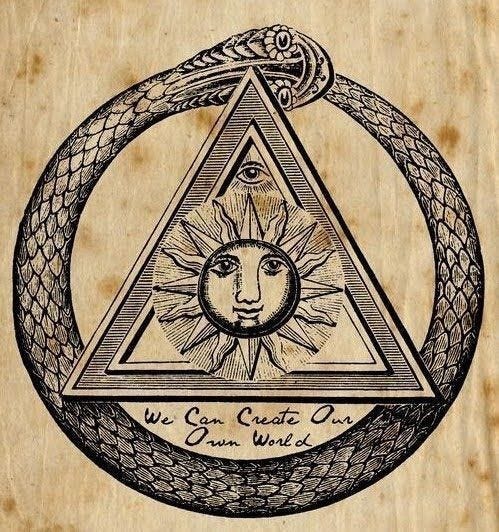
The whole of eternity shall perpetually find itself right back to where it began; time is a flat circle—the eternal recurrence of the same thing, one after another, all lead back to the same whole: the ouroboros of time continuously treads on us, and infringes on everything which we hold sacred and undeniable. Though it is not possible to take back existence, it is possible to still treat yourself as if you mattered within it. This here is the beginning of all yes-saying, of all life affirmation, of all action within a world whose complexity—if actually considered—would halt the whole function of society.
People know, on an intuitive level, whether they’re cut out for thinking or not; I feel most act in accordance with whatever they most immediately desire in the moment of having to act. The instincts of man are strong in the sense that they overpower all other drives, but they are weak in the sense that they are not done out of existential consequence—rather they are made out of debasing conformity; the modern man does nothing which will make him stand out from the crowd, even if it’s something he wishes to do for himself. The self is ostracized from the very beginning of life because it is not something that the present culture wishes to cultivate; it is much easier to control people if they feel subtracted from their individuality, and if they feel so systematically discouraged and weakened that no amount of independent thought on their part could ever amount to anything.
Modernity is a culture of objectification, not individual subjectivity. Everyone today identifies with labels and stereotypes and popular movements rather than moving to the rhythm of their own heart. Individuality is far superior to group identity because you remain free from objectification—there are no other subjects to judge and disenfranchise your own subjectivity, and so, you remain totally dependent only on yourself, and as a result are much closer to your own desires and truth. On an existential, individual scale, this is best; however, because society is not made for an individual alone, the best alternative is the nonsense we have today—boot-licking and kowtowing and stultifying yourself in order to be brought down to the herd’s level, and thus act in accordance with their will (the general will of Rousseau) rather than your will (the subjective will of yourself).
Every “thou shalt” was once an “I will.” What man wills is great; everything he follows that is not from his will is weak and vain. The culture we have today is the most perfect form of egoism possible because it has made egoism a virtue—it encourages greed and a worship of the self-image, but all done selfishly; it’s a complete inversion of Nietzsche’s concept of the rank order, of the aristocratic rebel, of the true Overman.
In the same way morals change with the times, so too do cultures, which move from bronze to silver to gold to bronze again. The capacity within man to overcome the age he’s in is largely a result of how much he can endure the absurdity of living in a manner contradictory to the current mode—that is, how well he can manage himself while among the herd, animals who treat thinking like a weather vane, changing with the wind in order to not fall out of favor.
Camus was absolutely right when he said, “The only way to deal with an unfree world is to become so absolutely free that your very existence is an act of rebellion.” To rebel is to refuse to be an object. It is the rejection of being a mere footnote in history or a tool for power. In this defiance, we affirm a shared human essence that remains untouchable and beyond the reach of those who wish to command it. In every free spirit, there’s an air of liberty so empowering it must be breathed in deeply or its scent will forever be lost. What is great in man is his capacity to move past his desire to know eternity in order to live. While some live without thinking critically, others only think critically and so fail to act at all; but the best are those who are able to think before acting, and thus make peace with themselves by finding the reasons behind their actions beyond will and instinct.