
Evolution
37th installment to my philosophical system.

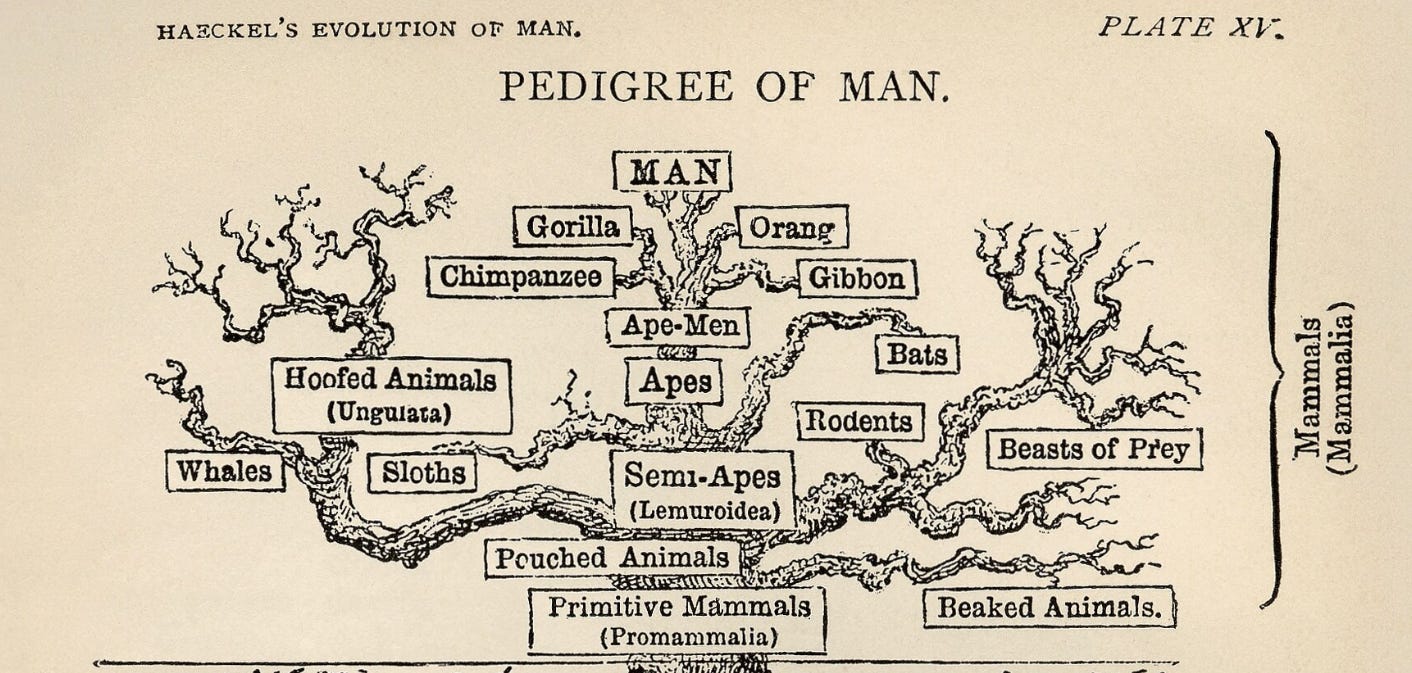
It may be said regarding the fundamental nature of being that evolution is a natural byproduct of it. Certainly, when one passes over the history of thought, one will find that reality has been conceptualized in various contradictory ways which, in the end, somehow all managed to intersect at the same point—as if every idea which man has ever thought, when paired with another idea, follows a kind of parallel postulate, where those two thoughts, when met with another thought and taken to their logical conclusion, find a point of intersection between them.
Every contradiction between opposing ideas is really an evolution in process. The whole flux of being finds itself embodied in the motions which bring it into being. When one is faced with the opposite of what they expected, they immediately look for categories by which to bracket the scenario in order to stave off any troubling thoughts which may result from not comprehending what the actuality is; aren’t we humans so pedantic and fastidious when it comes to avoiding what is painful to us? I, for one, think we have always feared the truth behind evolution because we cannot accept the fact that chaos is ultimately what rules, and order is merely what we cling to out of deference and fear of the unknown.
Our ignorance of the nature of things has always been unwavering and indomitable. What is total and absolute, yes, even unconquerable, is our doubt regarding everything. What has the whole history of intellect been but the nonstop creation and destruction of one paradigm after another—whole wars and genocides waged on behalf of ideas which man believed out of love for what was accepted on faith—faith, one of the strongest of all impulses in man.
I see within humanity the desire to affirm what is final and shun any notion of gradual change and development—especially within the realm of ideas, ideology in particular. If there really were a finality to ideas, there would be no debate; the first thought would have been the last, and everyone would be of the same opinion regarding the nature of the world. What we see, rather, is a constant commotion between competing forces and sects, raging like the ocean when creating a hurricane.
No idea seems applicable to anything which it purports to describe because, in the very act of processing it, it changes for us and is augmented to the point of making it seem completely different, even contradictory, from what it originally was; again, this contradiction is what man fears, for, since Aristotle, it has always seemed like an absurdity to allow for contradiction when thinking logically—as if logic itself were some sort of guarantor of truth and reality. I say no, and no again.
Evolution is feared for the same reason: it cannot be reconciled with man’s predefined categories of what reality is—as if reality were ever reconcilable with man’s notions of it, as if correspondence with reality were all we humans ever considered important. Logic is absurd because it’s upheld by syllogistic strings which are controlled by the desires of man, rather than his reason or rational judgment. “Reason is, and ought only to be the slave of the passions, and can never pretend to any other office than to serve and obey them,” says David Hume; it’s not a surprise, really, when you consider how close to a true skeptic he was—the only modern Pyrrhonic there has been.
Everyone with even a cursory knowledge of what evolution is today may have assumed I would’ve started this explication with Charles Darwin, or perhaps even with Anaximander, but I decided to avoid the scientific approach in favor of the philosophical, not only because considering things philosophically leads to more insight in my experience, but because most have relegated explanation to the scientific on the belief that everything in science is final, and any other interpretation outside of it is somehow absurd or wrong; like I said earlier, it is our desire for finality, and our fear of the unknown, that makes us condemn what we do not instantly perceive or understand. It is my task to show that everything is really evolutionary, because everything is really in flux, contradiction, and dialectical tension.
Evolution, in the scientific sense, refers to nothing more than the gradual accumulation of changes within allele frequencies over many generations due to various factors such as natural selection, mutation, and genetic drift. Now, if I were to leave you only with that, I would suspect you would feel a bit dissatisfied, not only because it’s incomprehensible to anyone who isn’t a biologist or a current student of 9th-grade biology, but because there is no existential content to it—there is nothing in that definition by which to relate to your own experience, aside from the fact that it distantly refers to your own gradual development as a member of the genus Homo.
The evolution I refer to is the evolution of man proper, not man reduced to a hypothesis, sterilized scientifically for the sake of “advancing human knowledge,” or some other platitude that is used to turn man into a diagram or schematic rather than a living and breathing individual with passions and prejudices which are already presupposed from the outset. Every investigation that atomizes man is already wrong in an existential sense, because whatever is concluded from that simplification can only refer to the ideal, not the actual. The actual is what the final cause of every explanation shoots for, and it’s what the principle of sufficient reason ultimately demands from our perception of causality. This issue is deep and profound, perhaps too profound for even a genius to comprehend fully. I know full well that whenever one speaks of the actual, they really only speak of a shadow, because our ignorance only leads us to the certainty of our own doubt, and nothing besides; to think Descartes thought he could base ontology on that rational basis—but he too still assumed reason itself was final, and that it had a teleology as well: asinine!
In the end, all roads lead back to Rousseau for we moderns, because he was the first to turn man into a subject, existentially speaking; and Kant, the great categorizer of concepts, was the first to do the same but philosophically speaking. I mean, where would we be without the great hermit of Königsberg, that enjoyer of long walks and dizzying contemplations; he gave us that undeniable delineation between analytical and synthetic propositions after all, and made them fourfold by the use of a priori and a posteriori considerations of them. I can’t believe a man was capable of showing the bankruptcy of all thought when not taken from the transcendental perspective, and yet still managed to be praised for it by showing what could and could not be predicated about reality: he effectively restarted philosophy in the modern era, and had it finished three decades later in Hegel—a more absurd course of events could not have played out. The late 18th century was very different indeed, for I know no one today who is capable of doing the same: of providing modern man a map of his own ignorance and not be ridiculed for it, or derided as already stating the obvious.
Most of the complexity of life has already been accepted a priori as unchangeable, and so, naturally, every philosophical intellectual today has an air of nihilism about them; I would say it’s a tragic thing, but I think I know too much at present to suspect any other outcome but where we find ourselves today; in a way, I’m even grateful to have been born in the thoroughly depraved and debauched era of history I find myself in, because it allows me to act as a new kind of Kant, or Hegel, or Nietzsche—in order to pave a new way for the future, it is necessary to first change the conception of it in the minds of everyone; everything else follows from that change in perspective.
When I said that every contradiction is really a form of embodied evolution, I was really referring to the Hegelian dialectic—the only tool still left to us moderns that hasn’t been corrupted by ignorance or enslaved to capital. Evolution is really a call for acknowledgment; it is meant to serve as a concept of awakening from which anyone who sees the true nature of reality—the ever-constant flux of change amidst the slow progression of time—can form from that enlightenment a new conception of being human, of existing in the world, of being a being itself, rather than a passive observer of being, as if you were only a body and a brain which you just so happen to be conscious of; no! the spirit of the human soul yearns to be reconnected with the heart, and every sensation that lifts you out of the depths of emptiness (to lose the sense of willing, as Schopenhauer called it) is truly what every action should be geared towards.
Evolution to me is not merely scientific; it is existential—it is the whole universe placed before us as it actually is: from the origins of life on Earth to the nebular hypothesis of solar systems, from extraterrestrial life to even the Big Bang and consciousness; is every mystery in the universe not in some way related back to our existence—we small, insignificant apes, lucky enough to have minds capable of creating knowledge, all for the sake of learning the things which shine above us and move below us?
It is palpably absurd to me to not really investigate life existentially, that is, ethically, emotionally, spiritually, and humanly; every triumph and tragedy on Earth has been like all the world to the one going through it, but in this one, do we not find ourselves? Wouldn’t it be insane, then, to view everything from only your own view, rather than take a perspective which encompasses the whole expanse of existence? Do we not all find ourselves related? Aren’t we all part and particle within the cosmos, one vast universe unto ourselves, capable of seeing within ourselves whole stars which died in order for us to be born? Don’t we all participate within the vast symphony of creation by merely being what we are, existing and inhabiting the world as we evolve through it?
It is very hard not to romanticize life because of how difficult it is to fully enclose it within the realm of concepts which we make for the sake of bypassing the immensity of it. It is for this reason why poetry is really more appropriate for themes which strive to represent totalities rather than singularities; hell, even singularities are infinite, because their inner complexity soars far beyond what man is capable of conceiving. The number of permutations within existence, while theoretically finite, is so absurdly large that, for a human life, it may as well be considered infinite. There is no concept so vast, however, that dialectics (evolution) could not approach it, or at least comprehend it.
The opposition between all ideas only finds grounds in the confusion we create for ourselves with all our self-made categories. Abstraction is the death of realism because it makes it impossible to metaphysically ground objects objectively, given their reliance on the subject; idealism must, therefore, be a necessary component of any serious philosophizing, due to its necessity when considering objects both subjectively and objectively. I find it impossible to even consider the world without the idealistic lens, because there is no matter without the mind, and there is no possible reduction to pure matter from the mere emergence of what is already within the content of perception as such—qualia, in that sense, is really an adjective for Kantian apperception (self-consciousness): subjectivity made integral to the objectivity of sensation, which arises from the interplay between content (phenomenal, empirical, external, objective perception) and synthetic a priori categories (noumenal, transcendental). Unless you’re a Hegelian, or a (dialectical) pragmatist like myself, there is no one who can claim any predicate about reality as real, in an objective sense, or final.
Evolution, as I use it here, demands that we do not seek to know the end, but rather seek to know the path which the end tends towards—if it tends towards anything at all. Within the uncertainty of man’s nature, Descartes—who is rightfully called the father of modern philosophy—tried to turn man into a binary: a mind and body; but from this arose the whole contradictory opposition—a war of false pretense—between the rationalist and empiricist schools of thought. Just like the Reformation before it, the Enlightenment gave rise to many “plausible” interpretations of what the scripture of the world was, but this multiplicity of forms and ideas gave rise to such a cacophony of sects and “rational” systematic treatments of all things under the sun, that half of all learning since then has been filled with prejudice on the one side, and misinterpretation on the other. It is for this reason that Hegel, in my view, can be argued as the last philosopher that ever walked the Earth; for he saw everything as fundamentally confused, and purposefully mischaracterized: the values which we upheld regarding knowledge were wrong, for its telos (end) was assumed from the start, rather than treating the evolution of man’s spirit as an evolution in and of itself, as well as being a continuous thing, unending and always striving; its end was defined before it was even considered, in much the same way a baby is named well before it can walk.
Life is in constant evolution and agitation. Each time we breathe, we are one step closer to the grave, and another second closer to death. Oh, what a great malaise life is; how contradictory it all seems. Existence is like a dream, for each time we consider it, we lose the original intent we had with investigating ourselves. Every time we strive to find what lies at the bottom of life, we discover more material by which to sift through and contemplate in order to come to a point where we can finally say anything solid about it, rather than hide behind the vagaries of abstractions which never touch the solid.
Dear reader, why do you think I keep you constantly in the dark whenever I explain anything that is yet to have an answer for it? It is because there is yet to be a vocabulary sufficient to elucidate existence existentially. I almost feel at times like Kant when he was writing his Critique of Pure Reason; there had yet to be a standard, academic German by which to organize and explicate all of the topics considered (every philosophical treatise prior was in Latin and, in Germany at least, after the manner of Christian Wolff—prolix beyond all conception)—and so, it’s no wonder Kant’s style is perhaps the most impenetrable in all of philosophy (I actually think Hegel is easier once you understand the dialectic, but Kant… he’s in the clouds before he lifts his pen up to write). The more I write, the closer I feel to eventually getting at the heart of the matter. But until then, I must resolve to remain in constant evolution and flux, and be appreciative that I have not gone silently into that good night of ignorance and barbarism which most people feel the need to consign themselves to today.