
Family
67th installment to my philosophical system.

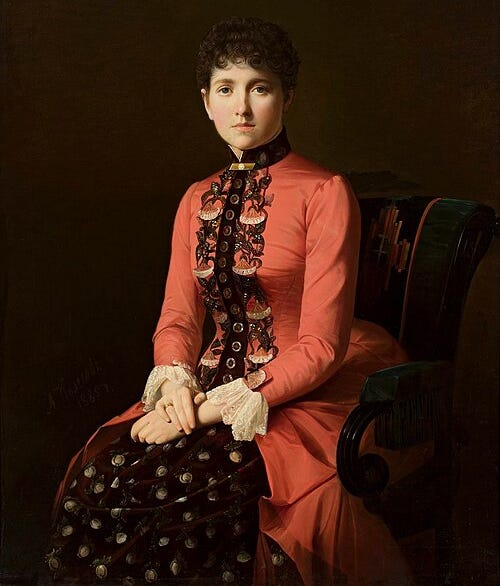
Families are all alike in that their happiness is bound in love, and that their unhappiness is always unique to themselves.
I struggled mightily to come up with that first sentence. I’m utterly perplexed by the subject of this essay, in fact, for the family has always been so intuitive to me as a concept that to feel the need to say anything on it seemed a waste of time. When looking into the history of the family, however, and finding that the origins of it have been of great interest to many people all throughout history—to say nothing of how different the original family units were—I supposed it a subject with more depth than it originally let on.
Families arose originally out of a need to establish a lineage: a map of relations that could reveal who was related to whom—and in the case of tribes, who would take over after the leader died. It was for this reason that many have theorized the first hunter-gatherer tribes were matriarchal rather than patriarchal; you could always tell who the mother of a child was, but not necessarily the father.
When the change took place is hard to date, but many have suggested that once agriculture became integrated into human social organization—and, as a result, led to the creation of civilizations—it was no longer necessary for women to be at the head of the family structure, since men were away from their wives far less—thanks to food being grown rather than hunted for—and thus made paternity more certain. It should also come as no surprise that once men took control, women were considered inferior—and this lasted for millennia, the effects of which we still feel in modern misogyny which, I’m afraid to say, has gained in popularity in the past few years.
To reiterate, the ancients viewed relationships primarily through a genealogical lens. What was important wasn’t love, commitment, fidelity, or even honesty, but strict hierarchy—order, if you will; a kind of order that made it very easy to determine who was to inherit the kingdom after the leader died. More often than not, polygamy was practiced, and this is where every famous internal struggle between households was born—out of an inability to determine who was the true heir to the kingdom.
Notice, too, how I’m speaking strictly in terms of hierarchy, and how I’m making reference primarily to lineage among nobility; that’s because the concept of the family as we know it today arose out of the nobility. The first families were essentially formed out of a desire to create dynasties to rule over the lands in which they lived. This was best seen in Ancient Rome, where famous clans (often claiming descent from mythological figures—such as the Gracchi, Fabii, Decii, Drusii, and Marcelli) would intermarry for the sake of consolidating their power, rather than losing a great portion of it through conflict between them.
Marriage was transactional, and so not established in the same way we have it today—again, it was never about love, but power; it was about maintaining status, keeping peace amongst the powerful, and ensuring the continuation of that power indefinitely. Of course, if that be the goal, it’s all doomed from the start, for power can never be sustained by a single person or family or dynasty alone—rather, power comes and goes in waves, and the more powerful the wave, the further it washes onto the shore, and in so doing leaves a greater mark upon the sand.
The family as it was practiced for most of history, like the monarchical principle, is dead—and thank God for that. It should be noted, too, that most cultures throughout history established families after the manner described above, and we still see hints of its barbarism and primitiveness today. For example, getting married today, at least in a Christian context, still carries with it that barbaric connotation of the daughter being property—to be walked down the aisle by the father in order to offer her up to the husband, and in so doing becoming his property, changing her last name to finalize it (traditionally, anyway). The transactional element never left it—in fact, we cannot help but couch it in financial terms.
Insofar as there is any philosophy in the concept of the family, it is only so existentially. In all honesty, I feel the subject is treated better historically, anthropologically, sociologically, or literarily—especially literarily, because there you could delve into the individual psychologies of each character, and in doing so paint a picture of reality in words.
Authors are the real explainers of humanity, because they tell what people are composed of, rather than merely what they’ve done or wish to do. An author knows how to put into words what can, normally, only be understood through personal experience; the greatest authors, for this reason, are often the best at providing description with philosophical insight—at creating correspondences between the characters and the reader. If the words of a writer do not transport you into the setting or psychology they’re writing about, I would scarce be able to call them one—they’re merely scribblers of nonsense, wasters of ink, idlers in the grove of prose, ramblers without wisdom, etc., etc., etc.
Never trust a writer who’s unable to speak his heart honestly. The death of all good prose is faking the spontaneity of it; in seeking to make it look effortless, you overwork it—creating drafts never to be returned to, going against what the heart calls forth from within—and as a result confuse the various sentiments each sentence is trying to convey, and in doing so make what you say ridiculous and pompous rather than simplistic and natural. If a sentence cannot stand on its own—if it could not be turned into a chapter on the beauty or honesty or truthfulness of it alone (as Laurence Sterne was one to do in his Tristram Shandy)—then it is not worth writing at all.
One should write the first thought which arises in their head; from there, write the next thought down, then the other, and the other—not long after that, you have yourself half a page of truthful ideas: from that point, take the mean of that half-page, and organize it so as to make it appear coherent. The hardest part of writing is being able to do this, however: to reconcile the deliberate (careful, thoughtful, rational, preparatory) aspect of it with the spontaneous (clumsy, extemporaneous, irrational, illogical) aspect of it.
The most common piece of advice given throughout all of history on writing is this: have something to say. In my opinion, it’s very fair advice, but it doesn’t address the actual issue implicit within all composition: how does one find something to say, or, better still, if they have something to say, how do they write it so as to make it accurately reflect what their heart wanted it to be?
You see, the deliberate aspect of writing wants you to be constrained, and to write only what is consistent with the last idea written down; but the spontaneous aspect wants you to write as the thoughts appear, which more often than not are conflicting and do not follow from what you just wrote. With this being the case, what is one to do?
This contradiction can only be overcome by doing a mix of both. One has to think deliberately but write spontaneously. You should organize and edit your writings to make them appear concise and deliberate; but you should write them as if none of that mattered at all. You must do both. It cannot be gotten around. If you try to rationalize it, or come up with reasons to justify it to yourself, you’ll find yourself more in contemplation than in writing.
As I’ve already said, write down the ideas as they come—that is the “have something to say” from earlier—and afterwards concern yourself solely with the style and coherence of it; in doing this, you may find yourself moving whole paragraphs around, or, more painfully, having to delete whole sections because they couldn’t be placed anywhere without ruining the flow—such is the fate of many sentences. Above all, the most important thing is simplicity. The shorter the paragraphs, the better—the same is true with chapters in novels. Brevity is the highest mark of genius in a writer.
Never let the deliberate aspect overtake you, for that always leads to writer’s block. Writer’s block is nothing more than a repression of the spontaneous aspect of writing. In my experience, it’s much better to be possessed by spontaneity than rigidity—you write more as a result, and from that you can at least have something to show for all your efforts, rather than staring at a blank page trying to develop a whole paragraph in your head before putting it to paper. Anyone experienced in writing will agree with me that—whether you write by hand, phone, or keyboard—you normally end up changing what you initially thought you were going to say in the act of writing it out. Notice my phrasing here, “in the act of writing it out”; that exact process is where the deliberate and spontaneous aspects of writing collide, negate, and synthesize each other—it’s there that writing actually gets done.
Personally, whenever I start a composition, I have no idea how it is to start or end. In fact, I don’t even give myself an ending to work toward—rather, I set a timer for three hours and hope at the end I’ve said enough of what I think to be satisfied with it from that point forward. The hardest part is always the first sentence, but from that single idea can come a whole composition—it merely depends on how well you’re able to flow spontaneously with that initial inspiration.
Every writing, like every musical impromptu or extemporaneous oration, is really a leap of faith—a leap into the depths of your conscience which, if you haven’t been there before, you have no idea how to navigate the immensity of. It’s for this reason that most people are utterly dumbfounded by the simplest questions you ask them (questions that aren’t commonplace—small talk—or surface level, that is): they’ve never thought about them, because they normally don’t think about anything that isn’t immediately before them, that doesn’t affect them personally, that doesn’t concern someone they know; most people today are totally superficial, and that’s why their talk is so common, vulgar, lame, boring, unintelligent, incoherent, illogical, confused, and everything else—they don’t think at all about anything outside of their egoism, and so they’re more often than not unable to fully appreciate a genius like Goethe or Emerson—to them, it’s merely words on a page; they read in order to comprehend, not to feel, and such is why they’re so uncultured and desirous of narratives not their own. On this point regarding the masses, Schopenhauer makes the following observation:
Meanwhile, hear what Thomas Hood says of them (Up the Rhine): “For a musical people they are the most noisy I ever met with.” That they are so is not due to their being more prone to making a noise than other people, but to their insensibility, which springs from obtuseness; they are not disturbed by it in reading or thinking, because they do not think; they only smoke, which is their substitute for thought. —On Noise.
Alas, a substitute for thought has always been what the majority secretly want—they’d die before thinking for themselves on any matter, even existential matters that concern them and them alone.
In writing, an author must strive to say only what is true for them, for in that they speak for all mankind. True genius in writing is saying something that could be applied to everyone living today. That’s why the ancients are still so revered today, even though the age in which people read them during their leisure hours is long gone, and probably never returning.
I think we ought to return to the topic of family, however.
Not being so good as to openly show my affection toward my family, my love is very deep for them nonetheless. Though all my misery at present stems from them, so too did my birth, and so, on that account alone, I feel I owe an eternal debt of gratitude.
I’m only as great as I am thanks to my family. I am born from them, and shall die being a descendant of them. I’m quite pleased with how family life seems presently overall, however.
I suppose no family life could be perfect—if all were, where would literature come from?
I find in reflecting upon all my past miseries—again, caused entirely by my family—that, if it weren’t for those experiences, I would not have fallen in love with the things I have, and in that sense would not have come as far as I have with respect to all my interests.
In order to get over all that was done to me, I threw myself entirely at all that was important and necessary for me, and in doing so have become quite competent in many aspects of life which I wanted to be. I know all of it doesn’t seem like much, especially considering my age, but I feel the process of working hard and overcoming my ignorance for the sake of them (my interests) was itself a very necessary aspect of my character development. I owe everything to my family, including the leisure they afford me now to work out my thoughts on every aspect of life, philosophically at least, before actually entering into it. On this account, again, I owe them my very soul.
Though I’m not a family man myself—and at present have no intentions of ever starting one—I do understand that family, for most people, is all they have (all they have as an activity which gives them meaning or a purpose for living, that is)—and so, let the rabble make kids; for Christ’s sake though, raise them yourselves: keep the phone and television away from them for as long as possible; make them love nature; teach them charity, kindness, humility, humbleness, and empathy; and lastly, let them wander through life freely in order that they may discover what they really love in life—and only step in to offer support, guidance, or warning when they’re on the precipice of a bad decision, nothing more, nothing less.