
Fate
44th installment to my philosophical system.

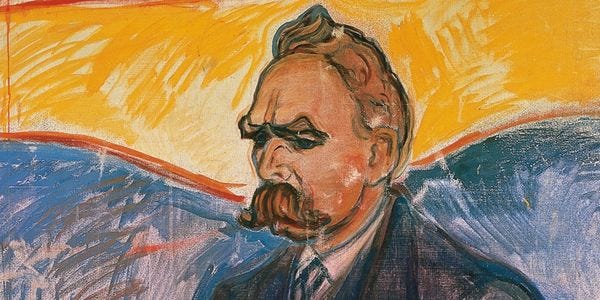
I know my fate. One day my name will be associated with the memory of something tremendous—a crisis without equal on earth, the most profound collision of conscience, a decision that was conjured up against everything that had been believed, demanded, hallowed so far. I am no man, I am dynamite.— Yet for all that, there is nothing in me of a founder of a religion—religions are affairs of the rabble; I find it necessary to wash my hands after I have come into contact with religious people.— I want no “believers”; I think I am too malicious to believe in myself; I never speak to masses.— I have a terrible fear that one day I will be pronounced holy: you will guess why I publish this book before; it shall prevent people from doing mischief with me. —Friedrich Nietzsche, Ecce Homo, Why I Am a Destiny.
Revaluation of all values: that is my formula for an act of supreme self-examination on the part of humanity, become flesh and genius in me. It is my fate that I have to be the first decent human being; that I know myself to stand in opposition to the mendaciousness of millennia.— I was the first to discover the truth by being the first to experience lies as lies—smelling them out.— My genius is in my nostrils. —Ibid.
I am, like every other man who has ever lived, fated to exist in confusion about the world and my place within it.
Within the vast domain of human experience, it necessarily behooves one to make what he will out of what the world provides him in it; but, being so far from his mind as to how all of it connects, man is hung from above and pulled down from below—on all sides is man attacked, mentally and physically, by all the oppressive forces of the world which manifest themselves in his experience as he is fated to come across them as he lives.
All this would seem to make fate, like chance, the ruler of all; and, in truth, it is—for, like chance, fate is that which drops from above without our notice until it has hit us on the head. Depending on its size, we may either receive a lump or be crushed to dust, for the size of fate varies with how large a burden we carry in the world. We may find ourselves high in one moment and low in the next, but the world carries on nonetheless.
This is our fate. We are all condemned to fate in the same way we in life are condemned to death. It’s not such a hard thing once you’ve gotten used to the notion of being nothing—merely one among billions—in a world whose purpose forever eludes us. Rather, one is strengthened at the thought of having only yourself to make use of—but, at the same time, it is a perilous thought: take it too far and you shall find it impossible to act, for, strong in doubt but weak in conviction (firm judgment), you may find yourself contemplating life more than living it, and thus soothe your inaction by calling your sloth a type of action, a great activity even—nonsense, palatable and convincing only to the wooden-headed. Your only real power in the world comes from overcoming what your present values have deemed treacherous.
Fate plays a role in man’s life in the same manner contingency does. Again, fate and chance are synonymous because they are both found in the contingency of life—and they are both thought necessary after the facts of them have played out. Everything can be explained after the fact; what matters is predicting what is to come before—whether it be from past experience, intuition, or sheer chance, all should rightly be considered before ever engaging with it. “… Before undertaking any enterprise, careful preparation must be made,” says Cicero in his De Officiis.
A large part of living life is enduring burdens you would rather not have gone through—nay, would have cursed your very existence for having suffered; it would’ve been better not to be at all than to have suffered misfortunes not brought on your own head by your own hands. Lord knows how much my own fate has given me trials and tribulations which were not my fault, and which I would have taken death over rather than go through. Everything in life is fated to decay and death, but while we live, we make constant justifications for why that means nothing to us, though deep down we know it means more than we give it credit for.
The sheer thought of life—considered existentially, that is—is enough to cause a panic; every post hoc rationalization for it falls flat the moment we recognize fate has other plans; everything comes apart at the seams when we see how life has played us for a fool, and how little control we really have over it. How dreadful is the thought really, truly, honestly? Incomprehensible, terrible, impossible to place in its true frame.
Fate is that which we are forced to face while in the midst of so much overbearing dread; the world antagonizes us each second we live: for the most part, the will to self-preservation, helped a little along by boredom and temporary joy, is responsible for all our commotion and movement—all in vain as far as I see it, but necessary regardless if we are to move beyond it, overcome it even. It is always after the fact that things seem light and easy, but in medias res one cannot help but feel despair at having to live at all; nothing seems worth surviving when misery and suffering is all your lot can afford—how many men and women have lived life only to die from the burden of living it?
I would venture to say nobody’s fate is known whilst they live; only post mortem are the causes realized after all the effects have played out. All this uncertainty has caused man, throughout history, to develop ways of deriving some “certainty” about life while in his infantile innocence regarding the ways of the world; one need only look at the history of divination to see the variety of ways man has devised in order to acquire even a slight premonition regarding his fate: Astrology, Pyromancy, Haruspicy, Palmistry, Augury, Runes, I Ching, Tarot (Cartomancy), Oneiromancy, etc.—the superstitious urge has never really left man, only changed in accordance with the prejudices of his times; one can just as easily place scientism or faith in reason (self-enlightenment) in the same category as tools of divination: the only difference between the two is how they’re justified—one claims evidence while the other claims inspiration. Both, as far as I’m concerned, however, are two ends of the same fragile string—pull too tightly in one direction over the other, and you must give way lest it rip in two.
Reason is simply a type of intuition about knowing—knowing in the existential sense, not in the reductionistic sense of being verified beyond all reasonable doubt, or being deduced from premises that are themselves “infallible”; rather, reasoning for the sake of life, in finding within the multiplicity of things a single overarching principle behind which everything lies, from which everything can be made sense. Aren’t we all after the same thing anyway—truth? Isn’t faith seeking understanding, or reasoning seeking evidence, born from the same impulse which causes man to reflect on his state in the first place? I, for one, have never thought the two should be separated, so long as one knows when they’re speaking syncretically (broadly, without fear of contradiction) and when they’re speaking scientifically (narrowly, with only evident facts on the mind).
In essence, my version of pragmatism is a synthesis of the mystical and scientific; one must have their hands in all the domains of life if they are to comprehend all the antinomies which necessarily arise between the warring presuppositions.
Without empathy, there can be no unity between people—the same is true in the realm of ideas; without it, you get what we have today: an increasingly varied number of specializations and academic disciplines that do not engage with each other at all—thus increasing the amount of specific knowledge but decreasing the amount of interdisciplinary knowledge; all this resulting in a motley of perspectives and worldviews that all cut across each other, while overlapping in some places, but totally without unity or coherence. It is not that domain-specific knowledge is bad—in fact, it is necessary—but when taken to the extreme as it has today, it far exceeds the practical bounds of knowledge’s telos (purpose), and thus makes everyone a specialist unable to do anything outside of their expertise.
To an academic, all this may seem like hogwash, and fair enough—but I’m not in the business of placating Ivy League intellectuals; my goal here (with my philosophy) is to reevaluate modernity on its own terms and return it from a handstand to a normal stance; I’m interested in knowledge for life, in changing the way we consider life: to move from the material to the pragmatic, from a plurality to a unity, from all things being apart to all things being together.
When I look out into the world, all I see is one constantly moving substance—the dialectic itself—not a diverse multitude of different things all vying for attention and opposition without harmony. If a thing is not for life, then it is not for me; every consideration must be human, and must be able to incorporate the heart of man into the investigation of nature as well. To constantly have an antagonism between reductionism and irrationalism is to fruitlessly labor on behalf of two masters, trying to reconcile the unreconcilable; the only synthesis found within this most powerful of negations is that of overlapping them with one dominant framework that incorporates both of them.
There is no light without corresponding darkness, and the same is true regarding our public and private lives; the private life is the intellectual one, while the public life is the pragmatic one—where you sacrifice, though not completely, some personal principle or aspect of your individuality in order to make your way through the world with less headache. This is the dualism which Romanticism has always been plagued with—the battle between the individual and the world—and which men like Goethe, Coleridge, and Emerson have tried to intellectually bridge by imbuing the materialist reductionist approach with subjectivity (in an idealist form)—all while acknowledging the mental anguish this will undoubtedly cause for those who are unable to adopt two contradictory modes of being.
I should mention, also, that I say “intellectually bridge” specifically because it was a particular approach unique to its time and place—to make intellectual what was, prior to the Enlightenment, in the realm of the religious, not the rational; in truth, there have always been men and women who were natural, existential pragmatists—those who didn’t even consider contradiction as something incorrect with respect to thinking, that is, something which was not considered irrational merely because wasn’t arrive at logically—say through some syllogism; some have an innate capacity to transcend their age by conceptualizing it in complete opposition to the norm—or, in other words, to conceive it in a unique way that is wholly their own. If everyone were capable of thinking out for themselves, independently of every other opinion and presupposition, there would be no need for existential philosophy—for everyone’s own wisdom would be enough, and they would rely only on their own understanding and reason from their own first principles on how things are to go with them in life.
That would be as near to a perfect world as I could conceive, for there would be very little in the way of coercion or mass manipulation by bad faith actors who, today, have more power than they’re capable of managing; of course, crime and poor material conditions would persist, but a world in which everyone has enough intelligence to know what is and isn’t for their benefit, as well as knowing the best ways to bring that about (hearing all objections and displaying a practical, dialectical judgment unheard of in the history of humanity), would make Democracy that much stronger and rational: it really is the ideal republic which the founding fathers were hopeful of bringing about; but they were still men of their era, stuck within an aristocratic mentality that strove to have the populace “managed” by their “more enlightened” peers—representatives, in a word—rather than bringing that level of enlightenment (self-consciousness, to use Hegel’s term) to the populace as a whole; this, along with slavery and the lack of suffrage for the majority—which contradicts the whole notion of a Democracy—were the original sins of America which we still wrestle with the implications of today.
America has never had a coherent narrative about what its goals are. Nobody since Thomas Jefferson really has had a comprehensive vision for what role values and individual differences are to play in the context of statecraft: the question really is, and has always been, how are millions of people to be collectively unified given a broad spectrum of individual differences which inform their visions of the future. Jefferson’s ideal was the enlightened, independent subsistence farmer, who owned just enough land to support himself and his family on for the rest of time, all the while enjoying his liberties and inculcating his children with his values; of course, this would never work today, and is lacking very much with respect to domestic policy overall, but it is a vision: a thing which, since Jefferson, has been derided as being impossible, or too ambitious, or too impractical—because one man’s liberty must, in some way, always be at odds with another’s. It is, I feel however, something which needs to be returned, for this nation will not last without a narrative, or project, that bridges all divides—and preserves the union through its unity of ideas.
Of all the things which we are forced to make sense of, life certainly remains the most difficult, not because it cannot be suppressed with concepts but because it cannot be overcome with concepts alone. All the prevailing notions that have to do with life are decadent, for they do not deal with life existentially, but rather only concern the material basis of its affections. The solution is, as already expressed, one where fate is taken hold of in the palm of our hands and made into something tangible through our correspondence with it, done between our mental world and the material world which we are surrounded by.
Fate must always be like the boulder which Sisyphus pushed if we are to think of it as something which we are in continuous opposition to, rather than as something which we are beholden to and which we must accept in order to progress honestly through the world. Fate is not our friend, but nor is it our enemy; we must accept the powers that be at first if we are to overcome them later. We must remain strong, and in doing so carve a path that is our own—a powerful one that we can be happy to walk through after paving it over with our experience.