
Hourglass Prose
A Trial in Composition—Written in an Hour

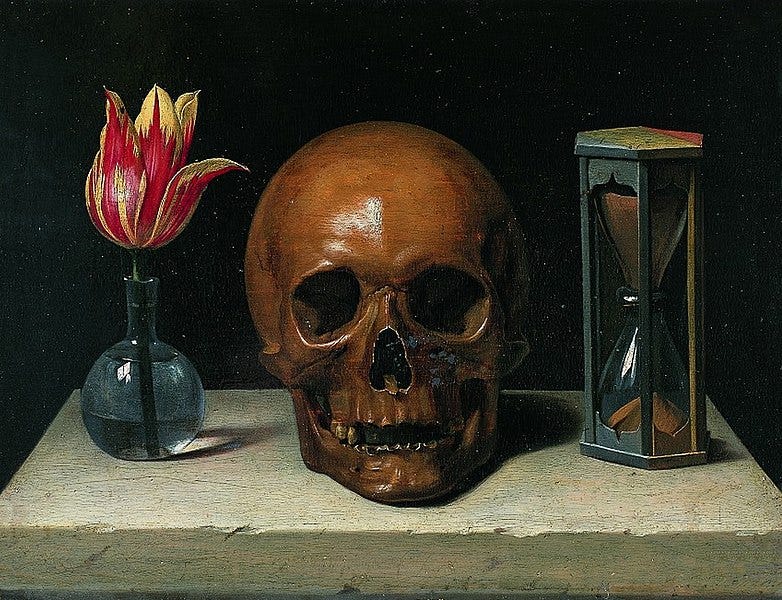
This is a test, a test against insomnia. I make myself more and more abject and dejected the more I refrain from writing what is true to me, what I think is true for others, and what should be expressed and heard by all. Is not this solitariness and silence within the dark the most sought-after thing for writers? Certainly for poets, for they find themselves in their heads or in nature, always contemplating upon that darker aspect of them—always seeking, but never seeming to find.
But for the true writers (novel writers)—Dostoevsky, Tolstoy, Melville, etc.—there seems to me a necessary change in scenery whenever they write; their thoughts reflect what they see, and what they see is impacted by what they surround themselves with. There are more insights within the acquiescence of one's own will than in what the prejudices of others say regarding what our will is.
Nature restores man, makes clear to him all that is worthwhile, and causes him to think only what he finds within himself. The true cause of man is the power of facing himself bluntly and wrestling with all the self-doubts that pervade his mind. Man transcends the boundaries of mere reflection when the reflection be upon himself; for what becomes of his thoughts after a deep enough look at them—nothing but the conscious awareness that he shall never burrow far enough into the depths of his being to comprehend the tangles and corridors of his soul.
My scenery is myself, my thoughts pertain to myself, and are initially only interesting to me. If I manage to capture someone with the truth I speak here, then peace be upon them—if not, peace upon them too, for not all my sentences are capable of resonating with everyone; although I think that should be a thing much to be strived for by writers—to make every thought, no matter how trivial, awaken a sense of awareness and appreciation for life in the reader. If I could empower but one person with these here scribbles, I would have been successful at my task.
The poet draws on analogies, the sensation of experience, the true embodiment of life as lived—looking for whatever combination of words allows for the deepest contrast, the most exquisite use of verbals, the most harmonious melody of speech. They care not for scenery—scenery to them is a distraction that fails to capture their feeling alone; they are able to write without its aid, their only aid is their reflections upon the initial thought.
The novel writer conforms himself to the scenery he places his character in. If it is a dark setting, his thoughts become dark. If it be in a forest—while the sun’s rays reflect beautifully off the newly dewed grass—then the expression sings and smells of pine cone and burnt wood. On a beach, sounds of shores as waves continuously move in and out, crashing about wildly but beautifully simultaneously. Near a pond, echoes of skipped rocks, moss on trees, buzzing bees, the soaring eagle’s screech, and the brown bear's roar.
Lastly, in a solitary room (a room for one's own), filled to the brim with books, half-crumpled pages are strewn about the floor as the writer crosses out various sections from a worthless draft; a draft which, at the time of penning it, he thought the greatest piece of writing ever scribbled. But now, as he reflects on it with a mind not in the clouds but hard to the ground, he realizes just how meretricious it really is.
Often is a writer’s judgment impaired by the entering of a flow state, a state which is so short-lived and temporary that anything written while under its influence seems like gold. The more one writes under such a state, the more one finds it harder to relinquish the most obviously paltry sentences. In writing, the unwritten word is better than the written one.
Brevity, while good in all things, is greatest in writing: the pithier the sentences, the more refined the diction, the shorter the paragraphs, and the faster the plot is progressed are all things that one should seek in their writing.
“How does one develop such an approach?” I hear you ask. Simple—read what is good (the classics preferably, the best prose stylists and poets the world has seen), and you shall naturally adopt that style. Just as children acquire their native tongue through enough interactions and examples of phrases and words used in particular contexts, so too does the writer acquire their style from whatever authors they read consistently.
You are the average of the five people you spend your time most with, says the common adage, and I will say the same is true of the five authors you read most. Study the construction of every worthwhile sentence—a sentence that struck your heart, caused pause, and reveled in deep reflection; the sentence that epitomized for you a sentiment or feeling you exactly felt before.
Often is one struck more by an aphorism rather than a paragraph, because aphorisms are wise, free, open, life-filled, and energetic. They excite within the reader an appreciation for the grand and elegant; an air of refinement comes upon them, and they desire from that point forward only the phrases that make reference to the soul—those words that liven up the soul, agitate the spirit, and rouse the mind to noble ruminations are the best to be penned.
As Erasmus noted so long ago, style should only conform to the purposes of the subject. Any style that hinders the author's thought is a style that should be avoided. Let the author decide what subject to write upon first, and after that, let all the ideas put forth be for the sake of said subject. Let all ideas be truthful—constrained by no rubric aside from the one within your heart—and all that is written should be worthy of being read.
What a read, I've gone over it twice and I just unravel more and more. Genuinely, delicious and resonating writing.