
Hypothesis
15th installment to my philosophical system.

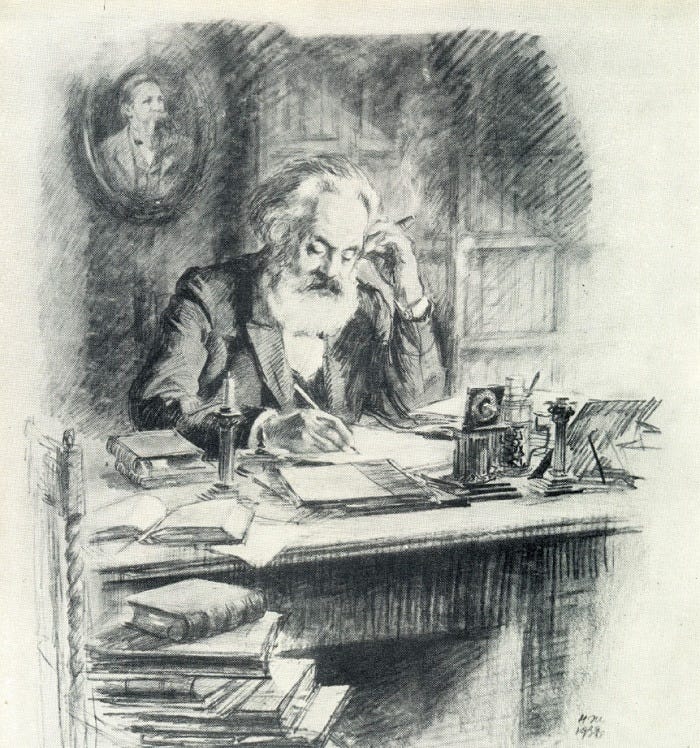
Everyone lives after their own hypothesis. The world is filled with thoughts about things—things of a trivial nature, which bear no significance outside of their recognition within our own brain. The home of every thought is the brain, and reality makes itself known to us through the labors of our minds to give some coherence to every uncorroborated fact of experience.
What a strange capacity it is: to make the world not after our own image, but after the image we are forced to take from all the material that surrounds us. The conditions of man are prior to him; but man, being vain and wanting so desperately to cling to that which makes him feel unique, places himself above those very conditions which bear him out.
The world molds us, and we, after having the breath of nature breathed into us, break free from it like a mummy from its wraps—only to reveal that which we are: flesh, blood, and bone. It has been a continuous mistake throughout intellectual history to assume this or that thing as true so long as it conforms to some criteria of truth which we ourselves are unsure of, but which we assume to be so because our reason has told us it is so. The thinking man today is too sure of himself, too scared to affirm that which he cannot know with certainty. Push off against that which you cannot brush up against, and you will find you move backwards anyway.
The materiality of things strikes us as certain enough, and these sensations should be enough to build whole castles out of—not in the clouds but upon soil and Earth, upon that which is actual and really tangible. It is a pragmatic decision, and for me that is enough to build off of, and to drive towards change in the world as such.
Change is that which happens as a result of man’s desire to see things brought about which differ from the present state of things. Change begins as a concept in the mind, but only after strength has been exerted, and our hands have moved a great distance, do we gradually see what was once in our minds made visible with our eyes; the actuality of change is made so thanks to the potential in man to bring it about.
Everything in the realm of man is an abstraction from himself. The objects of experience lie outside him, and yet they are equally a part of him in his experience. How could anything be differentiated were it not for man knowing what is not from him in the concrete? Here, man is amazed at the sight of everything different from him, and thus, he begins to philosophize—in the midst of wonder does he find it suitable to give himself free rein to assume everything which is not his own. From his own experience does man posit reality, and from its shared validity with others does a coherent picture of things gradually take form.
Like I said at the start, the world is filled with many thoughts, many opinions and ideas, which people hold to without realizing it. And so, philosophy is born out of our experience of things without our full cognition of them, and every explanation offered up as to what lies behind this experience has always ever been a hypothesis. Alas, we come back to the main topic. What is a hypothesis? As every schoolboy knows, it is “an educated guess,” but more specifically, “an assumption about some natural phenomenon which can be proved wrong through experiment.” Ah, but what is an experiment? A test of experience; or rather, an experience made specific, made scientific, made in a deliberately narrow way so as to remove all extraneous variables within a study. At once do we understand what is being said: it is the modern scientific method in all its glory; with all its independent and dependent variables, randomized control trials, and double-blind experiments—removing all biases for the sake of “accuracy” and “precision”.
The will to truth is strong here. The pragmatic nature of the whole enterprise is enough to make me faint in awe. It is, without doubt, the single most effective method for disproving claims about reality; but as I sit here ruminating upon all its benefits, I find that it has no answers to any questions that pertain to human experience as such. Man can never find himself in the scientific method, for like logic, it only reveals what is so within the limits of reason—what is tested for within the parameters of the study. Science, for that reason, can never hold a candle to literature or philosophy when asked, for example, “what is the meaning of life,” or “to what end should this be pursued,” or “what is the good life.” Science only probes into those things which fall neatly within conceptions which are falsifiable, and for this reason it is pragmatism (from an empirical-analytical standpoint) taken to its logical conclusion. From this exact line of reasoning, you get the famous dictum of Wittgenstein: “Whereof one cannot speak, thereof one must be silent.” The problem is that, as pragmatic as it sounds, nobody can actually follow through with this; for if someone truly felt their words failed to capture the meaning of their utterance, they would go the rest of their life without saying a word. It is pragmatism taken so far it becomes anti-pragmatic.
All that is concrete melts into the abstract the moment it is made a dogma. To justify its own sovereignty, it must develop reasons which lie outside of the initial experience. It is reason gone berserk. Such a thing could only ever come from reason, for reason turns the concrete into the abstract, and pats itself on the back for having made an objective perception into a subjective definition. There is your hypothesis for you: a compilation of prejudices which over time develop into sickly habits of thought, which are so persistent and ingrained that breaking out of them requires an entire revaluation of every mental scheme you have—an impossible task for most people. Indeed, the masses go about their reckless way serenely, and fall into every pit the world lays before them thanks to their conceptions of everything.
Everyone is absorbed into this or that pragmatic mode of thought, but does not see the deeper revelation that lies behind every first impression. We are all slaves to our minds, but we are also the liberators of ourselves, provided we change when the time calls for it. The key to every happy life is found in the heart, but is prevented from being grasped thanks to our brain’s over-correcting with undeveloped logic what it feels is false. This is the false habit of the modern world: to use reason where it shouldn’t be, and to treat reason as inherently better, or more appropriate, in every situation than feeling. This is yet another paradox of life. (It should be noted, too, that paradoxes only arise when a problem is viewed from the wrong perspective, and when a single approach is treated as best in general for a problem whose solution it continuously evades because it cannot be generalized.)
Every idea has its negation. The negative aspect of all thought approaches its initial positivity when it is taken to its logical conclusion. If the Sun were to represent the absolute unity of all ideas, then Earth would represent every particular idea whose revolution goes around and comes around until it eventually reaches the point where it initially was after enough time—in the context of ideas, after it has been taken to its logical conclusion over time. I get the sense that Hegel saw the true unity of all ideas (a concept beautifully argued for by Schelling) as fundamentally flawed, because it did not account for the evolution of ideas, the gradual change and development of sentiments within the heart, the ever-changing material conditions that follow events in the world, and the constantly willing and desiring nature of man to move beyond that which he is presently accustomed to.
Ideas must be dialectical if they are to persist through time and mature fully. The sign of a bad thinker is one who holds to a rigid system out of its “coherence” or “logical necessity.” Necessity! Please, don’t make me laugh. To even affirm a necessity is to define it in such a way that it cannot be anything else but a necessity. Every predicate is really the presupposition of its subject; it exists for the subject—like the rest of reality—and so, it hardens itself against outside influence for the sake of preserving its own internal purity. We see this kind of systemic decay and systematic collapse within almost every conception of Western thought, for the simple fact that most Westerners are caught between an eternal false dichotomy—either left or right, blue or red, coherent or incoherent, in short, true or false. Truth is a value. It is something which happens to an idea, born out of whether it advanced your particular goal or not. To hold to a doctrine about the consistency of an idea is exactly what you do if you wish to make it into a dogma. The dialectic of this line of reasoning is all too clear. It plays out first as tragedy, then as farce.
All of logic is a mirage, a charade, a phantom which appears before us like a genie released from its bottle in a cloud of smoke; likewise are hypotheses, assumed without reason and defended against all reason—it is a difficult thing to even talk of things in the positive sense when their negation is ever-present, and which makes a contemplative man shudder at the thought of affirming that which he doesn’t actually believe in; to speak of those things which are not agreed to, or assumed by, or even hinted at in the thought of a person, is to enter into a battlefield you are woefully unprepared for.
All arguments for one position over any other are necessarily false, for they demand that the “rules of discourse”—this unwritten guidebook which all must adhere to for no reason whatsoever—are followed, and that arguments are argued for on their terms. Every true debate is really one of presuppositions. Hegel knew this, which is why he explicitly made the thing-in-itself an aspect of his dialectical method—the method which reveals “the truth” in its application to reason—rather than in some Platonic idea which is “out there” but which can never be known “in this world”; to say nothing of the barefaced absurdity of materialism, with its obviously false assumptions and general agnosticism—those who preface everything they say with “maybe” or “perhaps,” as if the world needed your educated guess as to what really occurred, rather than your personal, independent explanation as to the nature of things as they appeared before you. What the dialectic ultimately allows for is true freedom.
Thinking requires a pragmatic, ethical emancipation, from which every thought is liberated from the chains of consistency or coherence. All things are coherent if none are—and that is precisely what I would like to see more of; for the world, to me, has always been a mirror of man’s hopes and dreams, rather than his rational conceptions of virtue and the good life. It is for that reason that I find in Marx the greatest system of hope and freedom possible, even if I disagree ultimately on the validity of his premises.
The premises from which we begin are not arbitrary ones, not dogmas, but real premises from which abstraction can only be made in the imagination. They are the real individuals, their activity and the material conditions under which they live, both those which they find already existing and those produced by their activity. These premises can thus be verified in a purely empirical way.
The first premise of all human history is, of course, the existence of living human individuals.
—The German Ideology, 1845, First Premises of Materialist Method.
And so we have it. The great Marx, in all his materialistic glory, providing us a premise which we are to take wholesale, provided we are materialists as he. It is amusing to note that this “self-evident” assumption falls prey to every folly that falls upon idealistic assumptions—it affirms that which is known in experience, but which cannot be justified in its experience outside of its sheer existence: as if being itself were a kind of starting point from which all systems stem. All of modern philosophy bears the sins of Descartes heavily; if only his cogito (I think) were really an arbitror (I suppose).
As much as I hate to say it, Marx is the true dogmatist; while Hegel only supposes the absolute to eventually reveal itself in the process of reasoning and self-realization, Marx—desiring to change the world, and to place humanity in a much brighter, higher light—felt the only way to do so was to affirm the material ground of all things in order to overcome that exact materiality, so that the proletariat (and humanity in general) may prosper as a result of recognizing their own power, and realizing what the true future ends in: FREEDOM!—in the inevitable change of the world via the labor of the working class, freeing themselves from the thankless job of working under deplorable conditions for the sake of their subsistence, all the while producing surplus value for their capitalist employers—who love nothing more than to see their profits rise, and to see their workmen desperate, tired, and without other options.
In many ways, I sympathize with Marx, for I too want to emancipate the world from the fetters of capital. Nietzsche said in his Wahnbriefe (Madness Letters) that, “I am just having all anti-Semites shot.” And one would have loved to see added to that, “… and all capitalists and union busters too.” Marx’s objective is the right one, but he approached it from the wrong philosophical perspective, I think. Then again, I suppose it is not fair to criticize a dead man, a genius, and without doubt the most influential philosopher who has ever lived; Marx also wasn’t just a man of theory (like myself), but a true comrade and patriot for the cause of liberty: he lived in poverty for the sake of studying the economic system which dominates and manipulates the way in which we conceive the world; he donated a third of his father’s inheritance to arm Belgian workers who were planning revolutionary action; and he wrote pamphlets like Wage Labour and Capital to “… wish to be understood by the workers.” I almost envy how honest and forthright Marx was with his intellectual objective. While I disagree with his presuppositional materialism, I cannot agree more with the subject which he strove his whole life to explicate, and in a very elegant and readable German prose which is to be the envy of philosophers and economists alike, who tend to write as if they spent their whole life in books, rather than in actual life—the life of the working class, to which I would assume all my readers belong.
I know full well that at the start I set out to discuss the hypothesis proper, but like with all my other essays, it devolved into a hodgepodge of static scribbles and half-developed ideas, but I suppose the nature of the subject is to blame rather than myself; for while I like to think of myself as an extraordinary writer, I—and possibly no one thus far in history—have ever been able to make dialectical thinking seem intelligible to one not already initiated into our obscure ways of thinking: of culling from every facet of life this or that experience with its own objectification in view, an experience which views its end as its own end—for itself.
Dialectics, which is the method Marx used in his analysis of capital, is the hypothesis which has no conclusion, for the continuous search for “truth,” alongside the continuous process of refining our assumptions, is very much the spirit which dialectics follows through and through.
Who I’m against primarily (philosophically) are formalists, or system builders, who, the second they make their premises known, strive to explain everything from them. Marx, like Kant, Hegel, and Feuerbach before him, were all philosophical architects; they were spinsters, the fabric of which they spun being ideas—their own ideas—which they developed and clung to for the sake of their sanity; none of them was ever bold enough to affirm the world in spite of it not having any metaphysical ground to speak of.
I know I’m repeating myself at this point, but I feel it must be said: I can’t get over how scared philosophers are to affirm reality should their conceptions of it be groundless. What does this silly superstition do for you? What do you think will happen to you should you be bold enough to assert, “I do not know, but I will act anyway!” Think pragmatically, but not so pragmatically that you discard thinking altogether. Great men like Marx and Hegel still cling to the notion of correspondence—that their internal (subjective) ideas must, in some way, refer back to their external (objective) experience. I see no need at all for this. Do I make myself ridiculous in affirming such a proposition—a proposition which I cannot justify no matter how greatly I wished to? So be it. I admit it there in full: I do not know, I have no hypothesis by which to get at the nature of this experience; but I shall act in spite of my ignorance pragmatically, and see whether my action in some way advanced whatever goal I had in mind in the first place.
Let me make myself as clear as possible. I believe with Marx that the only change possible in the world presently is change done through deliberate action, in our shared material reality, in order that the current material conditions which subjugate and impoverish all of us may be overcome collectively. I see no teleology to this, for I don’t believe it is a necessary outcome of our material conditions that man will free himself from capitalism—and in doing so break the manacle which his labor helped to produce—but rather that man must: 1) understand his present conditions, 2) contemplate the future which he wants to live in, 3) develop a plan for overcoming the present conditions to bring about that future (through much study of economics, history, philosophy, and literature), and finally, 4) ACT!
If true unity is to be achieved, it is to be done so on the collective backs of the proletariat. Unity is the recognition that man is both a single individual and part of a collective struggle for true freedom—freedom from all false ideas and dishonest narratives which are manufactured and delivered to us for the sake of keeping us down. The owners and controllers of globalized financialized capital (OCGFC) would quake in their boots if the whole human race were to see past the false veil which they place over our heads. They think we’re all stupid because we accept the contracts they provide us for the sake of our subsistence, but we’ll show them all soon enough I believe. I know how unlikely that seems considering the world presently is passive rather than active (there isn’t nearly as much fervor as there was during Marx’s age, where a workers uprising was happening seemingly every other year), but that is, I feel, actually a dangerous thing for the bourgeoisie—for the pressure is only increasing, and instead of having multiple small revolts, you’re begging for a full-scale revolution of the working class worldwide.
The bourgeoisie has stripped of its halo every occupation hitherto honoured and looked up to with reverent awe. It has converted the physician, the lawyer, the priest, the poet, the man of science, into its paid wage labourers. —Communist Manifesto.
If this is to be overcome, we must as a whole of humanity come together and reduce to atoms every vicious hypothesis which seeks to justify inequality and exploitation. The 21st century should not resort to 1st-century power dynamics and social stratification for the sake of saving those responsible for our oppression. Work itself is violence against man, for—like in dishonest argumentation—it presupposes a fair playing field, but is really rigged from the start; but, upon agreeing, you seemingly forfeit all chances you have of actually rejecting what you agreed to: all the terms are deliberately vague so as to make you go against your word should you make a capitulation to it. This is the malaise of the modern world—the haze whose noxious fumes have suffocated us completely, and have impaired our capacity to think properly with respect to it. We are (supposedly) modern, civilized human beings. Let us start treating each other likewise.
Freedom does not consist in any dreamt-of independence from natural laws, but in the knowledge of these laws, and in the possibility this gives of systematically making them work towards definite ends. — Engels, Anti-Dühring (1877).