
Infinity
45th installment to my philosophical system.

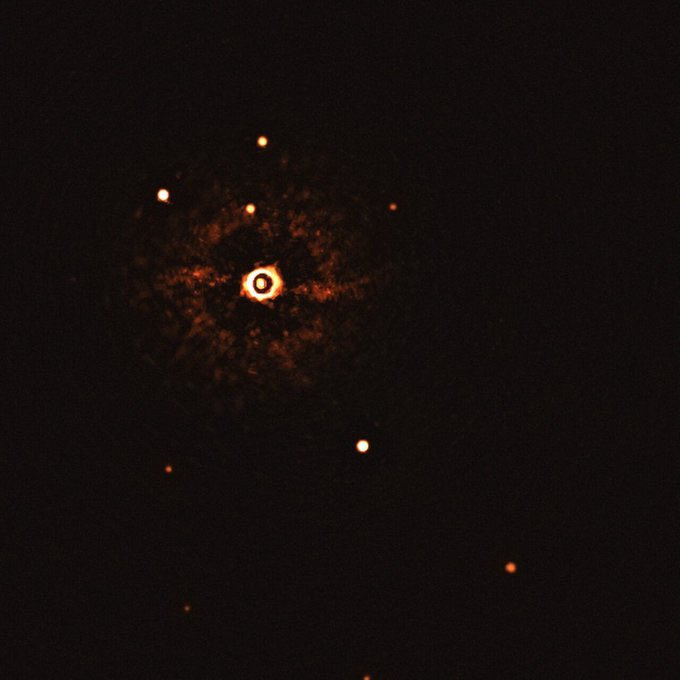
My life is an infinity. The world is grey and the void that surrounds it is black.
If the pages of my existence were to somehow be bound into a single folio volume, it would be the most depressing reading imaginable. I cannot think of anything more ridiculous than an author who obsesses over their past thoughts, and yet, I find myself to be exactly that kind of ridiculous individual. I am absurd. My life is everything and nothing to me. All this experience—to what end or purpose? Ah, that is just it: the question of purpose, of telos, of meaning, of definition, of line, circle, square, triangle, angle, value—in short, life… all this and then some, all for what? If life were a theorem, we would find its incompleteness the only Q.E.D. imaginable.
What is infinity, after all, but the one aspect of metaphysics which every metaphysician has written on, but in writing has said very little. Life is an infinity. This endless sea of corroborating experience is enough to make the present seem like all there is; and, if we are to speak metaphysically, we can say that is true, for what remains after a moment is simply that which was, and no longer is. All this talk of discovering something mysterious that lies hidden behind the great magnitude of infinity is nothing but wishful thinking. Man only presumes to know a thing when his heart is touched regarding it; otherwise, his own opinion will be enough for him, and the words of other men are to be treated as mere background noise.
Infinity is that concept which contains everything but which explains nothing. God is infinite, life is infinite, love is infinite, energy is finite—and conserved; but what does any of this have to do with the individual? I only feel a sense of infinity because of how overwhelming the sensations of life truly are. If there is one overarching theme running throughout my entire corpus, it is that everything which we say and think regarding the world is merely our attempt to manage its infinity. In the same way Newton developed the concept of limits (“ultimate ratios,” as he called them) to explain how quantities over finite time converge to a definite value, we philosophers and contemplators of life—we wanderers and shadow seekers, we dwellers in the dark, we free spirits, we artists, we writers, we pessimists and nihilists, etc.—develop our systems of thought and modes of expression out of the infinite abyss which we find in every aspect of life. The death and decay which override all, the sickly constitution of even the most lively of beings, the sheer immensity of our ignorance regarding ourselves—let alone the whole world we inhabit—all this and then some points to the ineffable and numinous (I dare say spiritual or ethical) aspects of being which we cannot comprehend, yet which we feel drawn to, and contemplate nonetheless.
Existence is not a collection of static parts, but a relentless convergence; when the distance between two entities diminishes toward the infinitesimal, they are ultimately rendered one and the same. This is not a union of harmony, but a dissolution through motion. Just as a line is merely a point that has lost its stillness, and a solid is but the ghost of a shifting surface, our reality is “generated” only through the agitation of a constant flux. We are rooted in a nature that abhors the permanent; like time itself, we are a “genesis” that exists only by moving, mirroring a physical world that finds its “truth” not in being, but in the inevitable equality of the void.
We are all made to pause when we reflect on what the world truly is. For all our insights and assumptions about life, we find the most impossible infinity to explain within it is ourselves. This temporary consciousness is the seed of all our experience, and the root of all our miseries. One burden in life after another piles on top of each other like the bodies in a mass grave, and we are forced to shovel over all of them nonetheless—that is, until they rise like zombies and return to us, the living, and make us part of their endless search for death.
Burdens are better than any other thing at making us wish for death; the infinity of life meets with a staggering discontinuity, or singularity, when you remember the fact that all this infiniteness finds its finiteness in death. Death: the end of all our woes, the great return into the dark—but this dark is not of ignorance, but of nothing whatsoever, as all things should be.
When one looks upon the history of the Earth and considers the eons which have passed in total lifelessness, only for single-celled organisms to suddenly appear as confusedly as they did—and from this generating every creature that has ever lived—one finds it a shame that this great journey which we call life was merely the byproduct of some random process. A process which just so happened to spontaneously create life after so many millennia of nothingness; the polymerization of molecules, and specifically the deoxyribonucleic catastrophe which has given rise to all cellular life—though man (Homo sapiens) is the only one consciously aware of it all—has been, perhaps, the most unfortunate event in all of history. But I think I’ve said enough regarding the misfortunes of all this infinity…—or have I?
Whenever one feels compelled to write—when they feel it is the only alternative to the rope, and so, speak their heart out of necessity rather than compulsion—you find that all of misery is born differently, but suffered identically. In this, you would think that every honest interpreter of themself would find they return to every theme which their heart feels, and this is exactly what happens; one can never truly be unique in literature, because everything which the heart brings forth has already been done by another, perhaps with more sensitivity and understanding than you; one merely reformulates what has already been said in order to make a variation upon it.
The dialectic of writing is this: one responds to the world, and in doing so says or writes many things which the world has already heard before—but because it is couched in the language of modernity, and very much a representative of the zeitgeist as a whole, it is praised by its contemporaries for its aptness and integrity to the modern condition. Of course, there were writers who were more prescient in this regard than others (Emerson, Nietzsche, Marx, Dostoevsky, Freud, Shestov, Kafka, etc.), but overall, everything written since about 1800 has come to pass, and has revealed itself to be a total repudiation of everything the human spirit cares about.
This infinity I can never escape. The moment one finds themselves in the “backrooms,” they feel a complete and total ominousness unwavering in its deleterious effects upon the soul of man; everything is crushing, and no amount of repetition can ever equal the size of this infinity which we are talking about—the infinity of life. Infinity is so large, in fact, that mathematicians deal with levels of infinity that transcend our normal understanding of what that means. There are levels to infinity: potential, actual, countable, uncountable, cardinal, etc.—there are even dimensions higher than our current 3-manifold: the fourth dimension of time, the tenth dimension of superstring theory, the eleventh dimension of M-theory, and the twelfth dimension of F-theory; theory after theory, infinity after infinity—but where does man find himself in all this talk of cosmic superstructures? This is what I was talking about earlier: man would unify the whole universe before he finds unity within himself. This is the scariness, indeed omnipotence, of infinity. There is nothing within man capable of staving off the undeniability of his own internal emptiness. Man’s life is a balancing act, stretched out along an infinite line dangling over an abyss equally as infinite.
Mankind is a rope fastened between animal and Overman—a rope over an abyss, a dangerous crossing, a dangerous on-the-way, a dangerous looking back, a dangerous shuddering and standing still. What is great in man is that he is a bridge and not an end. What is lovable about man is that he is a crossing over and a going under. I love those who do not know how to live unless by going under, for they are the ones who cross over. I love the great despisers because they are the great venerators and arrows of longing for the other shore. I love those who do not first seek behind the stars for a reason to go under and be a sacrifice, who instead sacrifice themselves for the earth so that the earth may one day become the Overman’s. I love the one who lives in order to know and who wants to know so that one day the Overman may live, and so he wants his going under. I love the one who works and invents in order to build a house for the Overman and to prepare earth, animals, and plants for him, for thus he wants his going under. —Friedrich Nietzsche, Thus Spoke Zarathustra (Section 4).
A going-over and a going-under! This is the infinite act of self-assurance, an act done only because the alternative is no action at all—and how disturbing it is to live life without at least striving to act and become something in it. I love those who act without a goal, who make up everything as they go along, who know what they want but also know it will never be within their powers to achieve—and yet they yearn anyway, work anyway, suffer anyway, endure anyway, and overcome anyway. My life is very much like that. My writings are very much like that. My soul and spirit are very much like that. I am one with this whole infinity and make my destiny out of everything which I feel within it. I do not know, and know I will never know, and yet I still yearn to know; I have never been able to live my life without first attempting to know—without that, what is the point of this crude barbarity which we call existence?
If I cannot give my heart to everything it yearns for, I cannot feel a reason to live. I must exhaust the desire to live intellectually if I am to feel satisfied enough to enter the world existentially. A large part of man’s misery today is his inability to find the time and energy to sit by himself, in a room of his own, and rummage (in his mind) through everything which has made him—which the world has done to him. We are, in fact, what the world does to us; and every human countenance bears the marks of its humanity: in how deeply their wrinkles appear, in how smart they are, in how healthy they are, in how sick they are, in how evil they are, in how merciful and kind they are—in short, in everything which they are. The eyes are the window to the soul which see every infinity, and none have reached the “undiscovered country” which all this talk of infinity really refers to.
Everything said about life must really be repeated and repeated till repetition itself has had enough. The dialectic must always find its center of gravity in the conduct of life and must never veer too far from its intended course, lest it fly off tangentially to the direction it originally intended. All concepts really return to infinity because every idea, as Plato thought, is a mere imitation of a higher realm, a world of forms, which must substantiate this one. The truth of this claim is irrelevant, as is every claim that tries to factualize life. All that one should really concern themselves with is whatever their heart is focused on in the moment of living. Everything else is folly.
It is impossible for most to conceive of life existentially—that is why those who do pursue this path are derided as crazy or foolish, vain or ambitious; the herd condemns what they do not understand and despise those who live after their own heart rather than following along with the majority. The majority live lives of quiet desperation, and that is something I wish to avoid at all cost; if I must live desperately and struggle mightily to even feed myself, then let me do so on my own terms, in my own way, after my own heart. Time and time again, I am renewed with a new lust for life by remembering how short my time truly is and how little all my material worries really are overall.
I mind not the times but the eternities (infinities); my mind is the keystone of my temple, without which the whole edifice should collapse. I must die before I live dishonestly, or dishonor my dignity, or act unfaithfully to myself. I must tarry with infinity until I’ve managed a sizeable portion of its totality. I must say everything I’ve wanted to before I can act on what is necessary in the world. I must think until I have thought the last thought and have said my piece on everything which concerns my existence. All this is what infinity demands—a total sacrifice of yourself to it, until you’re lucky enough to break free from it and no longer feel controlled by its domineering presence.
These thoughts you read now were born from a suffering unimaginable for most; and this is why I can never stop writing, why I can never stop living—I must see where all this suffering and infinity leads. If I didn’t care and thought as most do today, there would be no reason for me to philosophize, no reason to discover what I myself think about everything; things for me would simply boil down to a process of observation and inductive inference—I would be nothing more than an automaton made for the purpose of persisting selfishly in the world; a completely boring existence, which is why I find it abhorrent, and why I think it necessary to denounce as thoroughly as I could.
Anyone who bothers with getting about in the world will find that most of our actions scarcely offer any existential reflection. Most of my life was lived mutely, in total anonymity, without the slightest glance from anyone except my family and few friends. People always baffled me, because they never seemed to deeply concern themselves with life proper; life for them was gagner sa vie—a task which one pursues only to earn a living at the end of it; this narrative never sat right with my soul, in the same way the question of God never sat right in my mind.
Everything today is done without feeling because life today isn’t meant to be felt, except in moments where hedonism is engaged with in order to forget the pain of living; most people today are so diseased and sickly, they actually presume themselves to be healthy; this is a world-wide pandemic of the brain, the malfeasance of which is so severe my generation (Gen Z) is performing cognitively lower than the previous one—a trend with scarce any example in recent history.
It is embarrassing to even endure life at times as an intellectual today, because you’re constantly surrounded by Besserwisser (know-it-alls) who are really the most ignorant people humanity has had the misfortune of producing. Only a cursory glance at what these people’s dreams are will be all the proof you need to know regarding how backwards, narrow-minded, and staggeringly stupid the vast majority of mankind is. They have no concept of infinity and do not want the capacity to even contemplate it, because if it doesn’t aid them materially, they want none of it; hence comes all their pride and vanity and nonsense about their independence of mind, which is really a justification on their behalf to remain as ignorant as possible on everything that doesn’t concern them personally—egoism abounds, and the world shudders at the thought of being led by such baboons, ignorant men and women whose intelligence borders on the bovine.