
Introduction
This is the Introduction to my new philosophical system. I will periodically upload each new section to it as I write it - as if it were a serial publication.

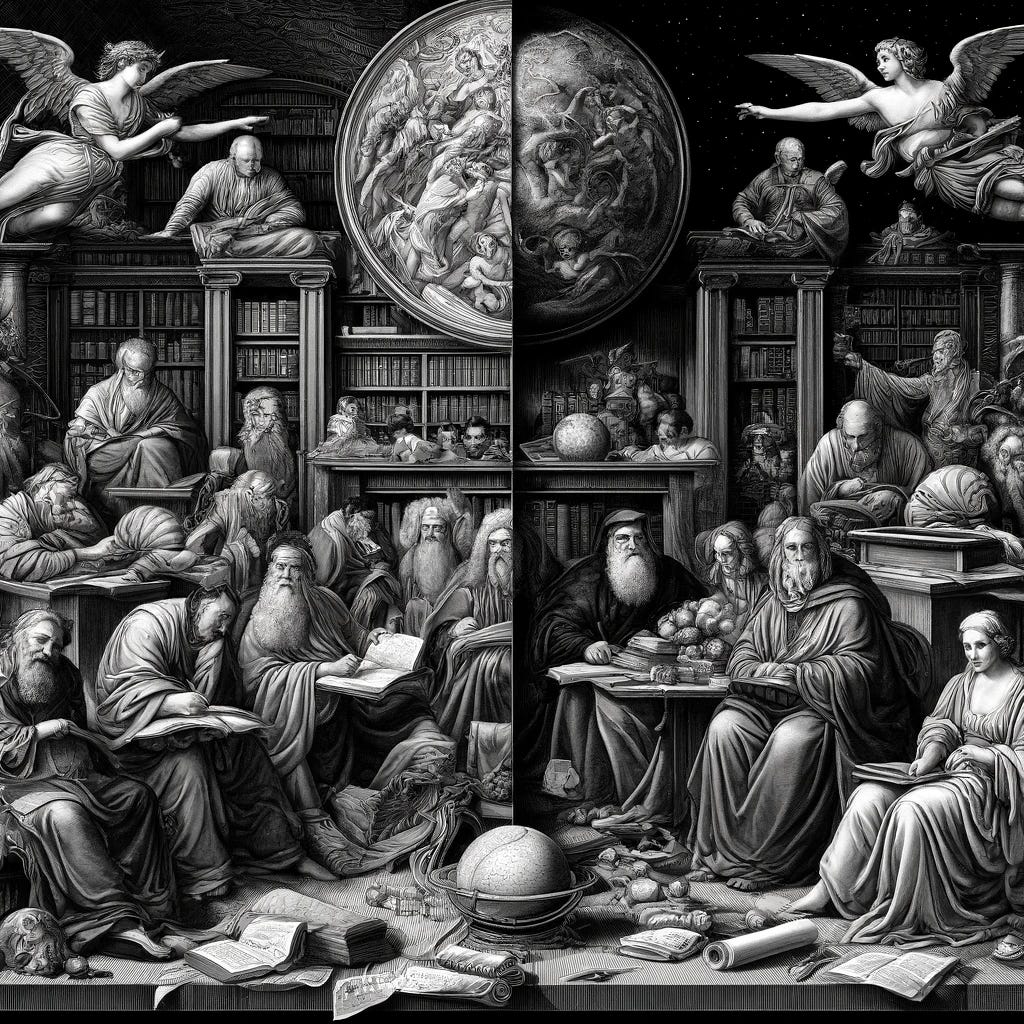
If man could make himself clear to others (and himself) at all times, philosophy would be unnecessary. It would merely be enough for him to say what he thinks in the immediate moment and go about the rest of his day completely oblivious to the magnificent phrase he just uttered. That is not the world we inhabit, however. What we are on this rock is a bunch of ignorant bunglers of the most sublime and exquisite existence we have.
It pains me to even write these words. It pains me to see all the time I dedicated to the study of existence—of misery, depression, madness, anxiety, subsistence, murder, crudeness, intolerance, prejudice, cant, and other worthy adjectives from the language of despondency—made small by the fact of its own finiteness, its inevitable end, its death. If such a thing could not last forever—if I could not put into a single immortal phrase the whole schematic procession of life—then all would be for naught. If I cannot view man in his immortality, to treat him as a line or circle in Euclid’s Geometry as Spinoza did, then to what end does man even attempt clarity with himself?
In studying and preparing as much as I have for this work, I have found that nearly every philosopher before me has treated existence with contempt. The whole of intellectual history has seemingly been a story of neglect. It’s as if man has only studied what was outside him, but never looked at what lies within him. “What lies within him,” you say with contempt. “Yes! What lies in man is something which has been ignored for far too long!”
The eternal conception of existence has made men of genius throughout history quake in their boots, for none—save perhaps Kierkegaard and Nietzsche—have truly wrestled with the inner essence of themselves. This is precisely why it seems so unfathomable, so incomprehensible, yet so near to us that we know it instinctually.
However, this instinctual knowing is precisely our very misfortune, for in our essence is what appears eternal, yet simultaneously it is consigned to dust and decay. Hence my lament at the start. If this clarity cannot be eternal, why should one even bother with existence in the first place?
It already seems evident that I’m embarking on a journey whose destination is constantly moving, and which the winds are constantly stalling our advancement. It’s with a heavy heart, then, that I begin nonetheless, in spite of my own lack of self-clarity, for if I should have waited for the moment when my mind was transparent to itself, and the eternal was looked upon in the same manner Moses looked upon God, this work would have only been completed on my deathbed.
I suppose that would have been a fitting ending, and perhaps the only true, correct ending—for the common man only recognizes the significance of his life as he enters terminal lucidity—but I am no common man, and I have enough faith and integrity in the innate genius within man to assume that my readers are not of common stock either. In fact, to even contemplate such a subject suggests an abnormal capacity of reflection. Nobody reading this is, in that sense, truly common. If you’ll allow me to hazard a guess, the title was what first caught your eye, and since you made it this far into this meretricious introduction, I can only assume you are a free spirit like myself: a true seeker of deep and esoteric things, a great wanderer in the forest of life, and perhaps even someone so distraught at the contemplations of life that you’d rather read the life of another man than your own great existence.
I understand you completely, you great soul, you. This here is a work of love. A love in the journey. A love in the seeking. A love in the understanding. And a love in the tripping and failing and overcoming of every complex facet of our existence, our shared humanity. All this which you see before you is the quintessence of both profundae valles et opacae sylvae (deep valleys and shady woods). Indeed, the work’s subtitle should really be A Journey Through Deep Valleys and Shady Woods, for I cannot conceive of a better analogy for existentialism than a stroll through a world enveloped in complete darkness and covered in massive trees.
It should be stated clearly at the outset that this work will be of little consolation or help to anyone seeking eternal answers, for life offers none. What all these words are to me should be interpreted by you as merely my representations, phantoms which guide but do not fully illuminate. Oh yes, they are completely useless in providing comfort—rather, they only serve to keep up the illusion that you’re getting anywhere, when in fact you’re in a padded room, raving mad, spazzing about on the floor in a muzzle and straightjacket. Such are the inevitable shortcomings of words. They merely imitate the mind, but do not give it relief. Resembling life in every way, their meaning vanishes as soon as they are no longer thought.
It would’ve been useful if God made me both talented and a genius, but alas, I was fated to only have half of each, and now must make do in piecing these ill-fitted objects together.
My whole life has been one preoccupation after another, concerning myself with everything that was nonessential to life, so as to avoid the hard task of actually apprehending it, and placing it before myself as judge so as to confer on it some kind of direction, even if it be inside an obviously illusory and fallen world. Since taking my first breath, I’ve had my mind on everything except life. And what a vain little fool I became for it; and what vexation I suffered for it; and with such delight did I relish in ignoring it!
Ah, I went my reckless way serenely, completely ignorant of all the struggle that was to come, and all the study I would have to undertake as a result, and all the wisdom I would later gain—far beyond my years—and all the melancholy that all that would eventually result in.
What I offer in this tome is nothing but myself: my story and my experiences, from which I have gained much insight and a peculiar faculty with language, so as to inform others of it. What I plan on providing the world in it is a new kind of philosophizing. A philosophizing which only a few have understood and implemented themselves, but who never sought to make it accessible to the masses.
I love existence. I love philosophizing about existence. In truth, that may be the only valid definition of what existentialism is: a person who loves philosophizing about existence—the only philosophical label I stand by. I want nothing more than to offer my knowledge and experience to the world, and in doing so provide the reader with not only a new perspective but an entirely new outlook on life; as well as equipping them with the tools, or rather, thought processes, which allow them to create their own upliftment, their own edification, and ultimately, their own wisdom.
You see, every philosopher up until me has only categorized the world; the point, however, is to essentialize it. I want to offer a systematically unsystematic system of philosophy, that is, to take the concept of a thing and make it the very essence of experience—or, put more succinctly, to make existence itself subject to the individual’s goals and ambitions rather than left to the whims of chance and open to violence from this cruel, external reality—which is merely the shell and not the kernel. Every philosopher before me—even Heidegger—has merely taken existence as given, which, to me, is equivalent to blaspheming the Holy Spirit, the one sin never to be forgiven.
What I ultimately want to do is produce a work so concise and elegant, so clear in exposition and enjoyable in style, yet so masterfully maieutic and deeply dialectical, that, for the rest of time afterwards, all will read this work with profit and pleasure. Indeed, I go further: I want this work to be so well written that I never have to write anything again, for all after it will appear like straw. It is not uncommon in history for great minds to embark on great journeys for which they are later shattered on the rocks—I have Nietzsche particularly in mind; but who in history before me has ever willingly embarked on a journey in which they don’t even know what the destination is? Nay, in that they willingly change the destination every second! I was the first. I am the first! It is my fate to be mankind’s first sacrificial scholar—to give my life to the cause of its own existence. My goal is to make everything so simple even its simplicity is baffling.
The only person who even slightly approaches me in this respect is Kierkegaard, and even then it’s a false comparison, for he ultimately had some end goal with all his silly pseudonyms; he even had plans of obtaining a livelihood, an occupation! A countryside priest, of all things! I, on the other hand, have no one—in fact, never had anyone—and must wander my way through the abyss without light. Even if I had the illumination of truth, Minerva’s torch, it would still be all for naught, for that light would still fail to enlighten my spirit. Enlightenment itself is a funny thing, for it never occurs to anyone the significance of that simple fact: that the outline of a figure is completely blackened the moment it eclipses its source. My source is the world, and my figure is my own. You see, I’m an abyss to myself, and so is everyone else to themselves, and it is in precisely this obscurity of the self—this wretched shadow of ignorance which follows us eternally—which I seek to rectify for all humanity, even if it cost me. The Spanish were right in calling man’s life a shadow—la vida es sombra—and Calderón rightly said,
“¿Qué es la vida? Un frenesí. / ¿Qué es la vida? Una ilusión, / una sombra, una ficción, / y el mayor bien es pequeño…”
(”What is life? A frenzy. / What is life? An illusion, / a shadow, a fiction, / and the greatest good is small…”)
Doesn’t one get the sense that life being a shadow could just as easily be said of knowledge regarding ourselves? We are what we are, and our shadow is what we represent when the light of truth attempts to illuminate us, but in turn only further darkens us. I find life itself the most fascinating thing! Whether it has an answer or not is irrelevant to me, for the search itself is all that matters, and whether it leads to disappointment or not does not imply its uselessness; in fact, disappointment lies at the bottom of truth’s well, for everything we do is saturated with it.
The journey is the important thing, not the destination; and life epitomizes a journey whose destination is never known until death itself. Death, however, has never been a satisfying answer for me. There lay my every fortune and misfortune. Such further questioning is what distinguished me from the common, from my contemporaries in particular—who were all too apt to accept the common maxim (which we all took as self-evident at one point or another): death is not the option, it’s the solution. It takes a nihilist to know a nihilist; and I’m fortunate enough to have encountered a wide enough range of ideas regarding eudaimonology that I can ultimately say with Goethe (who effectively dispels any idea of nihilism): Willst du dich des Lebens freuen, so mußt der Welt du Wert verleihen (If you want to enjoy life, you must give the world value). Wert verleihen—“to give value”—completely stops nihilism from ever taking root in the heart of man. Nihilism is the absence of all value… but to give a thing value? Ah, that there is the ultimate objective, the one goal by which we all must strive every second of every day to achieve.
Man, in order to become comprehensible, must first become subjective, and make his essence synonymous with his goal, his desire, his will. Man must live after his own understanding, and turn his eye towards every aspect of existence so as not to be frightened by the utter misery that lay at the core of it; indeed, that misery was the sole object which Schopenhauer’s philosophy revolved around; and Nietzsche predicated his entire philosophy of becoming and overcoming on misery. But more on misery later, for to go too much into it at the start would taint the rest of the work with a foreboding, tempestuous aspect.
I now wish to go into the essence of this work proper. In a single idea, this entire work can be described as a dialectician’s subjective perception of thrownness into the world. I have always wanted to make the clear more obscure, and the more obscure clear. Indeed, following Nietzsche, I deliberately write to be misunderstood; in so doing, I have always held out the hope of digging down to the bedrock of existence, from which my dialectical shovel could dig no further. It has always confused me why men have made the starting point of all their investigations reason—and facts of the matter—when life ultimately eludes any such analysis. The whole Enlightenment can be described as a wicked obsession with analysis and reductionism of the vulgar kind, from which axioms are proved and assumptions are borne out in investigations, but true solutions to the problems of life forever remained unsolved.
I return to this point: everyone before me has merely objectified existence and approached it from a structuralist, positivist perspective—where the fundamental presupposition is that of understanding the whole only in light of all its constituent parts; when, in truth, all parts can be further subdivided into greater and greater parts, from which nothing can be deduced but that it goes deeper than the mind can fathom. Where reason ends, there humanity begins; and where humanity begins, there progress lies. Man likes to think of himself as the guarantor of truth, so long as he remains a slave to reality as conception—that is, a slave to his concepts of reality rather than embodied actions stemming from his response to reality—but he will find that analysis without synthesis is empty, and synthesis without wisdom is vain.
What does it mean to be such a being with such a capacity of apperception? In every vain explanation for some causal structure to the motives of man, we consistently find that we are forever barred to what lies beyond the metaphysical horizon of our own capacities. It helps us not. All explanations are vain. The task, therefore, of the dialectician—which is really what I wish everyone to become in the process of reading this tome—is to explore the hidden and nonexistent in thought, for in reaching out to that which is incomprehensible will provide the necessary foundation from which one can think about life.
The only presupposition I assume you to hold throughout this work is that life has no objective solution to its innumerable problems, only vague narratives and unjustifiable expositions that relate to it. The only prerequisite I demand of you is to be able to read English.
The story of my preparation for this work will be revealed soon enough, but I feel it is here necessary to go into my primary influences which helped put this labor into motion. First and foremost being Schopenhauer, who was so influential on me, in fact, that the title and organizational structure bear the stamp of his influence. Next will undoubtedly be Kierkegaard, whose prose spirit I more or less write with at present. Hegel unquestionably takes the next spot, for his progressive development of the absolute idea as manifest in spirit totally changed the way I conceived existence as such. Nietzsche comes next, for he was the sole person responsible for annihilating my ill-conceived notions of what culture, knowledge, and existence were—all of which I had formerly adopted out of foolish custom and unhappy prejudice; the rock, so to say, of my cultural foundation was overturned, and thus I had to start off from scratch with a new set of values devised from my own encounters with existence, later to be manifested in my actions, thoughts, and ideas of the world—all of which I hope to present in their full glory. Last but not least is a man dear to my soul, and who taught me the true meaning of the term spirit: Ralph Waldo Emerson; this mighty titan of America, who so profoundly presents a life of self-reliance and amiable self-reflection that anyone with a heart yearning for encouragement and strength may find in every word of his the totality of transcendental meaning; my approach to thinking is, without question, nothing more than a mirror held up to the spirit of Emerson, in which I view the whole of existence as a divine substance made manifest in the conscious and unconscious representations of man. Without these men, I am nothing, and without their guidance, I would be nothing.
Everyone needs a narrative to place reality into so as to make comprehensible the sheer absurdities and confused representations of life. In fact, my philosophy here presented is nothing but life distilled to its bare essentials, from which the genius (my readers) may construct their own narrative for life—a type of life-view, or world perspective, from the stance of a single individual, that allows them to move a bit easier through the world. The world is a mess, and society organized as it is does little to address the existential components of it. Again, modern man is more automaton than rational beast, and it shows in his continuous deference to facts and logic—his reasonable deductions from empirical observations—as if these things were the true determiners of man’s happiness and fulfillment. Everyone today treats reason as a surrogate to existence, when in reality it is a poor propaedeutic—a nonsensical introduction to what should really be taught through embodied action and untrammeled sensibility, limited by wisdom and past experience only. Reason is like Charon of Greek mythology fame, who is tasked with transporting the souls of the dead across the River Styx to the realm of Hades; where in this analogy the souls of the dead represent our rational conceptions of life, and Hades itself is the place all our vain ideas go—a hellish repose in the fire and brimstone of indolence and idle regretfulness. Nothing is to come of any rational judgement but another question which pushes further back the ultimate solution we sought.
You see, dear reader, everything returns back to myself. I have to be the one for which everything is made either high or low, in accordance with my goals or intentions. Such is the essence of my radical, new philosophy: dialectical pragmatism. And there it is at once, the nova cogitans (new thoughts) which I hope to use, apply, and expound in every facet of existence. As I said earlier, however, such a project is bound to end in tears, for existence itself is too broad a topic by which to subjugate to concepts and ideas alone. No man, it is true, has achieved, perhaps, a tenth of the whole experiential realm of reality. All philosophers have done is relegate aspects of reality to concepts, and treat analysis as the highest peak of this conceptual framework; but again, nothing could be further from the truth of experience; for man, as Dostoevsky said, is not a mere piano key, but rather, as Kierkegaard suggested, a complete human being, with an incomparable capacity to comprehend, and an innate, almost supernatural ability to develop narratives and create upbuilding—upliftment and eternal striving—for themselves personally. The saving grace of humanity is in that artistic aspect, where the creative faculties are employed and new conceptions are developed which give a new light to past experience. So long as we are limited by language, however, concepts and ideas will have to be the poor translations we make use of in conceptualizing our personal journeys and life experiences.
Everything in life is an imitation of nature. Being human almost necessitates a particular kind of socialization—a poor social construct—from which we develop and become shaped and molded by. This is both our greatest strength and weakness; for on the one hand we have persisted throughout the ages because of our cooperative nature and innate capacity to help others in need; while at the same time being forced to confront the continuous contradictions we face when we, as individuals, must tolerate, to some extent, the annoying actions of others—which we interpret as hurtful to our own persons. This is what analysis ignores, for it cannot be reduced to an excitation or stimulus response. It is, rather, a complicated interaction of perceptions and interpretations which can only be viewed from their whole aspect, and which can only be understood afterwards, but must be confronted presently. That’s the most annoying aspect of existence: that we must rely on our memory of past experience for a situation we assume is most similar to it, when in reality the causes of this situation are nowhere near identical to the past one. In that sense, all is a false assumption that we pragmatically assume is most like it for the sake of taking action at all. But that very idea—of assuming similarity in reality where it is objectively lacking—is precisely the perspective that everyone must adopt if they are to bypass any perceived existential threat to their well-being.
No one in grief is consoled by making grief itself an object of investigation; but existence as such is so immense, and its aspects of experience nearly infinite, that to consider all things in light of its immensity lessens the magnitude of a direct experience merely by relating it to the concept that subsumes it. The nature of dialectic is just that: being able to perceive in a singular experience the whole of reality that rests behind it. Recall that the journey that constantly moves every second, and the winds which prevent our further progress forward, are both aspects of this singular whole; in this thought, all misery fades into nothingness, for we find ourselves corresponding to the universal as a whole, and are placed that much higher along the great scala intellectus (ladder of the Intellect), as our minds are filled with the complete immensity of reality, and we are comforted by our own awareness of our not knowing. It is in not knowing that we find our full knowing. Our whole perceptual apparatus then is shifted towards the infinite, the allegorical, the creative, the narrative, from which we find our hope not in potential answers, but in knowing that there is no final answer! If there be no final answer, there may as well be infinite answers! And infinite answers are what are necessary when confronting reality as such; for in this sea of infinity, a whole life-narrative rises from the foam like the birth of Venus.
If it could not be infinite, then all would be for naught; but since life is so vast, and unhinged in its vices and potential absurdities, it can only be presented to us as infinite; in which our intellects carve out the narrowest of narrow slices, and this little film (this slice) of experience we call the whole of our existence. Mirabile dictu, with all of life’s endless variety and complexity, it necessarily follows that all attempts to explain it—every foray into this question there has ever been—has only ever been like that of the blind man leading the blind! In the land of the blind the one-eyed man is king, and likewise regarding life, in the land of the reductionist the subjectivist is king.
Existence must be approached and understood subjectively. Life is lived forwards but understood backwards; and in the heart of everyman lies the hope that there is a potential reason for his coming into being, his forwardly lived reality; but, being dissuaded that there is any objectivity to his narrative, he either becomes a nihilist, a skeptic, a reductionist materialist (physicalist they like to be called today), a believer, a mystic, a syncretist, a spiritualist, a theosophist, a metaphysician, an occultist, a politician, or some kind of idealist or pragmatist. All such systems, whose purposes are to provide our life some order, some definite courses to follow, are nothing but subjective stances that we adopt for our comfort out of our own irrational reasons.
As I said at the very beginning: I am a dialectician—a dialectical pragmatist. I am a subjectivist, sensationalist, irrationalist, immoralist, Nietzschean, transcendentalist. Reality and me are not too different, for my mind constructs reality as it appears to me, and I do all I can to analyze and synthesize it using my incomparable skills in deductions and dialectic. I could ask for nothing more, for I am fully content in this eternal not knowing. So long as reality remains a consistent representation, not perceiving the noumenal aspect to it—should it even exist (which I do not think)—I shall forever be satisfied. It is enough. It is enough! For me, for my existence, and everything I love and cherish in it, it will be enough if I could endlessly make my life a commentary on every facet of it—a commentary so exhaustive and comprehensive, as well as elegant and enjoyable, that all who read it will be enlightened.
My goal is enlightenment! I wish to be enlightened, and wish to provide my fellow genius wanderers with the lamp of my experience, from which every light ray bears the impression of my past; a past filled with many wonders and excellent precepts, from which the whole species may look at and say: “This here is a man who has thought deeply about life.” Ah, to think deeply about life: to be, in the end, an existentialist—that is my greatest calling. To make my life a work of art, a creative experience, a grand event which calls out and rings across the entire globe: that is truly great!
If this introduction has done anything, let it serve the reader in giving them a sense of the kind of human being I am, the kind of thinker I have made myself, the type of individual I wish to be, and the man I have ultimately striven to become. If anything struck the reader as either absurd or contradictory, I urge them to lay the book aside forever, and leave it unread, for there is nothing but absurdity and contradiction in every analysis of existence I offer. However, if there were sentiments in my prose which struck a chord, even a minor one, in your heart, dear reader, I desire nothing more from you than a complete enjoyment in all I have said about life:—and I hope that my words and ideas have not only served as edification for your upbuilding but, more importantly, given you a method to develop your own lens by which to view this world we both inhabit and have a deep affection for.
What shall flow from this introduction is a coherent narrative—a complete existentialistic encyclopedia—from which anyone curious about the questions of existence may turn through this tome and find page after page of personal, subjective conceptions, which may serve as a foundation from which they (the reader) may build off of. Do not treat this book as the end of all investigations on life—for life is too large to contain its totality in a single tome—but rather as the stepping-off point from which future generations may find in it all that one could reasonably desire to know regarding their very existence.
In its structure, Schopenhauer’s The World as Will and Representation was followed almost to the letter—breaking the most important aspects of reality into epistemic, metaphysical, aesthetic, and ethical reflections; alongside a personal section called Self-Reflections, which is really meant to be a kind of autobiography and history of this project as told through my life. The topics chosen were those which I personally thought constituted the most important for existence, and which one would want to know about in regard to themselves. In its exposition, or style rather, I followed myself, but drew heavily from Schopenhauer—for his brevity and elegance—, Kierkegaard—for his stylistic approach to the dialectic—, Nietzsche—for his bombast and vivacity—, and Hegel—for his prolix but deeply informative introspection.
This here has been my attempt to sound the alarm, so to say, for the entire world—for a new philosophical system, an entirely new approach, is upon its doorstep, and will not take no for an answer.
You have an incredible mind.