
Judgment
20th installment to my philosophical system.

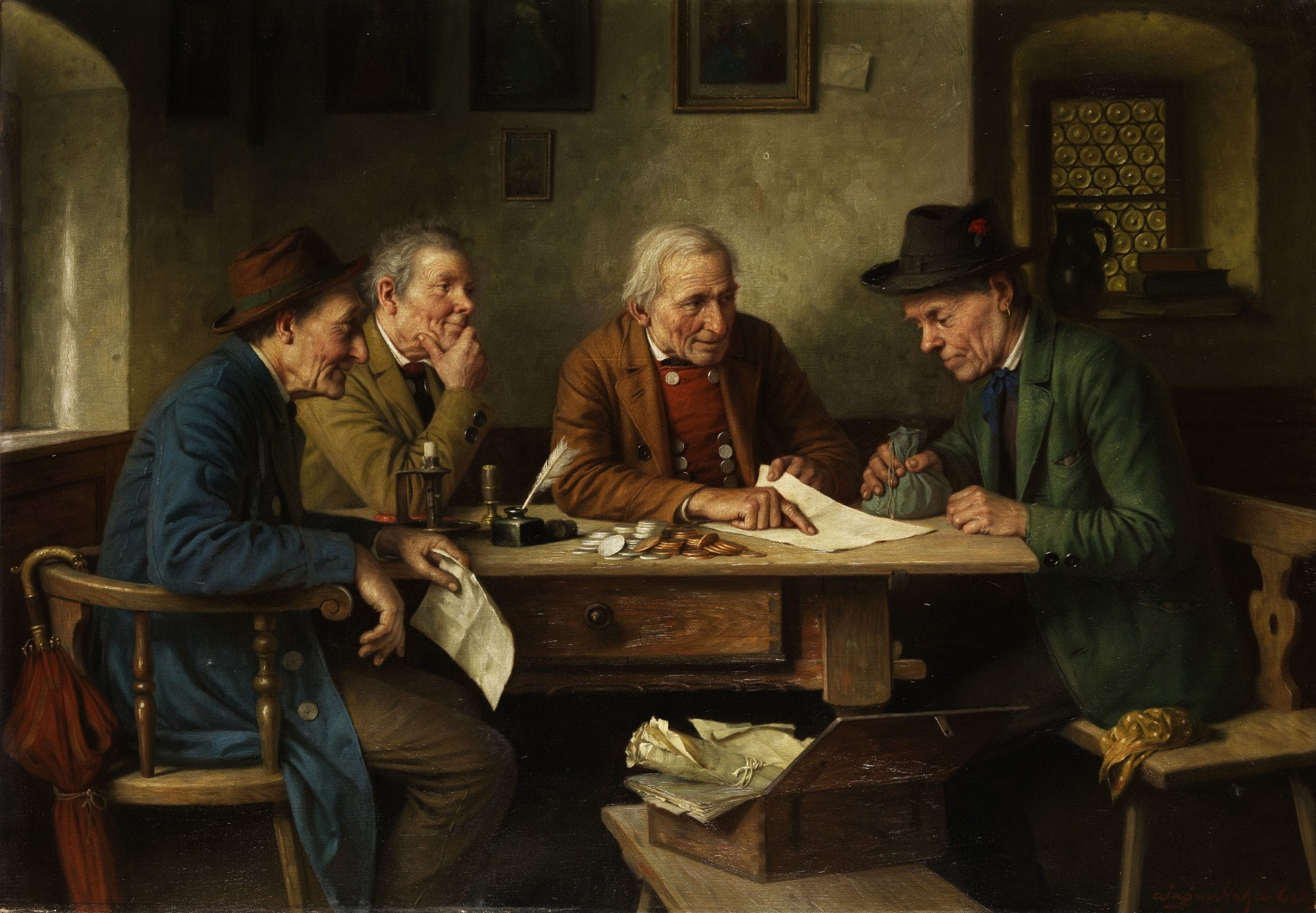
Kant has written a critique on the practical judgments of mankind, but I should like to write a dirge on them, for I find so often man kowtowing to principles and conceptions which he does not understand, yet which he feels enslaved to for the sake of consistency or conformity with the rest of society.
Judgment is an aspect of man’s mind in the same way his fingers are an aspect of his hands. What we have in judgment is nothing more than reason being placed in the ascendant when an experience within the world necessitates deliberation. Judgment is reason personified in the rational faculty, and it takes hold of man whenever he is confronted by that which is not an immediate threat to him, but which causes him to consider and reconsider nonetheless.
Every organism thinks as it lives, but not every organism is capable of judgment; in truth, judgment—born directly from reason and found in the mind as a capacity within it—is a direct byproduct of existence and can only be had in those creatures whose brains are sufficiently developed to abstract ideas (conceptions) from experience, and in cognizing these ideas, perform an action that coincides with the initial thought deliberated upon. One cannot live without formulating conceptions of the world. Esse est percipi, et vivere est experiri (to be is to be perceived, and to live is to experience).
The only difference between man and microbe in this respect is the degree to which this reality is conceived. To the microbe, I’m sure the only thing it considers—were it capable of thinking like man—is the countertop (or wherever on Earth) it finds itself upon; to it, that is the whole universe, for its inner experience is limited to its dimensionality, scope, field of view, perception, and being (as in its physical makeup). Man is so much higher than a microbe because he is the microbe made cognizant of itself. It may shock one to find that an adult human being is composed of over 37 trillion cells, and, greater still, some 7 octillion atoms. What an immense fortress of existence we are.
In experience, it seems like judgment is a necessity of consciousness, but that depends on the level of analysis which you’re willing to adopt. For most of life, judgment is not necessary; and this is seen in how absent-minded and aloof people are to the divinities that surround them at every moment. People consider life in the immediacy of their circumstances, but very few go beyond that mere immediacy to the higher aspects of judgment. What is more common is base instinct, mere reaction, and total subservience to the experience as it is in its appearance in consciousness. All the higher aspects of thinking (imagination, contemplation, creativity, etc.) are left to languish on the island of disuse and neglect, all for the sake of stupid practicality. What is not used is lost, and what is overused is lethargic.
Judgment, as a matter of reason, is had on behalf of a particular goal. Judgment is really synonymous with reason because it does not exist without it. Everything that exists is said to have a reason for its existence, but I feel the principle of sufficient reason has for far too long dominated our conceptions of what thinking really is, or rather what thinking should be. Judgment is reason made practical.
All thinking has an ethics behind it, because every thought, whether conscious or unconscious, displays to the world a drive or force which moves the mind to consider what the end of that action will be subjectively; you cannot have thought without the individual who performs the thoughts, and every thought has some content to it that ultimately relates to the experience being experienced and the teleology that arises in the mind in the process of that experience.
It would have been a boon to life had man never developed thought in the first place, for then, like the crude beasts that roam the savanna, life would only be in the immediate, and anxiety from existence itself would not have been; but alas, man is condemned to life so long as he breathes, and he makes his way through only so far as he finds purpose within that breathing. What then is judgment but the means by which man becomes himself in the midst of living life pragmatically?
What persists as a dogma among man today is the idea that the true purpose of judgment is really to serve reason—to slavishly adhere to what reason dictates to the mind. It has never been the case, however, that reason was the one faculty by which man grasped the world and subjugated it to his will. Rather, what has always persisted was a single overarching idea by which man viewed everything else.
Practicality exists as a necessary correlate of the material conditions of the world. What confronts man is nothing less than the totality of existence, and, seemingly throughout time, his goals have always been fashioned after the manner of a statue—firm, rigid, and unchanging—in order to assure himself that in that unwavering (flaccid and consistent) conviction he would arrive at a conclusion regarding his being which made sense of all the toil that was necessary to sustain it; his goal was really the ultimate end, but at the same time that goal turned in on itself, and as a result turned against him, and so he was left with the only absolute truth there could possibly be: all is flux!
The judgments of men are only as consistent as their reasons, which is to say not consistent at all: for stupid men use no reason, smart men use only reason (and in doing so become the most dogmatic and insufferable of all), and pragmatic men make reason a handmaid for their judgments.
The stupid man needs no comment, for he ekes out an existence well enough from his own obliviousness; he is undoubtedly the happiest of the three because he lives without introspection and doesn’t actually mind the toil and misery he endures for the sake of his life because he has no conception of what comfort is—he’s an ox for his job, gladly following orders blindly, and takes the deepest despairs upon himself with a smile, again, because he has no understanding of equality, fairness, or social mobility: things for him simply are what they are, and change doesn’t even occur in his little pea brain, again, all because he’s too stupid to see the very clear existential problems that lie before him.
The smart man, very much like David Hume, considers it the goal of his intellect to accept things only on proof, experience, or undeniable evidence; and as a result he becomes prosaic, lifeless, boring, and uninterested in speculation, abhorring the concepts of dialectic or change; he thinks himself the most rational, the most wise, the most logical, the most consistent, the most intellectual, and without doubt, the most correct in everything considered—he lacks intellectual humility because he’s found a framework that works for him and accepts it on that basis pragmatically, and in doing so has immense difficulty seeing beyond his own “right” method of thought; he is immovable in his ways and considers anything not born in rationality alone as absurd and worthy of being consigned to the flames: funnily enough he also claims agnosticism for everything he is not convinced of, and so always answers with the famous “I do not know” when pressed on an issue, and thus achieves nothing in the world of thought but selfsame certainty—certainty in what he already knows to be the case, just like the prolix and irrelevant logical positivists of the early 20th century, or the superfluous scholastics of the Middle Ages.
The smart man takes himself too seriously because he believes his reason alone is enough to apprehend the truth of reality. Sola ratione (by reason alone) is his motto; and so he lives out his life taking everything to task with his reason, subjecting all to his wicked analysis, coming up short in everything—for no one told him the world doesn’t live by reason alone (if he was a truly rational thinker he would’ve discovered that about the world long ago)—and thus sits atop mount Parnassus wondering why the heavens recede at his approach. You can formalize everything, have every academic discipline at your command, have an informed opinion on every topic under the sun, even write whole encyclopedias as a testament to your intellect, and yet still come up short in discovering what the point of all that intellect was for: the improvement of your judgment. Preferring to remain consistent in inaction—satisfied in your small sandbox of certainty—you think the whole world is to be understood through reason alone, and thus you understand nothing of it fully.
The pragmatic man, on the other hand, does away with all dogmatic prescriptions and in doing so rises above himself and views the world as it really is: changing, evolving, dynamic, etc. He is speculative and never certain, but he does not use that as a reason to halt his judgment. The pragmatic man deliberates and acts simultaneously. What we have in the pragmatic human being is one whose judgments of the world are made upon the basis of the particular goals he has for himself.
Thinking is a kind of action, and judgment is a kind of thinking: it is a thinking with a point, a purpose, a meaning, a “this” rather than “that.” Action is totally embodied when thinking ceases, momentarily, and becomes a movement of the body. Didn’t I say that thinking was a kind of action, though? Yes, I did—but you must remember that there are different kinds of actions in the world. To be idle is itself a kind of action. Thinking is man’s mental action—a never-ending cycle of abstraction and interpretation; whereas action, in the sense of actu agere (to act in actuality) is that which is embodied in the impulses or drives within man and results in the exchange of his power for some movement—a force which compels him to some kind of exertion of energy. That is judgmental pragmatism, if a label should be ascribed to it.
The pragmatic man doesn’t think in strictly rational or logical terms, dichotomizing everything into an either—or in order to say “yea” or “nay” in the face of a very complex decision. The only thing that matters is whether the judgment that led to the action was effective in furthering your goal. This is what I was referring to at the beginning; man today subordinates his goals, his ideals, or objectives for reasons other than the judgment being insufficient for the task.
There are innumerable barriers to man’s power (action) today, whether from social pressures or his own incompetence, that make living a kind of burden to him. The ultimate cause for stagnation in man is his own uncertainty within himself. The complete and utter fear he is to acquire at the mere thought of something of which he is uncertain is enough to cause him to despair and lose hope. In such a scenario, the only possible action to take is a leap into the unknown—that which is to be feared not because it is uncertain, but because not leaping into it would be much worse.
In a sense, the ultimate form of pragmatism within man is actions which are done not through judgments but intuitions. To rely on reason solely is to imitate the smart man, the man who does things right but doesn’t dare to do anything he doesn’t know with certainty is right; OH! how I despise such weak, feeble men—men who can’t get out of bed in the morning without first having the next ten years planned ahead of them. These are the ultimate deprecators of life! Their life is a lie, and they live selfishly for their own destruction—the only thing they feel in control of in the world. They yearn for control but find the world wanting in this respect, and so they either do nothing or become nihilists: anti-meaning becomes their new meaning, and thus they go headfirst into the dark abyss of meaninglessness which shall annihilate them.
In an abstract sense, every action is its own reason. Judgment today is viewed by men in a strict utilitarian sense—that which is done for the good of the individual—but that is absurd because it treats reason in a vacuum, devoid of the subject behind the reason. Action proves itself to itself in its own becoming in the world, a kind of movement which every living thing does, but only man can abstractly represent in his own mind and say very witty things upon. Just like how being necessitates non-being, action necessitates judgment, because judgment is a deliberation of reason that is made manifest in the world thanks to action.
All rational things are subject to judgment, and judgment is merely the aftereffect of something that is known after the fact of its embodiment in the world. It is hard enough to live within one’s self today—man being prey to so many violent temptations and wicked passions—but if truth is to be embodied in subjectivity while also being affirmed and displayed in the objective sphere of things within action, man must strive for a kind of irrational judgment that is supported by only the surest reason. If this conception of judgment is counterintuitive or plain nonsense, that is not my fault—blame the incomprehensible nature of the dialectic.
Man’s judgment, at the end of the day, will either be his life or his death, and it’s ultimately up to him to decide whether he is willing to toss the coin of life up in the air, though he is unsure which side it will land on; hence the irrationality of existence, and thus making the only rational judgment the completely irrational if life is to be lived at all. Rise above your judgments and obtain yourself at the expense of your doubts.