
Marxism
An overview of the central ideas and variations upon it.

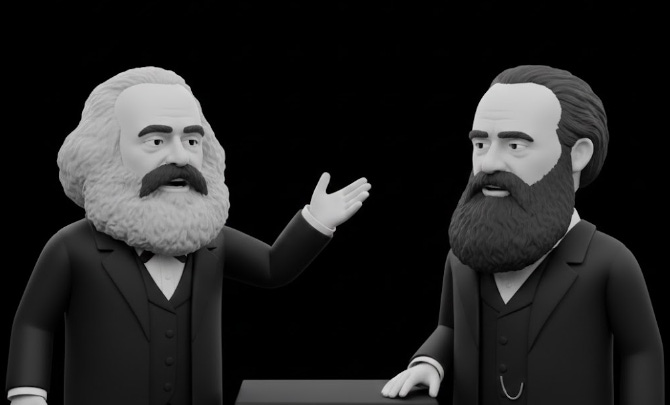
Marxism
The Marxist System of Thought
Materialism
Philosophical reflection is sometimes dismissed within Marxist politics as a luxury—an indulgence secondary to organizing, campaigning, or confronting reactionary forces. Yet theory and practice are not opposites. Because Marxism aims not merely at piecemeal reform but at the fundamental emancipation of humanity from exploitation, inequality, and oppression, it requires a worldview that is coherent, realistic, and historically grounded. Such ambitions demand philosophical clarity. Every political movement, implicitly or explicitly, rests on a philosophy; the task is therefore not to avoid philosophy, but to make its foundations explicit and critically examined.
At its core, Marxism is an unambiguously materialist philosophy. Materialism holds that there is a single reality—the material world—which exists independently of human consciousness. Matter does not depend on thought for its existence; rather, thought itself arises from material conditions. The natural world preceded human beings and would continue to exist without them. From this standpoint, there is no separate spiritual realm, no transcendent reality, and no divine agency standing outside nature.
This position contrasts sharply with idealism, which in its many forms has dominated much of the history of philosophy. Idealism typically holds that ideas, consciousness, or perception are primary, and that material reality is either dependent upon or inseparable from them. The familiar thought experiment—whether a tree falling in an unobserved forest makes a sound—illustrates the divide clearly. For the materialist, the answer is unequivocal: the sound occurs regardless of whether anyone is present to perceive it. Perception does not create reality; it merely registers it.
The historical predominance of idealism is not accidental. One reason lies in the abstract nature of thought itself. Thinking necessarily involves generalization and abstraction: an idea such as “chair” transcends any particular chair and applies to all chairs. This capacity, while indispensable, can foster the illusion that abstractions are more real or more perfect than the material objects from which they are derived. Hence, for some philosophers, the idea of a circle appears truer than any imperfect circle found in nature.
A second, more decisive reason is social. In class societies, a privileged minority is freed from manual labor and lives from the labor of others. This ruling or leisure class, historically more educated and more engaged with ideas, has had a material interest in elevating mental activity above physical work. The world of ideas is thereby valorized as noble and refined, while material production is treated as base or degrading. Idealism thus reflects, in philosophical form, the social hierarchy of class society.
Materialism, however, long predates Marx and Engels. The earliest Greek philosophers—such as Thales, Anaximander, and Heraclitus—sought to explain nature through natural causes alone, without recourse to gods or supernatural forces. Though many of their theories are scientifically obsolete, their attempt to understand the world in its own terms was a decisive intellectual breakthrough. As Engels observed, Heraclitus’ insight that everything is in constant motion—“everything is and is not, for everything is fluid”—captured a dynamic conception of reality that remains profoundly influential.
Following this early materialism, philosophy turned decisively toward idealism, most famously in Plato. His denigration of manual labor and his elevation of the realm of ideas reflected a broader contempt for ordinary productive activity. Matter came to be seen as inert and meaningless, requiring form, purpose, and animation from the mind. This prejudice persisted for centuries. Even in modern philosophy, figures such as Kant described matter as essentially lifeless and inert, incapable of accounting for life or purpose on its own.
Materialism reemerged forcefully with the Scientific Revolution and the Enlightenment, alongside the rise of the bourgeoisie. Enlightenment thinkers challenged religious dogma and asserted the intelligibility of nature through reason and science. This was a major historical advance and laid essential groundwork for Marx and Engels. Yet this earlier materialism was limited. Its “mechanical” form conceived nature as a system of passive objects governed by external forces. Consciousness, likewise, was often treated as a mere reflection of material conditions, lacking any active role.
Marx’s critique of this mechanical materialism, articulated most clearly in his Theses on Feuerbach, targeted its one-sidedness. While humans are shaped by material conditions, they are also active agents who transform those conditions. To treat consciousness as purely passive is to forget that human beings themselves are part of nature. In transforming the world through labor and social practice, they simultaneously transform themselves.
This insight constitutes the core of dialectical materialism. Matter is not inert; it is dynamic, self-developing, and internally contradictory. Human beings, as natural and social beings, participate in this process. History is not driven by ideas alone, nor by blind material forces, but by the interaction between material conditions and human activity. As Marx famously argued, human nature is not an abstract essence residing in individuals, but “the ensemble of social relations.”
Despite its explanatory power, idealism persists, both in religion and in modern philosophy. Twentieth-century thought, particularly in its postmodern forms, often embraces variants of subjective idealism, claiming that truth is constructed through discourse rather than discovered in an objective reality. From a Marxist perspective, this persistence reflects the continued existence of class society. As long as humanity does not consciously control its social relations, social forces appear alien and uncontrollable, encouraging retreat into subjectivism and abstraction.
The struggle for materialism is therefore inseparable from the class struggle itself. To defend a materialist worldview is not merely a theoretical exercise, but a political necessity: it affirms that society is governed by intelligible laws, that human beings can understand those laws, and that through collective action they can consciously reshape their world.
Epistemology
We concluded by noting the striking persistence of idealism in an era defined by unprecedented scientific discovery. Despite the vast expansion of knowledge about the natural world, philosophical traditions that deny either the existence of an objective material reality or the possibility of knowing it not only endure, but in many respects have grown stronger. Indeed, the twentieth century can be understood as a period of renewed idealist ascendancy, even more pronounced than in the nineteenth century.
Early in the century, this resurgence appeared in logical positivism, a school that held statements to be meaningful only insofar as they directly referred to an individual’s immediate experience. On this view, vast domains of human knowledge—including history and much of science—were declared meaningless. One could not meaningfully speak of events such as the Second World War unless one had personally experienced them. The implication was stark: knowledge beyond individual sense-experience was ruled out, and with it most of humanity’s accumulated understanding.
Closely related was empirio-criticism, a current Lenin famously critiqued in Materialism and Empirio-Criticism. Like logical positivism, it rejected the notion of an objective reality existing independently of consciousness and denied the possibility of objective truth. Knowledge was reduced to sensations and perceptions, severed from any independently existing material world.
Other influential movements, such as phenomenology and existentialism, followed a similar path. They began not with society or nature as such, but with the isolated thinking subject. The world was analyzed primarily in terms of how it appears to consciousness, rather than in terms of its objective structure or social relations. An independent reality, from this standpoint, was either inaccessible or philosophically meaningless.
After the Second World War, these tendencies culminated in postmodernism. Although stylistically distinct from earlier schools, postmodernism shared their core assumptions. It rejected the idea of objective truth altogether, arguing instead that knowledge is socially constructed through language and discourse. Science, on this account, is not a means of discovering facts about an independent world, but merely one culturally specific way of talking about reality. Truth becomes relative to particular societies or cultures, with no rational basis for judging one account as more correct than another.
Taken together, these currents represent the dominant strands of twentieth-century philosophy, and all are idealist in one form or another. Their shared weakness lies in their point of departure. They begin from formal logic and from the abstract, atomized individual—an individual conceived as a purely thinking subject, detached from social practice, labor, and material life. From this starting point, the problem of knowledge appears insoluble: how can isolated thought ever grasp an external world?
Marx identified this as a false problem, generated by an abstract and scholastic mode of reasoning. In his Theses on Feuerbach, he argued that the question of whether human thought can attain objective truth is not a theoretical puzzle to be solved by logic alone, but a practical question. Truth is demonstrated in practice—in humanity’s capacity to act upon, transform, and thereby understand the world. To isolate thinking from practice is to turn philosophy into an empty exercise divorced from real life.
This insight exposes the circularity of idealist epistemology. By beginning with an abstract individual whose ideas appear to arise spontaneously and independently of material activity, idealist philosophies inevitably conclude that knowledge cannot reach beyond consciousness itself. The conclusion merely restates the assumptions built into the starting point.
The problem is clearly illustrated in the writings of George Berkeley, an influential eighteenth-century idealist. Berkeley argued that ideas can resemble only other ideas, not material objects, since ideas and matter are fundamentally different in kind. Once this absolute separation is assumed, it becomes impossible to explain how thought could ever correspond to an objective world. Knowledge collapses inward, confined to the realm of subjective experience.
David Hume, like Berkeley, occupies a central place in modern philosophy. Although some deny that he was an idealist, his epistemology leads to essentially idealist conclusions. Hume famously argued that the mind is never directly acquainted with anything except its own perceptions and therefore can never establish a rational connection between those perceptions and external objects. Any supposed link between the mind and an objective world, he maintained, lacks rational foundation. From this premise it follows that the material world, as it exists independently of perception, is ultimately unknowable.
Lenin addressed this position directly in Materialism and Empirio-Criticism. For Hume and related thinkers, sensations function as a barrier separating two fundamentally unrelated realms: subjective experience and objective reality. Because sensations belong to consciousness, they allegedly prevent access to the external world rather than providing knowledge of it. By contrast, Marxist materialism understands sensations as a bridge, not a barrier. Human beings are themselves material, natural entities; sensation is therefore a relation between different parts of the same material world. Knowledge arises not from an impossible leap between two alien substances, but from practical interaction within a single, objective reality.
The dominant philosophical currents of the twentieth century largely repeat these arguments in new forms without resolving their core problems. The same issues appear, in more systematic fashion, in the work of Immanuel Kant. Kant argued that while experience is concrete and particular—tables, chairs, and specific objects—knowledge depends on abstract categories such as space, time, and causality, which are not themselves given in experience. Because these categories structure all perception, Kant concluded that we can never know the “thing in itself,” the object as it exists independently of our conceptual framework.
A powerful response to this argument was developed by Hegel. Although Hegel was himself an idealist, he exposed a decisive weakness in Kant’s position. The “thing in itself,” Hegel argued, is defined precisely by stripping away all determinate qualities—color, shape, spatial location, causal relations. What remains is a purely abstract entity devoid of content. Such an object is not unknowable; it is effectively nothing at all. The unknowable “thing in itself” is therefore not an independently existing reality, but a product of abstraction carried to an extreme. The error lies not in the use of concepts, but in assuming that because concepts are products of thought, the determinations they express do not belong to objects themselves.
General concepts such as hardness, extension, or causality are not found in any single, isolated perception. They arise through the accumulation and comparison of many experiences over time. Abstraction, in this sense, is not a distortion of reality but a means of grasping real relations that persist across particular instances. Kant’s failure was to treat experience atomistically—reducing it to the standpoint of an isolated individual at a single moment—rather than as a historical and social process. This limitation reflects the broader weakness of idealism, which neglects development, mediation, and practice.
Hume’s further objections illustrate the same problem. He noted that when one moves away from a table, it appears smaller, even though the table itself has not changed. From this he inferred a fundamental gap between perception and object. From a materialist standpoint, this poses no difficulty. Perception expresses a relation between the observer and the object under specific conditions. The change in appearance accurately reflects a change in spatial relation, not an illusion or contradiction. Idealism mistakes relational knowledge for false knowledge.
Ultimately, idealism suffers from a lack of explanatory power. Berkeley, for example, denied the existence of an independent material world and reduced reality to ideas in the mind. Yet he was compelled to explain why individuals’ perceptions broadly agree. His solution was to posit God as a universal perceiving mind that guarantees the consistency of experience. Objectivity, having been abolished in principle, had to be reintroduced in theological form. Other subjective idealists, such as Fichte, encountered similar difficulties and resolved them by covertly restoring objective constraints after initially denying them.
This pattern reveals idealism’s fundamental weakness. By starting from the isolated subject, it dissolves the material world into consciousness, only to reinsert objectivity in an ad hoc and often mystical manner. The result is a philosophy that adds nothing to practical understanding. Even the most radical idealists live as if an objective world exists: they eat, work, avoid danger, and engage in social life like everyone else. Their everyday practice contradicts their theoretical claims.
As Marx emphasized, it is practical human activity that ultimately grounds knowledge. Philosophies that detach thought from practice become empty abstractions. Idealism persists not because it explains the world better, but because it reflects specific social conditions. It is historically associated with privileged layers removed from material production, for whom abstract speculation can substitute for engagement with social reality. In this sense, idealism functions ideologically: by obscuring material relations, class struggle, and exploitation, it diverts attention from the real sources of human suffering and inequality.
The continued dominance of idealist philosophies, even in an age of advanced science, is therefore not accidental. It corresponds to the persistence of class society itself. As long as social relations remain opaque and human beings lack conscious control over their collective life, philosophies that deny objective knowledge and material causation will continue to find fertile ground. The struggle against idealism is thus not merely theoretical. It is inseparable from the broader political struggle against capitalism and for a society in which human beings can understand and consciously shape their own conditions of existence.
Human Nature
We examined the problem of idealism and the theory of knowledge, and showed that the problem becomes insoluble when thought is treated in isolation—abstracted from its social and historical conditions. If one begins from the standpoint of an abstract, self-contained individual, it becomes impossible to explain thought itself. The task, therefore, is no longer to speculate endlessly about whether knowledge is possible, but to confront what Marx called the “scholastic” question: what thought actually is, and how it develops in real history.
The Marxist approach to thought, and the necessity of situating it historically and socially, is expressed with exceptional clarity in Marx’s Theses on Feuerbach, written early in his career. In these brief but powerful texts, Marx demonstrates that even pre-Marxist materialism—especially in the case of Feuerbach—had not fully broken with idealism, and thus remained trapped by the same difficulties in explaining thought.
Marx observes that Feuerbach wishes to affirm the independence of material reality, insisting on the existence of sensuous objects distinct from thought. Yet Feuerbach fails to grasp human activity itself as objective activity. The implicit assumption is that while the material world exists independently of humanity, human thinking somehow stands apart from that world. This residual idealism prevents a coherent account of thought.
Marx’s intervention is revolutionary. In only a few pages, he reframes the problem historically, insisting that humanity is part of nature and has emerged from it. At the same time, he opens the way to understanding thought as a social process rather than as the property of isolated individuals. This is crystallized in his decisive rejection of abstract conceptions of human nature: “The human essence is no abstraction inherent in each single individual. In its reality it is the ensemble of social relations.”
Those who fail to grasp human nature in this way are compelled to treat it as an ahistorical abstraction—something supposedly present in full form within each individual from the outset. This conception underlies the familiar bourgeois appeal to “human nature” as an objection to social change. Its hidden premise is that human beings possess a fixed, inborn essence—rooted in biology, the soul, or some mysterious source—rather than a nature shaped through history and social relations. Because this essence is asserted rather than explained, its origins remain obscure.
The Theses on Feuerbach conclude with what is perhaps the most famous sentence in philosophy, in which Marx exposes the limits of philosophy itself: philosophers have only interpreted the world in various ways; the point is to change it. This line succinctly captures the practical orientation of Marxist philosophy.
This outlook rescues the problem of mind—or the so-called mind–body problem—from its abstract and one-sided treatment in traditional philosophy. While it does not by itself answer every question about thought, it places the problem in its proper context and provides the tools necessary to investigate it scientifically.
Materialism thus appears not merely as the assertion that the material world exists independently of the individual, but as the recognition that thought itself is part of the material world. Thought is not simply dependent on material conditions; it is a natural process within nature. Precisely because thought is material and active, it is capable of acting back upon the world. Unlike sensation, which merely registers external stimuli, thought is distinguished by its activity.
Marx develops this position further in the Economic and Philosophical Manuscripts of 1844, where he insists that to exist is to have an object. Human beings are part of nature and depend upon it entirely: we must breathe, eat, drink, and secure shelter. All our powers, including thought, are natural powers directed toward survival. Without this continuous interaction with nature, thought itself would cease.
From this standpoint, Marx rejects any worldview that posits non-material beings—whether gods, souls, or disembodied minds—standing outside nature. To exist is to stand in objective relations, to interact materially with other beings. Anything defined as wholly non-material is, by that very definition, unreal. This critique applies equally to idealist theories that treat thought as fundamentally separate from the material world.
Because human beings are natural and dependent beings, they are also vulnerable: deprivation, suffering, and need are real conditions of existence. This dependence provides the basis for understanding emotions, interests, and ultimately thought itself. Thought is not a mysterious or spiritual substance but a product of real, material needs.
Moreover, human beings do not relate to nature as isolated individuals but through society. The food we eat, the clothes we wear, and the shelter we inhabit are the products of complex networks of social labor. Survival itself is mediated by society. Any theory of thought that ignores this fact inevitably becomes abstract and mystical, treating ideas as though they arise from nowhere.
This perspective also clarifies earlier philosophical debates. Thinkers such as Hume and Kant argued that abstract categories like time and causality must originate in the mind, since they are not directly encountered in sensory experience. What is missing from this account is history and society. Just as Feuerbach treated human essence as inherent in individuals rather than historically formed, these philosophers treated abstractions as innate mental structures rather than as products of collective human practice.
In reality, all ideas arise from experience—not the experience of isolated individuals, but the accumulated, collective experience of humanity. At its foundation lies social labor: the practical activity through which humans transform nature in order to live. As Engels explains, labor not only expands humanity’s mastery over nature but also brings human beings into closer cooperation, creating the conditions for language, communication, and thought itself.
Thought and language developed historically through the production of tools and the social labor associated with them. Yet this real foundation of human consciousness has largely been obscured over time. One decisive reason for this obscurity is the emergence of class society, in which a privileged layer performs little or no productive labor and lives from the labor of others. Members of this ruling class engage primarily in ideas, abstractions, culture, and religion, and thus come to regard these as independent creations of the mind.
Engels explains that as ideological forms appeared to dominate society, the modest but decisive role of manual labor receded from view. Because the intellectual planning of labor could, at an early stage, be separated from its physical execution and imposed upon others, the material origins of ideas seemed to disappear altogether. In this way, the social division of labor concealed the role of labor itself in the formation of consciousness.
Understanding thought in this historical and social manner allows not only an explanation of its origins but also of its distortions. If human nature consists in the ensemble of social relations, and if individuals exist only through society, then social contradictions necessarily produce psychological ones. Under capitalism, individuals depend entirely on society for their survival, yet exercise no real control over it. The market—an impersonal and opaque force—determines production, employment, wages, and even the fate of entire communities. No conscious understanding or collective control of this process is possible within capitalism, and this generates alienation: a loss of meaning, agency, and connection to one’s own activity.
Marx emphasizes that human beings are unique among animals precisely because of social labor. While animals act upon nature largely through fixed biological capacities, humans create tools that exist independently of their bodies. These tools can be modified, improved, and transmitted across generations, allowing knowledge, culture, and social organization to develop historically. As productive activity evolves, so too does society—and with it, human consciousness.
Yet under capitalism this very process turns against humanity. Despite unprecedented mastery over nature and tool-making, society loses conscious control over production itself. The logic of the market replaces human planning. As a result, while technical knowledge expands, understanding of social relations deteriorates. This contradiction profoundly shapes consciousness, producing feelings of powerlessness, boredom, and estrangement from one’s own labor and its products.
This framework also clarifies a common error in contemporary discussions of the mind. Many scientists, seeking a materialist explanation of consciousness, attempt to locate it entirely within the structures of the brain. While the brain is undeniably the material substrate of thought, this approach remains incomplete. Trotsky warned that if consciousness were merely a passive byproduct of neural processes, it would serve no function and would be an unnecessary complication. Consciousness, he argued, emerges from its material substrate but also acts back upon it; it is active, not inert.
The missing dimension in reductionist accounts is society itself, which is no less material than the brain. Consciousness is shaped by language, labor, culture, and history. Identical biological brains placed in radically different social environments would not produce identical forms of thought. Ideas arise not from isolated nervous systems but from the collective, historical activity of humanity. The brain internalizes and mediates this social content, enabling thought to rise beyond what its purely biological structure could generate on its own.
This insight remains poorly understood, even today. Because it is marginalised or distorted in education and public discourse, many scientific and philosophical approaches reproduce the same abstraction Marx criticized: the separation of thought from its social and historical foundations.
The conclusion follows directly. If society produces thought, then the contradictions of society necessarily constrain and deform it. Humanity cannot yet be described as fully self-conscious, since it neither understands nor controls the forces governing its collective life. As Engels insists, genuine freedom and self-consciousness require more than knowledge: they require a revolutionary transformation of the mode of production and the social order built upon it. Only when production is consciously organized to meet human needs—when society collectively controls its own activity—can humanity truly attain self-consciousness.
Formal Logic
Thus far, our discussion has focused primarily on materialism. Marx’s philosophy, however, is not merely materialist but dialectical materialism. We have touched on elements of this method before—most notably when examining skepticism in bourgeois philosophy and the doubts surrounding the existence of an external world. These problems, we noted, are connected to limitations inherent in formal logic, particularly its tendency to isolate phenomena and treat them as fixed. Since logic occupies a central place in philosophy, it is necessary to address this directly.
Logic is commonly understood as the set of laws governing thought. From a materialist standpoint, these laws are not independent of reality but are derived from the most general features of the material world itself. Objects exist in determinate relations; they exhibit regularities and constraints, and these objective features are reflected in thought. Logical principles therefore express abstracted properties of reality. If a logical principle were to contradict the real structure of the world, it would ultimately prove untenable.
Formal logic, however, often treats its rules as self-sufficient and detached from material reality—as timeless norms governing thought regardless of what the world is like. In this view, logical axioms are taken as self-evident, requiring no grounding in experience or nature. From a materialist perspective, this reverses the true relation: logic does not precede reality but arises from it.
Logic, moreover, is not a manual that teaches people how to think correctly. As Hegel observed, the study of logic no more teaches one to think than the study of physiology teaches one to digest. Human beings are capable of thought because logic reflects the objective structures they already encounter in the world.
Formal logic was first systematized by Aristotle, who codified its principles and established it as a distinct discipline. Its most famous rule is the law of identity and non-contradiction: A is A, and cannot be non-A. This principle captures something real and necessary—it expresses the fact that objects possess determinate properties. Yet for all its usefulness, it is also profoundly limited.
The foundation of formal logic is abstraction. Abstraction is an indispensable operation of thought: it consists in isolating certain features of an object or process in order to understand them. By abstracting, we identify general properties—such as sharpness, hardness, or value—and thereby move beyond the immediacy of sense perception. Without abstraction, thought itself would be impossible.
Lenin emphasized that correct abstraction does not lead away from truth but closer to it. Scientific concepts, laws, and categories reflect reality more deeply and comprehensively than immediate perception alone. Knowledge advances from concrete experience to abstract thought, and from abstraction back to practice.
Yet abstraction is inherently one-sided. By isolating a feature from its context, abstraction simultaneously reveals and distorts reality. The properties we abstract—matter, sharpness, value—never exist in isolation. They exist only within a complex, changing web of relations. Formal logic, grounded in abstraction, therefore risks freezing reality, stripping it of motion, history, and interconnection.
This limitation becomes clear in classification. When we define a species by fixed characteristics, we gain real knowledge, but we also treat the object as static. Such thinking cannot explain how that species emerged, how it changes, or how it relates dynamically to its environment. Formal logic describes what something is, but not how it becomes or ceases to be.
At first glance, the law of identity appears indisputable: how could A not equal A? Yet Hegel demonstrated that this principle is ultimately a tautology—an empty statement that conveys no real knowledge. To say “a dog is a dog” tells us nothing about dogs. Any content we associate with the statement comes not from the proposition itself but from prior experience.
Pure identity, taken in isolation, collapses into emptiness. To say anything meaningful about an object, it must be determined—it must possess specific qualities that distinguish it from others. Determination implies limitation, relation, and contrast. Moreover, determinate qualities exist only in time. To be something—yellow, hard, heavy—is to persist through temporal change. Nothing exists outside time, and nothing remains identical with itself across it.
Dialectics therefore insists that change is not accidental but essential. The truth of an object lies not in static identity but in its movement and transformation. In this sense, A is not equal to A.
Trotsky illustrated this point vividly in his discussion of dialectical logic. Even a pound of sugar is never identical to itself: a more precise scale will always reveal differences, and over time it inevitably changes in weight, composition, and form. To claim that something is identical to itself “at a given moment” is no solution, since a moment, if real, belongs to time—and time is continuous change. If the moment is treated as a timeless instant, it becomes a purely mathematical abstraction devoid of reality.
Existence is an uninterrupted process of transformation, and time is a fundamental condition of being. The axiom A = A is valid only for what does not change—and what does not change does not exist. Formal logic, though necessary and powerful within limits, therefore fails to grasp reality in its movement. Dialectical materialism arises precisely from the need to understand the world not as a collection of fixed identities, but as a dynamic, interconnected, and evolving totality.
Change is universal. Everything changes continuously, and change itself entails contradiction: something both is and is not what it was. This may initially appear paradoxical—perhaps even more counterintuitive than the formal axiom that A equals A—but it expresses a deeper truth about reality.
Zeno’s famous paradoxes illustrate the limitations of formal logic when confronted with movement and change. Zeno argued that motion is impossible because, to travel from point A to point C, an object must first reach point B; yet before reaching B, it must reach an intermediate point, and so on ad infinitum. Since space can be divided endlessly, the object would supposedly never arrive at its destination. The paradox rests on the assumption that space consists of an infinite number of discrete points, each of which must be individually occupied.
This conclusion is absurd, since movement is an undeniable fact of experience. The error lies in the abstraction imposed by formal logic: space is treated as a collection of static points rather than as a continuous process. In reality, motion does not consist in jumping from one fixed position to another but in flowing through a continuum. To understand motion, one must grasp the unity of being and non-being—of here and there, of presence and absence—within the same process. Formal logic, which insists on fixed identities and discrete moments, cannot accommodate this.
Formal logic also treats itself as independent of material reality: a self-contained system of abstract rules indifferent to content. Its appeal lies in its apparent universality, clarity, and exclusion of contradiction. Yet this very indifference to content reveals its limits.
The classic syllogism—“If A, then B; A, therefore B”—is considered formally valid regardless of the truth of its premises. Thus, “If it rains, the streets are wet; it is raining; therefore the streets are wet” is treated as logically equivalent to “If it rains, the streets are on fire; it is raining; therefore the streets are on fire.” Formal logic concerns itself solely with structure, not with whether the statements correspond to reality.
By contrast, the inverted syllogism—“If A, then B; B, therefore A”—is deemed invalid. We know this not from logic alone, but from experience: streets can be wet for many reasons besides rain. Our recognition of this fact depends entirely on knowledge of the real world and its multiple, interacting causes. Without such material knowledge, logical forms would be empty and meaningless.
This abstraction from content has been elevated to a principle in much of modern philosophy. Systems such as propositional calculus reduce reasoning to symbolic operations devoid of reference to reality. They admit only binary values—true or false—exclude ambiguity, and flatten the richness of language. Even meaningful distinctions, such as the difference between “and” and “but,” are eliminated on the grounds that they are logically equivalent. In doing so, formal logic strips thought of nuance, context, and lived meaning.
As a result, formal logic becomes rigid and dogmatic. While it captures one aspect of truth—the relative stability of objects—it cannot account for development, contradiction, or transformation. Objects do persist through change, and it would be absurd to abandon all identity because of minor alterations. Formal logic correctly reflects this moment of stability.
But stability is only one side of reality. If thought remains confined to fixed identities, it becomes incapable of understanding processes, interconnections, and the transformation of one thing into another. Reality is not static; it is dynamic, contradictory, and historically developing. To grasp these deeper laws of change, thought must go beyond formal logic and adopt a dialectical approach—one that preserves identity while also comprehending contradiction, movement, and becoming.
Dialectical Logic
Quantity and Quality
Marxist philosophy begins from the recognition that all things change. Yet this insight, taken by itself, explains very little. Dialectics is not satisfied with the mere assertion of change; it seeks to understand how and why change occurs. Moreover, an exclusive focus on change is itself one-sided. Dialectical thinking proceeds through opposites, and reality exhibits not only transformation but also persistence. Things change, yet they also remain what they are—for otherwise nothing could exist at all.
This problem was already recognized in ancient philosophy. Heraclitus, often regarded as the founder of dialectics, famously declared that everything flows and that one can never step into the same river twice. Hegel later acknowledged Heraclitus’s profound influence, remarking that there was no proposition of Heraclitus he had not incorporated into his own Logic. Yet, according to Aristotle, one of Heraclitus’s followers pushed this doctrine to an absurd extreme, claiming that one could not step into the same river even once, since it is already changing at every moment. Taken literally, this view dissolves all stability and renders existence unintelligible.
The absurdity of this conclusion reveals the limitation of asserting change alone. For anything to exist, it must preserve certain defining characteristics over time. A river changes continuously, yet it remains a river: it has a source and a mouth, it consists of flowing water, and it endures as a determinate object. Thus, stability and change are not mutually exclusive; they are inseparable moments of the same process. The philosophical problem, therefore, is to explain how something remains itself while undergoing transformation, and how it passes from one determinate state to another.
This problem appears in classical paradoxes such as the “heap” and the “bald man.” A single grain of sand is not a heap, nor are two or three. Yet at some point, the addition of further grains produces a heap. Likewise, removing individual hairs does not immediately make a person bald, but continued quantitative loss eventually results in baldness. The difficulty lies in explaining how gradual, incremental changes give rise to a new quality. Philosophers struggled with this question for centuries.
Dialectical logic resolves it through the law of the transformation of quantity into quality. This law explains how quantitative changes accumulate within a system until they reach a threshold at which the existing structure can no longer be maintained, resulting in a qualitative leap. In this sense, all development proceeds through the accumulation of quantitative changes that culminate in decisive transformations. The law thus provides the conceptual bridge between stasis and change.
Its validity rests on the fact that all phenomena are organized wholes. Objects and processes are composed of parts that stand in definite relations to one another. These relations are not accidental or external; they determine the character and behavior of the whole. Hence the well-known expression that the whole is more than the sum of its parts.
A clear example is the difference between ice and liquid water. Both consist of the same molecules, yet they behave in fundamentally different ways. Ice, in many respects, has more in common with other solids than with water in its liquid form. The difference lies not in the components themselves, but in the relations among them. A change in these internal relations produces a new quality.
The same principle applies in social phenomena. Napoleon once observed that while individual Mamluk soldiers were superior fighters, French troops prevailed in large numbers due to their superior organization. At a certain scale, organization becomes decisive, transforming quantitative superiority into qualitative advantage. Once again, the relations among the parts determine the character of the whole.
Dialectical logic thus stands opposed to two common errors in thought. The first is gradualism, which assumes that all change proceeds in a smooth, linear fashion. This view overlooks the reality of leaps, ruptures, and sudden transformations following long periods of relative stability. Even in natural science, this error has been challenged—for example, by later developments in evolutionary theory that corrected Darwin’s original emphasis on purely gradual change.
The second error is reductionism, which treats the parts of a system as independent and explains the whole by reducing it to its elements. A prominent example is biological determinism, which attempts to explain human behavior directly through genes. Genes, however, do not encode specific behaviors; they participate in the construction of an organism whose actions arise from the interaction of its parts with one another and with society. To reduce complex social and psychological phenomena to isolated biological components is to ignore the decisive role of organization and relations.
Dialectical materialism rejects reductionism precisely because it recognizes that new qualities emerge from structured wholes. Wetness, for example, cannot be found in any individual water molecule, yet it is a real property of liquid water. This property does not originate from outside the system, nor does it contradict materialism; it arises from the relations among the molecules themselves.
Most quantitative changes do not immediately alter a system’s overall quality. Liquid water remains liquid across a wide range of temperatures. Yet at specific thresholds—freezing and boiling points—the accumulated quantitative change in heat energy disrupts the existing relations, producing an abrupt qualitative transformation. This is the essence of the transition from quantity to quality.
The same pattern governs social change. Revolutions and mass strikes often appear sudden and unexpected, triggered by seemingly minor events. In reality, they are the outcome of long-accumulating contradictions. The Tunisian Revolution, for instance, was ignited by a single act of protest, yet this act resonated because it crystallized widespread and long-standing social grievances. At a certain point, quantitative pressures became unbearable, and society underwent a qualitative rupture.
The political significance of this law is profound. Marxism is not concerned merely with isolated reforms or short-term improvements, but with the transformation of society as a whole. Such a task requires historical patience and theoretical clarity. Without an understanding of dialectical development, one is easily demoralized by setbacks or misled by surface appearances.
Before the financial crisis of 2008, capitalism appeared stable and self-correcting to many observers. Yet beneath this surface, inequalities, debt, and systemic contradictions were intensifying year after year. When these quantitative tensions reached a critical point, they erupted in a crisis that reshaped global consciousness and revived interest in Marxist analysis. The crisis was not an accident; it was a qualitative break produced by long-term quantitative accumulation.
For this reason, the law of the transformation of quantity into quality is indispensable for understanding both nature and society. It teaches us to look beyond immediate appearances, to grasp the inner relations of processes, and to maintain a long historical perspective. Only with such an approach can we comprehend how profound change becomes possible—and why it often arrives suddenly, after long periods of seeming immobility.
Contradiction and Opposition
The law of the transformation of quantity into quality already presupposes the existence of opposites. Quantity and quality are not isolated categories; they define one another and interpenetrate. This mutual implication points to a more fundamental principle of dialectical logic: the interpenetration and unity of opposites. From this principle arise both the logic of contradiction and the law of the negation of the negation, which together explain development and motion.
For dialectics, contradiction is not an error in thought but an objective feature of reality. Opposites are internally related: they depend upon one another, define one another, and yet stand in tension. This antagonism is not accidental; it is the source of movement and development. Motion does not originate externally, as though things were inert until struck by an outside force. Rather, motion arises from the inner nature of things themselves.
This marks a decisive break with mechanical materialism, particularly the Newtonian view that motion results solely from external causes. While external forces do exist, appealing to them ultimately explains nothing, since one must then account for the motion of the external force itself. Dialectics therefore insists on the concept of self-movement: matter moves because of internal contradictions inherent in its structure. Change is not imposed from without; it emerges from within.
Opposites, in this sense, are inseparable. They are not merely extreme differences but mutually conditioning poles of a single process. Movement persists only so long as neither side of the contradiction completely overcomes the other. If one pole were eliminated—if there were attraction without repulsion, or stability without tension—motion would cease altogether. It is the contradiction itself that generates development.
This insight resolves longstanding scientific and philosophical problems. Consider thermodynamics: entropy describes the tendency toward energy dissipation and disorder. Taken in isolation, this suggests an eventual cessation of motion. Yet this conclusion ignores the opposing tendency—the generation and concentration of energy. Without acknowledging both tendencies as mutually conditioning, it becomes impossible to explain either the persistence of motion or its origins. One-sided explanations collapse into contradiction.
The dialectical principle of opposition becomes clearer in concrete examples. Capitalist society, for instance, is a self-moving system with a distinct historical trajectory. Its development is driven by internal contradictions, foremost among them the class antagonism between capitalists and workers. These classes do not exist independently. Capitalists can exist as such only because workers are separated from the means of production and compelled to sell their labor power. Conversely, workers exist as workers precisely because capital is monopolized by capitalists. Each class defines and reproduces the other.
This interdependence is simultaneously antagonistic. The interests of capital and labor are directly opposed, producing an ongoing struggle that drives economic development, social conflict, and historical change. The class struggle is not an external disturbance of capitalism; it is the system’s inner motor.
The same structure appears in perception itself. Vision depends not on isolated colors or pure light but on contrast and opposition. A field of uniform brightness would render objects invisible. It is the tension between light and dark, between differing colors, that makes perception possible. Once again, it is not one pole alone but their relation that produces a determinate effect.
Opposites permeate all determinations of existence: part and whole, internal and external, large and small, hard and soft, wet and dry. Every quality is intelligible only in relation to its opposite. Objects are not aggregates of indifferent elements; they are structured unities whose qualities arise from the relations among their parts. This insight, already central to the discussion of quantity and quality, is equally fundamental to understanding contradiction and development.
Hegel articulated this principle with exceptional clarity. In the Encyclopedia Logic, he emphasizes that positive and negative are not independent realities but relational determinations. What is negative in one context is positive in another. Debts and assets, east and west, creditor and debtor exist only in relation to each other. Even in magnetism, the north and south poles cannot be separated; dividing a magnet produces two new poles, not isolated halves. Opposites confront not an alien other, but their own counterpart—“their other”—within a unified whole.
This dialectical unity also reconciles stasis and change. Persistence and transformation are not mutually exclusive but mutually conditioning. Stability is a moment of motion, just as motion presupposes relative stability. At the most fundamental level, this opposition can be understood as attraction and repulsion. Anything that exists must be held together by forces of cohesion, yet must also contain tension and differentiation, without which it would have no capacity to act or develop.
Many enduring philosophical disputes arise from treating one side of an opposition as exclusive. Nature versus nurture, intention versus consequence, internal character versus external action—these are false alternatives when taken in isolation. Ethical questions, for example, cannot be resolved solely by appeal to intention or outcome. Moral action requires both genuine intent and effective realization. To privilege one while excluding the other is to lapse into abstraction.
Dialectical logic therefore rejects one-sided explanations. Reality is structured through contradictions that are neither accidental nor destructive, but productive. Development arises not from the elimination of opposites, but from their unity, tension, and eventual transformation. To think dialectically is to grasp this movement as intrinsic to existence itself.
Everything that exists possesses an inner principle of movement. Motion does not arise solely from external forces acting upon inert objects; rather, it emerges from the internal character of things themselves. At the same time, this inner character necessarily expresses itself outwardly, establishing determinate relations with other things. Conversely, the inner nature of any object is itself shaped by the external conditions in which it develops. Inner and outer determination are therefore not opposed in isolation but exist in a continuous reciprocal relation.
Hegel’s familiar example of the acorn illustrates this clearly. An acorn is obviously not an oak tree: it differs in size, form, and function, lacking branches, leaves, and the visible characteristics of maturity. Yet, under appropriate external conditions, the acorn inevitably develops into an oak. The oak tree is thus the result of a synthesis between the acorn’s inner potential and the necessary external environment. Development consists precisely in this dynamic interaction between internal determination and external conditions.
All development proceeds through such dialectical relations. Processes unfold through oscillations between opposed moments—inner and outer, youth and age, parent and child—rather than through linear accumulation. This brings us to the law of the negation of the negation, one of the most frequently misunderstood principles of dialectical logic.
Engels offers a concise and illuminating example. A grain of barley, when placed under suitable conditions of soil, moisture, and warmth, undergoes a transformation: it germinates, and the grain as such ceases to exist. It is negated. In its place arises the barley plant, which grows, flowers, and is fertilized. When mature, it produces new grains of barley, after which the plant itself dies and is negated in turn. The outcome of this double negation is not the mere return of the original grain, but its reproduction on a higher level—tenfold, twentyfold, or more. The original form reappears, enriched and multiplied.
This process involves the dialectical concept Hegel termed sublation (Aufhebung): to negate while simultaneously preserving. In ordinary thought, negation is equated with simple destruction. Dialectics, by contrast, insists that development requires both cancellation and retention. Without this notion, it would be impossible to explain why an oak produces acorns resembling those from which it arose. Something essential is preserved through transformation, even as earlier forms are overcome.
Engels emphasizes that dialectical negation is not arbitrary annihilation. As Spinoza observed, every determination is simultaneously a negation. The form of negation is determined by the nature of the process itself. The acorn contains within it the accumulated results of a long developmental history. Its capacity to become an oak is not accidental, nor is it the product of chance or design. It is the crystallization of countless prior transformations in which useful structures were preserved.
In this sense, the acorn already contains its “other”—the oak tree—within itself. However different they may appear, the transition between them is lawful and necessary. An acorn will not become a human being or a different species of plant. Its development is constrained by its internal structure and history. The negation of the negation thus expresses the non-arbitrary character of change. Matter is not chaotic; it is self-organizing, lawful, and intelligible.
This insight has profound philosophical implications. Historically, matter has often been portrayed as inert, chaotic, and meaningless, requiring consciousness or divine intention to impose order. William Paley’s famous teleological argument rests on this assumption: the regularity and harmony of nature, he claimed, must be the product of an intelligent designer. The apparent order of the solar system and the complexity of living organisms were taken as proof of divine intervention.
Dialectical materialism rejects this conclusion. Matter is not passive chaos. For anything to exist at all, it must possess determinate structure and relative stability. Over time, this inherent organization gives rise to development through processes in which successful forms are preserved. Evolution exemplifies this most clearly. Traits that enhance survival and reproduction persist, not because they are intended or designed, but because they work within the lawful conditions of nature.
Through the negation of the negation, development proceeds not in simple cycles, but in an ascending spiral. The return to an earlier form occurs on a higher level, enriched by variation and accumulation. In biological evolution, most variations are insignificant, but over vast periods and changing environments, certain differences become decisive, eventually giving rise to new species. What is preserved is not sameness, but functionality.
Thus, order, regularity, and increasing complexity emerge immanently from natural processes themselves. No appeal to external consciousness or divine purpose is required. The law of the negation of the negation provides a materialist explanation for development, continuity, and progress in nature. Without it, the emergence of organized complexity would remain philosophically inexplicable.
Part and Whole
To grasp the problem of part and whole is to confront one of the most fundamental questions in philosophy: the relation between the universal and the individual. At issue is whether universal concepts—such as animal, color, or leaf—possess any real existence, or whether they are merely convenient fictions with no reality of their own.
The proper starting point is the nature of thought itself. Thought is inherently universalizing. Whenever we think, we necessarily employ universals; this is what distinguishes thought from mere sensation or instinct. Hegel repeatedly emphasized this point. It is impossible, he argued, to speak of a purely individual object, because the moment we do so we render it universal. To say “this leaf is green” is already to invoke universality twice: the object is identified as a leaf (a universal kind) and as green (a universal quality). Even an attempt to strip away such determinations and say merely “this” results in something even more abstract and universal, since everything can be designated as “this.” Paradoxically, to make an object more concrete, we must ascribe universal determinations to it. Thought therefore does not oppose the individual to the universal; it necessarily relates and unites them.
Classical idealism, most famously in Plato, drew a radical conclusion from this fact. Universals were taken to be the true essence of reality, possessing a higher and more genuine existence than their sensible manifestations. There was, on this view, an ideal leaf or pure greenness, of which concrete leaves and colors were imperfect copies. Although such a doctrine often strikes modern sensibilities as implausible, its underlying assumption—that universals enjoy an independent and prior existence—remains widespread in subtler forms.
One clear example is theological thought. God is conceived simultaneously as a universal principle—the essence and ground of the universe—and as a concrete, personal being with real existence. Here again, the universal is treated as something that exists independently and governs the particular. Similar patterns appear in the history of science. Early scientific theories often hypostatized abstractions, as when heat was explained by invoking distinct “hot” and “cold” forces rather than being understood as a property emerging from the motion of matter itself. Comparable errors appear in politics when social problems are attributed to abstract qualities such as “greed,” and solutions are sought by appealing to alternative universal values, as though such values could be freely chosen and imposed independently of material conditions.
From a materialist standpoint, this entire approach is rejected. Universals do not exist as autonomous entities; there is no realm in which pure color or pure form can be found. There exist only concrete objects with definite properties. Yet the issue is not resolved by simply denying the validity of universals. Hegel himself, despite being an idealist, often grasped this point with great clarity. In the Shorter Logic, he criticizes the notion of treating the universal as if it were merely one object alongside others. A universal, if reduced to such a status, becomes just another particular. As he notes, no one who desires fruit would reject cherries, pears, and grapes on the grounds that they are not “fruit” in general. The universal has meaning only insofar as it is realized in and through its particulars.
Hegel makes a similar point in the Phenomenology of Spirit when he observes that merely saying “all animals” does not constitute zoology. Abstract universality, detached from its concrete determinations, is empty. Laws of nature, likewise, are not inscribed somewhere in the sky; they cannot be perceived as independent objects. However, Hegel ultimately reintroduces idealism by claiming that such universals exist “for the mind,” as though they inhabited a distinct mental realm. From a Marxist perspective, this move is illegitimate.
Marx sharply criticizes this tendency, most famously in The Holy Family. If one treats “fruit” as a real entity existing independently of apples and pears, then the existence of actual fruits becomes mysterious: the abstract universal must somehow “unfold” itself into concrete forms, yet no rational explanation can be given for why or how this occurs. The same difficulty arises in theological accounts of creation. If God is perfect and self-sufficient, why does creation occur at all, and why in this particular form? Such questions admit no answer once the universal is detached from concrete reality.
Materialism therefore begins from the opposite direction. Concrete, material things are primary; they are what truly exist. Universals are not arbitrary conventions or mere mental inventions, but neither are they independent beings. Positivism errs by denying universals altogether, restricting knowledge to isolated facts and rejecting theoretical generalization. Yet this position is self-defeating, since thought itself cannot function without universals. To reduce them to subjective conventions is simply to relapse into a subtler form of idealism.
All concrete material objects are individual and finite, yet none is absolutely unique in the sense of standing outside general forms. Every physical thing is composed of atoms and molecules drawn from a limited set of elements, arranged according to repeatable patterns and governed by lawful regularities. This is why the universe is intelligible and, to a significant degree, predictable. Without such regularity, universal concepts would be useless, and human practice would be reduced to chance.
This pattern extends from inorganic nature into the organic world. Living beings belong to definite species. Although no two individuals are identical, variation remains bounded: organisms overwhelmingly conform to their type and behave in broadly predictable ways. The success of scientific generalization rests precisely on this fact. Universal laws work because reality itself exhibits stable regularities. Human society, and indeed civilization as a whole, depends on this predictability: tools, technologies, and social cooperation are possible only because materials and processes behave reliably.
Individual objects arise and pass away, yet what replaces them is not radically different. Beneath the flux of transient particulars lies a persistent order—lawful patterns that express why things behave as they do. In this sense, universals are real and indispensable. A correctly grasped law may even be more significant than any single instance, which is fleeting and incomplete. But this does not entail a return to idealism or the claim that universals exist independently of material reality.
The apparent contradiction is resolved through dialectical thinking, which rejects absolute oppositions. It is false to claim either that only isolated particulars exist and universals are mere fictions, or that universals alone are real and particulars are inferior copies. Materialism begins with concrete objects, but recognizes that they exist only within definite types and relations.
Consider a concrete apple. It is unquestionably real, yet it is not merely a singular object: it is an apple. Its “appleness” does not derive from an ideal form imposed from outside matter. Rather, it is the product of a material history—biological reproduction, environmental conditions, and the long process of evolution. The apple embodies the accumulated results of past development and also contains the potential for future development, insofar as it produces seeds that give rise to new trees. The universal exists here, not as something separate, but as a real determination internal to the object itself.
At the same time, the universal has no existence apart from its particulars. Just as the apple contains the universal within itself, the universal is nothing other than the ensemble of such concrete instances. The relation of part and whole clarifies this point. An arm functions as an arm only as part of a living body; precisely because it is a part, it depends on and is sustained by the whole. In the same way, a universal law is an adequate conceptual expression of the real historical development and interaction of material processes.
This understanding also illuminates how lawfulness operates in society. Social laws—such as the recurrence of economic crises under capitalism—are real and objective. Yet they do not exist prior to or outside society. They arise through the actions and relations of millions of individuals situated within definite class structures. Each historical moment is unique, shaped by particular people and circumstances, which is why crises and revolutions never occur in exactly the same way or at perfectly predictable times. Nonetheless, to deny their common features and lawful tendencies would be equally mistaken.
Dialectical materialism thus affirms both determination and contingency. The world, including capitalist society, is governed by real laws that can be known scientifically. At the same time, these laws are never manifested in a simple or mechanical way. They operate only through concrete, historically specific conditions. This perspective rejects both idealism and fatalism, allowing for a rigorous understanding of necessity that leaves room for complexity, variation, and human action.
Necessity and Chance
Just as part and whole are inseparable opposites that define one another, so too are necessity and chance. One cannot be understood in isolation from the other; each expresses itself only through its counterpart.
Marxism, as a materialist outlook, begins from the premise that nothing arises from nothing. Every event has causes and conditions, and in this sense Marxists are determinists. From this it is sometimes concluded—incorrectly—that Marxism implies fatalism: the belief that history unfolds according to a fixed script, that socialism must inevitably follow capitalism regardless of human action, and that all outcomes are rigidly preordained. This accusation rests on a confusion between dialectical determinism and crude, mechanical determinism.
Mechanical determinism conceives causation as a simple, linear chain in which one event necessarily produces the next, leaving no room for alternatives. This view is classically expressed in the idea known as “Laplace’s demon”: if one knew the precise position and motion of every particle in the universe at a given moment, the entire future could be calculated with absolute certainty. On this view, everything that happens could not have happened otherwise.
Engels subjected this conception to a devastating critique. He showed that such a worldview radically underestimates the complexity of reality. Far from eliminating chance, mechanical determinism dissolves necessity itself by treating every trivial detail as equally necessary. Engels illustrates this with irony: if everything is rigidly predetermined, then the fact that a pea pod contains five peas rather than four or six, that a dog’s tail is a particular length, or that someone is bitten by a flea at a precise time and place must all be necessary in exactly the same sense as the most fundamental laws of nature. In this framework, necessity becomes an empty label, indistinguishable from theological notions such as divine decree or fate. Science gains no real explanatory power, because there is no way to distinguish what is essential from what is incidental.
This reveals the core problem: if one abolishes chance entirely and retains only necessity, one loses the ability to understand reality. The same is true in reverse. Necessity and chance are dialectical opposites, each intelligible only through the other.
Every event, even the most accidental, has causes. Yet not all causes have the same significance. Being bitten by a flea at a particular hour is not a necessary feature of a person’s existence in the same sense as aging or mortality. Causation cannot therefore be reduced to an endless series of isolated cause–effect links. Reality is better understood as a vast web of interactions in which everything conditions everything else. What we single out as “the cause” of an event—such as a car accident—is usually just the most relevant factor for our purposes, not the totality of conditions that made the event possible.
Within this universal interconnectedness, patterns emerge. These recurring, law-governed regularities are what we properly call necessity. They are not merely predictable; they are intelligible, because we can grasp why they occur. Yet these necessities do not exist apart from the countless contingent events through which they are realized. As Marx emphasized, if necessity did not manifest itself through chance, it would appear mystical and inexplicable.
Modern science has rediscovered this insight in the study of complex systems. Fields such as chaos and complexity theory show that systems like the weather, gases, or human societies display lawful regularities at the aggregate level, even though the behavior of individual components is highly unpredictable. The motion of a single gas molecule is effectively random, yet the pressure and volume of a gas obey precise laws. Individual deaths are unpredictable, yet mortality rates in large populations are remarkably stable. What appears paradoxical dissolves once we grasp that necessity asserts itself through the interplay of innumerable contingent events.
History follows the same logic. Social laws do not operate independently of people, as though history itself were an autonomous agent. They exist only through human activity. As Marx famously put it, history does nothing by itself; it is nothing other than the activity of real, living people pursuing their aims. Necessity in history is therefore not fate, but the structured outcome of human actions under definite material conditions.
Dialectical materialism thus rejects both fatalism and arbitrariness. The world is lawful, and those laws can be known, but they are never imposed from outside reality. They emerge from and operate through concrete, contingent processes. Only by holding necessity and chance together can we understand nature, society, and history scientifically.
At first glance, Marx’s claim that history is nothing other than the activity of human beings pursuing their own aims can appear to emphasize randomness, even suggesting that society lacks objective laws. But this interpretation misunderstands Marx’s position. The apparent randomness observed in complex systems—whether in weather patterns or in social life—is always relative, never absolute. It does not imply the absence of causation.
In society, each individual is indeed unique and unpredictable in detail. One cannot infer a person’s precise actions on a given day simply from their social background. Yet individuals do not exist in a vacuum. They are formed within definite social conditions and are shaped by them. Despite personal differences, people tend to conform, broadly and over time, to identifiable social types—above all, class positions—because these positions generate shared interests and constraints. Individual uniqueness, therefore, is real but limited; it exists within objective social frameworks.
As a result, what appears random at the level of individuals becomes patterned and intelligible at the level of society as a whole. Deviations in one direction are offset by deviations in another, producing stable tendencies and averages. Social necessity thus emerges through the interaction of many relatively contingent actions. This expresses a central dialectical insight: the individual contains the whole, and the whole exists only through individuals. Necessity does not override chance; it realizes itself through it.
This relationship becomes especially clear in moments of social revolution. A revolution cannot be understood as the execution of an abstract law existing outside society, dictating events in advance with mechanical precision. Such a view would render social laws mystical and unintelligible. Revolutionary necessity exists only insofar as it is enacted through concrete people, acting under specific historical conditions.
The Tunisian Revolution of 2010 illustrates this point. The self-immolation of Mohamed Bouazizi was a contingent, personal act, shaped by his individual circumstances. Yet its explosive social consequences revealed that the underlying conditions were already ripe for upheaval. The rapid spread of revolt across Tunisia—and subsequently throughout the Arab world—demonstrated that the decisive cause was not the isolated incident itself, but the accumulated contradictions of capitalist society in the region. The event was accidental in form, but necessary in content. It triggered forces that were already present.
This dialectical understanding guards against both fatalism and voluntarism. Marxists affirm determinism in the sense that social processes are conditioned and lawful, but they reject the idea that this allows precise prediction of outcomes or timelines. Objective necessity does not eliminate uncertainty; it operates through it.
The question of freedom must be understood in this same framework. Traditional philosophy often poses freedom and determinism as mutually exclusive: if human actions are caused, freedom supposedly disappears, along with moral responsibility. Marxism rejects this false opposition. Freedom understood as absolute indeterminacy is neither scientific nor desirable; purely random action would be meaningless, not liberating.
Instead, freedom is given a material and intelligible meaning. Following Hegel, Marxism defines freedom as the recognition of necessity. Human beings cannot escape causal laws, but by understanding them, they can act consciously within them. Flight, for example, became possible not by defying nature, but by grasping the laws of aerodynamics and using them deliberately. Consciousness is therefore the precondition of freedom: it transforms blind necessity into purposeful action.
This insight has decisive political implications. Capitalism is governed by objective laws that generate crises and revolutionary situations. The ruling class cannot abolish these laws, but it can obstruct, distort, and defeat revolutionary movements through conscious intervention—by corruption, repression, and ideological manipulation. History repeatedly shows that objective conditions alone are insufficient for socialist transformation.
For this reason, recognizing necessity does not justify passivity. On the contrary, it demands conscious organization. A revolutionary party cannot manufacture a revolution at will, but it can understand the laws of social development and act to realize them rather than allowing them to be neutralized by the ruling class. Freedom in history, as in nature, consists not in escaping necessity, but in mastering it.
Far from undermining the struggle for socialism, this philosophical perspective grounds it scientifically. It affirms both the objective necessity of socialist transformation and the indispensable role of conscious human action in bringing it about.
Morality and Class Society
The relative absence of moral discourse in Marxism is not accidental. It follows directly from Marx’s critique of ideology itself. Marx famously observed that, in all ideology, human beings and their circumstances appear inverted, “as in a camera obscura.” By this he meant that dominant ideas do not transparently reflect social reality; they distort it. In any class society, the ruling ideas are the ideas of the ruling class. Intellectual frameworks—especially those closest to politics—tend therefore to obscure the real relations of power and production rather than illuminate them.
For this reason, Marx insists that societies must not be judged by what they say or think about themselves, but by what they materially do. Just as one should not judge an individual by their self-conception, one cannot understand a historical period through its own consciousness—its ideologies, moral claims, or self-justifications. These are secondary phenomena. The real foundations of society lie in its material structure: its mode of production and the class relations arising from it.
Morality, understood both as formal moral philosophy and as the dominant moral values of a society, belongs squarely within this ideological realm. Across history, moral systems have consistently served to legitimate existing class relations and to obscure the exploitation on which they rest. However diverse moral theories may appear, they share a common feature: they do not begin from an analysis of the unequal and exploitative character of the society in which they arise. That inequality is taken for granted. Moral reflection is instead confined to the behavior of isolated individuals, abstracted from the social conditions that shape and constrain their actions.
As a result, moral theory never asks the most fundamental question: whether a given society even allows for genuinely moral behavior. It does not ask whether people can reasonably be expected to follow moral rules within a system structured by exploitation, competition, and inequality, nor whether such a system ought therefore to be transformed. By ignoring social context, morality ends up justifying what is, in fact, unjustifiable.
For most of human history, this ideological function of morality was fulfilled through religion. Religious morality projected social norms onto a transcendent authority—God or the gods—presenting them as eternal, universal, and unquestionable. Fear of divine punishment enforced compliance, while the real material basis of these moral codes remained concealed. Yet moral norms did not descend from heaven. They arose from specific modes of production—slave society, feudalism, capitalism—which generated particular forms of property, family structures, and social expectations. Religion merely sanctified these historically contingent relations and presented them as timeless truths.
The prohibition against theft illustrates this clearly. In a society without private property or material inequality, theft would be meaningless as a concept. It only becomes intelligible once property exists, and especially once it is distributed in radically unequal ways. Widespread theft is itself a product of inequality. The moral commandment against theft, therefore, presupposes the very social conditions that generate both property and deprivation. Yet this historically specific rule is presented as an eternal moral law, thereby legitimating the inequalities from which it arises.
Because moral codes misrepresent their own origins, they are also routinely violated. No class society has ever broadly adhered to its proclaimed moral ideals. Hypocrisy is not a moral failure incidental to class society; it is structural to it. Ruling classes throughout history have engaged in war, conquest, deception, exploitation, and personal excess while simultaneously condemning these behaviors in moral doctrine. Capitalism is no exception. Official morality condemns violence, greed, dishonesty, and sexual transgression, yet these practices are integral to imperialism, class domination, and elite privilege.
Contemporary political life offers endless illustrations of this hypocrisy: moral outrage selectively deployed to defend ruling-class interests, principles invoked or discarded depending on convenience, and identical actions judged differently depending on who performs them. This is not accidental bad faith; it is the inevitable consequence of a moral framework detached from material reality.
The Enlightenment and the bourgeois revolutions marked a genuine advance insofar as they rejected religious authority and sought rational foundations for morality. Materialism was revived, and moral philosophy no longer relied on divine command. Yet bourgeois moral theories proved no less abstract or ahistorical than their religious predecessors. Just as the bourgeois ideals of freedom and equality could not be fully realized within a society based on wage labor and exploitation, bourgeois morality could not escape the contradictions of class society.
Modern moral philosophy largely crystallized into two dominant traditions: Kantianism and utilitarianism. Despite their differences, both abstract moral reasoning from the social conditions in which it operates. Neither begins from an analysis of class relations or exploitation; neither asks whether capitalist society itself systematically undermines the possibility of moral life. Consequently, these moral systems remain incapable of resolving the contradictions they purport to address.
Both Kantianism and utilitarianism exemplify the abstract character of bourgeois moral philosophy. Each seeks a timeless, universally valid moral code, detached from history and social relations.
Kant’s categorical imperative proposes that moral rules must be universally applicable: one should act only according to maxims that could be willed as universal laws. Lying, for instance, is condemned because a world in which everyone lied would undermine trust, whereas truth-telling appears universally beneficial. This approach claims to ground morality in pure reason. Yet its abstraction is immediately evident. Few people, even in principle, adhere consistently to such rigid rules, and the ideal itself collapses under scrutiny. Lying can be not only permissible but morally necessary in concrete situations—for example, when enslaved people deceive their oppressor in order to secure their freedom. The attempt to derive fixed, context-independent rules “once and for all” ignores the real conditions under which moral decisions are made. In practice, this morality mirrors a sanctimonious code of respectability: a public devotion to proper conduct that coexists comfortably with private hypocrisy and the delegation of morally dubious actions to others.
Utilitarianism appears, at first glance, more flexible. It reduces morality to a single principle: act in whatever way produces the greatest happiness for the greatest number. In this sense, the ends justify the means. This flexibility is often seen as its strength. Yet utilitarianism is no less abstract or ahistorical. It presupposes that “happiness” can be measured and compared by some neutral calculus, as if social conflicts could be resolved by feeding sufficient data into an impartial equation. In a class-divided society, this assumption is illusory. There is no neutral tribunal that can adjudicate between competing claims about what policies—such as austerity or war—produce the most happiness. The ruling class invariably defines “the greatest good” in line with its own interests, presenting policies that serve capital as necessary sacrifices for a supposedly happier future. Those who suffer the consequences have no effective means of disproving these claims within the existing social order.
As Trotsky observed, the decisive issue is not whether the ends justify the means—most people, in practice, accept that they do—but which ends are being pursued. For Marxists, the end is the abolition of capitalism and the establishment of socialism. This does not imply an indiscriminate endorsement of violence or cruelty. Means must be judged according to whether they actually advance class consciousness, strengthen the collective power of the working class, and hasten its emancipation. Not every means serves these ends, and many do not.
A genuinely scientific theory of morality must therefore be materialist. It begins from the recognition that there is no eternal, timeless morality standing above society. Moral codes arise from definite social relations and change as those relations change. While certain prohibitions—such as against indiscriminate killing—appear widely across societies, this reflects common material requirements of social life, not the existence of a transcendent moral law.
Moreover, within any given society, there is not one morality but many. Different classes, with opposing interests, generate opposing moralities. The morality of the picket line—solidarity, collective discipline, and resistance to strike-breaking—is a high moral principle for the working class. For the capitalist class, the same behavior is denounced as disorder or thuggery. There is no neutral standpoint from which these moralities can be reconciled.
Marxism therefore does not seek to impose an abstract ethical code on society. Its concern is to explain why class society, and capitalism in particular, systematically produces hypocrisy, injustice, and the continual violation of its own professed moral norms—and why the powerful so routinely evade accountability. From this standpoint, the highest moral principle is clear: whatever best serves the interests and emancipation of the proletariat, and thereby the liberation of humanity from class society, is moral. All other moralities function largely as ideological veils, obscuring the real social relations beneath them.
Lectures In the Marxist Mode
Dialectics, Science, and Nature
Marx and Engels conceived their socialism as scientific, grounded in a thoroughly materialist understanding of the world. They rejected any artificial division between human society and the rest of nature. For materialism, all that exists is matter in motion. The world is therefore intelligible in terms of measurable, quantitative relations—position, velocity, interaction—from which qualitative features such as solidity, texture, or color ultimately arise. What appears stable or fixed is, at a deeper level, the result of ongoing processes and relations.
This outlook is expressed philosophically in dialectical materialism. While a full exposition is impossible here, its essence can be captured in Heraclitus’ famous insight that everything both is and is not, because everything is in flux. At first glance, common sense seems to contradict this. Objects such as a table appear solid, static, and enduring. Yet scientific inquiry shows that such stability is always relative. Even the most seemingly inert object is constantly interacting with its environment: absorbing moisture, undergoing microscopic stresses, and slowly degrading through physical and biological processes. Quantitative changes accumulate until they produce qualitative transformations. What we call equilibrium is never absolute; it is a temporary balance within defined limits, and explaining these relative equilibria is as central to science as explaining change itself.
The question of identity further illustrates this point. If a table breaks a leg and the leg is replaced, is it still the same table? The answer is necessarily dialectical: yes and no. The object persists through change, yet it is never identical to itself at different moments. This intuition is captured humorously in the well-known paradox of the broom that has had multiple new handles and heads but is still regarded as the same broom. Far from being foolish, this reflects an implicit grasp of dialectics: objects endure precisely through continual transformation.
Dialectical analysis also rejects one-sided explanations. A table can be described “from below” as an arrangement of atoms and molecules whose interactions give rise to its physical properties. This account is entirely valid. But it is equally valid to explain the table “from above”: as a product of human labor, social organization, and economic relations. A carpenter’s design, the supply chain that delivers the wood, and the social system that sustains the worker are all constitutive of what the table is. Had a different tree been cut down, the resulting table would be materially different yet functionally identical. Dialectics insists on grasping both levels together—the part and the whole, necessity and accident, the general and the particular—rather than reducing one to the other.
Although this way of thinking often appears as mere common sense, it stands in sharp contrast to the undialectical assumptions that dominate everyday ideology. A familiar example is the invocation of “human nature” as an argument-stopper: the claim that social change is futile because humans are inherently selfish or violent. This presupposes a fixed, ahistorical human essence, unchanged across tens of thousands of years of social development. It also carries a reductionist scientific claim, most clearly expressed in sociobiology, which explains social behavior as a direct expression of genes conceived as selfish replicators. Here society is treated as nothing more than the sum of biologically determined individuals—a profoundly undialectical view that mirrors the social relations of capitalism and presents them as natural and eternal.
Dialectics, by contrast, reveals the reciprocal relationship between science and society. Scientific theories themselves develop within specific social contexts and are shaped, consciously or unconsciously, by prevailing social interests. They evolve historically, just as societies do. To understand science, philosophy, or morality, one must therefore situate them within their material and social conditions.
Historically, dialectical thinking long predates Marxism. Elements can be found in Taoist and Buddhist philosophy, but in the Western tradition it reached a high level of development among the ancient Greeks. Greek philosophy and natural science achieved remarkable insights—atomism, early evolutionary ideas, and sophisticated dialectical reasoning—despite limited technological means. Thinkers such as Democritus and, later, Lucretius displayed both naïveté and brilliance, anticipating ideas that would only be scientifically confirmed millennia later.
Yet these intellectual achievements did not translate into sustained social or productive progress. Greek science rested on a slave-based economy that sharply separated mental from manual labor. Philosophy and science were privileges of a ruling class sustained by the labor of slaves, and the social system itself blocked the practical application and further development of these ideas. As a result, ancient society reached an impasse and eventually collapsed.
The long period between antiquity and the Renaissance illustrates the decisive role of social conditions in intellectual development. Greek philosophy was not lost because of a lack of genius in the Middle Ages—figures such as Nicole Oresme made striking advances in mechanics that anticipated Newton—but because thought was subordinated to the theological dogma of feudal society. Philosophy and natural science were reduced to “handmaidens of theology,” constrained by the interests of the Church and the landed ruling class.
What was required was a new revolutionary class capable of liberating science from this spiritual dictatorship. This role was played by the bourgeoisie during the Renaissance and Reformation. In its struggle against feudalism, science became a weapon. Copernicus’ heliocentric theory shattered the medieval cosmology inherited from Ptolemy, which placed the Earth at the center of a divinely ordered universe of crystalline spheres. By overturning this worldview, Copernicus not only transformed astronomy but undermined the ideological foundations of feudal society itself. Science, freed from theological constraints, became a dynamic force of social change.
The dynamics of scientific change were famously analyzed by Thomas Kuhn, whose The Structure of Scientific Revolutions and The Copernican Revolution remain indispensable. Kuhn showed that science normally proceeds within a dominant paradigm—a shared framework of concepts, methods, and assumptions—and that progress is typically incremental. Periodically, however, accumulated anomalies generate a crisis, culminating in a scientific revolution in which the old paradigm is overthrown and replaced by a new one.
What Kuhn does not make fully explicit is that such revolutions in science never occur in isolation from broader social conditions. The Ptolemaic worldview, for example, long appeared eminently reasonable. It explained celestial motions with impressive accuracy, and common sense seemed to confirm it: if the Earth were moving, why could we not feel it, and why was the atmosphere not swept away? Yet the system entered a prolonged crisis well before Copernicus. New observations—especially of planetary motion—forced the introduction of increasingly complex mathematical devices, such as epicycles upon epicycles. The growing theoretical contortions signaled a paradigm in decay.
Crucially, it was not new observational instruments that precipitated the Copernican revolution. The telescope, as we know it, was developed only after Copernicus’ death. Rather, the decisive factor was a transformation in social relations. The Ptolemaic cosmos was a central ideological pillar of feudal society, and its overthrow coincided with the rise of the bourgeoisie, which appropriated science as a weapon against the old feudal order. Scientific revolutions, like social revolutions, involve periods of advance and retreat. After Copernicus there were moments of reaction, followed by renewed progress through Kepler and Galileo, culminating in Newton’s synthesis.
With Newton, a genuine revolution in physics occurred. For the first time, the same laws governed both terrestrial and celestial phenomena. The heavens were no longer governed by special, divine principles; they obeyed the same mechanics as objects on Earth. It is no accident that the scientific revolution began in astronomy. Celestial motions are regular, repetitive, and seemingly immutable, lending themselves to mechanical description. Earthly processes, by contrast, are marked by irreversibility and development: organisms are born, grow, and die; even simple chemical processes, such as cooking, cannot be reversed. Once science turned decisively toward nature “down here,” dialectics became unavoidable.
Ironically, Newton himself had little interest in philosophy and expressed open contempt for metaphysics. Yet his physics became the foundation of mechanical materialism: the view that the universe is a vast clockwork composed of isolated particles governed by timeless, ahistorical laws. In this framework, if the position and velocity of every particle were known, the entire future of the universe could be predicted—a conclusion famously articulated by Laplace. Time, directionality, and development disappear from the laws themselves.
This mechanistic outlook profoundly shaped philosophy. Thinkers such as Bacon and Locke extended it to human cognition, portraying human beings as passive recipients of sensory impressions. From here, it was a short step to subjective idealism. Berkeley and Hume exploited the limits of mechanical materialism to argue that we cannot know things as they are in themselves, only our perceptions. The reduction of reality to isolated sensations was not an accident but a philosophical consequence of a one-sided, undialectical materialism.
Significantly, the first attempt to reintroduce development into cosmology came from Immanuel Kant, whose nebular hypothesis proposed that the solar system itself had a history. Though largely dismissed until the twentieth century, Kant’s insight anticipated a dialectical understanding of nature as evolving rather than eternally fixed.
Once science turned fully toward the study of earthly processes, the necessity of dialectics became unmistakable. This is most clearly associated with the emergence of evolutionary thought at the turn of the nineteenth century. Darwin did not invent the idea of evolution; it was widely recognized that organisms change over generations, as artificial selection plainly demonstrates. Darwin’s achievement was to link these quantitative variations to qualitative transformations between species. In doing so, he introduced dialectical thinking into biology, showing how gradual accumulation could produce revolutionary change.
Darwin’s work formed part of a broader intellectual current. In geology, Charles Lyell advanced the theory of uniformitarianism, arguing that the same slow processes observable today—erosion, sedimentation, volcanism—account for vast geological transformations. This stood in contrast to catastrophism, which attributed change to sudden divine interventions. Lyell’s approach represented a dialectical break: large-scale transformations arise from the internal dynamics of nature itself.
Nevertheless, both Darwin and Lyell were influenced by the ideological climate of early nineteenth-century Britain. Gradualism reflected a broader bourgeois reformist worldview, hostile to sudden upheaval. Darwin, in particular, drew inspiration from Malthus, whose theory of population projected capitalist competition onto nature as a universal “struggle for existence.” While natural selection is scientifically sound, its original formulation carried philosophical baggage drawn from capitalist society, treating competition as a timeless natural law.
Darwin himself was troubled by the fossil record, which did not support smooth, continuous transitions between species. Instead, it revealed long periods of stability punctuated by abrupt changes. These anomalies were initially treated as gaps or failures of evidence. In the 1970s, however, Stephen Jay Gould and Niles Eldredge confronted the problem directly. Studying trilobites—abundant, widespread, and well-preserved—they found long intervals of stasis followed by rapid bursts of speciation. The result was the theory of punctuated equilibrium: species remain relatively unchanged for extended periods, interrupted by short, geologically brief episodes of rapid evolutionary change.
This model accords precisely with the dialectical law of the transformation of quantity into quality. Modern genetics has since provided robust confirmation, showing how accumulated genetic changes can suddenly reorganize developmental pathways, producing new forms. Nature, far from unfolding in a smooth, linear progression, advances through contradiction, stability, and rupture.
A striking empirical demonstration of evolutionary change was provided by a landmark experiment begun in the late 1980s on Escherichia coli bacteria. Because these organisms reproduce with extraordinary speed, it is possible to observe evolution directly across tens of thousands of generations under laboratory conditions. In this long-term study, the bacteria were supplied with glucose as their primary nutrient, alongside citrate, added merely as a pH stabilizer and not intended as a food source. For decades nothing remarkable occurred. Then, abruptly, researchers discovered that a population of E. coli had acquired the capacity to metabolize citrate in the presence of oxygen—something previously thought impossible for this species. This represented a genuine qualitative transformation: the bacteria had entered an entirely new metabolic domain.
Crucially, subsequent genetic analysis demonstrated that this breakthrough was not the result of a single mutation. It required a prolonged accumulation of prior, quantitatively small genetic changes that together created the conditions for a decisive qualitative leap. This finding provided a clear, experimentally grounded example of the transformation of quantity into quality. Similar patterns have since been documented across a wide range of organisms, from bacteria to stickleback fish, confirming that evolutionary novelty often emerges through long periods of incremental change punctuated by sudden reorganization.
These discoveries emerged despite the philosophical conservatism that has long shaped much of modern science. Scientists, after all, are not detached observers: they are human beings embedded in a specific historical and social context, and they inevitably bring philosophical assumptions to their work. For much of the twentieth century, dominant intellectual currents discouraged dialectical thinking, both in society and in nature. Yet the empirical investigation of natural processes has repeatedly revealed dynamics that conform precisely to dialectical patterns. The progress of science itself can thus be understood as the gradual uncovering of these laws as they operate within nature.
This outcome should not surprise us. All that exists is matter in motion, and qualitative transformations in nature can only be expressed through quantitative relations—position, velocity, mass, charge, energy, and so forth. At the same time, scientific development is neither linear nor automatic. History shows unmistakably that there are advances and regressions alike. While the long-term tendency of human knowledge has been toward greater breadth, depth, and mastery over nature, this trajectory has been repeatedly disrupted by social conditions.
Capitalism, in particular, exerts a powerful and contradictory influence on science. One of its defining features is its penetration into every sphere of human activity. The division of labor between mental and manual work is mirrored within science itself by ever-increasing specialization. To a degree, such specialization is unavoidable and necessary: no modern science could exist without it. Yet when carried to an extreme, specialization begins to undermine understanding. Entire careers may be spent mastering biochemistry while knowing little of anatomy, or anatomy while remaining unfamiliar with protein folding and cellular dynamics.
As Richard Lewontin famously observed, nature does not present itself in fragments. We do not encounter “heads,” “hands,” or “organs” in isolation, except under the anatomist’s knife. In nature there are only integrated organisms, intelligible only through their interaction with their environment. Reductionism—breaking phenomena into parts—is an indispensable moment of scientific progress, but it becomes an obstacle when elevated into a philosophy.
Indeed, many scientific advances depended precisely on such analytical separation. Modern chemistry would be inconceivable without the isolation of elements such as oxygen, achieved in the eighteenth century by Joseph Priestley and Antoine Lavoisier. Chlorine, for example, rarely appears in elemental form in nature, yet understanding its properties required isolating it from its compounds. Across physics, chemistry, and biology, scientists routinely extract components from their natural context and study them in artificial equilibrium. This method yields powerful insights—but equilibrium in nature is always temporary, while laboratory conditions are carefully imposed abstractions.
Nature itself does not obey simple, universal equations in their pure form. Even classical Newtonian mechanics reveals this limitation. While the two-body problem yields precise, predictable solutions, the introduction of a third gravitating body generates chaos. Infinitesimal quantitative differences in initial conditions rapidly produce qualitatively divergent outcomes. This “three-body problem” exemplifies how deterministic laws can nevertheless give rise to unpredictability—a phenomenon later popularized as the “butterfly effect.”
Such behavior demonstrates that irreducible complexity is a real feature of nature. Many systems cannot be fully captured by simple laws, which remain abstractions rather than complete descriptions. For a long time, dynamic, non-equilibrium systems were effectively intractable. Only with the advent of modern computing has it become possible to model them mathematically. From this effort emerged chaos theory and complexity theory, which have uncovered strikingly similar patterns across disparate fields.
These theories reveal two complementary tendencies. On the one hand, small quantitative changes can lead to dramatic qualitative transformations, so that a system rapidly loses resemblance to its earlier state. On the other hand, highly complex and stable structures can emerge that are largely independent of initial conditions. Convergent evolution provides a clear example: fins and flippers evolved independently in organisms with very different evolutionary histories, yet converged on remarkably similar forms. Both tendencies are inherent in dynamic, non-equilibrium systems.
A lucid account of these developments is provided by Mark Buchanan’s Ubiquity, which shows how modern science has rediscovered dialectical patterns under the guise of complexity theory. Taken together, these insights underscore a crucial point: scientific progress is not guaranteed. There is no immutable barrier preventing regression, even in an age of unprecedented accumulated knowledge. Science is inseparable from society, and when society enters crisis, science inevitably reflects that crisis.
Recent history provides ample evidence. Corporate interests have distorted research agendas, from the sugar industry’s long campaign to shift blame for heart disease onto fats, to earlier attempts by fossil-fuel monopolies to obscure the reality of climate change. Beyond such scandals lie subtler effects: the revival of idealist philosophies dressed in the language of modern science, debates over whether mathematical elegance can replace empirical verification, and the widespread reproducibility crisis afflicting fields from psychology to neuroscience.
As one scientific journal starkly summarized, in a culture that pressures scientists to produce rather than to discover, the result is a biased and impoverished science in which many published findings are either unconfirmed truths or unchallenged errors. The transformation of academia into a “publish or perish” factory degrades scientific integrity. Such pressures accumulate until they reach a tipping point, producing qualitative crises rather than gradual decline.
Science, therefore, is a battleground. It is a struggle to defend the genuine achievements of the past against distortion and decay, and simultaneously a struggle over ideas and methods. Throughout history, science and philosophy have served as instruments in the hands of contending social forces. Today, the defense of a materialist and dialectical understanding of nature is inseparable from the broader struggle to transform society itself.
Materialism of the Enlightenment
From the mid-fifteenth century to the close of the eighteenth—a span encompassing the Renaissance, the Reformation, and the Enlightenment—Europe passed through an epoch of extraordinary upheaval. These two and a half centuries were marked by the great bourgeois revolutions and by immense class struggles that reshaped society at every level. Conflict did not unfold only on battlefields or barricades, though these were plentiful, but also in religion, philosophy, science, art, and culture as a whole. It was an age in which an old social order, feudalism, was dying yet stubbornly clinging to life, while a new social order struggled to be born. Out of this prolonged crisis emerged a constellation of exceptionally bold and brilliant thinkers who defied persecution, challenged ecclesiastical authority, and sought nothing less than a revolution in human thought—one aimed at freeing reason from mysticism, superstition, and dogma, and grounding knowledge in rational inquiry, science, and, at its most radical, materialism. As Engels aptly remarked, it was an age that “called for giants and produced giants.”
The roots of this upheaval lay in the long decline of the feudal order that had dominated Europe for centuries. Following the collapse of the Roman Empire, Europe endured nearly a millennium of cultural regression: populations shrank, urban life declined, and much of the scientific and philosophical inheritance of antiquity was lost. Even the Greek language disappeared across much of Europe. As centers of learning decayed, the Catholic Church tightened its grip over intellectual life, fusing itself with the feudal ruling class and serving as its principal ideological pillar. Philosophy and what passed for natural science existed largely to glorify divine creation and humanity’s ordained place within it. The fragments of ancient Greek thought that survived—select elements of Plato and a diluted Aristotle—were pressed into service of theology.
Plato’s idealism, in particular, provided the dominant philosophical framework of the Middle Ages. He inverted the relationship between mind and matter, treating ideas as primary and material reality as secondary. For Plato, the changing, imperfect material world was merely a pale reflection of an eternal, perfect realm of ideas that existed independently of it. Christianity absorbed this outlook, recasting it theologically: true knowledge lay not in the sinful, transient world of the senses, but in the spiritual realm, accessible only through faith and divine revelation.
This worldview found systematic expression in scholasticism, the dominant intellectual method of the medieval period. Scholastic thinkers treated religious texts as unquestionable authorities and applied formal logic to them in order to extract further “truths.” Knowledge advanced through commentaries upon texts and commentaries upon commentaries, consuming immense intellectual energy while remaining detached from empirical investigation. Francis Bacon later captured the futility of this method with biting clarity, likening the medieval schoolmen to spiders spinning intricate webs—admirable in delicacy, but devoid of substance or practical value. Intelligence was not lacking; what was absent was engagement with the external world.
Notably, Bacon’s critique resonates beyond the Middle Ages. The inward-looking production of knowledge—discourse feeding upon discourse—has reappeared in modern academia, which in many respects inherits the scholastic tradition rather than that of the Enlightenment. It is no coincidence that currents such as postmodernism and the Frankfurt School openly reject the Enlightenment’s commitment to reason, scientific inquiry, and materialism. This rejection reflects not intellectual advance but bourgeois decline. In its revolutionary youth, the bourgeoisie stood for reason, science, and progress; its leading thinkers embodied these ideals because the rising capitalist class genuinely represented historical advance. Unlike feudal lords, whose wealth derived from land, the bourgeoisie depended on industry, trade, and technology—forces that grew in tandem with scientific progress. Their intellectual needs were fundamentally incompatible with the suffocating dominance of the Church.
The first signs of intellectual revolt appeared as early as the twelfth and thirteenth centuries with a crisis of scholasticism, triggered by the rediscovery of Aristotle’s works, often transmitted through Arabic scholarship. Although Aristotle had been Plato’s student, his outlook was fundamentally different: he emphasized observation, empirical investigation, and nature itself. The Aristotelian maxim that “nothing is in the intellect that was not first in the senses” marked a decisive step toward materialism. This crisis, however, was only a prelude to the far more profound philosophical and scientific revolution that began in the mid-fifteenth century.
That revolution found its early center in northern Italy and was inaugurated by Nicolaus Copernicus. In 1543, on his deathbed, he published On the Revolutions of the Heavenly Spheres, a work that placed the sun—not the Earth—at the center of the cosmos. Copernicus delayed publication out of well-founded fear: heliocentrism directly challenged the geocentric cosmology sanctioned by the Church and, with it, the theological justification of humanity’s fixed place in God’s creation. His work formed part of a broader scientific awakening that included advances in magnetism, anatomy, engineering, and technology—many of them stimulated by practical developments in industry.
The invention of the telescope in the Netherlands at the start of the seventeenth century proved decisive when it fell into the hands of Galileo Galilei, one of the greatest revolutionaries of the age and a central figure of the Enlightenment. Galileo did not merely observe the heavens; he revolutionized terrestrial mechanics and physics as a whole, subjecting inherited doctrines to rigorous experimental scrutiny. For this, he incurred the wrath of the Inquisition. Even before his major works appeared, he was silenced, while Giordano Bruno—an even more radical thinker—was burned at the stake. As the Church’s authority weakened, it increasingly resorted to terror to suppress intellectual revolt. Yet repression came too late: Galileo’s achievements shaped scientific and philosophical thought throughout the seventeenth and eighteenth centuries.
Parallel to the scientific revolution unfolded a philosophical one, centered above all in England, where materialism was restated and systematically developed for the first time in the modern era. Its principal architect was Francis Bacon. Unlike Galileo, Bacon was no political or religious revolutionary; he even served as Lord Chancellor under James I. Rather than confronting the Church directly, he sidestepped theology by declaring God unknowable to reason and sense perception, leaving faith aside and turning inquiry toward the material world. Despite this tactical retreat, Bacon was unequivocally materialist in his core principles: matter was primary, ideas were reflections of the external world, and knowledge arose through empirical investigation.
Bacon articulated the foundations of empiricism and the modern scientific method. Knowledge begins with observation, with the collection of facts through the senses, which serve as a window onto reality. Science advances by moving from the particular to the general—by identifying common features among phenomena and formulating universal conclusions through induction. This remains a valid starting point for scientific inquiry. Yet Bacon’s empiricism was one-sided. Sense perception alone does not yield knowledge. Observation is inseparable from reasoning: hypotheses guide what scientists look for, and theoretical insight shapes the interpretation of data. Reason and observation form a dialectical unity, each conditioning and transforming the other.
Human knowledge possesses multiple dimensions, of which sense perception is only one. The central philosophical dispute that emerged in early modern thought concerned the relative roles of sensory experience and reason. English materialism—especially as it developed after Francis Bacon—contained the potential for a rich, many-sided theory of knowledge. Yet in practice it unfolded in a narrowly one-sided manner. Bacon’s successors elevated sense impressions and empirical investigation into the exclusive foundation of knowledge, increasingly marginalizing the active role of reason. Empiricism thus hardened into a doctrine that treated sensory data as the sole source of cognition.
This imbalance provoked a reaction on the European continent, particularly in France, where a parallel tradition emerged that emphasized the rational dimension of knowledge. The great rationalist philosophers—beginning with René Descartes—accorded primacy to reason over empirical observation. They held that certain truths about the world could be deduced from principles innate to human reason, in a manner analogous to mathematical proof. While this method was philosophically legitimate, its unilateral emphasis tended toward idealism: the belief that reality could be derived from thought alone, independent of experience.
Nevertheless, the rationalist and idealist traditions made decisive philosophical contributions. Most notably, it was through idealism that dialectical thinking was rediscovered in the modern era. Moreover, not all rationalists were straightforward idealists; their positions were often more nuanced than later polemics suggest.
Returning to English materialism, its post-Baconian development was shaped decisively by the scientific achievements of the seventeenth century. Matter was conceived in strictly mechanical terms: all phenomena were reduced to motion governed by external forces. Drawing on Newtonian physics, matter was understood as fundamentally inert, incapable of self-movement. Motion arose only through external impact, collision, or impulse. John Locke explicitly maintained that matter could transmit motion but could not originate it. The universe was thus imagined as a vast mechanism—a system of interlocking parts producing linear chains of cause and effect, akin to clockwork.
On this view, the qualitative richness of nature was reduced to quantitative properties such as size, shape, motion, hardness, and spatial extension. This reductionism reflected not philosophical necessity but the uneven development of the sciences. Astronomy and mechanics had advanced rapidly through figures such as Galileo and Newton, while chemistry would not mature until the late eighteenth century, and biology until the nineteenth. Materialism therefore adopted the conceptual form of the most developed sciences of its time.
These assumptions extended into political and anthropological theory. Thomas Hobbes, a contemporary of Descartes who lived through the English Civil War, applied mechanical materialism to human society. In Leviathan, he portrayed the state as the mechanical aggregation of individuals, whose selfish and competitive impulses necessitated an absolute sovereign to impose order. Although Hobbes stripped political authority of divine justification—an implicitly subversive move—he was no revolutionary. His materialism was pragmatic and compatible with both monarchy and bourgeois rule.
The empiricist theory of knowledge underlying English materialism ultimately proved self-undermining. Knowledge was conceived as a passive process: external objects mechanically impressed themselves upon the senses, while the mind functioned as a tabula rasa, an empty slate awaiting inscription. This model introduced a rigid dualism between an external objective world and an internal subjective consciousness. Once this separation was established, a fundamental epistemological problem emerged: if all we ever possess are sense impressions, how can we know whether they correspond to an external reality at all?
Even Locke, often regarded as a materialist, wavered on this question. He famously described matter as “a something, we know not what,” merely the unknown support of perceived qualities. Taken to its logical conclusion, empiricism thus collapsed into skepticism and, ultimately, subjective idealism. David Hume denied the possibility of knowing whether a material world exists beyond perception, while George Berkeley rejected matter altogether, attributing the coherence of experience to divine intervention. Empiricism, having excluded reason as an active principle, arrived at philosophical sterility.
A solution to this impasse was articulated by Baruch Spinoza. Rejecting both mechanical materialism and Cartesian dualism, Spinoza argued that reality consists of a single substance with multiple attributes. Thought and extension—mind and matter—are not separate entities but different expressions of the same underlying reality. Human cognition is therefore not the passive reception of impressions from an external world, but an activity occurring within nature itself. Although Spinoza identified this substance with God in a pantheistic sense, his philosophy effectively dissolved the theological content of the concept. In practice, his monism came remarkably close to a consistent materialist worldview.
The philosophical trajectory of English empiricism cannot be separated from its social context. Locke wrote at the close of a revolutionary century that had culminated in the Glorious Revolution of 1688. By then, the English bourgeoisie had secured political power and sought stability rather than further upheaval. Locke’s philosophy mirrored this compromise: materially inclined yet cautious, mechanistic yet leaving room for God as a prime mover. It reflected a class that had arrived at power and now feared the implications of its own earlier radicalism.
Accordingly, the eighteenth century in Britain witnessed a philosophical retreat. Empiricism was driven to skeptical extremes, paralleling the growing conservatism of the ruling class. In France, however, materialism experienced a revolutionary revival. There, mounting contradictions between the bourgeoisie and the ancien régime—exacerbated by war, debt, and aristocratic privilege—produced an explosive social situation. French materialist philosophy became a weapon against monarchy, church, and feudal hierarchy, anticipating the political upheavals that would culminate in the French Revolution.
For a revolution as radical and far-reaching as the French Revolution to occur, it was first necessary to transform consciousness. The overthrow of the ancien régime required not only social and economic tensions but also a philosophical outlook capable of expressing the aspirations of a rising revolutionary class. French society, increasingly at odds with its inherited institutions, demanded a worldview that could legitimize reason, challenge authority, and articulate a vision of human emancipation.
It was under these conditions that English materialism—originally cautious and politically conservative in the hands of John Locke—was imported into France by Étienne Bonnot de Condillac and radically reworked. In France, this philosophy was stripped of its compromises and infused with revolutionary content by thinkers such as Julien Offray de La Mettrie, Claude Adrien Helvétius, Paul-Henri Thiry d’Holbach, and Denis Diderot. Closely associated with the broader Enlightenment movement, alongside figures such as Voltaire and Rousseau, these materialists transformed empiricism into a weapon against church, monarchy, and inherited privilege.
This transformation reflected the higher historical level at which the French Revolution unfolded compared with the English Revolution. Whereas the English upheaval of the seventeenth century was fought largely in religious terms—under the banner of a purified Protestantism—the French Revolution openly proclaimed reason as its guiding principle. Its ideals of liberty, equality, and justice were explicitly secular, and French materialism pursued its implications with corresponding rigor. Unlike Hobbes or Locke, who hesitated before the logical consequences of their own premises, the French materialists embraced the atheistic, anti-clerical, and revolutionary implications of materialism without reserve.
They rejected the divine right of kings, denounced superstition as a tool of oppression, and asserted that moral and political institutions should be judged by their contribution to human happiness. In direct opposition to Hobbes’s bleak anthropology, they argued that human character is shaped by social conditions. To elevate humanity, it was therefore necessary to transform the material circumstances of life. Suffering was not the result of original sin or metaphysical fate, but a social product—one that could be abolished through rational reorganization of society. Their vision allowed no consolation in an imagined afterlife: happiness, if it existed at all, must be realized on earth.
In this sense, French materialism already pointed beyond itself. Its insistence that human beings are products of their environment, and that social conditions determine consciousness, formed a direct bridge to later socialist and communist thought. Marxism, in particular, inherited this legacy. Marx himself greatly admired Diderot, whose writings he regarded as among the most vibrant achievements of the Enlightenment. Diderot’s Encyclopédie—to which he contributed thousands of articles—sought to systematize all contemporary knowledge in science, philosophy, and society, reflecting the Enlightenment conviction that reason and scientific inquiry were the keys to human liberation. For this work, Diderot and his collaborators endured censorship, persecution, and constant pressure from church and state.
The influence of French materialism extended further through the utopian socialists. Charles Fourier drew directly from its ideas, while Robert Owen—strongly influenced by Helvétius—sought to improve human character by improving material conditions, particularly in industrial production. Even in the twentieth century, this tradition retained its relevance. Vladimir Lenin, in his essay on militant materialism, urged Soviet communists to translate and disseminate the works of the French materialists in order to combat religious mysticism and awaken critical thinking among the peasantry, praising their intellectual vitality in contrast to the sterile dogmatism of much contemporary Marxist literature.
Yet French materialism also shared the limitations of its time. Like English materialism, it remained largely non-dialectical and mechanical. This was not the result of philosophical failure but of the prevailing level of scientific knowledge. Nature was widely conceived as static and unchanging: species were thought to be fixed, the solar system eternal in its motions, and geological formations either primordial or the result of biblical catastrophes. Evolutionary and developmental conceptions of nature had not yet taken hold. Although Immanuel Kant proposed the nebular hypothesis of the solar system’s formation, such ideas gained widespread acceptance only much later.
Despite these constraints, the French materialists occasionally anticipated later breakthroughs. In dialogues such as D’Alembert’s Dream, Diderot speculated about the transformation of species and the emergence of life from matter—insights strikingly ahead of their time, preceding Darwin by nearly a century.
The decisive limitation of French materialism, however, lay in its historical role. It was the ideological expression of a bourgeois revolution. Its appeal to “reason,” “humanity,” and the “rights of man” treated emancipation in abstract, universal terms. The French Revolution did not liberate humanity as such; it liberated the bourgeois class. The republic of reason revealed its own irrationalities, as the “rights of man” proved to be, in practice, the rights of bourgeois property. Utopian socialism extended Enlightenment rationalism to a critique of capitalism itself, correctly identifying its contradictions, but remained trapped in abstract moral reasoning rather than historical material analysis.
What the Enlightenment grasped was therefore historically true but not timelessly true. Feudalism had become irrational because it obstructed social development; it deserved to be overthrown. Today, capitalism occupies the same position. Its contradictions now stand in opposition to the needs of humanity as a whole. The task of liberation thus falls to a new revolutionary class—the proletariat—whose interests align with truth, reason, and scientific insight.
It is for this reason that contemporary defenders of capitalism increasingly reject the Enlightenment. Postmodernism and related currents abandon truth and rationality because scientific analysis now exposes capitalism as historically obsolete. Yet the Enlightenment tradition belongs not to those who flee from reason, but to those who carry it forward. Marxism stands not in opposition to these earlier thinkers, but on their shoulders. Alongside Marx, Engels, Lenin, and Trotsky, it inherits the legacy of Bacon, Descartes, Galileo, Spinoza, Diderot, and even Giordano Bruno—figures who, within the limits of their time, fought courageously for intellectual, spiritual, and human emancipation. Marxism represents the distilled and historically matured essence of that long revolutionary tradition.
On Historical Materialism
Over the course of his life, Marx made an extraordinary number of contributions to human thought. Among the most significant was his revolutionary approach to history: the application of dialectical materialism to the development of human society itself. The depth of this contribution becomes fully apparent only when it is situated against the background of how history was understood both before Marx—and, in many respects, even after his death.
Prior to Marx, historical writing largely consisted of chronicles of rulers, wars, and dynasties. Even classical figures such as Herodotus, for all their narrative brilliance, produced accounts that lacked any scientific method. What was missing was not information, but explanation—an understanding of the laws governing social development. This absence is striking, given that materialism as a philosophical outlook existed long before Marx. As Georgi Plekhanov later observed, the materialist conception of nature had not yet become a materialist conception of history. Eighteenth-century materialists, when they turned to society, continued to interpret history through ideas, beliefs, and moral systems—in short, through idealist categories.
This limitation has by no means disappeared. Contemporary bourgeois historiography remains dominated by two broad tendencies. The first treats existing social relations as eternal: inequality, exploitation, and domination are presented as unavoidable features of human existence. The second portrays history as a gradual cultural ascent culminating in modern liberal democracy. Francis Fukuyama’s “end of history” thesis exemplifies this view, suggesting that Western liberal values represent the final form of human society.
Even more reactionary, however, is the postmodern rejection of historical progress altogether. Here history is reduced to an incoherent sequence of events, devoid of structure, causality, or direction. The most succinct formulation of this outlook was offered not by an academic theorist, but by Henry Ford, who dismissed history as “one damn thing after another.” Any attempt to uncover patterns, laws, or explanations is regarded as misguided, if not absurd.
Underlying these approaches is a deep philosophical dualism inherited from early modern thought. Just as seventeenth-century materialists conceived the body as a machine but struggled to account for consciousness, bourgeois historians treat society as fundamentally distinct from nature. While the natural world is acknowledged to obey objective laws, human society—because it is composed of conscious beings—is said to lie beyond scientific explanation. Consciousness is thus placed outside nature, and social development becomes either arbitrary or inexplicable.
This dualism persists even in popular contemporary works. Yuval Noah Harari’s Sapiens, for example, argues that large-scale human cooperation is based on shared myths, and that society changes when those myths change. History is therefore reduced to the evolution of stories and beliefs. From a Marxist standpoint, this remains a form of idealism: materialism that stops at nature but abandons itself when confronted with society.
Marx’s decisive breakthrough lay in overcoming this contradiction. He was the first to place the development of human society on a consistently materialist and scientific foundation. Living through the same intellectual upheaval that produced Darwin’s theory of evolution, Marx recognized a profound parallel between natural and social history. It is no coincidence that Marx’s Preface to A Contribution to the Critique of Political Economy appeared in 1859, the same year as On the Origin of Species. As Engels later remarked, just as Darwin discovered the law of development of organic nature, Marx discovered the law of development of human society.
Marx’s starting point was deceptively simple: human beings must first eat, drink, clothe themselves, and secure shelter before they can engage in politics, art, science, or religion. Rather than rooting history in ideas, Marx rooted it in labor—in humanity’s practical interaction with the natural world. In Capital, he describes labor as an eternal condition of human existence, mediating the metabolism between humanity and nature and making social life itself possible.
This shift—from the “head” to the “hand”—was not merely philosophical. Engels later hypothesized that the evolution of the human hand, particularly the development of the precision grip, played a decisive role in the evolution of the human brain and consciousness. Subsequent scientific research has largely confirmed this insight, reinforcing the centrality of labor in human development.
From this foundation, Marx developed a systematic theory of history. In the famous Preface to A Contribution to the Critique of Political Economy, he explains that in producing their means of life, human beings inevitably enter into definite social relations—relations of production—that correspond to a given level of development of the productive forces. The totality of these relations constitutes the economic structure of society, upon which rises a legal and political superstructure and definite forms of social consciousness. Hence Marx’s crucial formulation: it is not the consciousness of individuals that determines their existence, but their social existence that determines their consciousness.
Several implications follow from this. First, labor is always a social process. Human beings never confront nature as isolated individuals, but as members of a cooperative and interdependent society. Second, the relations of production, once established, confront individuals as objective constraints, functioning almost like natural laws. One cannot simply opt out of capitalism upon recognizing its injustices; its social relations impose themselves upon individuals regardless of personal belief.
Marx explicitly criticized the view—already present in Enlightenment thought—that social forms are merely the products of reflection or shared ideas. Such explanations, he argued, temporarily dispelled the mystery of social relations without truly understanding their origins. Social relations are real and material, even though they are not tangible objects. Just as gravity is a real relation between bodies, economic and social relations are real forces shaping human behavior and consciousness.
Finally, Marx’s historical materialism is inseparable from dialectics. Social development is not linear or harmonious, but contradictory. Change proceeds through tensions, ruptures, and revolutionary leaps. This dialectical perspective demolishes the notion of a fixed and eternal “human nature.” What is commonly presented as human nature—competition, wage labor, private property, permanent settlement—is in fact historically specific. For the vast majority of humanity’s existence, such conditions were unknown. Early human societies had no concept of private property, wage labor, or permanent residence. These ideas would have appeared absurd for most of human history.
Abstract theories of human nature therefore oscillate between two equally unscientific caricatures: either pre-class societies are depicted as brutish and barbaric, redeemed only by civilization, or they are idealized as a lost paradise shattered by some mythical fall. Both views echo religious narratives rather than scientific analysis. In reality, human nature is neither fixed nor timeless. It changes as material conditions change, shaped above all by the forms of social labor through which humanity reproduces its existence.
We are not describing a crude mechanical process in which every technical innovation automatically produces a new ideology and a new social order. Nevertheless, beneath the development of ideas and institutions lies a decisive transformation in the means of production.
The Marxist archaeologist V. Gordon Childe captured this turning point with the concept of the Neolithic Revolution. Over a relatively short historical period, nomadic hunter-gatherer communities—who neither cultivated land nor domesticated animals—began to settle permanently. This shift would initially have seemed absurd, just as the idea of a society without private property or class oppression appears unimaginable to many today. Yet such “impossible” proposals become conceivable when the material foundations of life begin to change.
The decisive breakthrough was the domestication of plants and animals and the emergence of agriculture. Prior to this, notions such as land ownership were meaningless: without cultivation and surplus production, land could not function as a stable economic resource. Only with the beginnings of agriculture did new social relations emerge, including early forms of property—though private ownership in the modern sense developed much later.
The long-term consequence of agriculture was the production of a regular and reliable surplus. This surplus made possible an even more profound transformation: the rise of the first urban civilizations. Childe described this further stage as the Urban Revolution, in which growing productivity—such as the cultivation of the fertile lands of southern Mesopotamia—generated enough surplus to sustain an entire social layer that did not work the land. For the first time, a class could exist whose labor was devoted to administration, religion, and intellectual pursuits rather than direct production.
Even ancient thinkers recognized this connection. Aristotle observed that human beings begin to philosophize only once their basic needs are secured. He also argued that mathematics and astronomy first flourished in Egypt because the priestly class, freed from manual labor, possessed the leisure to develop abstract knowledge.
From a Marxist standpoint, this development carries a decisive implication: class society is not eternal, nor is it a product of some fixed “human nature.” It arises historically from the growth of the productive forces and the division of society into those who produce surplus and those who appropriate it.
Out of this division emerged the state. Engels explained that the state is not an inherent or permanent feature of human life, but a product of society reaching a stage where class antagonisms become irreconcilable. As he wrote, the state arises as a power that appears to stand above society in order to contain these conflicts and prevent society from tearing itself apart.
Historical evidence reflects this process clearly. Before roughly 3000 BCE, there is little sign of kingship. Then, following periods of crisis—especially in Mesopotamia—kings and organized states appear suddenly, “springing up like mushrooms,” presenting themselves as eternal institutions. Alongside them emerge standing armed bodies of men, distinct from the community itself, replacing earlier communal self-defense with organized coercive power.
Readers of The Communist Manifesto will recall that Marx’s famous declaration—“the history of all hitherto existing society is the history of class struggles”—is accompanied by a later clarification by Engels. Engels added that Marx was referring specifically to written history, since for the vast majority of human existence neither class society nor the state existed in any developed form.
In fact, history as we conventionally understand it—recorded, documented, and transmitted through writing—is itself a product of social development rooted in class society. Writing did not emerge from abstract intellectual curiosity, but from the practical requirements created by surplus production, trade, and exchange. The earliest “writing” consisted of simple symbols and clay tokens representing commodities such as sheep or cattle. These evolved into pictographic signs, and eventually into increasingly abstract systems. In Mesopotamia, this development culminated in cuneiform script, which later produced major cultural artifacts such as the Epic of Gilgamesh, Babylonian legal codes, and the Code of Hammurabi—often regarded as one of the earliest formal constitutions. Far from being born in poetic inspiration, writing originated in the mundane accounting practices of temple administrators. Historically, the accountant and the poet share the same origin: the growth of production and surplus.
This materialist method also provides insight into the evolution of religion. Marxism does not merely reduce religion to its social foundations; it also helps explain why religious upheavals occur at particular moments. The rise of Protestantism, for example, cannot be adequately understood as a purely theological dispute with Catholic doctrine. It developed where it did—above all in towns—because it corresponded to the emergence of new urban social layers: the early bourgeoisie. Religious conflict expressed deeper struggles against feudal relations and the established social order. Only a material analysis can explain why such “religious revolutions” erupt in specific places and periods rather than centuries earlier.
Once this approach is adopted, history ceases to appear as a chaotic sequence of unrelated events. It becomes intelligible as a structured process shaped by underlying social forces. Yet this process must not be imagined as smooth or automatic. The development of the productive forces does not unfold gradually and peacefully, nor does every technical innovation mechanically transform society. On the contrary, history is saturated with contradiction: advances are accompanied by crises, regressions, and violent upheavals. Progress exists, but it is fundamentally contradictory.
This contradiction arises because labor is a social process that generates not only tools and wealth, but also social relations—stable forms of economic organization. Over time these relations crystallize into institutions: the state, property relations, family structures, and legal systems. What once enabled progress can later become an obstacle to further development. Marx described such outdated relations as fetters upon the productive forces. What is historically progressive at one stage becomes reactionary at another. Societies, like living organisms, undergo birth, growth, maturity, decline, and eventual collapse.
Marx argues in The Communist Manifesto that when existing social relations can no longer develop the productive forces, society enters a period of crisis and revolutionary transformation. This was the historical path of capitalism itself: it emerged within feudal society, developed in conflict with feudal restrictions, and ultimately shattered those feudal property relations once they became incompatible with economic progress.
The same contradiction, it is argued, defines the modern world. Humanity possesses immense productive capacity—enough, potentially, to feed the global population—yet the concentration of wealth is extreme. Vast monopolies and financial institutions dominate economic life. Production is increasingly social and interconnected, yet the surplus generated by collective labor is appropriated privately. This produces absurdities: global problems such as climate change demand coordinated planning, but the system remains fragmented into competing private interests and rival nation-states. Even scientific discourse is distorted when economic interests incentivize denial and misinformation. Such phenomena are symptoms of a society entering decline.
Yet the dialectical nature of history means crisis does not only signal decay; it also signals the emergence of new forces. Just as capitalism developed within feudalism, a new class has developed within capitalism: the working class. Marxism emphasizes the proletariat not out of sentimentality, but because workers occupy a unique historical position. They operate the productive apparatus of society and already possess, in practice, the potential capacity to organize and run production collectively. Through their lived experience under capitalism, workers form trade unions, political movements, and eventually begin to advance demands that point beyond the existing order.
The Paris Commune illustrates this clearly. It was not engineered by Marxists, nor initiated as a theoretical experiment. It was a spontaneous uprising of the working class that produced the first example of a workers’ state. Marx drew lessons from it after the fact; the movement itself was the teacher. This exemplifies the Marxist method: theory is not imposed upon history, but developed through the scientific study of real struggle.
For this reason Marxists insist on studying revolutionary history and the experience of working-class movements. This is not romanticism or nostalgia, but the attempt to understand scientifically how social transformation occurs, and what conditions are required for an old order to be overthrown.
A further implication follows: history is not driven primarily by “great individuals.” A widespread belief holds that history advances through exceptional kings, conquerors, prophets, and legislators. Marxism rejects this view. Great individuals are not the creators of historical forces; rather, they are produced by them.
Early written sources illustrate how artificial the cult of the “great man” can be. The Sumerian King List records figures who allegedly ruled for tens of thousands of years—mythological inventions designed to present kingship as timeless and natural. Even the earliest historically plausible rulers are surrounded by legendary exaggeration. This reflects a persistent ideological need to portray institutions like kingship as eternal, rather than as historically recent developments.
The deeper truth is that identifiable “great individuals” appear only with the rise of class society and the state. Prior to the formation of states, there is little evidence of personalized political authority, statues of named rulers, or the glorification of individual leaders. Only when society becomes divided into classes—and when armed bodies of men require centralized command—does the figure of the ruler emerge as a dominant historical actor.
Napoleon provides a striking example. More has been written about him than perhaps any other individual in history, yet his rise was inseparable from the crisis of post-revolutionary France. Had Napoleon died before his coup, it is implausible that French society would simply have avoided the phenomenon later termed Bonapartism. Another figure would likely have emerged, perhaps less capable, perhaps more. Individuals matter, and personal talent can shape events, but the underlying social process generates the need for such individuals. History would not have halted because one man fell from his horse.
Consider Lenin, one of the greatest figures in Marxist history. I regard him as a truly exceptional individual. Yet I do not believe that Russian history was determined simply by the force of his personality. Lenin played an indispensable role, and it is difficult to imagine the October Revolution succeeding without Lenin and Trotsky. Nevertheless, even such towering individuals were not the ultimate makers of history.
Their decisive influence was possible only because of a unique historical moment: a brief period in which the class struggle reached an extraordinary intensity, and the underlying forces shaping society were exposed with unusual clarity. In such moments, individuals can indeed “tip the balance.” But when the revolutionary tide recedes, when the masses withdraw from active political life and counter-revolution advances, even the greatest leaders find themselves constrained by forces beyond their control.
This is precisely what Lenin experienced in the later years of the Soviet state. As the bureaucracy grew stronger and more self-confident, Lenin remarked that it felt as though he were in a car driving itself—one in which the driver no longer fully controlled the steering wheel. The same man who had helped shape history now found himself increasingly unable to direct it. The explanation lies not in Lenin’s personal limitations, but in the broader historical process: the decisive role belongs to the working class and the masses, whose movement alone gives revolutionary leaders their real power.
However, rejecting the “great man” theory does not mean denying the role of individuals altogether. It does not imply fatalism, nihilism, or the belief that human agency is meaningless. Marx himself clearly rejected such passivity. If history unfolded automatically, Marx could have lived a comfortable academic life, written his works in isolation, and waited for events to vindicate him. Instead, he devoted his life to revolutionary activity, helped found the First International, and engaged in fierce political struggles. This commitment reveals a central Marxist conviction: conscious human action matters.
This raises an important question: why does Marxism, a materialist theory, assign such importance to consciousness? The answer lies in its dialectical understanding of the relationship between ideas and material reality. Consciousness reflects the material world and is therefore secondary to it, but it is not powerless. Once ideas take hold of the masses, they can become a material force. Marx emphasized that ideas gain real power only when they “grip the minds of the masses.” For him, the development of working-class consciousness was essential: not merely an awareness of exploitation, but an understanding of the working class’s capacity to take control of production and reorganize society on a socialist basis.
This consciousness does not emerge from prophets announcing abstract truths. It arises through struggle, through collective experience, and through the accumulated lessons of working-class history. Yet even shared conviction is insufficient without organization. An idea held privately has no material effect; only when it is embodied in collective organization does it become an active force. In this sense, the revolutionary party represents the crystallization of class consciousness into practical power.
As Ted Grant once expressed it, the brain is matter made aware of itself. In the same way, the Marxist conception of history can be understood as class becoming aware of itself.
This perspective carries not only explanatory power but also a sense of responsibility. Revolution lies at the heart of the Marxist view of history, but the socialist revolution differs fundamentally from earlier transformations. The French Revolution, for example, unfolded only semi-consciously: its participants fought for ideals such as liberty, equality, and fraternity, but they did not fully grasp themselves as a class consciously overthrowing one social system in order to establish another. The Neolithic Revolution was even less self-aware.
The socialist revolution is different. It requires the conscious seizure of power by the working class and the deliberate transformation of society. Engels described this as the transition from the realm of necessity to the realm of freedom: humanity becomes free not through wishful thinking, but through understanding the laws that govern social existence and gaining the capacity to reshape them.
Archimedes once said that with a lever and a place to stand, he could move the earth. The Marxist view of history is such a lever: it enables the working class to understand its position in society, grasp the mechanisms of historical development, and act accordingly to reshape the world.
And this leads to Marx’s final and decisive conclusion: philosophers have only interpreted the world; the point, however, is to change it.
The Birth of Capitalism
The first thing that strikes one about such statements (regarding the truth of capitalism) is the sheer panic of the bourgeoisie. They feel compelled to defend a system they once proclaimed triumphant and permanent after the collapse of the Soviet Union. Yet their anxiety also reveals something important: when representatives of the ruling class speak about capitalism—its origins, its historical role, its supposed achievements—they rarely describe it in material terms. Instead, they frame it as the embodiment of freedom: free trade, free enterprise, free markets.
This ideological association is not accidental. Milton Friedman, for example, explicitly argued for a connection between economic freedom and political liberty. But what he calls “economic freedom” is, in practice, the freedom to exploit the labor of others—the freedom of capital to operate without restriction.
And when bourgeois theorists attempt to explain what capitalism actually is, they often cannot do so coherently. A striking example of popular liberal historiography is Yuval Noah Harari’s Sapiens, where capitalism appears almost as the result of a single intellectual breakthrough: Adam Smith, in 1776, supposedly discovers that investing money, employing workers, and reinvesting profits expands wealth, and humanity simply embraces the idea. Capitalism is then portrayed as a liberating system that “grows the pie,” lifting even the exploited out of poverty and ushering in an era of ever-rising prosperity.
This narrative is widespread, but it evades the real historical question. Capitalism is not merely the story of clever merchants buying low and selling high. It is not simply trade, money, or entrepreneurship. Merchants have existed for thousands of years. Money has existed throughout much of recorded civilization. Yet capitalism, in the Marxist sense, is historically specific.
The central question therefore is: what is capital, and how did it come into being?
For Marx, capital is not simply money, machinery, or even the capitalist as an individual. Capital is a social relation—an interaction between two opposing poles. On one side stands the concentration of the means of production as private wealth: property and money capable of accumulation. On the other side stands “free labor”: workers who are legally able to sell their labor-power, not as slaves sold as property, but as formally independent individuals selling their capacity to work.
This “freedom,” however, has a double character. The worker is free in the legal sense: not tied to the land like the serf, not owned as an instrument like the slave. Bourgeois ideology fixates on this aspect, insisting that wage labor cannot be slavery because the worker may choose an employer.
But the more decisive freedom under capitalism is the worker’s freedom from property. The proletarian is “free as a bird”—free of land, free of tools, free of independent means of subsistence. Having been separated from all conditions of production, the worker is compelled to sell labor-power in order to survive. This is the essence of wage labor: not voluntary exchange between equals, but coercion rooted in propertylessness.
Thus, the history of capitalism is fundamentally the history of producing these two conditions:
accumulated capital on the one hand, and a propertyless working class on the other. Marx stresses that this required a violent historical process: the separation of producers from their means of production. This is why he writes that the history of expropriation is “written in the annals of mankind in letters of blood and fire.”
The supposed “liberation” brought by capitalism therefore contains a brutal contradiction. It emerges partly through the struggles of serfs and peasants against feudal domination. Yet out of these struggles—and alongside the liberation of capital—came one of the most catastrophic waves of dispossession, robbery, and enslavement in human history.
This is the real prehistory of capitalism.
Given limited time, it is impossible to examine every aspect of this development. The focus must therefore be placed primarily on England, from roughly the thirteenth century onward. This is not because capitalism was confined to England, but because England became the first fully developed capitalist society, and the transition there unfolded gradually over centuries, allowing its stages to be examined distinctly. In France, by contrast, many processes—religious transformation, agrarian upheaval, and political revolution—were compressed into the span of a single generation.
Nevertheless, capitalism cannot be understood within the boundaries of any one country. The emergence of the world market—especially through colonial expansion and the transatlantic slave trade—was an essential component of the system’s rise.
At the heart of this entire transformation stood the class struggle within feudal society: the antagonism between lord and serf. The exploitation of serfs formed the backbone of feudalism, and the rise and decline of that relationship determined the fate of the system, particularly in England.
To understand this, one must first define serfdom. The serf typically possessed a small plot of land within the manor and enjoyed access to common pasture shared with other villagers. But these rights were conditional. In exchange, the serf was compelled by the lord to provide unpaid labor—labor extracted not through free contract, but through coercive obligation. This feudal exploitation formed the economic foundation from which capitalism would eventually emerge, not peacefully, but through centuries of conflict, dispossession, and revolutionary transformation.
There existed two principal forms of unpaid labor under feudalism. The first was the regular weekly obligation: for three or four days each week, the serf was compelled to work on the lord’s land without compensation. Bourgeois historians sometimes romanticize this arrangement, remarking that the serf “only worked four days a week.” What they ignore is that these four days were stolen labor, and that the remaining days were consumed by the peasant’s struggle to cultivate his own plot simply to survive. In reality, the serf worked virtually the entire week—partly for the lord, and partly to avoid starvation.
In addition to this routine exploitation, there was boon work: extraordinary labor demanded whenever the lord required it. If a mill needed construction, if harvest season demanded extra hands, or if the estate faced urgent tasks, the serf was expected to abandon his own work immediately and serve the lord. This was effectively slavery. The term serf itself carried the meaning of bondage, and contemporaries understood it as such. Even Pope Innocent III described the serf’s condition as one of extreme servitude—an admission that reveals the brutality of the institution.
Feudal society, however, was not a frozen and unchanging system. Its dissolution was not simply imposed from outside by urban merchants. Feudalism contained its own internal contradictions, above all the constant conflict between exploiters and exploited. Although this struggle did not resemble modern industrial class conflict, it played a decisive historical role.
One major form of resistance was flight. In England and across parts of Europe, a serf who escaped to a town and lived there for “a year and a day” could often claim legal freedom. Before that time elapsed, he could still be seized and dragged back like an escaped slave. This possibility, though dangerous, offered an attractive path to liberation.
Several forces accelerated this process. The Crusades, for example, indirectly expanded the opportunities for escape. English monarchs such as Richard I, in need of money for military ventures, sold charters to growing towns. These charters strengthened urban centers and widened the spaces where runaway serfs could settle. In many cases, the earliest bourgeois elements emerged from precisely these freed peasants. These towns were not yet industrial centers, but they developed new forms of social organization, most notably the guild system. Merchant guilds and craft guilds arose, and even journeymen—often exploited by master craftsmen—formed their own associations. These journeymen guilds were frequently suppressed, precisely because they resembled early forms of worker organization.
Yet throughout most of feudalism, the central struggle was not between bourgeois and aristocrat, but between peasant and lord. As Marx observes, the bourgeoisie often rose by taking advantage of victories won by others. Even documents like the Magna Carta illustrate this reality. Magna Carta was not a bourgeois constitutional triumph; it was an agreement imposed by barons and military nobles upon the king. Still, within it appeared provisions that benefited London merchants, revealing both their growing presence and their temporary alignment with aristocratic forces against royal arbitrariness.
The Black Death dramatically accelerated feudalism’s decline. Although it annihilated a vast portion of Europe’s population, it produced a severe labor shortage. This increased the bargaining power of wage laborers—peasants who worked seasonally for wages while maintaining their own land. Lords were weakened, and more serfs were able to flee to towns. The combined effect was decisive: by the end of the fourteenth century, serfdom had largely disappeared in England, even though it persisted much longer in places such as France.
The Peasants’ Revolt of 1381 further marked this transformation. One of its central demands was the abolition of serfdom. In practice, the revolt delivered a final blow to an institution that was already shrinking. At the time of the Domesday Book in the 1080s, serfs comprised roughly three-quarters of England’s population; by the late fourteenth century they had become a minority.
Yet as peasants gained freedom, the state increasingly intervened against them. English kings passed laws fixing the length of the working day and imposing maximum wages, arguing that laborers were too “lazy” and too expensive. This stands in sharp contrast to modern capitalist societies, where minimum wage laws are sometimes introduced to restrain exploitation. Here, the state acted openly to suppress workers’ bargaining power—revealing that capitalism did not emerge through “free markets,” but through extensive coercion and legal force.
In the fifteenth century, the Wars of the Roses further destabilized the old order. The feudal aristocracy exhausted itself through internal conflict, clearing the ground for the rise of absolutism under the Tudor monarchy. This new regime emerged partly because the old lords had lost their social foundation. Their power, like that of modern capitalists, depended upon control of labor. Once serfdom weakened, the aristocracy increasingly survived on rents and private retainers, resembling armed factions rather than a stable ruling class.
Henry VII consolidated royal power through financial dependence on the City of London, borrowing heavily from wealthy merchants and goldsmiths. Parliament was called less frequently because royal authority could increasingly rely on urban capital rather than feudal taxation. Thus an alliance emerged between the rising absolutist monarchy and the urban bourgeoisie against the remaining feudal nobility.
By the early Tudor period, England consisted largely of free small landholding peasants, a growing bourgeois class in the towns, and a weakened aristocracy. But these conditions alone did not yet constitute capitalism. A further decisive development was unfolding simultaneously: the emergence of the world market.
Trade and commodity exchange had existed for centuries, but from the medieval boom onward European commerce expanded dramatically. Interaction between Europe and the eastern Mediterranean grew, aided by the consolidation of Arab power and the development of major trading centers such as Venice. In northern Europe, the Hanseatic League linked Baltic trade to wider markets. England was drawn into this network through the rising demand for wool, especially from Flemish textile centers such as Ghent. Wool became so central to England’s early commercial life that its symbolism survives in Parliament itself, where the Speaker traditionally sits on the “Woolsack.”
As commodity exchange expanded, so too did the need for money as a universal medium. Demand increased for precious metals, and the feudal economy became increasingly penetrated by monetary relations. Lords, though still feudal rather than capitalist, attempted to adapt. One major strategy was the conversion of arable land into sheep pasture, displacing peasants and encroaching on common lands in order to profit from the wool trade. This marked the beginning of the enclosure process—what Marx later described as the robbery of the people.
By the fifteenth century, a rudimentary world market had formed around the Mediterranean, and many commercial techniques associated with capitalism—double-entry bookkeeping, early company structures, and financial innovations—were already developing, particularly in Italy.
In this context, the voyages of Columbus and Vasco da Gama were not mere accidents. Columbus, an Italian adventurer, sought backing from European courts because such expeditions required immense capital investment. The Spanish monarchy ultimately financed him not out of pure curiosity, but because the growing money economy had driven it into heavy debt. European powers were desperate to bypass Ottoman control of eastern trade routes, and the pressure of expanding commerce pushed them toward overseas exploration.
When the Americas were reached, the extraction of wealth—especially gold and silver—poured fuel onto the developing European economy. The conquest was marked by extraordinary brutality. Indigenous populations were forced to deliver fixed quantities of gold, and those who failed faced mutilation or death. Bartolomé de las Casas, writing as an eyewitness, reported that millions perished through war, slavery, and forced labor in the mines, remarking that the scale of destruction was almost impossible even for him to believe.
Thus the rise of the modern world economy was inseparable from both the internal decay of feudalism and the violent expansion of European conquest abroad.
It is almost unimaginable—though perhaps less so for anyone living under capitalism today—that such atrocities could be committed on so vast a scale. When the crimes of Spain and other European powers in the Americas are raised, bourgeois commentators often dismiss them as the sins of “feudal monarchies,” unrelated to modern capitalism. Yet the same barbarism reappeared under fully modern conditions. In the early twentieth century, King Leopold II of Belgium presided over horrors in the Congo comparable to those of the conquistadors: mutilation, mass execution, and terror, not in pursuit of gold but of rubber. This alone demonstrates that it is not gold itself that produces such violence, but the social power of the market system—the ruthless demand for value, whatever form it takes.
The ancient poet Virgil wrote that no wickedness is beyond the man driven by the accursed lust for gold. Later history proved that the object could change—gold could become rubber—while the social consequences remained identical. The conquerors and slave-drivers were not merely individual monsters; they were also embodiments of an expanding world economy, driven forward by forces larger than themselves. This does not absolve them, but it explains the terrifying consistency with which such crimes recur.
Marx captured this historical reality with brutal clarity:
“The discovery of gold and silver in America, the extirpation, enslavement and entombment in mines of the aboriginal population, the beginning of the conquest and looting of the East Indies, the turning of Africa into a warren for the commercial hunting of black skins, signalized the rosy dawn of the era of capitalist production.”
These were not isolated crimes. The Dutch employed similar methods in Indonesia, even hiring men explicitly known as “slave-stealers,” whose sole function was to seize human beings for sale. Across continents, the developing world market expanded through conquest, plunder, and forced labor.
The underlying reason was simple. The emerging commodity economy demanded a vast and continuous supply of labor. Yet no modern working class existed. People did not naturally wish to become wage laborers, dependent for survival on another’s employment. Most worked their own land, or possessed their own tools and workshops. Wage dependence was unstable, humiliating, and alien. If capitalism required a labor force, it had to be created—and it was created through coercion.
This is why, in the early period of European expansion, Europeans did not immediately conquer great kingdoms in Africa or Asia. They lacked the strength. Instead, they established coastal trading posts, which served as points of entry for the economic power of the world market. These footholds gradually opened entire regions to the pressure of global commodity exchange, breaking down traditional structures “like a wedge,” until local societies were subordinated to external demands. Marx later described this capacity of the bourgeois world market to smash “all Chinese walls”—a prediction realized dramatically in events such as the Opium Wars.
Alongside slavery and colonial plunder, the institutions of capitalism began to take recognizable shape even under absolutist monarchy. The London Stock Exchange was founded in 1571. The Bank of England—one of the first major national financial institutions—was established at the turn of the seventeenth century under Queen Elizabeth I. These developments demonstrate both the growing strength of the merchant class and its intimate relationship with the state. Capitalism did not emerge against the state, but through the state.
Yet the most decisive transformation occurred not overseas, but in the English countryside. The first great revolution that prepared the way for capitalism was not the English Civil War, nor the Industrial Revolution, but the agrarian upheaval created by enclosures. As wool prices rose—driven by expanding trade and intensified by inflation following the influx of precious metals—landowners found it increasingly profitable to convert arable land into pasture. Common lands were seized, peasants were expelled, and villages were dismantled.
Thomas More, witnessing this process, described it with bitter irony:
“Sheep… devour men.”
He observed that landlords and abbots enclosed fields, tore down houses, destroyed towns, and left only churches standing—sometimes converted into barns for sheep. A social catastrophe was unfolding: a population was being deliberately uprooted.
This was not a gentle modernization, but a violent restructuring of society. Landlords, speculators, and rising capitalist farmers waged war on rural communities, producing a new class of dispossessed people who wandered the countryside without land, work, or legal security. They became “surplus” human beings. Even contemporaries began to speak in terms resembling modern anxieties about overpopulation—not because there were too many people in absolute terms, but because the economic system had made them unnecessary.
The resulting chaos forced the state to intervene. Henry VIII attempted to restrain the destruction of large farmsteads, recognizing the danger posed by masses of homeless migrants. But the primary state response was terror.
In 1530, legislation declared homeless vagabonds to be criminals. They were whipped and imprisoned. Repeated offenses brought mutilation—half an ear cut off—and ultimately execution. In 1547, the law went further: those who refused work could be condemned as slaves to whoever denounced them. If they fled, they could be enslaved for life and branded; repeated escape could lead to death. Such slaves could be bought and sold. Their children could be seized and forced into apprenticeship until adulthood.
Thus, at the very moment when capitalism required “free labor,” the English state manufactured it through brutal unfreedom. The wage laborer did not arise voluntarily; he was produced through dispossession, legal persecution, and violence.
The scale of repression was enormous. Thousands were executed for theft under the Tudor monarchs, revealing how deeply social dislocation had destabilized England. Similar laws appeared in France and Holland, showing that this was not an English anomaly, but a general European pattern.
Capitalism, in its earliest stages, was therefore not founded on peaceful exchange and contractual freedom. It was born through expropriation, slavery, state terror, and the systematic destruction of older ways of life.
The English Reformation, in the particular form it assumed, was in many respects unique to England. It was not the decisive cause of capitalism, but it provided an immense stimulus to the rising bourgeois order—much like the Black Death or the discovery of the Americas. Its significance lay above all in the economic destruction of one of feudalism’s most powerful pillars: the Church.
The Church was among the greatest landowners in Europe. When its lands were expropriated by the state and then sold off—often at reduced prices—to speculators, merchants, ambitious farmers, royal favourites, and sections of the aristocracy, an enormous quantity of property was suddenly thrown onto the market. This accelerated the concentration of landownership and helped propel the development of agrarian capitalism. In effect, land ceased to be primarily a feudal possession bound up with personal obligation and became increasingly a commodity, alienable and transferable through sale.
The resemblance to modern privatization is striking: a ruling power liquidating vast public assets at bargain prices, enriching a narrow layer of buyers while deepening social dislocation.
As land became commercialized, rent became increasingly monetary, and landlords sought not stability but maximum profit. It is within this context that thinkers like John Locke developed theories of “improvement.” Locke argued that property becomes legitimate through labor, but he defined labor in terms of productivity and profitability. More revealing still, he claimed that the labor of one’s servants could be treated as one’s own labor—an early philosophical expression of the capitalist outlook, in which ownership appropriates the product of others’ work.
At the same time, the ruling class faced a growing crisis of poverty and displacement. Elizabeth I introduced the poor rate as a partial attempt to mitigate social breakdown. Yet even in this period, proposals emerged for a harsher solution. One parliamentary figure under James I suggested the creation of “prisons” in which parishes could force the unemployed to work in exchange for food—an early precursor to the workhouse system later perfected in Victorian Britain. The purpose was not merely to compel labor, but to discipline the dispossessed into becoming proletarians.
This reveals a central point: dispossession alone does not automatically create a working class. People expelled from the land do not naturally accept fourteen-hour workdays in factories for wages. The habits of wage labor had to be violently imposed. Marx notes that capitalist exploitation later appears to the worker as a “natural law,” but this apparent normality was achieved only after centuries of coercion, punishment, and forced discipline.
Children were seized and bound into long apprenticeships, forming a generation of factory laborers. The first manufactures arose in the sixteenth century—such as those established in Norwich—while later industrial factories expanded this process on a far greater scale. A working class did not simply “emerge”: it was forged.
This raises the broader question of the state. When people speak of the “bourgeois state,” they usually imagine constitutional liberal democracy, the most efficient political form for capitalist rule. Yet capitalism in England developed under absolutist monarchy. What role did absolutism play?
Engels explains that the state arises from society’s division into classes with irreconcilable interests. In order to prevent society from tearing itself apart, a power emerges that appears to stand above society while in fact preserving the conditions of domination. Marx, in his analysis of Bonapartism, shows that under conditions of intense class struggle the state may gain a degree of autonomy, rising above contending classes in order to impose order.
Absolutism functioned in this way. England contained a waning but still powerful feudal aristocracy, a large and turbulent peasantry, and an increasingly assertive bourgeoisie. In this volatile mixture, the monarchy elevated itself as a central authority, sometimes striking feudal rivals with bourgeois support, sometimes restraining bourgeois forces to maintain stability, and occasionally leaning on the peasantry against both. It imposed limits on manufacturing and attempted—though ultimately unsuccessfully—to restrain enclosures and rural destruction.
Yet the overall effect of absolutism was to provide the bourgeoisie with the political protection it needed to develop. Abroad, the state pursued mercantilist policies, secured markets by force, crushed competitors, and expanded colonial trade. At home, it maintained order amid social upheaval. The absolutist state thus served as a necessary incubator: it fed and sheltered the developing bourgeoisie until that class was strong enough to outgrow it.
But no state form remains permanently adequate for the class it serves. Absolutism eventually became a fetter. Once the bourgeoisie had accumulated sufficient wealth and power, it could overthrow the old political structure—but only by mobilizing broader layers of society. As Marx observed, the bourgeoisie repeatedly advanced by taking advantage of victories won through the struggles of other classes.
This was particularly clear in the bourgeois revolutions of England and France. In France, the intervention of the peasantry was indispensable; without it, the revolution could not have succeeded. The bourgeoisie placed itself at the head of the “nation,” but did so in order to secure its own interests.
In England, even after the Restoration, the decisive victory came with the so-called Glorious Revolution of 1688—essentially a coup replacing one monarch with William of Orange. After this, enclosures and land seizures that had previously been illegal or semi-illegal increasingly became formal acts of the state. Lands confiscated from defeated Royalists, like earlier Church lands, were sold off cheaply, delivering yet another immense transfer of wealth into bourgeois hands. The bourgeoisie, if not enthroned in the palace, was firmly seated in Parliament and thus in effective command of the state.
From that point onward, the state itself became an instrument not merely for governing society, but for restructuring it in the interests of capital.
The scale of this restructuring is evident. Between 1801 and 1831, Parliament enclosed approximately 3.5 million acres of common land—an enormous act of expropriation. Entire rural populations were displaced, driven into poverty, and compelled into wage dependence.
At the same time, the class character of the state revealed itself in another way. In 1833, the British government abolished slavery and compensated slave owners with £20 million—an immense sum, equivalent to a large portion of the national treasury. Thousands of families received payment. Yet the peasants and rural poor, violently dispossessed for centuries, received nothing. The state did not compensate the victims of enclosure; it compensated the owners of human beings.
This alone exposes the reality of class power: the state did not represent society as a whole, but the interests of property.
What, then, does this history tell us about capitalism—and about overthrowing it?
It shows that capitalism arose partly through struggles against feudal bondage and the stagnant “natural economy.” It emerged through liberation from certain forms of servitude. Yet this liberation was inseparable from a far greater wave of robbery, colonial conquest, enslavement, and terror. The freedom of capital was purchased through the subjugation of labor on an unprecedented scale—whether through chattel slavery abroad or wage slavery at home.
And yet this history also reveals capitalism’s contradiction. By concentrating the means of production—previously scattered among villages, households, and small workshops—it created the material basis for a new social order. For the first time, production was organized on a scale capable of providing abundance for all humanity. The tragedy is that this immense productive power was concentrated into the hands of a few.
This is why earlier revolts could not succeed in abolishing exploitation. The Peasants’ Revolt, the radical currents of the English Civil War, and similar movements lacked the material foundation necessary for a higher form of society. But the very development of capitalism has now created that foundation. In that sense alone can one speak of capitalism as “progressive”: it has unintentionally prepared the conditions for its own abolition.
Marx expressed this with characteristic precision:
“The transformation of scattered private property, arising from individual labor, into capitalist private property is naturally a process incomparably more protracted, violent and difficult than the transformation of capitalistic private property, already practically resting on socialized production, into socialized property. In the former case, we have the expropriation of the mass of the people by a few usurpers; in the latter, we have the expropriation of a few usurpers by the mass of the people.”
That is the essential historical trajectory: from the robbery of the many by the few, toward the reclamation of society by the many.
The Origins of Class Society
For centuries, human beings have asked why society is organized as it is. Today, this curiosity has become especially intense, reflected in the popularity of books such as Sapiens and Guns, Germs, and Steel. This fascination is not accidental: it arises because modern society is experiencing a profound crisis, and people increasingly want to understand how class societies emerged, how they developed, and how they collapsed.
Historically, philosophers and historians have often justified the domination of one section of society over another by presenting inequality as natural and eternal. Even now, despite overwhelming evidence to the contrary, we are repeatedly told that greed, exploitation, and class division are simply “human nature.” This argument is ancient. The first kings of Mesopotamia and Egypt traced their lineage back to the gods, and claimed that their earliest predecessors had ruled for tens of thousands of years. The purpose was clear: to portray the existing social order as permanent and unchangeable.
Yet human society has never been static. It has undergone countless transformations and will continue to do so. In fact, one of the few universal features of human history is that no social system lasts forever. Class society itself is extremely recent. Only in roughly the last five percent of the existence of anatomically modern humans have we lived under societies divided into classes—whether in Egypt, Mesopotamia, Greece, Rome, or modern capitalism. Nothing is eternal; some things are simply very old. Class society, like everything else, had a beginning.
For Marxists, the study of history is not an academic hobby, but a tool for understanding how society can be changed. History must be studied not as a frozen snapshot, but as a process of movement, development, and transformation. By examining how class society emerged, we uncover the forces that produced it—forces that are often hidden when society is treated as timeless.
Anthropology and archaeology show that for the first ninety-five percent of human existence, people lived in small, largely egalitarian communities without classes, kings, priests, or capitalists. Before agriculture, societies survived through hunting and gathering, and their social relations were fundamentally different from those of today. Engels described such societies as “primitive communism” because they were based on collective life and deep egalitarianism. Archaeological evidence supports this: throughout the Paleolithic, there are few signs of inherited wealth, permanent status, or rich burials. There is also little evidence of systematic oppression of women, though this is a subject requiring fuller discussion.
Because these societies left no written records, their internal social organization must be reconstructed indirectly. One important method is the study of modern hunter-gatherer groups, which offer a partial window into how earlier societies may have functioned. For example, the San peoples of the Kalahari Desert—particularly the Ju/’hoansi (!Kung)—have been studied extensively. Anthropologists note that such groups typically have no chiefs or permanent rulers, and that sharing is a central moral principle. Egalitarianism is actively defended through social mechanisms designed to prevent individuals from elevating themselves above the community.
Among the Ju/’hoansi, a successful hunter is not praised extravagantly. Instead, the kill may be mocked, and the hunter’s status deliberately diminished. This social pressure ensures that no one can use personal skill or privileged access to resources as a basis for domination. Even gifts are treated similarly: when an anthropologist once presented a cow as a gesture of thanks, the group responded not with gratitude but with ridicule, calling it a poor offering. What appears strange to modern eyes reflects a powerful communal safeguard against inequality.
Such practices also undermine the claim that greed and capitalism are expressions of eternal human nature. What is commonly called “human nature” is largely a reflection of social conditions. People living outside class society often hold radically different assumptions about what it means to be human.
A striking example comes from Peter Freuchen, who lived among Inuit communities in the Arctic. After returning from an unsuccessful walrus hunt, Freuchen found meat being delivered to his home by another hunter. When he attempted to express thanks, the hunter rejected it, explaining that mutual aid was simply part of being human: what one person has today, another may have tomorrow. Freuchen records the Inuit belief that “by gifts you make slaves, and by whips you make dogs.” This worldview reflects a society in which cooperation is not charity but necessity.
Such examples confirm Marx’s argument that human nature is not fixed, but continuously transformed through history. Hunter-gatherer societies were diverse across the world, from the Amazon to the Arctic, and prehistoric groups must also have varied greatly. Yet what is remarkable is the recurring presence of egalitarian morality and social organization across most hunter-gatherer cultures. This cannot be explained by shared commandments or traditions imposed from above. It is best explained by the material realities of hunter-gatherer life.
In mobile societies, there could be no significant accumulation of private property beyond small tools and personal items. Even sedentary hunter-gatherers could not own land in the later sense, since land was not yet a source of surplus production. Under conditions where resources were uncertain and fluctuated seasonally, cooperation was essential. A system of personal indebtedness or private hoarding would have been socially disastrous. Egalitarianism was not merely an ethical preference; it was a practical requirement of survival.
This illustrates a fundamental principle of historical materialism: ideas, morality, and political norms are powerful, but they endure only when they correspond to the material needs of society.
The question, then, is how such egalitarian societies transformed into their opposite. Primitive communism was not static. Like all social forms, it developed and changed over time. The transformation of human nature did not occur spontaneously; it was driven by changes in the way human beings produced their means of survival—by the development of tools, techniques, and productive capacity.
The development of productive forces is the underlying motor of human history. This process long predates agriculture. Stone tools were manufactured by early hominin ancestors millions of years ago, as seen in archaeological sites such as Olduvai Gorge in Tanzania. Engels argued in The Part Played by labor in the Transition from Ape to Man that the development of labor and tool-making contributed directly to the evolution of the human brain and consciousness. In this sense, labor was central to the making of humanity itself.
Around ten thousand years ago, however, an immense turning point occurred: the Neolithic Revolution, a term coined by the Marxist archaeologist V. Gordon Childe. This was a revolutionary shift in the productive forces that reshaped human history permanently. The plants and animals that form the basis of modern civilization—wheat, barley, maize, cattle, pigs—did not exist in their current forms prior to domestication. They were produced through long processes of human intervention and selective cultivation. In many cases, this transformation was not initially planned, but emerged gradually as communities sought greater stability by harvesting, replanting, and managing resources.
This development occurred independently in multiple regions of the world, including the Near East, South Asia, East Asia, and the Americas. It opened the possibility of agriculture and a new mode of life. Yet agriculture did not automatically produce class society. Its adoption initiated a long historical process rather than an immediate transformation.
Early farming villages retained many of the social features of primitive communism. There is little evidence in the earliest Neolithic sites of private property, inherited wealth, or class exploitation. At Çatalhöyük in modern Turkey, a settlement of remarkable size, houses appear largely uniform, and skeletal evidence suggests minimal differences in diet—strong indications of limited inequality. Similarly, at Skara Brae in Orkney, excavations reveal houses and furnishings of striking similarity, as well as shared workshops and communal access to tools, again suggesting an egalitarian structure.
Nevertheless, the Neolithic way of life introduced new conditions. Sedentary settlement provided greater reliability, but also made communities vulnerable to shocks such as floods, droughts, and famine. Planning became essential. Surplus had to be stored rather than immediately consumed. Most importantly, agriculture created the possibility—eventually the reality—of a consistent and reliable surplus product.
This surplus marked the beginning of a new historical era. It raised questions that hunter-gatherer society had never faced: how should surplus be stored, distributed, and managed? At first, surplus remained communal, serving as a collective safeguard and supporting those unable to produce, such as the sick and elderly, as well as shamans or healers. Over time, however, in parts of the Near East, surplus increasingly became concentrated in a new institution: the temple and priesthood.
This shift reflected the growing need for planning and organization—not only of surplus food, but also of surplus labor. Agriculture introduced seasonal rhythms in which labor could be redirected into collective projects, such as the construction of shrines, defensive walls, and especially irrigation canals. The emergence of priestly administrators represented an early and decisive step in the division of labor, particularly the division between mental and physical labor. Initially, this leadership likely arose with communal consent and appeared as a necessary social service. But its long-term historical significance was immense, because it laid the groundwork for the development of social stratification and, eventually, class society.
The emergence of a social layer freed from direct productive labor—able not only to organize and administer, but also to think, theorize, and create—formed the essential foundation of civilization. Once society produced enough surplus to support individuals who did not themselves farm or hunt, it became possible for religion, mathematics, art, and philosophy to develop systematically. Aristotle himself remarked on this dynamic, noting that mathematics first flourished in Egypt because the priestly class possessed the leisure necessary to devote themselves to such abstract pursuits.
Even before the rise of ancient Egypt, evidence from the Near East reveals the earliest stages of this transformation. One particularly important site is Eridu, located in what is now Iraq. Though originally a small Neolithic settlement, it displays two striking innovations. First, it provides some of the earliest evidence of buildings devoted exclusively to ritual and worship. Second, it shows early irrigation works designed to drain and cultivate land. These developments suggest the emergence of a new kind of leadership: individuals capable of organizing collective labor on a scale beyond the traditional kin-based community.
Irrigation itself reinforced this process. By increasing agricultural productivity, it generated larger surpluses, which in turn enhanced the importance of those responsible for directing and managing that surplus. As Eridu expanded, its temple complex grew in size and significance. Notably, the temple became known as the “House of the Aquifer,” a name that reflects its intimate connection with water management and irrigation. Alongside the priests arose specialized craftsmen, such as potters, indicating a growing division of labor. Society was no longer structured merely through hierarchy, but also through specialization, as distinct occupations began to crystallize.
By the later phase of the Ubaid period, archaeological evidence shows workshops directly attached to temple complexes. This strongly implies that economic production was becoming increasingly organized around temple institutions. The priestly planners were no longer simply spiritual figures; they were becoming the central administrative organ of society, coordinating labor and surplus distribution.
This development was not unique to Mesopotamia. A parallel process can be seen in early Maya civilization. In the Preclassic period, as the Maya lowlands shifted toward maize-based agriculture, large ritual sites began to appear. Massive platforms—some reaching fifty feet in height and several hundred feet in width—were constructed, requiring the mobilization of immense labor forces. Yet these early monuments lack the explicit glorification of elite individuals that characterizes later Maya architecture: there are no grand statues, no royal thrones, and no clear symbols of dynastic authority. This suggests that the organizing layer had not yet fully transformed into a distinct ruling class.
As Maya society developed further, religious leaders continued to coordinate agriculture and public works. However, this role carried a dangerous burden: when harvests failed, these same authorities were held responsible. In response, they often attempted to restore stability through further temple construction and intensified ritual activity—measures that ultimately could not resolve material crises.
Importantly, the rise of such governing layers did not always take the same form. In some early states, the administrative elite may have emerged less from priesthoods than from war leadership. Ancient Egypt may represent such a case. This diversity does not contradict the materialist understanding of history. It reflects the fact that different societies, shaped by different circumstances, may produce different institutional solutions to similar problems. Yet the underlying pattern remains lawful: comparable material needs tend to generate comparable social outcomes.
Thus, the organized Neolithic village was not yet a class society, but it contained the embryonic elements of one. The division between mental and physical labor, initially necessary for communal survival, became the basis from which the first ruling strata would emerge.
By the end of the Ubaid period in Mesopotamia, a decisive turning point occurred: the rise of the first cities. This transformation was so profound that V. Gordon Childe termed it the “Urban Revolution.” Agricultural expansion and the growing complexity of labor organization produced settlements of unprecedented size. In one famous case, two large temple villages—each devoted to a different deity—expanded until they merged into a single urban center: Uruk, widely regarded as the world’s first true city.
With Uruk, the division of labor was no longer confined within a single community; it expanded between settlements. Cities required continuous inflows of resources from surrounding villages. The temple institutions of Uruk imposed tithes on nearby agricultural communities, extracting a portion of their produce. Such extraction intensified rapidly. A settlement of over thirty thousand people required a degree of organization far beyond what village consensus could sustain. At this stage, quantitative growth began to transform into a qualitative social rupture.
A vivid illustration of these new relations appears in the archaeological record through the so-called bevel-rim bowls. These crude, mass-produced vessels appear in enormous quantities at Uruk. Their ugliness is striking, especially when compared with the finer pottery produced earlier. The prevailing interpretation is that these bowls were used to distribute standardized food rations to laborers. In effect, they represent an early form of wage payment—evidence of organized labor levies, likely drawn from surrounding villages and compelled to work on temple-directed construction projects.
Unlike earlier communal labor, these workers were increasingly detached from personal ties and collective benefit. A villager drafted into the city’s workforce might have had little reason to care about the construction of Uruk’s walls or temples. Here, the communal structure was dissolving, replaced by relations of compulsion and extraction. The citizens of Uruk did not all benefit equally. The temple bureaucracy monopolized the surplus, storing it, redistributing it, and trading it under its exclusive authority.
As taxation and tithes increased, poorer villagers were driven into debt. Those unable to repay could be enslaved, often along with their families. The temple, once an institution embedded within communal relations, was becoming a distinct social power standing above the community and increasingly opposed to it.
It is impossible to pinpoint the exact moment when this administrative layer became a ruling class. The transformation was dialectical: gradual quantitative changes eventually produced a qualitative leap. The common analogy is that of baldness—if hairs fall out one by one, it is difficult to identify the precise instant a man becomes bald. Yet at a certain point, the result is undeniable. By around 3100 BCE, the evidence strongly indicates that Mesopotamian society had produced a class of priests and scribes exercising effective control over production and distribution.
This new class required new instruments of domination. Most importantly, it invented writing—not primarily for literature or philosophy, but for accounting, administration, and the management of surplus. What had begun as voluntary offerings to the gods, consistent with older communal morality, had been transformed into a system of institutionalized expropriation. The very structures that arose out of communal life became the mechanisms that undermined and ultimately destroyed it.
To justify their growing privilege, these elites could point to real historical achievements. Between roughly 5000 and 2000 BCE, the world population increased dramatically—from perhaps five million to twenty-five million. Productive forces expanded, cities grew, and monumental advances such as writing emerged. Yet this progress came at a cost: it was built on the dispossession of the many for the benefit of the few. This pattern—the subjugation of the majority in the name of development—became the fundamental characteristic of class society.
A further step was still necessary: the emergence of the state. Early “priest-kings” represented the temple’s authority, but they did not yet possess a fully developed apparatus of coercion. Their dominance relied heavily on ideology and inherited communal legitimacy. In early societies, leadership still depended on maintaining consent through feasting, gift-giving, and prestige. Anthropological parallels—such as later Viking lords distributing gold and silver to retain loyalty—illustrate how early elites often had to secure allegiance through generosity rather than force.
However, once distinct classes emerged with fundamentally opposed interests, such leadership became unstable. A society divided between exploiters and exploited cannot be governed indefinitely through consensus and ritual authority. Leaders must ultimately serve one side against the other.
Uruk appears to have entered a major crisis during the third millennium BCE. Various explanations have been proposed—drought, soil exhaustion, and competition from rival cities—but these factors alone do not fully explain the collapse of an entire urban system. A more convincing interpretation is that growing pressures intensified class antagonisms. The temple may have attempted to raise taxes to sustain competition, while declining productivity may have made villages increasingly unwilling to surrender their produce. Under such conditions, the fragile compromise sustaining early urban society could not survive.
The result was a rupture. Uruk culture declined, and what emerged afterward was something new: cities dominated not merely by temples, but by palaces. Within these palaces lived kings known as lugals—literally “big men.” Unlike earlier priest-kings, these rulers possessed independent political authority and armed force. They could enforce laws and extract tribute not merely through religious legitimacy, but through coercion. This was the birth of the state in the strict sense: not simply leadership, but an institution of organized force created to maintain the rule of one class over another.
Engels summarized this development with precision: the state is not a power imposed on society from outside, but a product of society at a particular stage of development, arising from the fact that society has become entangled in irreconcilable contradictions and requires a force seemingly standing above it to keep those contradictions in check.
In The Origin of the Family, Private Property and the State, Engels describes the rise of the state most clearly through the examples of Athens and Rome, societies for which the historical record is far richer. In Athens, he explains how money and private property entered the old communal order “from without,” like a corrosive force, dissolving the traditional bonds and obligations of what he calls gentile society. The unchecked power of the nobility—an inheritance from earlier tribal structures—generated such severe social dislocation that the practical necessity of a state became unavoidable. Debt slavery spread, as citizens who could not meet their obligations were sold into bondage.
Under these conditions, the state emerged as an instrument for defending the interests of property owners, while also restraining the most destructive excesses of the ruling class in order to preserve social stability. This necessity lay behind the political reforms in Athens that weakened hereditary aristocratic privilege and replaced it with a legal system in which private property was codified and citizens were formally ranked according to wealth. While political offices were theoretically open to broad layers of society, the highest positions remained reserved for the richest property-owning strata.
Engels draws from this a fundamental conclusion: because the state arises from irreconcilable class antagonisms, it can only disappear once those antagonisms themselves are abolished. This stands in sharp contrast to the anarchist view that the state is the primary source of oppression, and that class society, inequality, and exploitation arise merely from the imposition of authority. Such a view cannot explain why, in Athens, Rome, Uruk, and countless other societies, the state appears only after class divisions have already formed and reached a stage where social conflict threatens to tear society apart. Indeed, in early class societies, the state often serves to prevent society from collapsing under the contradictions generated by class rule itself.
This is why coercive institutions such as police forces are absent in primitive communism. There is no archaeological evidence of such structures in egalitarian communal societies; coercive apparatuses arise only once antagonistic classes require enforcement mechanisms to maintain domination.
Yet this raises a final and crucial question: if the state and class society have a material basis, what role do ideas and individuals play in history?
The essential point is that human beings did not simply drift unconsciously into class society. The emergence of inequality and the state was not an automatic or inevitable process that unfolded uniformly wherever agriculture appeared. Historical development could be interrupted, slowed, reversed, or abandoned. Some communities rejected growing inequality, recognizing it as a violation of long-established communal norms. History contains many examples of societies that resisted these tendencies.
Nevertheless, those societies that did develop class structures and state institutions represented, at the time, a decisive leap forward in productive capacity. They were able to expand, consolidate, and ultimately dominate societies that remained at earlier stages of development. The choice of particular communities to resist or accept inequality may have been decisive in their own experience, yet in the broader historical movement it was the societies that developed stronger productive forces that spread and prevailed. Over time, this process culminated in the global dominance of class society, and eventually of capitalism itself, which in its historical phase represented an unprecedented expansion of productivity.
Still, none of this eliminates human agency. The formation of the state required conscious action by individuals and groups. As Marx writes in The Holy Family, history itself does nothing—it fights no battles and possesses no wealth; human beings do these things. For a minority to break apart the communal order and establish itself as master over society meant violating hundreds of thousands of years of tradition. This was not a passive development but an active social rupture.
Figures such as Narmer, traditionally regarded as the first pharaoh of Egypt, embody this transition. Depictions of him show the consolidation of political domination through violence and conquest. Yet such individuals did not shape history merely through personal genius. Their success reflected deeper social conditions: they acted at a moment when the old communal forms could no longer contain the contradictions of emerging class society, and when only a new coercive political structure could secure and expand the new relations of production. In this sense, individual agency and historical necessity are not opposites. Certain individuals play decisive roles precisely because their actions correspond to a real social need created by material development.
The overthrow of primitive communism, therefore, was not a “natural” development, nor the expression of human nature. It was an upheaval—a rupture that violated the moral foundations of egalitarian communal life. For millions, it was a tragedy, reducing formerly free people to the status of slaves, servants, and debtors. Yet it occurred for a reason: the old communal order had developed the productive forces as far as it could. Further growth required a new mode of production, and with it new social relations.
This reveals one of the deepest contradictions in history: what is historically progressive for humanity as a whole is not necessarily good for the majority living through it. The development of civilization often advanced through oppression.
But what was once progressive is not progressive forever. Today, capitalism and class society have become historically exhausted, just as primitive communism once became an obstacle to further development. The modern world is increasingly defined not by expansion but by crisis. Even bourgeois politicians have begun to express this anxiety. Comparisons between contemporary society and the late Roman Empire reflect an implicit recognition that the existing system is reaching its limits.
Unlike the transition to agriculture, which produced a dramatic expansion in population and productivity, capitalism now confronts stagnation, ecological catastrophe, and declining growth prospects. The productive forces it once unleashed are now constrained by the very social relations that brought them into being.
For this reason, the historically progressive task of the present is not the preservation of class society, but its overthrow. The new idea whose time has come is socialism: the conscious replacement of private ownership with collective ownership, and the planned organization of production by the working class on a global scale.
This socialist revolution would not mean a return to the scarcity of primitive communism. History does not repeat itself mechanically. Rather, it would represent a higher stage of development: the conscious organization of society by billions of people, building upon all the accumulated achievements of human civilization.
Just as the founders of the first class societies once broke violently with ancient communal traditions in order to advance social development, modern revolutionary socialists must break through the accumulated weight of exploitation, inequality, and ideological domination produced by thousands of years of class rule. The distinction is decisive: unlike every previous revolutionary ruling class, the working class does not struggle to install itself as a new exploiting elite. It fights to abolish class domination altogether, creating a society that is not only historically necessary, but genuinely liberating for all.
How Marx Became a Communist
Karl Marx is almost certainly the most famous communist in history. Today, virtually any discussion of communism—whether supportive or hostile—inevitably intersects with Marx’s ideas. Yet Marx was not born a communist, and communism itself existed long before he did. The real historical question is not simply how Marx became a communist, but how he transformed communism into something fundamentally new.
Marx was born on 5 May 1818 in Trier, in western Germany. His birthplace had been shaken by the French Revolution, the Revolutionary and Napoleonic Wars, and French occupation. After Napoleon’s defeat, Trier fell under Prussian rule, and Germany entered an era of restoration: absolutist monarchy reasserted itself, political reaction intensified, and censorship became pervasive. This was the same broader counterrevolutionary climate that produced the Holy Alliance, reinforced autocracy in Russia, and restored the Bourbon dynasty in France.
But Germany did not exist in isolation. While repression dominated politically, industrial capitalism and liberal ideas were rising rapidly in France and England. The July Revolution of 1830 in France was admired by many German liberals, including Marx’s father, Heinrich Marx. Heinrich, originally Jewish, converted to Protestantism largely to avoid discrimination under the Prussian state. Privately, he even celebrated the events of 1830—privately, because public enthusiasm for revolution could attract unwanted attention.
This contradiction shaped Marx’s early world. Germany remained semi-feudal: feudal property relations persisted, serfdom still existed in parts of the country, and an enormous absolutist bureaucracy ruled under King Frederick William IV of Prussia. Yet beneath this apparent stability, economic transformation had begun. Early reforms, including the development of tariff protection and the creation of the German Customs Union, encouraged the first growth of German industry and the emergence of a small, scattered bourgeoisie. This class looked outward, admiring the liberal and industrial progress of France and England, but lacked the strength to translate those ideas into an organized political movement.
Marx later mocked this German backwardness: Germany experienced the “restoration” of modern Europe without having undergone its revolution. It suffered repression while lacking the political achievements of bourgeois democracy. Capitalism and feudalism began to intertwine in a particularly harsh form. Landowners enclosed peasant lands, and the law increasingly functioned as an instrument to discipline the poor—sometimes forcing peasants into dependency resembling a new kind of serfdom. Marx personally witnessed this reality, and his father even defended peasants prosecuted under such laws, an experience that likely influenced Marx’s developing hostility to privilege and exploitation.
At the same time, liberal ideas entered Germany in an unusual way. Since political liberalism had no solid institutional foundation, it often appeared not as practical politics but as abstract philosophy. Marx later argued that German thinkers absorbed foreign political ideas in a purified theoretical form. In this environment, Hegel’s philosophy became central: liberal notions of freedom and the state were expressed not as party programs but as grand philosophical systems.
Marx first attended university in Bonn, where he began his relationship with Jenny von Westphalen. He also immersed himself in student life enough to alarm his family, and he was soon transferred to Berlin—the intellectual center of Hegelian philosophy. Initially, Marx disliked Hegel, finding his style obscure and difficult. Instead, he gravitated toward other philosophers, especially Kant.
A crucial insight into Marx’s character appears in a letter he wrote to his father in November 1837, at the age of nineteen. He described moments in life that function like “frontier posts,” marking the end of one stage and the beginning of another, forcing a person to examine reality with ruthless clarity. This habit of self-criticism and intellectual transition became a recurring pattern throughout Marx’s life.
At this stage Marx attempted to construct a complete philosophical system of law. In practice, this meant building an abstract framework first—logical categories meant to define the “essence” of law—then forcing real legal history and case material into that framework. He soon concluded that the entire project was misguided. He described his work as essentially worthless and recognized, even at this young age, the core weakness of idealism: the separation of “what is” from “what ought to be.”
Unable to resolve this contradiction, Marx turned—reluctantly but decisively—to Hegel. During a period of illness, he read Hegel intensely and became convinced by his method. Although Hegel was an idealist, Marx was drawn to the idea that truth is not abstract but concrete, and that philosophy must uncover contradictions within reality itself. Even before becoming a materialist, Marx was already seeking a method that could explain real historical development rather than moralize about it.
In Berlin, Marx also entered the circle of the Young Hegelians (or Left Hegelians). These were not socialists or communists, but radical liberals opposed to the official “Right Hegelians,” who tried to interpret Hegel as a justification for the Prussian state and church. The Young Hegelians emphasized the dynamic and critical aspects of Hegel’s philosophy, but politically they tended to aim only for a constitutional monarchy. Many believed they could reshape society through academic influence and state employment—transforming the nation through ideas rather than revolutionary struggle.
Marx initially shared this outlook. He imagined an academic career, but the Prussian state ensured that such a path was impossible: censorship and political vetting blocked Young Hegelians from university positions. This forced Marx into journalism.
In 1842, at around twenty-three years old, Marx became involved with the Rheinische Zeitung (Rhineland Times) and eventually became its editor. At this stage he was not a communist. He was better described as a radical liberal, defending freedom of the press and political rights in strongly moral and philosophical language. Yet even then, his writing revealed indignation toward the rich and deep sympathy for the poor.
This became clear in his reporting on parliamentary debates concerning “wood theft laws,” which criminalized peasants for collecting fallen wood from forests claimed by landowners. Marx’s analysis exposed the class character of law: property rights were treated as sacred and enforceable, while the basic needs of the poor were ignored. His critique suggested that the legal system did not represent universal justice but rather the organized power of the propertied classes.
At the same time, Marx still publicly rejected communism. When the newspaper was accused of communist sympathies for publishing a communist writer, Marx responded that communist ideas in their current form lacked even theoretical validity. However, he added a decisive qualification: such ideas deserved “thoroughgoing criticism.” That critical investigation—rather than blind conversion—became the path through which Marx would ultimately embrace communism.
The Prussian authorities soon increased pressure on the Rheinische Zeitung, especially after Marx refused to soften his attacks on the ruling class. Shareholders began to panic, but Marx would not compromise. Rather than accept censorship, he resigned. This episode already displayed a defining trait: whenever Marx encountered a political barrier, he did not retreat into resignation—he became more determined to push beyond it.
After leaving Prussia, Marx spent a short period in Switzerland and then moved to France in October 1843. It was in Paris that Marx can properly be described as becoming a communist. But this did not mean he became a “Marxist” overnight. Instead, he entered a vibrant political world filled with competing socialist and communist doctrines. In the 1840s, Paris was the center of revolutionary agitation: newspapers, journals, and pamphlets circulated widely, especially among the growing working class.
Among the most prominent communist figures was Étienne Cabet, a utopian communist inspired by Thomas More’s Utopia and by Robert Owen. Cabet promoted an idealized communist society through fictional writings about a communist land called Icaria, and his publications reached enormous audiences—hundreds of thousands of readers. Notably, Cabet popularized the slogan: “From each according to his ability, to each according to his needs,” a phrase later echoed in Marx’s Critique of the Gotha Programme.
Cabet’s ideas were not entirely new. French communism had deeper roots in Enlightenment thought. Thinkers such as Morelly argued in the eighteenth century that human beings were naturally communistic, and that private property was a violation of human nature and morality. This tradition presented communism as an ethical ideal grounded in abstract principles of equality and justice.
After the French Revolution, these ideas took on a sharper revolutionary form. In 1796, Babeuf’s “Conspiracy of the Equals” demanded the abolition of private property, inheritance, and privilege, arguing that the political rights won in 1789 were insufficient without complete social equality. This current fused republicanism, insurrection, and communism, but it often expressed itself in harsh, leveling demands that treated culture and individuality with suspicion.
Marx absorbed elements of this tradition, but he also rejected much of it. He criticized what he later called “barracks communism”—a crude, militarized egalitarianism that resembled primitive communism more than a genuinely modern emancipatory society. The communists of this tradition, in Marx’s view, lacked a serious understanding of historical development, economic transformation, and the growth of productive forces. Their communism was primarily moral and utopian rather than scientific.
Ironically, Marx was influenced even more by French socialists than by these communists, even though he preferred to call himself a communist rather than a socialist. In particular, he encountered the legacy of Saint-Simon and Fourier. Both men were dead by the time Marx arrived in Paris, and neither had led a major mass movement in his lifetime. Yet by the 1840s their ideas had become highly influential and helped shape socialist thinking across France.
Their socialism was still utopian, but it contained something more systematic than the moral communism of Cabet and Babeuf. They attempted to analyze society as a historical and economic system rather than merely condemning it as unjust. This more “scientific” element in French socialism—however incomplete—played an important role in Marx’s intellectual evolution.
The early communists largely demanded absolute equality and believed it could be achieved either through insurrection or by founding self-contained communes. Étienne Cabet, for example, urged his followers to emigrate to America and establish frontier colonies organized around communal property and strict egalitarianism. These experiments consistently failed, though one community left an unexpected legacy by founding what became the oldest winery in Illinois—an ironic footnote in the history of communism in the United States.
By contrast, Henri de Saint-Simon—though later classified as a “utopian socialist”—approached social transformation in a more explicitly scientific and historical manner. Deeply influenced by the French and American Revolutions, as well as by Adam Smith and Newton, he admired modern political economy and believed industrial development would reshape society. Saint-Simon envisioned a unified Europe governed by a rational technocratic authority—what he called a “Council of Newton”—elected through universal suffrage. In his view, the state had been necessary under feudalism because society was still immature, much like a child requiring supervision. But in the coming “industrial society,” the state would gradually become obsolete and would be replaced by the planned administration of production.
However, Saint-Simon’s ideal society was essentially an idealized capitalism: a planned economy led by enlightened industrialists, scientists, artists, and financiers. He did not advocate the abolition of private property, nor did he promote workers’ political power. Though he increasingly spoke of improving “as quickly as possible the condition of the proletariat,” his strategy remained explicitly reformist. He appealed not to workers, but to the ruling economic elite, urging them to govern more rationally for the benefit of the poor. After his death, his followers split into factions—some drifting into mysticism—while others took over liberal publications such as Le Globe, transforming Saint-Simonianism into an early socialist current. It was within this milieu that the term “socialist” began to circulate in France, associated with opposition to capitalist competition and advocacy of rational economic planning.
Another major influence was Charles Fourier, whose writing exposed the contradictions and hypocrisies of capitalist society with exceptional sharpness. Fourier was particularly important for his critique of marriage and the family, condemning women’s subordination and arguing that the status of women was a measure of social progress. He is often credited as one of the earliest thinkers to adopt the term “feminist,” and his ideas strongly influenced later socialist and Marxist treatments of the family. Many of the themes that appear in the Communist Manifesto—especially its attack on the bourgeois family—were inherited from Fourier rather than invented by Marx and Engels.
Fourier also advanced a theory of historical stages: feudalism was necessary, capitalism (“civilization”) was necessary, but both would eventually be superseded by a higher form of society. Yet his proposed route to socialism remained utopian. He believed change would occur through the construction of cooperative communities called phalansteries—large communal settlements of around 1,600 people. Like Cabet’s colonies, Fourierist experiments were often attempted in the United States, where they were ultimately absorbed into capitalist development.
Despite their differences, both the communist egalitarians and the early French socialists shared a decisive limitation: the working class was either ignored entirely or treated as a passive, impoverished mass to be uplifted by enlightened reformers. Even when insurrection was discussed, it was unclear whether this meant a genuine mass proletarian revolution or merely the action of a determined minority.
This reflected the historical conditions of the time. A coherent working-class political movement was only beginning to emerge in France. Yet the very rise of the proletariat was what gave socialist ideas their growing influence. The relationship between intellectual theory and working-class struggle was dialectical: workers did not passively receive doctrine, but developed consciousness through conflict and then adopted and reshaped available ideas into their own class demands. Thus, during the revolutionary upheavals leading toward 1848, slogans such as the “organization of labor” and the “right to work”—drawn from socialist writers and popularized by figures like Louis Blanc—became central demands of the workers’ movement.
Similarly, the Lyon workers’ uprisings of 1831 and 1834 marked an early moment in which workers openly fought under their own banner, asserting their distinct interests as a class. Even the term “working class,” first introduced in France by Saint-Simon, was transformed in meaning: for Saint-Simon it included industrialists and financiers as well as laborers, but in practice it became a weapon of self-identification for the proletariat alone.
Marx’s development toward communism was also decisively shaped by philosophy—above all by the influence of Ludwig Feuerbach. In early 1844, shortly after arriving in France, Marx encountered Feuerbach’s writings and was profoundly impressed. He even wrote to Feuerbach expressing admiration and declaring that his work had provided the philosophical foundation for communism.
Feuerbach’s central argument was that religion does not determine history and does not create humanity; rather, human beings create religion. Religious belief, he argued, is the alienated projection of human essence: because people cannot fully realize themselves under existing social constraints, they externalize their own qualities into an imagined perfect being. God, in this sense, is humanity’s own essence turned into an abstract object.
This had an enormous impact on Marx and an entire generation of German intellectuals. Yet Marx immediately began to move beyond Feuerbach. While Feuerbach spoke of “man” in an abstract, universal sense, Marx insisted that human beings must be understood concretely. He formulated a decisive step forward: man is not an isolated abstraction, but the product of social relations. Feuerbach had broken with theology, but he had not yet discovered the material basis of history. His alternative amounted to a kind of secular humanism—almost a “humanist religion”—rather than a scientific explanation of society.
Marx, however, had already grasped the problem: if human beings shape religion, then the task is to study the real conditions that shape human life itself. But he had not yet fully undertaken that investigation. At this stage he remained, in effect, a Feuerbachian communist.
A decisive turning point came when Marx encountered Friedrich Engels. Engels had recently returned from England, where he worked in his father’s factory in Salford near Manchester. There he had directly observed the realities of industrial capitalism and the rise of working-class struggle. Engels arrived in England in 1842 during the wave of Chartist agitation and the “Plug Plot” strikes, a revolutionary general strike movement that combined political and social demands. From this experience Engels began writing what would become The Condition of the Working Class in England.
Marx, meanwhile, had already begun drawing similar conclusions through his experiences in Paris: his encounters with French socialism, and his discussions with workers, led him toward the conviction that the proletariat was not merely a suffering class but a revolutionary force. The philosophical basis of this idea was clear in Marx’s early reasoning: the proletariat is the foundation of communism because, for workers, private property has effectively already been abolished. Their emancipation therefore entails the emancipation of all humanity.
When Marx and Engels met seriously in August 1844, they quickly discovered complete agreement on the essential questions. Engels contributed not only intellectual support but also concrete knowledge of English political economy and the advanced working-class movement in Britain. Their collaboration became permanent.
Their first major joint polemic, The Holy Family, was aimed at their former associates among the Young Hegelians. Its key message was a rejection of idealism and elitism. Ideas, Marx and Engels argued, accomplish nothing on their own: history is driven not by abstract criticism but by the revolutionary struggle of real social forces. They also attacked the contemptuous attitude of the Young Hegelians toward the masses. Marx insisted that one could not understand modern society without recognizing the moral energy, intellectual seriousness, and striving for development among French and English workers.
Soon afterward Marx was expelled from France under pressure from the Prussian authorities and relocated to Brussels. There he and Engels deepened their research, including a journey to England where Engels introduced Marx to Chartist leaders and helped him acquire further works of English political economy. Marx now began systematically studying the “anatomy” of civil society, which he increasingly recognized as rooted in economic relations. This period produced the Economic and Philosophic Manuscripts and marked the emergence of the central framework of historical materialism.
Marx then “settled accounts” with Feuerbach in his famous Theses on Feuerbach, in which he argued that philosophy cannot remain contemplative. Understanding the world is inseparable from transforming it. The most famous expression of this conclusion was his insistence that philosophers have only interpreted the world, while the real task is to change it.
The most decisive formulation, however, was Marx’s claim that Feuerbach’s “essence of man” remained abstract. Marx’s breakthrough was the principle that:
human essence is not inherent in isolated individuals but is the ensemble of social relations.
This insight became the foundation for the next major work, The German Ideology, in which Marx and Engels developed their mature conception of history. They argued that social structures and states arise not from ideals but from the real material activity of definite individuals—individuals who produce and reproduce their lives under definite conditions independent of their will. Here Marxism first fully articulates the concept that the development of society is governed by objective laws rooted in production and economic organization.
Marx’s materialism was not passive or merely philosophical. He rejected earlier materialism because it treated reality as static and external. Marx fused materialism with dialectics, preserving the emphasis on movement and contradiction previously associated with idealism. The result was a revolutionary method: dialectical materialism, which became the basis for a scientific theory of communism.
This new conception rejected utopianism. Marx and Engels defined communism not as an ideal model to be imposed upon society, but as a real historical process:
Communism is the real movement that abolishes the present state of things.
The possibility of communism, they argued, arises only from concrete premises already developing within capitalism itself: the expansion of industry, the growth of productive forces, the formation of a propertyless proletariat, and the unification of the world economy. Without a sufficiently advanced development of production, communism would collapse into scarcity and social regression, and the old oppressive relations would re-emerge.
Having established theoretical clarity, Marx and Engels turned to practical organization. They founded the Communist Correspondence Committees, aiming to connect revolutionaries across Europe, exchange information, and coordinate action internationally. They reached out even to those with whom they disagreed, such as Proudhon and the English Chartists, in order to overcome the narrow national and intellectual isolation that plagued socialist circles. Marx emphasized the need for unity in action and international coordination—already foreshadowing the later principles of the First International.
Engels also directly intervened in workers’ educational societies, debating rival socialist currents and attempting to win militants to revolutionary communism. Their approach was consistent: political work had to be guided by theoretical clarity, not improvisation or moral enthusiasm. Engels openly stated that their main weapon was theoretical superiority, and he urged Marx to write more because he recognized Marx’s exceptional intellectual power.
The first major published expression of historical materialism was The Poverty of Philosophy, Marx’s critique of Pierre-Joseph Proudhon. Proudhon, influenced by Saint-Simon and hostile to revolutionary upheaval, argued that the state could be made obsolete through economic reforms rather than overthrown. He became the first major theorist of anarchism, insisting that society could abolish oppression by dissolving political authority instead of seizing it. Though he claimed to base his views on political economy and dialectics, Marx argued that Proudhon fundamentally misunderstood economic categories such as value, exchange, and scarcity, and that his approach could not explain capitalism’s real historical development.
Because capitalist society is permanently marked by the contradiction between use-value and exchange-value, Proudhon argued that the value of commodities is ultimately determined by free will. By this he meant that value arises from agreement: the seller wishes to sell at a certain price, the buyer wishes to purchase at another, and through negotiation they reach a contract. This “meeting of wills” was (and remains) a familiar idea in French contract theory, and Proudhon treated it as an unavoidable foundation of economic life.
From this premise he drew a broader conclusion: since exchange is based on voluntary agreement, society can likewise freely choose to reorganize itself. Yet his position was internally contradictory. On the one hand, he claimed the laws of commodity production are inevitable; on the other, he insisted that an essentially anarchist society could be consciously constructed upon those same laws.
Marx’s critique was that Proudhon eternalized bourgeois relations. Proudhon assumed that the division of labor necessarily implies commodity exchange, but the division of labor has existed throughout human history without requiring a specifically capitalist system in which individuals must produce commodities in order to survive. In other words, Proudhon treated historically specific capitalist relations as if they were timeless and natural.
What is significant about Marx’s rebuttal is that it was not merely denunciatory. He did not simply accuse Proudhon of reformism or theoretical error; he demonstrated the error by tracing the historical development of bourgeois production itself. Much of what later appears in the sweeping opening chapter of the Communist Manifesto—the dramatic account of capitalism’s revolutionary transformation of society—is essentially a more condensed and poetic expression of the historical analysis Marx developed against Proudhon. The Marxist method, in this sense, is not to declare an idea false, but to explain why it is false by uncovering its social origin and its historical conditions.
Proudhon’s political conclusions followed naturally from his theory. He argued that society could eliminate the need for the state without revolutionary struggle. Unlike Saint-Simon—who imagined that industrialists, bankers, and intellectual elites might peacefully improve the condition of the poor—Proudhon appealed more directly to workers, influenced by the mutual-aid societies and cooperative traditions he encountered among the workers of Lyon. He proposed that workers should save money, establish cooperative factories, and exchange goods strictly according to the cost of production: materials plus a modest payment for labor. Profit, in his view, was merely the unjust surplus added beyond these costs.
Marx and Engels rejected this approach. Engels pointed out that similar cooperative schemes had already been attempted in England and had failed: producing under capitalist conditions while deliberately refusing profit simply meant economic collapse. Proudhon treated the cooperative model as a universal remedy, imagining that workers could gradually outcompete and “buy out” the capitalists while the state passively allowed the transformation to occur. The appeal of such a vision is obvious—especially after the trauma of revolutionary upheaval—because it promised emancipation without renewed civil conflict.
Yet Marx insisted that this was an illusion. Proudhon’s goal was essentially capitalism without capitalism’s consequences: universal commodity production without inequality, exploitation, or class domination. This is why Marx classified him, not as a socialist representing petty-bourgeois resistance, but as a theorist of “bourgeois socialism”: someone who wished to preserve the economic foundations of capitalism while abolishing its social antagonisms.
Marx’s alternative was not utopian construction but the real historical development of the working class, particularly in England. After analyzing capitalism’s rise, Marx turned to the concrete growth of trade unionism and Chartism, showing how workers’ economic struggle was already producing national political organization and revolutionary confrontation. The rise of a working-class party, the fight for democratic rights, and the increasing intensity of strikes and insurrections pointed toward open class war. Marx argued that political revolution could not be dismissed as merely superficial: every political revolution contains a social content, and genuine emancipation necessarily passes through revolutionary conflict.
This emphasis on the necessity of struggle shaped Marx and Engels’ practical activity. Their “theoretical superiority” was not mere arrogance; it was a weapon in political combat. Though initially lacking a disciplined organization, their correspondence committees and writings gradually won influence within existing revolutionary circles.
A decisive example was their relationship to the League of the Just, a German émigré organization influenced by Blanquist traditions. Blanqui’s secret society, the Society of the Seasons, had attempted an insurrection in Paris in 1839, when several hundred armed militants seized the Hôtel de Ville. But the masses did not rise in support, and the conspirators were isolated and defeated. German workers in Paris had participated in this effort, and after exile—especially in England—they preserved their communism, often mixed with apocalyptic and Christian elements.
One of their most prominent leaders, Wilhelm Weitling, embodied this tendency. Coming from extreme poverty and largely self-educated, he advocated violent insurrection as the road to communism, but with a strongly messianic character. In 1846 a major conflict erupted when Weitling sought support for a reckless plan: an armed invasion of Prussia by militant journeymen workers crossing the border to ignite revolution. Marx and Engels rejected the proposal as adventurism without a serious theoretical or strategic basis.
At a famous meeting in London, Engels attempted to explain their objections. Marx intervened sharply, demanding clarity about the theoretical foundations and probable outcome of such actions. Weitling responded evasively and dismissed the need for theory. At that moment Marx struck the table and declared: “Ignorance never helped anyone.” The confrontation revealed a fundamental divide between revolutionary activism for its own sake and revolutionary action grounded in scientific analysis.
This dispute shook the League of the Just and accelerated an internal split. A more serious faction, represented by figures such as Karl Schapper and Joseph Moll, increasingly aligned with Marx. Eventually Moll travelled to Brussels and urged Marx and Engels to join and reshape the organization. They were invited to attend the League’s congresses in 1847, where their ideas were adopted as the new program.
As a result, the League of the Just was transformed into the Communist League. Its old slogan, “All men are brothers,” was replaced by the sharper and explicitly international call: “Workers of all countries, unite!” The League then commissioned Marx to write its programmatic statement. The outcome was the Communist Manifesto.
The Manifesto distilled everything Marx and Engels had developed up to that point: the historical account of capitalism and the proletariat, the critique of competing socialist currents, and the strategic insistence that communists must organize the working class into an independent force capable of seizing power. Its immediate purpose was to prepare revolutionaries—especially in Germany—for the coming upheaval. Germany still faced the unfinished tasks of national unification and democratic revolution, but Marx argued that communists must fight alongside bourgeois forces only insofar as necessary, while simultaneously forging the proletariat into a class able to struggle for its own rule.
When revolution erupted in 1848, the Communist League proved far too small and fragile to withstand the storm. The Manifesto appeared only days before the outbreak of revolution in France, and the organization rapidly dissolved under the pressure of events. Yet the ideas survived, and Marx would later build upon them in his interpretation of 1848, the Paris Commune, and in the founding of the First International.
In this sense, Marxist communism—the scientific, revolutionary communism of Marx and Engels—was decisively born in this period, publicly announced in the Communist Manifesto, and forged through relentless struggle against reformist illusions, utopianism, and undisciplined revolutionary adventurism.
The Origins of Marxist Economics
Marxist economics is studied because the economic organization of society is regarded as the foundation upon which the rest of social life is built. Since it is impossible to examine every aspect of Marxist political economy in a single lecture, the focus must be placed on its most fundamental element: the labor theory of value.
However, to properly understand Marx’s theory, it is necessary to understand its intellectual origins. Marx did not develop his ideas in isolation. He studied earlier economists closely, criticized them rigorously, and on that basis uncovered the essential laws governing the capitalist mode of production. What follows, therefore, is a brief overview of the major currents of economic thought prior to Marx—especially those ideas which later became the building blocks of his own work.
The serious study of political economy first emerged in seventeenth-century England, with the school known as mercantilism. Mercantilists argued that wealth and value were created through commerce and trade. In their view, value arose from circulation: buying cheaply and selling dearly. This was the political economy of a rising merchant bourgeoisie allied with the state. Merchants generated wealth for themselves and the nation, while the state—particularly through naval power—protected trade routes and commercial expansion.
Mercantilism therefore supported strong state intervention aimed at strengthening one empire against its rivals. Its policies were essentially protectionist: colonies were restricted from trading with foreign powers, tariffs were imposed on imported goods, subsidies were granted to domestic industries, and governments sought consistent trade surpluses so that gold and silver would flow into the home country. A major representative of this tradition was Thomas Mun, whose England’s Treasure by Forraign Trade was regarded by Adam Smith as one of the most sophisticated expositions of mercantilist doctrine. Mercantilist policies reached their peak in England during the period of the Long Parliament and the Civil War, exemplified by measures such as the Navigation Act of 1651, which required that trade be carried in English ships by English crews.
In the eighteenth century, economic theory advanced significantly in France through the work of the Physiocrats. Unlike the mercantilists, who located value in circulation, the Physiocrats argued that wealth ultimately originated in production, and more specifically in labor. This marked an important step toward a labor theory of value. Yet their view was limited by the overwhelmingly agricultural character of French society at the time. They concluded that only agricultural labor produced value, while artisans, manufacturers, and merchants were “sterile” or unproductive. In their model, profit appeared essentially as rent extracted by landowners from productive agricultural activity.
The leading Physiocrat, François Quesnay, expressed these ideas in his famous Tableau Économique, which also represented a breakthrough in another respect: it depicted the economy as a system of interrelations between social groups within a nation. This was a clear advance over mercantilism, which had largely focused on trade between states rather than internal economic dynamics.
As the Industrial Revolution gathered momentum, the centre of economic thought returned to Britain, culminating in the work of Adam Smith, whose The Wealth of Nations appeared in 1776. Smith absorbed the Physiocrats’ emphasis on production while sharply rejecting mercantilism. His major contribution was to generalize the Physiocratic insight: value was not produced only by agriculture, but by labor in general. With Smith, a general labor theory of value emerged in a form recognizably close to later Marxist formulations. Smith argued that the value of commodities is determined by the amount of labor-time required for their production, illustrating the point with examples such as the exchange value of beavers and deer among hunters.
Smith’s work inaugurated the period of classical political economy, developed further by figures such as Thomas Malthus and, most importantly, David Ricardo. Though they differed on specific questions, they shared Smith’s fundamental premise: the value of commodities is determined by labor-time. Ricardo, in Marx’s view, represented the most rigorous expression of classical economics and gave the clearest theoretical form to the labor theory of value within bourgeois thought.
These economists were products of the Enlightenment and the ideological triumph of the bourgeoisie. They provided real insight into capitalism’s operation, and Marx’s economic theory owed much to their discoveries. Yet their work contained serious limitations.
First, classical economists failed to overcome what Marx later called commodity fetishism. Under capitalism, production is socially divided: individuals perform separate kinds of labor, producing distinct commodities which must be exchanged. In reality, this exchange is a social relation between people—an exchange of human labor. Yet capitalism makes it appear as though the relationship exists between commodities themselves, as though things interact independently of the people who created them. The classical economists, Marx argued, accepted this surface appearance and could not penetrate beneath it to grasp the deeper social relations concealed within capitalist production.
This weakness was particularly evident in Ricardo. Although he understood labor-time as the regulator of exchange-value, he largely treated value as a phenomenon governing commodities already circulating in the market. Marx criticized him for failing to analyze value at its source: the process of production itself, and specifically the relationship between living labor and capital. Ricardo therefore did not develop the labor theory of value to its full logical conclusion.
Second, and more fundamentally, the classical economists treated capitalism as an essentially natural and eternal system, rather than a historically specific stage of social development. Because they regarded capitalist production as permanent, they underestimated or denied its internal contradictions. This was especially evident in their rejection of the possibility of systemic crisis caused by overproduction. Many argued instead that capitalist production naturally tends toward equilibrium: every act of production creates its own corresponding demand, ensuring that supply and demand will balance in the long run.
This idea was most famously formulated by Jean-Baptiste Say in what became known as Say’s Law, according to which the creation of one product automatically opens a market for others.
Say’s argument, in essence, is that capitalism naturally tends toward equilibrium and stability: although sale and purchase are separate acts, they ultimately balance each other out. Marx accepted part of this observation—namely, that under capitalism selling and buying are distinct moments—but he drew the opposite conclusion. It is precisely this separation, Marx argued, that creates the possibility of crisis, particularly crises of overproduction.
As capitalism develops, the gap between the initial sale of a commodity and its final purchase grows wider. The rise of merchants, middlemen, credit relations, expanding markets, and increasingly complex circulation allows producers to realize the value of their commodities by selling them to intermediaries, even when no final consumer has yet been found. The producer can therefore continue producing on an expanded scale without the market having demonstrated that the goods can actually be absorbed. In this way, the very separation that Say treated as a stabilizing mechanism becomes, for Marx, a key condition for the eruption of large-scale crises.
This contrast reflects a deeper methodological difference. Marxist political economy treats capitalism as a dynamic historical system, one that evolves, expands, and generates new contradictions as it develops. Classical economics, by contrast, tended to treat capitalism as static and self-regulating, assuming that it naturally moves toward balance. Marx’s approach—visible throughout his work, from primitive accumulation to the analysis of world markets—was to grasp capitalism as a system in motion, shaped by internal tensions that intensify over time.
Ultimately, classical political economy could not overcome its own contradictions. Its inability to develop the labor theory of value to its full conclusions was not simply an intellectual failure, but a political one. In the period of bourgeois ascendancy, economists like Smith and Ricardo could still pursue serious investigation. Yet as capitalism matured, the ruling class no longer required such analysis. The labor theory of value was not useful for maximizing profit in the short term, and bourgeois thought increasingly shifted toward mathematical modelling and technical forecasting.
More importantly, the labor theory of value became ideologically dangerous. If wealth is produced by labor, then the claim of capital to profit appears increasingly illegitimate. As the working class emerged as a political force, socialist thinkers began to use the labor theory of value as a weapon against capitalist society itself. At a certain stage, bourgeois economists did not merely neglect the labor theory of value—they actively abandoned it. This marked the decline of classical political economy and its replacement by theories designed not to explain capitalism’s foundations, but to rationalize its continued existence. In modern universities, this shift is reflected in the dominance of marginal utility theory and price-based models, rather than serious engagement with value as a social relation.
It was Marx who rescued and completed the labor theory of value. He regarded it as the central law of capitalist society, the foundation upon which all other economic relations rest. His analysis began with the most basic unit of capitalism: the commodity. Not everything produced is a commodity; goods made for direct personal use are not commodities. Commodities are specifically those products made for exchange, and the dominance of commodity exchange is the hallmark of capitalism.
Every commodity, Marx argued, possesses two fundamental aspects. First, it has a use-value: it satisfies some human need or desire. Second, it has an exchange-value: it can be exchanged in definite proportions for other commodities. This raises a decisive question—what makes such comparison possible? Commodities may share no physical characteristics, yet they can still be exchanged. A pineapple and a mobile phone have nothing materially in common, yet both acquire exchange-value. Marx concluded that the common substance underlying all commodities is human labor, and that their value is determined by the quantity of labor-time socially required for their production.
Here Marx advanced beyond Smith and Ricardo by introducing the crucial category of socially necessary labor time. Value is not determined by the labor expended by an unusually slow or inefficient worker, but by the average labor time required under prevailing conditions of production, given the existing level of technique and productivity. The market enforces this standard: enterprises unable to meet it will face higher costs than the price they can obtain and will ultimately be eliminated.
Marx then distinguished sharply between value and price. Price is the monetary expression of value, but it fluctuates above and below value according to supply and demand, scarcity and abundance. These fluctuations, however, do not explain value itself. Modern bourgeois economics, particularly marginal utility theory, often treats price and value as identical, claiming that subjective demand determines value. Marx rejected this. If supply and demand were perfectly balanced across the entire economy, price fluctuations would disappear—yet commodities would still exchange in definite proportions. Therefore, supply and demand can explain deviations in price, but not the underlying law that regulates exchange.
Marx insisted that value is an objective social reality rooted in production, not merely a reflection of subjective preferences. Without distinguishing value from price, capitalism cannot be understood scientifically.
At this stage Marx posed the decisive problem: if commodities exchange at their value—if, over time, price fluctuations cancel out—then exchange appears fair and balanced. If equivalents are exchanged for equivalents, how is it possible that capitalism nevertheless produces inequality, exploitation, and the accumulation of immense wealth in the hands of a minority?
That question leads directly to Marx’s greatest breakthrough: the discovery of surplus value.
Marx argues that if commodities are generally exchanged at their true values, a decisive question remains: where does profit—surplus value—come from? His answer is that profit originates from a special commodity: labor-power, meaning the worker’s capacity to work. Unlike other commodities, labor-power is unique because it can produce more value than it itself costs.
Classical economists struggled to clarify whether workers sell their labor or their labor-power. Marx insists that what is sold is not labor itself, but the worker’s ability to labor. Like every commodity, labor-power has a value determined by the labor time necessary for its production. Concretely, this means the value of labor-power corresponds to the cost of maintaining and reproducing the worker: food, shelter, clothing, and the means required to sustain a family and raise future workers.
Once the capitalist purchases labor-power through wages, the worker is set to work transforming raw materials into commodities. However, raw materials do not generate new value; they merely transfer their existing value into the finished product. Only living human labor adds new value. This is the basis of exploitation and the source of surplus value.
Marx illustrates this through the working day. In an eight-hour day, the worker may spend the first four hours producing enough value to cover the wage paid for labor-power. Yet the worker must continue working beyond this point. The remaining hours constitute surplus labor time—unpaid labor—which produces surplus value, realized by the capitalist as profit. Capitalist accumulation therefore depends on expanding surplus labor, either by lengthening the working day or by intensifying labor so that necessary labor time is reduced and surplus labor increased.
These methods, however, encounter physical, social, and historical limits. There are only so many hours in a day, and working-class resistance and established living standards impose constraints on how far exploitation can be intensified.
This discovery—surplus value arising from the exploitation of labor-power—is, for Marx, the central breakthrough that Smith and Ricardo could not fully reach. It also provides the foundation for Marxist crisis theory. Since workers are paid less than the total value they produce, the mass of society lacks the purchasing power to buy back the full output of capitalist production. This structural contradiction leads inevitably to crises of overproduction.
Marx notes that certain economists, such as Sismondi, recognized aspects of this contradiction more clearly than Ricardo. Yet their analyses remained limited, often falling into underconsumptionist explanations. Marx instead synthesizes and surpasses classical political economy, using the labor theory of value to explain not only profit but also capitalist instability and crisis.
The ultimate conclusion of this analysis is as politically radical as bourgeois economists feared: capitalism is defined by a fundamental contradiction between social production (carried out collectively by workers) and private appropriation (captured by the capitalist class). As long as this contradiction persists, economic crises will recur. For Marx, overcoming these crises requires abolishing the private appropriation of socially produced wealth.
Thus Marxism represents the highest development of classical political economy. After Marx, bourgeois economics abandoned serious value theory and increasingly replaced it with marginal utility theory, mathematical modelling, and techniques aimed at managing capitalism rather than understanding its underlying laws. Marx therefore “rescues” and completes the labor theory of value, pushing it to its logical conclusion and providing the most comprehensive framework for understanding capitalism as a whole.
The Marxist View of History
Historical materialism is the Marxist method of analyzing history. To discuss it properly, we must first clarify what we mean by “history” itself. In the conventional sense, history is often treated as a record of events: a sequence of occurrences, narrated and partially explained. For Marxists, however, history is not primarily a literary exercise of storytelling or description. It is the scientific study of human social development.
At its core, the true content of history is human life—specifically, the development of human society through the struggle to satisfy material needs. In The German Ideology, Marx explains that the first historical act is the production of the means to meet human needs, and that this immediately generates new needs, which then require new forms of production. In other words, the foundation of all society is labor: humanity’s ability to transform nature in order to survive and develop. History, therefore, is the evolution of this productive activity and the social relations arising from it.
This approach sharply distinguishes Marxism from bourgeois historical and economic thought. Before Marx, history was commonly interpreted through morality, myths, great individuals, or abstract ideals. Marx instead grounded history in material production and human labor, arguing that the development of tools, techniques, and productive forces follows an intelligible pattern over time. In this sense, Marx sought to make the study of history scientific, comparable to how natural science investigates the laws governing the physical world.
The central Marxist claim is that consciousness is shaped by material conditions. Marx famously argued that social being determines consciousness: human thought does not float independently above the material world but develops through humanity’s changing relationship with nature and production. Bourgeois historians often reject the idea that history can be governed by any law-like process, treating society as fundamentally random—driven by individual desires, competing wills, and vague instincts such as “self-preservation.” Yet such explanations cannot account for the profound transformations in human social organization across centuries and millennia.
Marxism instead applies a method similar to Darwin’s scientific approach to evolution. Darwin demonstrated that species develop through their material interaction with nature. Marxists argue that human societies develop in a comparable way: not through the arbitrary intentions of individuals, but through the development of the productive forces. Labor, and the tools created through labor, are what make human beings distinct—and they form the true motor of historical development.
Engels even emphasizes the biological-material roots of humanity’s emergence: the upright posture marked the transition from ape to human, freeing the hands for tool use, sharpening vision, and stimulating brain development. This illustrates the Marxist principle that human progress is inseparable from material transformation and practical activity. In this sense, Marx’s discovery parallels Darwin’s: Darwin uncovered the law of development in organic nature, while Marx uncovered the law of development in human history.
A clear example of this can be seen in the agricultural revolution beginning roughly 10,000 years ago in the Middle East. Farming transformed the conditions of production, creating surpluses and freeing time for more complex thought and social organization. This shift was reflected culturally, even in the emergence of new forms of abstract art. The demands of agriculture also rapidly advanced humanity’s understanding of nature, increasing collective power over the environment. This illustrates Marx’s argument that society’s intellectual and cultural life develops from its material foundation. As Engels summarized: humanity must first eat, drink, and find shelter before it can meaningfully pursue politics, religion, science, or art.
Historical materialism therefore explains social development through the growth and limits of the productive forces. The productive forces form the material foundation upon which culture, laws, morality, and civilization are built. When the productive forces outgrow an existing social structure, they become constrained—creating the basis for a new form of society capable of further development. Each major historical mode of production—slavery, feudalism, capitalism—has advanced humanity by expanding productive capacity, even while generating new contradictions.
This framework also explains why every social system tends to view itself as permanent and ultimate. Each produces its own characteristic outlook: its morality, religion, legal system, and psychology. These ideas are not timeless truths but reflections of the class relations rooted in the economic structure of society. For example, attitudes toward adultery and female sexuality are often treated as biologically “natural,” but Engels argued that strict monogamy emerged historically from class society and inheritance, tied to surplus production and property relations. The relationship between the economic base and ideology is complex and sometimes contradictory, but it is ultimately grounded in material conditions.
This also reshapes how Marxists understand “progress.” Liberal ideology tends to treat history as a moral ascent toward modern capitalist democracy, as if exploitation has always existed but society has gradually become more enlightened. Postmodernist thought often takes the opposite view: history is random and disconnected, making meaningful change impossible. Both outlooks ultimately justify capitalism—either as the endpoint of history or as an unavoidable accident.
Marxism rejects both. History is dialectical: shaped by contradiction, struggle, and transformation. Progress is real, but it is not linear, nor is it identical with moral improvement. A society may be “progressive” in the sense that it develops the productive forces, even if it is brutal by modern standards. Slavery, for instance, was historically progressive in that it required a certain level of productivity and surplus, allowing large-scale production to expand. This does not morally justify slavery; it explains its historical function. Capitalism itself arose “dripping from every pore with blood and dirt,” yet it represented an immense leap in humanity’s productive power.
Marxism also refutes claims about a fixed “human nature.” For most of human existence, class society did not exist. Humanity lived for tens of thousands of years in communal arrangements without the state, without enforced inequality, and without the modern family structure. These societies depended on cooperation, communal child-rearing, and collective responsibility. Yet Marxism does not romanticize this past or advocate returning to it. Primitive communism lacked the productive development needed to overcome scarcity. The goal is not regression, but a higher form of social organization built upon humanity’s modern productive capacity.
The emergence of class society becomes intelligible once surplus production becomes possible. When agriculture and settled production created surpluses, society faced a new question: who controls what is produced beyond immediate survival? Since production was not yet advanced enough for everyone to live without labor, an idle ruling layer could arise. From this point, society divided into classes: a possessing class and a laboring class.
In Marxist terms, a class is defined by its relationship to the means of production. The ruling class owns and controls production, shaping society according to its interests. The working class is compelled to labor and produce a surplus, which the ruling class appropriates. This division produces conflict—class struggle—which becomes the driving force of historical development.
As Engels wrote in his 1885 preface to The Eighteenth Brumaire of Louis Bonaparte, Marx discovered the law of motion of history: political, religious, and philosophical struggles are ultimately expressions of social class struggle, and these class conflicts are conditioned by the mode of production and exchange. This is why Marx and Engels famously declared in The Communist Manifesto that “the history of all hitherto existing society is the history of class struggles.”
A concrete illustration of this dynamic is the transition from feudalism to capitalism. Feudal society was structured like a hierarchy, justified through religion and tradition, with the king and nobility at the top. Lords claimed to protect peasants, while peasants were obligated to produce food and labor in return. Priests legitimized the system spiritually, and knights defended it militarily. This entire worldview—its morality, duties, and institutions—reflected the material organization of feudal production.
Historical materialism explains such transitions not through the ambitions of individuals, but through the contradictions between developing productive forces and outdated social relations. When those contradictions sharpen, class struggle intensifies, and society is forced into transformation.
Even throughout this transition, class struggle remained the decisive motor of change. The early development of capitalism began with the resistance of serfs against their feudal lords, alongside the gradual rise of towns, commodity exchange, and a new social layer—the bourgeoisie, often emerging from those who had broken free of feudal dependence.
Yet capitalism did not simply “appear” once this new class emerged. History does not advance through abstract decisions about how society should be organized. Rather, new productive forces developed within the old feudal framework, and eventually entered into open conflict with feudal property relations. The old order—especially the landed aristocracy—became a fetter on economic development. The result was not a peaceful transition, but a prolonged struggle in which the rising bourgeoisie fought to establish new social relations suited to the emerging mode of production.
This is precisely what the historical materialist method clarifies: it allows us to explain historical turning points not as the product of personal ambitions, but as expressions of deeper material forces. For example, figures such as Henry VIII are often portrayed as decisive historical agents driven by private desires—his divorce and the break with Rome. But the true significance of his actions lies in their economic consequences. The dissolution of the monasteries and redistribution of church lands accelerated the rise of new property holders and strengthened the emerging bourgeois and landlord interests. What appears as a religious or personal drama is, in reality, bound up with the transformation of class relations.
From this perspective, the great bourgeois revolutions—such as the English Revolution of the 1640s, the American Revolution, and the French Revolution—were not random political upheavals. They were decisive struggles through which the bourgeoisie broke the feudal order and established the foundations for capitalism on an expanding scale.
In the United States, the Civil War provides a striking example of historical contradiction and progress. The abolition of slavery was historically progressive not merely in a moral sense, but because it cleared the path for capitalism’s full development across the country. The conflict expressed the clash between the slaveholding Southern ruling class and the industrial capitalist interests of the North. Marx closely followed this struggle because he understood that the destruction of slavery was necessary for the development of a unified working class. As he observed, “labor in the white skin cannot emancipate itself where it is branded in the black skin.”
When an old socio-economic system enters decline, the crisis is not confined to the economy. Stagnation expresses itself across society: in intellectual life, culture, law, and ideology. Feudalism’s decay was accompanied by paralysis imposed by the Church and by institutions that increasingly obstructed scientific and social development. The transformation required struggle on every level, and this is why the class struggle is central to understanding history.
Capitalism, despite its brutality, played a historically progressive role by vastly developing the productive forces. But one of its most decisive contributions was the creation of the modern working class. Out of the proletariat arose trade unions, political parties, and mass organization. The working class becomes revolutionary not because of moral superiority, but because of its material position: it produces society’s wealth and possesses no weapon except collective organization. Without organization, the proletariat is reduced to raw material for exploitation.
This leads directly to the question of the individual in history. Marxism does not deny the importance of individuals, but it rejects the idea that history is shaped primarily by exceptional personalities. Individuals can play decisive roles only within definite historical conditions. As Marx wrote in The Eighteenth Brumaire of Louis Bonaparte: “Men make their own history, but they do not make it as they please… but under circumstances existing already, given and transmitted from the past.”
Thus, Marxism explains individuals by placing them in their historical context. Lenin, for instance, could not have become Lenin without the Bolshevik Party and the revolutionary conditions that produced the need for such leadership. There is a dialectical relationship between leader and masses, particularly in moments of crisis and revolution.
Historical materialism therefore does not teach passivity. It does not claim socialism will arrive automatically through economic collapse. No crisis, however severe, guarantees revolution. Socialism requires conscious action. Revolution is not an accident of history but a deliberate historical intervention carried out by human beings who understand the objective forces at work.
The value of historical materialism lies precisely here: it provides the scientific basis for revolutionary strategy. It teaches that society can be consciously transformed—but only if the underlying processes of class struggle and economic development are understood.
Finally, this method gives not only clarity but confidence. It reveals that capitalism, like every previous social system, is not eternal. Its contradictions signal decline at every level, and the ruling class senses this instability. But historical development has consistently moved toward the expansion of productive forces and human potential. The lesson of history is not resignation, but the opposite: the world can be changed, and therefore it must be changed.
Capitalism, Cycles, and Crises
The immediate question is whether the post-pandemic period will produce a new boom. Over the past year, many commentators speculated about a return to a “new roaring twenties,” drawing superficial parallels with the economic upswing that followed the Spanish flu. Some bourgeois analysts even suggested that, since the 1920s saw rapid growth—particularly in the United States—the coming decade might follow the same pattern. This view was expressed publicly by the CEO of Barclays at the World Economic Forum in Davos.
Yet this comparison is deeply misleading. As HSBC’s senior economic adviser replied, the 1920s were prosperous mainly for the wealthy—the “Great Gatsby” layers—but the decade ended in catastrophe with the Wall Street crash of 1929 and the Great Depression. The lesson is clear: a boom for some can still prepare the ground for systemic crisis.
It is true that a global rebound has occurred. After a contraction of roughly 3.2 percent the previous year, the world economy was projected to grow by around 6 percent. Many ruling-class commentators therefore speak confidently of a new era of prosperity driven by “pent-up demand.” During the first year of the pandemic, an additional $5.4 trillion was accumulated in savings worldwide—around 6 percent of global GDP. However, these savings were distributed extremely unevenly, concentrated overwhelmingly among the richest layers, primarily in the advanced capitalist economies. Nevertheless, as restrictions eased, part of this hoarded wealth began to flow back into consumption.
Consequently, bourgeois economists shifted rapidly from fearing depression to fearing the opposite danger: overheating. This concern is intensified by the enormous stimulus measures introduced internationally to prevent collapse. These interventions have totalled more than $16.5 trillion, much of it financed through quantitative easing—money created by central banks on a vast scale. In Marxist terms, this represents an expansion of fictitious capital: claims to wealth not backed by an equivalent expansion of real value production. In the United States alone, the M2 money supply rose by around $4 trillion during 2020—an increase of approximately 26 percent, an extraordinary expansion by historical standards.
At the same time, the recovery has been constrained by major supply-side disruptions: factory shutdowns during lockdowns, bottlenecks in global shipping, labor shortages, rising energy prices, and shortages of key inputs such as semiconductors, chemicals, and plastics. These contradictions have become visible even at the level of everyday life, with empty shelves increasingly common in supermarkets. The combination of surging demand with restricted productive capacity has created ideal conditions for inflationary pressure.
Inflation in the United States rose above 4 percent, its highest level since 2008. Prices of steel, shipping, semiconductors, and energy increased sharply, while speculative assets—stocks, cryptocurrencies, and real estate—experienced dramatic inflation as well. Some institutions, including the US Federal Reserve, argued that this inflation would be temporary, a natural rebound after the pandemic shock. Others, such as former US Treasury Secretary Larry Summers, warned that inflation could become entrenched and uncontrollable.
A central fear among serious capitalist strategists is that the cure could be worse than the disease. If inflation accelerates, central banks may be forced to raise interest rates sharply. Yet the global economy is now dependent on ultra-cheap credit. In Britain, for example, the base rate sat near 0.1 percent. Even modest rate increases could push millions of indebted households and firms into crisis, destroy large numbers of “zombie companies” sustained only by low borrowing costs, and trigger capital flight from speculative bubbles into safer assets—bursting inflated markets in the process.
No precise forecast is possible. The world economy is a complex and unstable system shaped not only by economic mechanisms but also by political decisions and the unpredictable evolution of the pandemic itself. While the rebound is real, warning signs of renewed slowdown are already visible: weaker-than-expected job creation in the United States, the long-term deceleration of Chinese growth, the looming Evergrande crisis with its potential for wider financial contagion, and Europe’s energy crisis, which is already forcing industrial shutdowns and threatens to deepen poverty.
The decisive issue, however, is not simply whether the economy will expand in the short term, but what kind of historical period capitalism has entered. Is the system approaching a sustained boom comparable to the post–Second World War upswing, or is it moving into an era resembling the interwar decades of stagnation, instability, and decline? This question is inseparable from politics: it will shape class consciousness, social conflict, and the development of the class struggle.
To answer it, Marxists must adopt a longer historical perspective. Leon Trotsky developed such an approach in the early 1920s through his concept of the “curve of capitalist development.” He introduced this framework in a speech to the Communist International at its Third Congress in 1921, at a time when ultra-left elements believed the First World War had automatically produced capitalism’s final crisis. The war had indeed unleashed revolutionary upheavals—most dramatically in Russia, but also in Germany, Italy, Britain, and across Europe. Yet capitalism temporarily stabilized, not because its contradictions disappeared, but because the revolutionary opportunities were betrayed by reformist leaderships.
This stabilization caused confusion among communists. If capitalism could revive after the war, did that mean revolution was no longer on the agenda? Trotsky responded by insisting that capitalism does not develop in a straight line but in a zigzag, through cyclical booms and slumps. The return of a temporary upswing did not signify renewed health, but merely that capitalism was “not yet dead.” As Trotsky argued, as long as capitalism remains in existence, it will continue to oscillate between crises and expansions. These cycles are inherent to the system.
However, Trotsky stressed that the ordinary business cycle must be understood within a broader historical framework. Short-term booms and recessions sit upon a long-term curve that defines the epoch as one of general ascent, stagnation, or decline. In periods of ascent, booms outweigh slumps and the productive forces expand. In stagnation, booms and slumps roughly cancel each other. In decline, the destructive impact of crises outweighs recoveries and the general trajectory turns downward.
These long-term conditions have profound political consequences. Economic cycles influence unemployment, wages, state finances, and the stability of ruling-class regimes. They shape political realignments and social conflict. Yet Trotsky also emphasized that the most explosive political convulsions tend to arise precisely during transitions between epochs.
In hindsight, Trotsky’s analysis proved prescient. The postwar stabilization did not lead to sustained equilibrium but to a turbulent epoch of decline marked by revolutionary crises, including Germany in 1923, China in 1925–27, the British General Strike of 1926, the crash of 1929, the Great Depression, the rise of fascism, the Spanish Revolution, and the explosive class struggle in the United States. That these events did not culminate in socialist victory was ultimately due to leadership failures and the degeneration of the Communist International under Stalinism.
Trotsky’s argument also served as a critique of Nikolai Kondratiev’s “long wave” theory. Kondratiev claimed that capitalism experiences not only regular business cycles of roughly 7–11 years, but also 50-year waves driven by long-term investment patterns. It is true that capitalism’s history contains distinct epochs: the expansion of 1894–1914, the crisis-ridden period of 1915–39, and the enormous postwar boom of 1945–74. But Kondratiev attempted to explain these epochs mechanically, as the outcome of an investment cycle tied to the replacement of a so-called “basic capital fund” of infrastructure and heavy industrial installations.
Trotsky rejected this approach. Investment and innovation do not occur in fixed, periodic leaps; they occur continuously, driven by competition, depreciation, and technological obsolescence. Capitalists cannot wait decades to modernize if rivals adopt superior machinery. Kondratiev’s theory therefore distorts the real dynamics of capitalist accumulation.
Nonetheless, Kondratiev’s ideas remain influential today. Investment strategists and reformist theorists periodically revive them, using “long waves” to claim that capitalism will inevitably recover and enter a new golden age. Paul Mason, for example, echoed such arguments by suggesting a new upswing might be imminent, though he admitted it had stalled due to weakened labor organization and stagnant wages. The political implication of long-wave theory is always the same: capitalism does not require overthrow, because prosperity will supposedly return automatically.
Trotsky countered this with a fundamentally different method. Capitalism is not a stable mechanical system striving toward equilibrium. Its equilibrium is dynamic and constantly disrupted and restored. Crises and booms are economic expressions of this instability; strikes and revolutions are its expression in class relations; wars and trade conflicts are its expression internationally. Capitalism’s trajectory is shaped not by a fixed cycle but by a complex interaction of economic contradictions and political events.
This brings us to the underlying question: why are crises inevitable under capitalism? Marx and Engels already provided the essential answer in The Communist Manifesto: bourgeois society is too narrow to contain the wealth it produces. Capitalism periodically generates crises of overproduction—not because too much is produced relative to human need, but because too much is produced to be sold profitably.
The root of this contradiction lies in the source of profit. Workers produce far more value than they receive in wages. They are paid only enough to reproduce their labor-power at a given standard of living—often barely enough to survive. The remainder of the value they create is appropriated by the capitalist class as surplus value, appearing as profit, interest, and rent. This structural exploitation means that the mass of society can never fully purchase the wealth it creates, generating the conditions for recurring crisis.
The difficulty, however, is that surplus value can only be realized as profit if the commodities produced are actually sold. Capitalism therefore requires a market capable of absorbing the output of production. Yet if workers receive only a fraction of the value they create, an obvious contradiction emerges: where will sufficient demand come from to purchase the full mass of commodities? A persistent gap seems to exist between production and consumption.
If such a shortfall is inherent, one might ask why capitalism is not permanently in crisis. The system temporarily circumvents this contradiction in several ways. First, capitalists may seek markets abroad, exporting commodities when domestic demand proves inadequate, as in the export-driven models of countries such as Germany and China. But this does not resolve the problem; it merely relocates it internationally, since not all nations can simultaneously be net exporters.
Second, a portion of surplus value is reinvested into production. Capitalists create demand by purchasing machinery, buildings, and infrastructure. Yet this solution is unstable, because expanding productive capacity ultimately produces even more commodities, thereby reproducing the same contradiction on a larger scale.
The most significant mechanism for postponing crisis is the expansion of credit, which artificially enlarges purchasing power in the present. But credit must eventually be repaid, with interest, meaning that today’s expansion becomes tomorrow’s restriction. Over time, the contradiction intensifies: goods remain unsold, firms collapse, credit contracts, and the system eventually enters a generalized crisis. This phenomenon of overproduction is fundamental to Marxist crisis theory.
This framework is crucial for understanding the Great Depression of the 1930s. Unlike ordinary boom-and-bust cycles, the Depression was marked by persistent stagnation. Although partial recoveries occurred, they did not restore capitalism to its former vitality. Unemployment remained high, investment stayed depressed, and the system entered what Marxists describe as an organic crisis—a period in which capitalism could no longer develop the productive forces as before. The barriers of private ownership and the nation-state had become severe constraints, signalling that capitalist development had entered a downward historical phase. The result was not only economic collapse but extreme political turbulence.
Overproduction on a world scale could not be resolved without massive destruction of productive forces, creating conditions for intensified class struggle and sharpening conflicts between nations. Yet, as Lenin and Trotsky emphasized, capitalism has no “automatic” final crisis: it will always struggle to restore equilibrium unless consciously overthrown by the working class. The real question is therefore not whether capitalism can recover, but at what cost.
In the case of the 1930s, it was not Roosevelt’s New Deal that ended the Depression, but the impact of the Second World War. War destroyed vast productive capacity and consumed enormous resources, wiping out surplus capacity in a manner analogous to a catastrophic slump. This devastation cleared the ground for the post-war boom, the longest and most powerful upswing in capitalist history.
However, this boom was not inevitable. It was made possible politically by the role of reformist and Stalinist leaderships, who restrained revolutionary movements that erupted across Europe and elsewhere at the end of the war, thereby enabling capitalism to stabilize itself. As Ted Grant argued, the post-war expansion resulted from a convergence of specific historical conditions: the reconstruction of war-torn economies, the opening of vast new opportunities for profitable investment, the application of technologies developed during wartime, and the continuation of elements of state planning and nationalization introduced under wartime necessity. The United States also played a decisive role in financing Western European recovery through the Marshall Plan, creating a favorable international balance of forces for capitalist growth.
This period, often remembered as capitalism’s “golden age,” was characterized by high growth, rising world trade, full employment, and the construction of welfare states in advanced capitalist countries. It shaped the outlook of millions, fostering the belief that capitalism could be permanently regulated in the interests of society.
Yet this stability could not endure. Overproduction is inherent to capitalism, and even if a temporary balance is achieved, it produces larger imbalances at a higher level. The very strength of post-war expansion created the conditions for renewed crisis, which erupted in the global breakdown of 1973–74. The consequences included mass unemployment, intensified class struggle, and revolutionary upheavals in countries such as Greece, Portugal, and Spain. Once again, capitalism survived largely because reformist and Stalinist leaderships prevented revolutionary breakthroughs.
Capitalism later regained a measure of stability during the 1980s and 1990s through a combination of factors: intensified attacks on workers to restore profitability, the weakening of trade unions, wage suppression, and the privatization of state-owned industries. The collapse of Stalinism in the USSR and Eastern Europe, along with China’s integration into the world market, opened vast new fields for capitalist investment. At the same time, unprecedented growth in government, corporate, and household debt extended the system beyond its natural limits.
But the same forces that sustained this expansion eventually became barriers. Credit, which had driven growth, became suffocating once its limits were reached. The result was the crisis of 2008, after which the world economy entered a prolonged period of stagnation. Growth in advanced capitalist countries remained weak, productivity slowed or declined, and debt levels continued to rise dramatically. International tensions also intensified, expressed through increasing protectionism.
The pandemic accelerated these contradictions. Governments responded by injecting colossal sums into the economy, expanding debt and generating vast quantities of fictitious capital. This reinforces Trotsky’s argument that capitalism’s long-term trajectory must be understood through the “curve” of its historical development: despite temporary rebounds, the decisive question is whether the system is still rising, has matured, or is entering decline. Even with short-term recoveries, the system as a whole increasingly displays symptoms of profound sickness and structural overproduction.
Evidence of this can be seen in low capacity utilization across major economies and in the persistence of enormous excess industrial capacity. In steel production alone, global excess capacity is estimated at over 600 million metric tons—several times the total capacity of the European Union—indicating the scale of productive forces that cannot be profitably absorbed by the market. Such conditions suppress investment, the principal engine of capitalist expansion. In Britain, for example, business investment remains significantly below pre-pandemic levels, confirming the absence of conditions for a sustained upswing comparable to the post-war boom.
For these reasons, the current rebound should not be mistaken for the beginning of a new era of prosperity. Capitalism will continue to fluctuate, but the overall trajectory since 2008 suggests stagnation and decline rather than a new “roaring twenties.” No automatic corrective wave will restore long-term stability.
This has profound implications for class struggle. As Trotsky observed, attempts to restore economic equilibrium inevitably disrupt social equilibrium. Already, the ruling class is attempting to impose the costs of crisis onto workers through wage suppression, inflation, and insecure employment practices. Predictably, this has begun to provoke resistance: growing unionization, strike waves, and increasing militancy in multiple countries.
The broader political significance is that an entire generation has come of age knowing only capitalism in crisis. This has produced deep polarization, radicalization, and a growing receptiveness—especially among youth—to Marxist and communist ideas. In the coming period, millions will be driven into struggle and will increasingly confront the limits of reformist leaderships. The objective conditions for revolutionary movements are therefore maturing internationally.
The essential task, from this standpoint, is to prepare politically and organizationally so that when mass movements erupt, the working class possesses the leadership and clarity necessary to overthrow capitalism and initiate a worldwide socialist transformation.
On Inflation
Inflation is felt most immediately in everyday life: at the supermarket checkout, at the gas station, and above all in rising rents and household bills. In essence, inflation means that money is losing its purchasing power as the prices of goods and services increase. And unless wages rise at the same pace, inflation becomes a direct assault on working-class living standards.
2020 had seen inflation reach its highest levels in roughly four decades. In Britain it was around 10%, though official figures often understate the real burden. In the Eurozone it is similarly high, while in the United States it exceeded 8% in recent measurements. And beyond the advanced capitalist countries, the situation is far worse: many formerly colonized and developing economies face hyperinflation and acute currency crises. Turkey, Lebanon, Argentina, and Sri Lanka are prominent examples.
The ruling class has no coherent explanation for this phenomenon, and therefore no genuine solution. Instead, it turns to scapegoats. In the West this often takes the form of blaming Putin and the war in Ukraine, particularly for rising energy costs. Yet the dominant narrative pushed by governments, employers, and their academic defenders is that workers themselves are responsible. We are told inflation is driven by excessive wage demands, by “inflation expectations,” and by an alleged wage–price spiral.
These explanations are superficial. They treat inflation and instability as accidental disturbances rather than expressions of deeper contradictions. Bourgeois economists focus only on the surface—price movements on the market—without probing the underlying forces that shape them. Their purpose is not to understand capitalism, but to justify it: to portray the system as fundamentally rational and efficient, and to present crises as the result of irresponsible politicians, militant trade unionists, or other external disruptions.
From this standpoint, the only remedy they prescribe for inflation is higher interest rates. Central banks claim they must “cool the economy” by reducing demand—language that disguises what is really intended: the deliberate creation of recession and unemployment in order to suppress wages and restore profitability. The Federal Reserve, the European Central Bank, and the Bank of England have all raised interest rates aggressively in pursuit of this strategy. In practice, the ruling class seeks to exchange inflation for austerity. For workers, it is merely a choice between different forms of impoverishment.
A real explanation requires stripping away the mystification surrounding money and the market and analyzing capitalism scientifically. Inflation is not an isolated “cost of living crisis,” but another expression of capitalism’s underlying laws. These laws operate invisibly, but they manifest themselves in the prices of life’s necessities.
Marx begins, therefore, not with money but with the fundamental unit of capitalism: the commodity. Capitalism is based on commodity production and exchange, governed by the law of value. Money is not the real economy; it is a symbol. The real economy consists of the production of material goods and the social relations through which they are produced. As Marx writes at the beginning of Capital, wealth under capitalism appears as “an immense accumulation of commodities.”
A commodity is a good or service produced by labor, not for direct use, but for sale on the market. It possesses a dual character. It has use-value, meaning it satisfies some human need, and it has exchange-value, meaning it can be traded for other commodities in definite proportions. Marx argued that what all commodities share in common is that they are products of labor. Their value is therefore determined by socially necessary labor time—the average amount of labor required to produce them given prevailing techniques and productivity.
Yet value itself is not visible. It cannot be touched or directly observed. What we encounter in everyday life is not value but price. Price is the monetary expression of value, and it fluctuates under the pressure of supply and demand. When demand exceeds supply, prices tend to rise; when supply exceeds demand, they tend to fall. But these fluctuations are not random. They oscillate around an underlying center of gravity: value.
In real capitalism, however, prices can diverge sharply from value. Monopolies, market distortions, and restrictions on supply can drive prices far above their underlying value. Such divergences are crucial for understanding modern inflation.
Marx explains these ideas with particular clarity not only in Capital, but also in his shorter work Value, Price and Profit. There he responds to an argument that closely resembles today’s ruling-class propaganda. A liberal reformist, Citizen Weston, claimed that workers’ wage demands inevitably cause inflation, and that trade unions therefore achieve nothing: any gain in wages would supposedly be cancelled out by higher prices.
Marx rejects this argument by explaining that all value in the economy is created by the working class. The total value produced is then divided between the classes: workers receive a portion as wages, while capitalists appropriate the remainder as profit. Wages are the price of a commodity sold by workers—labor-power, the capacity to work. Like all commodities, labor-power has a value determined by the socially necessary labor time required to reproduce it: the cost of food, housing, clothing, and the means needed to sustain workers and their families. All labor performed beyond this necessary amount produces surplus value, the unpaid labor that forms the basis of capitalist profit.
The relationship can be imagined as a pie produced by the working class. The total pie represents the total value created. Society then divides it: one slice goes to workers as wages, another to capitalists as profit. Inflation does not enlarge the pie. It merely alters the monetary measurement of its slices. Just as changing from inches to centimeters does not change the length of an object, rising prices do not increase real wealth.
What inflation does accomplish is a redistribution of wealth and income. It shifts value between different social groups. Creditors lose relative to debtors, smaller firms are squeezed by larger ones, and above all workers lose to the capitalist class if wages lag behind rising prices. Under such conditions, the capitalist share of the pie grows while the workers’ share shrinks. Capitalists benefit as sellers of commodities while not necessarily paying more for labor-power. This is precisely the situation today: real wages fall while profits, especially among major corporations, rise.
For this reason, workers are not the cause of inflation. They are its victims.
At the same time, it is insufficient to explain inflation simply as corporate greed or price gouging. Some on the left argue that inflation is primarily a “profit–price spiral,” pointing to soaring corporate profits. While it is true that large firms are not suffering, blaming inflation purely on profiteering explains little. As Marx observes, if capitalists could freely raise prices without limit in order to maximize profits, they would do so constantly. The fact that they do not reveals the real constraint: competition and the limits of the market.
Monopolies may possess greater power to raise prices, but even they face limits. Smaller businesses, lacking such power, are crushed. This is also why capitalists resist wage increases so fiercely. They understand that any general rise in wages must ultimately come at the expense of profits.
Thus, although corporate profits are rising, inflation cannot be reduced to mere price gouging. And it follows that the crisis cannot be solved simply by imposing windfall taxes on “excess profits.” Such measures may redistribute income temporarily, but they do not address the underlying mechanisms driving inflation within capitalism itself.
Before turning to the deeper causes of inflation and the question of solutions, it is necessary to address the other major bourgeois explanation: monetarism.
Monetarists—most famously Milton Friedman—advance the quantity theory of money, arguing that inflation results from “too much money chasing too few goods.” In Friedman’s words, inflation is “always and everywhere a monetary phenomenon.” The proposed remedy is therefore simple: restrict the money supply.
Yet this argument immediately raises a fundamental question which monetarists rarely answer: what is money? Prices are the monetary expression of the exchange-value of commodities, and money, in all its forms, is ultimately a measure of value—value created by labor. The monetary system, including currency and credit, expresses the distribution of this value throughout society. The money held in wallets and bank accounts represents a claim upon a portion of real social wealth, guaranteed and enforced by the state.
Historically, money did not always exist. It arose alongside class society, commodity production, and exchange. Over time, trade led to the emergence of a particular commodity functioning as a universal equivalent—a “money commodity”—against which all other commodities could be compared. Money thus developed into a means of circulation, a unit of account, and a store of value. Precious metals, particularly gold and silver, became dominant because of their durability and portability.
Over centuries, however, the growing needs of expanding economies required an increased money supply. This led to the debasement of coinage and the gradual separation of money’s nominal value from the value of the metal itself. Money increasingly ceased to be a commodity in its own right and became a mere symbol of value, paving the way for paper currency and, eventually, today’s digital money. Modern money is largely a token, and this creates a new source of instability: the quantity of money in circulation can become detached from the real value produced in society, generating inflationary pressures.
In this narrow sense, monetarists are not entirely wrong. If the money supply were doubled while the volume of commodities remained unchanged, prices would rise accordingly. This is the partial truth underlying their claim that inflation is a monetary phenomenon. It also explains why monetarists oppose expansive Keynesian policies and favor “sound money” systems such as the gold standard, which restrain monetary expansion.
The gold standard was introduced in Britain after the Napoleonic Wars precisely to contain inflation by tying currency to a material anchor. Yet it collapsed under the pressures of World War I, when states printed money to finance military expenditure. With currencies rigidly fixed to gold, the only way for a country to restore competitiveness was through “internal devaluation”—cutting wages and living standards. Britain’s return to the gold standard under Churchill intensified this process and helped prepare the conditions for the General Strike of 1926. Ultimately, the gold standard disintegrated during the Great Depression.
After World War II it was replaced by the Bretton Woods system, under which the dollar became the global reserve currency, pegged to gold, while other currencies were pegged to the dollar. This arrangement provided relative stability during the post-war boom, largely because the United States emerged as the dominant imperialist power. But by the late 1960s the system began to unravel under the strain of inflationary policies, military spending, and mounting contradictions in the world economy. Bretton Woods collapsed in the early 1970s, giving way to the modern era of floating fiat currencies, in which money is no longer anchored to any material base.
Since then, governments and central banks have repeatedly exploited this freedom to expand the money supply in order to postpone crises. Yet rather than eliminating capitalism’s contradictions, this has merely displaced them—preparing the ground for deeper crises later.
Here the monetarists confuse symptoms with causes. They correctly warn that states cannot simply print their way out of crisis, pointing to examples such as Weimar Germany or modern Venezuela. But their solution—tight money and higher interest rates—is no solution at all. They fail to grasp why rigid monetary systems like the gold standard and Bretton Woods collapsed in the first place: capitalism’s expansion eventually outgrows such restraints, and the monetary framework becomes a fetter on development. At that point, what once provided stability turns into a source of instability.
Thus monetary crises and inflation are not primarily technical errors of policy, but reflections of capitalism’s deeper contradictions—above all the conflict between the productive forces and the limits imposed by private property and the nation-state.
Moreover, the monetarist slogan “too much money chasing too few goods” raises further unanswered questions: what counts as “too much” money, and why are there “too few” goods? Most money in capitalist society is not created directly by the state but by private banks through the expansion of credit. Banks generate money in response to economic demand—mortgages, business loans, speculative investment. In other words, money creation is driven by the dynamics of capitalist production itself.
Likewise, the volume of goods produced is not determined by the availability of money, but by profitability. Capitalists do not produce to meet human needs; they produce only where profit can be realized. Money may appear as the motor force of the system, but the real motor is profit.
This is demonstrated clearly by the period after 2008. Interest rates were near zero, monetary policy was extremely loose, and vast sums were injected through quantitative easing. Yet investment remained weak and growth sluggish. The dominant fear was not inflation but deflation. According to monetarist logic, such monetary expansion should have produced runaway inflation—but it did not.
The reason is that much of this newly created money did not enter productive investment or workers’ consumption. Instead, it flowed into speculation—property, stock markets, and financial bubbles. At the same time, austerity policies drained purchasing power from the working class. Most importantly, global forces were exerting strong downward pressure on prices: worldwide overproduction, excess capacity, intensified globalization, cheaper labor and raw materials, and technological developments that reduced the cost of many capital goods. These factors suppressed inflation for decades and encouraged the ruling class to believe it had been permanently conquered.
Now many of these forces are reversing, and inflation has returned with explosive force.
On one side, monetarists insist that tight money and higher interest rates will solve the crisis. On the other, neo-Keynesians and modern monetary theorists argue the opposite: that states can print freely and manage capitalism through monetary expansion. But both camps share the same underlying illusion. They attribute to money a power it does not possess. They are guilty, in Marx’s terms, of money fetishism—the belief that the economy can be controlled through “tricks of circulation.”
Marx’s point is that capitalism cannot be managed simply by manipulating the money supply, because it is not fundamentally driven by money. It is driven by the anarchic pursuit of profit under private ownership. Money functions as a lubricant and a representation of value, but it is not the real engine of production.
The alternative is not better monetary management, but the abolition of commodity production and the replacement of market anarchy with conscious planning. Genuine control over economic life requires socialist planning based on common ownership and democratic workers’ control, producing for human need rather than private profit. Only under such conditions can money itself gradually lose its social function and begin to wither away.
With this Marxist framework established, it becomes possible to examine the real forces driving inflation today.
To grasp inflation in a serious way, it is not enough to study Marxist economics alone; one must also be armed with Marxist philosophy, above all dialectical materialism. The economy must be understood as a complex, interconnected totality—not through the one-sided, mechanical, and empiricist lens of bourgeois economists.
Both dominant schools of bourgeois thought fall into reductionism. Monetarists claim inflation is simply the result of excessive money supply, curable through higher interest rates and tighter monetary policy. Keynesians, by contrast, attribute inflation to excessive demand, to be restrained through taxation and fiscal policy. Yet neither identifies the real source of the crisis: capitalism itself.
In reality, the present inflationary episode cannot be reduced to a single cause. It is the product of a perfect storm, formed by contradictions accumulating over decades.
A central factor is what Marx called fictitious capital: money circulating as capital—money seeking to generate more money—without a corresponding expansion of real value in commodity production. Marx includes within this category national debt, government bonds, stocks, and financial derivatives, as well as unproductive state expenditure. State spending that does not create new value—whether in wasteful public works or massive arms spending—expands monetary claims on wealth without expanding the underlying wealth itself.
During the pandemic, the intervention of the state injected an enormous wave of fictitious capital into the world economy. Trillions were poured into fiscal support packages, while central banks created vast additional sums through monetary expansion. Once lockdowns ended, this money translated into a surge of “pent-up demand,” which collided with supply bottlenecks, disruptions, and dislocations created by the pandemic. The result was a situation in which a reduced flow of commodities was now represented by an inflated mass of money—producing a generalized rise in prices.
This does not merely vindicate certain monetarist warnings; above all it exposes the limits of Keynesianism and the impossibility of “managing” capitalism. In attempting to prevent systemic collapse, the ruling class has only intensified capitalism’s contradictions. The outcome has been soaring prices, mountains of debt, and escalating volatility—conditions that prepare the ground for deeper crises ahead.
Alongside fictitious capital, inflation has been driven by repeated shocks to supply. The pandemic itself disrupted production, and these disruptions have been prolonged by policies such as China’s zero-COVID strategy. The war in Ukraine has further destabilized supplies of oil, gas, grain, and other key commodities. Climate change has compounded the crisis through droughts and floods that devastate agriculture and divert vast resources into mitigation and adaptation.
Yet these supply shocks do not always reflect a genuine rise in value—that is, a rise in socially necessary labor time. In many cases, prices rise while production costs remain stable, allowing major corporations to reap super-profits. For example, an oil producer whose costs do not significantly increase can still benefit enormously from inflated global energy prices. Scarcity becomes a mechanism for profit extraction.
This reveals capitalism’s real character. Far from being an efficient system of resource allocation, the market is incapable of responding rationally to sudden swings in supply and demand. The problem has been worsened by decades of underinvestment in infrastructure and productive industry, as capital has increasingly flowed into speculative and parasitic sectors such as finance.
At the same time, capitalism has systematically stripped the global economy of resilience. “Just-in-time” production eliminates redundancy in order to maximize profit, leaving supply chains brittle and highly vulnerable to disruption. Even small fluctuations can now produce dramatic price spikes. The drastic reduction of gas storage capacity in countries such as the UK illustrates this general trend: the system is engineered not for stability, but for short-term profitability.
Under normal competitive conditions, high profits generated by shortages would attract new investment, expand production, and bring prices down. But modern capitalism is dominated by giant monopolies. These corporations can sit on their profits, restrict supply, and maintain high prices, while the sheer scale of capital required prevents new competitors from entering the market. Monopoly power therefore becomes an additional driver of inflation.
A further factor is the rising cost of production itself, as socially necessary labor time increases in certain sectors. Climate adaptation measures add to costs, but even more significant is the growth of protectionism and the retreat from globalization. Brexit, Trump’s trade wars (continued under Biden), and the broader fracturing of world trade have all contributed to a reversal of the efficiencies once achieved through global integration, economies of scale, and international supply chains. This “balkanization” of the world economy pushes prices upward and exposes how the nation-state, private property, and the market act as barriers to the development of the productive forces.
The overall consequence is a drift toward stagflation: high inflation combined with slowing growth, already pointing toward the danger of a new global slump. Whatever strategy the ruling class adopts leads toward disaster. Raising interest rates is a blunt instrument: it can trigger recession, but it cannot resolve energy shortages, repair supply chains, or compel productive investment. Yet failing to tighten policy risks allowing inflation to spiral further. Under capitalism, every path leads to ruin.
And whichever route is taken—whether through inflation or austerity—it is the working class that will be forced to pay. The conditions are therefore ripening for explosive class struggles across the world. Recent upheavals, such as those seen in Sri Lanka and Britain, are not isolated events but warnings of what lies ahead as debt burdens grow heavier, interest rates rise, and investors demand repayment.
Inflation is thus a complex, many-headed phenomenon, but its root is unmistakable. The true culprit is the capitalist system and its ruling class: the reckless expansion of money and debt to delay crisis; the profiteering from scarcity; the stretching of supply chains and labor to the breaking point; and the descent into economic nationalism and imperialist war—all driven by the pursuit of profit.
Reformists respond by demanding minor concessions: windfall taxes, price controls, one-off handouts, or temporary pay rises. But such measures merely treat symptoms. The real task is not to demand a larger slice of the pie, but to demand control over the bakery itself. That means fighting for a real minimum wage, a sliding scale of wages linked to prices, the nationalization of the major monopolies—especially in energy—and the expropriation of billionaires and their super-profits.
Above all, inflation is not evidence of genuine scarcity. Humanity possesses the resources, productive capacity, and technology to provide abundance and to solve climate change, poverty, disease, and homelessness many times over. Volatile prices instead reveal the irrationality of an anarchic system incapable of meeting human needs. Inflation, debt, and recurring crises are symptoms of capitalism’s decay—an unstable order sustained only through ever greater injections of credit, money, and state intervention.
This system cannot be repaired. To eliminate inflation at its roots requires abolishing the capitalist market and replacing it with rational economic planning based on common ownership and democratic workers’ control. Capitalism is crisis and chaos. It must be overthrown.
Marxist Economics and the Crisis of Capitalism
The dominant ideas in any society are, in effect, the ideas of the ruling class. Because it controls economic power, education, and the media, the bourgeoisie possesses immense influence over public opinion. This is also the function of bourgeois economics: not to uncover the truth of capitalist society, but to justify it—above all by denying that capitalism rests upon exploitation.
Hence the familiar claim that the economy is merely the harmonious cooperation of “factors of production”: land, labor, and capital. The worker sells labor for wages, the capitalist invests capital and receives profit, the landlord collects rent, and all parties supposedly benefit. In this account, class antagonisms disappear, and capitalism is presented as natural, eternal, and mutually advantageous.
Marxism rejects this illusion by insisting that capitalism is historically specific. It did not always exist, nor did the modern working class. Capitalism emerged through a brutal historical process which Marx described as primitive accumulation: the peasantry was forcibly driven off the land, stripped of its means of subsistence, and compelled to crowd into towns and cities where survival required selling labor for wages. Meanwhile, the initial wealth of the rising capitalist class was amassed not through peaceful thrift, but through conquest, robbery, piracy, and plunder.
From this violent birth emerged two decisive classes: a working class deprived of property and means of production, and a capitalist class which monopolized them. The worker, lacking independent access to land or tools, must approach the employer “cap in hand” in order to obtain a wage and live.
One of Marx’s great contributions was to demonstrate that economics is not fundamentally a relationship between things, but a relationship between people. Behind the surface world of commodities, markets, and exchange lies a definite social structure of domination and exploitation. Marx’s task was to tear away the veil concealing these relations, expose the contradictions of capitalist society, and trace where they must ultimately lead.
In developing his critique, Marx built upon the more scientific insights of classical bourgeois economists such as Adam Smith and David Ricardo, particularly their development of the labor theory of value. The principle is simple: commodities—goods produced for sale—possess value determined by the amount of labor time required for their production. This stands opposed to modern apologetics which claim that value is merely subjective or arbitrary. For Marx, exchange requires a common property underlying commodities, and that common property is their character as products of human labor.
However, Marx clarified that value is not determined by the labor time of inefficient or lazy individuals, but by socially necessary labor time—that is, the average labor required under normal conditions, with average productivity, technique, and intensity. If one producer takes twice as long as another due to inferior machinery, the market will not reward this inefficiency. Commodities that require more than the socially necessary labor time cannot be sold competitively and are effectively rejected by the market.
The labor theory of value also raises the decisive question: if commodities exchange according to their value, where does profit come from? Marx’s answer lies in the unique character of what the worker sells.
The worker does not truly sell “labor,” but rather labor power—the capacity to work, the expenditure of energy and skill. Labor power itself is a commodity, and like any commodity it has a value determined by the labor time required to reproduce it: the food, clothing, shelter, and other necessities needed to sustain the worker and enable them to return to work each day.
The capitalist, in this sense, pays the full value of labor power. Yet labor power differs from every other commodity in one crucial respect: it produces more value than it costs. This is the secret of surplus value, and therefore the secret of profit.
In the working day, a portion of labor reproduces the value of the worker’s wage—this is necessary labor. But the worker continues working beyond this point, producing additional value which is not paid for. This unpaid portion is surplus labor, and it creates surplus value appropriated by the capitalist. Profit is therefore nothing other than the unpaid labor of the working class.
Since capitalism exists for profit, the capitalist is compelled to maximize surplus value. This can be done in two main ways.
First, by extending the working day—forcing workers to labor longer hours. Marx termed this the extraction of absolute surplus value, and it has historically been accompanied by fierce struggle over working time, including the brutal exploitation of children and workers forced into 12-, 14-, or even 16-hour shifts.
But there are limits: the working day cannot be extended indefinitely. Therefore capitalism develops a second method: intensifying labor through machinery, new techniques, and higher productivity. This is the production of relative surplus value. By increasing productivity, the worker can reproduce the value of their wage in fewer hours, thereby expanding the unpaid portion of the working day. Machinery, factory discipline, and systems such as the production line are therefore not neutral innovations; they are mechanisms for intensifying exploitation.
A further method of increasing profit is to reduce wages. Since national income is divided between wages and profits, a decline in labor’s share necessarily increases capital’s share. Over recent decades, this has occurred widely: working conditions have worsened, real wages have been suppressed, and exploitation has intensified across advanced capitalist countries and beyond.
Yet this process is not simply the result of individual greed. Capitalists are governed by the laws of competition, which compel them to reduce costs in order to survive. Those who introduce superior machinery can produce commodities more cheaply, undercut rivals, seize market share, and temporarily gain super-profits. But competitors must eventually adopt the same methods, generalizing the new technique across the industry and eliminating the advantage—until a further innovation begins the cycle again. Thus competition drives an endless revolutionizing of production and a relentless intensification of labor.
Finally, Marxism distinguishes between value and price. Value is the underlying regulator, while prices fluctuate around it according to supply and demand. Scarcity can drive prices above value; oversupply can drive them below. These price movements then shape investment decisions, since capital flows toward sectors with higher profits. If cabbages become highly profitable due to shortage, capital shifts toward cabbage production. But once supply expands, prices fall and profits decline, producing a tendency toward an average rate of profit across the economy.
The relentless drive of capitalism is the maximization of profit. Yet to understand how this system functions, it is essential to distinguish between value and price. Value is determined by the socially necessary labor time embodied in a commodity. Price, by contrast, fluctuates above and below this value according to the forces of supply and demand. These price movements are superficial, like the changing tides, whereas value is the underlying “sea level” around which prices oscillate.
Bourgeois economists focus almost exclusively on prices and market movements, treating them as the decisive reality. Marxism, however, insists that prices cannot be properly understood without grasping the deeper foundation: the value relations rooted in production.
This analysis of the working day reveals the origin of profit. Capitalists are driven to increase profitability through higher productivity, intensified labor, and methods of rationalizing production. To deepen this explanation, Marx divides capital into two distinct components: constant capital and variable capital.
Constant capital includes machinery, buildings, raw materials, and energy inputs. It is “constant” because it creates no new value; it merely transfers its existing value, gradually or immediately, into the commodities produced. A machine, for example, contributes to output only by passing on its own depreciating value over time.
Variable capital, by contrast, consists of wages—the expenditure on labor power. It is “variable” because it is the only element of capital that produces new value. A factory full of machines creates nothing on its own; machinery rusts and decays unless living labor sets it in motion. Only through human labor does new value arise. Without labor power, profit would be impossible.
This point also refutes the notion that profit comes simply from buying cheaply and selling dearly. Such transactions merely redistribute existing value. They do not create additional value. The creation of surplus value—the source of profit—can only occur through the exploitation of labor.
Historically, capitalism has tended toward an ever-greater concentration and centralization of capital. Each crisis wipes out weaker firms and strengthens larger ones, producing ever more powerful monopolies and expanding the dominance of major banks. The general development of capitalism therefore involves the growth of machinery, larger factories, and more advanced techniques. As productivity rises, fewer workers are required to produce the same output. Capitalism thus expands constant capital at the expense of variable capital.
But this creates a fundamental contradiction. Since living labor is the sole source of surplus value, the reduction of labor relative to machinery produces a tendency for profitability to decline. Marx described this as the tendency of the rate of profit to fall: profit is surplus value in relation to total capital invested, and as total capital rises while labor becomes proportionally smaller, the rate of profit is pushed downward.
This tendency is not absolute, because capitalism generates counteracting forces. Among these are the intensification of exploitation, wage suppression, technological advances that cheapen production, and the opening of new markets. For example, the profitability crisis that developed in many advanced economies during the 1960s and 1970s was partially reversed through brutal attacks on organized labor, factory closures, and restructuring—combined with globalization and the integration of new labor markets such as China. These factors temporarily restored profit rates up to the crisis of 2008.
Yet capitalism’s deepest contradiction remains: the working class cannot buy back the full value of what it produces, because profit depends upon unpaid labor. If workers received the entire value they created, surplus value would vanish. This creates a permanent tension: capitalism expands production while simultaneously restricting the purchasing power of the masses.
Capitalism temporarily resolves this problem by reinvesting surplus value into machinery, technology, and new production. This creates additional demand through the growth of industries producing capital goods, and the wages paid in those sectors help sustain consumption. In this way, accumulation generates its own market.
But this solution contains a trap. Continuous reinvestment expands productive capacity to such a degree that capitalism eventually produces more than it can profitably sell. The system therefore enters crises not of scarcity, but of overproduction—overproduction not in relation to human need, but in relation to profitable markets. Society may desperately require housing, food, and essential goods, yet vast quantities remain unsold because people lack the money to purchase them.
This contradiction produces the classic capitalist crisis: idle workers, idle factories, and idle machinery. Production is halted not because society has enough, but because profit cannot be realized. Commodities must be sold in order for their value to be realized, and thus production and the market are inseparably linked.
The only way capitalism restores profitability is through crisis itself. By bankruptcies, closures, and the scrapping of machinery, excess capacity is destroyed. This “creative destruction” eliminates weaker capitals and reduces the total value in circulation—often dramatically, as seen in financial crashes when trillions in paper wealth vanish. On this basis, conditions emerge for renewed investment and a temporary recovery.
However, the recent period has shown a significant departure from the classical pattern. The recovery after 2008 was historically weak, suggesting that capitalism is increasingly unable to restore stable growth. The system has developed into monopoly and finance capitalism on a global scale, carving up the world and reaching its historical limits. Rather than a sustained expansion, capitalism appears to be moving toward deeper instability, intensified rivalry between major powers, trade conflict, and renewed crisis.
In such conditions, living standards are driven downward, unemployment rises, and social polarization intensifies. These are precisely the circumstances under which working-class consciousness can shift rapidly, as it did in earlier historical crises. Marx devoted his life to uncovering these laws of capitalist development—not merely as an academic exercise, but to demonstrate that capitalism contains contradictions it cannot resolve.
The conclusion is that society requires a new economic foundation: the abolition of private property and production for profit, and the rational planning of resources in the interests of human need. Under such a system, technological progress and automation could reduce working time dramatically, eliminate mass unemployment, and raise living standards universally, instead of enriching a small minority while immiserating the majority.
Ultimately, Marxist economics reveals not only how capitalism functions, but why it must be superseded. The contradictions of the system are insoluble. The only real way forward is the overthrow of capitalism and the construction of a planned socialist economy.
On Bonapartism
In 2017, Saudi Arabia’s Crown Prince, Mohammed bin Salman, ordered the detention of several hundred princes, ministers, and prominent businessmen, confining them in the Ritz-Carlton in Riyadh. Around 2,000 bank accounts—holding an estimated $800 billion in assets—were frozen. Roughly 400 detainees were accused of corruption, and 26 new judges were appointed to prosecute them. Through this campaign, the regime extracted approximately $100 billion in fines and settlements.
A comparable process has unfolded in China. Since 2012, Xi Jinping has overseen a sweeping anti-corruption drive that has ensnared around 120 high-ranking officials, senior military figures, and executives of major state-owned enterprises. More recently, the Chinese government launched a regulatory crackdown on the business empire of billionaire Jack Ma after his public criticism of the regime. Following this, Ma disappeared from public view for several months.
Russia provides another striking example. In 2000, Vladimir Putin targeted Vladimir Gusinsky, a powerful media magnate whose outlets criticized the Kremlin. Gusinsky was imprisoned and later exiled. Soon afterward, Putin moved against Mikhail Khodorkovsky, then Russia’s richest man and a political opponent. In 2003, Khodorkovsky was jailed in Siberia and his assets were seized. Numerous other cases followed in similar fashion.
For Marxists, such developments demand explanation. Engels and Lenin emphasize that under capitalism the state is, in its essence, an instrument of class rule: an apparatus of armed bodies—police, courts, prisons, and military—designed to defend private property and uphold bourgeois domination. The officials who administer the state are, in the final analysis, the servants of the ruling class.
Yet in these cases, the supposed servants of capital appear to be striking at sections of the capitalist elite themselves—imprisoning, exiling, dispossessing, and sometimes eliminating individuals who belong to the ruling class. How can this be reconciled with the Marxist understanding of the state?
Liberal commentators offer no serious answer. For them, such episodes are simply abhorrent. Liberalism prefers that the coercive foundations of the state remain concealed beneath a façade of democracy, civil liberties, and procedural legality. Liberals do not object to the state’s monopoly on violence in principle; rather, they object to its open and unapologetic display. Hypocrisy is acceptable—so long as it is not made too visible.
This liberal confusion is especially evident in the recent wave of commentary about “strongman politics.” A prominent example is Gideon Rachman, foreign affairs editor of the Financial Times, whose 2022 book The Age of the Strongman: How the Cult of the Leader Threatens Democracy Around the World is essentially a catalogue of liberal grievances against authoritarian regimes. It offers little real explanation of why such regimes arise. Rachman’s claim that Putin’s ascent is explained by “nationalism and corruption” is meaningless, since such conditions exist in virtually every capitalist society to one degree or another. It explains neither why Putin emerged, nor why he consolidated power at that particular historical moment.
Because liberals cannot explain the phenomenon, they can offer no strategy for combating it. Their perspective collapses into resignation. One reviewer in The Scotsman, summarizing the liberal mood, concluded that all that remains is to cling to the postwar international order and “pray” that the current wave of authoritarianism will pass.
Such an approach is useless for Marxists. Marxism does not respond to political developments with moral outrage or passive hope. It seeks to understand the world scientifically in order to change it. The questions therefore remain decisive: why do demagogues and dictators rise? how do they maintain their grip on power? and what future awaits such regimes?
Mohammed bin Salman, Xi Jinping, and Vladimir Putin are not historical anomalies. Nor is it unprecedented for the state to turn against parts of its own ruling class. Marx analyzed this phenomenon with exceptional clarity in The Eighteenth Brumaire of Louis Bonaparte, where he explained how, under certain conditions, the state apparatus can elevate itself above society and appear to stand “independent” of the competing classes, balancing between them while strengthening its own power.
This is the phenomenon Marxists describe as Bonapartism, and it is essential for understanding the emergence of modern dictatorships and authoritarian regimes.
The classical model of Bonapartism is found in the regime of Napoleon Bonaparte himself. To understand what Marxists mean by the term, it is necessary to examine the historical conditions that produced Napoleon’s rise.
Napoleon came to power in the aftermath—and specifically during the decline—of the French Revolution. Beginning in 1789, the Revolution had been driven by an alliance between the bourgeoisie, the Parisian proletariat, and the broad masses of the peasantry. Together they destroyed the monarchy, dismantled the old feudal order, confiscated aristocratic land, and redistributed much of it to the peasants. In doing so, they laid the foundations for capitalism in France and carried revolutionary war across Europe.
At its height, the Revolution—under the Committee of Public Safety—unleashed the Jacobin Terror against counterrevolutionary forces seeking to restore the monarchy. Emboldened by these victories, the Paris proletariat, though numerically small, began to push beyond the limits of a bourgeois revolution. Taking seriously the slogan “liberty, equality, fraternity,” they sought not merely formal political rights, but genuine social and economic equality. For a moment, the idea of striking at private property and advancing forms of workers’ control began to enter political consciousness.
This, however, marked the Revolution’s furthest advance. Both the bourgeoisie and the peasantry recoiled. The peasants wished to secure the land they had gained as private property, while the bourgeoisie was fundamentally committed to defending property relations. These classes, far larger and socially weightier than the Paris workers, pushed the revolutionary pendulum back in the opposite direction. The instruments of repression once directed against royalist conspirators were increasingly turned against the revolutionary working-class elements themselves.
The demand that now dominated was not the restoration of the monarchy, but the restoration of bourgeois order. The Paris workers attempted to resist this reaction through riots and demonstrations, including the bread uprisings of 1795. These movements were crushed violently in the name of “order,” and the man who carried out this repression was a young officer: Napoleon Bonaparte.
The bourgeoisie had mobilized the masses to overthrow feudalism, but once the monarchy had fallen, no class was able to decisively impose its authority. The struggle between bourgeois and proletarian forces reached a deadlock, producing a situation of unstable equilibrium. In such circumstances, political power tends to pass into the hands of armed force. Napoleon, commanding the loyalty of the army—an army largely drawn from the peasantry—emerged as the figure capable of restoring stability.
To secure power, Napoleon balanced between the contending forces. To the bourgeoisie he promised an end to disorder and revolutionary upheaval; to the masses and soldiers he promised to defend the Revolution against monarchist restoration. By presenting himself as the protector of all sides, he elevated himself above society, ruling through demagogy while consolidating an increasingly autonomous state apparatus.
Yet despite his revolutionary rhetoric, Napoleon ultimately defended a definite social foundation: bourgeois private property, the central economic conquest of the Revolution. His dictatorship did not overturn the class character of the new society. Instead, it destroyed the political forms the Revolution had produced.
As capitalist development advanced, Napoleon could keep society relatively subdued through economic growth, while presenting himself as the guardian of revolutionary achievements. But in reality he liquidated democratic gains, relying ever more openly on coercion. He expanded police surveillance, built networks of informers, censored the press, reopened prisons, restored the Church, and launched military adventures abroad. His regime was based fundamentally on force.
By 1804, Napoleon crowned himself Emperor. He justified each major step through plebiscites and referendums conducted under conditions where free discussion was impossible. Such procedures were merely a democratic façade for rule by the sword.
Napoleon’s dictatorship did not reverse the bourgeois transformation of society. It preserved the new economic order, while radically altering the political regime. The state apparatus—armies, police, spies, and repression—expanded enormously, and its costs were borne by society as a whole, including both bourgeois and proletarian layers. In this sense Napoleon resembled a guard hired to protect the house who climbed onto its roof, installed himself as ruler, and forced the occupants to finance his throne.
This is the essence of Bonapartism: a condition of unstable equilibrium between the classes, allowing a “strong man” to maneuver between them, elevate the state above society to an exceptional degree, and rule through executive power and coercion—without altering the underlying class basis of the regime.
Bonapartism, however, is not a rigid blueprint or checklist. It is an analogy rooted in historical comparison. Each regime must be analyzed concretely, identifying both similarities and differences.
Marx applied this method in The Eighteenth Brumaire of Louis Bonaparte, analyzing the rise of Napoleon’s nephew. After the revolutionary upheavals of 1848 were crushed in blood, the working class was exhausted. But the bourgeoisie, in suppressing the workers, also weakened its own political authority and capacity to rule directly. Once again, society entered a state of paralysis and class deadlock.
In this context Louis Bonaparte rose by leaning on the army and the peasantry, offering “order” after chaos. Marx famously described him as being “raised on the shoulders of a drunken soldiery,” bought with “whiskey and sausages.” Like Napoleon I, Louis Bonaparte balanced between classes, defended the capitalist order, and ruled by coercion while extracting an enormous price from the bourgeoisie for preserving its system.
Bonapartism therefore describes the situation in which the bourgeoisie, too weak to rule through normal parliamentary means, must accept a dictatorial state power that formally stands above society, yet ultimately safeguards capitalist property relations.
Certain later regimes—such as those of Hitler, Mussolini, and Franco—can also be described as Bonapartist in important respects, but with significant qualifications. Their ascent to power was not based primarily on the army alone, but on fascist mass movements, driven by the enraged petty bourgeoisie and financed by big capital. Fascism differs from classical Bonapartism precisely because it relies on a mobilized reactionary movement to smash workers’ organizations. Hitler, for example, did not rise by balancing between classes in the same way; he relied on a mass petty-bourgeois base to destroy proletarian resistance.
This distinction is crucial. Bonapartism is a powerful analytical category, but it must be applied carefully, with attention to the specific historical and social forces that bring each regime into existence.
Once the fascists had crushed the working class—exhausted and demoralized after defeat—their regimes increasingly shed their earlier character as mass movements and evolved into military-police dictatorships. In Germany, for example, the Night of the Long Knives marked the decisive transition: Hitler eliminated elements of his own movement in order to consolidate a state power based not on street militias, but on the army, the police, and the repressive apparatus of the state.
At this stage, although fascism continued to defend capitalist private property, it also subordinated sections of the capitalist class to the political will of the regime. The social foundation of rule shifted decisively toward the armed bodies of men. The system remained capitalist in its economic essence, but politically it took on the features of a Bonapartist dictatorship, ruling openly by force.
This reflects the classical logic of Bonapartism: a situation of unstable equilibrium between the classes, typically emerging after periods of war, revolution, counterrevolution, and exhaustion. When neither side is capable of ruling directly, a “strong man” can maneuver between them, appeal demagogically to each, and elevate the state above society, ruling by the sword while preserving the underlying class structure.
However, Bonapartism does not arise only after revolutionary crises. It can also appear in anticipation of war and revolution, functioning as a kind of pre-emptive dictatorship. Such regimes lack the relative stability of Napoleon’s rule, which emerged during capitalism’s early ascent.
A striking example is interwar France. In 1934, the government of Gaston Doumergue came to power amid violent confrontations between armed fascist gangs in the streets and mass workers’ mobilizations, including general strikes. The classes were not yet exhausted; rather, they were preparing for decisive conflict. Doumergue attempted to balance between them, making demagogic promises to all sides while leaning on the army as the real foundation of authority. Parliamentary forms existed, but in practice they were increasingly irrelevant.
Trotsky captured the instability of such regimes with a vivid metaphor: Bonapartism in these circumstances resembles a cork with two forks stuck in it, balanced on the head of a pin—a precarious equilibrium maintained only temporarily. Predictably, Doumergue’s government lasted only nine months, followed by a succession of short-lived and fragile administrations. This was Bonapartism not in capitalism’s youthful rise, but in its period of decay, marked by chronic political instability.
Bonapartism is therefore not an abstract label but a concrete historical phenomenon. Its value lies in what it reveals about the balance of class forces at a given moment and how that balance shapes the political form of the state.
Numerous other examples illuminate its different expressions. In Chile, Pinochet’s coup of 1973 produced a classical bourgeois Bonapartist dictatorship. The existing regime could not stabilize society or fulfill its promises, and the pendulum swung violently toward reaction. Pinochet raised himself above society on the basis of the army and ruled through terror, while firmly defending private property and bourgeois interests.
Bonapartism also appears in colonial and semi-colonial settings. In Mexico during the 1930s, the regime of Lázaro Cárdenas balanced between the revolutionary pressure of the Mexican masses and the interests of foreign imperial capital. While fundamentally defending private property—often through the form of state capitalism—Cárdenas made major concessions to workers, including nationalizations such as oil and railways. By leaning on the labor movement against imperialist pressure, he strengthened the autonomy of the state apparatus and consolidated a Bonapartist-type regime.
Similar political dynamics can be traced even in pre-modern societies. Caesarism in ancient Rome reflected the elevation of a strongman above competing social layers, supported by armed force and sustained through demagogic appeals to the masses. Another historical parallel can be found in England after the Wars of the Roses, when the ruling class exhausted itself through civil war. Out of this ruin emerged the Tudor monarchy, which balanced between rival elites and the emerging bourgeoisie, establishing a centralized absolutist state supported primarily by force.
Marxists also speak of proletarian Bonapartism: dictatorship not on the basis of capitalism, but on the foundation of a nationalized and planned economy. Stalinism is the clearest example. Stalin rose not during the revolutionary surge of 1917, but during its ebb—after years of imperialist war, civil war, and mass exhaustion. With world capitalism stabilizing in the 1920s and revolutionary momentum retreating, Stalin was able to elevate the state above society, speaking in the name of the revolution while systematically dismantling the workers’ democracy it had created.
As Napoleon preserved the economic gains of the bourgeois revolution while destroying its political freedoms, Stalin preserved the nationalized foundations of the October Revolution while crushing its democratic and internationalist content. Both regimes built vast repressive state apparatuses and ruled by coercion, though they represented different underlying class foundations—one bourgeois, the other rooted in a degenerated workers’ state.
Modern Bonapartism can be seen in regimes such as Putin’s Russia and Xi Jinping’s China, though each emerged through different historical routes. In Russia, the capitalist restoration of the early 1990s produced an explosion of corruption, gangsterism, and social collapse. The oligarchs looted state assets, and the misery imposed on the working class threatened to provoke major upheaval. In this context Putin rose in 2000 promising order. He reassured the oligarchs that he would contain popular unrest, while simultaneously presenting himself to the masses as the man who would discipline the oligarchy. By selectively imprisoning and exiling certain prominent capitalists—especially political opponents—he strengthened his authority and reinforced the image of an “arbiter” above society. Over time, he elevated the security apparatus above all classes and ruled increasingly through authoritarian force.
China presents a different path: not chaotic capitalist restoration, but a managed transition under Communist Party leadership. This has produced tensions both from the capitalist class and from the working masses. Xi Jinping’s anti-corruption drive exemplifies Bonapartist maneuvering: striking highly public blows against sections of the elite in order to reinforce state authority and contain social discontent. The Chinese regime remains capitalist in its essential economic character, yet the state—embodied in the Communist Party and its security apparatus—stands increasingly above society, disciplining capital when necessary and ruling through centralized coercive power.
In all these cases, the essential point remains the same: Bonapartism describes a political form in which, under conditions of sharp contradiction and unstable equilibrium, the state power rises above society, balances between contending forces, and rules by force—while ultimately preserving the underlying social order.
In contemporary China, the Communist Party maintains party cells within most major businesses, ensuring continuous political supervision over the capitalist class. In this way, the state apparatus does not simply serve capital, as it typically does under liberal democracy, but increasingly dictates to it. This reflects the fact that Xi Jinping’s regime rests, in the final analysis, upon the coercive power of the state, and it is no accident that China devotes vast resources to internal security—reportedly exceeding what it spends on external defense. The regime therefore bears the character of a police dictatorship, even while ultimately safeguarding the interests of capitalism.
Despite their differences, all Bonapartist regimes share a fundamental contradiction. They arise from an urgent striving for order amid conditions of intense class struggle—whether following revolution and counterrevolution, or as a preemptive response to looming instability. Under certain conditions they can impose a measure of stability. Yet they achieve this stability only by accumulating deeper contradictions, thereby generating greater instability in the long term.
This is precisely why the capitalist class, whenever possible, prefers liberal democracy to dictatorship. Liberal democratic institutions generally provide safer mechanisms for containing conflict, whereas Bonapartist rule suppresses open political struggle only by forcing tensions underground, where they eventually re-emerge in more explosive forms. Lenin emphasized this point in State and Revolution, arguing that bourgeois democracy, while still a dictatorship of capital in essence, is often the most effective and durable political shell for capitalist rule.
Napoleon’s own regime illustrates this contradiction. He stabilized France after revolutionary turmoil, but his rule relied on militarism and conquest, culminating in the Napoleonic Wars and continent-wide upheaval. A regime that rules by the sword domestically is naturally driven toward the sword abroad. The same logic is visible in Putin’s Russia: authoritarian repression at home has been paired with military adventurism abroad, producing profound instability not only for Russia but internationally.
Even Stalinist “proletarian Bonapartism” followed the same pattern. Stalinism imposed order after the chaos of civil war, but the terror of the purges and the Moscow Trials shattered Soviet society and gravely weakened the state. By eliminating large sections of the military leadership, Stalin created conditions that could have led to catastrophe when Nazi Germany invaded.
History repeatedly confirms that Bonapartist regimes, though capable of temporary stabilization, often collapse into crisis and provoke revolutionary consequences. Franco’s dictatorship in Spain ultimately gave way in the 1970s to a wave of mass struggle with revolutionary potential. Salazar’s regime in Portugal culminated in the Carnation Revolution of 1974. Such outcomes reflect the structural weakness of Bonapartism: it lacks a broad and stable social base, relying instead on the army, police, and security services—a narrow foundation that compels constant maneuvering and repression.
Bonapartist regimes survive by balancing between social forces, shifting alliances, and exploiting divisions, whether between classes or between ethnic and regional groupings. Yet repression remains their essential crutch. By crushing opposition parties, censoring dissent, and curtailing workers’ organizations, they close off the normal channels through which social pressure is released. In the short term, this may produce the appearance of stability; in reality, it is like sealing a pressure cooker. The pressure continues to rise unseen until it erupts violently.
So long as economic growth continues, such regimes retain room to maneuver. Rising revenues allow concessions, bribery, and expansion of the security apparatus. Putin’s rule, for example, depended heavily on high oil prices. Xi Jinping’s authority has been sustained by decades of Chinese economic expansion. But economic crisis sharply restricts a Bonapartist regime’s ability to stabilize society, since it cannot buy consent as easily and has already destroyed the political mechanisms that might otherwise absorb mass anger.
This is why economic crisis becomes so dangerous for such systems. With no credible opposition parties, no independent institutions, and no legitimate outlets for dissent, popular anger concentrates directly upon the regime itself. This dynamic helps explain the revolutionary upheavals confronting Iran in the context of economic collapse. It also helps explain why Putin chose the moment of deepening internal discontent to escalate conflict with the West over Ukraine, using war as a diversion against potential class struggle. Likewise, the Chinese regime responded to the 2008 crisis with an extraordinary stimulus program, because an economic breakdown in China would produce rapid and potentially revolutionary consequences.
For this reason, China’s ruling class increasingly consolidates power around Xi Jinping. Facing growing contradictions, it has doubled down on authoritarian centralization, reinforcing Bonapartist features rather than relaxing them.
Understanding these dynamics clarifies not only how Bonapartism arises and functions, but also how it must be fought. Marxists oppose Bonapartist dictatorship, but bourgeois liberals oppose it as well—at least verbally. Liberal commentators often claim to prefer constitutional democracy as the best means of defending private property. Yet history shows repeatedly that when class struggle intensifies, bourgeois liberals will ultimately side with dictatorship if that dictatorship promises to preserve capitalism rather than risk workers’ power.
Marx demonstrated this sharply in The Eighteenth Brumaire of Louis Bonaparte, tracing how liberal bourgeois forces—while protesting and lamenting—steadily surrendered power to Louis Bonaparte in the name of restoring order against the working class. A similar process occurred in Iran after the overthrow of the Shah. Sections of the liberal middle class initially opposed monarchy, but once the revolution developed a more proletarian character, they supported Khomeini’s regime in crushing the workers’ movement in the name of stability.
The lesson is clear: Bonapartism cannot be defeated through appeals to liberal democracy or through class collaboration with bourgeois liberals. The only effective strategy is an independent working-class struggle, aimed at breaking the unstable equilibrium that allows a Bonapartist ruler to balance between classes. In such moments, the goal must be to resolve the crisis in the interests of the working class, rather than allowing the state to rise above society as an authoritarian arbiter.
This was precisely the Bolshevik approach in 1917. After February, the Kerensky government attempted to stabilize society through demagogic promises and reliance on the army, moving in a Bonapartist direction. The Bolsheviks rejected all support for the bourgeois government, insisting instead on “All power to the Soviets.” By decisively aligning with the working class, they prevented the regime from successfully balancing between classes and thereby blocked the consolidation of Bonapartist rule.
This remains the Marxist method in relation to modern authoritarian regimes such as Russia and China. Rather than joining liberal moralistic denunciations or advocating alliances with bourgeois democrats, Marxists insist upon working-class independence and revolutionary methods.
Finally, Bonapartism must be used as a theoretical concept with precision. It is a powerful analytical tool, but if misapplied it leads to serious political errors. Many contemporary figures—such as Trump, Bolsonaro, or Modi—are often described as Bonapartist. Others even extend the term to mainstream politicians such as Boris Johnson. Such usage is generally mistaken. Populism, demagogy, and hostility to liberal norms do not automatically constitute Bonapartism. Bonapartism implies a military-police dictatorship, the elevation of the state above society, and a regime ruling primarily through coercion.
To label such figures Bonapartist would imply either that society stands on the brink of imminent revolutionary resolution, or that revolutionary struggle has already exhausted the contending classes, allowing a dictator to rise above them. Neither condition applies in countries like Britain or the United States. Therefore, careless theoretical labeling produces false political conclusions and disorients revolutionary strategy.
Bonapartism, properly understood, is not a slogan to be thrown around but a framework that must be grounded in concrete historical and social analysis. It does not replace the need to study each regime in detail; it only provides a starting point. Only through rigorous theoretical clarity can one correctly understand political reality—and on that basis, change it.
Keynesianism and the Post-War Boom
The study of Keynesianism and the post-war boom is not merely an academic exercise. It is directly relevant to contemporary political debates, because the period from roughly 1945 to 1973 represents the longest and most generalized boom in the history of capitalism. Although it contained minor fluctuations, it was nevertheless an era of extraordinary expansion—an unparalleled surge in investment, industrial production, world trade, scientific progress, and technological development. The only remotely comparable period was the upswing from the late 1870s to 1914, yet even that expansion did not match the scale of the post-war boom.
This prolonged prosperity profoundly shaped the consciousness of an entire generation. Even those who did not live through it inherited its memory through culture, political tradition, and the labor movement. When older generations speak nostalgically of the “good old days,” this is not merely sentimental distortion: compared with present conditions, working-class life genuinely improved. Living standards rose rapidly, welfare provision expanded, full employment became the norm, major industries were nationalized, education was broadly accessible, and housing was relatively affordable and secure.
The result was a widespread illusion that capitalism, properly managed, could provide lasting prosperity and social stability. For many, this era came to represent capitalism’s “normal” functioning, while the crises that followed appeared as deviations—temporary failures that could supposedly be corrected by restoring the right economic policies. This belief remains influential today, especially in the argument that modern austerity and so-called neoliberalism are simply ideological choices, rather than expressions of deeper capitalist contradictions. From this perspective, the solution appears straightforward: revive Keynesian stimulus, run large deficits, and rebuild the welfare state as in the post-war years.
For Marxists, however, such claims demand a serious response. If capitalism could sustain such conditions once, why cannot it do so again? If it cannot, what explains the difference? The post-war boom must therefore be understood not as a normal expression of capitalism, but as an historically exceptional period made possible by a rare convergence of factors—above all, the economic and political consequences of the Second World War, and the role played by social democracy and Stalinism in stabilizing capitalist rule after 1945.
A dialectical analysis requires that we situate the post-war boom within the broader development of capitalism. Even Marx and Engels, writing in the Communist Manifesto, recognized capitalism’s historically progressive role. Competition compelled capitalists to reinvest profits, expand production, and revolutionize the productive forces. They described capitalism as a system capable of achieving “wonders far surpassing Egyptian pyramids, Roman aqueducts, and Gothic cathedrals.”
By the mid-nineteenth century—particularly between 1850 and 1870—capitalism had largely fulfilled its historic task in Western Europe. Feudal barriers were smashed, nation-states consolidated, and the productive forces developed to such a degree that the material basis for socialism was being created. Yet even then, capitalism increasingly began to act as a fetter upon further development. Marx and Engels therefore believed revolution was imminent. They underestimated capitalism’s remaining capacity to expand through world trade, colonial markets, and new spheres of investment. Capitalism proved itself a relative fetter rather than an absolute one: it restricted development compared with what a planned socialist economy could achieve, but it still retained room for growth.
Between roughly 1870 and 1914 capitalism experienced a major upswing. Industrial output expanded across the advanced capitalist world. At the same time, Marx’s prediction that free competition would generate monopolies was confirmed: capital became increasingly centralized into a small number of giant firms, and global economic integration accelerated. What is now called “globalization” is therefore not a recent phenomenon, but a long-standing product of capitalism’s relentless drive to secure markets, resources, and profits.
By 1914, however, capitalism entered a qualitatively new phase. The world economy was dominated by monopolies, divided among competing imperialist powers. Under these conditions, the global order could only be re-divided through war. The First World War demonstrated conclusively that capitalism had ceased to be historically progressive. The very forces that once drove it forward—private ownership and the nation-state—had become barriers to human development.
The war inaugurated a prolonged epoch of capitalist decline, marked by wars, revolutions, and counterrevolutions. The decisive factor preventing socialist transformation after 1917 was not the absence of revolutionary potential, but the failure of working-class leadership in the advanced capitalist countries to take power. This political failure allowed capitalism to recover, though in a far more unstable form than before. Growth continued, but unevenly, punctuated by sharp crises and collapses.
This instability culminated in the catastrophic crisis of 1929, the most severe economic collapse capitalism had yet experienced. Production fell dramatically, productive capacity lay idle, and mass unemployment reached unprecedented levels. In Britain, unemployment before 1914 averaged around 3–4 percent; between 1919 and 1939 it averaged roughly 13 percent, and in many countries unemployment reached 25 percent or more. The absurdity of idle factories alongside mass poverty undermined confidence in capitalism and provoked widespread questioning of the system.
It was within this context that John Maynard Keynes developed his theories. In The Means to Prosperity (1933) and The General Theory of Employment, Interest and Money (1936), Keynes sought above all to address the problem of mass unemployment. He argued that capitalism’s crisis stemmed primarily from insufficient “effective demand”—that is, inadequate consumption and investment. A downturn produced a vicious cycle: unemployment reduced workers’ purchasing power, weak consumption discouraged capitalist investment, and declining investment further deepened unemployment.
Keynes concluded that the state must intervene to break this cycle by expanding public spending. Government expenditure—whether on infrastructure, housing, or even purposeless labor—could inject money into the economy, restore demand, and revive production. His famous illustration was that even paying workers to dig holes and fill them in again would be preferable to leaving them unemployed, because the essential aim was simply to circulate money and stimulate demand.
Yet Keynes was not a socialist, nor was he motivated by sympathy for the working class. He openly identified with the bourgeoisie, stating that in the class struggle he stood with the “educated bourgeoisie.” He opposed Bolshevism, rejected the Russian Revolution, and remained a committed Liberal Party figure—aligned with the traditional political representatives of British capitalism. His project was not to overthrow capitalism but to rescue it from its own instability, and to avert revolutionary upheaval by reforming the system.
This is precisely why it is historically ironic—but politically significant—that Keynesian ideas are frequently revived within the labor movement today, often presented as a path to working-class improvement without class struggle. Keynesianism promises a capitalism that can be made humane through the correct policies, a “responsible” capitalism that can reconcile the system with social stability.
However, a central weakness in Keynes’s framework is that it does not explain the underlying causes of capitalist crisis. He largely treats crises as a problem of confidence and investment psychology—what he called the “animal spirits” of capitalists—rather than as a product of the objective contradictions of capitalist production itself. His theory therefore offers techniques for managing symptoms, but fails to identify why crises repeatedly arise as an inherent feature of capitalism.
Keynesianism ultimately fails to explain why capitalist confidence collapses in the first place. It treats crises as if they arise from sudden changes in mood—capitalists simply losing optimism and therefore refusing to invest. Yet confidence does not evaporate arbitrarily. It reflects material conditions.
Marx provided a far deeper explanation decades before Keynes. He argued that capitalist crisis is rooted in the fundamental structure of the system: production is social, but ownership is private, and production is carried out not for human need, but for profit. Profit, moreover, does not emerge spontaneously. It is derived from surplus labor, the unpaid portion of the working class’s work.
Workers produce value through labor, but they receive only part of that value back in wages—typically limited to what is necessary to sustain and reproduce them as a class, though this “minimum” can rise through class struggle. The remainder of the value they create is appropriated by the capitalist class as profit, interest, and rent.
This produces an inherent contradiction. Capitalists must sell commodities in order to realize profit, yet the working class is paid only a fraction of the total value of what it produces. This raises an unavoidable question: where does the demand come from to buy back the full output of capitalist production? From this perspective, it seems capitalism should be in permanent crisis.
Marx explained that capitalism temporarily offsets this contradiction in several ways. It can export commodities abroad, selling surplus goods in foreign markets. But this merely displaces the problem internationally—since not every country can be a net exporter. It can also expand production of machinery and industrial goods—what Marx called Department I production, as opposed to Department II consumer goods. Yet this only reproduces the contradiction on a larger scale, since new means of production must ultimately be used to generate even greater output.
A further mechanism is credit. Credit allows markets to expand artificially by enabling workers and consumers to purchase beyond their immediate income. But this expansion is unstable, since debts must eventually be repaid with interest, intensifying future pressure.
At the same time, capitalist competition compels firms to reduce costs relentlessly. This often means suppressing wages or replacing workers with machinery. What is rational for each capitalist individually becomes irrational for the capitalist class as a whole: by undermining wages, they erode the very purchasing power required to absorb production. In effect, capitalism cuts away its own foundation.
The result is not primarily a crisis of underconsumption, but a crisis of overproduction—not overproduction relative to human needs, but relative to the narrow limits of a market constrained by private property and profit.
Although Keynesian policies were partially implemented during the Great Depression—such as the New Deal in the United States—the Depression was not decisively overcome by stimulus spending. Recovery came primarily through the shift to war production: rearmament compelled large-scale investment, while conscription absorbed unemployment.
After the Second World War, governments across the capitalist world did adopt Keynesian-style deficit financing and high public spending. In Britain, both labor and Conservative governments upheld what became known as the post-war consensus. This coincided with the greatest boom in capitalist history: decades of growth, rising living standards, and near full employment. Reformists took this as proof that capitalism had been stabilized.
Yet these reforms were not simply gifts from above. They were concessions made under pressure. The ruling class accepted the welfare state and nationalizations largely because it feared revolution. As after the First World War, the end of the Second World War unleashed major upheavals and revolutionary movements across Europe and beyond—in Greece, Italy, France, Eastern Europe, and China. The decisive reason capitalism survived was the role played by social democratic and Stalinist leaderships, which diverted revolutionary struggles into reformist channels and blocked the working class from taking power.
This political containment created the stability necessary for capitalist recovery. It confirms a central Marxist point: reformist leaders frequently serve as one of capitalism’s most reliable supports, restraining revolutionary potential at decisive moments.
The revolutionary possibilities of the post-war period are vividly reflected in The Spirit of ’45, which contains interviews with workers describing their expectations and militancy after the war. Though the film itself advances a reformist message, the testimony reveals how unwilling working people were to return to the misery of the 1930s, and how strong the demand for fundamental change truly was.
This historical outcome also disoriented sections of the Trotskyist movement. Trotsky had predicted that the war would end in capitalist collapse and socialist revolution. When this did not occur, some Fourth International leaders responded mechanically, even claiming the war had not “really ended.” Others swung sharply in the opposite direction, adapting to reformism and Keynesian optimism.
Certain theorists attempted to explain the post-war boom by abandoning Marxist crisis theory altogether. Tony Cliff, for example, argued that capitalism had stabilized itself through a “permanent arms economy,” claiming that military expenditure eliminated the cycle of boom and bust. Under this view, revolutionary struggle would arise not from crisis but from alienation.
Others, such as Ernest Mandel, went further, suggesting that the advanced working class had become effectively bourgeoisified. He even made such claims in early 1968—immediately before the greatest general strike in French history, when ten million workers walked out.
The lesson is clear: the post-war boom was real, but it was historically exceptional, rooted in specific economic and political conditions that cannot simply be recreated through policy. The belief that Keynesianism can permanently tame capitalism misunderstands both the origins of capitalist crisis and the extraordinary circumstances that produced the post-war “golden age.”
Ted Grant was virtually alone among the leaders of the Fourth International in rejecting the post-war perspective of imminent capitalist collapse and immediate revolution. While many others rapidly drifted into reformism—concluding that capitalism had solved its fundamental contradictions—Grant maintained a sober and materialist assessment. He explained both the real causes of the post-war boom and, crucially, why that boom would inevitably culminate in a renewed slump.
In 1960 he published a major article, “Will There Be a Slump?”, in which he did not reduce the recovery to a single explanation, but argued that the boom arose through a dialectical interaction of multiple economic and political factors, each reinforcing the other.
A decisive political precondition was the betrayal of revolutionary opportunities by the Stalinists and Social Democrats. By restraining the working class and stabilizing bourgeois rule, they created the political conditions necessary for capitalist reconstruction.
Economically, the destruction of the Second World War played a central role. Vast amounts of productive capacity, consumer goods, and infrastructure were obliterated across Europe. Entire industrial regions and cities were reduced to rubble, resembling the devastation seen in modern war zones. This destruction functioned much like a crisis: it wiped out excess capacity and created the necessity for large-scale reinvestment. The resulting reconstruction boom, Grant noted—citing UN assessments—continued until roughly 1958.
Another key factor was the Marshall Plan, amounting in modern terms to roughly $130 billion, aimed at strengthening Western Europe as a bulwark against the USSR and suppressing revolutionary unrest by easing austerity pressures. Much of this aid was recycled into the purchase of American goods, generating a profitable feedback loop for U.S. capitalism.
The boom was further propelled by the massive expansion of industrial investment, especially in new sectors that emerged from wartime research and production: plastics, aluminium, electronics, rocket technology, and atomic energy. Output expanded rapidly in chemicals, synthetic fibres, synthetic rubber, light metals, household electrical goods, natural gas, and construction. Wartime advances in science and technique spilled over into civilian industry, while new methods of industrial organization and management produced major increases in productivity.
Grant also emphasized the enormous growth of military spending, which averaged around 10% of GDP in both Britain and the United States. This generated large quantities of what Marxists describe as fictitious capital—money pumped into production that does not expand real productive value in the normal sense, since it is ultimately directed toward destruction rather than social reproduction.
Alongside this, the period witnessed the wave of colonial revolutions and formal independence movements, creating new national bourgeois classes with greater freedom to develop domestic industry. At the same time, the boom in the advanced capitalist countries sharply increased demand for raw materials from the former colonial world. These developments were mutually reinforcing.
State intervention also played a major role. Keynesian-style welfare policies softened unemployment and social instability, while governments nationalized major unproductive or devastated sectors such as coal, steel, transport, and power. In many cases, the bourgeoisie welcomed this, since the state absorbed enormous reconstruction costs and provided cheap energy and materials to private industry. Once these industries were modernized, they were frequently privatized again—an early example of the familiar pattern: socialize losses, privatize profits.
Internationally, the boom was reinforced by a major expansion of world trade. Protectionist barriers were reduced, often as a condition for receiving Marshall aid. The IMF and the Bretton Woods system enforced fixed exchange rates tied to the U.S. dollar, preventing competitive devaluations and instead forcing internal wage restraint.
Underlying all of this was the extraordinary position of the United States after 1945. Unlike Europe, its productive base was largely intact, and by 1945 it held roughly two-thirds of the world’s gold reserves, making the dollar “as good as gold.” American dominance underpinned the monetary order and strengthened the stability of world capitalism.
Grant argued, however, that the deepest driving force behind the boom was the vast scope for profitable investment, which functioned as the primary motor of capitalist expansion. Yet he insisted this was not the product of Keynesian wisdom. The boom was made possible by the war itself: on the one hand, the destruction of overcapacity; on the other, the unprecedented technological development driven by wartime necessity. In this sense, the post-war boom was a product of capitalism’s brutal “creative destruction”—a process purchased at the cost of tens of millions of lives and the devastation of whole continents.
This is why comparisons between post-war deficit spending and present-day proposals for Keynesian revival are fundamentally misleading. Britain’s post-war debt, for example, was extremely high—around 240–250% of GDP—yet it existed within the context of an expanding world market and exceptional growth. Today the global economy is characterized not by reconstruction-led expansion but by stagnation, crisis tendencies, and weakening trade. There is no modern equivalent of the Marshall Plan, nor any basis for decades of sustained growth at post-war rates.
Grant’s most important contribution was to show that the boom itself contained the seeds of its own destruction. Keynesianism assumes that state intervention can permanently regulate capitalism, but this ignores the reality that the state possesses no independent wealth. It must raise funds through taxation, borrowing, or money creation.
If the state raises taxes, it ultimately cuts into capitalist profits, discouraging investment. If it relies on borrowing or deficit spending, it expands demand artificially without necessarily increasing real value production, generating inflationary pressures. Military expenditure in particular exemplifies this contradiction: it circulates money through the economy without producing goods that re-enter productive accumulation. In the long run, such policies debase currency, reduce real wages, and provoke class struggle.
Moreover, nationalizing a minority portion of the economy cannot overcome the logic of the market. If most production remains privately owned, the decisive forces remain profit, competition, and world-market pressures. Nationalized industries still depend on demand from private industry, and when the private sector enters crisis, state industries are dragged down with it.
Grant also argued that the boom intensified the underlying contradiction of capitalist production: expanding productive capacity continually outruns the limits of the market. Even where living standards rose, the share of wealth going to workers declined relative to that accruing to capital. This widening gulf deepened the tendency toward overproduction and prepared the ground for crisis.
The post-war expansion of world trade, while initially stimulating growth, ensured that the next crisis would be global in scope.
Grant identified the immediate spark of the 1970s crisis as the collapse of Bretton Woods. That collapse was driven by mounting contradictions: U.S. war spending in Vietnam, growing trade deficits, and unbearable pressure on the dollar. In 1971 the U.S. abandoned dollar-gold convertibility, and the entire system began to unravel. The oil shock of 1973 intensified the crisis dramatically, producing global instability, defaults, and recession.
The result was stagflation—high inflation combined with unemployment and stagnation—something Keynesian theory insisted should not occur. This historical failure led the ruling class to abandon Keynesianism in favor of monetarism and what later became known as neoliberalism. These policies were not merely ideological choices, but a practical attempt to restore profitability through wage restraint, union-busting, privatization, welfare cuts, and the strengthening of the coercive apparatus of the state.
Ultimately, the post-war boom was historically unique: it arose from the devastation and reconstruction of war, U.S. dominance, and the political containment of revolutionary movements. There is no realistic basis for its repetition. No amount of deficit financing can abolish capitalism’s crisis tendencies; at best it postpones them, and often intensifies their eventual eruption.
The continued popularity of Keynesian illusions—seen today in proposals for a “responsible capitalism,” including forms of Corbynism—rests on misunderstanding the real laws of capitalist accumulation. Even the largest Keynesian experiment in modern history, China’s massive post-2009 investment drive, has culminated in an enormous crisis of overproduction.
The central conclusion is therefore unavoidable: capitalism cannot be permanently stabilized through state management. The solution is not tinkering at the margins, but conscious democratic control and planning of production, so that society is no longer dominated by blind market forces. Only through such planning can humanity systematically eliminate poverty, hunger, homelessness, and scarcity, and build a world of abundance.
The Rise and Fall of Neoliberalism and Globalization
The central question is whether the era commonly described as neoliberalism is now approaching its end. Many believe it is. Recent political and economic developments certainly suggest that the global order established over the past several decades is coming under increasing strain.
Over the past year, for example, Donald Trump was elected in the United States on an explicitly nationalist platform: “America First.” He promised to renegotiate or abandon free trade agreements, impose protectionist tariffs, and build a wall along the Mexican border. On his first day in office, he signed an executive order withdrawing the United States from the Trans-Pacific Partnership (TPP)—a twelve-nation trade agreement that had taken seven years to negotiate and was widely regarded as the largest free trade deal in history. Trump openly declared that the era of multinational trade agreements was over. At the same time, negotiations for the Transatlantic Trade and Investment Partnership (TTIP) between the U.S. and the European Union were effectively shelved, already weakened by significant working-class opposition across Europe.
Britain’s referendum to leave the European Union—Brexit—was another major rupture. Britain became the first country to withdraw from the EU’s vast free trade bloc, but it is unlikely to be the last. Across Europe, anti-EU sentiment has intensified, reflected in the rise of parties demanding similar referendums in countries such as France, Germany, Austria, Italy, and the Netherlands. The crisis in Catalonia further highlights these centrifugal forces: independence would almost certainly mean expulsion from the EU and could accelerate the fragmentation of Spain itself.
These political developments correspond to broader economic trends. World trade growth has slowed sharply. In 2016 it fell to around 1.3%, following a collapse of roughly 10% in 2015. This stands in stark contrast to the post-war period, when world trade expanded at an average annual rate of over 12%. Protectionist measures have also proliferated as governments attempt, in effect, to export unemployment and crisis abroad. According to the Global Trade Alert, the G20 countries alone have introduced more than 11,000 protectionist measures since the onset of the 2008 crisis.
This raises an obvious question: does this mean globalization is reaching its limits, and with it the neoliberal era?
The shifting mood can even be seen within institutions historically associated with neoliberal orthodoxy. In 2016 the International Monetary Fund published an article titled “Neoliberalism: Oversold?”—a striking admission from an organization long viewed as a key architect of privatization, deregulation, and austerity. Yet it would be naïve to interpret this as the IMF abandoning its fundamental outlook.
To properly address these questions, it is first necessary to clarify what neoliberalism actually is. Liberalism, in the classical sense, emerged as the ideology of the rising capitalist class in the late eighteenth and early nineteenth centuries, associated with thinkers such as Locke, Hobbes, Adam Smith, and John Stuart Mill. It emphasized private property as the foundation of freedom, the “invisible hand” of the market, free trade, and a limited role for the state. These ideas were not abstract inventions, but ideological expressions of the material interests of capitalism during its ascendant phase.
Neoliberalism is not fundamentally different in content. The term usually refers to the set of policies implemented internationally from the late 1970s and 1980s onward—associated with Pinochet in Chile, Thatcher in Britain, and Reagan in the United States, and later adopted by virtually every major capitalist government. Its core themes were familiar: the supremacy of the market, privatization, deregulation, hostility to state ownership, abolition of tariffs and subsidies, and the opening of national economies to foreign trade and investment. It was also linked to monetarism and supply-side economics, championed by Milton Friedman and influenced by theorists such as Friedrich Hayek. In contrast to Keynesianism, neoliberal policy insisted that governments should not intervene to stimulate demand through spending, but should instead enforce balanced budgets, restrict public expenditure, and control inflation through monetary policy—usually by manipulating interest rates via central banks. In practice, this meant austerity: shifting the burden of crisis onto the working class through wage restraint, welfare cuts, and reductions in public services.
The reason neoliberalism attracts so much attention is not because it represents a fundamentally new system, but because it is often treated as though it were distinct from capitalism itself—as though capitalism could be made humane simply by removing “neoliberal” politicians and replacing them with better ideas. Reformist leaders frequently argue that ending neoliberalism would automatically end austerity and restore the conditions of the post-war boom: full employment, rising wages, expanding welfare provisions, and general prosperity.
This is an idealistic way of understanding history. It treats policies and ideology as the driving forces of society, while ignoring the material conditions that produce them. From a Marxist standpoint, ideas do not fall from the sky; they arise from the economic structure of society and the changing relations between classes. This does not occur mechanically or in a simplistic one-to-one fashion, but through a complex and contradictory process. Once established, ruling ideologies can even react back upon the economic base, sometimes delaying or distorting developments. But the fundamental point remains: to understand neoliberalism—and whether it is ending—one must understand the historical conditions that gave rise to it.
That requires a dialectical approach: viewing neoliberalism not as an isolated phenomenon, but as part of a broader process shaped by the evolution of the world economy and the international class struggle. It also demands attention not only to the actions of capitalist politicians, but to the role played by labor leaders, reformist parties, and the broader balance of class forces internationally.
For this reason, it is impossible to understand neoliberalism without examining what preceded it: the post-war period, the so-called “Golden Age” of capitalism. This era is often portrayed as proof that capitalism can function smoothly and humanely, producing full employment, stable jobs, rising wages, secure pensions, welfare states, and social housing. It is frequently attributed to the “post-war consensus,” essentially Keynesian deficit financing and state intervention.
But this view is itself deeply misleading. The post-war boom was not the normal functioning of capitalism, nor merely the result of enlightened policy. It was a historically exceptional period with a specific material foundation. Moreover, the boom lasted long enough—roughly a quarter century—to profoundly shape the consciousness of those who lived through it, and even of later generations, many of whom came to regard it as capitalism’s natural state rather than a historical anomaly.
To understand neoliberalism, and whether it can truly be replaced by a return to Keynesianism, one must therefore begin by understanding the real material basis of that post-war boom—and why it eventually collapsed.
If one examines capitalism over the long term, it becomes clear that its crises are not accidental, but inevitable. Ted Grant—one of the founding figures of the International Marxist Tendency—made precisely this point in his influential 1960 article Will There Be a Slump? He wrote during the height of the post-war boom, when many on the left, including self-proclaimed Marxists, believed capitalism had fundamentally transformed itself. They argued that the old cycle of boom and bust had been abolished, that mass unemployment belonged to the past, and that capitalism was gradually evolving into socialism.
Grant rejected this as a superficial and empirical illusion. The absence of a major crisis for several years did not mean capitalism had changed its nature. A slump, he insisted, would arrive as surely as night follows day. The essential task was therefore to understand the real causes of the boom, so as not to lose one’s bearings or be swept along by the prevailing optimism.
Grant identified a number of interconnected factors behind the post-war expansion.
First, there was a decisive political factor: the failure of the Stalinist and Social Democratic leaderships to carry the revolutionary wave at the end of the Second World War through to victory. Their betrayals disarmed the working class and created the political conditions for capitalist stabilization.
Second, the war itself had destroyed vast quantities of productive capacity—factories, machinery, infrastructure—as well as enormous stocks of consumer goods. This destruction functioned much like an economic crisis: it wiped out excess capacity, temporarily resolving the problem of overproduction and “resetting” the system.
Third, the Marshall Plan injected enormous resources into Western Europe—equivalent to roughly $130 billion in today’s terms. Its purpose was political: to create a buffer against the USSR and suppress revolutionary pressures by easing austerity. Much of this aid was used to purchase American goods, reinforcing U.S. economic dominance.
Fourth, there was a massive increase in industrial investment, especially in new sectors developed during the war—plastics, aluminum, electronics, rocketry, and atomic energy.
Fifth, these new industries experienced rapidly rising output and productivity. Advances in science and technology, combined with improved industrial management and supply-chain organization, drove productivity sharply upward.
Sixth, enormous quantities of fictitious capital were generated through military spending, which accounted for around 10% of GDP in countries such as Britain and the United States.
Seventh, the colonial revolutions and the independence of formerly oppressed nations created new ruling classes in the developing world, expanding opportunities for industrial growth. At the same time, the boom in advanced capitalist economies increased demand for raw materials from these regions, reinforcing the cycle.
Eighth, state intervention played an important role. Welfare states helped soften the effects of unemployment, while governments nationalized unprofitable but strategically vital industries—steel, coal, transport, and power. The state absorbed the cost of rebuilding industries devastated by war, modernized them, and supplied the broader economy with cheap energy and raw materials.
Ninth, world trade expanded dramatically. Protectionist barriers were reduced, often as a condition for Marshall Plan assistance. The Bretton Woods system, administered through the IMF, imposed fixed exchange rates tied to the U.S. dollar, which was backed by gold. This prevented competitive devaluations and instead pushed states toward internal devaluation—wage restraint and attacks on social spending. Underpinning this system was the overwhelming dominance of the United States, whose economy had emerged from the war intact and whose reserves held two-thirds of the world’s gold. The dollar, in effect, became “as good as gold,” and the U.S. assumed the role of hegemonic guarantor of world capitalism.
All these factors interacted and reinforced one another, producing a powerful upward momentum. As the capitalist economies expanded, they created the material basis for an unprecedented period of reforms. Since profits were rising and the economic “pie” was growing, the ruling class—under pressure from below—was prepared to grant concessions in order to preserve social stability. The welfare state, nationalizations, and other reforms were not gifts; they were defensive measures, shaped by the revolutionary mood that followed the war and the determination of workers not to return to the misery of the 1930s. Even conservative governments often maintained these reforms because they could afford them and had no urgent need to provoke a direct confrontation with the working class.
Yet despite this extraordinary boom, none of these developments altered capitalism’s fundamental nature. Its contradictions remained intact, and therefore crisis was unavoidable.
Marx and Engels had already described this in the Communist Manifesto, explaining that capitalism periodically produces crises because “the conditions of bourgeois society are too narrow to comprise the wealth created by them.” In other words, capitalism is driven not by human need but by profit. Production expands relentlessly, but the market cannot indefinitely absorb what is produced.
Profit itself, Marx explained, does not arise from exchange or from money “breeding” money. It comes from surplus value: the unpaid labor of the working class. Workers do not receive the full value they create; wages are limited to what is socially necessary to maintain their standard of living and reproduce their class. The remainder of the value they generate is appropriated by the ruling class as profit, interest, and rent.
This creates a central contradiction. Capitalists can only realize profit by selling commodities, yet workers—the main producers—are paid only a fraction of what they produce. The system therefore contains an inherent tendency toward overproduction: goods accumulate that cannot be sold at a profit.
Capitalism temporarily escapes this contradiction in several ways. One is by expanding into foreign markets, exporting commodities abroad. China today is a clear example: its working class cannot consume the totality of what it produces, so vast quantities are sold in Europe and North America. But this does not resolve the contradiction—it merely displaces it internationally.
A more significant mechanism is reinvestment. Capitalists plough part of their surplus back into production, expanding factories, machinery, and infrastructure. Historically, this gave capitalism a progressive character by developing the productive forces. But this solution is self-defeating: expanded productive capacity demands an ever-larger market, which eventually becomes impossible to secure. The contradiction returns on a higher level.
Another mechanism is credit. Credit can artificially expand purchasing power in the present, but only by mortgaging the future. Debts must be repaid with interest. Over time, this only deepens instability until commodities remain unsold, firms collapse, and crisis erupts.
At a certain point, the very forces that propelled expansion—investment, trade, technological development—reverse into their opposite and become a brake on growth. This is the tipping point at which boom turns into bust.
Marx and Engels described the capitalist solution to crisis with brutal clarity: capitalism overcomes crises “by the enforced destruction of a mass of productive forces,” and “by the conquest of new markets and by the more thorough exploitation of the old ones.” But in doing so, it merely prepares “more extensive and more destructive crises.”
This is precisely what occurred in the mid-twentieth century. The Great Depression was ultimately resolved not through policy ingenuity but through the destruction of productive forces during the Second World War, followed by the vast expansion of world trade and intensified exploitation driven by technological progress and rising productivity. The post-war boom, therefore, did not abolish crisis—it laid the groundwork for the global crisis of the 1970s.
That crisis was triggered by the oil shock following the Arab-Israeli war, which led to an embargo and a dramatic surge in oil prices. This produced widespread deficits and defaults, plunging the world economy into turmoil. But the oil crisis was only the immediate catalyst; the underlying cause was the accumulated contradiction of overproduction. In the same way, the subprime mortgage collapse of 2008 was not the root cause of crisis, but merely the event that exposed a deeper systemic instability.
The result in the 1970s was stagflation: low growth and high unemployment combined with runaway inflation. Keynesian theory had claimed this combination was impossible. Inflation was supposed to accompany high demand, and high demand was supposed to mean high employment. Yet reality shattered this framework. It was precisely this failure that led the ruling class to abandon Keynesian deficit spending and monetary expansion, since these policies had only produced accelerating inflation and economic paralysis.
Keynesianism appears attractive because it interprets crisis as a simple lack of demand. If workers cannot buy back what they produce, then the state should fill the gap by borrowing and spending—creating jobs, investing in infrastructure, and stimulating growth. The flaw is that the state has no independent source of wealth. It must raise funds through taxation, borrowing, or printing money.
Taxing capital cuts into profits, discouraging investment, since capitalists invest only where profit is sufficiently high. Taxing workers undermines the very demand the state is trying to stimulate, taking away with one hand what it returns with the other. Borrowing expands debt burdens and must eventually be repaid with interest, setting limits on what can be sustained. Printing money, when unbacked by real value, inevitably leads to inflation through currency debasement.
This is exactly what unfolded in Britain. Inflation rose from 9.4% in 1971 to 27% by 1975, alongside soaring unemployment, which reached one million in that same period. The result was a major upsurge of class struggle as workers fought to prevent inflation from destroying their living standards. In the early 1970s, the miners launched a series of strikes—among the most explosive confrontations since the General Strike of 1926—driven by the basic demand for wages that could keep pace with a rapidly collapsing standard of living.
In 1974, the Conservative government—then in power—called a snap election framed around the question of authority: who governs the country, Parliament or the trade unions? In effect, it was posed as a confrontation with the miners and the organized working class. The result was politically decisive: the Conservatives were removed from office and replaced by a labor government, which quickly settled the strike.
Yet the labor leadership proved incapable of resolving the deepening economic crisis. Britain faced a severe balance-of-payments problem alongside a spiraling budget deficit. Had labor been a revolutionary socialist government, it could have used the unrest and momentum within the labor movement to break decisively with capitalism—taking control of the commanding heights of the economy and organizing production according to social need. Instead, as reformists, they accepted the limits of capitalist management. Their options were either to declare bankruptcy—threatening the interests of the financial establishment—or to seek assistance from the International Monetary Fund. They chose the latter in 1975–76.
The IMF loan came with strict conditions: spending cuts, austerity, and wage restraint. Thus a labor government elected through working-class militancy found itself demanding sacrifices from the very class that had brought it to power. For a brief period, many workers tolerated these demands, believing restraint might produce recovery. But the crisis persisted. Inflation remained high, unemployment grew, and living standards steadily declined. Since the downturn was international in scope, it could not be solved through isolated wage cuts or domestic belt-tightening.
This contradiction culminated in the Winter of Discontent of 1978–79, when Britain experienced a wave of strikes on a scale not seen in decades. Nearly 30 million working days were lost. Essential services were disrupted: refuse piled up in the streets, transport faltered, and even gravediggers struck. The labor government, committed to preserving capitalism, had no solution beyond further restraint and budget balancing, and the political consequences were inevitable.
In 1976, labor Prime Minister James Callaghan openly admitted the failure of Keynesian policy. He stated that governments could no longer “spend their way out of recession,” and that such attempts merely produced inflation followed by even higher unemployment. This was not a Marxist analysis, but it echoed Marx and Engels’ argument that capitalism resolves crises only by laying the groundwork for deeper crises later.
The collapse of Keynesian credibility helped prepare labor’s defeat in 1979 and the rise of Margaret Thatcher. Thatcher’s program—later termed neoliberalism—was not simply an ideological preference, but a strategy to restore capitalist profitability. Her government attacked wages and living standards, confronted the trade unions, deregulated finance, and privatized nationalized industries. Monetarism replaced Keynesian deficit spending, justified publicly as an anti-inflation measure, but in practice it produced mass unemployment. Interest rates were sharply raised, businesses collapsed, and unemployment rose beyond three million. This unemployment was not merely a side-effect: it served as a weapon against labor, strengthening the employers’ hand.
This was openly acknowledged by Thatcher’s adviser Alan Budd, who later explained that the deflationary policies of the early 1980s were a means of weakening organized labor. Union membership fell dramatically between 1979 and 1984, reflecting the shifting balance of forces.
The pivotal confrontation was the miners’ strike of 1984–85. The government had prepared for years, stockpiling coal and deliberately provoking the struggle against what it regarded as one of the most militant sections of the working class. The miners fought with extraordinary determination and enjoyed broad solidarity, nationally and internationally. Their defeat was not inevitable; it resulted primarily from the refusal of labor and trade union leaders to broaden the conflict into a general strike capable of bringing down the government. This hesitation flowed from reformism itself: a leadership committed to capitalism fears a movement that could exceed the boundaries of the existing system.
The defeat of the miners produced widespread demoralization and strengthened Thatcher’s hand. It enabled accelerated deregulation—such as the financial “Big Bang”—and a rapid wave of privatizations. Industries nationalized after 1945, including steel, coal, energy, transport, and telecommunications, were sold off, alongside large portions of public housing through the “Right to Buy.” Thatcher’s government sought to make these transformations irreversible before political conditions could shift against it.
The labor Party itself was transformed by these defeats. Activists drained away, and the right wing consolidated control—first under Neil Kinnock and later under Tony Blair—accepting and continuing Thatcherite policies. The collapse of the Soviet Union further strengthened this rightward drift, providing ideological justification for the claim that “there is no alternative.” In the absence of revolutionary leadership, conditions across the world were driven downward in a global race to the bottom.
Britain was not the first example of neoliberal restructuring. Chile under Pinochet is often presented as the original “laboratory” for neoliberalism, but the deeper reality was political. Chile in the early 1970s was moving toward revolution under the Allende government, which introduced sweeping reforms and nationalizations. The mass movement it unleashed went far beyond Allende’s reformist intentions, and the ruling class—supported by US imperialism—moved to crush it. Allende refused to arm the working class or carry the struggle through to its conclusion. The result was counter-revolution: Pinochet’s dictatorship murdered thousands, destroyed the labor movement, and reversed the gains of the previous period.
In 1975, economists trained under Milton Friedman—known as the “Chicago Boys”—were brought in to restructure Chile’s economy. Privatization, deregulation, and the removal of labor protections were not neutral economic experiments, but the economic program of a victorious counter-revolution: restoring capitalist profitability through repression and terror, and sending a warning internationally.
In the United States, Ronald Reagan implemented similar policies after coming to power in 1980. But the decisive shift began earlier, in 1979, when Federal Reserve Chairman Paul Volcker sharply raised interest rates. By 1981, rates approached 20%. This triggered a global shock. US banks had lent heavily to developing countries, and the sudden rise in interest rates made repayment impossible. Many states defaulted and were forced to seek IMF assistance.
The IMF and US financial institutions acted not as humanitarian lenders but as instruments of imperial power. Loans were granted only on the condition that countries adopt “structural adjustment” programs: privatizing state industries, cutting welfare, removing tariffs, weakening labor protections, and opening markets to foreign capital. Mexico’s default in 1982 was followed by similar crises across Latin America, and by the mid-1990s the same model had been imposed across numerous countries. The logic persists today, as seen in Greece, where bailout packages demanded privatization and austerity.
Neoliberalism, therefore, cannot be understood in isolation. It represents the offensive of the ruling class following the bankruptcy of reformism. In Britain, labor’s failure to break with capitalism prepared the ground for Thatcher. In Chile, Allende’s inability to complete the revolutionary process prepared the ground for Pinochet. Again and again, reformism disarmed the working class, leaving capitalist reaction free to strike back.
This analysis also has implications for the present. Neoliberalism is often defined as a refusal of state intervention, yet capitalism has never functioned without state involvement. The bank bailouts of 2008 proved this clearly. China, likewise, responded to the global crisis with the largest state-driven investment surge in history, quadrupling its debt within seven years to over 235% of GDP. It poured enormous resources into infrastructure, industry, and construction—reportedly using more concrete in three years than the United States used in the entire twentieth century. Yet this has only produced severe overcapacity and vast overproduction, visible in underused infrastructure and “ghost cities.” Keynesian-style stimulus did not abolish capitalism’s contradictions; it merely postponed them at a higher level.
The ruling class does not follow a “pure” neoliberal doctrine. It adopts whatever policies circumstances permit, based on the balance of class forces. Monetarism was moderated when unemployment became socially explosive; bailouts were introduced when finance threatened collapse. These shifts do not represent an alternative path out of crisis, but improvisations imposed by the system’s own instability.
The essential conclusion is that the global crisis of capitalism cannot be resolved through rejecting neoliberalism alone, nor by returning to Keynesianism under modern conditions. The post-war boom depended on historical factors that no longer exist. Ending austerity and neoliberal restructuring ultimately requires breaking with capitalism itself: taking the productive forces created by capitalist development into democratic social ownership, organizing production for human need rather than private profit, and doing so on an international scale.
Marxism vs. Libertarianism
The term “economic calculation problem” (ECP) is not one most people encounter outside of online political debate. It is commonly invoked—often repetitively—by libertarian commentators, especially in the comment sections of socialist content, where it functions as a kind of slogan rather than a serious argument. Among defenders of capitalism, however, it is treated as a central objection to socialism and economic planning.
In essence, the claim is that a planned economy is impossible because modern production is too complex to coordinate consciously. Only the market, they argue, through competition and the “invisible hand,” can efficiently allocate resources and determine what should be produced, in what quantities, and at what price.
Yet a brief look at contemporary capitalism provides a devastating rebuttal. The modern market system is defined not by harmony but by chaos: shortages of basic goods, supply chain breakdowns, labor shortages alongside unemployment, empty homes held for speculation amid a housing crisis, and energy systems that oscillate between blackouts and bailouts. Even food production is subordinated to profitability, producing grotesque waste and destruction. Above all stands the most severe indictment of the market: capitalism’s inability to prevent ecological catastrophe, despite possessing the technology to do so.
These contradictions expose the limits of production for profit and demonstrate the necessity of a socialist alternative based on planning, public ownership, and workers’ control. While the most fanatical free-market enthusiasts have become less vocal in recent years—since it is increasingly obvious that their system is failing—the ideological defense of the market remains dominant in universities, textbooks, and mainstream economic theory. There, capitalism is presented not as a historically specific system, but as an abstract set of mathematical models supposedly tending toward equilibrium, disrupted only by trade unions, state intervention, or barriers to free trade.
For socialists, therefore, the crucial task is not only to argue for planning, but to understand capitalism scientifically. That understanding is provided most coherently by Marxism.
The economic calculation debate itself has been raging for roughly a century. On one side stand libertarians and free-market theorists, backed by business and political elites; on the other stand defenders of socialist planning. To grasp the roots of this debate, one must examine the origins of modern libertarian economics, which traces back to the Austrian School, most famously associated with Ludwig von Mises and Friedrich Hayek. These thinkers saw themselves as the true heirs of classical liberal political economy, represented by figures such as Adam Smith and David Ricardo.
Political economy originally emerged alongside capitalism itself. Smith and Ricardo attempted to analyze capitalism scientifically, as a system governed by objective laws and internal dynamics, rather than as a set of abstract formulas. Their advocacy of free trade expressed the interests of a rising bourgeoisie—especially British capitalism—seeking to dominate the world market.
Marx took up the same scientific project but placed it in the service of the working-class movement. Beginning from the foundations laid by Ricardo, he developed political economy far beyond its liberal limits, demonstrating that capitalism is inherently contradictory and crisis-prone. For this reason, the economists who followed Ricardo increasingly abandoned serious scientific analysis and instead became defenders of the existing order. Marx described them as “vulgar economists,” because their role was no longer to understand capitalism but to justify it.
Historical developments reinforced this shift. By the late nineteenth and early twentieth century, the growth of mass trade unions, socialist parties, and the Second International made the revolutionary potential of the working class impossible to ignore. In response, bourgeois academia launched an ideological counteroffensive. Vienna became one of its major centers, producing philosophical and economic trends hostile to Marxism. Economically, Austrian theorists attacked Marx at what they considered his central foundation: the labor theory of value.
Against this, they advanced marginal utility theory, a subjectivist account of value based on individual preferences. Similar ideas appeared elsewhere in bourgeois economics, but the Austrian School systematized them into a direct theoretical challenge to Marxism.
To understand why this dispute matters, one must clarify what the labor theory of value actually asserts. In its simplest form, it holds that labor is the source of new value. Nature provides raw materials, but it is the application of human labor in production that creates value in society. This idea existed long before Marx and was central to classical economics.
However, Marx showed that the classical formulation was incomplete. Smith and Ricardo often treated capitalism as if it were merely an expanded version of simple barter between isolated individuals, illustrated through imaginary examples like Robinson Crusoe exchanging products according to the labor time required to obtain them. But capitalism is not a system of direct barter. It is a system of generalized commodity production in which individuals confront not personal exchange ratios but objective market prices.
Marx therefore developed the labor theory of value in a rigorous way. Commodities, he argued, are not valued according to the individual labor time spent producing them, but according to socially necessary labor time—the average labor time required under given technological and historical conditions. This concept allowed Marx to explain capitalism as a system with objective laws operating behind the apparent randomness of market movements.
From this foundation Marx derived his theory of exploitation. Profit does not arise from exchange or cleverness, but from surplus value: the unpaid portion of the worker’s labor. The capitalist purchases labor-power (the capacity to work) and pays wages equal to its value, but then compels the worker to produce more value than the wage represents. The difference becomes surplus value, later distributed as profit, interest, and rent.
The labor theory of value also explains capitalism’s relentless drive to intensify labor, extend working hours, raise productivity through machinery, and expand accumulation. Above all, it explains capitalism’s crises. Because workers are paid less than the total value they produce, the system continually confronts a contradiction: production tends to outstrip the limits of the market, producing crises of overproduction.
The Austrian School sought to destroy Marxism by undermining this theoretical foundation. They believed that disproving the labor theory of value would cause the entire Marxist system to collapse. This reflected an idealist worldview, imagining that history is determined by academic arguments rather than by material struggle and class interests.
Many of their criticisms rest on confusions—especially between labor and labor-power—but their central attack focused on the distinction between value and price. Marx never denied the existence of market prices or supply and demand. Rather, he argued that price fluctuations are the surface appearance of a deeper law. Supply and demand cause prices to rise above or fall below value, but they do not explain why commodities systematically exchange in particular proportions over time.
Marx compared this to gravity: we observe motion directly, but motion is governed by underlying laws that are not immediately visible. Likewise, market prices appear chaotic, but beneath them lies value, determined by socially necessary labor time. Prices may rarely coincide exactly with values due to monopolies, distortions, and competition, but they tend to oscillate around value over time.
This is why Marx insists that value must be distinguished from price. Without the concept of value, economics cannot explain why, under normal conditions, a car tends to exchange for far more than a pen. Supply and demand can explain short-term movements, but they cannot explain the underlying structure of exchange relations in capitalist society.
Thus, the labor theory of value remains indispensable—not as a moral claim, but as the key to understanding capitalist production, exploitation, accumulation, and crisis. It is precisely for this reason that it became the main target of the Austrian critique, and why it remains central to the debate over socialism and economic planning.
Marginal utility theorists, by contrast, confine themselves to appearances. They focus only on the surface phenomenon of price, and never penetrate to the underlying question of value. One might say they know the price of everything and the value of nothing. Their perspective is rooted almost entirely in consumption, treating production as secondary or irrelevant.
For them, value is not an objective social relation but a purely subjective quality: the usefulness a commodity has for a consumer relative to alternative commodities. Their key concept is “marginal” utility—how much satisfaction a good provides compared with the next best substitute.
Marx never denied that commodities must possess use-value. If something has no social usefulness, it cannot be sold, cannot enter the market, and therefore has no price and no exchange-value. Use-value is thus a precondition of exchange. But exchange-value itself cannot be explained through utility, because exchange is a quantitative relation: it requires something measurable, objective, and socially comparable.
In real economic life we are not confronted with other people’s private desires. We do not know, for instance, how intensely someone else wants a commodity when we buy it online. What we confront is an objective fact: a socially established price formed through competition. Utility, by contrast, is arbitrary and qualitative. Different objects satisfy different needs, and different people value the same object differently. There is no coherent way to measure one utility against another.
The one universal feature shared by all commodities—the only basis on which they can be systematically compared—is that they are all products of human labor, specifically social labor. Marginal utility theory therefore ties itself into contradictions: it claims to explain exchange, yet bases itself on subjective impressions that can yield no objective economic law.
This is why it produces an approach that is profoundly unhistorical and abstract. Instead of explaining capitalism as a specific system governed by definite laws, it reduces economics to timeless truths supposedly derived from “human nature.” Like the worst tendencies of classical liberal political economy, it retreats into fictional illustrations—men on desert islands, diamond hunters, and imaginary barter—divorced from the lived reality of capitalist society, where the central issue is not choice but survival.
In this sense, marginal utility theory is not a scientific explanation of capitalism, but an ideological apology for it. And it did nothing to halt the growth of socialism. On the contrary, the ruling class became increasingly alarmed by the revolutionary wave after the First World War—above all the Russian Revolution—and by the growing tendency toward state planning and monopolization even within capitalism itself.
It was under these conditions that a new and more aggressive Austrian offensive emerged in the 1920s, led by Ludwig von Mises. Mises argued that socialism was not merely flawed in practice, but “wrong in theory and in practice.” His central claim was that socialist planning is impossible because the economy is too complex: only the market, through price signals, can coordinate production and allocate resources efficiently. Any state regulation, he insisted, merely distorts prices and undermines the market mechanism. The logical conclusion was a fully competitive market without state interference.
Yet history immediately contradicted this dogma. While Mises denounced planning, the Soviet Union—despite immense backwardness—achieved dramatic industrial advances. At the same time, capitalism plunged into the Great Depression, the most catastrophic crisis in its history. The Austrian school could neither explain this collapse nor offer a remedy.
As Trotsky observed in The Revolution Betrayed, the Soviet planned economy demonstrated its strength not through abstract debate but through material achievements: “steel, cement, and electricity.” Meanwhile, capitalism’s “rational market” produced mass unemployment, waste, and ruin.
Faced with this, Friedrich Hayek shifted the argument. Socialism, he now claimed, was not strictly impossible, but inefficient, technically difficult, and above all morally and politically dangerous. His critique largely attacked a caricature of socialism—identifying it with Stalinist bureaucratic command planning—and targeted two tendencies: Stalinist defenders such as Maurice Dobb, and reformist “market socialist” theorists like Oskar Lange and Fred Taylor, who proposed incoherent hybrids of state ownership combined with capitalist price mechanisms.
In this confusion, Trotsky stood out as the only major Marxist who both defended the gains of Soviet planning and explained the dangers of bureaucratic degeneration. In The Revolution Betrayed and in his 1932 article The Soviet Economy in Danger, Trotsky argued that the bureaucracy was not an inevitable feature of socialism, but a product of isolation and scarcity. Where abundance did not exist, a privileged administrative caste emerged to ration scarcity in its own interest. His analogy was vivid: the bureaucracy resembled a policeman controlling a bread queue when there was not enough bread.
Trotsky insisted that planned economy requires the “oxygen” of workers’ democracy. Bureaucratic domination suffocated that democracy, producing distortions, irrational directives, and destructive economic outcomes. Hayek later cynically extracted Trotsky’s criticisms of bureaucracy and used them as ammunition against socialism itself, ignoring Trotsky’s actual position: defense of planned property relations alongside opposition to bureaucratic rule.
Trotsky’s real argument was not that planning is impossible, but that no “universal mind” can mechanically design an economy from above. He emphasized that in the transition from capitalism to communism, limited use of market prices could be necessary as an indicator of scarcity—but only after capitalism had been abolished and the means of production placed under the control of a workers’ state. Over time, democratic planning and workers’ management would replace the need for price signals.
Above all, Trotsky stressed that the problem is not fundamentally one of calculation. Communism cannot be reached by a better algorithm or a larger bureaucracy. The economy is not a set of equations, nor a sterile textbook model of isolated individuals trading in abstraction. It is a living social organism: millions of workers producing, consuming, struggling, and surviving.
Thus, the central issue is not technical but political. It is a question of class power: which class owns the means of production, and whether production is organized for profit or for need.
In reality, immense planning already exists under capitalism. Large corporations do not leave internal production to the “free market.” They coordinate supply chains, manage logistics, purchase suppliers, and integrate distribution networks on a global scale. Inside these firms, the capitalist is not a champion of freedom but a dictator: workers have no democratic control over production, and no genuine autonomy.
The contradiction is that while there is extensive planning within monopolies, there remains chaos between them. Each firm produces blindly for an unknown market, driven by private ownership and profit. This is the true source of capitalist anarchy.
Modern technology makes the potential for rational planning even clearer. Corporations now track consumer behaviour in real time, harvesting enormous amounts of data about production, distribution, and demand. Yet this information is not used to liberate society, but to dominate it. Capitalism cannot plan rationally because it cannot plan what it does not collectively control—and it cannot control what it does not own.
This tendency toward monopolization and concentration is not an accident, nor a distortion caused by state intervention, as Hayek claimed. It is an objective law of capitalism itself. Marx explained that free competition inevitably generates its opposite: monopoly. The strongest firms devour the weakest; economies of scale crush smaller producers; crises accelerate bankruptcies and consolidation. Monopoly is not a deviation from capitalism but its logical development.
And it is precisely these same capitalist laws that generate crises of overproduction. The irony is that it is not socialism, but capitalism, that fails both in theory and in practice.
Marx begins Capital by assuming an idealized competitive capitalism, very much like the libertarian fantasy of perfect markets. Yet even under those assumptions, he demonstrates that capitalism necessarily produces crises. The source is simple: profit requires wage suppression. Each capitalist attempts rationally to reduce wages to increase surplus value. But if all capitalists do this, the purchasing power of society collapses, and commodities cannot be sold. The system seizes up, not because of inefficiency in production, but because production is subordinated to profit rather than human need.
The result is not harmony but waste: unemployment, idle factories, shattered lives, and the destruction of productive potential on a vast scale.
All of this produces not genuine scarcity, but what Marx described as “poverty amidst plenty.” The devastation capitalism creates does not arise because too little is produced, but because too much is produced to be profitably sold. In The Communist Manifesto, Marx shows that crises erupt not from insufficiency, but from overabundance—society is thrown into ruin precisely because its productive forces have outgrown the narrow limits of capitalist property relations.
Trotsky makes the same point in The Revolution Betrayed. He argues that the fundamental evil of capitalism is not merely the obscene extravagance of the ruling class—repellent as that is—but the fact that, in order to preserve its privileges, the bourgeoisie maintains private ownership of the means of production. The result is not progress, but economic anarchy and decay.
This is the central contradiction: even when capitalism functions exactly as it is supposed to—when every firm behaves “rationally” and competitively—the outcome is irrational for society as a whole. Capitalism is most destructive precisely when it is operating according to its own internal logic.
The Austrian School cannot explain this. Instead of confronting the real cause of periodic crises, it distracts itself with abstract debates about allocating “scarce resources.” Yet the problem today is not scarcity. Humanity possesses immense productive capacity. The real question is how to place this abundance under common ownership and democratic workers’ control, so that production can be consciously organized to eliminate remaining shortages and meet human needs rather than capitalist profit.
For this reason, the ruling class itself was never fully persuaded by Hayek’s economic arguments. Indeed, Hayek increasingly retreated from economics into moral and political appeals about freedom, choice, and individuality. This shift is clear in The Road to Serfdom, where the defense of the market becomes less a scientific argument than a moralistic sermon. The hypocrisy is obvious: Hayek and his followers had no hesitation in supporting authoritarian regimes—such as Pinochet’s dictatorship in Chile—when brute force was required to crush socialism and impose “market freedom.”
During the Great Depression, the bourgeoisie largely abandoned Hayekian dogma and turned instead to the supposed pragmatism of Keynesianism. This was itself an implicit admission that unregulated markets had failed and that some degree of state planning was unavoidable. The ruling class could not tolerate the social consequences of Hayek’s prescription—mass unemployment, collapsing living standards, and political instability. Keynes famously mocked this fatalism: “In the long run we are all dead.”
Keynesianism appeared to offer a means of saving capitalism from itself through state intervention—patching the system rather than abolishing it. The same pattern has repeated in modern crises. In 2008, financial giants demanded bailouts on the grounds that they were “too big to fail.” During the pandemic, the loudest champions of free enterprise rushed to the state for loans, subsidies, and rescue packages. The invisible hand, when confronted with reality, always reaches for the visible hand of government.
Yet Keynesianism and Hayekianism are not opposites in substance. They are merely two strategies for defending the same capitalist order. Their disagreement concerns the form of capitalism—how much state intervention is required—not whether capitalism itself should be preserved. Neither offers a genuine path forward for the working class.
In practice, libertarianism has largely abandoned serious economic claims and survives mainly as a moral ideology: a rhetoric of “freedom” used to justify attacks on wages, unions, and workers’ rights. Its institutions are typically financed by the very monopolies it claims to oppose, and its arguments serve as a convenient cover for policies that enrich capital at labor’s expense.
Against this, it must be said plainly: there is no real freedom for individuals within an economic system beyond their control. Under capitalism, the decisive choices are not made democratically by society, but by unaccountable bosses, bankers, and billionaires.
Engels captured the essence of genuine freedom when he wrote that freedom lies in the understanding of necessity—a formulation drawn from Hegel. Freedom does not come from pretending laws do not exist. One may imagine oneself free of gravity, but jumping from a window quickly reveals the truth. Real freedom comes from understanding objective laws and harnessing them to human purposes—just as humanity overcame the limitations of gravity not through fantasy, but through science and flight.
The same applies to society. The laws of capitalist economy cannot be reformed into serving human needs. They must be understood, confronted, and overthrown. Only by replacing capitalism with socialist planning and workers’ control can humanity make the transition Engels described: the leap from the realm of necessity to the realm of freedom. That transformation requires organization and revolution.
Marxism, Keynesianism, and Modern Monetary Theory
John Maynard Keynes once remarked, in The General Theory, that “practical men, who believe themselves to be quite exempt from any intellectual influence, are usually the slaves of some defunct economist.” He wrote this in the 1930s, aiming his barb at both Stalinist dogmatists and free-market zealots who preached the invisible hand of Adam Smith. Ironically, those words now apply most aptly to the modern Keynesians themselves.
Across much of today’s Left, Keynes has become the unacknowledged authority whose ideas are endlessly recycled under new labels. We are repeatedly told that Marxism is obsolete because it is old, and that salvation lies in “new” thinking. Yet what is offered instead are familiar reformist formulas: municipal socialism, inclusive ownership funds, “21st-century” public ownership, modern monetary theory, and, above all, the Green New Deal—frequently justified by the claim that governments can simply create money and spend their way to prosperity. Stripped of novelty and branding, these proposals amount to a revival of Keynesian economics.
The shared premise behind all of them is that austerity is merely ideological—a matter of bad political choices rather than a product of the capitalist system itself. From this flows the belief that capitalism can be reformed, managed responsibly, and even made environmentally sustainable. The task, it is claimed, is not to overthrow the system, but to patch it up. Yet this idea is as old as capitalism itself, and its failure is best demonstrated when reformist programmes are tested in practice.
As Lenin observed, politics is concentrated economics. The collapse of reformist governments exposes the limits of reformist economics. Greece provides the clearest example. SYRIZA came to power promising to end austerity, only to enforce harsher cuts than its conservative predecessors. Its eventual electoral defeat flowed directly from this betrayal. The lesson is not national or accidental: governments that accept the framework of capitalism inevitably administer austerity, regardless of their intentions.
This illusion is widespread in the British labor movement as well. The argument is often reduced to personalities: remove the Conservatives and prosperity will return. But austerity is not imposed because the ruling class enjoys it. On the contrary, cuts generate instability that capital would prefer to avoid. The problem is that capitalism, in its current crisis, offers no alternative. Any government that refuses to break with the system will be compelled to attack living standards, no matter how progressive its rhetoric.
Keynesianism proposes “growth” as the solution to austerity, as if growth were a policy lever that can be switched on at will. Yet capitalists themselves have no interest in stagnation; they live from growth. The real question—never adequately answered by Keynesian theory—is why growth has stalled. Marx’s analysis is decisive here. Growth under capitalism depends on profitable investment: surplus value must be reinvested in new productive forces. Competition compels capitalists to expand production, introduce new technologies, and raise productivity. But this same process generates its own limit. Production expands beyond what the market can absorb, producing crises of overproduction.
Keynes rejected this framework. He reinterpreted crises not as overproduction, but as “underconsumption” or insufficient “effective demand.” In this view, capitalism falters because households cannot buy enough goods and capitalists will not invest enough in production. Keynes correctly identified the vicious circle of crisis—unemployment reduces demand, reduced demand discourages investment, and falling investment deepens unemployment—but he treated this as a malfunction to be corrected, not a contradiction rooted in capitalist production itself.
This perspective was shaped by Keynes’s historical context. Writing during the Great Depression, he sought a way out of capitalism’s deepest crisis. Crucially, he was not a socialist. Keynes was a liberal, openly hostile to communism, and explicit about his class allegiance. He declared that “the class war will find me on the side of the educated bourgeoisie.” His objective was not emancipation, but stabilization: to save capitalism from its own breakdowns.
Marx had already argued that political economy reached its scientific peak with Adam Smith and David Ricardo. Beyond that point, genuine progress required confronting capitalism’s internal contradictions, something only Marxism attempted. Subsequent economists therefore retreated into abstraction, idealism, and apologetics—what Marx called “vulgar economics.” Keynes criticized some of these figures, but he never broke with the bourgeois standpoint they shared. His theory remained an effort to manage capitalism, not transcend it.
John Maynard Keynes believed that classical economists were too fixated on the invisible hand and the supposed efficiency of markets. To him, many free-market thinkers had become apologists for capitalism rather than scientists trying to understand how it actually functions. The Great Depression exposed this very weakness: capitalism was clearly failing, and apologetics alone could not explain or resolve the crisis. For Keynes, the task was no longer to justify the market but to save capitalism itself—and he placed that responsibility on the capitalist state.
Keynes argued that the state, acting on behalf of the capitalist class as a whole, should intervene to overcome the uncoordinated individual actions of competing capitalists. Instead of leaving market forces to resolve downturns, the state should stimulate aggregate demand—primarily through public investment and spending—to create a virtuous economic cycle. Money in the hands of workers would increase consumption, which would encourage investment, production, and employment. Keynes even framed this in deliberately blunt terms: if necessary, governments might as well pay people to dig holes and then fill them in again, just to put money into circulation. His focus was jumpstarting economic activity, not satisfying social needs per se.
Even before Keynes, critics of what became Keynesian thinking had pointed out its limits. Classical Marxists such as Engels noted long ago that simply increasing demand doesn’t create new value—it merely redistributes existing wealth. Ted Grant, writing in the 1960s during the post-war boom, argued that governments have no independent source of value; they can spend only by redistributing what has already been produced. Real value, in Marx’s terms, is created in the productive process by workers. Money spent by the state must come from somewhere: taxation, borrowing, or money creation.
If the state taxes capitalists, it cuts into profits and discourages investment. If it taxes workers, it reduces purchasing power. Debt must eventually be repaid with interest. Printing money, meanwhile, can lead to inflation when it exceeds the real value produced in the economy. In all cases, state intervention merely reshuffles the existing economic pie; it does not generate real wealth on its own.
This is where Modern Monetary Theory (MMT) enters the debate. MMT is often presented as a kind of updated Keynesianism—sometimes dubbed “neo-Keynesianism.” It has gained traction in left-wing circles, particularly in connection with proposals like the Green New Deal. Leading advocates include Bill Mitchell and political figures such as Alexandria Ocasio-Cortez and Bernie Sanders’s advisers. Its central claims can be summarized as follows:
Sovereign currency issuers (countries that control their own money) can never run out of money, because they can always create more.
Inflation is not a concern as long as there is excess capacity in the economy—unused factories, unemployed workers, and idle productive resources.
Budget deficits are not inherently bad; governments do not need to tax before they can spend. According to MMT proponents, taxes function mainly to control inflation, like control rods in a nuclear reactor.
In this framework, government deficits are not problems to be feared; they are tools to maintain employment and utilize idle resources. Taxation, on this view, exists primarily to regulate demand rather than fund spending.
There is no doubt that MMT has arisen in response to the long crisis of capitalism since 2008. Governments responded to that crisis with austerity, and for most people real wages and investment have stagnated for over a decade. This is true, and it exposes the failures of orthodox policy. But the conclusion that “austerity doesn’t work, so we should just print money” is not a sufficient explanation of capitalism’s deeper contradictions.
A key flaw in MMT is its conception of money. MMT tends to treat money as something fundamentally created by the state, often via the imposition of taxes. This is derived from a historical idea known as the state theory of money (or chartalism), associated with 19th-century economist Georg Knapp. In this view, money originates with the state and exists because the state demands it for tax payments.
Marx offered a different explanation. For Marx, money arises out of commodity production and exchange—out of class-divided society, not solely from state decree. When societies produce for exchange rather than direct use, a universal equivalent is required to facilitate that exchange. Money, in this sense, is a measure of value rooted in the social labor embodied in commodities. It functions as:
a medium of exchange,
a store of value, and
a unit of account.
Money did not suddenly appear with modern states; it emerged historically as part of the development of commodity production and class society, long before modern nation-states existed.
The Marxist perspective therefore sees both the market and the state as historically specific institutions rooted in particular forms of social property. Markets coordinate exchange under capitalism because access to productive assets is privately held. States operate within these market societies to stabilize conditions favorable to capital accumulation—not to serve workers’ needs.
At its core, money is not valuable in itself. It is a representation of value, and that value, as Marx explained, is determined by socially necessary labor-time—the average amount of labor required to produce a commodity under given historical, technological, and social conditions. This value is not directly visible in production; it is realized through exchange, appearing on the market as an objective relation expressed in the form of price.
Modern money illustrates this especially clearly. Paper notes have no inherent worth, and digital money is nothing more than numbers on a screen. Yet money functions as a symbol of value. But symbolic does not mean arbitrary: money remains grounded in objective economic conditions. There is no limitless freedom to create wealth by printing currency. The money supply must ultimately correspond to the mass of commodities in circulation—because money represents the value embodied in those commodities. If the supply of money rises without a corresponding expansion of real production, the result is inflation: more money chasing the same quantity of goods, driving prices upward.
Under capitalism, however, governments do not fully control the money supply. Much of it is created through private bank lending. Mortgages, business loans, and credit expansion increase the money supply in response to demand. This produces a stabilizing feedback mechanism: money creation is generally tied to economic activity. Governments may create money, but they cannot determine its value by decree. A central bank can issue currency, but it cannot “print” real wealth—teachers, doctors, schools, hospitals, and productive capacity cannot be conjured into existence by monetary policy.
Modern Monetary Theory partially acknowledges this by admitting that the real limit on state spending is not finance but resources. Yet this immediately raises a deeper question that Keynesianism and MMT never adequately answer: if the resources exist, why are they not already being used? Why does a system overflowing with idle labor and unused productive capacity fail to provide essential services such as healthcare, education, and housing?
The answer is that capitalism does not suffer from a lack of resources, but from a contradiction Marx described as “poverty amidst plenty.” There are empty houses alongside homelessness, unemployment alongside unmet social needs, and unused productive forces alongside stagnation. The problem is not physical scarcity but the fact that production is organized for profit, not human necessity.
This exposes the fundamental weakness of Keynesianism and MMT. They propose methods of crisis-management—state spending, monetary expansion, stimulus—but they do not provide a genuine explanation of why crises emerge in the first place. They offer techniques for stabilizing capitalism after breakdown has already occurred, rather than a theory of capitalism’s internal contradictions.
This is why their solutions repeatedly fail. There is no shortage of money in the system: corporations sit on enormous cash reserves, not because they lack funds, but because profitable investment opportunities are absent. Quantitative easing demonstrated the same point: increasing the money supply does not automatically generate real investment or economic expansion. It is, as critics have observed, like pushing on a string—money can be created, but it cannot force capitalists to invest when profitability is weak. Hence modern capitalism increasingly fears not inflation, but deflation and stagnation: insufficient demand, sluggish growth, and chronic underinvestment.
The deeper explanation lies in Marxist crisis theory. Capitalist crises are not fundamentally crises of under-consumption, but of overproduction—the production of more commodities than the market can absorb profitably. Restricted consumption by the masses is a permanent feature of class society, and under capitalism it is intensified because profit depends on exploitation. Workers receive wages only sufficient to reproduce their labor power, yet they produce far more value than they are paid. This unpaid surplus becomes profit. As a result, the working class can never buy back the full product of its labor.
Thus capitalism repeatedly generates excess commodities, saturated markets, and idle capacity. When goods cannot be sold profitably, production is cut, investment collapses, unemployment rises, and society is plunged into crisis—not because too little has been produced, but because too much has been produced relative to what can be sold at a profit. As Marx put it in the Communist Manifesto, society is thrown into disorder “not because there is too little, but because there is too much”—too much industry, too much commerce, too many means of subsistence.
The central question, however, is why capitalism does not remain in a permanent state of crisis. If overproduction is an inherent tendency of the system, how does capitalism ever recover? Marx explained that the ruling class can temporarily overcome crises through a variety of mechanisms: renewed investment, the expansion of credit, the conquest of new markets through imperialism, and, above all, war. These methods artificially extend the market and create outlets for surplus production, allowing capitalism to stagger forward.
Yet these “solutions” merely postpone the contradiction, and in doing so prepare the ground for even deeper crises. Over the past century, capitalism has repeatedly relied on these methods—credit expansion, speculative bubbles, imperialist rivalry, and state intervention—until the system has been driven to its limits. The Great Depression, inaugurated by the Wall Street Crash, was the sharpest expression of this in the early twentieth century. Today, more than a decade after the financial crash of 2008, capitalism remains trapped in stagnation, demonstrating that the crisis has not been resolved, only prolonged.
The historical record also exposes the limits of Keynesian policy in practice. The most famous attempt to apply Keynesian principles was Roosevelt’s New Deal in the United States: vast public works programmes, infrastructure projects, and state spending designed to stimulate demand and reduce unemployment. These policies are the direct inspiration for modern proposals such as the Green New Deal. Yet the New Deal failed to end the Depression; unemployment actually rose after its introduction. In the end, the decisive “solution” was not reform but the catastrophic destruction of the Second World War, which absorbed the unemployed into armies and mobilized production for annihilation. Capitalism, in other words, restored stability by destroying the means of life in order to continue living—a grotesque expression of its barbarism.
Even Keynes himself was forced to acknowledge this. Reflecting on the experience, he admitted that it seemed politically impossible for capitalist democracies to organize expenditure on the scale required to validate his theory except under conditions of war. In effect, Keynesianism proved viable only when capitalism was compelled into extraordinary mobilization by imperialist conflict. The same logic applies today: no amount of regulation or state management can solve crises such as climate collapse, which arise directly from capitalism’s relentless drive for profit.
An even clearer illustration of Keynesianism’s failure can be seen in contemporary China. Following the 2008 slump, the Chinese state launched the largest stimulus programme in modern history, attempting to maintain growth through enormous public investment. The result has been spiraling government debt, speculative credit bubbles, vast infrastructure projects of dubious use, and “ghost cities” of empty housing. More importantly, this policy produced a colossal surplus of industrial output, generating massive overcapacity and intensifying overproduction on a world scale. The consequences have been exported internationally: collapsing prices, industrial shutdowns abroad, and entire sectors—such as steel production in Britain—undermined by gluts of Chinese exports.
Many within the British labor movement nonetheless look nostalgically to the post-war boom, imagining that Keynesian measures can be revived. They point to the creation of the welfare state, council housing, and the NHS, noting that these were built when debt-to-GDP ratios were far higher than today. But this comparison ignores the decisive historical context. The post-war boom was a unique epoch, underpinned by extraordinary conditions: the destruction of productive forces during the war, the Marshall Plan, rapid technological development, and the expansion of world trade under the dominance of US imperialism. None of these conditions exist today. Instead, the world economy is characterized by stagnation, slowing trade, rising protectionism, intensifying rivalry between the United States and China, and the growing prospect of renewed global slumps.
That is why it is such an indictment of today’s labor Left that it turns to Keynes as its guiding authority. Keynes himself was never on the side of the working class; his project was to rescue capitalism. He criticized the blind faith of free-market economists and mocked their obsession with long-run equilibrium—famously remarking that “in the long run we are all dead.” But his alternative was not socialism. It was the technocratic management of capitalism from above, treating the economy as a set of aggregate variables rather than as a living system of class struggle over surplus value.
This outlook appeals to the so-called pragmatists at the top of the labor movement, who dismiss socialism as utopian. Yet after a decade of crisis with no resolution in sight, reality has reversed the terms. Those who believe capitalism can be reformed are now the true utopians. The only genuine realism lies in recognizing that capitalism cannot be stabilized indefinitely, and that its contradictions cannot be abolished through monetary tricks or state spending.
Modern Monetary Theory merely repeats Keynesian logic in an intensified form. It demands that the state intervene more aggressively—what some proponents even describe as “taking control of the means of production of money.” But despite its radical language, nothing essential is challenged. Private property remains intact. The profit motive remains untouched. Real power continues to rest with the capitalist class, because ownership of the means of production remains in their hands. These theories do not seek to overturn capitalism; they seek only to patch it up.
The alternative is not the printing of money, but the rational planning of production. Yet planning is impossible without ownership. What society does not control, it cannot direct; and what it does not own, it cannot control. The real task is therefore the nationalization of the banks and the major monopolies that dominate the economy, placing them under democratic workers’ control and management. Only then can production be removed from the anarchy of the market and reorganized according to a conscious socialist plan—an economy based on need rather than profit.
That is the only way to mobilize the vast idle resources of modern society and direct them toward solving humanity’s real problems. Keynesianism and MMT offer, at best, temporary palliatives; at worst, they are quack remedies designed to preserve the system that generates the crisis. Genuine liberation requires not clever financial mechanisms, but a scientific understanding of capitalism’s laws—and the determination to replace them with a new set of laws grounded in democratic socialist planning.
Marx devoted his life to that scientific analysis, above all in Capital. The task he set remains ours: not merely to interpret capitalism in different ways, but to overthrow it.
On Capitalism and Technology
The context for today’s discussion is unmistakable. Everywhere we look, we are promised a technological renaissance: 3D printing, artificial intelligence, machine learning, driverless cars, and the “internet of things.” We are told that these innovations will usher in an age of abundance, leisure, and effortless productivity. Yet the reality we actually experience is the opposite: permanent stagnation, widening inequality, and deepening ecological crisis.
Despite an extraordinary rise in productivity, living standards have not risen in proportion. Workers are not enjoying shorter hours or improved wages; instead, they are being driven to work harder for less. This contradiction is clearly reflected in the data. In the United States during the first decade of this century—still the most advanced capitalist economy—productivity grew by roughly 2.5% per year, while real wages rose by only around 1.5%. The result is obvious: labor receives a declining share of society’s wealth, while profits take an increasing share. This trend is visible not only in the United States, Britain, and Germany, but also in emerging economies such as Mexico and China.
What we are witnessing, therefore, is not technology serving humanity, but technology serving profit. Productivity increases do not translate into higher wages or reduced working hours. Instead, they intensify exploitation: machines displace workers into unemployment, while those still employed are compelled to produce more under worsening conditions.
The explanation for this lies in the nature of capitalism itself. Capitalism is a system of production for profit, rooted in private ownership and the class relationship between wage labor and capital. All value in society is ultimately created by labor. The surplus value extracted from workers—the unpaid portion of their labor—becomes the source of profit, interest, and rent. In other words, it is the foundation of wealth for bosses, bankers, and landlords alike.
Capitalists, acting individually, are driven to increase surplus value. Marx explained that they do so through two principal methods. The first is the production of absolute surplus value: extending the working day so that workers labor longer without a corresponding rise in pay. The second is the production of relative surplus value: raising the rate of exploitation by increasing productivity, so that more goods are produced in the same amount of labor-time. It is this latter method that defines the historical role of technology under capitalism. Technology is not introduced to liberate workers, but to increase the ratio of surplus value to wages.
This process unfolds through competition. Each capitalist attempts to reduce their costs of production below the social average—to produce commodities in less time than the prevailing socially necessary labor-time. By doing so, they can secure super-profits, undercut competitors, and expand their market share. Yet as new machinery and techniques spread throughout the economy, what was once an advantage becomes the new norm. Super-profits vanish, productivity becomes generalized, and a higher average rate of exploitation is established across society.
In capitalism’s early period, this competitive dynamic gave the system a revolutionary character. The pursuit of profit forced the development of science, industry, and technique. It drove the expansion of the productive forces and propelled society forward with unprecedented speed.
This distinguishes capitalism from earlier class societies. Under slavery, the slave was treated as a tool: exploited until exhaustion and replaced without concern. There was little incentive to develop machinery when brute coercion could simply intensify labor. Under feudalism, production was largely tied to land, and surplus was consumed directly by the ruling class rather than expanded through systematic reinvestment. Neither system contained the same internal pressure to revolutionize production.
Capitalism, by contrast, rests on wage labor. The worker is not purchased as property, but sells labor-power for a definite period of time. The capitalist buys this labor-power and seeks to extract the maximum output from it within that period. The most effective way to do so is by raising productivity—by placing more machinery “behind the elbow” of the worker. This is the real engine of capitalism’s dynamism.
But this also reveals a deeper point: technology is not a gift from heaven, nor merely the product of isolated genius. It depends upon definite material and social conditions. Scientific breakthroughs require an economic foundation and a social system that demands their application. This is the essence of Marx’s materialist conception of history: productive forces develop not simply because individuals are clever, but because society’s needs compel development.
A striking illustration is the steam engine. A primitive version existed in antiquity, developed by Hero of Alexandria, but it remained a curiosity—a toy—because slave society had no incentive to apply it productively. Only under capitalism, centuries later, could figures such as James Watt refine and implement steam power on a mass scale. The steam engine transformed industry precisely because capitalism required it. It freed production from dependence on water power and relocated industry toward coal supplies, reshaping the entire geography of economic life. Individual inventors may appear as decisive figures, but they are ultimately expressions of deeper social necessity.
Yet Marx also emphasized that capitalism’s historical motor force eventually becomes its opposite. The same private ownership, competition, and production for profit that once accelerated technological development ultimately become barriers to further progress. Science itself begins to degrade under the pressure of market forces. Even publicly funded institutions—such as universities—are driven into competition, withholding research, racing to publish first, and prioritizing funding and career survival over genuine collaboration. In this way, the laws of the market penetrate even the public sphere, distorting and constraining scientific advancement.
Even in spheres that ought to be devoted to the advancement of knowledge, the logic of capitalism intrudes. Science and technology are increasingly obstructed by competition, intellectual property, and the private ownership of innovation. Instead of firms collaborating to develop the best products for society, corporations like Google, Apple, and Samsung maintain rival research departments, jealously guarding patents and suing one another over trivial design features. In such a system, progress is not shared: it is monopolized, and the primary beneficiaries are often not engineers or consumers, but lawyers.
At the same time, capitalism is plagued by saturated markets, chronic overproduction, and vast unused capacity. The result is not a surge of productive investment, but its opposite: investment stagnates, productivity growth slows, and innovation loses its transformative force. Modern capitalism increasingly appears incapable of producing breakthroughs comparable to the foundational inventions of earlier eras—electricity, plumbing, or telecommunications—which revolutionized productivity far more than many contemporary technologies.
Rather than investing in machinery and automation to improve production, capitalism often finds it cheaper to rely on low wages and intensified exploitation. This reveals that capitalism has reached its historical limits: its earlier dynamism has given way to stagnation, and the system increasingly depends on credit and artificial stimulus merely to survive.
Marx described this historical turning point in the Preface to A Contribution to the Critique of Political Economy. Across history, productive forces tend to develop, but there are periods when they come into conflict with existing social and property relations. When society’s technological capacity outgrows the capitalist framework of private ownership, that framework becomes a barrier rather than a motor of progress. This is precisely the contradiction visible today: immense technological potential exists, yet living conditions deteriorate, inequality rises, ecological crises deepen, and workers feel not liberated by innovation but increasingly dominated by it.
Capitalist production develops not through rational planning, but through chaos. Even bourgeois economists acknowledge this instability through the concept of “creative destruction,” coined by Joseph Schumpeter. Capitalism cannot modernize smoothly for the benefit of all; it advances through breakdowns, closures, and crises, destroying entire industries to clear space for new investment. But these developments are driven not by human need, but by profitability—so technology is often introduced primarily to replace workers and reduce labor costs, not to improve life.
This produces the contradiction now widely discussed as “technological unemployment”: mass joblessness existing alongside overwork. Automation displaces workers, swelling the reserve army of labor and depressing wages. Those still employed are pushed to work harder, under threat of replacement. The harder they work, the fewer workers are required—intensifying the cycle. Technology, rather than freeing society, becomes an instrument of discipline and insecurity.
This explains why workers throughout history have resisted machinery. The Luddites, far from being irrational enemies of progress, were a militant movement responding to the real threat of dispossession and unemployment. Their lack was not insight, but political power: unable to control production socially, they fought the machine itself.
Similar contradictions persist today. A striking example is the defence of Britain’s Trident nuclear programme by some trade union leadership—not because it serves society, but because it preserves jobs in military industry. Yet a rational alternative is obvious: the same skills, machinery, and technical knowledge could be redirected into socially necessary production—renewable energy, healthcare technology, infrastructure, and public industry.
This is not merely theoretical. In the 1970s, workers at Lucas Aerospace produced a detailed plan for converting arms production toward socially beneficial technologies, demonstrating that workers themselves often understand far better than conservative labor leaders how production could be reorganized. Their example illustrates the real solution: not clinging to destructive industries for employment, but establishing democratic planning so that society’s productive capacity serves human need rather than profit.
The central contradiction capitalists now face is that technological unemployment threatens to destroy the very source of their wealth. Workers alone create new value; machines, as Marx emphasized, merely transfer their existing value into the commodities they help produce. Yet as automation expands, capitalism steadily raises what Marx called the organic composition of capital—the growing ratio of machinery and raw materials to living labor. The long-term consequence is a tendency for the general rate of profit to decline, since the system increasingly replaces the only element capable of generating surplus value.
At the same time, automation intensifies capitalism’s crisis of overproduction. Machines may produce commodities, but they cannot purchase them. This contradiction is captured in the well-known story attributed to Henry Ford: when he pointed to new machinery and asked a union leader how these machines would pay union dues, the union leader replied immediately, “Yes—but how will they buy your cars?” The remark exposes capitalism’s dilemma: in replacing workers to reduce costs, capital simultaneously undermines the market that sustains production.
What appears rational for each capitalist individually—investing in technology to reduce labor costs and increase competitiveness—becomes irrational when generalized across society. This reflects the fundamental contradiction Engels identified: production is increasingly social and interconnected, yet ownership remains private. Within giant corporations there exists immense internal planning, coordinating production and distribution on a vast scale. But between firms, the economy remains anarchic, governed by the blind forces of competition and the market. Far from proving that planning is impossible, capitalism demonstrates that planning already exists—only in a distorted form, subordinated to private profit.
This contradiction increasingly shapes modern life. Many bourgeois economists now speak of a “race against the machine,” suggesting that humanity is no longer advancing alongside technology, but competing against it for survival. At the same time, a second trend has emerged: “innovation pessimism,” the claim that productivity growth is stagnating and that modern inventions no longer deliver the transformative economic impact of earlier breakthroughs such as electricity, plumbing, or mass telecommunications. These two anxieties—fear of excessive automation and fear of insufficient innovation—appear contradictory, yet they are simply two expressions of the same capitalist impasse.
As writers such as Paul Mason have argued, earlier waves of mechanization often advanced because organized workers resisted wage reductions, making machinery a profitable substitute for labor. Today, however, globalization, automation, and decades of political attacks on trade unions have depressed wages so severely that exploiting cheap labor is frequently more profitable than investing in new machinery. In many industries, production has not advanced technologically—it has regressed. Tasks once mechanized are increasingly performed by low-paid, precarious workers, while vast amounts of manufacturing are outsourced to regions where labor is cheaper than automation.
The so-called “sharing economy” is a vivid example of this regression. Platforms like Airbnb do not solve the housing crisis by expanding supply; they monetize scarcity by turning existing homes into profit-making assets. In many cases, housing is removed from the long-term rental market and redirected toward tourism, worsening the shortage for local residents. Likewise, the “gig economy” exemplified by Uber or Deliveroo does not represent technological progress in the development of productive forces. It is built on precarious employment, stagnating wages, and the desperation of workers forced to take additional jobs simply to survive. These corporations do not reinvest their profits into public transport, housing, or retraining; instead, they profit from the crisis itself.
Yet these technologies also reveal something else: the enormous potential of a planned economy. The very existence of platforms capable of allocating labor, transport, and accommodation in real time demonstrates that society already possesses the technical means to coordinate resources efficiently. Under socialism, such tools could be used to guarantee affordable housing, integrated public transport, and rational economic organization. The obstacle is not technological capability, but private ownership.
This underlines a crucial Marxist point: there is no such thing as inherently “good” or “bad” technology. Technology is shaped by class relations. Its consequences depend on who owns it, who controls it, and for what purpose it is deployed. Many inventions later used for social benefit originated in war industries; capitalism repeatedly demonstrates that human ingenuity is subordinated to destruction and profit. The question is why society cannot apply these capabilities directly to human needs.
Social media illustrates the same contradiction. Some claim it will aid emancipation by enabling communication and organization; others view it as a tool of surveillance and manipulation. Both are correct, because the technology contains opposing possibilities. Under capitalism, it is exploited for advertising, profit, and state monitoring. But under democratic control, it could form part of an unprecedented infrastructure for social planning and collective decision-making.
Under capitalism, however, technology has not liberated humanity. As Marx observed, the worker increasingly becomes an appendage of the machine. Automation now threatens not only manual labor but also white-collar professions once thought secure—accounting, law, medicine, and administration. Studies predicting large-scale automation of jobs reflect this reality: even the educated middle strata are being pulled into the same insecurity long experienced by industrial workers.
The result is a distinctly modern dystopia. A century ago, many imagined that technological progress would create a society burdened by too much leisure. Instead, capitalism has produced the opposite: longer working hours, greater stress, stagnant wages, and insecurity, despite unprecedented productive potential. The material means exist to reduce the working week dramatically and to allow everyone time for education, culture, science, and democratic participation. But capitalism blocks this possibility, transforming abundance into hardship.
This is why today’s widespread sense of stalled progress—what economists call innovation pessimism—is not merely an intellectual mood. It reflects the exhaustion of a system that can no longer develop the productive forces in a rational way. Technology has created the conditions for a higher form of society, but capitalism can no longer harness it effectively. The choice is therefore not between technological optimism and pessimism, but between private profit and democratic planning.
The real promise of modern technology is not simply easier work, but the gradual abolition of unnecessary labor altogether. Freed from the compulsion to work for survival, humanity could begin to develop art, culture, science, and creativity on an unprecedented scale. In Engels’ terms, society could finally pass from the realm of necessity into the realm of freedom. Achieving this requires not technical innovation, but revolutionary social transformation—nationally and internationally.
On UBI and Automation
Automation and technological change have become defining issues of our era. We live in what is often described as a digital age, dominated by smartphones, social media, artificial intelligence, and rapidly advancing innovations. Driverless cars, virtual reality, 3D printing, and machine learning all point toward the possibility of unprecedented abundance—perhaps even a society in which leisure replaces labor as the organizing principle of life.
Yet alongside this promise exists an equally powerful anxiety. The same technologies that suggest liberation also generate widespread fear of technological unemployment: the belief that machines will eliminate human work on a mass scale. This fear is sharpened by the speed of change, which increasingly leaves workers unable to adapt quickly enough. A widely cited Oxford study has even suggested that as many as half of existing jobs in the United States could be susceptible to automation within the coming decades, with the threat extending beyond traditional factory labor into white-collar professions such as accounting, legal services, and administrative work.
It is in this context that the idea of a Universal Basic Income has gained renewed attention. In its simplest form, UBI refers to an unconditional payment made to every citizen, regardless of income, age, or employment status. Unsurprisingly, attitudes toward UBI mirror the contradictory hopes and fears surrounding technology itself. Some on the left view it as a step toward a future of abundance—an early foundation for a society in which human beings are freed from the compulsion to work. Others argue that it could strengthen workers’ bargaining power by providing a secure economic floor, allowing greater freedom to resist exploitation, to strike, or to pursue creative and intellectual activity.
At the same time, UBI has also attracted support from libertarian and right-wing advocates. For them, it can function as a substitute for the welfare state: a justification for dismantling public services and replacing them with a minimal cash payment, leaving capitalist exploitation untouched while offering a superficial appearance of reform. Historically, similar proposals have been advanced by figures such as Milton Friedman through the concept of a “negative income tax.” The fact that UBI appeals simultaneously to progressive reformers and free-market ideologues reveals how politically ambiguous the idea remains.
This division—both in attitudes toward automation and in attitudes toward UBI—reflects a deeper problem: these questions are rarely analyzed within their broader economic and political context. Technology is often treated as an autonomous force, developing independently according to its own internal logic. Similarly, proposals such as UBI are discussed as isolated reforms, detached from the structure of capitalist society. Yet any serious assessment must raise the decisive political questions: Who controls the technology? Who benefits from its development? Who will pay for reforms such as UBI?
A Marxist approach begins precisely from this standpoint. Marx himself addressed these issues directly, particularly in Capital, where he devoted substantial attention to machinery and its effects on labor. Even in his own time, technological development provoked resistance. The Luddite rebellions—workers smashing mechanized looms they believed would destroy their livelihoods—reflected the same anxieties that now re-emerge in modern debates over artificial intelligence. Marx did not dismiss these fears as irrational; rather, he insisted that machinery must be understood within the specific social relations of capitalism.
Under capitalism, production takes the form of commodity production: goods are produced not primarily for use, but for exchange and profit. Commodities possess value, and this value, Marx argued, is determined by socially necessary labor-time—the average amount of labor required to produce them under given historical, technological, and social conditions. labor is therefore the ultimate source of value. Machines do not create new value; they only transfer into the final product the value already embodied within them—what Marx described as “dead labor” crystallized from past production.
This point is crucial, because capitalism is driven by profit, and profit arises from surplus value—the unpaid labor extracted from the working class. Since machines cannot generate surplus value, the capitalist’s drive toward automation contains an inherent contradiction: technology is introduced to raise productivity and reduce labor costs, yet living labor remains the sole source of new value.
Nevertheless, competition forces capitalists relentlessly to invest in machinery, research, and innovation. Each capitalist attempts to reduce their costs of production below the social average, thereby producing commodities in less labor-time than competitors. This grants them an advantage: they can sell more cheaply, capture market share, and drive rivals out of business. In this way, technological development becomes an unavoidable weapon in the struggle for profit.
In its historical ascent, this competitive drive gave capitalism an undeniably revolutionary character. Marx himself acknowledged this in The Communist Manifesto, describing capitalism as a system that unleashed productive forces on a scale unmatched by any previous society. Through competition, capitalism transformed science, industry, and production, creating immense wealth and technological power.
Yet the fundamental problem is that all of this development takes place under private ownership and without rational planning. Technological progress is not introduced to reduce the working week or lighten the burdens of society, but to intensify exploitation and increase profits. Any broader social benefit is incidental. As a result, technological progress unfolds in a chaotic, contradictory manner—advancing human capability while simultaneously deepening insecurity and inequality.
Even bourgeois economists have recognized this destructive character. Joseph Schumpeter famously described capitalist development as a process of “creative destruction”: old industries must be demolished so that new ones can arise. But history demonstrates the brutality of this process. Industries do not disappear through smooth transition and retraining; they are crushed. The collapse of mining communities in Britain, for example, was not managed as an orderly shift into new employment, but enforced through state repression and mass unemployment. The same pattern repeats today, as industries such as steel are dismantled under the pressure of global overproduction, leaving entire regions economically devastated.
Thus, while capitalism creates new technologies and new industries, it does so in a way that overwhelmingly benefits a tiny elite. Productivity gains are concentrated into wealth at the top, while millions are discarded into precarious work, low wages, and chronic insecurity. This is the essential contradiction of technological development under capitalism: the immense potential for human liberation exists, but it is systematically transformed into a mechanism of exploitation and social decay.
Today, automation and technological change are shaping society in profoundly contradictory ways. On the one hand, modern tech monopolies—Google, Apple, Facebook, and others—generate immense wealth with relatively small but highly educated workforces. These firms concentrate enormous productive power in the hands of a narrow elite, rewarding executives and skilled specialists with extraordinary incomes.
On the other hand, many of the workers displaced by technological innovation are pushed into the expanding gig economy—often managed by the very same corporations driving automation. Jobs such as delivery work or ride-hailing are typically low-paid, precarious, and physically demanding, representing not a rise in productivity but a degradation of labor. Thus, technological progress under capitalism produces simultaneous extremes: highly efficient production for the few, and worsening conditions for the many.
This process reinforces itself. As Marx explained, automation creates a “reserve army of labor”—a mass of workers made surplus to requirements—which drives wages downward. In such conditions, capitalists often find it cheaper to rely on insecure, underpaid human labor than to invest in expensive machinery. The result is a paradox: capitalism can become a barrier to the full deployment of technology, even when technological capacity exists.
At the same time, automation intensifies capitalism’s deeper crisis of overproduction. As machines reduce the need for labor, they also reduce the purchasing power of workers, who are the primary consumers of the commodities produced. This contradiction is captured in the well-known anecdote attributed to Henry Ford: machines may replace workers, but machines cannot buy the products they produce. The logic of profit undermines the market’s ability to absorb the output of modern industry.
This contradiction helps explain what mainstream economists call the “productivity puzzle.” Despite rapid technological advances, productivity growth in many advanced economies has stagnated. Bourgeois economists often treat this as a mystery, but the explanation lies in capitalism’s uneven development: high productivity in monopolized sectors is offset by the expansion of low-productivity, insecure work across the broader economy.
Engels highlighted a related contradiction: within individual firms, production is meticulously planned, yet between firms the market remains anarchic and uncoordinated. This prevents technological gains from being rationally distributed for social benefit. Innovation is not introduced to reduce working hours or improve general well-being, but to maximize profit and dominate markets.
It is in this context that universal basic income (UBI) has emerged as a widely discussed proposal. The concept—an unconditional income paid to all citizens—has roots in Thomas Paine, who originally framed it as a way to preserve social stability by redistributing a portion of land-based wealth without challenging the underlying structure of exploitation. This historical origin is instructive: UBI is not automatically progressive.
From a Marxist standpoint, no reform and no technology is inherently emancipatory. Everything depends on class power—who proposes it, who funds it, and whose interests it serves. A UBI funded by taxing the wealthy, strengthening the welfare state, and empowering workers could function as part of a broader left program, potentially serving as a transitional demand. However, UBI can also be promoted by libertarian forces as a mechanism to dismantle public services, weaken collective protections, and provide a superficial veneer of fairness while exploitation continues unabated.
Advocates of universal basic income on the left often present it as a remedy for the insecurity created by the gig economy. By guaranteeing every individual a stable income, they argue, workers would no longer be forced to accept the most exploitative jobs out of desperation. A universal safety net would strengthen bargaining power, raise wage expectations across the working class, and provide the confidence to resist deteriorating conditions.
Yet this argument immediately raises a fundamental problem: who would implement such a policy in the first place? A genuinely empowering UBI would require not merely legislation, but a state willing to act decisively in the interests of workers—something that could only emerge through a radical left government, propelled by sustained mass pressure from below. Such a government, moreover, would not introduce UBI in isolation; it would already be strengthening trade union rights, expanding workers’ protections, and confronting the power of monopolies. In this sense, the supposed benefits of UBI cannot be separated from the broader struggle for political power.
Equally decisive is the question of funding. Any serious basic income scheme would be enormously expensive. Right-wing critics emphasize this, and history shows how effective such arguments can be in shaping public opinion—such as in Switzerland, where a referendum on UBI failed amid fears of unsustainable taxation. Studies have suggested that even a modest UBI in the United States—around $10,000 per year—would require substantial increases in tax revenue. The crucial question, therefore, is not simply whether UBI is desirable, but who would ultimately bear the cost.
Under capitalism, it is clear that the wealthiest corporations and monopolies—particularly the major technology firms—already resist paying even existing taxes. Many are notorious for aggressive tax avoidance, while simultaneously undermining labor protections. Companies such as Uber have repeatedly demonstrated their willingness to circumvent regulation and evade legal obligations. In the context of capitalist crisis, where the ruling class seeks to shift the burden downward, the expectation that the same monopolies would voluntarily fund an even larger welfare program is profoundly unrealistic.
This reveals the utopian character of many reformist arguments. They assume that austerity and social cuts are merely ideological choices, rather than expressions of capitalism’s material contradictions. The implicit belief is that the capitalist class can be persuaded into benevolence—that the state can be pressured into redistributing wealth without fundamentally challenging property relations. Yet the capitalist state is not a neutral instrument; as Lenin emphasized, it is ultimately an apparatus for defending private property and ruling-class power.
The limitations of philanthropic capitalism illustrate this clearly. Billionaires may endorse redistribution so long as it remains voluntary and under their control. Bill Gates, for example, has promoted the idea of “taxing robots” to fund social programs. But the proposal collapses under scrutiny: robots do not earn wages, and machines do not hold taxable income. In practice, such a policy could only mean taxing the profits of the corporations that own and deploy technology—in other words, taxing the rich. Yet if implemented within capitalism, such measures could easily produce unintended consequences: capitalists might respond not by investing in automation, but by intensifying reliance on cheap, precarious labor. The attempt to regulate capitalism often yields not a humane version of the system, but the worst of both worlds—neither rational planning nor the “creative destruction” idealized by free-market theorists.
The real issue is not automation itself. Marxists are not hostile to innovation, productivity, or scientific advancement. The problem is that under capitalism the benefits of technological progress are privatized, while the costs are socialized. Productivity gains enrich a tiny minority, while displaced workers are forced into insecure, low-paid employment.
This contradiction can be seen in debates around companies like Uber. A reformist approach may call for banning such firms outright, but this risks endangering tens of thousands of jobs while removing services that many rely upon. The rational solution is not prohibition, but public ownership and democratic control: integrating transport services into a unified publicly run system, protecting employment, and ensuring workers can unionize and fight for improved conditions. Yet reformism avoids such proposals because they raise the central question it refuses to confront—ownership.
This is precisely the weakness of UBI as it is commonly framed. It focuses on redistribution while leaving untouched the structure of production and control. Marx addressed the same problem in his critique of reformist socialism in the Critique of the Gotha Programme, arguing that obsessing over distribution obscures the deeper issue: who owns the means of production. If ownership remains private, inequality will continually reproduce itself, regardless of how wealth is redistributed after the fact. Attempts at taxation and redistribution under capitalism routinely fall hardest on those least able to evade them, while the rich shift wealth offshore and escape the burden.
The logical conclusion is that society cannot meaningfully solve the contradictions created by automation through redistribution alone. The only way to make the ruling class truly pay is to expropriate the monopolies themselves—bringing the major corporations, banks, and technological giants into public ownership under democratic control.
In this respect, inequality is not the fundamental disease of capitalism, but a symptom. Trotsky captured the essence of the problem: the central evil is not merely the extravagance of the wealthy, but the fact that private ownership condemns the entire economy to disorder, waste, and stagnation. Capitalism’s private control over production becomes a direct barrier to technological development and social progress.
UBI, therefore, does not offer a genuine solution. At best, it can function as a transitional demand—highlighting the absurdity of a system where millions are made redundant by technology while millions more are trapped in exhausting, precarious work. Its greatest value lies in exposing the irrationality of capitalism and pointing toward the necessity of working-class power and socialist planning.
The goal must be to place technology itself under democratic control. As Jeremy Corbyn has suggested, the task is to bring automation under workers’ ownership—not through vague cooperative schemes, but through genuine public ownership integrated into a rational economic plan. Only then could society distribute both labor and leisure fairly, reduce the working week, and use automation to expand human freedom rather than deepen exploitation.
A democratic socialist plan of production would make it possible to share the gains of technology across society, harmonize economic development with the needs of humanity and the planet, and create the material basis for real democracy: a society of abundance, leisure, and universal participation in social life. The promise of automation is real—but it can only be fulfilled once ownership and control are wrested from the capitalist class.
From Barter to Bitcoin—What Is Money
Karl Marx, writing in poverty in Soho, once remarked with bitter irony that no one had ever written so much about money while possessing so little. Yet he also made a sharper observation: not even love, he said, has made so many fools of men as the pondering over the nature of money. This is an appropriate point of departure, because money appears as something more than a mere tool—it seems to rule over society as an independent and almost supernatural force.
Throughout history, money has occupied a strangely revered position. Religious traditions speak of it with dread—“the love of money is the root of all evil”—and modern life seems to reduce every human need into a need for money. Yet money is only one of many “idols” in class society: law, the state, religion, and other institutions likewise appear as mysterious powers standing above humanity. A Marxist, dialectical-materialist analysis strips away this mysticism. It reveals that these forces are not eternal truths, but historical products, rooted in definite social relations.
To understand money properly, one must study its origins and development. Only then can we grasp not merely how it functions, but how it might ultimately disappear—how society might rid itself of this “golden chain” that binds human life to an impersonal system of exchange.
Marx himself insisted that the “riddle” of money is inseparable from the “riddle” of commodities. Capitalism is, above all, a system of generalized commodity production and exchange. Once the commodity is understood—its nature, its role in society, and its contradictions—the emergence of money becomes intelligible. The further questions of coins, banknotes, credit, or even cryptocurrencies are secondary: they are only different forms through which the same underlying social relation expresses itself.
History confirms that money has not always existed. Early human societies were not divided into exploiters and exploited, but organized communally in tribes. Marx and Engels described this as primitive communism: “communist” because the tools and products of labor were held in common, but “primitive” because production remained undeveloped and scarcity prevailed. In such conditions, goods were not exchanged between individuals; they were contributed to and taken from the collective store. Without exchange, there were no commodities—and without commodities, there was no need for money.
Even the earliest civilizations reveal a similar pattern. In Mesopotamia, economic life revolved around great city-states, temples, and palaces. Produce was stored in communal storehouses, recorded on inscribed tablets, and distributed through bureaucratic administration. This was not a market economy but a planned system of accounting and allocation. In fact, mathematics itself emerged partly from these accounting needs. The resemblance to a modern corporation is striking: within a large firm, money does not circulate internally—only bookkeeping does. This already hints that money is not an eternal necessity, but a specific mechanism tied to certain social conditions.
Money arises historically with the rise of commodity production and trade. A commodity is not something produced for direct use, but for exchange on the market. Commodity exchange begins at society’s edges, where different tribes barter surpluses. Yet once trade begins, it develops its own momentum. The logic of exchange penetrates inward, reshaping the internal life of the community. Engels described this process as acting “like a corrosive acid,” dissolving old communal bonds and replacing them with private property, legal codes, and fixed social hierarchies.
As the division of labor expanded, commodity production grew. With it came debts, usury, and the accumulation of wealth at one pole and dependence at the other. These phenomena did not originate with modern capitalism; they have existed since the earliest emergence of class society. The birth of money is inseparable from the birth of exploitation.
Within expanding exchange, a practical need arises: a single commodity must serve as a universal equivalent, a standard against which all other commodities can be compared. This universal equivalent is the beginning of money. Money allows exchange to be separated into two acts—sale and purchase—thus enabling trade over wider distances and across time. It becomes a means of circulation, but also a unit of account, a store of value, and a means of payment for settling debts and taxes. These functions are not separate inventions; they are expressions of money’s single role as the universal commodity.
Money does not appear through conscious planning. Different societies historically adopted different money commodities—cattle in some places, for instance, because of their central economic role. But precious metals, especially gold and silver, became dominant because their physical properties made them uniquely suited: they are homogeneous, divisible, durable, and highly value-dense. Gold is not revered because it “sparkles”; rather, it sparkles in the imagination because it became money. The mystique of gold is a social product.
Yet the mystery of money cannot be solved without addressing the mystery of value. Every commodity, Marx explains, has a dual character. It has use-value, the qualitative property that makes it useful, without which it would never be demanded. But it also has exchange-value, the quantitative relation in which one commodity trades for another. Exchange-value reflects the commodity’s value, which Marx argues is determined not by subjective preference but by the amount of socially necessary labor-time required for its production—the average labor-time under normal conditions with average productivity.
This value includes both living labor and the “dead labor” embodied in tools, raw materials, and machinery. Prices are the monetary expression of value, shaped by supply and demand, and constantly fluctuating. Yet despite deviations, market prices tend to gravitate around the underlying value determined by labor-time.
Value, therefore, is not a natural property of things. It is a social relation, expressing the relationship between different producers through the labor embodied in their products. Money is simply the most developed expression of this relation. It is the universal representation of value, and thus the universal claim upon society’s wealth. What money ultimately signifies is an individual’s entitlement to a portion of the total social product.
This also clarifies phenomena like inflation: changes in the money supply can redistribute claims on wealth, transferring value between groups. And because money expresses social relations, it is reinforced by political power. Modern currencies are guaranteed by the state, which transforms monetary relations into legal property relations.
Before Marx, economists failed to grasp this essence. They fixated on money’s external forms rather than its social content. The same confusion persists today. Debates rage over whether money is fundamentally a means of exchange or a unit of account, whether it originates in trade or in debt, whether we should return to the gold standard or adopt flexible fiat currencies, whether banks should be stripped of their power to create credit, or whether cryptocurrencies might revolutionize finance. Movements like “Positive Money” and the rise of Bitcoin reflect widespread anger at the banking system, particularly after the crisis of 2008 and the decade of austerity that followed.
But these reformist proposals begin from a mistaken premise: that finance is an abnormal corruption of an otherwise healthy capitalism. In reality, debt, lending, and usury are as old as class society itself. In the earliest revolts, people often destroyed the debt tablets on which obligations were recorded—an attempt to abolish the existing social relations and reset society on new terms. Mesopotamian temples already functioned as primitive financial institutions, storing wealth and charging interest. As trade expanded in Hellenistic Greece and Ptolemaic Egypt, international banking grew: merchants transferred credit, exchanged currencies, and developed financial networks.
Under the Roman Empire, these systems expanded further, supported by imperial stability. But when Rome collapsed, so too did the integrated financial order. Money fragmented into countless local coinages, minted by rival kingdoms and fiefdoms. These coins were frequently debased, revealing a crucial historical trend: money gradually ceased to be valuable primarily as a material object and became increasingly a symbol of value. The path leads from metal coins, to paper money, and finally to the modern system in which most “money” exists only as digits in bank accounts.
Yet this symbolic character does not mean money is arbitrary. Even when reduced to pure representation, money must still be anchored in real production. It must represent real value generated in the economy. If the money supply expands without a corresponding expansion of commodities and productive value, inflation follows. In this sense, “printing money” cannot abolish crisis. It merely debases the currency, no differently from medieval rulers watering down their coinage. Historical examples—from Weimar Germany to modern Venezuela—show that when the link between money and real production collapses, instability becomes inevitable.
This contradiction reappears whenever trade and capitalism develop. With the revival of international commerce and the rise of merchant city-states, banking re-emerged. The early bourgeoisie often acted as creditors to feudal monarchs, financing wars and state expenditures. Yet these rulers repeatedly defaulted, borrowing vast sums only to refuse repayment. Thus, from its earliest stages, capitalism carried within it the tensions between money as symbol, money as value, and money as an instrument of class domination.
As the merchant class accumulated wealth and influence, it increasingly asserted its power through the financial institutions of the emerging capitalist order. This development culminated in the creation of national banks, the most significant early example being the Bank of England, founded in 1694. Though formally a private institution, its historical role was unmistakable: it represented the growing strength of the bourgeoisie and the gradual transfer of monetary authority away from the old feudal ruling strata and into the hands of a new capitalist class.
The establishment of national banks brought with it the consolidation of national debt. State borrowing became institutionalized, and taxation increasingly served as the mechanism through which those debts were repaid. In practice, this meant the systematic transfer of wealth upward: taxes extracted money disproportionately from the lower and middle layers of society, funneling it toward the financial and propertied elite. Marx famously remarked that under capitalism the only thing genuinely held in common is the national debt—a claim that modern bank bailouts and austerity policies have only reinforced.
With time, this process went further. Banking evolved into what is now known as fractional reserve banking, whereby private banks are able to create credit far beyond the cash reserves they physically possess. As long as a bank holds some deposits, it can issue loans, effectively creating new money in the form of credit. The result is that the overwhelming majority of money in modern circulation is not physical currency at all, but bank-created credit—commonly estimated at roughly 97% of the total money supply.
This enormous credit system is not a secondary distortion of capitalism. It is one of its essential foundations. Capitalism could neither have emerged nor functioned without credit. Just as the creation of a working class was historically necessary, so too was the creation of financial institutions capable of mobilizing and concentrating money on a vast scale.
Credit plays several key roles. At its simplest, it gives capitalism fluidity: production can continue without interruption, since capitalists do not need to wait for goods to be sold before purchasing raw materials and restarting production. Credit allows buying, selling, and producing to occur simultaneously, overcoming bottlenecks and sustaining circulation.
More importantly, credit serves as a temporary counterweight to capitalism’s deeper contradiction: its tendency toward overproduction. Since the working class produces society’s wealth but receives only a portion of it in wages, the system repeatedly generates more commodities than the market can absorb. Credit artificially expands the market by allowing consumption and investment to exceed immediate purchasing power. Yet because credit must be repaid—with interest—it does not eliminate crisis. It merely postpones it, intensifying the eventual collapse, as seen dramatically in 2008.
Marx and later Lenin emphasized another decisive function of banking: it gathers countless small savings scattered throughout society—wages, pensions, personal deposits—and concentrates them into large sums capable of functioning as capital. Not all money is capital. Capital is money large enough to be invested in a way that produces profit. The credit system performs the crucial task of transforming dispersed private savings into concentrated financial power, placing it at the disposal of large-scale capitalists.
For this reason, the banking system does not “democratize” capitalism, despite modern illusions that share ownership or pension investments make ordinary people into capitalists. The opposite is true: credit centralizes control and deepens the dominance of finance. As Lenin argued, capitalism increasingly develops into the era of finance capital, in which banks and monopolies fuse into a single concentrated power.
Yet the expansion of credit carries an inherent danger. By enabling money to be created seemingly out of nothing, the system weakens the connection between the money supply and real production. This creates the conditions for instability: financial markets can soar while real wages stagnate, and paper claims on wealth multiply far beyond the actual value being produced. Such contradictions inevitably prepare the ground for larger crises.
This also explains why, in periods of uncertainty, societies develop a renewed craving for something tangible—above all gold. When confidence collapses, people seek a commodity that appears solid and real. Historically, capitalism has therefore moved in cycles: periods of stability encourage expanding credit and monetary growth, but crisis produces contraction, panic, and credit collapse. Marx emphasized that it is not the shortage of credit that causes crisis; rather, crisis causes the sudden withdrawal of credit, which then accelerates the breakdown.
This historical pattern helps explain the rise of the gold standard in nineteenth-century Britain. After the Napoleonic Wars, government debt expanded rapidly and inflation rose. The gold standard was introduced as a mechanism to restrict the money supply and enforce financial discipline. Supported by the global dominance of the British Empire, the system spread internationally and facilitated world trade by stabilizing exchange rates. But it served British capitalism above all, reinforcing its financial supremacy.
The gold standard ultimately broke under the strain of World War I, when capitalist stability gave way to international conflict and economic fragmentation. Nations increasingly pursued “beggar-thy-neighbour” policies, attempting to export crisis through competitive devaluation. Britain, whose currency was overvalued, tried to maintain its gold parity through “internal devaluation”—wage cuts and austerity imposed on the working class. This intensified social instability and contributed to mass struggles such as the General Strike of 1926. After the crash of 1929 and the Great Depression, country after country abandoned gold to regain monetary flexibility. The system disintegrated.
After World War II, a new framework emerged: the Bretton Woods system. It functioned as a modified gold standard, but now world currencies were pegged not directly to gold, but to the US dollar, which itself was treated as “as good as gold.” This arrangement reflected America’s new imperial dominance. With the majority of global gold reserves held in the United States, the dollar became the anchor of world trade and finance. Bretton Woods helped facilitate a vast expansion of international commerce, but it rested fundamentally on the post-war economic boom and American hegemony.
As growth slowed and contradictions reasserted themselves, Bretton Woods came under increasing pressure. US inflation accelerated, driven by Vietnam War expenditures and expansive Keynesian policies. Since the dollar served as the world’s reserve currency, American inflation was effectively exported across the globe. By the early 1970s, amid rising instability and the wider crisis that erupted in 1973, the Bretton Woods system collapsed. The world shifted toward floating exchange rates, where currency values fluctuate according to supply and demand, reflecting the relative strength and competitiveness of national economies.
This new regime was presented as a form of automatic regulation: weaker economies would see their currencies fall, making exports cheaper and restoring competitiveness. But in reality the burden fell, as always, upon the working class, who paid through rising import prices and declining living standards.
Ultimately, the currency system—whether based on gold, the dollar, or floating exchange rates—cannot resolve capitalism’s contradictions. In times of boom it may appear stable, but in crisis the nation-state reasserts itself, economies pull in opposing directions, and monetary arrangements unravel. Contemporary examples, such as Greece under the Eurozone’s rigid constraints, reveal a familiar logic: internal devaluation, austerity, and social ruin imposed in the name of competitiveness.
Yet competitiveness itself is a relative measure. Not every country can be “most competitive.” If one nation rises, another must fall. In the final analysis, capitalism’s monetary order is inseparable from its international rivalry, its crises, and its permanent tendency to shift the cost of instability onto the working class.
The Eurozone crisis has revealed, in modern form, the same fundamental limits that once shattered the gold standard. What the last century demonstrates with remarkable consistency is that every international monetary system eventually reaches a breaking point. Each arrangement—whether gold, Bretton Woods, or floating currencies—functions only so long as capitalism provides a sufficient degree of economic and political stability. But sooner or later, stability gives way to contradiction. The monetary framework that once facilitated trade becomes instead a mechanism that intensifies rivalry between nations, amplifies imbalances, and fuels instability.
This is precisely what has occurred in the Eurozone. During the period when European economies appeared to be moving in the same direction, the single currency seemed highly successful—particularly for German capital and German banks. No one objected when Greece accumulated debt, since that borrowing translated into demand for German exports. Yet the moment the broader capitalist crisis deepened, the Euro’s apparent strength turned into its opposite: it became a suffocating constraint, especially for the weaker and less competitive economies—Greece, Portugal, Spain, and Italy—trapped inside a monetary straightjacket with no viable route of escape.
The essential point, however, is that the Euro is not the root problem. It is merely the form through which the crisis expresses itself. Whether inside or outside the Eurozone, the underlying contradiction remains: Greek capitalism, and capitalism in the weaker European states generally, cannot compete successfully on a global scale. The policies imposed by the IMF and European institutions are therefore aimed at one objective: forcing down wages and living standards to make European labor “competitive” on conditions resembling those of China. In other words, “competitiveness” is simply a euphemism for a race to the bottom in the interests of capital.
This recurring breakdown of monetary regimes reflects a deeper truth: monetary crises are not the cause of capitalist crises, but their consequence. Every collapse of an international money system is ultimately an expression of capitalism’s underlying instability. And because the ruling class is committed to preserving capitalism itself, it has no genuine solution.
This is increasingly clear today. Traditional monetary tools—such as lowering interest rates—have been exhausted. Rates have already been pushed to zero, leaving no meaningful room for further stimulus. Hence the turn to extraordinary measures like quantitative easing, which was initially celebrated as a stabilizing instrument. In reality, it merely displaced the contradictions. While it provided temporary calm in Europe and the United States, it also spilled into emerging markets, inflating speculative bubbles abroad. The resulting crises in places such as Turkey and Argentina show that there is no “free lunch” under capitalism: instability is not eliminated, only postponed and redistributed, until it erupts elsewhere with greater force.
For this reason, the numerous proposals for “fixing” money—whether through banking reform, democratized credit, or monetary redesign—amount to attacks on symptoms rather than the disease itself. Bank lending is not chaotic merely because bankers are greedy. It is chaotic because capitalism is driven by an insatiable need to expand markets, compensate for stagnation, and overcome the barriers created by overproduction. The absence of productive investment is not primarily a moral failure of financiers; it is a rational response to the crisis of profitability and saturated markets. No administrative reform of banking can abolish those underlying forces.
It is within this context that cryptocurrencies emerged, particularly Bitcoin. They represent a libertarian attempt to escape the power of states and central banks over money creation, especially after quantitative easing revealed how easily governments can expand the money supply. Instead of a centralized authority maintaining a single ledger, Bitcoin relies on a decentralized blockchain: a distributed record of transactions. New currency is generated through “mining,” in which participants perform computational work to validate transactions and update the ledger.
But cryptocurrencies have exposed serious contradictions. Mining consumes enormous amounts of electricity, draining real material resources for the sake of producing digital tokens. Moreover, Bitcoin lacks a stable anchor in real economic activity. Its primary use has been limited to fringe transactions and speculative investment. As a result, it has not become a genuine currency, but rather a vehicle for gambling—its price fluctuating wildly, making it unsuitable as a reliable unit of account or means of exchange. A currency that rises and collapses daily cannot serve as the stable medium required for ordinary commerce.
Under capitalism, then, Bitcoin can only remain a utopian experiment. The real problem is not the interference of central banks, but the anarchic nature of capitalist production itself.
If the aim is to abolish the “evils” associated with money, the conclusion is unavoidable: money cannot simply be abolished by decree. It arose historically from definite material conditions—commodity production, exchange, and private ownership. Money represents value, and value arises from a system in which goods are produced not for direct use, but for the market. To abolish money, one must abolish the social relations that require it.
In Marxist terms, to overcome the “money fetish,” society must overcome the “commodity fetish.” That requires the abolition of commodity production itself, replacing it with collective ownership and planned production—a communist society, not in the primitive form of scarcity, but on the higher foundation of modern abundance.
Even then, money would not vanish overnight. Like the state, it would wither away gradually. A transitional socialist period would begin with the working class taking control of the key levers of the economy and integrating production under a democratic plan. As more sectors are removed from the market and reorganized socially, fewer goods would function as commodities, and the need for money would steadily diminish.
The logic of this transition is already visible in limited form even under capitalism. Public services such as healthcare operate partially outside direct monetary exchange. One could extend this principle further: food, housing, transport, and other necessities could likewise be removed from the market. As this process advances, monetary interaction becomes less central to daily life.
Trotsky described this transition in terms of wages. Under capitalism, workers receive not only a direct money wage, but also an indirect “social wage” through public services. The movement toward communism would mean reducing dependence on the individual money wage and expanding the social wage until money becomes merely a token—an accounting device rather than a decisive power over human life.
In the long run, once scarcity is overcome and production reaches a level of genuine abundance, even such tokens would become unnecessary. Society would finally be able to realize Marx’s principle: from each according to ability, to each according to need.
Trotsky expressed the point clearly: money cannot be arbitrarily abolished; it must exhaust its historical role and fall away. Only when social wealth has grown so far that humanity no longer measures life in anxious calculations of labor-time and rationed consumption will money lose its power to dominate society. Then it will survive, if at all, only as bookkeeping—and eventually even that will disappear.
That, ultimately, is the aim: not the reform of money, but the abolition of the system that makes money necessary.
Cryptocurrency, NFTs, and Speculative Bubbles
If you are looking for investment advice, you will be disappointed. The subject here is not how to profit from speculation, but what speculation is, why it has become so dominant, and what it reveals about the present stage of capitalism.
In recent years capitalism has entered an era of unprecedented speculative frenzy. The pandemic period, in particular, saw an explosion of financial gambling on a scale rarely witnessed before. Vast sums poured into cryptocurrencies, NFTs, and other speculative assets, while even traditional markets—stocks and property—became increasingly driven by volatility and irrational price surges. The dramatic rise of Bitcoin’s market value, the sudden boom in NFTs, and the GameStop episode—where amateur traders forced share prices upward to punish hedge funds engaged in short selling—were not isolated anomalies. They were expressions of a deeper economic tendency.
The question is therefore unavoidable: why is speculation intensifying, and why now?
The answer lies in the fundamental contradictions of capitalism itself—above all, overproduction and the anarchic character of market competition. Every speculative bubble in history has eventually collapsed, and when it does, it is ordinary people who bear the losses. Speculation is not a sign of economic vitality, but of systemic weakness: a symptom of capitalism’s growing inability to develop the productive forces in the progressive manner it once did.
As Marx explained, there comes a point when the productive capacities of society come into conflict with the property relations through which production is organized. At that stage, what were once engines of development become barriers. Speculation cannot be removed through reforms or regulation; it is not an accidental distortion of capitalism but an organic feature of the system. To abolish speculation in any meaningful sense would require abolishing capitalism itself and replacing it with a rational, democratically planned economy.
Capitalism is commonly imagined as a system rooted in production: the creation of goods and services, the expansion of industry and science, and the accumulation of wealth through investment. In reality, capitalism is based on commodity production—goods produced for sale on the market. These commodities possess use-value (they satisfy human needs) and exchange-value, which Marx demonstrated is determined by the socially necessary labor time required for their production.
Labor, therefore, is the source of value. Machines do not create value; they merely transfer the value embodied in them into the commodities they help produce. Profit originates not in buying and selling, but in production itself—specifically in the unpaid labor of the working class. Workers are paid wages sufficient to reproduce their labor power, but the working day contains an additional portion during which they produce surplus-value. This surplus is then divided among the capitalist class as profit, rent, and interest.
However, capitalism contains not only productive sectors that generate surplus-value, but also vast unproductive sectors that do not create new value, but instead appropriate a portion of value produced elsewhere. This is not a moral condemnation of workers in education, healthcare, or public services. It is simply the capitalist economic definition: such labor does not generate surplus-value in commodity production. In many advanced capitalist economies—Britain being a prime example—finance, insurance, and rent-seeking have grown disproportionately, producing increasingly parasitic “rentier” economies. Wealth is no longer expanded primarily through production, but redistributed among capitalists through speculation, interest, and financial manipulation—like a casino economy feeding off productive labor.
To grasp why this matters, it is necessary to distinguish value from price. Value is rooted in socially necessary labor time, whereas market price fluctuates according to supply and demand. Although price tends to gravitate around value, the two can become sharply divorced. Speculation thrives precisely in this gap: it is an attempt to profit from price movements detached from underlying value.
Marx described the basic circuit of capitalist production as M–C–M′: money is invested in commodities (including labor power), commodities are sold, and the capitalist ends with more money than they began with. But under conditions of heightened competition, market saturation, and uncertainty, capital increasingly seeks to bypass production altogether, pursuing M–M′—money generating more money without passing through commodity production.
This shift is central to understanding the modern speculative boom. Capitalists do not pursue production because they value producing useful goods; they pursue whatever yields profit. If speculation provides quicker and easier returns than investment in industry—especially in an oversaturated global market dominated by monopolies—capital naturally flows into speculative channels.
Yet speculation does not increase the wealth of society. If an asset is bought for $10 and sold for $20, no new value has been created; wealth has merely been transferred. The speculator’s gain is someone else’s loss, and the productive base of the economy is not strengthened. This is why speculation is ultimately parasitic: it siphons value created by productive labor into unproductive financial accumulation.
The expansion of speculation, therefore, reflects capitalism’s crisis-ridden character. What is rational for the individual capitalist—maximizing profit through speculation—becomes irrational for society as a whole, producing instability, waste, and stagnation.
This tendency is further intensified by the modern growth of fictitious capital. Marx used this term to describe forms of “capital” that appear to represent real value, but in fact constitute claims on future surplus-value: shares, bonds, derivatives, and other financial instruments. Unlike real capital invested in production, fictitious capital is not directly involved in generating new value. It is traded as though it were wealth itself, even though it represents only a title to future profits or taxes.
Banks and financial institutions play a central role in this process. Through credit systems and fractional-reserve banking, they create layers of financial claims far exceeding the real value underpinning them. As these claims multiply, large sections of the capitalist class become increasingly detached from production, living instead as coupon-clippers—seeking income from interest, dividends, and speculative gains. The result is a system where countless investors hold overlapping claims on the same limited pool of value, claims which cannot all be realized simultaneously. When confidence collapses, the fictitious structure is exposed, and crises erupt.
Speculation, however, is not unique to the modern era. It has repeatedly accompanied capitalism throughout its history. The Dutch tulip mania of the seventeenth century provides an early example: tulip bulbs became objects of speculative obsession, traded on credit, until the bubble burst in 1637 and prices collapsed. Likewise, the railway mania of the 1840s in Britain—fuelled by excitement over revolutionary transport technology—created an investment bubble that contributed to the crisis of 1846–47. In that case, speculation at least left behind tangible infrastructure: thousands of miles of railways that could be used productively.
The Wall Street crash of 1929 remains the most famous case. After World War I, fictitious capital expanded dramatically, and the stock market became increasingly detached from real production. Stocks, originally a mechanism for raising funds for productive investment, were transformed into speculative commodities in their own right. The stock market ceased to reflect real economic conditions and became instead a vast arena for fictitious capital. Investors no longer cared whether firms produced genuine value; they cared only whether asset prices rose. Indeed, speculators could profit not only from companies succeeding, but also from companies failing—through mechanisms such as short selling, the same principle behind hedge funds betting on corporate collapse, as in the GameStop episode.
Thus, modern speculative excess is not an aberration. It is capitalism expressing its own internal contradictions: overproduction, stagnation in profitable investment, the growth of parasitic unproductive sectors, and the ballooning of fictitious capital. These forces propel capital away from production and into increasingly unstable forms of financial gambling—until the inevitable crash arrives.
Again, speculative bubbles are not unique to the modern period. They are a recurring feature of capitalism.
Tulip Mania in 17th-century Holland was driven by credit-fueled frenzy, where bulbs were purchased in the hope of reselling at higher prices. In 1637 the bubble burst and prices collapsed.
Railway Mania in Britain in the 1840s was a speculative boom tied to a genuinely productive innovation. Investment in railways reached roughly 7% of British GDP. When the bubble burst, many investors were ruined, yet the economy still gained a vast railway network that could be used productively. This shows that speculation can attach itself even to socially useful developments.
The Wall Street crash of 1929 followed a massive inflation of stock values, increasingly divorced from the real profitability of firms. The stock market ceased to be a mechanism for productive investment and became a self-contained arena for speculation in fictitious capital. Capitalists became “coupon clippers,” profiting from paper claims rather than production. When economic slowdown hit, panic selling spread, and the crash cascaded into the Great Depression.
Similarly, the dot-com bubble of the early 2000s was fueled by low interest rates and cheap credit. Investors poured money into internet startups regardless of profitability, inflating valuations until the bubble collapsed.
Across all these cases, the mechanism is the same: investors pile in, prices rise, confidence collapses, and capital flees—leaving ruin behind.
The current era must be understood in the context of the long-term developments since the 1970s. In Britain, industrial production was consciously dismantled, nationalized industries were privatized, finance and legal services were promoted, and deregulation became the guiding doctrine. Trade union power and working-class living standards were systematically attacked. This restored profitability temporarily, but at the cost of long-term decay.
The apparent stability of the 1990s and early 2000s was not based on a genuine productive boom, but on debt expansion and fictitious capital. This set the stage for 2008, which was triggered by speculation in mortgage-backed securities. Though it appeared as a financial crisis, its root was capitalist overproduction and the bloated, debt-ridden financial system.
When the crash came, governments used enormous amounts of public money to rescue banks, followed by a decade of austerity imposed on the working class.
Today, similar processes are unfolding internationally. China faces a massive property bubble, with real estate tied to roughly 30% of GDP. Evergrande accumulated extraordinary debts on the assumption that property prices would rise indefinitely. Falling sales and unfinished developments have revealed the fragility of the system. This bubble, like all others, cannot expand forever.
In Britain, pension funds have also been pushed toward crisis through “liability-driven investments” (LDIs), marketed as safe, yet dependent on stable bond prices and low interest rates. When interest rates rose and bond values fell, pension schemes faced margin calls and were forced into emergency selling—deepening the crisis. Even supposedly “risk-free” investments become unstable in a speculative system.
When the pandemic hit in 2020, the signs of a new slump were already present. The pandemic did not create the crisis so much as accelerate it. Governments responded with enormous stimulus spending, ultra-low interest rates, and vast credit expansion. Trillions were injected into the economy, much of it flowing into speculation: housing, stocks, and cryptocurrencies.
Keynesian stimulus can temporarily stabilize capitalism, but it creates deeper instability later—through inflation, debt accumulation, and ever-larger speculative bubbles. The fact that the world is now entering recession less than two years after unprecedented pandemic stimulus demonstrates the bankruptcy of this approach.
Meanwhile, libertarians and austerity advocates propose monetary tightening, higher interest rates, and spending cuts. This does not resolve capitalism’s contradictions either; it simply provokes immediate crisis and sharper confrontation with the working class.
Neither Keynesians nor libertarians can abolish capitalist crises, because both operate within the same framework.
Cryptocurrencies and NFTs are not fundamentally new phenomena. They are merely new vehicles for the old capitalist drive toward speculative profit.
Bitcoin is decentralized and maintained through blockchain verification. But whatever enthusiasts claim about “the future of money,” cryptocurrency is overwhelmingly purchased for one reason: speculation. Its extreme volatility—often swinging by enormous percentages in short periods—makes it unsuitable as a stable currency or store of value. Moreover, it possesses no inherent value in the Marxist sense, because it is not a commodity produced by socially necessary labor. It is therefore not anchored to real value production.
Capitalism, however, can treat almost anything as a commodity. This reflects what Marx called commodity fetishism: social relations between people appear as relations between things. Under such conditions, even objects without real value can be bought and sold as though they were genuine wealth.
NFTs follow the same logic. An NFT is not the artwork itself, but a tokenized certificate of ownership stored on the blockchain. It attempts to impose artificial scarcity onto digital objects that can otherwise be copied infinitely. The entire phenomenon is structured for resale and profit. The quality of the art is irrelevant; the function is speculative trading.
The absurdity of this market is not merely cultural—it is an expression of capitalism’s rottenness and irrationality.
Even traditional markets, supposedly tied to real production, are profoundly distorted. Stock valuations can become wildly detached from profitability. Tesla’s valuation, for example, has implied a scale of market dominance far beyond its real sales. This illustrates how fictitious capital inflates beyond any realistic capacity for profit-making.
Speculation is not confined to exotic assets. It permeates the entire system, including essential goods. Food prices can be driven upward by speculation, worsening hunger and hardship worldwide. Land and housing—basic necessities—are treated as speculative assets, driving prices beyond the reach of workers.
None of this enriches society. It redistributes wealth upward, while leaving instability behind.
Even serious bourgeois commentators recognize the danger. As Bloomberg columnist Noah Smith remarked, valuations are inflated across the board and the world faces an “everything bubble.” The question is not whether further crashes will occur, but when.
As interest rates rise to combat inflation, property markets and financial assets will be hit hard. The cost of borrowing will deepen recessionary pressures in an already fragile global economy. And as instability grows, capitalists will lurch from one speculative outlet to another, desperately attempting to preserve their wealth.
Reformists are wrong to imagine speculation can simply be regulated away, restoring a stable and prosperous capitalism. No such capitalism has ever existed. Speculation is not a removable corruption; it is an essential expression of capitalist production itself.
The only real solution is the abolition of capitalism.
Capitalism has become a barrier to further social development. If society is to escape crisis, inequality, and the chaos of speculative capitalism, the commanding heights of the economy must be brought under democratic public ownership and workers’ control.
The major banks and financial institutions—the arteries of capitalism—must be nationalized and merged, allowing their vast resources to be redirected into productive investment. Instead of being wasted in speculation, wealth could be used for housing, infrastructure, healthcare, education, and the rational transformation of society. The resources exist to end poverty, address climate change, and provide a dignified standard of living for all—but these possibilities are strangled by private ownership and profit.
Such a transformation would require the expropriation of the billionaire class, whose fortunes are built not on productive labor, but on the appropriation of wealth created by workers internationally.
Only through socialism—through conscious economic planning rather than blind market forces—can humanity finally escape the anarchy of capitalist crisis and take control of its collective future.
The End of Globalization
Although the topic is often framed as a question—“Is this deglobalization?”—the answer is essentially obvious: no serious doubt exists that globalization is ending. The real issue is not whether it is happening, but why it is happening and what it signifies.
To understand this, the first task is to define terms. Globalization, in this context, does not mean the internet, tourism, or studying abroad. It refers to something far more specific: free trade, the expansion of world trade, and the growth of the world market. Deglobalization therefore means the slowing, stagnation, or reversal of that expansion. Its opposite is protectionism—the erection of barriers designed to shield national industries and markets from foreign competition.
However, protectionism should not be understood as a collection of isolated policy choices—tariffs here, subsidies there. It must be understood historically, as part of a broader process of capitalist development. In this sense, it resembles the classical debate on imperialism: Karl Kautsky treated imperialism primarily as a policy decision of the ruling class, whereas Lenin argued that imperialism was not merely a policy but a stage and outcome of capitalist development itself. In the same way, free trade and protectionism are not simply optional strategies; they arise from capitalism’s evolving contradictions.
This shift becomes especially clear when contrasted with the atmosphere of the early 2000s, when globalization was widely celebrated. Liberals and conservatives alike promoted free trade as the universal path to prosperity, treating Adam Smith’s Wealth of Nations almost as scripture. Smith’s work, along with Ricardo’s later refinements, was indeed historically important: together they laid the foundations of classical political economy, and their labor-based approach to value became a major precursor to Marx’s own economic theory.
There is also a real material basis for why world trade expanded so dramatically. Global trade has contributed enormously to the development of productive forces: new machinery, technology, and large-scale industrial production have radically reduced the labor required to produce goods. Items once considered luxuries—such as pens in the 1940s—have become cheap, mass-produced commodities. Modern production itself depends on international supply chains: it is impossible to manufacture smartphones, laptops, or electric cars without minerals such as cobalt and nickel extracted in other regions of the world.
Globalization also allows production to be concentrated into fewer, larger factories, generating economies of scale and greater efficiency. It enables raw materials to be sourced where they are cheapest and most accessible. Under conditions of pure free trade, for example, it would be irrational to extract costly shale oil at $60 per barrel if oil could be obtained in Saudi Arabia for a fraction of that cost. Likewise, production clusters form around supply chains: electronics manufacturing is concentrated around the South China Sea because component industries are already located there. It would be economically inefficient to build a screen-manufacturing industry in Michigan if all the supporting supply networks remain thousands of miles away.
The result is that world trade cheapens commodities and frees labor for other sectors. Industrial employment in the West has declined as a proportion of the workforce, not because less is being produced, but because far more is being produced with fewer workers. Meanwhile, sectors such as healthcare and social services expand, absorbing a greater share of labor—an outcome many would regard as socially desirable.
Historically, the period after the Second World War saw an extraordinary expansion of world trade. In 1970, world trade amounted to roughly 13% of global GDP; by 1980 it had risen to 21%; by the late 1990s to around 24%; and on the eve of the 2008 crisis it approached 31%. In other words, nearly one-third of global production was being directed toward the world market. This accelerating integration is what is properly meant by globalization.
This expansion was reinforced politically through international free trade agreements. The General Agreement on Tariffs and Trade (GATT), signed in 1947, gradually expanded in membership and scope. Over the decades, successive rounds reduced tariff barriers, especially among the advanced capitalist states. By the time GATT was absorbed into the newly formed World Trade Organization in 1994, membership had risen to 128 countries. The WTO framework extended beyond tariffs into services, government procurement, and dispute settlement mechanisms, institutionalizing the global free trade order.
Yet this raises a deeper historical question: what role does the nation-state play in capitalist development?
Capitalism originally emerged not as a world market, but as a national one. A central task of the bourgeois revolutions was the creation of unified national markets by abolishing the fragmented regional barriers of feudalism. In pre-capitalist Europe, internal tariffs often existed even between neighboring towns; capitalism required their removal in order to allow a unified market, standardized prices, and internal competition.
But as capitalism developed, competition drove enterprises to expand. Small producers were gradually eliminated, and monopoly tendencies emerged. Industrial machinery became larger, more expensive, and more technologically complex, raising the barrier to entry for new firms. Where a textile producer once needed only handlooms, the modern capitalist required mechanized power looms and steam engines. The need for larger capital investment concentrated production into fewer hands.
At first, capitalist expansion primarily meant the export of commodities. Later, it evolved into something more advanced: the export of capital itself. Instead of merely selling goods abroad, capitalists invested abroad—building factories, lending money, and extracting profits through financial domination. Surplus wealth accumulated in the banks of advanced economies was increasingly exported to less developed countries, where higher profits could be secured. This is the stage Lenin described as imperialism: the domination of monopoly and finance capital on a global scale.
As productive forces outgrew national boundaries, the world market became necessary. The post-war expansion of trade stimulated national economies and temporarily weakened two historic barriers to capitalist development: the nation-state and private property. This stood in sharp contrast to the interwar period, when protectionism and competitive currency devaluations shattered the world economy and transformed recession into global depression.
The history of capitalism thus reveals a dialectical pattern: free trade and globalization arise during periods of capitalist ascent, while protectionism intensifies when contradictions sharpen and competition becomes destructive.
This dynamic was visible as early as the nineteenth century. In the mid-1800s Britain dominated global manufacturing. British goods, produced cheaply and efficiently, flooded world markets and devastated local industries, including India’s textile production. Britain’s free trade ideology was reflected politically in the repeal of the Corn Laws, which lowered food prices and allowed British capitalists to maintain lower wages while exporting manufactured goods across the world.
But other nations did not accept permanent British industrial supremacy. Countries such as Sweden introduced restrictions on raw material exports, aiming to force domestic processing and industrial development rather than functioning merely as suppliers of unprocessed resources. Once Swedish industry strengthened, such restrictions could be relaxed. In the United States, similar conflicts emerged: the agrarian South favored free trade to export cotton to Britain, while the industrial North demanded protectionist barriers to defend itself against British manufacturing dominance. These tensions formed part of the wider political struggle leading into the Civil War.
By the late nineteenth century, Britain’s dominance weakened as Germany and the United States rose as industrial rivals. British politics shifted accordingly, and protectionist ideas regained influence—especially through imperial preference systems that favored trade within the British Empire and restricted foreign access to colonial markets. This intensified global rivalry: Germany, now an advanced industrial power, needed export markets but possessed few colonies. The result was a growing demand within the German ruling class for a redivision of the world—a struggle for colonial markets and strategic territory.
It was in this period that the imperialist powers began rapidly dividing the globe, particularly Africa, reversing earlier trends in which colonial expansion had temporarily slowed. This new scramble for colonies coincided with the first tremors of the deeper capitalist crisis that would erupt fully in the early twentieth century. The escalating struggle for markets, resources, and imperial dominance formed the historical background to the outbreak of the First World War.
The global economic crisis, imperialism, free trade, protectionism, and war are inseparably connected. War, as Clausewitz observed, is politics by other means—and as Trotsky emphasized, politics is concentrated economics. The development of productive forces, industrial monopolization, and the exhaustion of markets are not merely economic processes: they inevitably produce political tensions, and ultimately military conflict.
The First World War did not resolve capitalism’s contradictions. On the contrary, it intensified them. In the interwar period, the world entered an era of aggressive protectionism—what Adam Smith condemned as “beggar-thy-neighbour” policy: the attempt to cure unemployment and crisis at home by exporting them abroad. In practice, this meant shifting demand away from imported goods toward domestic production, thereby forcing the burden of crisis onto rival economies.
During the Great Depression, such policies spread rapidly. Britain introduced imperial preference, restricting access to its markets while favoring goods from its colonies. In the United States, the 1933 Buy American Act required government procurement to prioritize domestically produced goods. Similar measures were adopted across the capitalist world as every national ruling class sought to shield itself from the consequences of global economic collapse.
A comparable turning point occurred after 2007–2008. The financial crisis effectively ended the post-war trajectory of expanding free trade. The Doha Round of WTO negotiations—intended to further liberalize trade by reducing tariffs and agricultural subsidies—collapsed and has never been meaningfully revived. The long process of steadily lowering trade barriers was halted by the crisis.
Even under Obama, the United States revived protectionist measures. The Buy American framework, which had remained formally in place for decades but had been weakened by trade agreements, was reinforced through the 2009 Recovery Act. Further proposals were advanced in 2011, though blocked by Republicans. Trump then escalated protectionist rhetoric and policy, although even his measures were partially constrained by WTO rules.
Under Biden, the direction has not fundamentally changed. While his administration has sought friendlier relations with Europe and Canada, its strategic orientation has been to “modernize” the WTO rules—meaning, in reality, to expand the freedom of national states to impose protectionist policies. The ambitions of mainstream politicians have declined so far that the goal is no longer the expansion of free trade, but merely the prevention of uncontrolled tariff escalation.
This shift is driven by two intertwined forces. First, the world market is no longer expanding as it did before 2008. Economic China, Europe, and the United States all face stagnation, overcapacity, and intensifying competition. Second, the last three decades of global development have produced a new world power: China.
Since the mid-1990s, China has achieved extraordinary productivity growth, raising output per worker at a pace unmatched by any major economy. The average value produced per hour by Chinese labor has risen dramatically, transforming China into one of the world’s central industrial powers. Although Chinese productivity still lags behind the most advanced Western economies—particularly in high-tech sectors—the sheer scale of its workforce and industrial base means that China’s economy now approaches the size of the United States.
This has profoundly altered world relations. The United States remains the dominant military power, spending more on defense than the next ten countries combined, and still holding decisive global influence. Yet China’s industrial ascent has triggered growing strategic anxiety in Washington and European capitals, particularly as Beijing has sought to develop advanced sectors such as semiconductors, aerospace, and other high-value industries with both economic and military implications.
Semiconductors are central to this new phase of rivalry. Taiwan dominates the production of the most advanced chips, manufacturing the overwhelming majority of the smallest and most sophisticated semiconductors used in modern electronics. Control of this supply is therefore a decisive strategic issue. If the United States were able to restrict China’s access to advanced chips—as it has done against Russia—the consequences for Chinese industry and military capacity would be immense. Conversely, if China were able to disrupt Taiwan’s output through blockade or military pressure, the consequences for the US and European economies would be equally catastrophic.
This is one of the clearest expressions of deglobalization. Nations can no longer assume that supply chains will remain politically neutral or uninterrupted. The mere possibility of disruption forces governments and corporations to rebuild domestic production capacity. This is why the US, Europe, and China are all pouring vast sums into national semiconductor industries. The logic is not economic efficiency but strategic survival.
Yet this shift carries a heavy economic cost. Protectionism undermines precisely the mechanisms that made globalization profitable: economies of scale, specialization, and the international division of labor. As even orthodox economists recognize, breaking global supply chains inevitably raises production costs, reduces efficiency, and increases prices. The likely result is higher inflation, a sharper cost-of-living crisis, intensified labor conflict, and growing political instability.
The crucial point is that this process cannot be stopped by political will alone. Free trade and protectionism are not simply policy choices; they are expressions of deeper historical forces. Capitalism once expanded world trade and played a progressive role in developing production, but it cannot simply “turn the clock back” to the era of post-war stability. That period has ended. The foundations on which decades of global growth rested are now eroding.
Globalization, as it existed in the late twentieth century, is not returning. The system has entered a new phase defined by rivalry, economic fragmentation, and protectionist escalation. The task is therefore to explain not only why globalization is collapsing, but what its consequences will be.
Ultimately, free trade is not a solution to capitalism’s contradictions—nor is protectionism. Both arise from the same system, and both generate crisis in different forms. The collapse of globalization is only one aspect of a broader breakdown. A stable and rational world economy cannot be rebuilt on a capitalist foundation; it requires conscious planning, international cooperation, and production organized around social need rather than profit.
Only on the basis of working-class power and socialist transformation could world trade and world relations be re-established on a genuinely progressive and sustainable foundation.
The Role of the Individual in History
The question of the individual’s role in history is often raised in connection with The Communist Manifesto, where Marx and Engels famously declare that “the history of all hitherto existing society is the history of class struggles.” This statement is frequently torn from its context—especially by academic critics and opponents of Marxism—who portray Marxism as a crude form of economic determinism, as though history were nothing but the mechanical outcome of blind economic forces, with human beings reduced to mere automatons driven by impersonal class interests.
If this caricature were true, Marxism would indeed leave no room for the individual in history. It would also be easy to refute: one could simply point to countless examples where a single person, appearing at the right moment, has clearly shaped the course of events.
Consider the United States in recent years. The country has witnessed one of the largest social upheavals in living memory. It would be absurd to explain such an eruption purely as the product of one man, Donald Trump. The roots lie far deeper: years of austerity, decades of foreclosures, centuries of racial oppression, entrenched police violence, and finally the devastating effects of the COVID-19 pandemic, which killed hundreds of thousands—disproportionately Black and Latino, disproportionately working-class—alongside mass unemployment. These accumulated injustices produced an unbearable social pressure.
Yet while Trump did not create these conditions, he undeniably acted as a catalyst. Not out of any historical consciousness or deliberate service to the long-term interests of his class—indeed, it would be giving him too much credit to suggest that—but because of his narrow, self-interested attempt to secure reelection. Presenting himself as a “law and order” candidate, unleashing federal forces on protesters, and inflaming tensions through provocative political gestures, he poured fuel onto an already raging fire. In this sense, he accelerated forces already moving beneath the surface.
Examples like this confirm an obvious truth: individuals can exert immense influence on history. But Marxists have never denied this. The idea that Marxism rejects the historical importance of individuals is not Marxism at all, but a straw-man invention.
Marx and Engels themselves stated this plainly in The Holy Family (1845):
“History does nothing… it is man, real, living man who does all that… History is nothing but the activity of man pursuing his aims.”
This is a decisive rejection of the notion that history is some independent power standing above humanity. History is made by human beings.
However, acknowledging that people make history does not mean that history is made freely, arbitrarily, or without constraint. Individuals may act with spontaneity and choice in daily life—one may decide to attend a political meeting or stay in bed—but this freedom is always bounded by material necessity. Everyone must eat, clothe themselves, and secure shelter. And the means by which they do so are not chosen at will, but are determined by the social and economic structure into which they are born.
A working-class person today must sell their labor power in order to survive. Had that same person been born sixteen centuries earlier, they would most likely have been a serf, bound to the land, producing their bread through feudal labor obligations. One cannot simply choose to recreate feudal relations in modern capitalism; the economic structure is the product of centuries of development and imposes itself upon individuals regardless of their preferences.
Even under capitalism, individuals have limited freedoms: one may choose where to shop, when to buy a home, or where to invest money. Yet out of the countless economic decisions made daily—billions of purchases, investments, and contracts—larger patterns emerge over time. The boom-bust cycle asserts itself. Crises produce bankruptcies, mergers, and the concentration of capital. Monopoly power expands. National capitalist blocs come into conflict. Trade wars, alliances, and military confrontations arise—not because any one person planned them, but because they result from the inner laws of capitalist development.
Engels expressed this relationship between individual action and historical law with striking clarity in his letter to Joseph Bloch (1890), describing history as the outcome of countless interacting wills, like forces combining into a single resultant:
“The final result always arises from conflicts between many individual wills… thus there are innumerable intersecting forces… which give rise to one resultant—the historical event.”
This captures the central Marxist point: history is shaped by human actions, yet those actions collectively produce outcomes that no single individual intended.
But individuals do not all exert the same weight. In periods of acute crisis, the actions of a few can become decisive, because they embody and concentrate the forces of entire classes. Luther’s defiance against the Church expressed the broader revolt of the German bourgeois layers against Catholic domination. Robespierre’s incorruptible revolutionary will gave voice to the pressures and aspirations of the radical petty bourgeoisie and the sans-culottes of Paris.
This raises the essential question: if individuals can be decisive, does this contradict the Marxist claim that history is driven by classes? Is history made by classes, or by individuals?
The Marxist answer is that it is made by both—but in a specific relationship: individuals act, but they act within historically inherited conditions, and the decisive direction of history is determined by the struggle between social classes, while exceptional individuals may become the concentrated expression of those class forces at critical turning points.
This apparent contradiction dissolves once we understand that the relationship between individuals and historical forces is dialectical. The interaction between leaders and masses, individuals and classes, parties and society is not mechanical but reciprocal: each shapes the other. To clarify this relationship, it is necessary to make a brief philosophical detour—because what we are really discussing is the connection between accident and necessity.
From the standpoint of history’s general laws, the emergence of a particular individual at a particular moment always appears accidental. There is nothing inherent in the objective development of society that requires that a specific man or woman must be born at a precise time and place in order to play a decisive role.
A familiar example makes this clear. An embittered petty-bourgeois youth in early twentieth-century Austria failed as a mediocre watercolor painter, was swept into the catastrophe of the First World War, became radicalized into fanatical reaction, and eventually rose to become the Führer of Nazi Germany. From one angle, this is an accident: a random event—an illness, an accident, even a falling roof tile—could easily have ended his life long before he entered politics. History contains nothing that guaranteed that Adolf Hitler must exist.
And yet, if Hitler had been removed from the picture, another figure would almost certainly have taken his place. Germany in the 1920s and 1930s was saturated with reactionary organizations: veterans’ leagues, officer cliques, nationalist conspiracies, and paramilitary factions. The social environment produced no shortage of aspiring “Führers.” Hitler rose not because of some personal destiny, but because he was able—through a combination of circumstances and personal traits—to give political expression to a profound social demand rooted in the interests of German capitalism.
The German bourgeoisie had faced, since 1918, a wave of revolutionary upheavals in which the working class had repeatedly attempted to take power. These struggles were defeated, not because of a lack of revolutionary energy, but through exhaustion, inexperience, and above all the failures and betrayals of the workers’ own leadership. The result was demoralization within the working class and terror within the ruling class. The bourgeoisie became convinced that only the annihilation of workers’ organizations—through the most extreme methods—could secure its survival.
Then came the Wall Street Crash of 1929, plunging German capitalism into acute crisis. Entire layers of the petty bourgeoisie were ruined. Disillusioned with the working class and desperate for salvation, they searched frantically for a messianic force to restore stability. Under these conditions, all that remained was for a decisive section of the bourgeoisie to finance and empower a fascist movement. Hitler became the chosen instrument.
That this was not merely a German peculiarity is demonstrated by the broader pattern: fascist movements rose in the same period in Italy under Mussolini, in Spain under Franco, and elsewhere. Thus, depending on how one approaches the question, Hitler’s rise was both accidental and necessary. In Hegel’s formulation, necessity expressed itself through accident: the individual was accidental, but the social forces that produced him were not.
A parallel from nature illustrates the same principle. Imagine snow accumulating on a mountain. Early in winter the layer is thin, but over time it thickens until it reaches a critical point. Eventually, a single snowflake may fall in exactly the wrong place and trigger an avalanche. That snowflake might appear decisive—yet the avalanche was only possible because of the vast accumulation of snow that preceded it. To explain the avalanche by writing the biography of the “great snowflake” would be absurd. The decisive factor was the buildup of conditions that made an avalanche inevitable.
The “great man” theory of history commits precisely this error. It isolates leaders from the immense social forces that carried them to prominence. It sees only the snowflake and ignores the mountain.
Of course, human history is more complex than an avalanche. Unlike snowflakes, human beings act consciously. Whether we fully understand the consequences of our actions is another matter, but we do not behave as inert objects. And just as humanity learned to manipulate nature long before understanding its laws, so too people have shaped society long before grasping the laws of historical development.
Yet the discovery of those laws does not abolish them. Knowing the rhythms of the seasons does not eliminate winter, but it allows us to plant and harvest at the most favorable moment. Understanding genetics does not undo biology, but it enables us to cure diseases. In the same way, understanding the laws of history does not remove them, but it allows conscious forces to intervene effectively—to bend historical development toward definite aims.
For most of human existence, however, these laws remained hidden. This was not accidental. Human societies for thousands of years were dominated by minority exploiting classes, and the rule of such classes requires ideological concealment. Exploitation must be cloaked in religion, tradition, or political mystification. Even when the bourgeoisie came to power, it did not openly proclaim its real aims. The English and French Revolutions were not fought under slogans such as profit, property, and capitalist domination; they were fought under lofty banners—religious liberty, the rights of man, universal freedom—because only such ideals could rally the masses behind a revolution that ultimately installed yet another exploiting minority.
The socialist revolution is fundamentally different from every revolution that preceded it. It is not the replacement of one exploiting class by another, but the struggle of the exploited majority against an exploiting minority. For the working class to take power in its own interests, it cannot act blindly or serve as the instrument of another class. It must consciously understand itself as a class, grasp its relation to all other classes, and recognize its historical role.
This is why socialist revolution demands a far higher level of consciousness than any struggle that came before. Even a fight for higher wages requires organization and collective will. But a revolution requires something far greater: the unification of millions into a single coordinated force, pursuing a goal that cannot be grasped through workplace experience alone. It requires an understanding of society as a whole—its contradictions, its class structure, and the dynamics of capitalism.
Such a task cannot be accomplished spontaneously. It requires theorists, educators, strategists, and organizers. It requires leadership. It requires a revolutionary party capable of fusing the diverse struggles of the working class into a unified political movement.
Therefore, the fact that socialism is the movement of the majority does not diminish the importance of individuals, leadership, or organization. On the contrary: because socialist revolution is necessarily conscious, the role of leadership becomes even more significant. Consciousness and conscious organization are not optional additions—they are indispensable conditions for victory.
As a brief aside, this necessity for conscious and organized leadership also explains why acts of individual terror are reactionary from the standpoint of the working class. Eliminating a tyrant does not remove the ruling class from power, nor does it abolish the social conditions that produced that tyrant in the first place. But the deeper problem is that individual terror lowers political consciousness: it teaches workers that they do not need parties, unions, programs, or collective struggle. It substitutes the organized activity of millions with the isolated deeds of a few “heroic” individuals—and thereby undermines the very basis of revolutionary emancipation.
These questions cannot be understood purely in the abstract. If we want to grasp the concrete role of leadership in history, we must turn to the greatest laboratory of working-class struggle yet seen: the great revolutions, and above all the Russian Revolution of 1917. Nowhere is the decisive significance of revolutionary leadership demonstrated more clearly than in October, when the working class seized power for the first time on a national scale. The lessons of this experience are concentrated in Trotsky’s History of the Russian Revolution, which remains one of the finest studies ever written on the interaction between mass movements and individual leaders.
Even a brief reading makes one fact unavoidable: without Lenin and Trotsky, it is highly unlikely that the October Revolution would have occurred at all. And at several decisive turning points, the presence—or absence—of Lenin proved critical.
When the revolution erupted in February 1917, Lenin was stranded in Swiss exile, struggling to return to Russia. In his absence, the Bolshevik leadership in Petrograd fell to second-rank figures, notably Kamenev and Stalin. Under their direction the party shifted sharply to the right. They offered support to the Provisional Government, endorsed continuation of the imperialist war, and even drifted toward reunification with the Mensheviks—a course that would have meant dissolving the Bolshevik Party and stripping the working class of an independent revolutionary instrument. In practice, it would have made socialist revolution impossible.
Lenin’s return in April transformed the situation. Almost immediately he launched a political struggle against this opportunist course. He published the April Theses under his own name because no other leading Bolshevik would attach themselves to such a radical perspective. Yet within weeks—through the force of his authority and clarity—he succeeded in rearming the party politically and overcoming the prevailing confusion. Later, on the eve of October, he again had to exert relentless pressure against hesitation and resistance within the leadership to ensure that preparations for insurrection were made and carried through. Once more, his intervention was decisive.
Critics of Marxism—anarchists, liberals, and reformist social democrats alike—often treat this emphasis on leadership as Marxism’s supposed Achilles heel. Their objections typically take two forms. First: was Russia merely fortunate to have Lenin in 1917? Second: if Lenin was essential, was the degeneration of the revolution after his death—culminating in Stalinism—therefore inevitable?
To answer the first objection, we must reject the idea that Lenin was a historical accident in the crude sense. Lenin was not “born Lenin.” He was forged by the Russian revolutionary movement and by the specific historical conditions that produced it.
Russia, at the end of the nineteenth century, was the most backward country in Europe. Yet it produced generations of revolutionary youth who fought heroically against tsarism long before Lenin entered politics. Revolutionary terrorism reached spectacular heights: thousands of officials were assassinated, and even Tsar Alexander II was killed by the People’s Will organization. But these actions failed to weaken the foundations of absolutism. Their failure became a profound historical lesson.
At the same time, intense intellectual struggles unfolded over Russia’s future. Radical thinkers such as Chernyshevsky left behind a powerful theoretical legacy. The most advanced elements of the populist tradition, particularly Plekhanov, broke with Narodism and fused Russia’s revolutionary heritage with Marxism, incorporating the accumulated experience of the Western labor movement. Lenin inherited this entire tradition.
In the 1890s, as Lenin came of age, the Russian working class began to awaken. Massive strike waves erupted under illegal conditions, and even the most basic economic struggles immediately raised political questions: repression, censorship, police power, and the legitimacy of the autocracy itself. These experiences educated Lenin, but also formed an entire layer of revolutionary militants.
Through the upheavals of 1905, the years of reaction, the revival of struggle before the First World War, the collapse of the Second International, and finally the crisis of 1917, Bolshevism itself became a school of revolutionary theory and practice. Within this process, a kind of political selection took place, similar to natural selection in nature: ideas, leaders, and tendencies were tested repeatedly under fire. Those who could not keep pace were discarded. Even figures of great historical importance, such as Plekhanov, became disoriented and politically irrelevant when confronted with new realities. Lenin’s authority grew because again and again he proved correct, flexible, and farsighted. His leadership was not the product of chance, but of long historical experience distilled into a single individual.
The working-class movement underwent the same process. The Mensheviks failed the test of 1905 by insisting that the liberals must lead the bourgeois-democratic revolution, and that the workers must subordinate themselves accordingly. When the liberals revealed themselves as cowardly and reactionary, Menshevism was discredited among the most advanced workers. In the revival of struggle from 1912 to 1914, hundreds of thousands of militant workers rallied behind the Bolsheviks because the party had won authority through years of struggle and verification in practice.
Revolutions accelerate this selection process immensely. In 1917 the Bolsheviks began as a minority, largely because the revolution drew in broad layers of the previously passive masses, temporarily strengthening the Mensheviks and Socialist Revolutionaries. But the masses learned rapidly through experience. The Bolshevik Party expanded from a small organization into a mass force of hundreds of thousands by October.
Yet one decisive conclusion follows: a revolutionary party cannot be improvised in the midst of revolution. The failed attempts to construct such parties during the German Revolution or the Spanish Civil War show that the necessary cadres, theory, and organization must be built in advance.
Thus Lenin was not an inexplicable miracle. He was the product of a rich revolutionary tradition, sharpened through decades of struggle. But this does not diminish the role of individual genius. Just as Darwin’s theory of evolution required a vast accumulation of scientific data gathered over generations—but still demanded a mind capable of grasping the whole—so Lenin’s achievement depended on the historical inheritance of Russian Marxism, yet required conscious intervention and extraordinary insight. Nothing automatic could have created Bolshevism; it was deliberately constructed through the efforts of Lenin and thousands of cadres.
The second objection concerns Stalin: if Lenin’s leadership was essential, was Stalinism therefore inevitable once Lenin died?
Here we must recognize that revolutions and counterrevolutions produce opposite forms of political selection. When the revolution advances, it raises to prominence the most capable, audacious, and theoretically clear individuals. When the revolution retreats, the reverse occurs: mediocrity rises, bureaucracy grows, and the finest elements are pushed aside.
In 1917 Stalin was politically insignificant. His role was so unimpressive that later Soviet historiography had to fabricate an exaggerated revolutionary biography for him. He was a second-rate figure, nursing resentment, lacking theoretical depth, and driven largely by ambition. Yet when the revolution ebbed, he found his opportunity.
The degeneration of the revolution was not caused by Stalin’s personality. It was rooted in objective conditions. The Russian Revolution confronted tasks that could not be completed within the confines of a backward, isolated country. Without successful revolution in the advanced capitalist world, Soviet Russia faced hunger, devastation, and economic collapse. Under such pressures the most advanced workers were exhausted and demoralized. As the working class retreated, the bureaucracy rose, accumulating privileges and consolidating power. In the brutal conditions of backwardness—shaped by centuries of oppression—narrow, scheming, and authoritarian personalities flourished. Stalin was not unique; he was simply the type of individual suited to a Thermidorian bureaucratic reaction.
His key advantage was not brilliance but his credentials as an “old Bolshevik,” which made him useful as a figurehead for the usurping bureaucracy. His theoretical weakness, far from hindering him, helped him: he maneuvered empirically, cautiously, and opportunistically. He hid behind others—first Kamenev and Zinoviev against Trotsky, later Bukharin against Zinoviev and Kamenev—until he was able to destroy them all and establish himself as the executioner of the revolution.
Trotsky, by contrast, understood the process in advance. He recognized that without international revolution the advanced workers would likely be defeated by the rising bureaucracy. His theoretical clarity could not stop the degeneration, but it allowed him to preserve the revolutionary tradition, regroup cadres, and maintain the continuity of Marxism for a future revival.
The struggle between Stalin and Trotsky was not a personal duel. It was the expression of a deeper conflict: the bureaucratic caste against the revolutionary proletariat and the authentic traditions of Bolshevism. Trotsky was correct on every fundamental question—permanent revolution, the united front versus the popular front, the lessons of China, and the nature of the Soviet bureaucracy—yet he was defeated because the social forces at that moment favored bureaucratic reaction. Only decades later, with the collapse of the Soviet Union, was Trotsky’s analysis vindicated in the clearest possible way.
History does not move in a straight line. It advances through defeats, detours, and reversals. But the long-term collapse of Stalinism, and the crisis of reformism and social democracy, have cleared the ground for Marxist ideas to re-emerge. The coming period will be one of profound capitalist crisis—of wars, revolutions, and counterrevolutions—an era that will burn away old illusions and forge new cadres through bitter experience.
Yet none of this will happen automatically. Just as the Bolshevik Party was consciously built, revolutionary leadership must be consciously built again. The success of the socialist revolution depends upon the deliberate efforts of countless individuals who understand their role in history—who add their weight, however small, to the scales of struggle.
We are not passive observers of historical necessity. We are the conscious factor within it. And by organizing, educating, and intervening, we can help tip the balance of history toward the victory of the working class and the triumph of world socialist revolution.
The Variants of Marxism
Leninism
Leninism refers to the body of political theory and practice associated with Vladimir I. Lenin, leader of the Bolshevik Party and principal architect of the Russian Revolution. It should not be conflated with Marxism as such, nor with Marxism–Leninism, which was formulated only after Lenin’s death. Lenin himself regarded his project as an application and development of Marxism adapted to the specific social, economic, and political conditions of Russia. Over time, however, his theoretical innovations coalesced into a distinct current of Marxist thought now known as Leninism.
It is important to distinguish Leninism from Bolshevism, though the two are closely related. Bolshevism was the organizational and political expression of Leninism in practice. While all Bolsheviks were Leninists, not all Leninists were Bolsheviks. The Bolshevik Party, which seized power in October 1917 and later became the ruling party of the Soviet Union, was the first political organization to embody Leninism fully. For this reason, Leninism is often used interchangeably with Bolshevism, even though the doctrine evolved significantly after Lenin’s death.
At its core, Leninism represents the first successful attempt in modern history to establish a government claiming to rule in the name of the working class. For this reason, the Russian Revolution is often described as the first proletarian revolution. Yet Russia itself was not a predominantly proletarian society. It was largely agrarian, with a vast peasantry and a relatively small industrial working class. This social reality shaped Leninism profoundly. The alliance between workers and peasants was considered essential to revolutionary success, symbolized by the hammer and sickle: the hammer representing the proletariat and the sickle the peasantry.
Leninism emerged from what can be described as a crisis in orthodox Marxism. Classical Marxist theory viewed capitalism as a historically progressive system that, despite its exploitation and instability, developed the productive forces necessary for socialism. Marx and Engels believed that socialism could emerge only in advanced capitalist societies with a large, organized proletariat capable of seizing control of production. Capitalist crises, they argued, would eventually radicalize this class, which had both the incentive and the structural power to overthrow the system.
By the early twentieth century, however, these predictions had not materialized. Socialist revolutions failed to occur in the most advanced capitalist countries of Western Europe. Lenin confronted the problem of how a socialist revolution could occur in Russia, a semi-feudal society that lacked the material conditions Marx believed necessary for socialism. Many Marxists at the time argued that Russia could only undergo a bourgeois-democratic revolution, completing its transition to capitalism before socialism could even be considered.
Lenin rejected this conclusion. His confidence rested on his analysis of imperialism, developed most fully in Imperialism, the Highest Stage of Capitalism (1916). Building on the work of thinkers such as Nikolai Bukharin, Lenin argued that capitalism had entered a new stage characterized by monopoly, finance capital, and global expansion. In this imperialist stage, major capitalist powers exported capital abroad, exploited colonies, and used state power and warfare to secure resources and markets.
Lenin argued that imperialism intensified global contradictions while temporarily stabilizing capitalism in the core countries. Profits extracted from colonies allowed capitalists to offer higher wages to segments of the working class in imperial centers, creating what Lenin called a “labor aristocracy.” This privileged layer of workers, he argued, became less revolutionary, weakening the prospects for socialist revolution in advanced capitalist states. As a result, revolutionary potential shifted to the periphery—the colonized and semi-colonized world—where exploitation was most severe and social contradictions most acute.
This analysis overturned classical Marxist assumptions. Revolution, Lenin argued, was more likely to erupt in economically backward countries integrated into the global capitalist system through imperialism. Yet Lenin did not believe revolution would arise spontaneously. Unlike Marxists who trusted in the organic development of class consciousness, Lenin was deeply skeptical of revolutionary spontaneity. In What Is to Be Done? (1902), he argued that workers’ movements tended to remain at the level of “trade-union consciousness,” focusing on immediate economic demands rather than the revolutionary overthrow of capitalism.
Lenin’s solution was the vanguard party: a tightly organized, disciplined body of professional revolutionaries tasked with introducing socialist consciousness into the working class and providing strategic leadership. This party would operate according to the principle of democratic centralism, allowing internal debate but requiring strict unity once decisions were made. Through conscious intervention, the vanguard party could accelerate revolutionary conditions rather than waiting passively for historical development.
Lenin was aware that Russia lacked the material foundations for socialism. His strategy relied on the expectation that a successful Russian revolution would ignite socialist revolutions in advanced capitalist countries, particularly Germany. When these revolutions failed—most notably with the defeat of the German Revolution of 1918–1919—Lenin’s hopes for immediate international socialism were dashed. Attention increasingly shifted toward anti-colonial and national liberation movements in the developing world.
Leninism subsequently exerted a profound influence on revolutionary movements in regions Marx and Engels had considered unsuitable for socialism, including China, Vietnam, and parts of Latin America. Initially, these movements did not conceive of themselves as following “Leninism” as a distinct doctrine. However, after the consolidation of Soviet power, the Bolsheviks claimed that their interpretation of Marxism had proven itself in practice.
Following Lenin’s death in 1924, Joseph Stalin formalized this interpretation under the label “Marxism–Leninism,” which became the official ideology of the Soviet state. Through the Communist International (Comintern), founded in 1919, the Soviet Union promoted Marxism–Leninism globally, supporting communist parties that adhered to its doctrinal framework. Over time, Marxism–Leninism displaced other Marxist currents and became the dominant form of official, state-backed Marxism worldwide.
The legacy of Leninism remains contested. Some argue that Stalin betrayed Lenin’s revolutionary vision and distorted his ideas; others maintain that Stalin merely extended Leninism to its logical conclusions. The most prominent tradition endorsing the betrayal thesis is Trotskyism, which remains a significant alternative current within Marxist thought.
Trotskyism
Trotskyism is a Marxist current derived from the ideas of Leon Trotsky, a leading figure of the Russian Revolution of 1917, a senior Bolshevik, and a major Marxist theorist. Trotsky played a central role in the October Revolution and the early Soviet state, most notably as founder of the Red Army. Following Lenin’s death, he became the principal political rival of Joseph Stalin. Trotsky’s opposition to Stalin’s policies ultimately led to his expulsion from the Communist Party, exile, and assassination in Mexico in 1940 by an agent of Stalin’s secret police.
After Trotsky’s death, numerous Trotskyist organizations emerged internationally. Although these groups are often marked by internal divisions and sectarian fragmentation, they share several defining theoretical commitments rooted in Trotsky’s writings. At the core of Trotskyism are internationalism, the theory of permanent revolution, and a sustained critique of bureaucratic domination. Above all, Trotskyism presents itself as a defense of Leninism against what it regards as its distortion under Stalin, commonly labeled Marxism–Leninism.
Trotsky rejected the doctrine of “socialism in one country,” arguing that socialism could not survive in isolation within a single nation surrounded by hostile capitalist powers. He maintained that capitalism is a global system and that socialist transformation must therefore be international in scope. For Trotsky, the success of socialism depended on the spread of revolution to multiple countries, particularly advanced industrial states, with developed and underdeveloped regions supporting one another. This position aligns closely with Marx’s original internationalist framework.
Trotsky’s theory of permanent revolution held that socialist transformation is not a discrete or completed event but an ongoing global process. In societies with delayed or uneven capitalist development, Trotsky argued that the working class could lead a revolution that combined democratic and socialist tasks, but that this revolution would need to extend beyond national borders in order to endure. Socialism, in his view, could not stabilize itself permanently within a single state.
In The Revolution Betrayed (1936), written during his exile, Trotsky offered a comprehensive critique of the Soviet Union under Stalin. He described it as a “degenerated workers’ state,” arguing that while the foundations of proletarian rule formally remained, real power had passed to a bureaucratic elite. This bureaucracy, Trotsky claimed, functioned as a privileged stratum separated from and dominating the working class. The dictatorship of the proletariat had thus been replaced by the dictatorship of a party apparatus—and ultimately by the rule of a single individual.
Trotsky did not reject Soviet power itself, nor did he abandon the Leninist conception of a vanguard party. He continued to support the idea of party leadership and centralized authority, but insisted on internal party democracy and meaningful proletarian representation. His critique was directed not at socialism as such, but at the concentration of power in the hands of an unaccountable bureaucracy. For this reason, Trotsky defended the Soviet experiment even while condemning Stalinist governance.
Trotskyism is often perceived as a more democratic and humane alternative to Stalinism, emphasizing workers’ democracy and resistance to bureaucratic ossification. However, this reputation is complicated by Trotsky’s earlier positions. Prior to his political defeat, Trotsky supported policies that later became hallmarks of Stalinist rule, including forced collectivization. Moreover, in earlier works such as Terrorism and Communism (1920), Trotsky expressed little concern for liberal democracy or institutional checks on power, defending revolutionary coercion in explicitly authoritarian terms.
Despite its limited success in leading revolutions, Trotskyism has remained influential in Western democracies, where it has often served as a dissident form of Marxism. Its appeal lies partly in the narrative it offers: Stalin is cast as the betrayer of socialism, while Trotsky appears as the tragic alternative whose vision was never fully realized. This framework allows adherents to preserve the core principles of Marxism and Leninism while attributing historical failures primarily to Stalin’s leadership.
In this sense, Trotskyism functions as both a political theory and a counterfactual explanation of twentieth-century socialism. It offers an account of what went wrong without requiring a fundamental reassessment of Marxist or Leninist premises, positioning itself as the unrealized path that might have led socialism toward a different outcome.
Marxism–Leninism
Marxism–Leninism is the most historically influential form of Marxism, not because of its theoretical originality, but because it became the official ideology of numerous twentieth-century states. It was not formulated by Karl Marx or Vladimir Lenin as a unified doctrine; rather, the term and system were codified by Joseph Stalin in the 1920s, most notably in The Foundations of Leninism. Under Stalin, Marxism–Leninism became the legitimating ideology of the Soviet state and the Communist Party of the Soviet Union, presented as the orthodox continuation of Marx, Engels, and Lenin while excluding rival Marxist interpretations.
The consolidation of Marxism–Leninism served a political purpose. It established ideological continuity from Marx through Lenin to Stalin, while marginalizing and ultimately eliminating alternative socialist currents within the Bolshevik movement. In this sense, Marxism–Leninism was less an ideology of revolutionary rupture than a doctrine of regime legitimation—designed to justify one-party rule, centralized authority, and the political monopoly of the communist party-state.
Its global dominance was driven largely by geopolitics. During the Cold War, alignment with the Soviet Union required adherence to Marxism–Leninism in its Stalinist form. Revolutionary movements and post-colonial regimes seeking Soviet military, economic, or diplomatic support adopted the label, sometimes regardless of their prior ideological commitments. This explains why leaders such as Fidel Castro—initially a nationalist rather than a communist—later embraced Marxism–Leninism. Through institutions such as the Communist International, the Soviet Union actively exported this model, reinforcing its status as the “official” version of Marxism worldwide.
As a result, Marxism–Leninism became the stated ideology of a wide array of regimes with sharply divergent political practices, including the Soviet Union, Maoist China, Vietnam, Cuba, Eastern Europe, Yugoslavia, Albania, Afghanistan, and several African states such as Angola, Ethiopia, Mozambique, Somalia, Madagascar, and Burkina Faso. Despite their differences—and in some cases open hostility toward one another—these regimes shared certain structural features: one-party rule, the fusion of party and state, constitutionalized political monopoly, and the claim to represent a “dictatorship of the proletariat.”
Economically, Marxist–Leninist states typically implemented command economies characterized by state ownership of major industries and centralized planning. While initially justified as necessary for socialist development, these systems frequently produced inefficiencies and shortages. In response, several surviving Marxist–Leninist regimes—notably China, Vietnam, Laos, and Cuba—later introduced extensive market reforms while retaining one-party political control. These adaptations did not lead to ideological abandonment; instead, Marxism–Leninism was reinterpreted as a flexible, transitional framework rather than a fixed economic model.
A defining feature of Marxism–Leninism in practice was its embrace of nationalism. Although classical Marxism emphasized international proletarian revolution, nearly all Marxist–Leninist regimes emerged from national liberation struggles rather than socialist revolutions in advanced capitalist societies. Consequently, national sovereignty and state consolidation consistently took precedence over internationalism.
Within Marxist–Leninist thought itself, significant internal divisions persist. “General” Marxist–Leninists tend to defend most regimes that self-identify as socialist, viewing them as imperfect but legitimate examples of “actually existing socialism.” In contrast, anti-revisionist Marxist–Leninists reject many post-Stalin regimes as ideological deviations, often accusing them of betraying socialism through reform or compromise. These debates, while sometimes appearing semantic, reflect a fundamental tension between doctrinal purity and political pragmatism.
Marxism–Leninism has been widely criticized for bureaucratic authoritarianism, suppression of dissent, and divergence from Marx’s original vision of workers’ self-emancipation. Defenders, however, argue that these outcomes were unavoidable responses to historical constraints, material conditions, and counterrevolutionary threats. This justification relies heavily on a deterministic reading of historical materialism, which is frequently used to rationalize policy failures, repression, and ideological reversals as necessary stages of socialist development.
Today, Marxism–Leninism persists less as a revolutionary program than as a legitimating narrative. It provides ruling parties with ideological continuity and supporters with a framework that preserves faith in socialism by reinterpreting historical outcomes rather than abandoning the model itself. In this respect, Marxism–Leninism functions primarily as a doctrine of political justification—one that adapts to changing realities while maintaining the authority of the party-state and postponing the realization of communism indefinitely.
Anti-Revisionist Marxism-Leninism
Anti-revisionist Marxist-Leninists articulate a position sharply opposed to what is often called “general” or “official” Marxism-Leninism. They reject the claim that most self-described Marxist-Leninist regimes—past or present—were genuinely socialist, and instead label them revisionist. Their critique, however, does not center on authoritarianism, repression, or bureaucratic domination in the conventional liberal sense. On the contrary, anti-revisionists typically argue that these regimes failed because they were insufficiently rigorous in suppressing revisionism within the party and society.
Central to this view is a particular interpretation of Soviet history. Anti-revisionists generally hold that socialism in the USSR was fundamentally betrayed after Joseph Stalin’s death in 1953. Nikita Khrushchev’s 1956 “Secret Speech,” which condemned Stalin’s purges, repression, and cult of personality, is treated as the decisive turning point at which the Soviet Union abandoned Marxism-Leninism and entered a revisionist phase. From this perspective, de-Stalinization marked not moral progress but ideological degeneration. For this reason, anti-revisionists often defend Stalin’s campaign against alleged revisionists as historically justified, even while conceding—sometimes reluctantly—that excesses occurred. In many cases, they imply that repression should have been more thorough, not less.
This position draws on earlier Marxist debates over revisionism, which began in the late nineteenth century as theoretical disputes over reform, revolution, and the interpretation of Marx’s work. Under Stalin, however, revisionism ceased to be a purely intellectual category and became a lethal political accusation. During the Great Purge of the 1930s, deviation from the party line was sufficient to warrant imprisonment or execution. Archival evidence indicates that, even under conservative estimates, roughly 700,000 people were executed during the purges, while millions more were sent to labor camps. Although Stalin exercised decisive control over the security apparatus, the purges were also driven by local officials who exploited accusations of revisionism to eliminate rivals and settle personal scores.
The irony, frequently noted by critics, is that despite the vast scale of repression ostensibly designed to prevent capitalist restoration, those whom anti-revisionists later denounced as revisionists ultimately assumed power after Stalin’s death. Anti-revisionist Marxist-Leninists attribute this outcome to Khrushchev’s policies, which they regard as ideologically corrosive. These include the doctrine of “peaceful coexistence” with the capitalist West, the introduction of limited market mechanisms and decentralization, and the replacement of the “dictatorship of the proletariat” with the broader notion of a “state of the whole people,” which they interpret as a declaration that class struggle had ended within Soviet society.
Notably, some of these alleged revisionist moves had precedents under Stalin himself. In 1936, Stalin proclaimed that exploiting classes had been eliminated in the USSR and suggested that the country was entering a lower phase of communism—a claim later criticized by Mao Zedong. Nevertheless, the narrative of post-Stalinist revisionism gained prominence during the Sino-Soviet split, when the Chinese Communist Party and its allies accused the Soviet leadership of betraying Marxism-Leninism. These accusations were intertwined with geopolitical rivalry, as disputes over ideological purity masked struggles for influence and legitimacy within the socialist world.
Anti-revisionists tend to view Khrushchev’s de-Stalinization as especially damaging because it exposed state crimes and thereby undermined the revolutionary mythology that sustained one-party rule. From this perspective, acknowledging past atrocities threatened the legitimacy of communist parties as ruling elites. This concern helps explain why other socialist states blamed de-Stalinization for unrest such as the 1956 Hungarian uprising, which they dismissed as counterrevolutionary rather than as an expression of genuine social discontent.
Later Soviet leaders, particularly Leonid Brezhnev, attempted to stabilize the system by halting both condemnation and rehabilitation of Stalin, effectively freezing ideological development. By contrast, the Chinese leadership after Mao adopted a more calculated strategy. Deng Xiaoping preserved Mao’s symbolic authority while dismantling his policies, encapsulated in the formula that Mao was “70 percent correct and 30 percent wrong.” This maneuver enabled the introduction of market reforms under the banner of “socialism with Chinese characteristics,” maintaining party dominance while abandoning central features of the Stalinist economic model.
From a critical perspective, anti-revisionist Marxist-Leninism overlooks a fundamental problem: Marxism-Leninism, from its codification under Stalin, functioned primarily as a state ideology designed to legitimize the permanent rule of a single party. Categories such as “revisionism” served less as neutral theoretical judgments than as political instruments, deployed to justify purges, repression, and policy shifts. Power struggles within the party were necessarily framed in Marxist terms, since ideological legitimacy replaced electoral accountability. Under Stalin, class struggle rhetoric legitimized forced collectivization and mass repression; under Khrushchev, new formulations legitimized bureaucratic consolidation without purges.
Although anti-revisionists differ from general Marxist-Leninists in rejecting most existing regimes as socialist, they often share the assumption that ideological purity, rather than the structural role of Marxism-Leninism as a regime-legitimating doctrine, is the decisive issue. As a result, their critique remains internal to the Marxist-Leninist framework itself. Today, anti-revisionist Marxist-Leninism survives largely as a marginal current, frequently overlapping with or giving way to Maoism, while Marxism-Leninism more broadly continues to function less as a program for revolutionary transformation than as a historical narrative that legitimizes party rule and reinterprets past failures as necessary stages in an unfinished process.
Stalin-Leninism
“Stalin-Leninism” is a deeply contested term within Marxist-Leninist discourse. Outside communist circles, it is often used intuitively to describe the political system associated with Joseph Stalin. Within Marxist-Leninist movements, however, the term is frequently rejected as vague, polemical, or illegitimate. Anti-revisionist Marxist-Leninists in particular tend to deny that Stalin-Leninism exists as a distinct doctrine, insisting instead that Stalin merely upheld Marxism-Leninism in its authentic form. From this perspective, “Stalin-Leninism” is dismissed as an anti-communist or Trotskyist slur rather than a meaningful analytical category.
The irony is that those most inclined to deny the term’s validity often hold positions that are substantively Stalinist. Figures such as Mao Zedong, Enver Hoxha, Nicolae Ceaușescu, and Kim Il-sung are frequently labeled “Stalinists,” though this designation is often applied imprecisely. Their inclusion typically rests on the authoritarian or totalitarian character of their regimes, but authoritarianism alone does not suffice to define Stalinism in a rigorous sense.
Trotskyists, by contrast, have tended to use “Stalin-Leninism” far more expansively. For them, the term often denotes the abandonment of international revolution in favor of “socialism in one country,” and is applied not only to the USSR under Stalin but to nearly all forms of twentieth-century state socialism, including Cuba, Vietnam, and contemporary China. This usage, however, collapses important historical and ideological distinctions and renders the concept analytically blunt.
A more precise definition understands Stalin-Leninism as the constellation of doctrines, practices, and legitimating narratives associated specifically with Stalin’s rule and with those who later upheld his political line. In this sense, Stalin-Leninism is characterized by extreme centralization of power, rapid state-driven industrialization, forced collectivization of agriculture, pervasive surveillance, mass purges within the party and society, and an uncompromising suppression of dissent. It represents a form of Marxism-Leninism transformed into a fully totalitarian state ideology, in which deviation from the official line was criminalized and often fatal.
Under this definition, most post-Stalin socialist regimes cannot accurately be described as Stalinist. The Soviet leadership after 1953—particularly under Nikita Khrushchev—explicitly repudiated core elements of Stalin’s system through de-Stalinization. Cuba under Castro, Yugoslavia under Tito, and the post-Stalin USSR were all condemned by self-identified Stalinists as revisionist, not celebrated as continuations of Stalin’s legacy. This is precisely why the indiscriminate labeling of all Marxist-Leninist regimes as Stalinist is conceptually misleading and allows Marxist-Leninists to dismiss the critique entirely.
In a substantive sense, Stalinists are those who affirm Stalin’s anti-revisionist historical narrative and defend his policies as both necessary and fundamentally correct. Hallmarks of this position include justifying the Great Purges and show trials as legitimate measures against revisionism, treating post-Stalin reforms as the decisive betrayal of socialism, and maintaining that the Soviet project could have been preserved through even harsher repression of internal enemies. Stalinism, in this sense, is not merely admiration for Stalin as a historical figure, but adherence to his political logic.
Among twentieth-century leaders, the figure who most clearly embodied Stalinism outside the USSR was Enver Hoxha of Albania.
Hoxhaism
Hoxhaism takes its name from Enver Hoxha, who ruled Albania from 1944 until his death in 1985. It is widely regarded as the most uncompromisingly anti-revisionist—and thus most explicitly Stalinist—variant of Marxism-Leninism. Hoxha regarded Stalin as the last genuine Marxist-Leninist leader and held that, following Stalin’s death, the Soviet Union and most communist parties worldwide had abandoned socialism.
Hoxhaism is defined by an absolute rejection of de-Stalinization, a rigid commitment to what Hoxha understood as orthodox Marxism-Leninism, and an obsessive hostility to any perceived deviation from Stalin’s line. Hoxha denounced both Yugoslavia under Tito and the USSR under Khrushchev as revisionist, and later extended the same accusation to Maoist China. In his worldview, nearly all socialist states were revisionist, with Stalin—and Albania under Hoxha—as the sole guardians of authentic Marxism-Leninism.
After breaking with both the Soviet Union and China, Hoxha transformed Albania into an intensely isolated state, pursuing extreme economic autarky and ideological self-reliance. His regime implemented total state control over the economy, enforced militant atheism, and in 1967 formally declared Albania the world’s first atheist state by banning all religious practice. Albania became one of the most isolated countries on earth, often compared to a European analogue of North Korea.
While Hoxha claimed to preserve Marxist-Leninist purity, his policies produced a society marked by poverty, isolation, and pervasive repression. Albania under Hoxha functioned as a Stalinist time capsule, frozen long after Stalin’s death, illustrating how the pursuit of ideological absolutism can culminate in political stagnation and social devastation.
Although Hoxhaism briefly attracted anti-revisionist communist parties disillusioned with both Moscow and Beijing—including, for a time, small factions in Western countries—it has since receded into political marginality. Today, explicit Hoxhaism survives primarily as a niche current, often overlapping with or giving way to Maoism. More broadly, anti-revisionist Marxism-Leninism as a whole has declined, while most contemporary Marxist-Leninists align with more pragmatic, regime-affirming interpretations of the tradition.
Despite their differences, general Marxist-Leninists, anti-revisionists, Maoists, and Hoxhaists are frequently grouped together under the pejorative label “tankies”—a term reflecting how internal distinctions within Marxism-Leninism are often flattened in broader political discourse.
Tankies
The term tankie originated as a pejorative within the British left during the Cold War. It was first used to describe communist hardliners—particularly within the Communist Party of Great Britain—who defended the Soviet Union’s decision to deploy tanks to suppress the Hungarian Uprising in 1956 and later the Prague Spring in Czechoslovakia in 1968. The label captured a posture of unconditional loyalty to Soviet power, especially the willingness to justify military repression as a necessary act of “anti-imperialism.”
Over time, the meaning of tankie broadened considerably. Today, it is no longer primarily associated with Soviet tanks, but with a distinctive style of online left-wing politics characterized by uncritical support for regimes that identify as socialist or position themselves as opponents of Western, especially U.S., hegemony. In contemporary usage, tankie often refers to individuals who defend or minimize the atrocities, repression, and authoritarianism of states such as the USSR, contemporary China, North Korea, or Cuba, while dismissing most criticism as Western propaganda. In some cases, the label extends even further, encompassing support for non-socialist but anti-American regimes, such as Putin’s Russia or the Assad government in Syria.
As the term has spread, tankie has also become increasingly imprecise. Much like labels such as fascist, it is frequently deployed loosely as a catch-all insult to delegitimize communist or anti-imperialist viewpoints, particularly by liberals or anarchists. Used in this indiscriminate way, it loses analytical value. When used more carefully, however, it gestures toward a substantive critique: the tendency to treat “actually existing socialist” or anti-Western regimes as objects of reflexive defense, regardless of their internal political realities. For this reason, tankies are sometimes described as “regime enthusiasts” or “regime cheerleaders.”
Tankies typically frame themselves as contrarians exposing exaggerations or distortions in Western media narratives about geopolitical rivals. Many of their critiques of U.S. imperialism, foreign intervention, and hypocrisy are not without merit. Opposition to the Vietnam War, protests against the Iraq War, or criticism of the long-standing U.S. embargo on Cuba do not in themselves make one a tankie. One can reject American imperialism without embracing the apologetics and historical narratives commonly associated with Marxist-Leninist hardliners.
What distinguishes tankie politics is not merely anti-imperialism, but the collapse of critical judgment when confronted with non-Western or “socialist” states. Authoritarianism is often dismissed through whataboutism: pointing to Western crimes to argue that repression is universal and therefore analytically meaningless. From this perspective, all states are authoritarian; what matters is which class interests they purportedly serve. Critics argue that this reasoning does not negate authoritarianism but instead normalizes it, raising doubts about whether such politics would produce more humane outcomes if placed in power.
Rather than constituting a coherent ideology, tankie is best understood as a mentality or aesthetic—a way of relating to global politics driven by cynicism toward liberal narratives and a desire for clear geopolitical antagonists. For many adherents, attachment to powerful “anti-imperialist” states appears to supply meaning, certainty, or hope in a period marked by political fragmentation and declining faith in transformative projects. In this sense, tankie politics often reflects nihilism more than a serious program for socialist transformation.
Nevertheless, tankies have had a disproportionate impact on the public image of socialism. Cold War anti-communism has long portrayed Marxism itself as inherently totalitarian, pointing to Marxist-Leninist states as definitive proof. Many serious Marxists reject this conclusion and emphasize the deep divergence between Marx’s emancipatory vision and the realities of twentieth-century party-states. By contrast, tankie responses often mirror anti-communist narratives in reverse: where critics say socialism must be authoritarian, tankies implicitly accept the premise and simply insist that such authoritarianism was justified or beneficial.
This dynamic has led to significant fractures on the left. While some strands of Marxism-Leninism remain broadly apologetic toward past and present regimes, others have attempted to critically revise or transcend this legacy altogether. Among the most influential of these attempts is Maoism—or Marxism-Leninism-Maoism—which its proponents present as the most advanced and self-critical development of the Marxist-Leninist tradition.
Maoism
A common misconception about Maoism is that it was an ideology devised by Mao Zedong himself. Maoists are typically careful to distinguish Mao Zedong Thought from Maoism, and this distinction is substantive rather than merely semantic. Mao Zedong Thought refers to the theoretical framework developed by Mao and the Chinese Communist Party from the 1920s until Mao’s death, whereas Maoism is a later doctrine that emerged after his death, systematizing and universalizing selected elements of his thought.
Mao Zedong Thought adapted Marxism–Leninism to China’s specific historical and social conditions. Confronted with a society that was overwhelmingly agrarian, Mao rejected the orthodox Marxist emphasis on an urban industrial proletariat as the primary revolutionary subject. Instead, he elevated the peasantry to a central revolutionary role, arguing that rural masses, rather than city workers, constituted the decisive force in China’s revolution. This reorientation marked a significant departure from classical Marxism and from Soviet models.
Among Mao’s most influential contributions was the strategy of protracted people’s war, which emphasized guerrilla warfare rooted in rural areas and the gradual encirclement of cities. Developed during the Chinese Civil War—particularly as the Communist Party retreated from urban centers and regrouped in the countryside—this strategy proved decisive to the CCP’s survival and eventual victory. Its success conferred immense authority on Mao and contributed to the emergence of a powerful cult of personality. The model would later influence revolutionary movements in Vietnam, Cuba, and elsewhere.
Another key concept was the mass line, a method of leadership that stressed close engagement with the population. In principle, the party was to gather ideas from the masses, refine them through Marxist analysis, and return them as policies aligned with revolutionary objectives. While often presented as a distinctive theoretical innovation, the mass line largely amounted to a call for political responsiveness and attentiveness to popular conditions—something not inherently unique to Maoism.
Although Mao shared with Stalin a fixation on combating “revisionism” and preserving revolutionary orthodoxy, important differences separated them. Mao was openly critical of aspects of Stalin’s rule, particularly extreme bureaucratization. While Mao’s campaigns and policies resulted in enormous human suffering—most notably during the Great Leap Forward—his methods of political repression generally differed in form and scale from Stalin’s mass purges and labor camp system. Mao often relied on ideological campaigns, social pressure, and forced “reeducation” among the peasantry rather than systematic executions.
Mao’s deep anxiety about bureaucratic degeneration within the Communist Party culminated in the Cultural Revolution, which sought to mobilize youth and mass movements against perceived elite corruption and capitalist restoration. Central to this effort was Mao’s belief in continuous revolution: the idea that class struggle persists even under socialism. This critique was directed not only at the Soviet Union but also at the Chinese Communist Party itself.
Mao Zedong Thought was formally enshrined in the constitution of the CCP and served as its guiding ideology during Mao’s lifetime. Yet Mao repeatedly clashed with party leadership, especially in the years preceding the Cultural Revolution. After his death and the prosecution of the Gang of Four, China decisively abandoned Mao’s revolutionary path.
Importantly, Mao Zedong Thought was never intended by Mao to serve as a universal model for global revolution. He consistently emphasized that revolutionary strategy must correspond to local conditions. Nonetheless, Mao’s ideas inspired movements abroad, particularly in agrarian societies such as India, Nepal, and Peru, and also influenced activists in Europe and the United States. During the Sino-Soviet split, many anti-revisionist Marxist–Leninists outside China embraced Mao as a revolutionary alternative to the Soviet model.
According to most contemporary Maoists, Maoism proper did not crystallize into a distinct ideology during Mao’s lifetime. Instead, they argue that it emerged later, most notably through the formulation of Marxism–Leninism–Maoism by the Communist Party of Peru under Abimael Guzmán (“Chairman Gonzalo”). From this perspective, Maoism represents not merely Mao Zedong’s thought, but what its adherents claim to be a higher, universal stage in the development of Marxist theory.
Marxism–Leninism–Maoism
Contemporary Maoists often describe their ideology as Marxism–Leninism–Maoism (MLM), which they regard as the most advanced stage in the development of Marxist theory. In practice, this label encompasses a wide range of adherents—from armed guerrilla movements operating in parts of Asia to online activists in advanced industrial societies whose material conditions bear little resemblance to those envisioned by Maoist strategy. Despite this disparity, Maoism has produced several concrete revolutionary movements, including the Naxalite insurgency in India, the Maoist movement in Nepal, the New People’s Army in the Philippines, and most controversially, the Shining Path in Peru.
MLM is generally situated on the far-left, anti-revisionist end of the Marxist spectrum. Its adherents reject reformist socialism and capitalist accommodation, insisting on revolutionary rupture. While Maoists do not typically describe themselves as “ultra-left,” they sharply distinguish their position from Marxists who accept gradual reform or parliamentary compromise. Even within MLM, however, there is significant internal diversity, ranging from comparatively restrained insurgent movements to highly radical and uncompromising variants.
On the more moderate end of the Maoist spectrum—relative to MLM standards—groups such as the New People’s Army in the Philippines articulate a program centered on agrarian reform, “new democracy,” and prolonged guerrilla warfare. They justify armed struggle by portraying the Philippine state as an oligarchic system dominated by entrenched political dynasties, rather than a genuine democracy. While their tactics remain violent, their ideological framework is often presented as disciplined, strategic, and oriented toward mass support.
At the opposite extreme lies the Peruvian variant known as Gonzalo Thought, developed under Abimael Guzmán (“Chairman Gonzalo”), the leader of the Communist Party of Peru—commonly called the Shining Path. Gonzalo’s followers claim that Marxism–Leninism–Maoism was first synthesized as a coherent and universal doctrine in Peru, elevating Maoism from a nationally specific application into a global revolutionary framework. Guzmán is credited by his adherents with systematizing Mao’s ideas into what they regard as the definitive, highest stage of Marxism.
Emerging from a small academic circle led by Guzmán, then a philosophy professor, the Shining Path embraced the most militant elements of Maoist theory and intensified them. This development was especially striking during the 1980s, a period when many communist parties worldwide were abandoning armed struggle. As the Soviet Union and China were increasingly viewed as non-revolutionary states and European communist parties shifted toward reformism, the Peruvian Maoists doubled down on revolutionary violence. For MLM adherents, this persistence marked a decisive reaffirmation of revolutionary commitment.
Yet the Shining Path’s legacy is deeply contested. Guzmán openly promoted extreme doctrines such as the “blood quota,” the notion that revolution necessarily requires large-scale sacrifice, including the lives of party members. Critics argue that this transformed Maoism into something resembling a revolutionary death cult, reinforced by an intense cult of personality surrounding Guzmán. Although the movement initially recruited workers and marginalized indigenous peasants, it later alienated much of this base through brutal campaigns of terror, including massacres of civilians.
Despite this, some Maoists continue to defend the Shining Path on the grounds that it waged a sustained people’s war against the Peruvian state. What is often overlooked, however, is that the insurgency initially targeted a social-democratic government, contributing to widespread instability. This chaos facilitated the rise of Alberto Fujimori’s authoritarian regime, which seized power under the promise of restoring order. The Shining Path itself rapidly declined after Guzmán’s capture in 1992, underscoring its heavy dependence on centralized leadership.
Within Maoism today, a major fault line separates those who uphold Gonzalo Thought from those who reject it. While Gonzalo’s followers emphasize the Shining Path’s ability to conduct insurgency in both rural and urban settings as proof of MLM’s universality, many other Maoists view the Peruvian experience as a cautionary example rather than a model to be replicated.
Despite these divisions, most Maoists agree on several core principles central to MLM. These include the necessity of continuous revolution to combat revisionism, the belief that class struggle persists indefinitely under socialism, and, above all, the conviction that protracted people’s war constitutes the universal strategy for revolutionary change. In contrast to Mao Zedong’s original insistence on adapting theory to national conditions, MLM seeks to universalize Maoist strategy and apply it even to advanced capitalist societies.
This ambition explains the persistence of Maoist groups and sympathizers in the Global North, including Europe and the United States. Yet even among Maoists, there is disagreement over whether such societies are viable terrain for revolution. Some argue that MLM is universally applicable, while others contend that affluent capitalist states are “too rich” or structurally insulated from revolutionary upheaval. This tension has given rise to related currents such as Third-Worldism, which places revolutionary potential primarily in the Global South.
Third-Worldism
Marxist Third-Worldism is not simply Marxism applied to the Global South. Rather, it is a distinct and highly controversial current within radical Marxist thought, often—though not always—emerging from Maoist and anti-revisionist traditions. At its core, Third-Worldism radically revises classical Marxist assumptions about where revolutionary agency is to be found.
Where Marx anticipated socialist revolution in the most advanced capitalist societies, Third-Worldists argue that workers in Europe and North America have been structurally integrated into global capitalism through imperialism. According to this view, First World workers benefit materially—through higher wages, welfare states, and consumer abundance—from the exploitation of the Global South, and are therefore no longer a revolutionary class. This analysis draws heavily on Lenin’s concept of the labor aristocracy, extending it from a privileged stratum of workers to the working classes of imperial core nations as a whole.
Third-Worldism is partly inspired by Mao Zedong’s Three Worlds Theory, which divided the globe into:
First World imperialist powers (the United States, Western Europe, Japan),
A Second World of advanced but rival states (including the Soviet Union, which Mao increasingly regarded as “social-imperialist”), and
A Third World of exploited and underdeveloped nations.
Although Mao formulated this framework primarily as a geopolitical strategy rather than a theory of revolution, Third-Worldists transformed it into a revolutionary analysis. They argue that global capitalism operates primarily through exploitation between nations, not merely between classes within nations. Underdevelopment in the Global South is therefore understood not as a transitional stage, but as a permanent condition actively maintained by imperialism. In this framework, the revolutionary slogan shifts from “workers of the world unite” to “oppressed nations unite against imperialism.”
As a result, Third-Worldists largely abandon the idea that organized labor in advanced capitalist countries can serve as the primary agent of socialist transformation. Instead, they locate revolutionary potential in the struggles of peasants, informal workers, and marginalized populations in the Global South, who experience the most direct and violent forms of capitalist exploitation.
Critics argue that Third-Worldism tends toward political nihilism. If First World workers are dismissed as irredeemably corrupted by imperial privilege, there is little incentive to organize them at all. In practice, this often results in political paralysis, with Third-Worldists devoting more energy to denouncing other leftists as “social-imperialists” than to building concrete movements. The perspective is also criticized for romanticizing struggles in the Global South while neglecting internal class divisions, state power, and authoritarian dynamics within those societies.
Elements of Third-Worldist reasoning are frequently invoked by Marxists who do not explicitly identify as Third-Worldists, particularly in critiques of social democracy. Nordic welfare states are often portrayed as prosperous only because they allegedly extract vast wealth from the Global South. While it is true that Scandinavian corporations—like other multinational firms—participate in global labor exploitation, critics argue that Third-Worldist accounts exaggerate this relationship. Nordic welfare systems are not primarily funded by imperial super-profits, but by domestic taxation, high productivity, and class compromise within advanced capitalist economies.
Moreover, the logic of Third-Worldism raises uncomfortable inconsistencies when applied globally. If access to cheap goods and labor constitutes imperialist benefit, then contemporary China—often defended by Marxist-Leninists as socialist—also profits from imperialist dynamics through global trade, foreign direct investment, and labor exploitation. Notably, many Maoists and anti-revisionist Third-Worldists are consistent on this point, rejecting the classification of modern China as socialist and instead describing it as a revisionist capitalist state. In turn, they often label Marxist-Leninists who defend contemporary China as “Dengists.”
In sum, Third-Worldism represents a radical reorientation of Marxist theory: one that replaces class-based internationalism with a nation-centered analysis of global exploitation. While it offers a powerful critique of imperialism, it remains deeply contested for its theoretical generalizations, strategic pessimism regarding First World labor, and tendency toward ideological absolutism.
Dengism
Dengism is a polemical term most often used—especially by Maoists and other anti-revisionist Marxists—as an insult aimed at contemporary Marxist-Leninists who defend the post-Mao trajectory of the People’s Republic of China. Although frequently treated as synonymous with “general Marxism-Leninism,” the label is more precise and refers specifically to the political and economic transformation of China under Deng Xiaoping after Mao Zedong’s death.
Following Mao, Deng rejected the strategy of perpetual class struggle and ideological purification that had defined the Cultural Revolution. In its place, he advanced a pragmatic orientation focused on political stability and the rapid development of the productive forces. This outlook is often summarized by Deng’s famous maxim: “It doesn’t matter whether a cat is black or white, so long as it catches mice.” Ideological purity was subordinated to results, particularly economic growth and national strength.
Under Deng’s leadership, China implemented the Four Modernizations, introduced market mechanisms, permitted private enterprise, decentralized agricultural and industrial decision-making, and opened the country to foreign direct investment. Whereas Mao deeply distrusted technocrats, managers, and professionals as potential carriers of bourgeois restoration, Deng embraced technocratic governance and accepted rising inequality as a temporary cost of development, encapsulated in his claim that “some people must get rich first.”
These reforms contributed to dramatic economic growth and lifted hundreds of millions out of poverty. Politically, however, the Communist Party—haunted by the chaos of the Cultural Revolution—maintained strict control and rejected political liberalization. The resulting system came to be officially described as “socialism with Chinese characteristics,” a formulation upheld by successive Chinese leaders from Deng through Jiang Zemin and Xi Jinping.
At the center of this model is the socialist market economy, which combines state ownership and macro-planning with regulated market activity. Markets are treated as instruments rather than ends in themselves, intended to strengthen national development under Party supervision. Maoists and other anti-revisionists argue that these reforms marked China’s abandonment of socialism in favor of capitalism. By contrast, defenders of Dengism maintain that socialism is a transitional stage, not a fully realized social order, and that market reforms are a necessary means to eventually achieve communism. Acceptance of this claim largely defines the contemporary Marxist-Leninist position on China.
Titoism (Market Socialism)
Titoism refers to the distinctive political and economic system developed under Josip Broz Tito, the leader of socialist Yugoslavia. Although Tito identified as a Marxist-Leninist, his interpretation sharply diverged from Soviet orthodoxy, earning Yugoslavia the label of “revisionist” from Stalin and his allies.
Unlike most Eastern European socialist states, Yugoslavia was not installed by the Red Army but emerged from a successful indigenous partisan resistance against fascism during World War II. This gave Tito exceptional political and military legitimacy and enabled Yugoslavia to pursue an independent path. After refusing to subordinate the country to Moscow, Yugoslavia broke with the Soviet bloc and became a founding member of the Non-Aligned Movement, positioning itself between East and West during the Cold War.
The defining feature of Titoism was worker self-management. Instead of centralized, top-down control by party bureaucrats, Yugoslav enterprises were formally managed by workers’ councils, granting employees a direct role in workplace decision-making. At the same time, Yugoslavia permitted markets, enterprise competition, and extensive trade with Western countries. This hybrid arrangement—combining social ownership with market exchange—is why the system is commonly described as market socialism.
Today, this model is frequently invoked by advocates of democratic or market socialism, including contemporary Marxist economists such as Richard D. Wolff. However, orthodox, ultra-left, and anti-revisionist Marxists have long criticized market socialism as a departure from Marxism. The debate over its legitimacy remains unresolved within Marxist theory.
Another notable feature of Titoism was its emphasis on “brotherhood and unity,” an effort to balance Yugoslavia’s diverse ethnic and national groups within a single federal state. While far from perfect, this framework maintained relative ethnic stability during Tito’s lifetime—an achievement rendered stark by the violent disintegration of Yugoslavia in the 1990s.
Yugoslavia was not a utopia. It remained a one-party state, experienced political repression, struggled with inflation, and relied heavily on foreign debt. Nonetheless, compared to Soviet-style command economies, Titoism represented a genuine alternative—a third path between rigid central planning and Western capitalism. The widespread nostalgia for the Tito era among many former Yugoslav citizens reflects this perception.
Ultimately, Titoism demonstrated that socialism need not take a uniform, Moscow-directed form. It showed that socialist systems could be plural, locally adapted, and institutionally diverse. Its association with Tito’s name reflects not only the longevity of his rule but also his enduring popularity within Yugoslavia.
Castroism
Castroism, often referred to as Fidelismo, denotes the distinctive ideological orientation of revolutionary Cuba under the leadership of Fidel Castro and the Communist Party of Cuba. While the party’s official doctrine is Marxism-Leninism, Castroism is best understood as a pragmatic synthesis of Cuban nationalism, anti-imperialism, and selectively adopted Marxist-Leninist principles, shaped decisively by Cuba’s historical and geopolitical circumstances.
A crucial and often overlooked fact is that Castro was not initially a communist. During the early stages of the Cuban Revolution—beginning with the failed Moncada Barracks attack in 1953 and culminating in the overthrow of Fulgencio Batista in 1959—Castro explicitly denied being a Marxist. He presented himself instead as a nationalist reformer committed to political sovereignty, social justice, and representative democracy. While figures such as Che Guevara and other revolutionaries were openly communist, Castro’s early rhetoric emphasized progressive nationalism rather than socialism.
The ideological transformation of the revolution occurred after the seizure of power, not before it. It was only in 1961 that Castro formally declared Cuba a socialist state. This shift was driven in large part by external pressure. The United States’ economic isolation of Cuba, coupled with overt hostility and the Bay of Pigs invasion, effectively closed off any possibility of accommodation with Washington. Faced with existential threats, Cuba aligned with the Soviet Union out of strategic necessity. Castro later maintained that this alignment was not merely opportunistic, but also reflected a genuine ideological conversion following the perceived failure of liberal reformism and U.S. diplomacy.
Despite this alignment, Castroism was never a simple replica of Soviet-style communism. Cuba developed a distinct socialist model that differed in both scale and method from other Marxist-Leninist states. Political repression certainly existed, but it generally took less lethal forms than in the Stalinist USSR. Dissidents were more often imprisoned or exiled—most notably to the United States—rather than subjected to mass executions. Castro’s enduring domestic popularity, repeatedly acknowledged even by U.S. intelligence agencies, further reduced the regime’s reliance on extreme coercion.
The United States, recognizing the improbability of overthrowing Castro through internal revolt, instead pursued a long-term strategy of economic strangulation. The U.S. embargo, reinforced by extraterritorial sanctions, imposed severe constraints on Cuba’s economy by penalizing third-party countries and firms that conducted business with the island. The consequences for Cuban living standards were profound, especially after the collapse of the Soviet Union.
The dissolution of the USSR precipitated Cuba’s “Special Period” in the 1990s, marked by acute shortages of fuel, food, and basic goods, as well as widespread infrastructural decay. Unlike China and Vietnam, Cuba did not undertake full-scale market reforms, largely due to ideological caution, geopolitical vulnerability, and the absence of a comparable influx of foreign capital. Nevertheless, sustained economic pressure has compelled the Cuban state to introduce limited market mechanisms, creating tensions within the system and fueling debates over whether Cuba has retreated from socialism or failed to reform sufficiently.
In ideological terms, Castroism is less rigid and doctrinaire than classical Marxism-Leninism. It lacks the systematic theoretical structure of Stalinism and is instead characterized by flexibility, nationalism, and adaptation. For this reason, anti-revisionist Marxists have long dismissed Castroism as revisionist. Yet this very flexibility has been central to Cuba’s survival.
Ultimately, Castroism is best understood not as a fixed ideology, but as an evolving political strategy—a continuous effort to preserve national sovereignty and social gains while navigating the pressures imposed by global capitalism and proximity to a hostile superpower. It reflects the realities of a small revolutionary state striving to endure in an unforgiving international system.
Guevarism
Guevarism refers to the set of revolutionary ideas associated with Ernesto “Che” Guevara, the Argentine Marxist revolutionary who played a central role in the Cuban Revolution and was executed in Bolivia in 1967. Although closely linked historically to Castro and the Cuban revolutionary process, Guevarism is distinct from Castroism and never became the official ideology of the Cuban state. Instead, it developed as a loosely defined revolutionary outlook derived from Guevara’s writings, experiences, and symbolic legacy.
During his lifetime—and even more so after his death—Guevara became an iconic, almost mythic figure in Cuba and internationally. His personal charisma, ascetic commitment, and willingness to die for revolutionary ideals contributed to his transformation into a global symbol of militant anti-imperialism. While he is often categorized as a Marxist-Leninist, Guevara articulated a number of ideas that diverged significantly from orthodox Soviet Marxism. Scholars frequently describe his thought as an eclectic synthesis, combining elements drawn from Lenin, Trotsky, and Mao, while remaining highly original in emphasis and tone.
The core of Guevarism lies in foco theory (foquismo). This theory holds that a small, mobile guerrilla force can initiate revolutionary change through armed struggle, even in the absence of fully developed social and economic conditions. Rather than waiting for objective conditions to mature—as orthodox Marxism typically prescribed—the revolutionary foco creates those conditions through action, inspiring the masses by example. This conception emerged directly from the Cuban experience, in which a relatively small guerrilla force, beginning with fewer than one hundred fighters, succeeded in overthrowing the U.S.-backed Batista dictatorship. However, that success depended on highly specific circumstances: a deeply unpopular regime, widespread social discontent, and the perception of foreign domination.
Guevara articulated the moral and political foundations of this approach with clarity, portraying the guerrilla fighter as a social reformer who takes up arms in response to popular suffering and injustice. Like Mao Zedong, he departed from the classical Marxist emphasis on the urban proletariat and instead placed revolutionary hope in the rural peasantry, whom he viewed as the decisive force in much of the Global South. Guevarism was therefore explicitly anti-imperialist, aimed above all at dismantling U.S. influence in Latin America and promoting the internationalization of revolution across the so-called Third World.
The limitations of foco theory became evident in Guevara’s final campaign in Bolivia. There, the social and political conditions that had favored the Cuban Revolution were absent: the peasantry remained largely unmobilized, the local Communist Party withheld support, and the guerrilla movement was quickly isolated. Guevara’s capture and execution transformed him into a revolutionary martyr but also demonstrated that foco theory was not a universally applicable model. It ultimately overestimated the capacity of revolutionary will alone to compensate for unfavorable material and political conditions.
Despite these failures, Guevara’s influence extended far beyond Cuba. His ideas inspired guerrilla movements in Latin America, Africa, and Asia, as well as radical New Left organizations in Europe and the United States. While some of these movements achieved limited success, many were defeated, underscoring the practical constraints of Guevarist strategy.
Guevara’s contribution was not purely tactical. He also advanced a moral vision of socialism centered on the creation of a “new man”: a selfless, disciplined individual motivated by voluntary commitment to the collective good rather than coercion or material incentive. This ideal, influenced in part by Friedrich Nietzsche’s concept of the Übermensch but stripped of its elitism, emphasized ethical transformation as a prerequisite for genuine socialism.
In the end, Guevarism never crystallized into a systematic ideology or enduring state doctrine, nor did it occupy a central place in Cuba’s official political philosophy. Its lasting significance lies instead in its symbolic power: the enduring image of the revolutionary who seeks to forge history from the margins through sacrifice, conviction, and armed struggle.
Juche
Juche is the official state ideology of the Democratic People’s Republic of Korea (DPRK), formulated under Kim Il-sung to legitimate North Korea’s distinctive path to socialism. The term juche is commonly translated as “self-reliance,” a concept that lies at the core of the doctrine. In principle, Juche demands political, economic, and military independence from all foreign powers, not only capitalist states but any external influence whatsoever. It therefore combines radical anti-imperialism with an intense form of nationalist isolationism.
Although Juche is sometimes loosely associated with Marxism-Leninism, it is best understood as a fundamentally distinct ideology. In its early phase, the North Korean leadership formally identified as Marxist-Leninist, and Kim Il-sung initially presented Juche as a contextual adaptation of Marxism-Leninism suited to Korean conditions. Over time, however, Juche increasingly diverged from orthodox Marxist theory, particularly as the DPRK sought to assert autonomy from both the Soviet Union and China. In this process, class struggle was progressively deemphasized, while absolute loyalty to the state and, above all, to the leader became the central ideological principle.
By the 1970s, Juche had officially replaced Marxism-Leninism as the guiding doctrine of the North Korean state. Rather than grounding legitimacy in proletarian internationalism, Juche reoriented ideology around national sovereignty, political unity, and devotion to the ruling family. Although class struggle rhetoric continued to be deployed selectively—especially to denounce internal dissent as “class enemies”—its function was largely instrumental rather than doctrinal.
Economically, Juche prioritizes domestic production and strict state control over trade, resulting in a highly centralized command economy. While officially justified as a safeguard of self-reliance and sovereignty—particularly in light of Korea’s history of colonial domination and the trauma of the Korean War—this model has produced chronic shortages, stagnation, and systemic inefficiency. Critics argue that North Korea’s refusal to adopt market-oriented reforms, such as those pursued in China and Vietnam, stems less from ideological purity than from political calculation. Market reforms would generate new economic elites and expand foreign contact, both of which could threaten the monopoly on power held by the Kim dynasty.
This political structure sharply distinguishes North Korea from other surviving socialist states. Whereas China and Vietnam maintain one-party systems characterized by internal elite competition and limited meritocratic advancement, North Korea operates as a one-faction state centered on hereditary rule. Power is monopolized by a single family, making the regime structurally closer to a dynastic monarchy than to a conventional authoritarian party-state.
North Korea’s extreme isolation and pervasive repression have been consistently justified by the regime through the invocation of external threats, particularly from the United States and South Korea. This persistent hostility has allowed the leadership to rationalize internal control and militarization as necessary measures of national survival. The costs of this system, however, have fallen overwhelmingly on the North Korean population.
In sum, Juche is neither a variant of Marxism-Leninism nor a continuation of classical socialist ideology. It represents a nationalist, leader-centered doctrine that prioritizes regime preservation and sovereign autonomy over class-based analysis or international socialism. Despite persistent attempts by some external commentators to portray North Korea as a conventional Marxist-Leninist state, the DPRK itself no longer claims such an identity.
Left Communism
Left communism designates a loose family of ultraleft Marxist tendencies that emerged in the early twentieth century in opposition to what later became orthodox Marxism-Leninism. The term itself was popularized by Vladimir Lenin in Left-Wing Communism: An Infantile Disorder (1920), where he polemicized against Marxists who regarded themselves as more revolutionary than the Bolsheviks and criticized Lenin’s strategy as insufficiently socialist or overly pragmatic. Ironically, the label “left communist” thus originates as a critique rather than a self-description.
Rather than a unified doctrine, left communism functions as an umbrella category encompassing movements that shared little beyond their rejection of mainstream revolutionary socialism as it actually existed in power. These currents typically opposed participation in parliamentary politics, trade unions, and reformist compromises, and they rejected the legitimacy of Soviet-style party-states. Two broad and sharply distinct traditions are usually grouped under this heading: council communism and the Italian current associated with Amadeo Bordiga.
Council communism developed primarily in Germany and the Netherlands in the aftermath of World War I, associated with figures such as Anton Pannekoek and Otto Rühle. At its core was the conviction that genuine socialism could only be realized through workers’ councils (Räte or soviets), understood as democratic, self-managed assemblies through which workers would directly govern both production and society as a whole. These councils were conceived not merely as workplace organs, but as the fundamental institutions of political power.
Council communists emerged to the left of both Karl Kautsky’s commitment to parliamentary democracy and Lenin’s theory of the vanguard party. While both Kautsky and Lenin initially supported workers’ councils, neither believed they should permanently replace representative institutions or party leadership. Council communists, by contrast, insisted that subordinating councils to a party inevitably produced a new ruling elite.
The Bolshevik trajectory after 1917 crystallized this conflict. Although Lenin famously championed the slogan “All power to the Soviets,” the consolidation of one-party rule and the marginalization of independent council activity convinced council communists that the Russian Revolution had degenerated into a new form of domination. From their perspective, the Soviet Union represented not the realization but the defeat of socialism.
Consistent with this view, council communists rejected electoral participation and often refused involvement in trade unions, which they regarded as integrated into the capitalist order. They opposed vanguardism and political parties altogether, viewing them as inherently hierarchical. Socialism, they argued, must arise from the autonomous, bottom-up self-organization of the working class rather than from state administration—even a state claiming to act in workers’ interests. This emphasis on decentralization, self-management, and anti-authoritarianism has often led observers to note affinities between council communism and anarchism, despite its explicitly Marxist theoretical foundations.
The Italian left communist tradition associated with Amadeo Bordiga represents a radically different form of ultraleftism. Bordiga, a founding figure of the Italian Communist Party, rejected parliamentary participation and trade unionism much like the council communists, but for entirely different reasons. Unlike them, he had little interest in democracy, worker self-management, or spontaneity. Instead, Bordiga was an uncompromising advocate of vanguardism, party centralization, and doctrinal purity.
Bordiga regarded himself as a true Leninist and denounced the Soviet Union not for being too authoritarian, but for being insufficiently communist. In his view, the USSR had preserved capitalist social relations and retreated into opportunism, particularly under Stalin. He rejected the cult of leadership and personal authority, insisting that the communist party should function as a collective, impersonal organ embodying historical necessity rather than popular will.
Hostile to activism, reformism, and what he considered liberal individualism, Bordiga dismissed most forms of leftist political engagement as distractions unless they directly advanced the revolutionary rupture itself. He opposed socialism in one country and claimed fidelity to what he understood as Marx’s original theoretical framework, even though Marx and Engels never explicitly endorsed the kind of rigid vanguard party Bordiga defended.
For critics, Bordigism appears paradoxical: ultraleft in its refusal of compromise, yet authoritarian in its disdain for democracy. Some have described it as more Leninist than Lenin—or even more centralized than Stalinism—given its rejection of popular participation in favor of strict party discipline.
In contemporary political subcultures, left communism has experienced a modest revival, particularly among younger audiences. Part of its appeal lies precisely in its historical marginality: these doctrines were never fully implemented at the state level and therefore lack the political baggage associated with Stalinism or other governing socialist regimes. For those attracted to Marxism but repelled by authoritarian state socialism, council communism and Bordigism often present themselves as visions of “uncompromised” or “untried” Marxism.
Despite their shared opposition to mainstream Marxism-Leninism, however, the gulf between these two traditions underscores an essential point: “left communism” is not a single ideology, but a contested space of mutually antagonistic theories united primarily by their rejection of actually existing socialism.
Luxembourgism
“Luxembourgism” is a label sometimes used to describe interpretations of Marxism associated with the thought of Rosa Luxemburg (1871–1919), one of the most important revolutionary theorists of the German socialist movement and a central figure in the German Revolution of 1918–1919. The term, however, is misleading. Luxemburg herself never claimed to found a distinct doctrine, nor did her closest collaborators regard her ideas as constituting a separate ideological school. Much of what is today called “Luxembourgism” is therefore a retrospective construction, often shaped by misunderstandings or selective readings of her work.
Luxemburg is best known for Reform or Revolution (1899), written in opposition to Eduard Bernstein’s revisionist argument that socialism could be achieved gradually through parliamentary reform. Against Bernstein, Luxemburg insisted that capitalism could not be transformed piecemeal into socialism and that revolutionary rupture remained indispensable. On this point, she stood firmly within the revolutionary Marxist tradition.
In popular portrayals, Luxemburg is often contrasted with Vladimir Lenin as a gentler, more democratic alternative—a theorist of spontaneity set against Lenin’s emphasis on organization and discipline. This opposition, while not entirely groundless, is greatly exaggerated. Luxemburg did not reject revolutionary parties or leadership; she viewed parties as necessary educators and coordinators of working-class struggle. Her criticism was directed instead at excessive centralization and elitism, which she believed risked suffocating proletarian democracy and replacing working-class self-emancipation with bureaucratic rule.
For Luxemburg, socialism required active and continuous mass participation. While she accepted the need for a transitional state after a revolution, she opposed the concentration of power in a one-party system and warned that the suppression of political pluralism would undermine socialist democracy from within. Her famous critique of Bolshevik practice after 1917—particularly the restriction of press freedom and the dissolution of competing socialist parties—was rooted not in hostility to the Russian Revolution, which she supported, but in the conviction that “freedom is always the freedom of those who think differently.”
In this respect, Luxemburg stood closer to Karl Kautsky than to Lenin on questions of democracy, though she was also to Kautsky’s left. She placed far greater emphasis on mass strikes and extra-parliamentary action and was deeply skeptical of parliamentary participation as a primary strategy, fearing it would domesticate and demobilize the working class. Whereas Kautsky argued that electoral success was necessary to secure proletarian legitimacy, Luxemburg worried that overreliance on parliamentary methods would blunt revolutionary consciousness.
Despite her iconic status after her murder in 1919—carried out by right-wing paramilitaries with the acquiescence of elements within the Social Democratic government—Luxemburg’s ideas never crystallized into a coherent, lasting political tendency. Contrary to common belief, she was neither a council communist nor a libertarian communist, and her thought cannot be neatly assimilated to later ultraleft traditions. Instead, she occupies an ambiguous position within Marxism: a revolutionary committed to mass democracy, hostile both to reformist gradualism and to authoritarian centralism.
In short, “Luxembourgism” names less a systematic ideology than an enduring tension within Marxism itself—between organization and spontaneity, leadership and democracy, discipline and freedom—embodied in the work and legacy of Rosa Luxemburg rather than resolved by it.
Libertarian Communism
Libertarian communism is a tradition within socialist thought that advocates the abolition of both capitalism and the state, replacing them with decentralized, self-governing communities organized through voluntary cooperation. Despite its modern associations, this tradition is historically significant: the term libertarian itself originated within the socialist left in the nineteenth century, long before it was appropriated by advocates of free-market capitalism.
At its core, libertarian communism shares with Marxism the goal of a classless, stateless society, but it diverges sharply in how that goal is to be achieved. Classical Marxism holds that the state is an instrument of class domination that will eventually “wither away” once class antagonisms are resolved through socialism. Anarchist and libertarian communist theorists reject this premise. They argue instead that the state is not merely a product of class conflict but a primary generator and enforcer of hierarchy. From this perspective, centralized authority and monopolies on violence actively reproduce class domination rather than dissolve it, making the immediate abolition of the state a necessity rather than a distant outcome.
Libertarian communists therefore oppose both capitalist markets and state socialism, which they see as reproducing similar hierarchies under different guises. In their critique, Soviet-style systems did not eliminate exploitation but replaced private capitalists with bureaucratic elites, leaving alienation and domination largely intact. Against this, libertarian communism emphasizes direct democracy, collective ownership, and horizontal coordination, typically through assemblies, federations, and workers’ councils unmediated by a centralized party or state apparatus.
Although often dismissed as utopian, libertarian communism has appeared in practice, usually under conditions of crisis and at limited scales. The most frequently cited historical example is revolutionary Catalonia during the Spanish Civil War (1936–1939), where workers and peasants collectively managed factories, farms, and services through democratic assemblies before being crushed by Francoist forces. George Orwell’s Homage to Catalonia provides a first-hand account of this experiment. Similar efforts emerged in Ukraine between 1917 and 1921, particularly under the influence of anarchist movements associated with Nestor Makhno.
More recent examples often referenced include worker-occupied factories in Argentina following the 2001 economic collapse, where enterprises were run cooperatively without traditional owners. Contemporary libertarian communist sympathizers also point to autonomous regions such as Rojava in northern Syria and the Zapatista movement in Chiapas, Mexico, as partial realizations of libertarian socialist principles. While these movements differ ideologically and operate within severe geopolitical constraints, they share commitments to decentralization, local self-governance, and participatory democracy.
The central unresolved question facing libertarian communism concerns scale and coordination: whether a highly decentralized, non-statist system can effectively manage a complex modern economy without recourse to markets or centralized planning. Supporters respond that faith in bureaucratic state power is itself the true utopianism, given the historical record of authoritarian socialism.
In sum, libertarian communism represents a long-standing and serious strand of socialist thought, rooted in anarchist critiques of authority and informed by concrete historical experiments. Whether viable beyond localized or transitional contexts remains contested, but its critique of state power and bureaucratic domination continues to exert a lasting influence on radical political theory.
Autonomism
Autonomist Marxism—often called Autonomism—emerged in Italy during the 1960s and 1970s amid waves of worker and student unrest that unfolded largely outside the control of traditional trade unions and party structures. Associated most prominently with thinkers such as Mario Tronti and Antonio Negri, Autonomism developed in response to a concrete social reality: workers organizing strikes, occupations, and forms of resistance on their own initiative, without waiting for guidance from a centralized vanguard party.
At its core, Autonomism rejects the Leninist model of party leadership and argues that the working class possesses an inherent capacity for self-organization. Rather than seeing capital as the sole driving force of historical change, autonomists emphasize the autonomy of labor: workers’ struggles are understood as primary, with capital reacting defensively to contain and discipline them. This perspective placed autonomists in direct conflict with the Italian Communist Party, which at the time was pursuing a more moderate, parliamentary-oriented strategy later known as Eurocommunism.
Although rooted in real mass movements, Autonomism has also been embraced retrospectively by Western Marxist intellectuals seeking to distance themselves from the authoritarian legacy of Soviet-style communism while avoiding orthodox Marxism or Trotskyism. As a result, it has acquired a reputation as an eclectic and theoretically fashionable current within the Western New Left—comparable in tone and influence to Situationism—more influential in academic and cultural discourse than in sustained political organization.
Situationism
Situationism refers to the ideas and practices of the Situationist International, a radical intellectual and artistic movement active primarily from the late 1950s through the upheavals of the 1960s. Closely associated with Guy Debord, Situationism combined elements of Marxism, anarchism, and avant-garde aesthetics to critique the ways in which advanced capitalism colonizes everyday life.
The movement’s most influential text, Debord’s The Society of the Spectacle, argues that under modern capitalism, lived social reality is increasingly replaced by images, representations, and commodified experiences. Human relations are mediated by advertising, mass media, and consumer culture, producing passive spectators rather than active participants in social life. The “spectacle” is thus not merely media saturation but a social relation organized around appearances and consumption.
In response, Situationists sought to disrupt this passivity through the creation of situations: deliberately constructed moments meant to break routine, expose the artificiality of consumer culture, and provoke critical awareness. One of their signature techniques was détournement, the subversive reuse of existing cultural materials—advertisements, slogans, images—reworked to convey radical or ironic meanings. In this sense, Situationist practice anticipated contemporary forms of meme culture and culture jamming.
The Situationist International exerted a notable influence on the May 1968 uprisings in France, encapsulated in slogans such as “Be realistic—demand the impossible.” Rejecting gradual reform, Situationists called for a total reimagining of social life beyond both capitalism and bureaucratic socialism. While critics dismissed the movement as elitist or overly aestheticized, its emphasis on everyday life, alienation, and mediated experience continues to inform critiques of consumerism and digital culture.
The proliferation of movements such as Autonomism and Situationism highlights a broader historical irony: many of the most experimental and fragmented Marxist tendencies emerged in Western Europe—the very region where Marx himself expected socialism to take root first. Some critics interpret these failures as evidence against Marxism as a whole, while others argue that such currents departed too far from classical Marxism to serve as decisive tests of its core claims.
To understand this tension, it is necessary to return to Marxism before Leninism—specifically to the tradition known as Orthodox Marxism, which developed in late nineteenth- and early twentieth-century Europe, particularly within the German Social Democratic movement. Examining this earlier phase is essential for grasping how Marx’s ideas were first systematized before the revolutionary break introduced by Lenin and the Bolsheviks.
Orthodox Marxism
Orthodox Marxism is not a sectarian creed or a rigid dogma, but a retrospective label applied to the dominant interpretation of Marxism from the late nineteenth to the early twentieth century. It is “orthodox” only in the sense of fidelity to the central theoretical claims of Karl Marx and Friedrich Engels, rather than adherence to a fixed canon or institutional authority.
At its core lies historical materialism: the view that the development of societies is governed by material conditions, above all by modes of production and the class struggles they generate. Political institutions, cultural forms, and prevailing ideas are understood as shaped, in the last instance, by economic structures. From this framework follows a further defining commitment of orthodox Marxism—the conviction that capitalism contains inherent contradictions that will ultimately lead to its collapse. Periodic crises, exploitation of labor, and the concentration of capital are seen not as accidental flaws but as structural tendencies that prepare the transition to socialism through a dialectical historical process.
Among the most influential figures of orthodox Marxism was Karl Kautsky, long regarded as the foremost interpreter of Marxist theory and instrumental in shaping the German Social Democratic Party (SPD) into a Marxist mass organization. Alongside him stood August Bebel, co-founder of the SPD, who championed socialism through democratic organization and working-class mobilization, and Georgi Plekhanov, often described as the founder of Russian Marxism, who played a decisive role in introducing Marxist theory to Russia.
Kautsky’s prominence was closely tied to the emergence of the debate over revisionism. This controversy began in the 1890s with Eduard Bernstein, who argued that capitalism was not collapsing as Marx had predicted but was instead stabilizing through reforms, parliamentary democracy, and rising living standards for workers. In Evolutionary Socialism, Bernstein concluded that socialism could be achieved gradually through peaceful reform rather than revolutionary rupture. For many Marxists, this position appeared to abandon the revolutionary core of Marxism—its emphasis on class struggle and proletarian revolution—and was therefore denounced as revisionist.
Anti-revisionism arose in response, with Kautsky initially positioning himself as the principal defender of Marxist orthodoxy against Bernstein. Rosa Luxemburg soon joined this critique, most famously in Reform or Revolution, arguing that reform without revolution merely reconciled workers to capitalism rather than overcoming it. While most Marxists accepted the need to adapt theory to new historical circumstances, orthodox Marxists insisted that such adaptation must preserve Marxism’s fundamental commitments, particularly the centrality of class struggle and the goal of socialism grounded in proletarian power.
Over time, however, accusations of revisionism became increasingly politicized and ambiguous, often serving as weapons in intra-Marxist disputes rather than as precise theoretical judgments. In a striking irony, Vladimir Lenin would later denounce Kautsky himself as a revisionist in polemics such as The Renegade Kautsky, a condemnation that permanently damaged Kautsky’s reputation among later Marxists, many of whom encountered him only through Lenin’s critique.
The decline of orthodox Marxism as the dominant interpretation of Marxism was shaped less by theoretical refutation than by historical outcomes. Leninism gained ascendancy because the Bolsheviks succeeded in seizing and consolidating power after the Russian Revolution, while orthodox Marxist-inspired movements, most notably in Germany, failed to do so. Political victory, rather than doctrinal continuity, determined which version of Marxism would define the twentieth century.
In Russia, Plekhanov’s orthodox Marxism had emphasized a stagist conception of history. He argued that Russia must first overthrow tsarism and pass through a phase of liberal capitalism to develop its productive forces and democratic institutions. Only then, once capitalism had created a mature working class, could socialism be a viable project. Early Russian Marxists accepted this gradualism, believing that historical stages could not be radically accelerated. By the 1890s, their influence had grown substantially, culminating in the founding of the Russian Social Democratic Workers’ Party in 1898 and the establishment of Iskra (“The Spark”) as its journal. Yet Plekhanov’s intellectual leadership was soon eclipsed by a younger revolutionary who would reject key elements of orthodox Marxism’s historical patience—Vladimir Ilyich Lenin.
Liberation Theology
Among the most heterodox currents influenced by Marxism is liberation theology, often described as Christian Marxism or Marxist Christianity. Emerging primarily within the Catholic Church, liberation theology represents a distinctive and radical form of Christian socialism—one that appropriates Marxism as a critical analytic framework while interpreting the Christian gospel as a mandate for social and political emancipation.
Unlike most Marxist traditions, which famously treated religion as an instrument of domination, liberation theologians argued that religion could function not only as an opiate, but also as a force of resistance. Rather than rejecting faith, they sought to mobilize it. Biblical narratives—most notably the Exodus story of liberation from bondage—were reinterpreted as paradigms of collective struggle against oppression. God was understood as standing decisively with the poor, while systems of exploitation were framed as moral as well as material evils.
Liberation theology arose in the context of Cold War Latin America, a region marked by extreme inequality, authoritarian regimes, and repeated foreign-backed interventions. Confronted with mass poverty and state violence, radical priests, theologians, and lay activists began to argue that the Church could not confine itself to charity or spiritual consolation. Instead, it had a duty to confront the structural causes of suffering—chief among them capitalism and political repression—and to organize alongside the poor themselves.
This was not merely a theoretical current. Liberation theologians were deeply involved in grassroots organizing, base communities, and, in some cases, revolutionary movements. In El Salvador, liberation theology helped radicalize peasants and informed the political culture surrounding the Farabundo Martí National Liberation Front (FMLN). Archbishop Óscar Romero became its most internationally recognized figure, assassinated after publicly condemning state violence and urging soldiers to disobey orders to kill civilians. In Nicaragua, several priests openly supported and joined the Sandinista Revolution of 1979; most famously, Ernesto Cardenal served as Minister of Culture after the revolution. In Peru, Gustavo Gutiérrez articulated the movement’s theoretical foundations in A Theology of Liberation, the work that coined the term and gave it global prominence.
Liberation theology provoked intense opposition. The Vatican, particularly under Pope John Paul II, feared that it blurred the line between Christian doctrine and Marxist ideology. Western intelligence agencies likewise viewed it as a political threat; U.S. intelligence analyses warned that liberation theology represented a potent fusion of Christianity and Marxism capable of radicalizing mass religious populations. What alarmed these institutions was not atheism, but the political consequences of taking Christian ethics seriously.
Whether liberation theology should be considered genuinely Marxist remains debated. Its proponents did not advocate dialectical materialism as a creed, nor did they replace theology with Marxist philosophy. Instead, Marxism functioned as an interpretive tool—a means of analyzing exploitation, class power, and structural poverty—rather than as a comprehensive worldview. Liberation theologians were not Marxists because they believed in Marx, but because they believed that Marx’s critique of capitalism clarified why Christian ideals of justice, solidarity, and human dignity were systematically thwarted.
From this perspective, the fundamental incompatibility was not between Christianity and Marxism, but between Christianity and capitalism. Liberation theology sought not to convert Marxists to religion, but to radicalize Christians—to transform faith into praxis. In doing so, it challenged the long-standing assumption that Marxism and religion were irreconcilable opposites, demonstrating that, in certain historical contexts, priests could read Capital alongside Scripture and help lead mass movements for social transformation.
Although its greatest influence was in Latin America, liberation theology remains one of the most striking examples of Marxism’s adaptation beyond its classical, secular forms. It illustrates how Marxist analysis could be reinterpreted and deployed within radically different moral and cultural frameworks, laying the groundwork for later debates about Marxism’s relationship to democracy, culture, and religion. This transition from revolutionary insurgency to institutional adaptation leads directly to the next major development: Eurocommunism.
Eurocommunism
Eurocommunism was a significant yet frequently misunderstood political current that emerged in Western Europe during the 1970s. It developed as a conscious departure from both Soviet-style Marxism–Leninism and classical orthodox Marxism, positioning itself as a “third way” between revolutionary communism and reformist social democracy. Its advocates sought to preserve Marxism’s long-term commitment to communism while rejecting authoritarian models and embracing democratic institutions.
Unlike many democratic socialists, who often abandon the goal of a classless, stateless society or regard it as impractical, Eurocommunists continued to identify explicitly as communists. They maintained that communism remained the ultimate horizon of emancipation, even if it could only be reached through a gradual, democratic, and pluralistic process. The central claim of Eurocommunism was that, in the postwar context of expanded suffrage, constitutional government, and mass political parties, socialism—and eventually communism—could be achieved through democratic means rather than insurrection.
Eurocommunist parties emphasized civil liberties, political pluralism, and parliamentary participation. However, they differed internally on how far existing liberal-democratic institutions would need to be transformed after taking power. Both moderate and more radical variants emerged, particularly in Italy, France, Spain, and Portugal, with the Italian Communist Party (PCI) representing the most influential example.
In Italy, the PCI came close to power on multiple occasions. After World War II, communist-led partisans played a decisive role in defeating fascism, yet Soviet leadership discouraged any revolutionary seizure of power, partly to avoid antagonizing Western allies during postwar reconstruction. In later decades, the PCI achieved substantial electoral success, and allegations of foreign interference—alongside covert anti-communist operations such as Operation Gladio—fueled controversy over whether a democratic communist victory was ever permitted to materialize.
The rise of Eurocommunism was driven in large part by disillusionment with the Soviet Union. Revelations of Stalinist repression, followed by the violent suppression of reform movements in Hungary (1956) and Czechoslovakia (1968), convinced many Western communists that Soviet-style socialism was neither reformable nor desirable. These events prompted Western European communist parties to distance themselves from Marxism–Leninism and assert political independence from Moscow.
Additional momentum came from the collapse of right-wing dictatorships in Southern Europe during the mid-1970s and from the broader economic crises of that decade. Many Eurocommunists believed that capitalism was entering a terminal phase and that democratic socialist governments could soon be elected. Despite some successes—such as near-electoral victories in Italy and brief participation in government in Portugal—Eurocommunism ultimately failed to achieve lasting power.
The reasons for this failure remain contested. The economic turbulence of the 1970s undermined confidence in ambitious reform programs, while the rise of neoliberalism in the 1980s displaced collective visions with market-oriented individualism. Eurocommunism increasingly appeared out of step with the prevailing political climate. Moreover, its parties struggled to respond effectively to emerging social movements such as feminism and environmentalism, allowing social democratic parties—later transformed by neoliberalism—to absorb these constituencies more successfully.
Cold War dynamics further weakened Eurocommunism. Renewed geopolitical tensions, widespread NATO alignment, and fear of antagonizing the United States made the prospect of a peaceful transition to socialism appear increasingly unrealistic. The failure of Soviet reform under Mikhail Gorbachev, combined with the market-oriented transformations of China and Vietnam, reinforced the perception that communism in any form was unviable. In this context, Eurocommunist aspirations seemed increasingly utopian.
Internally, Eurocommunism also suffered from strategic ambiguity. Its parties struggled to articulate a coherent identity distinct from social democracy, making it easy for reformist parties to appropriate similar policies without the stigma attached to the term “communism.” Like social democrats, Eurocommunists failed to offer a persuasive explanation for the economic crises of the 1970s or a convincing alternative to the emerging neoliberal consensus.
Eurocommunism faced criticism from multiple directions. Revolutionary Marxists condemned its parliamentary strategy as revisionist and incompatible with the overthrow of capitalism, while Marxist–Leninist hardliners criticized its rejection of Soviet leadership as a betrayal of international solidarity. To its critics, Eurocommunism appeared trapped between revolution and reform, lacking a clear path forward. To its defenders, however, it represented the most realistic and humane alternative to Soviet authoritarianism in societies where revolution was politically implausible.
By the late twentieth century, Eurocommunism had largely been displaced by democratic socialist and rebranded social democratic movements, as the term “communism” itself fell out of favor. Ironically, this evolution has contributed to contemporary confusion on the European left, where social democratic parties are often seen as neoliberal, democratic socialists as the true heirs of social democracy, and communist parties as occupying the space once held by democratic socialism—leaving revolutionary communism largely confined to marginal groups. Eurocommunism thus stands as a revealing episode in the history of Marxism’s adaptation to liberal-democratic societies.
Western Marxism
Western Marxism is a broad and imprecise label rather than a unified school of thought. The term was popularized in the mid-twentieth century by the Marxist historian Perry Anderson and later revisited in contemporary debates, including those influenced by Domenico Losurdo. It is often used—sometimes pejoratively—by critics who contrast the theoretical productivity of Marxism in Western Europe with the apparent political “success” of Marxism in the East. Within this framing, Western Marxism is accused of explaining defeat rather than achieving victory.
In general, the category refers to Marxist thinkers who operated primarily as intellectuals rather than revolutionary organizers. Instead of focusing on seizing state power, they concentrated on reinterpreting Marxist theory to explain why capitalism proved more resilient in advanced industrial societies than Marx had anticipated. The Western Marxist canon typically includes figures such as Georg Lukács, Antonio Gramsci, and the theorists of the Frankfurt School.
A central concern of Western Marxism was the failure of socialist revolution in the capitalist core. Frankfurt School theorists—such as Max Horkheimer, Theodor Adorno, and Herbert Marcuse—argued that capitalism maintained dominance not only through economic exploitation but also through culture and ideology. Mass media, consumerism, and cultural industries were seen as shaping consciousness itself, producing conformity and passivity rather than revolutionary awareness. Capitalism, in this view, organized everyday life, values, and desires, not merely production.
Antonio Gramsci’s theory of cultural hegemony strongly influenced this tradition. Gramsci argued that ruling classes maintain power less through coercion than through consent, embedding their worldview in cultural norms, institutions, and “common sense.” This insight helped explain why workers in advanced capitalist societies often identified with existing social orders rather than rebelling against them. Western Marxism thus shifted attention from economic determinism toward culture, ideology, and subjectivity.
As a result, Western Marxism is often characterized as a tradition more concerned with diagnosing capitalism’s ideological stability than with articulating concrete strategies for revolution. It became especially influential in universities and cultural criticism, reinforcing its reputation as a theoretical rather than practical orientation.
Democratic Socialism and Social Democracy
After surveying the many historical and theoretical variants of Marxism, it is fitting to return to the two most familiar and widely debated traditions on the contemporary left: social democracy and democratic socialism. Despite their similar names and overlapping policy agendas, they represent distinct political visions with different diagnoses of capitalism and divergent long-term goals.
Social democracy seeks to reform capitalism rather than transcend it. Its aim is to make capitalist societies more equitable, stable, and humane through robust welfare states, progressive taxation, strong labor protections, and extensive public services. The Nordic countries are often cited as paradigmatic examples. In this framework, private ownership of the means of production and market competition remain intact, but are constrained by regulation and redistribution. Social democrats believe that capitalism can be managed and civilized—restrained rather than abolished—so that economic growth is combined with social security and political democracy.
Democratic socialism, by contrast, regards capitalism itself as a structural problem rather than a system merely in need of correction. While democratic socialists frequently support the same short-term reforms advocated by social democrats, they view these reforms as transitional measures rather than endpoints. Their ultimate objective is a post-capitalist society grounded in social or worker ownership of the means of production. What distinguishes democratic socialism from revolutionary Marxism is its commitment to achieving this transformation through democratic institutions—such as elections, mass participation, and constitutional processes—rather than through insurrection or vanguard rule.
The central difference between the two traditions, therefore, lies not in immediate policy preferences but in their end goals. Social democracy aims to humanize capitalism; democratic socialism aims, over time, to move beyond it. Put simply, social democrats seek to improve the rules of the existing game, whereas democratic socialists seek eventually to change the game itself.
This distinction has long been contested within Marxist theory. Many Marxists have argued that the term “democratic socialism” is redundant or misleading, since socialism, in its classical formulation, was already understood to be inherently democratic. Marx himself envisioned socialism as the realization of radical democracy, grounded in popular self-rule and the abolition of class domination. From this perspective, the need to prefix socialism with “democratic” arose largely as a reaction to the authoritarian trajectories of twentieth-century state socialist regimes, particularly in the Soviet Union and its successors.
The emergence of democratic socialism as a distinct label reflects both historical experience and political necessity. As Soviet-style systems became increasingly associated with repression, one-party rule, and bureaucratic domination, many socialists sought to differentiate their projects explicitly from those models. Whether these regimes should be considered socialist at all remains a matter of deep disagreement: some locate the authoritarian turn with Stalin, others trace it back to Lenin, while Marxist-Leninists maintain that these systems embodied an alternative, substantively democratic form of governance.
Marx himself was ambivalent about the feasibility of a democratic road to socialism. He allowed for the possibility that socialism might be achieved through electoral means in sufficiently democratic societies, but he was skeptical given the political conditions of his time. In the nineteenth century, most states lacked universal suffrage, and political power was openly restricted by property qualifications—what Marx described, quite literally, as the dictatorship of the bourgeoisie. As a result, Marx devoted comparatively little systematic attention to theories of democratic governance, leaving later socialists to grapple with questions he did not fully resolve.
In contemporary politics, democratic socialism has become the most visible and accessible socialist current, particularly in countries with established liberal democratic institutions. It often serves as an entry point for broader critiques of inequality and capitalist power, while remaining anchored in democratic legitimacy. Social democracy, meanwhile, continues to function as a reformist tradition that accepts capitalism’s permanence while striving to mitigate its worst effects. Understanding the distinction between the two is essential for making sense of modern left-wing politics and the enduring debates over reform, revolution, and democracy.
Conclusion
Entering the leftist intellectual landscape often comes with an implicit pressure to adopt a fixed ideological identity, but yielding to this pressure too quickly is usually a mistake. A more serious approach requires sustained engagement with the internal tensions, historical failures, and unresolved questions that characterize every political tradition. Many people, however, are drawn to ideologies precisely because they appear to offer prepackaged answers—systems that promise certainty, belonging, and purpose without the burden of continuous critical reflection.
This dynamic is evident in the rhetoric of some Marxist-Leninists and anarchists, who often speak with an air of finality, as though they have uncovered a definitive truth. Narratives of conversion—“I was once a reformist, but after reading Lenin I saw the truth”—can foster intellectual arrogance and political isolation. The result is frequently dogmatism: adherence to rigid doctrines that resonate within insular circles but fail to connect with broader social realities.
At the same time, rejecting Marxism outright would be a mistake. Marxism remains a powerful analytical framework for understanding capitalism, class relations, and structural inequality. Yet it is best understood as one interpretive lens among many, not as a comprehensive worldview capable of explaining all social and political phenomena. Marx himself did not intend to produce a sacred text or a timeless political catechism; he sought to develop a critical, historically grounded method for analyzing material conditions.
For this reason, grounding contemporary political movements in the authority of figures who lived nearly two centuries ago is of limited value, especially across radically different historical and cultural contexts. Revolutionary leaders such as Lenin, Mao, or Hồ Chí Minh adapted Marxist ideas to very specific social, economic, and geopolitical conditions. Transplanting their doctrines wholesale into societies with different histories and political traditions—particularly where such figures are unfamiliar or deeply unpopular—is unlikely to generate mass support. Movements that demand ideological conformity rather than meeting people where they are tend to remain marginal, devolving into sects, personality cults, or online subcultures.
History suggests that successful political transformation—whether achieved through reform, revolution, or structural reconfiguration—depends on a delicate synthesis of innovation and continuity. Durable movements articulate genuinely new possibilities while grounding them in familiar traditions, institutions, and values. Above all, they remain attentive to the concrete socioeconomic and geopolitical conditions of their time, recognizing that no ideology, however sophisticated, can substitute for historically informed political judgment.