
Medicine
60th installment to my philosophical system.

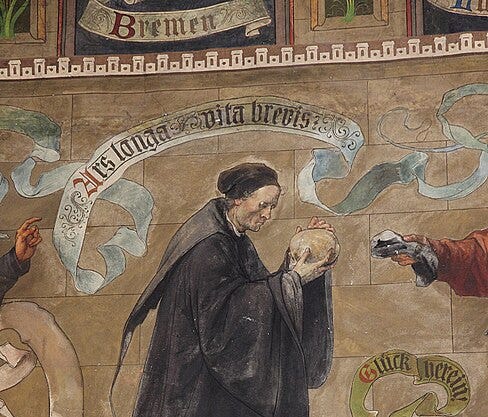
Ὁ βίος βραχύς, ἡ δὲ τέχνη μακρή, ὁ δὲ καιρὸς ὀξύς, ἡ δὲ πεῖρα σφαλερή, ἡ δὲ κρίσις χαλεπή.
(Life is short, and craft long, opportunity fleeting, experimentations perilous, and judgment difficult.) —Hippocrates, Aphorisms.
ἀσκεῖν περὶ τὰ νοσήματα δύο, ὠφελεῖν ἢ μὴ βλάπτειν. ἡ τέχνη διὰ τριῶν, τὸ νόσημα καὶ ὁ νοσέων καὶ ὁ ἰητρός: ὁ ἰητρὸς ὑπηρέτης τῆς τέχνης: ὑπεναντιοῦσθ.
(Practice, in regards to diseases, two things: to help, or at least, to do no harm. The art consists of three: the disease, the patient, and the physician. The physician is the servant of the art; and the patient must struggle against the disease along with the physician.) —Hippocrates, Epidemics (Book I, Section 11).
There goes life, if not for medicine. What wonders have been brought upon this Earth that equal the glory and goodness of medicine? Such a great art, unmatched in the benefits it provides to our very lives, and perhaps the most useful, practically at least, for the everyday functioning of man.
Medicine belongs to the interest of all mankind, is practiced professionally by physicians, and has always been looked at with admiration by those ignorant of its inner workings—those same workings which supply all the benefits a sick man can receive.
As with mathematics and physics, medicine belongs to that noble strand of science whose antiquity reaches so far into the past that it would be hard not to find a person living in the last ten millennia, say, who was not aware of witch doctors, folk healers, local alchemists, healer gods, and health magicians. So long as there have been sick people, there have always been those who profess to have certain techniques which can alleviate, if not outright restore, a person’s health completely. While the intentions have always been good, it can hardly be argued that most of the techniques employed by doctors throughout history have been effective; in fact, I would argue that of all the sciences which directly pertain to the study of man, medicine has undergone the slowest advancement of them all. This was especially noticeable during the Enlightenment, when seemingly every other year a new discovery was being made in mathematics, metallurgy, physics, engineering, anatomy, biology, etc. Thomas Young (1773–1829), a polymath and the greatest physician of his age, famously wrote in a poem his lament on the state of medical science during his era:
Medical men, my mood mistaking,
Most mawkish, monstrous messes making,
Molest me much; more manfully,
My mind might meet my malady:
Medicine’s mere mockery murders me.
Medicine, like all noble sciences, underwent a period in which the majority of its practices were total nonsense by today’s standards. No subject is ever born perfected, and so mankind must necessarily advance by small increments and overcome many longstanding dogmas if the level of care is to be improved and the quality of patient outcomes advanced to the point of saving lives upon every application of its art.
To speak of the history of medicine is really to speak of a history of errors, as well as to speak of every healing tradition that man, no matter where on the globe, has practiced at some time or another; and while that seems an interesting topic for historians of medical practice—I am no such man. I am a philosopher! I make no pretension to having any medical knowledge at all. I do confess it here at the outset: I am no shrink, no nurse, no medic, no doctor, nor even a doctor’s apprentice. I am simply a man who loves to speak on subjects he has limited experience with, but on whom he has many thoughts nonetheless; and I have many thoughts which I feel I must release into the world, expertise be damned.
One should never let one’s lack of qualifications prevent them from speaking on a subject they studied, though not to a sufficient degree to feel totally confident in it. If mankind were to defer to expertise in everything in thinking, there would be a monopoly on thought, and that would ensure a dictatorship in the republic of letters, which I feel can never happen. Accolades and scholastic achievements do not make a scholar, but rather steadfast resolve in seeking to improve one’s own understanding, while remaining humble in what one does and does not know.
I do not fear being incorrect in my judgments on anything. I rather welcome the idea of being corrected on every aspect of my thinking, in order that my values may be more in sync with my own comprehension of things. It is folly to presume oneself to know all, and worse still, to remain in the wrong when it comes to things that pertain to one’s own interpretations. An interpretation is never wrong in the academic sense, but it can be wrong with respect to one’s own heart—which is really to say, in conflict with what one understands from an analysis of reality. Are the perspectivists wrong when they say there are no facts, only interpretations? I would say your answer to this question determines your psychological temperament well enough and confirms to you just what kind of thinker you are.
In my own case, I am a thorough epistemological perspectivist (Nietzschean in all respects, if I may be honest), and from this I derive my worldview completely and utterly. I do not fear being incorrect, but rather fear having a worthy idea heard by nobody because I feel I lack the knowledge or qualifications necessary to speak my mind. For a philosopher in the tradition to which I belong, having an idea go unwritten is like a physician caught performing malpractice. At this point, I would rather die than pass over an idea or aphorism that contains the epitome of my being.
I have become such a great stylist in writing and have taken such a liking to my own thoughts that, at this point, not writing them down would feel like a complete betrayal of everything I have sacrificed to perfect this great art as much as I have. A writer must always have an idea of what vexes him if he is honestly to scribble down the whole truth and nothing but the truth with respect to his soul; in much the same way, a doctor must have an idea of what ails the patient if he is to make the correct diagnosis and proper prognosis—to say nothing of the therapeusis.
As a writer, my therapeusis is the page; my maladies are mental rather than physical, and I find the prognosis is always the same with me: a week-long bout of depression with periodic episodes of manic psychosis. The diagnosis, however, is always uncertain, for I find the most general attribution that can be considered a cause for all my illnesses is existence itself. The world is a stage, and every player I am forced to play alongside has a certain disdain for me—I suspect because of how contrary I am to them with respect to my character, manners, and overall laziness (at least in the eyes of the majority)—so be it, though; as far as I can see, we are all in the same boat. They have just as little going on within them as I do; the only difference is that I can turn my inactivity into the most incredible literary productions mankind has ever seen.
I know myself better than perhaps anybody else who has ever lived, and as a result, my writings are among the most honest things ever scribbled by man. I sometimes like to think that if I were not a writer, I would almost certainly be a musician (and I say this as a man who has never touched an instrument), for I feel a natural connection to the harmony produced by musical notes: my nature is never brighter or more cheerful than when I am listening to Mozart; never more powerful or unstoppable than when I am listening to Beethoven, Liszt, Alkan, or Wagner; never more sentimental or empathetic than when I am listening to Chopin or Tchaikovsky; and never more content and nonchalant than when I am listening to Satie. Though I cannot read music, I can listen quite well—and this, I feel, is really all I need in order to inhabit the spirit the composer was striving to put me in. As I said, I am so self-aware as a person that I am able to take the notes played in a piece of music and graft them directly onto my own temperament: I become what the music sings, and in doing so, I am able to compose in every emotional state imaginable, all resulting in drastically different compositions.
I often envy musicians, for I feel they’re more easily able to capture the heart of man in music than words ever can. Sometimes I catch myself wishing to emulate them so much that I call my own completed compositions musical scores—sheet music written in the whole alphabet rather than in the chromatic scale. I agree wholeheartedly with Tchaikovsky when he said, “Music possesses incomparably more powerful means and is a subtler language for the articulation of the thousand different moments of the soul’s moods.” The writer can only capture the soul within the span of a sentence—a paragraph if he is talented, and whole books if he is a genius (like Tolstoy)—but it is extremely hard to modulate and harmonize the emotions within the written word without sounding disjointed, confused, or totally extemporaneous, which only serves to mystify rather than clarify.
In music, a man can go from a C to G♯ (augmented fifth) relatively quickly; whereas in writing, there is almost no analogy by which to speak in terms of transitioning from one emotion to the next. What is the scale progression of love or hate? Is there a way to quantify, in terms of frequency, what the emotions feel each passing second? Has there been a calculus developed such that the instantaneous rate of change with respect to how we feel emotionally can be shown? Can the derivative of that function even be computed? I would scarce think it an elementary function.
The heart feels all, and yet, in literature—even for the greatest geniuses—it is very difficult to replicate in all its complexity without going either too far in the realist direction or too far in the stream-of-consciousness direction. A writer, when he feels he cannot express what he wishes to say exactly as he feels it, reduces the emotion to the point of making it fit within one of the well-established techniques (schools of thought in literature) in order to overcome it—but this is total dishonesty as I see it. Did John Ruskin find any parallels in literature when he was writing The Stones of Venice? What about Marcel Proust when he was writing In Search of Lost Time? Tolstoy when writing War and Peace? Or, perhaps more appropriate than all the rest, Balzac when he was composing that monumental encyclopedia of humanity, La Comédie humaine? I do not think any author—and here I include Shakespeare and Goethe—has yet found a way to accurately depict humanity in all its fullness, at least in the same way a symphony can. There is almost no comparison, in my opinion.
If an author really wishes to express humanity as accurately as possible—and represent all the emotions in all their rises and falls, taking account of all the externalities and chance circumstances that go into making that production—he ought to write a book ten times longer than the Bible if he is to get anywhere with respect to that. It is difficult enough to write a good paragraph, let alone a consistent book that accurately depicts the soul—so now just imagine how difficult it would be to write a book that reads with the same vividness and liveliness as, say, Mozart’s Don Giovanni, Beethoven’s Ninth Symphony, or Rossini’s William Tell.
To add insult to injury, a writer must always remember that what he writes one day will never exactly match what he writes the next day. Every writing session is a war, and each minute a casualty is suffered, and morale is always on the precipice of a dangerous fall. How does one write musically, though? As I have said in the past, experience has shown me that the best approach is brevity tethered with honesty: for brevity represents the variations of the soul—the rapidly changing emotions, that is—and honesty represents the key in which the composition was composed.
Some might think this rather obvious and maybe a bit too naïve, but to my own thinking this common-sense approach is best; one must never forget that music is more engaging than writing—for it requires less of an attention span—and so, as a result, writing should try to approach that spontaneity and rapidity of change with a kind of sprezzatura. Even the best books will not retain the reader if they are too long, which is why so many revere the Bible but few have read it in its entirety, if they have read it at all: the same can be said of many philosophical works, like Kant’s Critique of Pure Reason or Nietzsche’s Thus Spoke Zarathustra; and literary works have this as well, like Victor Hugo’s Les Misérables or David Foster Wallace’s Infinite Jest.
If one is to write musically, one must write in a style that best imitates the natural flux of the world and the ever-changing nature of the human heart; that is, one must write, if I may summarize in a word, aphoristically. Every four paragraphs should resemble the seasons: moving from hot to cold, wet to dry, calm to windy, mild to chaotic—everything must be said in them that the heart demands, and they should, at the cost of everything, represent the truth as you interpret it—not as it is, or as people collectively agree it to be, but as it reveals itself to your soul; it must literally sing, almost poetically. It is for this reason poetry better captures the heart than prose, but I am speaking from a prose writer’s perspective, for I am one after all—and I am a craftsman with the pen, if I do say so myself. On this point, Kafka is supreme: “Don’t bend; don’t water it down; don’t try to make it logical; don’t edit your own soul according to the fashion. Rather, follow your most intense obsessions mercilessly.”
Out of all the writers I have read—and, dear reader, trust me when I tell you I have read just about everything from Homer to Hemingway—those writers who perfectly capture brevity with liveliness are (in no particular order): Nietzsche, Emerson, Kierkegaard, Schopenhauer, Montaigne, Goethe, Shakespeare, Francis Bacon, Joseph Addison, Samuel Johnson, William Hazlitt, Laurence Sterne, and Richard Wagner (not in his autobiography, but in his polemical essays on culture and art during the 1848 uprisings—seriously, they are perhaps the most underrated prose writings of all time). In terms of how the writings should be organized, content-wise, I find no better example than Thomas à Kempis’ The Imitation of Christ, where a single heading is given that has under it many subsections which not only structure the work coherently, but allow the mind to wander over many topics in a manner resembling most closely, I think, how we actually experience emotion—contingently, by chance, on a dare, on a whim, on a blow of the wind which moves a leaf which in turn creates a butterfly effect. That is how writing approaches music most closely, I feel. If a piece of writing does not provide me with a sense of love for nature and the world at large, and fails to speak to my heart or uplift my spirits, then that is not writing at all, but rather vain scribbles from an individual who does not know the first thing about composition.
But I seem to have rambled on and on without actually addressing the subject at hand. I was supposed to write about medicine and ended up writing on how writing for me is a kind of medicine. I had plans of mentioning men like Susruta, Hippocrates, Galen, and Avicenna, but it seems my mind was not interested in exposing all of their errors, as Cardano already did in his longest work—Contradicentia medicorum libri (Contradictions of the Physicians), a 628-page polemic against the whole history of medicine up until his own time. If I may end with a quote by Leibniz on what I think medicine should be, I give it here:
Moral and medical matters: these are the things which ought to be valued above all. For this reason I value microscopy above telescopy; and if someone were to find a certain and tested cure of any disease whatsoever, he would in my judgment have accomplished something greater than if he had discovered the quadrature of the circle.
And also,
“Human life is a sacred thing”; therefore it “should never be subject to the marketplace.”