
Nature
36th installment to my philosophical system.

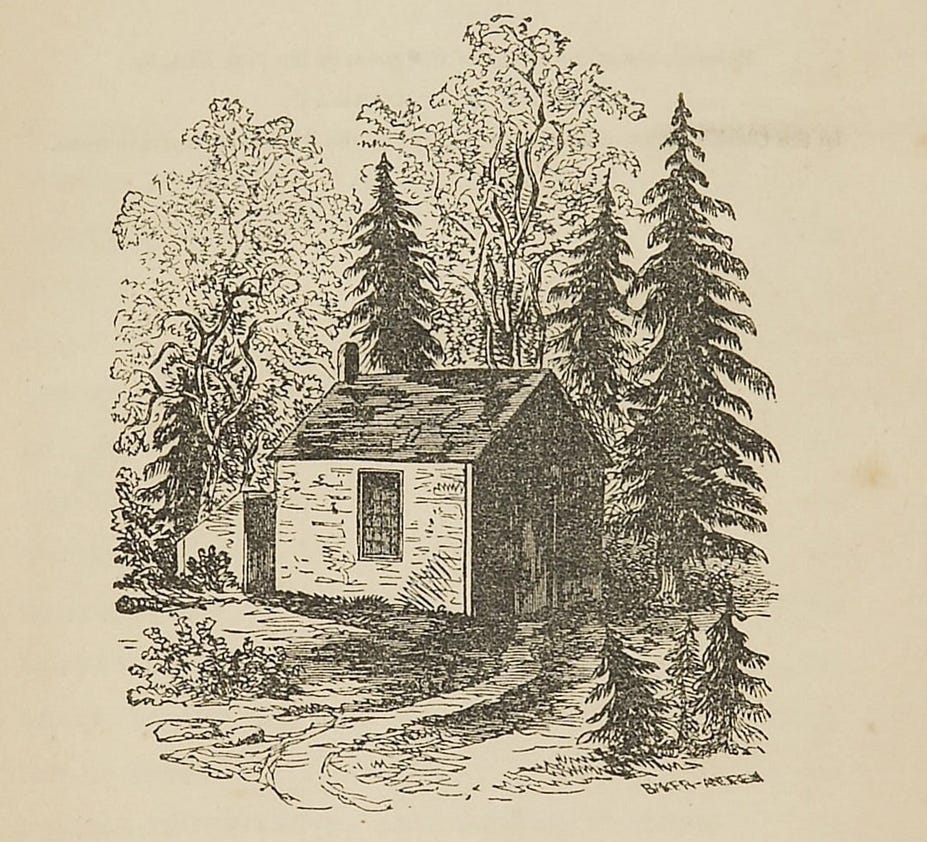
I wanted to live deep and suck out all the marrow of life, to live so sturdily and Spartan-like as to put to rout all that was not life, to cut a broad swath and shave close, to drive life into a corner, and reduce it to its lowest terms.
—Henry David Thoreau.
When I look out onto the world and look past all the superficial things which are taken as truth today, I see the true meaning behind nature. I am a man thoroughly in love with nature, and I only wish it were possible to instill this kind of passion in others without effort.
All my life, I feel, was lived in disregard of nature. What nature was to me before I knew her was merely an abstraction—something enjoyed by people who had only sense enough to quickly discard her when reality came calling. I never heeded reality, however. The creative soul, the wanderer, the seeker, the yearner, the existential enjoyer—in short, the philosopher of life (poet of existence)—has never been one to take reality as it is, but rather to see in reality what it should be.
The distinction between the descriptive and the normative has always dominated the psyche of man; the descriptive is in the ascendant today, but it is, thankfully, on its way out—as more and more see the necessity of community and sympathy between individuals, rather than the morose isolation and egoism by which we have been led. These influences come from without, with no relation to anything within ourselves for ourselves. The normative, the subjective, the spiritual, the mystical (whatever you wish to label it) has more or less been relegated to a kind of esotericism—something to be looked at in awe, but not really deeply understood, let alone practiced; and if it be practiced, it is done in a very shallow and meaningless way.
I’ve never been one to really allow the world to limit my heart. My interests were always paramount, and always to be followed without the slightest hesitation or distraction. My life is one long passion with the damned and demented; in fact, the word “passion” alone may have sufficed, for if we look upon our Lord and Savior—Jesus Christ—we see in his Passion the final steps within a long journey that make up a story worthy of changing all of history. What is it within the whips, and jeers, and crown of thorns, however, which makes us come unto him with reverence and awe? Indeed, I know many people converted merely on a single telling of the Passion narrative, but again I ask: why is the nature of suffering in Christ so supreme that we give ourselves up to him and follow him almost forever after? It is in his sufferings that we see ourselves. Jesus is like a mirror from which all of humanity’s deeds are reflected for all to see. Jesus spoke for all humanity with his death and was the final sacrifice needed for man’s salvation. That is the power of the story, after all: that a man was willing to die for us, for all his children, only to return again after three days and ascend beyond this world to a place where he reigns like a king, but much more powerfully than even the greatest conqueror of Earth.
Again, what is great in the Christ story is that there has only been one Jesus, and there has only been one true sufferer when thought of from the religious perspective. The subjectivity of it is immense. The sensation one feels at the thought of Christ is unlike any other: so much immensity, so much depth, so much power—all born within the breast of a single man who knew himself to be the Savior, the Son of God, the true prophet of whom the whole Tanakh spoke. Such incomparable magnitude is nearly incomprehensible for any man to describe. We are in Christ when we speak of our passion, for his passion is like our passion, but much greater—so great, in fact, that it transcends everyone else’s. His suffering was so full and complete that, within it, every other person can find something to relate to.
But I think that’s enough exegesis out of me. I only wished to call to light what the Passion meant to me. The passion of Christ is the passion for all mankind. But I want to return to a phrase which I did not emphasize when initially writing: “and thus follow him almost forever after.” The important part here is almost. Why almost? Am I not a believer? Are the sufferings of Christ nothing to me? The truth is, in Christ I find myself, but I do not subscribe to any doctrine, dogma, denomination, sect, or creed regarding him. It is not that I place myself above God, but that I only find myself in Him, and I do not place myself beneath Him. I am a follower of Christ in the same way I am a follower of Muhammad, Mani, Valentinus, Buddha, Zarathustra, and Socrates. In truth, like every great mind—be it sage, syncretist, mystic, poet, prophet, philosopher, novelist, or existentialist—I am a follower of myself, like every true individual that has ever lived. There was no Christianity before Christ, no Islam before Muhammad, and no self (subject, in an existential sense) before me.
My shadow is really the only one who knows me, for like it, I exist, yet I feel when I consider life honestly, I do not think, and therefore am not, and can never be—just like the shadow which cannot be without the object to obstruct the light. The light of my life is really only comprehensible when I see the shadow of my ignorance regarding the source of it. The moon may shine, but only because the sun allows it to be so; otherwise, there would be an eternal new moon, which would grow old very fast, I feel.
It is in this ignorance that I search and destroy, collect and discard, gather and waste. Is this not the greatest passion of all time? Does one not feel their life so internally and powerfully that they could turn their individualities into their personal religions? Could one not consider their very selves like Brahman to the Hindus, or like the Dao to Daoists, or like nature to the Romantics and Transcendentalists? Ah, this ignorance of life… this very aspect of singularity made to survive in a world full of contradicting pluralities, amongst others, amongst other omnipotent individuals. How, when faced with such a situation, is anyone really to humble themselves before existence and not go mad at the prospect of it? Didn’t Pascal and Kierkegaard find the answer in God, and Emerson and Nietzsche in nature, and Schopenhauer in the will, and Tolstoy in love, and Kafka and Camus in the absurdity of existence itself?
Didn’t all great thinkers return to the Earth and either spiritualize or humanize it? I like to think everyone’s meaning, or purpose, is monistic—from Platonism to Irenicism: from the Forms to matter, from the Nous to the Monads, from animism to atheism—man’s search for meaning has always been dependent upon himself. That is the one premise which upholds all of existentialism; nay further, humanism (as Feuerbach defined it) is but an extrapolation of the religious impulse—but placed within ourselves, where it originally was, rather than outside ourselves, where most today think it to be. The true and final religion, in that sense, is humanism.
The greatest misfortune in the history of mankind was the triumph of abstraction over man: where man became submissive to himself, submissive to his own ideas, and relegated his whole activity to propitiating what he thought was right, rather than what was actually right for his own life. I once said that any man who wishes to treat religion in a purely objective (rational) way will either become a Spinozist or an atheist; they will either treat their holy books literally or allegorically (spiritually)—but true individuals who know themselves will treat it like neither, but rather pragmatically, that is to say, in both aspects. For, again, the point of belief (or faith) is not to forget your humanity (individuality), but to uplift and encourage your humanity. Kierkegaard, like Jacobi and Tertullian before him, is supreme on this point:
Faith is precisely the contradiction between the infinite passion of the individual’s inwardness and the objective uncertainty. If I am capable of grasping God objectively, I do not believe, but precisely because I cannot do this I must believe.
Where is the upliftment in anything? Where am I in anything? Where am I supposed to go in order to find myself within this vast sea of nature which constantly pulls me in every direction and which leaves me without a rudder to steer with? I say it is within you, in your heart, soul, and mind; it is in your love for others and in your hatred for the wicked; it is in your fortunes and misfortunes, your victories and your defeats: in short, it is in your life. Every answer to the question of life’s meaning—if we are to take it at face value and not skirt around it—will necessarily be recognized inwardly but understood outwardly. It is in the internal recognition of our actions from the external world that reality appears before us—both manifesting in our minds and in the world at large.
Reality is both becoming and perception, will and representation, appearance and existence—whatever delineation you like. The only thing you must remember is this, dear reader: the world is a mess, and society will provide you no answers, for the world at present is run by people who see no qualms in needless immiseration so long as they benefit from it. Therefore, you must trust nobody but yourself ultimately and find strength enough to move beyond the Zeitgeist and create for yourself a new paradigm by which to live, in order for others to do the same.
As much as it pains me to admit this—for I spent a year of my life thinking this—individuality alone will not save you; a benign form of universal egoism (essentially socialism with democratic characteristics) is, in the long run, no different from hell. A world in which everyone sees each other as a means to an end, rather than an end in themselves, is a world made for beasts, demons, and everything non-humanitarian. Almost everything in the world at present is hateful to me because nothing in it is true. There is so little honesty in people because they hide their true motives under a litany of false justifications made to seem strong using absurd assumptions and entirely wrong presuppositions. It is this reason that makes life seem no different than a bad joke. What a joke this world is, this cruel experience, this absurd state of things; a man can hardly understand why he lives, let alone comprehend what he lives for. Isn’t it much better, then, to live without trying—to stop taking it all so seriously, treating everything as if it has a reason for being or a final answer—as if life were a multiple-choice exam? Let’s be serious now—stop taking even the moonlight seriously; there’s nothing in it anyway but the whole of earthly joys. What little that will be when faced with the oblivion of time, from which there is no escape and no medicine powerful enough to forget completely.
I am, if I may be allowed to speak without vanity, a man who finds meaning in the unending search for what existence really is. That is why I described my life at the start of this as one long passion (suffering) with the damned and demented; by “damned and demented,” I really mean those whom I sit alongside and who are, like me, absolutely stunned and bewildered by what life really is. That is why I find myself in every great thinker, sage, prophet, or poet who, again like me, sought the answer to the universe—I see myself in everyone who has ever been and would die before I relinquish myself, my reason, and my individuality for the sake of a false consolation that comes from being told what is true, rather than discovering what is so on your own.
Nature to me is the world, is humanity, is being human. Most questions to life can be answered by simply staring at a tree in my view. There’s a famous anecdote about Henry David Thoreau regarding this feeling of nature as the ultimate source of all things beautiful and the truth of all things human:
Why, one morning I went out in my field across there to the river, and there, beside that little old mud pond, was standing Da-a-vid Henry, and he wasn’t doin’ nothin’ but just standin’ there—lookin’ at that pond, and when I came back at noon, there he was standin’ with his hands behind him just lookin’ down into that pond, and after dinner when I come back again if there wasn’t Da-a-vid standin’ there just like as if he had been there all day, gazin’ down into that pond, and I stopped and looked at him and I says, ‘Da-a-vid Henry, what air you a-doin’?’ And he didn’t turn his head and he didn’t look at me. He kept on lookin’ down at that pond, and he said, as if he was thinkin’ about the stars in the heavens, ‘Mr. Murray, I’m a-studyin’—the habits —of the bullfrog!’ And there that darned fool had been standin’ —the livelong day—a-studyin’—the habits—of the bull-frog!
This recollection of the neighbor’s regarding the habits of Thoreau informs us more than I think we can bargain for. There is in this single anecdote the whole universe—I say truthfully. What Thoreau sees in nature is the whole expanse of creation, laid out for man to take part in. Man is not merely some passive receiver of sensations—sensations which astonish him temporarily, but which can just as quickly be forgotten—but a participant in creation every time he observes nature. The glory of nature is almost enough to make me affirm God Almighty. I said before that I feel God in the Passion of Christ, but the temptation is just as strong to affirm Him when I look out into the world and see everything that is magnificent in it.
Just think about it: you’re sitting there out in the sun, as far from anxiety as one can imagine, and while you sit, bathing in all that heavenly glory, you notice a little bullfrog hopping about—you wonder, “Maybe it’s looking for a partner, maybe it’s hungry, maybe it just wants to go for a hop in the sun.” All these thoughts hit you at once, and immediately you come to the correct conclusion about that little bullfrog: it’s just like me. Am I not like that little bullfrog, hopping about, looking for something to love, something to do, something to enjoy and take part in? I, for one, would like to think I am just as glorious as that little bullfrog, come to think of it. If I may be allowed to quote Emerson regarding this matter:
Who is he that shall controul me? Why may not I act & speak & write & think with entire freedom? What am I to the Universe, or, the Universe, what is it to me? Who hath forged the chains of Wrong & Right, of Opinion & Custom? And must I wear them? Is Society my anointed King? Or is there any mightier community or any man or more than man, whose slave I am? I am solitary in the vast society of beings; I consort with no species; I indulge no sympathies.
Man is but a part of the world, but the whole of his essence. Me and the little bullfrog are solitary in the vast society of being—this “being” is nature, and like your own subjectivity, it is the truest truth that truth can truly be; it is the truth of all truths, the truth above all other truths. One finds in the presence of truth that which is numinous and ineffable—even atheists become believers when they stare at the moon, for who would be so bold as to proclaim the moon an empirical fact only, and nothing more? Nay, nevermore, nevermore; the raven atop the bust of Pallas above my chamber door is not merely a sign, but a whole realm of existence—this raven is but one aspect of the whole essence of reality.
Like nature, I am one with it, and come unto it with reverence reserved for something above myself; that is the problem with most people today: the things they place above themselves are really below them and are beneath notice and contempt when you really understand how trivial and unimportant they are in an existential sense. I talked earlier about the descriptive and the normative—that, too, has to go: the whole notion of thought being divided into two, or unified in one, or three, or four, or however many you wish to make the world out to be. The world to me is like God to a Thomist: apophatic, negative, never to be predicated in positive terms, but merely in negative ones—what it is not. The world is not anything but that: itself. The world is ipsum esse subsistens (existence itself), and in that self-same actuality, I find all that one could need in life. That certainty I feel regarding nature’s nature gives me hope beyond everything else.
What I find in nature is really a relation with myself, between me and it: I feel a part of this it because I know I am it; I am nature, in nature, loving nature, sustained by nature, and see every aspect of myself in nature. I am, in truth, really lying when I speak on nature, for her source is so great and inexhaustible; all we really do when we talk about her is merely mention an aspect of her, never do we enjoy nature fully, solely in love for the sake of love itself—that to me is what the whole world shows itself to be. Nature is powerful because she confuses the logicians and amazes the naturalists; when one wishes to speak about her logically, they instantly sound incoherent and contradict themselves at every turn. Who is the one person alive smart enough to turn the beauty of nature into a syllogism? I pity the fool vain enough to actually think they’ve apprehended nature by merely restating what they’ve seen in their own words. Nature, like our life, is beyond words, because our intellect can’t conceive what nature is beyond us—there is no knowable noumenal in this respect, only the phantoms of the phenomenal.
So be it, though… for life: it is enough, it is enough! The dialectical interplay between all things washes over everything—the ever-evolving response to and from the interactions played out in the world are what constitute what we are, and what we are, we are. No amount of categorizing, systematizing, organizing, connecting, and relating will ever deduce for you the true purpose, the true meaning, of life. Only in moments of silence, when the sounds of the world no longer hum in your ears, can you hear the inner voice from within speak the truth which transcends you: that is truth, that is nature!
It is only necessary to behold thus the least fact or phenomenon, however familiar, from a point a hair’s breadth aside from our habitual path or routine, to be overcome, enchanted by its beauty and significance . . . To perceive freshly, with fresh sense, is to be inspired . . . My body is all sentient. As I go here or there, I am tickled by this or that I come in contact with, as if I touched the wires of a battery. I can generally recall — have fresh in my mind — several scratches last received. These I continually recall to mind, reimpress, and harp upon. The age of miracles is each moment thus returned . . .
We get only transient and partial glimpses of the beauty of the world. Standing at the right angle, we are dazzled by the colors of the rainbow in colorless ice. From the right point of view, every storm and every drop in it is a rainbow . . . I have seen an attribute of another world and condition of things. It is a wonderful fact that I should be affected, and thus deeply and powerfully, more than by aught else in all my experience.
—Henry David Thoreau.