
On Essay Writing
Essay 16

My mind is suddenly vivified at the ready apprehension of a proper thought. God, how long have I waited! How dreadful these past four days of March have been to me—unable to give me proper support either in leisure or tranquility—under constant and perfidious attacks of some disturbing sound from my family or from outside (some moron revving up his car engine like he’s some mechanic. He tells me it’s good for the oil to circulate, as if the oil that starts the engine were like blood in the body!), or from the natural shortness of my own profundity.
It’s difficult for a scholar to cohabitate with people who resemble more the barbarous Gallic tribes than the dignified Roman legions, to say nothing of the golden and immortal Greeks—who, from the sheer ingenuity of their minds, founded the intellectual concepts that prop up the West, while also giving us some of the most sublime poetry ever penned!
To get to my actual topic, however, it has been over four months since I wrote my first Substack post, and I make an attempt here to rectify—or rather, make right—what I perceive to be an error when scribbling that first triviality.
As a matter of fact, if I may be allowed to set the record straight, the topic of the essay I write here was supposed to be the one I was to write initially. Instead, either in my timidity or in the overpowering affectations of my mind when I set out to write that first essay, what became On Writing Introductions was originally supposed to be the one I pen here, On Essay Writing.
The nature of the mind never finds a fixed place upon which to always stand. Rather, in the natural recognitions and forgettings of this or that sensation, man’s whole intellect becomes fixed on one or two things and quickly becomes transfixed by the next, in complete ignorance as to why he set his initial inclination on the first thing to begin with.
If man could have complete transparency with himself and be master of all his thoughts at all times, there would be no ambivalence about whether what he reflects upon is worthy of him or not. Mankind’s spirit of inquiry and interest in academic matters are but temporary. His constancy in this or that process of reasoning is fleeting; like the ocean tides, he rises with the scholars one ebb and debauches himself with the carnal enjoyments of the world in the other. Instead of being a consistent peripatetic like Aristotle, or being a real follower and observer of this or that image upon the cave of Plato, or a real scholarly individual—albeit haughty and intemperate when it comes to receiving his ataraxia, like Epicurus—he shifts about here and there without the slightest care or appreciation for constancy in his noble purposes.
It is natural to be inclined only toward those things that make a man happy, but the introspective man, who thoroughly cares how his time is being used each day, always has about his mind what goodness he has done, or in what way what he enjoys is beneficial to his future endeavors. I say here, to actually relate to the title of this essay, that the essay writer must have each foot in opposite camps. It is degrading to the senses to have the mind only upon reason—what this or that thing is in factuality—rather than what the sensations have to say about it. However, it is too overstimulating, and equally degrading and detrimental, to always have the mind upon pleasure and good feeling—for in this way, one becomes too accustomed to good feelings, and suddenly what was once a pleasant surprise now becomes a dreary bore, not worthy of remembrance or consideration. This is why I say one must be willing to have each foot in different camps, so as to proportionally balance each other out.
A good essay writer never ignores reason, nor is he overindulgent in it; and likewise, never is he completely the romantic or sentimentalist. One must be willing to emulate Rousseau and Byron on the one hand, and on the other, become like Kant and Newton. This is why all the world-renowned essay writers—Schopenhauer, Emerson, Dr. Johnson, Hazlitt, Montaigne, Bacon, Nietzsche, Goethe, Addison, etc.—always maintained their logical consistency in composition while also making everything they said utterly beautiful, with much attention placed upon this or that sentiment.
The essence of all pretty writing—purple prose, as it’s occasionally called—is to ensure much contrast is used for each thought; that is to say, each thought should contain something in it that relates back to the senses, something that makes it picturesque, that makes us pause for a second to conjure up what is said in our own minds. This doesn’t only have to relate to scenery or setting. One could make a very vivid description of how they were feeling internally at the moment they felt something. This is what made Shakespeare the greatest writer history has known: his ability to vary his blank verse not only with the purpose of forwarding the plot—quite boringly—but also by providing, at times, internal monologues of the character’s inner subjectivity, what they felt given the situation they were put in, with profound relatability. Universally, almost, has he been accepted by all, because he executes every plot device with delicate precision while also enriching the reader with the elegance of his language.
Another thing the essay writer must be—aside from a chameleon, adopting rational or sentimental styles at a whim for the sake of the writing—is a sage. The writer must compress the thought but never the sentiment. They must provide what they think in complete honesty without losing the grandeur that hit them upon the initial reflection. Complete brevity with earnest adherence to honest representation, but never without beauty or delicacy. Pithy must the writer be. Never become a bore in anything you describe, no matter how commonplace. Word count matters only for those who love writing for writing’s sake. I used to believe that if you were a good writer—a truly elegant writer whose powers far exceed the average scribbler—it would be your duty to fill the page endlessly with all the insights your powerful mind has gathered. But I now think that one who gives only the best of their daily reflections, who selectively provides the reader with only the most powerful and provocative of their thoughts, is the far greater writer. The modern sage, just like the ancient Sibylline Oracles and soothsayers, should give what they think in a manner that is at first confusing, so as to make the receiver puzzled—for this allows more profundity to be had when they finally acquire a taste of understanding.
One cannot fully appreciate a parable until after they have ruminated upon it. Wisdom is anything but swift. It doesn’t come at command like a dog; rather, it requires much wooing and careful petting if it is to be brought under our command. Nor is wisdom under any obligation to make itself pretty for us or present itself in a manner that is appealing. What the essay writer must do is conform the sentiments of each feeling with clarity, inconfundible clearness, like glass. Most writers' compositions resemble a dirty church window more than anything else. They think themselves profound when, in truth, they wrap up what they think in incoherent verbiage, and this haziness gets mistaken for the epitome of profundity. They think they perceive something in the turbidity of the light, when in reality they glance at nothing but phantoms and mirages, brought on through their own lack of clarity—so much impreciseness that they confuse themselves, and so, like Hegel, remain alive and in the minds of others merely on account of their own delirium in writing.
Sage-like, too, is the writer who listens to the echoes and reverberations of their initial thoughts. Let me make clear right here, hopefully for the rest of time, that the best of writers is he who enters the gauntlet of his own reflections dauntlessly, without fear of mania—let death appear like a mockery to him when compared to wrestling with his thoughts. A writer must have the passion of a radical jihadist, a person who, as they say so often in those utterly benign and overly masculine propaganda videos: “We love death more than the infidel loves life!” Now that is real courage—a man willing to die for what he believes. As detestable and utterly reprehensible as these cretins are on the whole, one cannot deny that they say every word with complete conviction; they really have no qualms about dying for what they believe.
The writer must be just as fearless—in fact, more so. Anyone can die for a falsehood they think true; but who is willing to die for something they themselves cannot understand? Shall we all not wish to venture into the depths of our character, to inquire into our soul, to ponder what we receive at this or that moment, every second? Who among us is willing to do such a thing? Has there ever been a man with so much courage and utter power of mind to withstand such an onslaught? Nay, I think no one there has ever been. Nietzsche became insane with the thoughts he prophesied. Emerson lost his mental faculties at the end of his life. Goethe was unable to conceptualize the second part of Faust. Dr. Johnson dealt with several bouts of depression from his reflections, especially upon death. Bacon was under constant assault from the practical affairs of the world, which ate much of his time for contemplation and ready apprehension of this or that thought. Montaigne had to lock himself away in his tower, surrounded by books, completely free from all the cares of existence, to truly paint himself upon the page. Kierkegaard, perhaps the most vibrant and honest soul humanity has ever seen, occupied himself with a single thought his entire life without any deviation: “What does it mean to exist?” All these writers were fearless in their approach, but so too were they puzzled at their own complexity, at their own existence, and the nature and mechanics of their own reflections.
At the heart of all good writing is an honest apprehension of what you yourself think in the exact moment your neurons fire. Often does thought profound enough to put upon the page resemble more an epiphany—maybe even a rapture, as Jerome described—than something which you just hit upon by accident. I’m amazed at my own incompetence when it comes to expressing what I truly feel; and yet, the greatest of all writers are they who can perform just that in the most concise manner possible. Let us writers never forget what Goethe once said—indeed, it may be said he was speaking not merely of his age but for all times with this one:
Alles Gescheite ist schon gedacht worden, man muss nur versuchen, es noch einmal zu denken.
(There is nothing worth thinking, for it has already been thought before; we must only try to think it anew.)
All writers, hear me! Take every utterance I preach henceforth with due seriousness: I say that one can write in whatever manner they wish, so long as they make variations upon the same thought in a manner that gives it life. You are free to express yourself on anything you wish, so long as it be done in a manner that makes it filled with existence, personality, joy, truth, honesty, brevity, clearness, and, above all, meaning. Make it have a message; become sage-like, as I said earlier. Give the reader something which they themselves might have missed in their own reflections throughout the day. Do not write as if you were trying to convince; write as if you were trying to awaken—to awaken something in the reader. This can only be done by those who perceive in their mind readymade thoughts, that is to say, half-baked thoughts that become supreme as they are reflected upon more and more.
Style is another thing that the essay writer cannot avoid. It may have been touched on in previous reflections thus far, but not fully explicated. Style is the form in which our thoughts conform to our subject. In the classical, and especially the neoclassical, authors, they always say that writing comprises two aspects—the form and the matter: where matter is what we write about (the subject), and form is how we present it (the style). Style, as Erasmus so elegantly put it in the Ciceronianus, is forever to be subordinate to the ends which we aim to procure in our diction. For example, he says:
But let your first and chief care be to know the subject which you undertake to present. This will furnish you wealth of speech and true, natural emotions. Your language will live, breathe, persuade, convince, and fully express your self.
And also says,
… Any diction is cold and dead which does not come from the heart.
And elsewhere says,
Further, I do not approve of the imitation of one copy from whose lines you would not dare to depart, but that which culls from all authors, and especially the most famous, what in each excels and accords with your own genius, — not just adding to your speech all the beautiful things that you find, but digesting them and making them your own, so that they may seem to have been born from your mind and not borrowed from others, and may breathe forth the vigor and strength of your nature, causing those who read to recognize, instead of a mosaic drawn from Cicero, an offspring of your own brain as they say Minerva was of the brain of Jupiter, reflecting the living image of the parent, so that your speech may not seem a patchwork, but a river flowing forth from the fount of your heart.
Lastly, he says,
He makes but a feeble effort toward Ciceronian style who approaches the task without being previously trained by the reading of many authors, by the knowledge of many branches of study, and by acquaintance with a wide range of subjects, not to repeat what has been said about natural ability and practical judgment.
Indeed, reader, I have more or less followed in the footsteps of Erasmus in this regard down to the letter: autodidactic in full, proud of all the mistakes I made along the way, and happy that I am ignorant in those things which I care little for. Much time has been wasted, but what youth doesn’t suffer from misapprehension at the thought of approaching those they admire in learning? It is common for the love of learning to get carried away with us, and in turn, turn us into mere bookworms and compilers of what others have said—as I believe Grotius and Montaigne were wont to do—which is why I refuse to ornament or beautify what I say with the culling of other people’s thoughts; rather, I prefer to make my own thoughts worthy of quotation. Let every thought appear as if it were written only after hours of much difficulty in providing the proper syntax.
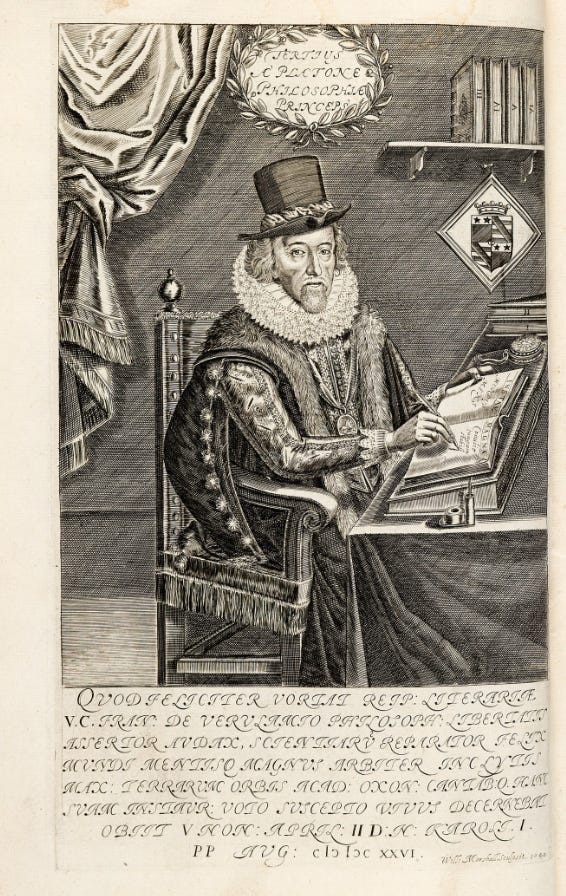
All writers should strive to write in a manner that is worthy of praise—praise of the kind Will Durant gave of Francis Bacon (a man I myself adore and try my utmost to emulate in style):
Rarely shall you find so much meat so admirably dressed and flavored in so small a dish.
…
Bacon abhors padding and disdains to waste a word. He offers us infinite riches in a little phrase. Each of these essays gives, in a page or two, the distilled subtlety of a mastermind on a major issue of life.
…
It is a style like sturdy Tacitus's, compact yet polished, and indeed some of its conciseness is due to the skillful adaptation of Latin idiom and phrase. But its wealth of metaphor is characteristically Elizabethan and reflects the exuberance of the Renaissance. No man in English literature is so fertile in pregnant and pithy comparisons. Their lavish array is the one defective element in Bacon's style; the endless metaphors and allegories and allusions fall like whips upon our nerves and tire us out at last.
The essays are like rich and heavy food, which cannot be digested in large quantities at once, but taken four or five at a time, they are the finest intellectual nourishment in English.
A final consideration must be made, I think, and that is on the natural flow of ideas. All our sentiments are contained in a single good idea just waiting to be had. Indeed, a whole day may be revealed in writing that is inspired by a single thought that occurs to us in the most mundane of situations. Notice, dear reader, how every sentence I pen draws from the previous sentiment, and also notice how each sentiment receives its own investigation as its own paragraph (almost all the time). That is, in a sense, what it means to write aphoristically—the approach I always take. To stroll through the flowery groves of our mind and rest upon a mossy rock within a glimmering grotto, where the shadows of Plato’s forms compel us with this or that suggestion. Now, that previous sentence is a beautiful example of my power and is precisely what I wish to convey: look at how I draw on the senses (flowery, glimmering grotto, mossy rock) while also including various verbs (stroll, rest upon, compels us). This is the essence of all writing, I think—nothing better than allowing each initial perception to be viewed as the greatest thought we ever had, or as if it were the last thought we were ever to think. I could go on further with examples and explication, but I think that would be to sin against my rule of brevity from earlier. Allow me to summarize with a quote from Emerson’s journal:
As there is always a subject for life, so there is always a subject for each hour, if only a man has wit enough to find what that is. I sit Friday night & note the first thought that rises. Presently another, presently five or six—of all these I take the mean, as the subject for Saturday's sermon.
This is how I, too, approach my every composition. The number of thoughts we could think—some profound and some that can be turned so—is so inconceivable and innumerable that it is better to defer to the natural affectations and sensations that make themselves most readily available to us in the moment we set upon writing. Fear not your own thought—merely listen to it, to your heart, really, and all you write should be grand enough to read and worthy enough for praise.
With that, I think I have provided all I think on what the essay writer should strive for. Let the style live, let it be honest and from the heart, let it be concise, let it draw on the senses, let the diction roll off the tongue, let it bring a smile to one who reads it, and lastly, above all, for God’s sake, let it be anything but boring. That is all.