
On Tiredness
Essay 24

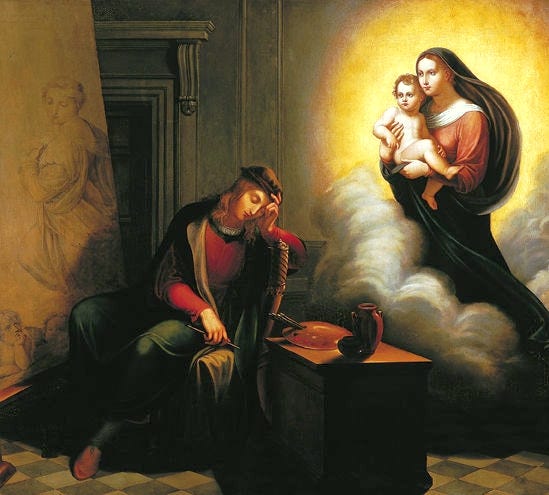
A silent mind is a peaceful mind, but a tired mind, even in the midst of great silence, cannot find itself at peace. There is nothing more taxing on the will of an individual than being amongst the ranks of the narcoleptic. What becomes of our great intellect when oppressed on all sides by a deep haze? From where does all this graininess come? And to what end is all our labor when done under the finger of tiredness? There is a certain tragic aspect to tiredness. Under its spell, one can either feel liberated, freed from the confines of a schedule placed upon us by societal constraint, or enslaved, unable to provide anything because the weight of our eyelids is insurmountable—to say nothing of our weary limbs, our scattered thoughts, our confused confessions, and our rejected advances on sleep herself.
Doesn't one feel like some tragic hero whenever battling lethargy with insomnia? It's shocking to see how cruelly we are treated when we miss a few hours. And to think we're repaid by this lapse in judgment, or more likely, honest mistake, with the cold embrace of nothingness: slow, dazed, confused, stuttering, doddering, lamenting—all such things we become when bereft of sleep.
A dearth of sleep is the touch of death. To become tired is one thing, to feel tired is wholly another. The light of day awakes the soul, but the spirit lingers in misapprehension when under the shadow of a noontime sun. Time is but a machination—a deadly conspiracy—against the waking man. As one is forced to rise at the crowing of the rooster, and have sprightly dawn break upon the sky, they feel themselves empowered and encouraged to seize the day; but one, perhaps a solitary individual, up since the turn of day, is made timid by such a sight. To be the first to hear the morning of the Dove, the laments of the Loon, the pecking of the Woodpecker, and the caw of the Crow is not an achievement to boast of. It is a sign that one has made night their mistress, and that the passing of an hour is just as innocuous as a second.
The annals of time are long, but the interstices short, and within such shortness is the allegory of our life. While the man who becomes tired does so as a result of his punctuality, performing all his necessary labors in due order without much trouble, the man who feels tired becomes so from his own industry; being up long before everyone else, he relishes the silence, and pursues his passions with the greatest alacrity—and, not one to be outdone by more temporally conforming fellows, he makes it a duty to remain awake long after these men have shut themselves from the world. He wears his baggy eyes with pride. There is a sense of joy that comes with knowing that you are the one who watches the sun make its entrance. Often, and with good reason I think, man stays up longer than he needs to as a matter of principle. Much can be done when time is all you possess. The wise man makes his time work for him; the fool scarcely knows what time it is.
A solitary individual, devoid of any idleness or worthless ambitions, views time as merely a means by which to further his own grand ideals. Think of the solitary reader who recalls that maxim of Samuel Johnson, saying, "Any man who devotes five hours a day to reading can become learned within a year." And so, feeling inspired by the prospect of all the riches that avail a man of culture and humane learning, he sits upon his sturdy chair, book in hand, and reads well into the night. There is no immediate danger in so useful an occupation, but taken to the extreme, as all men desirous of recognition for their intellectual acumen are wont to do, they place upon themselves greater burdens than they realize—making themselves tired as a result, and are thus smitten with their own heroic sacrifices for the sake of their erudition. Thus do we have the makings of a man who is permanently in a state of 'feeling tired.'
A man who comes home after a long day of toil feels he has earned his rest, and is thus able to sleep on command, but our solitary individual, our loner, our free spirit, our intellectual, isn't afforded such assurity. In his mind, his labors are trivial. He feels he contributes nothing to the world, and that all he writes is trite garbage—just a rehash of some previous idea already perfected by a long-dead master. He labors well into the night, and yawns plenty in the day—the light of which passes over him without his notice. He is found disheveled: messy hair, bad breath, half-eaten food scattered throughout the room, dirty clothes, and, worst of all, a strong excretion emanates from him; this pale, emaciated bundle of bones has seen better days—he knows it himself—and yet he must continue on. To him, labor is his life.
To become tired is to be perpetually dissatisfied with your own progress. There is always a sense of urgency in the intellectual. A deep anxiety makes itself apparent the moment you catch a glimpse of his face. He wears himself out, grinds himself to dust, and in the end wishes nothing more than that sanctuarius quiet met with only in sleep or death. He wishes himself to be dust, to never breathe again, but finds himself unable to carry through with it—and so he lingers perpetually between sleep and death, sleep and death, sleep and death. The clock stares him down, however, and with each passing second he feels more and more helpless. There is nothing he can do.
Man is so designed to adapt to his situation, but should the burden be too much, he may find himself extinct. This is another problem universal among scholars: their ambition to take on more than they are capable of. Letting the experience of life be witness to so many fatal ends, distractions, and shortcomings, one becomes all too cognizant of how little time we really have. It would be befitting of everyone to follow in the footsteps of Proust, and search for lost time with every passing second. With each undulation of the pendulum we find that it is isochronous, and so, with each passing second being equal, so too are our sufferings in this world, all equal.
Life is isochronous, only made distinguishable by our varying levels of cognition. What becomes of us when tired is of little importance—only that we forget about thinking for a time. We pass time hoping to use more of it when our situation is appropriate for it, but when in life is the situation ever appropriate? We continuously dance between death and life as we live. From beginning to end, we find the ever-present time, and its dear companion death, follow us like some ravenous beast. We are given no moment to ponder or reflect. What we are faced with in life consistently is the desire to sleep, on the one hand, and the desire to move, to be active, to become a living verb, on the other. The intercourse between the two is what we call action, wretched affairs we undertake for no other reason than custom, that get us moving about, interacting, and communicating our hopes and dreams to others. It is for these reasons that one finally recognizes the urgency we must have towards life. A sickly soul wishes for nothing but death because they see it as something better than life; but a soul nourished with high ideals, noble models, and great ideas will find themselves seeking a meaning of life beyond that pitiless suffering.
No one wakes up one day and decides upon a course of life that is completely different from the life they were already living; rather, like a tree, the development of our ideas, the solidification of our passions, and the advancement of our intellect are only made apparent in the fullness of our maturity. We must engage with life, stumble along the way, traverse great mountains, clear vast oceans, rest in fine forests, and endure danger if we are to find a worthwhile thing to strive for. A tired mind is never at peace, but whoever said life is always peaceful? More tragedies occur in a day than can be conceived in a lifetime. My confession to all is that a tired mind is a mind at work, and that is enough for me to live off of.