
On Writing Truthfully
Essay 25

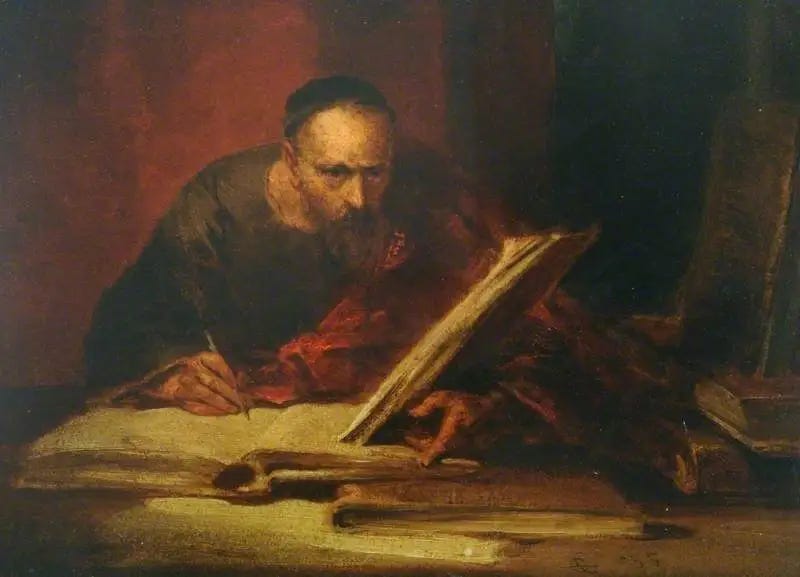
The essence of all truthful writing is contained in brevity. And though men carry with them multiple prejudices and wicked tendencies in composition—like bad habits—even they must admit the truth of so noble a reality. All that comes to mind upon first reflection is clear, obvious, and useful. Within a short time afterwards, however—by this I mean a few seconds—it instantly becomes obscure, forgotten, and empty. Man can only hold onto ideas for so long before their vividness and clarity inevitably degrade.
Though much is labored over, much is lost, for in trying too hard to capture a thought purely, one forgets the infinite variety of sensations that subjugate us every second. It is vain folly to think yourself the complete master of every thought. We are as clueless behind creativity as we are behind love. The metaphysics of all things may receive treatment from those bold enough to believe they’ve acquired the right view of reality, but they overestimate themselves if they think their proposals bring us closer to essence. The only essence is my essence. What is true for me becomes true for all: that there is an axiomatic statement—I define it thus and reason my way to inevitable conclusions.
By brevity, I mean the ability to organize thoughts in a manner that allows concise descriptions and memorable sentences. The best sentences touch the poetic without fully embracing it. Though language is best served cold in my view—for I ultimately admire the man who says in a phrase what would take books to expound—I see danger in letting prose reside solely in the factual. Some mystification must occur to engage the reader. Facts and opinions alone, even wrought from experience, cannot command attention.
What draws man to certain styles over others is the effect by which the organization of words and ideas has upon their mind. Some like extemporaneous, stream-of-consciousness writing; others prefer the realist prose of the 19th century; some like purple prose; others the poetic; some the truthful; and worst of all, the gratifying.
In literature, the beginning of your journey starts with first discovering what genre you like. This is quickly followed by what themes you prefer in that genre; then by what plots, what characters, what settings—and lastly, what style. Style is last in our discovery but foremost in our own writing.
Once we identify the sentences we wish to emulate, we must labor endlessly until we extract the true essence of such prose: that is, what within that particular order, syntax, and diction had such a dramatic effect upon us. After a while, however, mere emulation becomes tedious. Write long enough in that formulaic manner, and you’ll find yourself unable to adapt to the flow of your ideas.
Style is like a tree. It begins with a single seed and, with care, sprouts into a mighty oak. Though battered by nature’s cruelty, it grows stronger. Such a thing could not form so strong a trunk had wind and rain, snow and hail, heat and cold not consistently assailed it.
Speaking broadly on truth: the writer must never forget their purpose. The best writers comprehend their own emotions as they write. Every idea is true, for it springs from their reflections. What seems trivial at first gains elegance and power when followed by equally potent ideas that support or relate to it. The birth of simplicity lies in clear thinking.
Some men are prolific, able to write endlessly on nearly any topic their mind encounters. Others, like myself, struggle mightily to form even a clear conception of their ideas. Men who write with ease do so either because they do not know what they think, spinning out every thought to the last thread—thus becoming boring in the process by saying everything—or because they know exactly what they think, expressing it in a manner that is illuminating to the reader and pleasurable to themselves.
It is a difficult business, knowing what you think. It is not enough to have passively considered a subject. You must immerse yourself in it, become one with it, wrestle with competing ideas. It requires far more time and attention than one might initially assume. Writing is not strictly about ideas—it’s about refining and modifying initial perceptions to give them a more perfect form.
Patience is invaluable in composition, for it is very rare to write both copiously and elegantly at once. Dear God, how many hours have I let slip by as I reread the same paragraph over and over, searching for the right transitional or concluding sentence, only to realize the initial idea was flawed (that it wasn’t truly from the heart) or that it needed no reworking at all?
In writing, the following question always arises: What is the best approach to composition? What procedure must I follow to write most consistently? The problem is that the question assumes a single correct answer exists. There is no universal formula or routine to produce excellent prose. Writing is unlike other skills in that the more you practice, the more consistent you become. Rather, the opposite is true. The more experienced you grow as a writer, the better your writing becomes—but the longer it takes, for it becomes easier to spot every imperfection as you master the craft. And this paralyzes the author completely.
We, in our foolish age, place so much emphasis on productivity and raw output that it spoils the very process of composition—so much so that it would be preferable to spend the rest of our lives reading rather than picking up a pen to create our own work of art. Everyone remains beholden to some trite tradition or routine that has worked for them, never realizing how harmful this is to their future creativity.
The best rule in writing is to have no rule. The only truth in writing is to follow what your spirit sings when the drums begin to beat. This essay concerns truth in writing, and thus I give you the ultimate truth: Free yourself from tradition. Do not rest your laurels on another author’s style. Emulate no one past the point of usefulness. Follow only your own footsteps. Write only what you would wish to see written by others. Write only when you have something to say. And never let writer’s block prevent you from finding an idea worth pursuing.
Most would read these truths and dismiss them as common knowledge—advice everyone already follows intuitively. And so, they are heard but never remembered, liked but never adhered to. The common wisdom of all ages is approved by the masses and thus quickly forgotten, slipping slowly into obscurity until some insightful newcomer restates it afresh. And so these truths endure, forever rising and falling in recognition.
All that the multitude approves is simple, honest, direct—almost self-evident. Yet because it is so widely accepted, it is ignored. People assume that what they easily comprehend must be wrong, believing that true profundity lies only in what perplexes them. And so they deliberately discard wisdom in favor of confusion.
This is why writing should never soar beyond the reader’s grasp. Simple is best in the end.
The writer needs only one tool to make any composition worthwhile: inspiration—the ability to draw from surroundings for the sake of ideas. Remember this is only possible when one pauses to reflect on what they truly think. Introspection is composition's constant companion. This eradicates writer's block and allows for a seamless flow of ideas. Even if the flow jumps wildly, and the topics seem unrelated to the title, it's still writing. All that appears irrelevant can be repaired in editing.
Most writers misunderstand editing's true purpose: to correct errors that may have arisen in the rapidity of thought. The best method—and I have Tolstoy and Schopenhauer as authorities here—is to convey all you wish to say in the briefest way possible, while remaining polished and elegant. Truth alone is engaging enough, and all truth grows from a nascent seed within the soul, planted there by experience or meditation.
The need to construct every sentence with contrast is, generally, a perversion. Recall Erasmus's ancient rule: style should conform to how you wish to convey the idea. Anything beyond the pragmatic in writing becomes dogma, which I cannot abide. In writing, you're damned if you make a system and damned if you lack one. No one has ever found a consistent balance between writing clearly (almost literally) and writing metaphorically—that is, poetically, allegorically, imaginatively, vividly—all words relating back to the senses. The reason is that these inhabit two different spheres of composition, each with its own genera and style.
But as I said, we are beholden to no master but ourselves. Writing is the most liberating of crafts and should reflect a style brimming with life and vitality.