
Opposition
39th installment to my philosophical system.

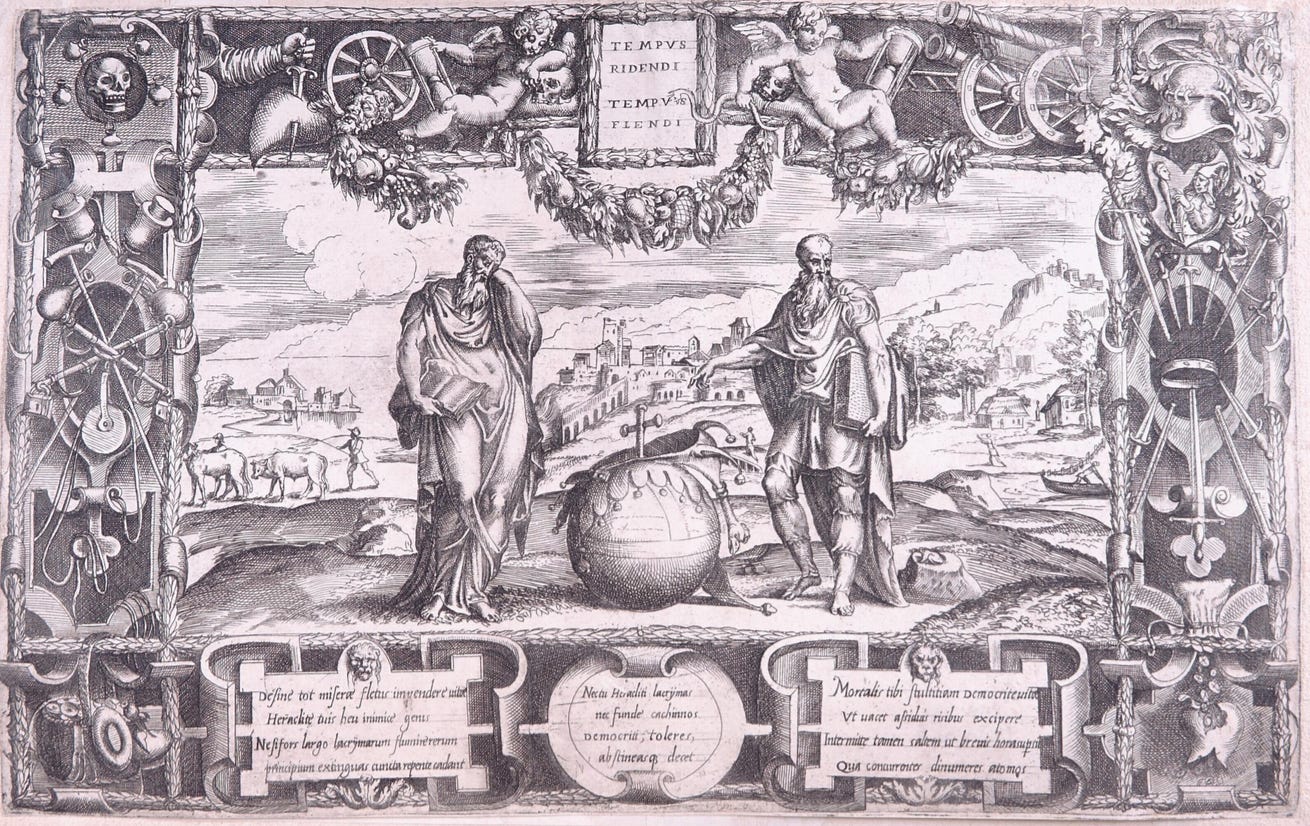
Opposition brings concord. Out of discord comes the fairest harmony.
—Heraclitus.
The ways of the world depart in opposition but are upheld in contradiction. If the force of my speculative-theoretical conjectures on contradiction have not made themselves felt so far, they will certainly be made so here.
If we are to speak of ourselves as subjects within the world, it must first be recognized that any attempt to understand that subject (the individuality of our person) comprehensively is bound to end in tears. The fact that no amount of overcoming can ever become a true becoming is a result of the present dearth in concepts regarding subjectivity as it relates to modernity.
We find ourselves presently in a very interesting time in history. There has never before been so much relation and interconnectivity between people and their ideas, but this overwhelming sense of connection is perhaps too much for we moderns to cope with given our present mental architecture. Our social nature dooms us to a sort of benign complicity with technology. What is praised and rewarded is the ability to acquire attention, and further still the ability to monetize it. Without the obsession that comes with the need to continuously acquire more and more of that which is necessary to survive, there would be no social malaise as it currently exists.
The system in its current form is so synchronized with the passions that drove its development in the first place, that any form of opposition to it is considered either absurd or dead from the start. It cannot be helped, however, by those who dream of a better future, to consider the current situation and not wish it to be anything but what it presently is. I find that if subjectivity is to be made actual, and realized in the world—in a complete form of self-awareness that transcends the current modality of thinking—it must first start with the subject recognizing its individuality, and, right after, recognizing that this individuality is connected with all other individualities.
From here, to use Hegelian language, the spirit which progresses as the eyes of men move from Earth to heaven, and advance forward from the dogmatic present to a more rational and self-actual future, it will be possible to create a collective bellow from every living being which calls for the end of the oppression it has been under since the beginning of our modern era.
But the growing of consciousness has always been a hard thing, for it is still new, and I don’t believe the masses have yet overcome their herd mentality; it’s a very interesting distinction that Nietzsche actually makes between the herd and the so-called rulers: because what he effectively does is turn whatever the masses desire into a form of religiosity built solely upon ressentiment—a sense of hostility directed toward an object that one identifies as the cause of one’s frustration.
What currently exists in the age we inhabit is nothing more than a system of gaslighting that turns each systemic deprivation into a personal failing. It has always been noticed that those with nothing will want for nothing so long as nobody else has anything, but the instant something is acquired by one which is novel, and perhaps even collectively desired by all, those with nothing will suddenly have a want for something, and thus turn the whole course of their being around the acquisition of that one object. Today, this object is money, and, I suppose more generally, abstraction—for abstraction has truly been the cause of universal suffering, for out of it one could build a whole narrative that accounts for every subjective facet of their being, while also justifying all their actions so long as they relate back to their narrative.
You see now how the system is set up in order to deliberately stifle our creativity and reduce our empathy for others? I would venture to say there can be no true subjectivity without first releasing all of us from the chains of opposition which are not our own. Again, the trick is to make it seem as if the oppressive chains which bind us were ours from the start; but anyone with even a slight understanding of history, philosophy, or intellectual development, would know that everything today which structures how we live in reality was designed to ensure order and subservience, not true freedom born from the opposition we face on behalf of these conditions.
This is not to say that were these conditions eliminated there would be no opposition—for opposition exists as a byproduct of our inability to comprehend what we are—but rather to say that those things which oppress us would be our own cogitations, rather than mere reactions to the oppressive stick which perpetually pokes us while we’re chained in order to indulge in our futile thrashes in response.
The world in which our own subjectivity is the only problem is (if I may sound like Leibniz for a second) the greatest of all possible worlds. What does this imply? It implies that material conditions are no longer an issue, and that the only real problems which face man now are existential; in much the same way the bourgeoisie have always had a problem of occupying their time in order to pass it by more quickly—considering they didn’t have to work in order to live—this perfect world, freed from the manacle of labor, will allow the masses to face perennial problems more directly, because their time and energy is now their own, rather than belonging to their employer for the sake of their survival.
The moment one is freed from the necessity of work in order to live—true living can begin. Many like to argue that it is natural to work, and that humans have always needed to work in order to survive, but this naturalistic fallacy forgets that leisure and sloth are equally natural, and that people are compelled as much to work out of boredom as they are (especially today) out of necessity. The only restraint on man, when he is no longer bound by the oppressive chain of labor for his subsistence, is his imagination—that is, the things he can consider for himself on his own time; those things which he can judge for himself in order to understand what he is in himself for the sake of self-examination.
There is, perhaps, no aspect of existence so powerful as the need for finality or closure. What we seek in self-examination is the same thing which was written on the stones at Delphi—Γνῶθι σεαυτόν, know thyself: of what this life consists, it has, up until now, only been considered from the subjective, but it cannot be forgotten that in knowing whatever you presume yourself to be, there is always a tension of what you may become in the search for yourself. This, I call, a dialectical opposition: an aspect of the world that shall forever elude the individual because they approach the aspect as something to be overcome in a single moment, rather than something which must be continuously overcome again and again forever and ever with no end to it. This is the ultimate opposition—the opposition born in reality itself, which cannot be avoided because the contradiction is integral to reality.
The whole structure which transcends the objective world is that born in the subjective; the abstract which necessarily follows from every consideration of the objective world can only be a shadow of what the subject presumes the world to be: in that sense there is no real world, but only our world for ourselves, coincidentally inhabited by other selves who presume the same. This is why one can never surpass their own individuality, they can never grow out of what they are subjectively, and so they are doomed to only being able to relate to others in themselves, rather than actually knowing what the other is objectively. Here, Kant laughs, and cries out “victory!” for having so thoroughly expounded this most fundamental of all antinomies. The best world, in that sense then, is really only one comprised of existential antinomies.
But what is life aside from its implicit oppositions and contradictions? I venture to say a great nothing, or, perhaps, a nothing from which a something must be born. I already argued that necessity is an illusion, and that contingency is the only true necessity with respect to the individual, but I haven’t yet fully propounded what the existential absolute really is—and if I did, I did not do so sufficiently to ease my dialectical mind.
It must first be acknowledged that the object which man has craved above all else is novelty, and that in this continuous craving for that which is new has given rise to many things which man has falsely assumed to be the absolute thing. Every man really lives a lie, because he doesn’t yet know what he really lives for, and in this not-knowing comes a sense of dread so powerful he feels he must find something to cling to in order to live at all—hence come all our traditions and routines and religions.
Modernity is built upon this continuous lie: the lie that man, in his present circumstance, can, in fact, build himself, and make something of himself, and even choose his own values, but this is absurd. Man can no more choose his own values than he can choose his own interests; what sustains man, in fact, is the faith he has in his unchosen values. Values, at least to Nietzsche, were ideas which the herd were only capable of being subject to, rather than masters of themselves; in a very astonishing way, this more or less echoes Marx and Engels in The German Ideology:
The ideas of the ruling class are in every epoch the ruling ideas, i.e. the class which is the ruling material force of society, is at the same time its ruling intellectual force. The class which has the means of material production at its disposal, has control at the same time over the means of mental production, so that thereby, generally speaking, the ideas of those who lack the means of mental production are subject to it. The ruling ideas are nothing more than the ideal expression of the dominant material relationships, the dominant material relationships grasped as ideas; hence of the relationships which make the one class the ruling one, therefore, the ideas of its dominance. The individuals composing the ruling class possess among other things consciousness, and therefore think. Insofar, therefore, as they rule as a class and determine the extent and compass of an epoch, it is self-evident that they do this in its whole range, hence among other things rule also as thinkers, as producers of ideas, and regulate the production and distribution of the ideas of their age: thus their ideas are the ruling ideas of the epoch. —Part I: Feuerbach. Opposition of the Materialist and Idealist Outlook, B. The Illusion of the Epoch.
This is why I said earlier that no man can truly live existentially, that is, as his own person independent of the corrupting forces of society at large (which is already dominated by the ideas of the ruling class), unless he either becomes spiritual—as was the case with Pascal and Kierkegaard, who both staked their lives on the proposition that God exists, and were only able to maintain themselves through their overwhelming faith in God; or pragmatical—here really meaning a synthesis of the material way of being (as laid out by Marx primarily), and the ideal way of being (as exemplified in someone like Hegel).
What is lacking in the world today is the capacity for most people to tarry with the contradictory: (Hegelian) dialectics as a way of being is shunned because it is seen as ridiculous or unlikely to be a tool for progression and eventual emancipation. This makes sense especially when you consider how categorized and systematized and dichotomized the whole world at present is; there has never been a time in history like now: where we understand the natural world as well as we do, yet feel ourselves—personally, subjectively—more dead or obscure than ever before. This contradiction arises precisely from our inability to accept the absurdity of existence: we would rather die, or subjugate ourselves to narratives or values not our own, than actually become our own person (our individual self), or dare to reevaluate our values; it is not that Nietzsche said we can create our own values, but rather that we must deliberately become what our will values in response to the world at large—in that sense always being open to change and contradiction in how we view ourselves.
Existence is an ongoing process, and has no end to it until we draw our final breaths in it. Everything in life seems absurd because we do not find a point to it, but this is a mistaken conceptualization; it is not that there isn’t a point to life, but that the point has to be drawn by our own hand from within ourselves—we have to actively call out into the world in order to see what echo rebounds and strikes us like a blast from a trumpet. The hard point of life isn’t in living it, or even in enduring it, but rather in searching for it amidst all the oppositions and contradictions which pervade it.
Very few today are true existential thinkers because they still think in terms of categories—rather than in contradictions—that purport to answer all of life’s questions; again though, life is not a question to be solved, but a reality to be experienced: it must be lived forwards but understood backwards. There are no two ways around it, dialectics is the only solution to opposition because it doesn’t claim to solve opposition, only tarry with it for life’s sake. This is why finality or closure is perhaps the ultimate desire in man: without it, he feels himself for what he truly is—a small subject crushed by the immensity of his ignorance and the magnitude of the cosmos; without the ability to say “this is final,” or “this is done, and no longer in need of investigation,” man will endlessly create for himself paradoxes which his mind cannot overcome, and thus he will feel unable to comprehend the meaning of his own subjectivity; in such despair, he will find nothing but suffering, and afterwards generalize this feeling to be the pervading force of reality, as Schopenhauer did; I feel, in this context, it must be remembered that the first half of Pascal’s Pensées was dedicated to the THE MISERY OF MAN WITHOUT GOD—God here being the object by which to place all earthly misery upon in order to live at all; this black sea of nothingness, which is the universe, is so incomprehensible to us conscious creatures of Earth, that it is better to forget thinking all together if it cannot give us a sense of what is final in life aside from death. I, for one, have found this to be the wrong approach to life—for it is, again, made on a false dichotomy that assumes life is to be lived linearly, in a homogeneous manner, without contradiction: this is wrong existentially.
And so it is. Man today must be willing to synthesize both the abstract and the concrete, the contradictory and the noncontradictory, the autistic and the schizophrenic. That is, after all, what my existential philosophy tries to be—both dialectical in the Hegelian sense, and pragmatic in the William James sense: in a phrase, dialectical pragmatism.
I wish it were possible, for me at least, to live life as the majority do—without the slightest concern for their existential character, busying themselves with distractions that will provide their life no greater depth than the temporary pleasure it gives them, but to me this has always been dishonest. I’m overly conscious, I feel, regarding the world and my place in it; this consciousness gave birth to a monster within me—a fear so foreboding I would never be able to challenge it were it not for my resolve to see the truth of this world.
If only it were easier for me, or, better yet, for everybody, to find themselves in the world, fully actualized and totally in command of their person, rather than always feeling at the behest of commands not born from within their own heart. If only I didn’t have to create my own philosophy, scouring through intellectual history in order to find answers which, in the end, were really always in me from the beginning.
Life, for me, really does seem more a hassle than it’s worth at times I think to myself; but then I remember how few have really considered it at all, and how miserable they are as a result, not realizing they could throw the chains off from themselves in a second should they recognize that the cause of their misery is themselves, or rather, how they see themselves amidst this systemically broken system; out of that recognition comes the necessary consciousness which builds towards a better future through action. Yes, action—that is what I found the answer of life to be.
In the final analysis, one will find that life only sustains itself in purpose-driven action, action that is existential and done for the sake of not only yourself but others as well. The only real opposition which exists is between yourself and the world at large, and in that tension gives rise to what you really are as an individual.