
Prophecy
90th installment to my philosophical system.

If a man could know what was to become of him in the future, I suspect that would greatly diminish his desire to act in the present. What we are as we exist currently is an organized collection of matter that, through accident or fortuitous chance, happens to have a mind capable of beholding itself. We come into this world at great cause to our mothers, and we are sustained from the very start on values that we come to see as natural and proper to the formation of our future success. Life always has a way of turning our decisions towards its own ends. It’s as if we do not live our lives, but rather live through ourselves.
Prophecy, in all of its substantiations, merely represents one of the oldest urges in man—to know. Man is never without some doubt. This doubt causes him more anguish than he would like to admit. Every decision, when taken from a broad enough perspective, becomes consequential. On account of this, man has done everything in his power to give his mind some ease. I’ve argued before, and will again here, that doubt is itself a byproduct of reason, which is born out of our consciousness. Were men akin to gorillas or orangutans, instincts would predominate the mind, and reflection on the order that we human beings are familiar with would never occur to us. Reason is reflection abstracted beyond experience. Given that we’re the kind of species that we are, we have many faculties born in us which allow us to carry on the necessary functions for our survival. To enumerate the list would be impossible, but first and foremost among those a priori qualities is reason.
It was doubt that legitimized the practice of prophesying in the first place. Reason turns all things on their head by making the implausible seem plausible. Ignorance arises out of reason poorly done. When a connection is drawn between two acausal events, you inevitably have a situation in which the offered justification in no way relates to the action in question. To remain oblivious to this fact is to be ignorant. Though most men fear this ignorance, they don’t know how to avoid it because they assume it can be overcome with superstition—i.e., with more ignorance. Ignorance is degrading to the soul so long as it’s tethered simultaneously with the desire to know.
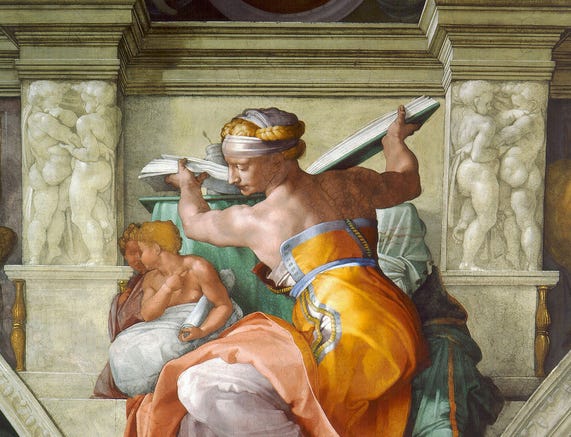
So long as man thinks, he must always feel the sense of finality closing in around him; he wants final answers but can never have them, for the questions he seeks answers to have no final answer. In a very real sense, ongoing prophecies were the earliest forms of re-evaluation—at least where reason is concerned. One event would lead to the initial prophecy being changed in some way, and on account of that, a new one would have to be cast—whether it be from augurs, haruspices, or sibyls alike.
All throughout history, people have been said to be inspired by some divine force—an internal sense which we today would call an intuition. From Moses and the prophets of Israel (as attested by Ibn Ezra and Maimonides), to the daemon of Socrates (related by Plato and Xenophon), to the familiar spirit of Fazio Cardano (as his son Gerolamo noted in his autobiography), to the muse of Goethe (noted in his letters to Herder and in his Dichtung und Wahrheit). It is simply a prejudice of history that these men described the same feeling in different ways. It’s the result of poetical or allegorical language that gets taken literally.
Where ignorance reigns, a man must either make himself skeptical of all claims or adopt a habit of mind which allows him to make all claims equally plausible: that is, either turn agnostic or turn insane. To be exact, this kind of false dichotomy could only be seriously entertained by those who hold the powers of reason above and beyond what they can actually provide; those sickly scholastics, walking around as if on stilts, sullen and embittered that reason gives them all the answers they look for, and yet are still deep down dissatisfied.
It’s a kind of thinking that leads to either/or conclusions only, and on that basis, it is completely devoid of existentialism of any kind. In other words, it’s a conclusion one could only arrive at by having their minds endlessly addled with stupid hypothetical questions that remove nuance completely from the scenario and only seek to color everything in either black or white. This kind of thinking has become so prevalent that people still call themselves champions of reason, as if this were the 18th century. As far as I’m concerned, the only reason these people know is reason in the colloquial sense—a justification made on behalf of a prejudice, done with the intent of defending a value.
Such is why everything seems so predictable today, and why surprise is dead as a concept. Nothing shocks unless it is deliberately provocative, and even still—that is more often than not staged and calculated, too. People are fake, even to themselves. Nobody has any ambition beyond themselves; they don’t even believe in a higher realm anymore—that is, unless that higher realm pertains to their material ambitions. With that proviso stated, everyone suddenly speaks the same language and understands the same sermons of decadence. As Voltaire said, “When it is a question of money, everybody is of the same religion.” And damn ignorance for that.
As long as man thinks, he suffers. There’s never any end to man’s troubles, and they only compound the more he reflects on them. Thinking rationally is only applicable to those problems which are themselves the result of reason. People are tied in knots of their own making when they question things like the state of the times, the debt crisis, the lack of housing, income inequality, etc. As far as I see it, these are institutional problems that are the direct result of the system’s own line of reasoning. In other words, these problems only serve as proof that the system is functioning as intended. It isn’t really a secret at this point that capital’s main goal is the perpetuation of itself, and it stops at nothing for this end. The world is controlled by capital, and it has been a disaster for the human race.
There are few, if any, avenues in life which a man can turn down and find secure happiness in. No matter what a man does, he will always be met with suffering and disappointment; and in moments where he does not feel one of these two constants, he’s made to feel the dread of their return. Even pleasure is made a source of torture when the world is looked at through an objective lens. Hence why we have art, so that we would not die from life.
Man finds the struggle with himself almost too much at times, and so he seeks to distract himself with this or that egoistic end—a goal which will never satisfy him, but which he does anyway to pass the time because he has nothing better to do and doesn’t wish to coast through the day on stormy shores but rather in calm currents.
The amount of effort which must go into sustaining oneself, when properly considered, boggles the mind; and though it doesn’t seem like much because we do so on instinct, when considered rationally, one cannot help but be shocked. Reason makes the simple complex and vice versa. That is why I love reflecting on the little things in life. They offer me more material than I initially bargain for, and through them, I come to consider many things I otherwise wouldn’t have. All my writings are really prolonged conversations with my own reason, prompted by the essay title, and reflected on over a three-hour period. Whatever I come up with is merely what my mind offered me on that day. I have no doubt that every essay I write, should I have written them on a different day, would have come out drastically different from what they ultimately became.
I’ve also noticed that what really determines the style and length of my essay isn’t necessarily what I wrote or read before writing, but rather what the general atmosphere is inside my head. Some of my writings are very constrained, very polished, very to the point, and very concise. Others are sprawling messes that can hardly be said to relate to the title of the essay itself; these are usually my best essays style-wise, but I don’t always want that, for I have concerns outside of purple prose. Some (as I feel this one is) are a mix of both: a clear brevity in style, but at the same time not exactly on the topic at hand. Naturally, my best essays are the ones that do both, but in a manner that is non-compromising to the integrity of my spirit—which I feel I’m constantly in a war against.
When you start the essay also matters a great deal. The more tired you are, the more likely you are to write boilerplate prose—worn-out, hackneyed phrases that you wouldn’t have even considered were your mind fresh. That’s usually why the essays you write after just waking often come out better than the ones you write after having settled into your routine for the day. The numerous things which strike us throughout the day often serve to paralyze our mind should it be late into our routine rather than when we begin it.
Another thing which has to be noted is the subject of the essay itself. Some topics simply afford the author more interesting speculations. It’s usually a topic they’re familiar with and which they’ve occupied themselves with for a good amount of time. Chance, too, plays a large factor. Some topics leave an author so completely bereft of ideas that in their extemporal thoughts they develop astonishing masterpieces, though, again, this is few and far between. A man can only get as far as his mind is willing to take him.
In the main, shorter essays are better than longer ones. A simple style is superior to an ornamental one. A topic which offers various interpretations is easier to write than a narrow one. The timing at which you begin your composition is perhaps the main factor in determining how it comes out overall. And lastly, writings approached with brevity and the reader in mind can never go wrong: let them be short, confused, and totally off the mark—they’ll still find a place in the reader’s heart, for the form alone will make up for the lack of matter.
Sometimes in writing, it feels like you can never say what you really mean. This is the result of a confusion between the intent of the sentence and the actual words written. Sometimes we leave a thought half-developed, or not developed at all, and so always feel incomplete in some sense. Those who are especially attuned to their sentiments will never find the time nor space to capture the infinity which they’re carrying around with them. An author is simply one who wrestles with thoughts and hopes by the end of their wrestling they write a few good sentences that get at the heart of what they meant. Is that a good sentence? No matter, it was honest.
In the back of every author’s mind is a visceral sense of their own confusion with respect to the composition. Ideas are treacherous things, and we’re never in command of our minds completely; if we were, we could write at will, but this is impossible, for thoughts arise slowly and are kindled like a fire, rather than appearing in consistent spontaneity—though on this point, in certain cases of flow state, a person can, in fact, call at will the right words for the idea they have in mind; whether this kind of thing can actually be learned, however, I scarcely think possible. Every method or technique for “writing well” is false in an absolute sense. The moment one tries to explain an intuition that has worked for them, they objectify it, and in doing so try to reduce its incomprehensibility down to a vague notion which may or may not click with the recipient.
It’s this reason, in fact, that separates great writers from immortal ones. A great writer (Walter Pater, for example) knows how to say exactly what they want using the exact words they had envisioned, and in such an elegant way that nobody can misunderstand them. An immortal writer (say, Leo Tolstoy), however, knows how to go beyond mere conventionality and can make even the common seem uncommon; their style is not one of mere brevity and refinement beautified with diction, but rather on an entirely different plane of existence.
Immortal writers transcend the normal boundaries of the written form itself; indeed, their prose borders on music, for the images which their words evoke are almost always played out in our minds in the moment of reading them. This is really what separates the wheat from the chaff in the world of literature. There are those writers who know how to say what they mean and do so in a very tidy and elegant manner; and then there are those who go beyond meaning itself and touch, as it were, the soul of the reader.
For myself, I certainly feel I touch immortality at times, but only when I write without constraint and when I have more vigor than I do now. Presently, I am merely a great writer, but this composition is really nothing to write home about. For my own standards, it can hardly be called good, but it’ll do, for it’s honest enough—and that, to me, is the most important of all.
Perfection can never be found in writing. If one tried to write a whole book in their head perfectly before putting it to paper, they would never start the book. Every idea we have is subject to evolution and can seemingly always be improved in some way. So long as man is honest with himself, he can never find perfection, for his honesty would prevent him from being vain enough to actually proclaim perfection. The closest a book has ever gotten to perfection was perhaps the King James Bible; no other book (of its length, anyway) even comes close to matching the sheer simplicity, elegance, and profundity of it.
There have been many shorter compositions that deserve their rightful immortality—The Imitation of Christ by Thomas à Kempis, In Praise of Folly by Erasmus, The Book of My Life by Gerolamo Cardano, The Essays of Francis Bacon, Jefferson’s Declaration of Independence, Schopenhauer’s The Wisdom of Life, Lincoln’s Gettysburg Address, etc.—but no book really matches the KJV even remotely; give me Don Quixote, Hamlet, and Faust wrapped in one, and I will show you a book that still doesn’t compare.
Again, perfection is a vain thing to strive for in composition. To fret over this or that incidental aspect of a work gets an author nowhere. The best rule, I’ve found, is to have no rule with regards to composition. Write as it comes, make it naïve, make it truthful, edit it assiduously, and make sure every word written has a purpose—that is, has a reason for being there.
A single thing must always be recognized before you write, and it is the fact that whatever you do write will never live up to what you had envisioned it to be. With this acknowledged, I believe anyone can start on any writing and not be too dismayed by what was written by the end of the day. We can rarely equal our dreams in reality, and so we should only ever strive to make reality as it is a kind of dream. La vida es sueño, says Calderón.