
Quality
30th installment to my philosophical system.

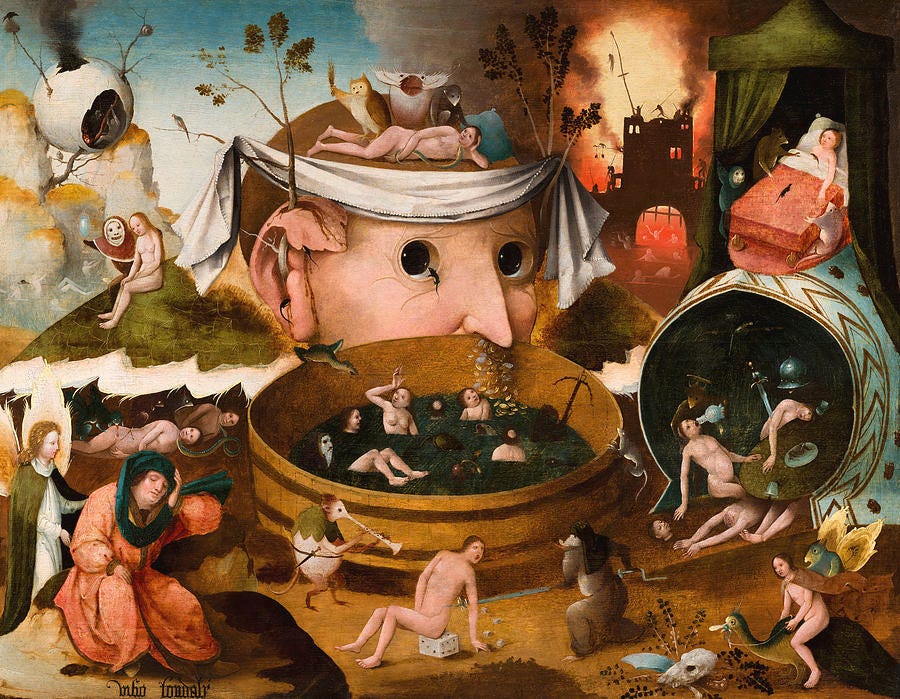
Man is quality. Now, with that said, one could spend their whole life (as philologists do over the fragments of the Pre-Socratics) struggling to figure out what exactly that means, but I doubt anyone would be impressed with the results after the lapse of a few years, let alone centuries.
Quality is merely the counterpart to form, which has its seed in matter. The whole of reality seems bound in this one kernel which is both a truth and a lie. You see, to even put words to quality is to engage in a contradiction—contradiction reigns supreme, after all.
Whenever a person describes something which they see, they mention its adjectives—its secondary qualities—but the ontology always remains veiled, encircled by a kind of foreboding, ominous mist which no one can see past.
By quality, I do not mean here the colloquial definition: something well-made, or of good standard, or elegant in appearance; rather, I speak of its philosophical depths, the mystery of it—a thing so obvious it would seem staggering to one who isn’t interested in torturing themselves mentally over it.
When we label a thing—that is, provide a signification to an object in order to distinguish it from others—we think we’ve done so in an analytical manner; in a certain manner, even objective, with surety, never feeling the need to question what lies at the bottom of this infinite leap into obscurity. We are so simple and intuitive in our approach to formulating things that we actually presume ourselves to be the real guarantors of what things are; like Adam at the start of Genesis, we are made so as to do the work of God and provide a name to all the animals—and more generally, to all the things that are not animals but which equally belong to God’s creation.
There’s a certain gap—an ontological gap—which everyone leaps past without recognizing the abyss they have just entered into. Surrounded by so much darkness, man assumes the only light which he could create is out of himself, and so he denotes things, labels things, names things, provides definitions and significations to objects which are not himself but which he feels (perhaps even knows) to be apart from him. All these things fall under the name of quality.
Ah, quality, dear quality, how elusive you are, strutting about in a burqa of mystery. Everyone thinks they can comprehend you through labels and systems of categories, but they do not understand the depths to which you throw all concepts down. At the bottom of the well does not lie truth but ignorance, and you are but ignorance (to us mortals) personified. Could we even perceive you? I say yes and no, for again, you necessitate contradiction every time we contemplate you. If I say that a quality belongs to an object, do I say that absolutely, or do I say that pragmatically? Here lies the contradiction, or, better yet, the dialectic from which a synthesis may be found.
To consider a thing from two contradictory aspects is merely to grapple with the reality that other conscious agents have a different interpretation of the same thing observed. The world, in essence, is an ever-evolving, ever-changing cycle of various opinions put forth and self-assured conclusions deduced that really get us nowhere but closer to the certainty that we really do not know what we are describing. Our world, intellectually speaking, runs on consensus. If a quality is ascribed to a thing enough times, and accepted by most people on that basis, then it is fair enough to describe that object by its collective adjective—its quality.
Now, for those who are not epistemic pragmatists or perspectivists—I mainly refer here to realists or some type of objectivists—this notion is abhorrent, and yet, it is undeniable that what people think about the world and how they actually live in the world are two completely separate things, and are more often than not contradictory. We live after the manner of our circumstances, not our conceptions or idealizations about our circumstances.
This thing has a quality, I ascribe it some meaning—does that make it objective? My whole philosophy is a systematic refutation of the question “is this thing objective?” Objectivity has no meaning outside of our ideas surrounding the meaning of objectivity. When I speak of the objectivity of a thing, what I really refer to is the thing’s quality—even the notion of an unchanging, static nature to an object is really just a narrative, a perspective, a useful illusion which assures our sanity and coherence. The empiricists are right, and the rationalists are right, but not in absolute senses.
To claim a thing to be absolute is to claim a thing which you cannot ultimately know: it is to assert, as a fundamental premise, mind you, that there is a mind-independent ontology behind all observable reality. I’m reminded of Russell’s teapot in such an instance; but, be that as it may, I’m not so much interested in arguing for or against the various kinds of evidence that make such a claim or premise justifiable, but rather in the psychology behind why one would believe that in the first place. I find all things in reality absurd, and the most absurd thing of all is life—which is but a quality painted onto the canvas of the universe as far as I’m concerned.
All ideas stem from our mind, and in that way only have validity for our mind. The material which existed prior to us can only be deduced from a pragmatic stance, not an objective one, and this is because what it means to be objective cannot be mind-independent. The very definition of objective (as it is used today by most people) contradicts itself, because nothing comes to man without first presenting itself to him in the mind, thus not mind-independent—the mind itself existing prior to man, but known by him in his use of it.
We can only lay hold of the claim that reality is but a poor translation, a confused representation, of everything which we apprehend and come to know in experience; it is for this reason that Schopenhauer considered philosophy a science, because nothing in it as a subject is to be assumed as existing without first being either empirically given or demonstrated from indubitable conclusions drawn from sound premises. In many ways, Schopenhauer was, at his heart, a pragmatist—even though most today consider him a type of post-Kantian idealist (he viewed himself as the only true successor of Kant because he only drew his philosophy from ideas which nature supported).
It takes, as I said earlier, a certain type of intellect to be able to question the obvious, to confuse yourself over things you already know, to think deeply upon those things which others accept out of prejudice or convenience; these types of thinkers cannot be called pragmatists, because accepting something merely because it is pragmatic to do so ignores the purpose of pragmatism—it is not for reassuring yourself the world is as it seems, but rather a method of speculating what lies beyond the world. Even scientists cannot call themselves pragmatists really, because their assumptions are made on behalf of “brute facts,” things which simply are because they are—I find there is no difference in that and assuming, as the religious believers do, that God’s will brought everything into being.
Philosophers love wisdom, but they only arrive at wisdom when they consider things in their complexity, rather than in their simplified mundanity. Just think how boring it would be to be omniscient, to know everything before it occurs: I’m sure misery would no longer exist for that person (assuming them to be of an intellectual temperament), but action must still follow, even if you have total insight into the positions of atoms and everything stemming from them. Now that is a slave’s life.
Man must seek and overcome. Those seem to me the only two solid foundations by which to build an existential existence. Question all things, never be certain, in fact, embrace uncertainty, but do not let it cripple your capacity to act in the world as I have let it do to me. I’ve discovered this soon enough, and now all I want to do is rid myself of this writing burden.
Wouldn’t it be the greatest confirmation of my systematically unsystematic system to leave it off halfway, never to be completed? I feel it would. I’m sick of writing it, if I may be honest, and the quality of it is becoming less and less a concern for me. I might soon only leave myself an hour to write a section rather than three. I must, however, get over these feelings of emptiness regarding it. I mean, it is the culmination of everything I’ve done for the last five years, after all. Shouldn’t that count for something? I say it does, and it would be a disservice to my younger self—that self which was obsessed with acquiring all the knowledge in the world before entering into it—if I didn’t see to its completion.
We must all have some external principle which we can place our faith in in order to exist and hitch all our actions to. The life of one who thinks is one who does nothing else, and as a result they are slandered in the world, from which they turn all their feelings of guilt and shame and suffering into wonderful acts of creation. I’ve always been a wanderer in that sense. I’ve never been happy with knowing mere facts about the world, or having a diagrammatic understanding of things. I’ve always been drawn towards those things which are not graspable, and which elude every attempt to systematize them.
One cannot imitate genius; you must embody it in action. Lord, how far I’ve fallen—turning my only action into thinking, doing nothing with myself in the world at large but contemplating it, hesitating along every step of potential action, comprehending everything but understanding nothing, becoming nothing but a statue in thought. This is the very contradiction which I must live through, and which every thinking person with a large heart must think through. I’m sure the comforts are very large for those who can forgo reality and believe in a life after this one; and the same I think could be said of the nihilists who already assume nothing matters and so act in a very destructive manner as a result: isn’t that kind of life what the modern world sells to us anyway?
My situation, I would argue, is actually beyond incomprehensible—even the word absurd fails to do it justice: I’m surrounded by no one who understands my heart, in a city for which there is nothing for me here, in a state that is perhaps the most ignorant of all the others, in a country that doesn’t admire erudition—and in fact deliberately goes out of its way to malign and mock it—in an epoch of history in which everything seems to move from bad to worse, and finally, in a world as meaningless and empty as this one.
The absurd man, it has been said, was born in Augustine, for he was the first true existentialist—the first human being, at least in the West, to question deeply the meaning of his crisis in a philosophical manner. The modern man, who is also absurd (but this time is conscious of it), was born in Rousseau; and, not long afterwards, there lived a Dane from Copenhagen who was so precocious he, despite not being a novelist, wrote out a series of “philosophical” tracts so powerful and elegant they showed the progression of man’s own existence—the realization of his own anxious state, of everything coming apart at the seams in life itself: this man was Søren Aabye Kierkegaard. In the major works of this man, we have nothing but complete inwardness, a total awareness of self—in fact, the self is the only concern, and everything that is written that doesn’t concern the self is merely ancillary to the self. All of existence is in Kierkegaard because he was the first modern existentialist—he is even called the father of existentialism, rightfully so.
Man has always been in a state of anxiety about existence, and it only becomes more absurd the deeper you venture into the darkness of it. It is here that the famous quote by Nietzsche strikes one most powerfully: “He who fights with monsters should look to it that he himself does not become a monster. And if you gaze long into an abyss, the abyss also gazes into you.” Dear reader, this is what you must take away from my philosophy above all else: that monster is you; that abyss is you; that darkness is you; that evilness is you; that goodness is you; this very life is… you.
The inward contradictions of outward experience are, by nature, astonishing. It leaves one in awe to have a sense of what life could be, rather than what life is; this sense of hope is singular but infinite, powerful but weakening, ever-changing but static in the moment; it leaves one not, not once, ever—so long as one lives, they must carry their life as a burden, a bundle of miseries wrapped nicely in a burlesque sack. Every quality is absurd because quality seems to necessitate the deduction that things are permanent and non-changing, when in truth everything is dialectical.
I feel a prejudice, which has its origins in Aristotle, has been allowed to live for far too long, and that is the prejudice of efficient and final causes. We need to get past the notion of things having reasons, or causes, for their coming into existence. It seems very reasonable to assume that things which exist are only so because someone made them like that, but since the times of Aristotle, the questions which he posed no longer seem to hold weight, and that is because our knowledge of things has advanced so far beyond what he thought conceivable. If we go by first principles, then of course we would have to have some initial cause, some prime mover, to bring all things into existence; but this kind of reasoning doesn’t hold today, again, because centuries have passed in which men have striven to overcome the prejudices of the ancients, and we moderns are the epitome of every overcoming of the ancients.
Cause only holds for those things which we do, but for those things which remain out of our comprehension, it doesn’t make sense to assume they follow the same type of reasoning. It is the folly of man to assume everything which he places under his domain of understanding is the final word on that thing. Isn’t it more reasonable to be unreasonable and accept the fact—indeed, perhaps the only objective truth!—that reason is a product of an ape, and that that ape changes his reason as the world changes around him?
Speaking dialectically, we can only say along with Heraclitus that:
This world-order (kosmos), the same for all, no god nor man did create, but it ever was and is and will be: ever-living fire, kindling in measures and being quenched in measures.
— Quoted by Clement, Stromateis, B30.
And,
τὰ ὄντα ἰέναι τε πάντα καὶ μένειν οὐδέν. (All entities move and nothing remains still.)
— Quoted by Plato, Cratylus, 401d.
And,
Πάντα ῥεῖ. (Everything flows.)
— Simplicius’ Commentary on Aristotle’s Physics, 1313.11.
And finally,
δὶς ἐς τὸν αὐτὸν ποταμὸν οὐκ ἂν ἐμβαίης. (You could not step twice into the same river.)
— Quoted by Plato, Cratylus, 402a.
This great ocean! This great abyss. This great life. How strange everything is, and how much stranger the quality of all things appears when you try to understand them in words. Everything flows, and that is why we can get no satisfaction out of our ever-present, static, seemingly unchangeable life! Such is the state of man: such is his quality. But what of the quality? Why do we presume to think it actually matters? Misery is nothing but the misplaced attention to things in life. Of all the things to concern yourself with in the short span of time you have on Earth, you choose to spend it thinking about things which do nothing for you. Overcome yourself. You must be better. You must. You simply need to find a reason to become so. Nothing more, nothing less.
If I appear to go everywhere in my analysis, I am once again forced to blame the nature of the topic. The quality of my writing, I feel, is only as good as my misery is strong—and so let this horror reign on, and give me a reason not to cut the play short. Again I ask: why should I care how any of this comes out anyway? What is the quality of myself, which is really to ask, what is the quality of my writing? The quality of my writing? Ah, a thing I’m very fond of. So fond of, in fact, that I’m currently in the depths of misery because of it. I once wrote an almanac on the mental anguish of scholarship, and I said there that one who seeks knowledge for its own sake will have all the wisdom in the world but, so deep in contemplation and mired in the minutiae of insignificant details, will lose the name of action in it; and this loss of action is the worst thing, for the world at present doesn’t afford one the opportunity to sit with themselves and become transparent to themselves in thought—rather, what we allow is one to languish and forgo the dream, the real life, for the sake of remaining awake in a sick consciousness, the fake life, the modern life, the life which we live at present, and which we are ashamed to be stuck in.
Nothing, if it is not pursued for its own end, will ever be accomplished; even the things that are completed with their end in mind are but vain merits, or false credentials, which we attach to our character as if they really meant something—all done for the sake of our vanity rather than our understanding, and this propels us to vainglorious ideals which are thought of fondly in old age and considered reasonable in youth, but which reveal the sober debauchery that is ambition.
The ever-growing divide between those who do and do not do will only increase the worse things get. But, as a writer of the soul, of the single individual, of the absurd man who cannot fathom the whole of life and reality: I find it best to see just how far the misery can go—all this for the sake of a little quality in life.