
Quantity
31st installment to my philosophical system.

Life is a quantity.
The whole story of civilization is one collective episode of mass hysteria. This mass of existence, this pile of bodies, this deluge of flesh, this perplexing collection of matter and motion, atoms and voids—all this and then some is our collective quantity.
It would only be fitting to place atop the tombstone of humanity the following epitaph—the only real truth that bears out every existence: Après moi, l’obscurité de la mort (After me, the darkness of death). It is fitting that it be in French, for of all the languages in the world, it is the only one that simplifies life by obscuring it in ponderous phrases, and yet, in its obscurity, reveals more than it initially intended. This is why the average Frenchman comes off as more cultured or intelligent than the average Englishman: his own language is so confusing to him it forces him to think through his thoughts more carefully, and so he always says something that seems profound, even though it is just his average thought, and he thinks very little of it. It is very hard to have (literary) style in French for that reason also: “Parce qu’en français, c’est plus facile d’écrire sans style“ (Because in French, it is easier to write without style), said Samuel Beckett.
In quantity, every quality gets blended into one collective whole and so loses whatever uniqueness it had for the sake of a drab uniformity. This doesn’t only apply to languages, though; it may be found in every facet of experience. So long as one is doomed to live, they must interpret the whole world through one transparent lens and reflect every incoming ray of life to a focal point from which every diverging radii may collect, and that focus becomes the quantity which every quality melts into—slowly, morosely, deafeningly—all to death. We may scream at the thought of it, but we have no mouth by which to convey our dismay in this instance and so must thrash about until we concuss ourselves to oblivion.
The world reveals itself only in the dreams of those perverse enough to sleep within it. The night of death looms as the light of life fades from ourselves, and thus is only to be brought to consciousness in those who see us there, lying motionless, shutting down as it were—as we do in sleep—but this time… permanently.
The thought of a deathbed is enough to make a man dear to life shudder, but this happy man—so full of energy and excitement for the days of toil ahead of him—has probably never considered what the world is like for those who pay dearly for each breath drawn. In the memory of my soul, reaching to the past, I find a happy kid enjoying the innocence of play and having no concept of true toil; now, I find the weight of existence crushing and the thought of responsibility staggering—to even maintain my life seems like some kind of mistake. From whence did this sensation come, and why must it now live in me as one lives in a home not their own?
I have often contemplated what the point of all this quantity is. When one looks at a single object, they observe it not only ontologically (that is, qualitatively) but metaphysically (that is, quantitatively). The distinction made between emergentism and reductionism is one of ontology and metaphysics, of quality and quantity, of the whole versus the singular. I can only speak as a singular man but must make and shape my thoughts thoroughly enough in order to speak on something in a concrete, rather than abstract, way. If one were to only speak in the abstract, there would be no way to communicate concrete things—and we humans are very earthly, material, vain, avaricious creatures.
The language of Plato’s Forms is precisely the language of the obscure, because that only speaks of the shadows, the qualities of the objects, but never the objects themselves. When we consider the object qua object, we really refer to it in the concrete; every abstraction is really a placeholder for something concrete—except for when we refer to things that are abstract in nature, like our ambitions or dreams, or when we speak of “numinous concepts” like the divine, love, empathy, trust, God, etc.
This fact right here is why I can never be satisfied with merely speaking of things as they appear, and why repetition is the overarching theme of all my works: to live is to contradict everything you see before you, because the mind is incapable of perceiving anything at all without first conforming it (the objects of experience) to the “categories” which allow perception in the first place.
It is for this reason, too, why many people assume the notion of another world, or Hinterwelt, as absurd: not only is there no empirical basis for it, but, deductively speaking, there is no cause from which it could be deduced without falling into circularity or an infinite regress of causes. There seems to be no circle large enough to encompass all quantities which make up all qualities. And so the opposition and negation must go on. Live, live, yes… live and let yourself die in the world; become one with that which you cannot comprehend—it is the only way to live past contradiction after all.
Life is not like a pendulum which swings back and forth between pain and boredom, but rather between the abstract and the concrete—between those things which have been overcome in reason and those which have not. The human mind is capable of only so much juggling before it becomes a confusing ensemble of various states of collapse and reemergence. We emerge out of ourselves from within ourselves. The subject-object distinction is, yet again, another aspect of existence which reasoning alone cannot overcome, but only sublate and transcend in the motions of existence, given life via the dialectic itself.
I’ve said many times before that to live is really the worst sentence a person could receive. All these confusions—in truth, contradictions—about the world we must bear nobly, but to do so is really to live a lie. For it is asking you to bear the excruciating light of illumination which has no real source; that source is yourself, you are your own misery, and this dark world looks to you in your lowliest of low moments as something solid, something firm in the dark to step on, but the moment you do… down into the abyss you go.
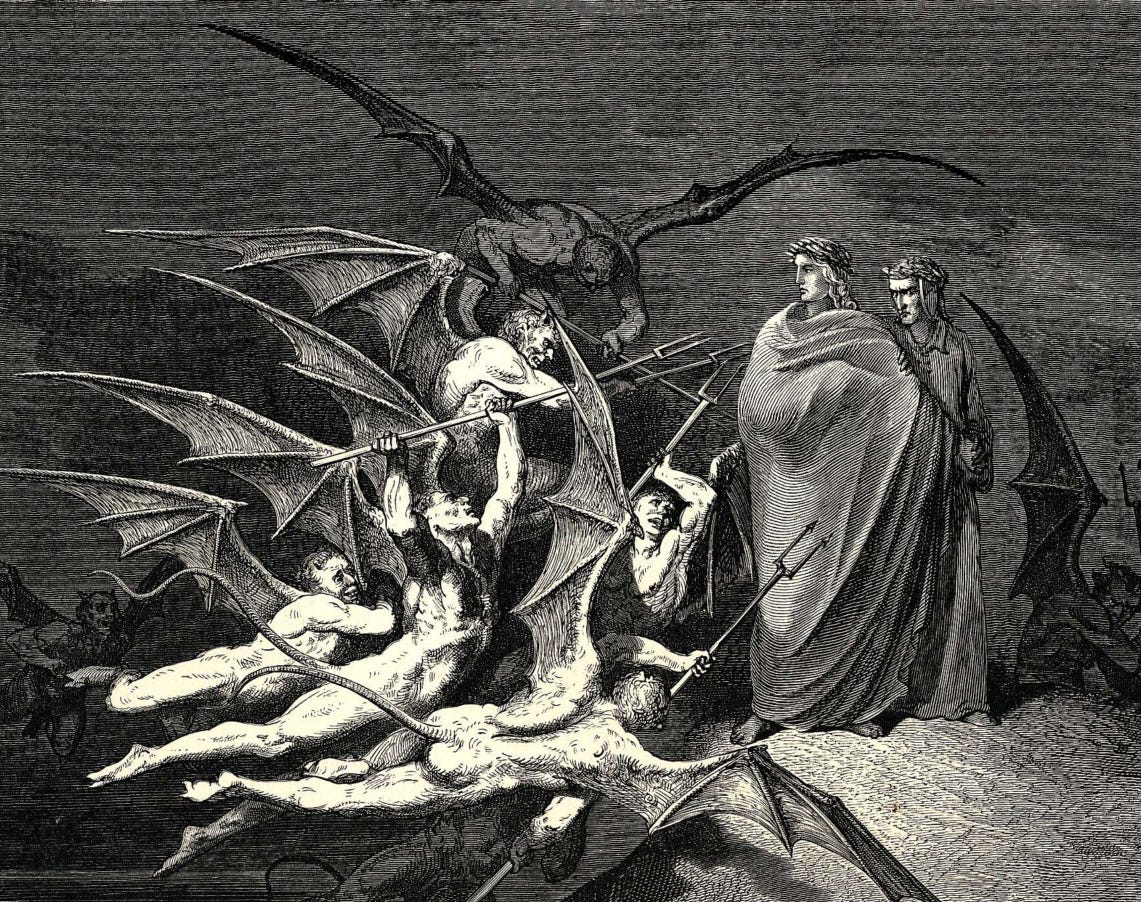
The greatest analogy to life is really Dante’s Inferno: where we awake within a dark forest midway on our life’s journey, shaken and confused from the right path, and turn to ourselves to escape this tenebrous terrain—only to be prevented by three beasts which represent to us our true nature of lust and fraud, pride and violence, avarice and greed. No matter where we turn, no matter all our smarts, no matter all our good intentions and ambitious dreams, we become like nothing when faced with what we really are: wretched beasts, no better than the actual beasts which prevented us from escaping this turbid night of wretched sights—visions no heart or godly power can compel and exorcize, for this forest is dark and wicked, and we are no match for its malevolence.
How could anyone hope to become something in the world if their raison d’être (reason for being) is nothing but an ombre d’air (shadow of air)? Contradiction—the whole of life—is itself a circle which has no quantifiable diameter. Whenever man is tasked with thinking for himself about things, he is met with considerations he never before imagined and is also hit with various unknowns which, prior, never troubled him, but which he must now think through.
What is to come of our individuality if we are unprepared to make sense of its true meaning? Like the love for a person that is no longer alive, life exhausts us by merely being in the midst of it; we say to ourselves it wouldn’t have been so bad had we not experienced this or that thing, but when has the contemplation of alternatives ever revealed to us something useful in our sufferings? Nay, on the contrary, the possibility of imagining another world only heightens our suffering, for we then reckon all the goods that would’ve come our way had we done the other thing, and not the actual thing we did which led us to this misery in the first place.
Socrates was considered the wisest man in Athens because he had, unlike the sophists, the humility to admit he did not know anything which he spoke of. It was this revelation to him by the Oracle of Delphi, however, that began his suffering, for after it was told to him, he dedicated his life to disproving the oracle’s prophecy… but he never did. Socrates never did find a man wiser than he, a man who could finally put to rest all his doubts and uncertainties, and so he was left alone in a world of his own misunderstanding—as am I currently.
Life is lived forward, but understood backward. To attempt to understand life as you are walking through it is the task of philosophy: it is not a subject for those who only wish to sound smart, or who only wish to know the techniques of debate to defeat others with, but for those who genuinely want to know—those who seek life in wisdom, not wisdom for the sake of life.
A great mistake in conceptualizing life is to assume that it has a final answer, that it has an actual reason or purpose behind it—that everything which we experience is part of a much greater teleological story which we are not privy to, but which we feel must be so. I’m of the belief that even if it had a first cause or final purpose, we would never know it, and I affirm that belief because it seems more reasonable to me that what the ultimate purpose is for man is merely born out of his own mind, rather than already existing prior to him and left to him as a task to discover as he lives out his life.
There is no grand story, or reason, to life—only what we make of it as we make our way through it; our purpose is our own, and what we find great or small, meaningful or insignificant, high or low, joyful or sad, is for us to experience and make use of.
All this can only be approached, however, in a dialectical manner. It is in overcoming the contradictions of it all, and repeating the same wretched contradictions over and over again, that one can finally reason past that which hinders them.
Notice how all our troubles stem from our inability to remain happy or content with our present state; there is always a desire to figure things out in man, and this turns him into a slave of his mind, which he can never rid himself of without ending himself entirely. This is why I say that life is a contradiction: because every attempt to abstract it from the experiences which give rise to cognition in the first place only leads us to consider the opposite, the “what could have been,” rather than the “what is” as we live through life itself.
This sensation I would like to call the cunning of confusion: the sense that every action we take eventually leads to our disavowal of it and the desire to have done its opposite, because we crave a certain amount of novelty in life sufficient to satisfy our innate desires, but which we are incapable of because we are perpetually willing, dissatisfied animals, whose only true nature lies in the restless search for new things. In all this, we are overcoming sense via confusion; in being confused, we eventually find a new thing which to attach ourselves to, if only for a time, in order to avoid the mental torture that comes with actually facing reality as it really is. This is the dread of every self-conscious creature, but it is particularly felt by those intellectually self-reflective, deeply sentimental, overwrought individuals—in a phrase, those perfect existentialists.
Every confusion which occurs in thought, and most especially between two people who talk past each other, is merely the result of a difference in perspective. We must all live after our own experience and must necessarily draw on those things which have shaped us carefully enough in order for our mind to have some sense of clarity. But, however, this world thrives on the contradictions implicit in life—life as a series of opposing ideas.
Every idea is really a prejudicial ideology, a private language which is understood by all—une langue patois pour chaque homme (a dialect for every man)—but grasped by none. Here, it becomes clear that there is no peace in life, only peace from life in the solace of ideas born from experience.
It is a thing to be lamented that all this quantity—these objects which we label and name and think we understand as a result—can never be fully apprehended, but only gently touched, and even then, it hurts us painfully, for our every act becomes a leap of faith as a result, rather than a step into certainty. Without certainty, there is only contradiction, but such is life: that is why repetition is the first part of upbuilding, and thus, the creation of real quantity for life.