
Reasoning
14th installment to my philosophical system.

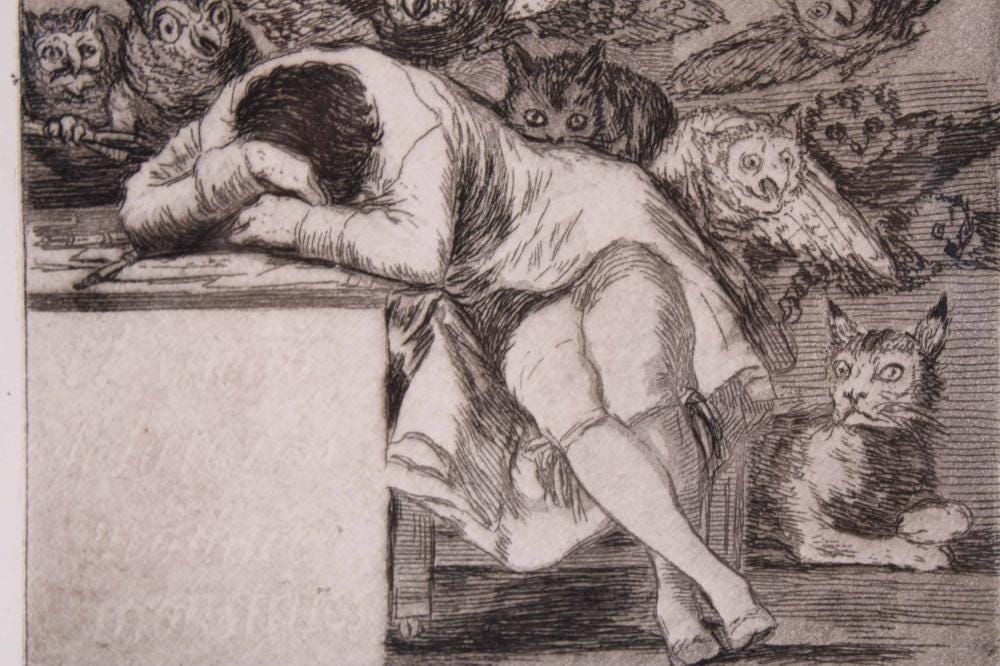
Reasoning is the process by which logic manifests itself. Man has always considered his position in the world as something precarious—as something bound to drop dead in due time—and with this recognition has come, understandably, an innate sense of confusion and timidity when placed face-to-face with it. The world offers man no answers whatsoever, and so, desirous of living and continuing on as best he could in the face of overwhelming odds, he developed within himself a tool of boundless utility and applicability: reason (which in the process of its use is called reasoning). This was the most mendacious minute in human history, but alas, it was only a minute, and man was fated to die like the rest in due time all the same.
Man does not feel himself if he cannot compare what he is with other people or ideas. It is only when man feels he could dominate reality that he feels at home with himself, and can exercise his power to the extent that it furthers his own ends and happiness. Without this, there is nothing by which to expend energy on, and so all would remain stagnant and inert, undeveloped, and destined to decay with time. It was reason that made man cognizant of this very fact: without his strength and effort, his labor in every pursuit and discipline—all for the sake of his vanity and self-aggrandizement, his desire to overcome all that obstructs him—the world he inhabited would be left to other beasts of burden to overtake and die in selfishly, all without progressing it one step.
Such is the story of man: a single revolt within the mind that led to countless revolutions and paradigm shifts, one after another, all to further his own conception of the world—shifting and adapting to all that he finds in order that his ideals may be more firmly secured and established. It would be man’s greatest boon if he could build the whole world after his own image, but, unfortunately for him, the world is more resistant to change than he thinks; and even if he could, either through persuasion, force, or conceiving an idea whose time has come (to be, more or less, in agreement with the Zeitgeist—as well as understanding what is to be done for the advancement and prosperity of humanity), time would beg to differ with all such abstractions—for time itself has no time to listen to the shouts of utopians and idealists who wish to free humanity from its fetters. Man is the animal who uses reason to overturn his former reasons; and in this triumph of reasoning, reason reasons over reason, and comes to a reasonable reason to overthrow reason. In this overthrow, we have the happiest cause for celebration—a reasoned justification has been born in us through our reasoning, and in this a new potential for greater prospects which we can only dream of. Justification itself is a form of reason, in which we provide various reasons for why we have thought what we have about reality. We can’t even discuss reason without referring back to itself—to itself as idea, concept, or significance; it’s a tool so vast and infinite, that any attempt to abolish it reverts back for a time, but always returns with a greater form of emancipation.
To ourselves we are reason: humanity is reason in action (never forget that reason is a verb). In fact, the word “reasoning” is, to speak grammatically, the present participle and gerund of reason: that is, spoken of as an action occurring in the present tense, and which has the -ing suffix at the end to indicate that it is a gerund—a verb that is not in the infinitive form. Even in our linguistics do we display our own self-importance. Our desire to act in such a way that doesn’t merely make us in and of the world, but as the world itself, is all too present in our self-conception of who we are. Man’s ambition knows no end. Man wants the world and everything in it, and anything that stands in front of him will be routed and overthrown—just like reason overthrowing itself every second.
It is shocking to me that nobody recognizes the infinity that lies within them. Reality is born in us, and receives its attire thanks to the material which preexisted our very cognition of it. A human being is a constant agitation, an ever-moving and thinking creature who finds the limits materiality places on him absurd and worth ignoring—even overcoming if possible; nay, it doesn’t matter whether it is possible or not, what matters is that it is attempted. It is no surprise that the word “being” is used (in English at least) in conjunction with “human” when referring to man. Man as the single individual, as a singular entity—a being, whose existence also posits the whole of reality as such. Reality as negation and affirmation. Humanity as instinct and intuition. Life as idea and material. The whole concept of reason has its basis in man’s conception of himself, born out of his self-consciousness, whose highest form is found in his complete freedom to affirm his own individuality. What is offered to man in the idea of being himself is nothing less than the whole of his being, affirmed in the confines of his essence as such. I said earlier that man’s totality is found in the unity between his essence and being: with essence being the material (objective) side of his reality, and being being the immaterial (subjective) side of his reality. All our reasonings and miseries stem from this very fact of self-conscious experience.
It is to be mourned that no man (whether genius, commander, or prophet—sometimes even all three like in the cases of Solomon or Muhammad) has ever brought us true freedom: freedom from every want and desire, which propels us to reason in the first place. Desire itself is a subjective abstraction born from our material conditions. Every particular has the abstract and the concrete within it; every facet of life presents itself to us without our consent, and we are thus compelled by it, or moved by the sensation of it, to either want or flee from it. By concrete, I mean the sensation of the particular (the external object in the world) which causes our desire, and by abstract, I mean the idea born in our minds of what the particular represents to us; in that sense, every evaluation of reality is an a priori prejudice known to us only a posteriori, and which we allow to have command over us. What is man without his prejudices? Nothing but an unthinking beast, who views every sensation only in relation to what pleasure or pain it causes. It is for this reason that any attempts to ground the world within an objective framework is folly; and it is also for this reason that man has developed reason. Every idea which strikes the mind of man is born in experience, but was shaped by material realities which were prior to our experiencing them. The table of categories which Kant gave the world, and which he was so lavishly praised for—seen in the eyes of many as the pinnacle of Enlightenment thought—is really just the prejudices of a thinking beast.
This obscure (in his lifetime) Königsbergian was a physically weak, effeminate, slender, solitary man—taking more walks than his health demanded: a waste of time!—who saw the world in all its variety, and conceived of its intelligibility in abstract conceptions; and so, through an overly prolix analysis of reason—worked out in a manner akin to a mad man whose goal was to torture paper with ink: the audacity of this little German, treating philosophy as if it were architecture (his vile architectonic structure of thinking)—came to justify his reason by stating what a bricklayer could have discovered in five minutes on his own: that all of reality responds to our perceptions of it (and vice versa), and that the complexity of life is nothing but a by-product of the infinite multitude of experiences within it. Man wishes to correlate the variety of his experiences with a concept that “explains” it; in doing this, man makes his life after the image of causality—as if our entire being were but a game of pairing the right cause with the right effect, but no one will ever find themselves in such a way.
Out of safety do we make the world, and out of conformity with society do we act within it—thus do we all, in some sense, live a lie, a life that is not true to ourselves: our individuality as it is. Kant is great because he was the first to recognize that existence is necessarily dualistic: that reality appears to us, but that prior to reality is our potentiality to experience it in the first place; and also that this appearance cannot be known in an absolute sense. Every attempt after Kant to reconcile this subjective-objective divide has only ever been a fairy-tale, a presuppositional apologetic. This is why all of metaphysics, and by extension all of philosophy, after Kant has been nothing more than reversions to forms of Platonic idealism, Aristotelian realism, or Socratic maieutics. For myself, I take the Socratic route; and I find the only possible reconciliation between subject and object to be born within the inwardness of man, within his inner conflict, and within his capacity to endure and overcome all! Life is dialectical precisely because it is interpretable, and it is tolerable only in so far as man recognizes his own singularity within it. Every day is a tough battle, and so too are all the innumerable aspects of it which we have within it, but which we are incapable of expressing truly. This is why writing is the nearest to the soul a person can get to another that isn’t themselves. Your own experience is sacred, and you must do whatever you can to preserve it, and make the most out of it that is possible.
What is seen as complex on the surface is really vague and uninteresting in the depths. True freedom, in my view, is the ability to toss aside the desire of all desires: TRUTH! What every common man does is grope about through the dark hall of life hoping to grab the veil which prevents him from seeing the light. Like a fool, man dives headfirst into life without first looking at what he dives into exactly. Hence the indomitable confusion which reigns supreme across the entire Earth, and all the stupid smokescreens and distractions which we have come up with to distract us from the crude, barbaric, undeveloped state of our being. Our essence is always to be confused so long as we think we find it in false idols and conceptions not from within ourselves. Man is born in strife, and privation is the common order of existence; all rank orders with respect to the nature and character of humanity are, in a biological sense, born out in those specimens who are the fittest among us. It is this inevitable material reality which all philosophers—idealists and realists alike—must brush up against, and break through, in fact, if they are to truly make something of themselves in this insane world. For some—I have Hegel in mind here—true freedom (freedom from truth) is accomplished when all humanity comes together and brings about its total self-realization (for every being)—where every individual comes to know the one, supreme absolute. For others, like myself and Nietzsche, true freedom is really an idea that has no place in man to begin with; rather what freedom is, is recognizing how feeble and paltry it is as an idea from the start: what has truth ever really done for us, aside from making claims it can’t support, and emboldening vainglorious men to develop whole systems which are circular in the main, and incoherent in the particular. Thus the vanity of reasoning as a whole.
Every desire is born within, and every passion is a response to the sudden urge to expend power in overcoming. This is truly what man must be today. He must be uncompromising in his hatred for truth. “Truth for whom? To what end? Where does it lie, and can it be measured? If no, I want none of it.” Man loves to hide behind ignorance the moment he is caught affirming that which he feels his reasoning has affirmed for him. Why bother with any of it? It’s obvious to those with an innate capacity to sense bullshit that no one really stands ten toes down on anything they believe to be so. This is most obvious today in politics, which is essentially one giant circle-jerk of self-affirmation and propaganda, justified with arguments made by pundits and pseudo-intellectuals. I’ve developed over the past year a virulent contempt for all these mawkish morons, bloviating baboons, whose ignorance borders on the bovine. Everything that is false is dear to me, and everything which man proclaims as truth is pointed at with the finger of contempt. Oh, how I hate everybody who is not true to themselves. How I greatly despise the vast majority of people, for the simple reason that they’re all so scared to think for themselves, and have very little ambition to really change the world. Everyone, at least in this crumbling republic (America), would die before fighting for what is truly right. We have, as a nation, been led astray by knaves and fools who put profits over people—billionaires and asset managers who would rather see humanity go extinct than have their massive fortunes ceded off to those who need it. The collective will of humanity is far from true WILL-TO-POWER; rather, it is WILL-TO-MYSELF—a debasing form of selfishness, in which the end of all justifications comes down to an unethical bottom line that puts the self before the collective good. The collective must never override the single individual, but likewise, a single individual must not prevent others from recognizing themselves as individuals; and yet, this is exactly what we have today: incentives perfectly tailored to a society with the aim of producing burnout and total capitulation, furthered by ruthless competition and staggering ignorance, making any form of solidarity nigh impossible. We’ve made a whip for ourselves, and now we are being told to flagellate our backs. Disgraceful.
Humanity has been in a constant struggle to overcome what it fears will be its end. Every religion and utopian vision bears this out all-too clearly. Unfortunately, so long as man is condemned to live, he must be forced to reason about his condition; and on all sides, while in the midst of life, must he hear the foolish opinions and downright falsities of every idiot and billboard. Everything is constantly telling man what to be except himself, and so long as he believes his salvation lies in understanding reality, he will be condemned eternally to pick up ideas which are not his own—from without, and yet which pull him from both the front and back. What is man to do when reasoning, that trite faculty of the mind, fails him completely? OVERCOME! SUBLATE—DIALECTICALLY; that is, to view each abstract and concrete through their negative aspect, in order that their higher synthesis may be achieved.
Make great and noble goals for yourself, from yourself, and live in such a way that makes each hardship endured a kind of blessing, from which innumerable good fortunes may arise afterwards, like forgotten seeds scattered across the soil, which receive copious amounts of water from an auspicious rain cloud. As Nietzsche rightly said,
Man becomes that which he wants to be; his volition precedes his existence. —Human, All Too Human, Section Two, Aphorism #39.