
Reflections on America
Its History and Politics

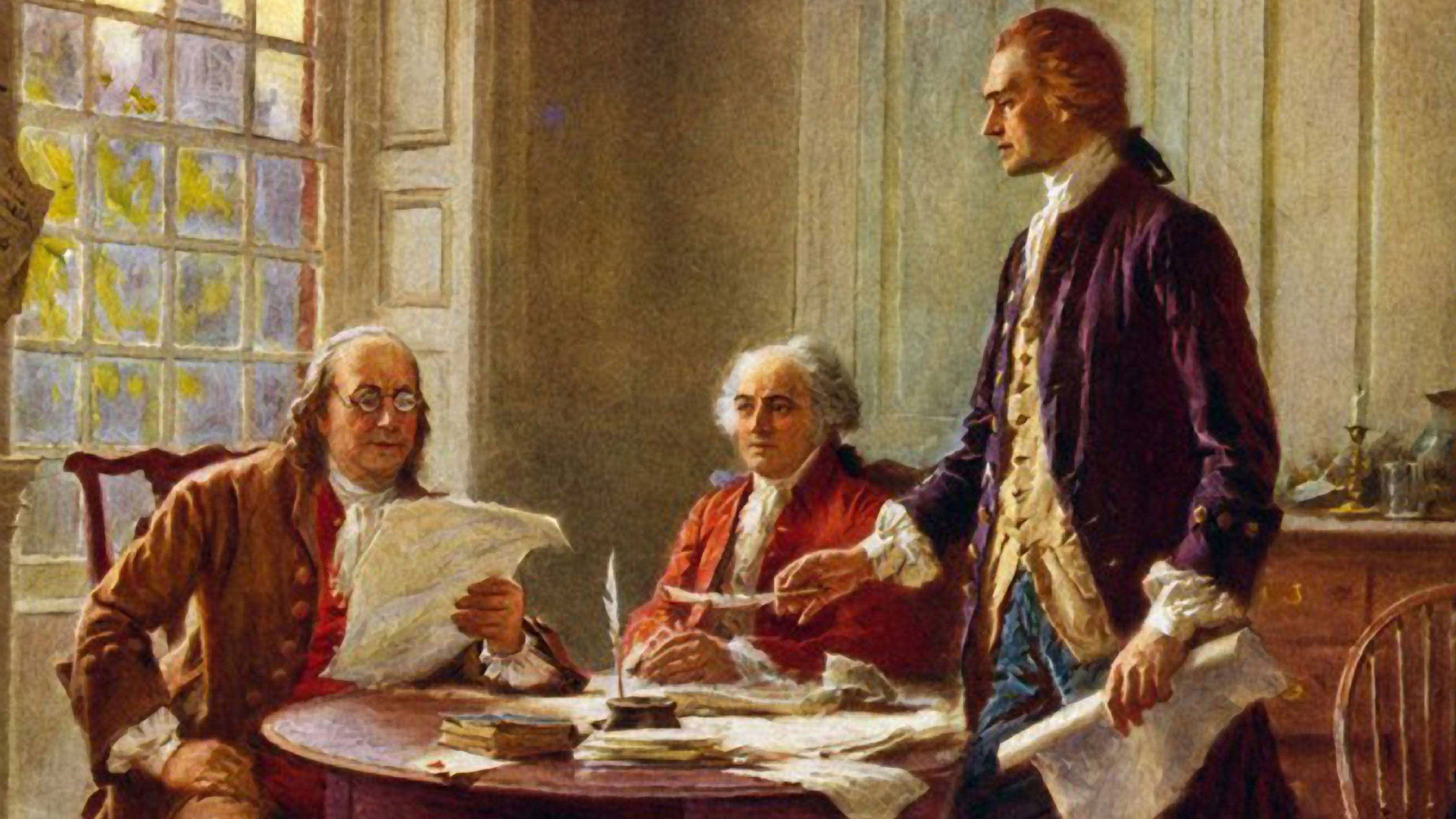
The Historical Aspect
George Washington: The Virtuous Founder
Civilization advances not by accident but by the union of character and circumstance. In this great current, the United States rose as the colossus of the modern age. Its story, like that of Rome or Athens, begins not with institutions, but with a man — and in America, that man was George Washington.
Few are granted the power to found a nation; fewer still renounce it. Washington, by nature and necessity, was the rarest of political figures: the virtuous general. He was not a philosopher like Jefferson nor a financial visionary like Hamilton, but something steadier — the embodiment of gravitas and the sovereign gift of temperament that Cicero deemed the essence of statesmanship.
His apprenticeship came on the battlefields of the French and Indian War, where he learned both the mechanics of empire and the humiliations of colonial subordination. From these lessons grew his conviction that only unity — first of command, later of nation — could secure survival.
The Revolution was the crucible of his destiny. At its end, with victory at Yorktown, Washington embodied the new republican virtue. His resignation of command astonished Europe. “If he does that,” said King George III, “he will be the greatest man in the world.” Like Cincinnatus, he returned to private life, affirming that in the republic, the sword must remain subordinate to law.
Yet the weakness of the Articles of Confederation summoned him back. At the Constitutional Convention, his very presence gave assurance to the fragile experiment. Elected unanimously as the first president, he defined the office through prudence, knowing that every act was precedent. His cabinet — Hamilton and Jefferson — represented opposing visions, which he balanced with measured dignity, though leaning toward Hamilton’s energetic federalism.
Washington foresaw the dangers of faction and warned in his Farewell Address against “the baneful effects of party spirit” and against entangling foreign alliances, understanding that both could erode the republic’s independence.
In character, too, he stood apart. Though a slaveholder, he alone among the Founders freed his slaves in his will — an imperfect but telling gesture of conscience against the moral stain of his age.
He died not as king or conqueror, but as citizen and guardian of a fledgling nation. In him the Republic found its exemplar: “first in war, first in peace, and first in the hearts of his countrymen.”
Washington’s legacy is more than monuments of stone; it is a living reminder that the strength of a nation rests not only on arms or laws, but on the virtue of its leaders.
John Adams: The Stubborn Patriot
To follow a titan is a thankless fate. Succeeding George Washington — sanctified in his own virtue — was a burden few could bear. John Adams, with his flinty principles and cantankerous manner, carried it with obstinacy. Brilliant yet irascible, indispensable yet unpopular, he was a founder whose presidency became a tragic prelude to Jefferson’s ascendancy.
Adams’ convictions were forged in Massachusetts. When the Stamp Act of 1765 threatened colonial liberties, he rose with the fervor of a Puritan and the logic of a jurist, declaring that taxation without consent and trials without juries were sacrileges against English law. His reputation, however, was secured not by rebellion alone but by integrity: when British soldiers fired on a Boston crowd, Adams defended them in court, insisting that law must rule even over passion. “Facts are stubborn things,” he told the jury — a creed that became his epitaph.
At the Continental Congress, Adams was the tireless architect of independence. He nominated Washington as commander of the Continental Army, ensuring unity between New England and Virginia. His Thoughts on Government distilled his political creed: a republic must be “an empire of laws, not of men,” safeguarded by checks against popular frenzy. Though Jefferson drafted the Declaration, Adams was its fiercest midwife in debate and adoption.
His years as diplomat in Europe honed his statecraft, but at home he never mastered politics. As Washington’s vice president, his pompous gravity earned ridicule, and his instinct for order often seemed aristocratic. Elected president in 1796, he inherited a nation divided and a world in upheaval. France, enraged by America’s treaty with Britain, preyed on American shipping. Adams avoided full-scale war but presided over a bitter Quasi-War at sea, while Hamilton agitated for an army at home.
The darkest stain of his presidency came with the Alien and Sedition Acts of 1798. Intended to guard security, they harassed immigrants and silenced critics — a betrayal of the First Amendment. Though Adams neither devised nor enforced them with zeal, his assent made him complicit, and Jefferson’s Republicans answered with the Kentucky and Virginia Resolutions, which planted the seeds of nullification and, ultimately, disunion.
Yet Adams’ prudence secured peace with France and his appointment of John Marshall as Chief Justice endowed the judiciary with enduring authority. Still, the Federalists, fractured and fading, fell with him in 1800, as Jefferson claimed the “Revolution of 1800” for the republic’s future.
Adams retired embittered but later reconciled with Jefferson, their correspondence becoming a dialogue on revolution and mortality. Fittingly, both men died on July 4, 1826, the fiftieth anniversary of the Declaration they had wrought together. Adams’ final words — “Thomas Jefferson still survives” — were mistaken in fact but profound in spirit.
Thus stands John Adams: austere, unpolished, unyielding. His presidency was marred, yet his devotion to liberty was incorruptible. If Washington embodied dignity, Adams embodied principle — reminding us that in a republic, character may outlast charm, and that liberty, like the facts he so revered, is a stubborn thing.
Thomas Jefferson: The Philosopher of Contradictions
In Thomas Jefferson, nature joined brilliance with paradox — a philosopher of liberty who held men in bondage. Among the Founders, he was the most radiant intellect and yet the most perplexing contradiction: statesman of letters, apostle of agrarian virtue, and scientist of revolution, stained by the very institution he condemned in words.
A child of the Enlightenment, Jefferson’s mind ranged without boundary: philosophy, architecture, botany, history, and theology alike. His Notes on the State of Virginia remains the earliest profound survey of America’s land and people, while his vast library, later sold to Congress, became the seed of the nation’s own. Above all, his pen gave the world the Declaration of Independence — a creed distilled from centuries of thought: that all men are created equal and endowed with inalienable rights. Yet even as he wrote, he owned slaves, and when Southern delegates struck his anti-slavery clause from the draft, he yielded. The moral wound endured.
Jefferson’s belief in the moral teachings of Jesus inspired his private Jefferson Bible, stripped of miracles and dogma, leaving only ethical precepts. His Virginia Statute for Religious Freedom, meanwhile, stands as one of history’s clearest declarations of the secular state — a triumph of toleration.
Politically, he was as contradictory as he was brilliant. He preached states’ rights yet, as president, wielded power with Hamiltonian force. He dreamed of a republic of yeoman farmers yet sustained that vision on enslaved labor. In public, he posed as the philosopher; in practice, he directed partisan battles through surrogates, allowing his hands to remain seemingly unstained. Even Washington, wounded by Jeffersonian slanders, withdrew from him in cold silence.
Together with Madison, Jefferson forged the Republican Party as an answer to Hamilton’s Federalism. Their Virginia and Kentucky Resolutions proclaimed that states might nullify unconstitutional laws — a doctrine that, decades later, would be claimed by secessionists. Washington himself foresaw its danger to the Union.
Elected president in 1800 after a bitter contest with Adams, Jefferson began his tenure with the irony of a small-government theorist presiding over government. Hamilton’s last-minute support saved him from losing to his own running mate, Aaron Burr — a rivalry that culminated in Hamilton’s death by duel.
In foreign affairs, Jefferson tested his ideals. Rejecting tribute to the Barbary pirates, he dispatched the navy in America’s first overseas war, proving that even the philosopher must take up the sword. His greatest triumph was the Louisiana Purchase, which doubled the nation’s territory and ensured its continental destiny, though it stretched the Constitution he revered. The Lewis and Clark expedition, his design, mapped the path to the Pacific.
Yet his policies also bore failure. Confronted by British abuses on the seas, Jefferson turned to the Embargo Act, forbidding American trade abroad. Intended as peaceful coercion, it instead devastated the nation’s economy and revealed the harsh paradox of the liberty-loving president who enforced coercion at home.
His second term ended in frustration, and he retired to Monticello, where he founded the University of Virginia, his “academical village,” and guided Monroe in policies that shaped the Monroe Doctrine. His mind remained fertile though his finances collapsed.
On July 4, 1826 — the fiftieth anniversary of the Declaration — Jefferson died, on the same day as John Adams. On his tombstone he recorded no office, only three achievements: author of the Declaration of Independence, of the Virginia Statute for Religious Freedom, and founder of the University of Virginia. These he deemed the true measure of his life.
Jefferson remains the republic’s mirror: visionary yet flawed, eloquent yet compromised, a prophet of liberty bound by chains of his own making. In him America sees both its noblest aspirations and its oldest sins — the philosopher of freedom who could not free himself from contradiction.
James Madison: Architect of the Republic
Small in stature but immense in influence, James Madison was an unlikely giant of history. At five feet four and barely a hundred pounds, he carried on his frail shoulders the immense weight of a nation’s birth, its Constitution, and its liberties. Remembered as the “Father of the Constitution” and the chief architect of the Bill of Rights, he was the philosopher who designed America’s political framework — and yet, like his peers, a man of contradictions whose ideals shifted with the tempests of his age.
Born into Virginia’s planter aristocracy, Madison inherited both land and slaves, embodying the South’s moral paradox: devotion to liberty amid the practice of bondage. Educated in the classics of Cicero, Montesquieu, and Locke, his mind was exacting in logic yet supple enough to bend with necessity. In the Virginia legislature, he allied with Thomas Jefferson to draft the Virginia Statute for Religious Freedom, a clarion of Enlightenment thought that severed church from state.
But the Articles of Confederation soon revealed the perils of weak government. Bankruptcy loomed, disunion threatened, and even Washington despaired. It was Madison who pressed for a Constitutional Convention and persuaded Washington to preside, knowing his authority alone could steady the states.
At Philadelphia in 1787, Madison was no mere secretary but the intellectual compass of the assembly. His Virginia Plan sketched a bicameral legislature with proportional representation, forming the skeleton of the republic. He spoke more than two hundred times, weaving together republican ideals and federal structure. By intellect and perseverance, he earned the title “Father of the Constitution.”
Yet his framework remained incomplete. Madison opposed adding a Bill of Rights, trusting the Constitution’s structure to safeguard liberty. Jefferson, writing from France, urged otherwise: “A bill of rights is what the people are entitled to against every government on earth.” Madison yielded and, through careful statesmanship, secured the first ten amendments — a charter of freedom cherished ever since.
Still, the republic quickly fractured along partisan lines. Madison joined Jefferson against Hamilton’s vision of banks, armies, and centralized power, fearing monarchy in republican guise. Together they forged the Democratic-Republican Party, defenders of the yeoman farmer and state sovereignty. Their opposition culminated in the Virginia and Kentucky Resolutions, asserting a state’s right to nullify federal law. Intended as a shield against Federalist excess, the doctrine later armed secessionists who threatened the Union itself.
As Jefferson’s Secretary of State, Madison oversaw the Louisiana Purchase, a bold expansion of the republic that stretched constitutional interpretation. In 1809, he assumed the presidency amid global upheaval. Britain and France trampled American neutrality, seizing ships and sailors. Madison, reluctant to fight, was pressed by “War Hawks” into the War of 1812.
The conflict laid bare the nation’s frailties: a dissolved national bank, divided Congress, inept generals, and militias bound to state lines. The British burned Washington, forcing Madison to flee — the only president to lead troops into the field, though ignominiously. Yet from humiliation arose triumphs: Perry’s victory on Lake Erie, Jackson’s stand at New Orleans, and the defiant flag over Fort McHenry, inspiring the “Star-Spangled Banner.” The Treaty of Ghent restored no land but secured national honor.
War transformed Madison. Once wary of central power, he now recognized its necessity. He signed the charter for the Second Bank of the United States, admitted the need for stronger institutions, and presided over the “Era of Good Feelings,” a fleeting moment of unity.
In retirement at Montpelier, Madison reflected on the Constitution he had fathered. He lived to see it tested by war, faction, and ideology — and still it endured. He died in 1836, last of the great Founders, his mind sharp to the end.
Madison lacked Washington’s grandeur, Jefferson’s romantic idealism, or Hamilton’s economic genius. Yet he was the republic’s most subtle craftsman, a philosopher-statesman whose careful hands built the framework of American self-government. In his slight frame resided the keenest mind of the Revolution, one that reconciled liberty with order, ideals with necessity.
His legacy is America’s own paradox: a nation forever divided between states’ rights and federal power, liberty and security, passion and reason — yet, because of Madison, still improbably whole.
James Monroe: The Birth of an American Hemisphere
James Monroe, born into Virginia’s planter aristocracy, first entered history as a young soldier of the Revolution. He fought under Washington, was wounded at Trenton, and forever carried the scar as a reminder of liberty’s cost. From the battlefield he turned to statesmanship, studying law under Thomas Jefferson, whose republican ideals shaped his creed. Though wary of the Federal Constitution, Monroe’s principles matured with the needs of nationhood. He joined Jefferson’s Democratic-Republicans, served as diplomat in the Louisiana Purchase, and became the only man ever to hold simultaneously the offices of Secretary of State and Secretary of War during the crisis of 1812.
Elected President in 1816, Monroe presided over the Era of Good Feelings, a brief season of national harmony after years of faction. His administration marked a period of territorial growth and diplomatic assertion: Florida was acquired from Spain, American borders reached the Pacific, and Oregon was secured for joint occupation with Britain. Yet unity proved fragile. The Missouri Crisis of 1820 exposed the deep rift of slavery, resolved only by Henry Clay’s precarious compromise—a truce that preserved the Union but postponed its reckoning.
Monroe’s greatest legacy lay in diplomacy. Guided by John Quincy Adams, he issued the Monroe Doctrine in 1823: the Western Hemisphere was closed to new European colonization, while the United States pledged neutrality in Europe’s quarrels. Though the young nation lacked the power to enforce it, the declaration asserted America’s guardianship over the New World and became a pillar of its foreign policy for centuries.
Beyond politics, Monroe supported the colonization movement that led to the founding of Liberia, whose capital, Monrovia, still bears his name—a testament both to humanitarian ambition and the contradictions of a slaveholding republic.
Reelected without opposition, Monroe became known as “The Last Cocked Hat,” the final president of the Revolutionary generation. Retiring in 1825, he left a nation enlarged in territory, emboldened in diplomacy, yet shadowed by the unresolved problem of slavery. He died on July 4, 1831, joining Jefferson and Adams in death on Independence Day.
History remembers Monroe not as the philosopher or visionary of his peers, but as the steady craftsman of nationhood. His calm moderation, territorial expansions, and bold doctrine helped transform the fledgling republic into a confident continental power, poised for both greatness and trial.
John Quincy Adams: The Prophet of the Republic
If lineage could confer both burden and blessing, none bore it more heavily than John Quincy Adams, son of John Adams and heir to a stern tradition of Puritan duty. A prodigy of intellect, he entered diplomacy in youth, serving as minister to the Netherlands, Prussia, Russia, and Great Britain. He helped craft the Treaty of Ghent, ending the War of 1812, and as Monroe’s Secretary of State, he secured territorial expansion and gave lasting form to the Monroe Doctrine.
Yet Adams’ genius with treaties faltered in politics. Elevated to the presidency in 1824 by the House of Representatives through Henry Clay’s support—the so-called “corrupt bargain”—he began his term under suspicion and hostility. Lacking charisma and refusing to flatter the public, he advanced a vision too lofty for his age: a nation bound by roads, canals, and railways, enriched by education, science, and the arts. Congress, dominated by Jacksonians, thwarted him at every turn, and in 1828 he fell before Andrew Jackson, reviled in one of the ugliest campaigns in American history.
Defeat did not silence him. Returning to Washington as a Massachusetts congressman, Adams found his true calling as a tribune of conscience. From the House, he denounced the slave power with prophetic clarity, warning that the Union would one day break upon its contradictions and that emancipation would come by the sword. He also helped lay the foundations of the Smithsonian Institution, ensuring knowledge itself would be part of the nation’s inheritance.
Adams’ vision of America was moral as well as political. He cautioned that the republic must not become “the dictatress of the world” at the cost of its soul, a warning against empire that echoed through later generations.
He died as he had lived—in service—collapsing on the floor of Congress in 1848. Adams remains a figure of tragic grandeur: too principled for partisan politics, too austere to win popularity, yet too honest to bend. If his presidency was thwarted, his later years gave him the voice of a prophet, one whose words and foresight shaped the conscience of the republic long after his passing.
Andrew Jackson: The Strongman of Democracy
The rise of Andrew Jackson was no routine change of administration but a seismic shift in the American spirit. Not a polished aristocrat but a son of the frontier, he was hardened by war, duels, and loss—an orphan turned lawyer, general, and conqueror of New Orleans. To his followers, he was the common man’s Caesar; to his foes, a tyrant in homespun.
With Jackson, the presidency passed from the scholar’s study to the public square. He claimed the nation itself—not Congress or the courts—as his constituency. His inaugural drew jubilant crowds that stormed the White House, shattering glass and furniture in their eagerness to greet their champion. It was democracy triumphant, and democracy unrestrained.
Jackson governed as he had fought: relentlessly. From Jefferson’s old Republicanism he forged a new Democratic Party, militant in its populism. He stood with the farmer against the banker, the frontier against the coast, the people against entrenched privilege. Aristocrats derided him as “King Andrew,” but his followers hailed him as “Old Hickory”—tough, unbending, enduring.
His achievements were formidable. He rooted out corruption, extended pensions to Revolutionary veterans, and confronted the Nullification Crisis, when South Carolina threatened secession over tariffs. His proclamation rang like a martial command: “The Union must and shall be preserved!”—the voice of Washington, magnified in thunder.
Yet his triumphs were shadowed by cruelty. The Indian Removal Act of 1830 became a national tragedy as tens of thousands of Native Americans—the Cherokee, Choctaw, Chickasaw, and others—were driven west along the Trail of Tears, their dead marking the path of forced exile. Jackson preserved the Union but shattered nations within it.
His war on the Second Bank of the United States revealed both his populist fervor and his destructiveness. Casting it as a fortress of privilege, he tore it down with righteous zeal. But in victory he unleashed chaos, and within months the Panic of 1837 ravaged the economy, ruining thousands.
Jackson himself was a storm in human form: fierce in loyalty, implacable in hatred. He fought enemies with pistol and policy alike, and left office lamenting only that he had not shot Henry Clay or hanged John C. Calhoun. Alexis de Tocqueville, observing from abroad, saw in him the dangerous seduction of majoritarian power—a president wielding vetoes as weapons, claiming the mantle of the people above the restraints of law.
Thus Jackson’s legacy is Janus-faced. He was both democrat and despot, champion of the common man and author of dispossession, destroyer of privilege and patron of panic. His age, the Age of Jackson, bore the contradictions of America itself: liberty shadowed by tyranny, prosperity tempered by violence, democracy entwined with exclusion.
Jackson left the presidency transformed. He had remade the office into the engine of popular will, amplifying the voice of the majority but risking the fury of the mob. In him, America found its first strongman, and the Republic would never be the same.
Martin Van Buren: The Magician of American Politics
In the unfolding of American democracy, Martin Van Buren stands less as a warrior or philosopher than as the subtle architect of politics itself. Born in 1782 to a Dutch tavern-keeper in Kinderhook, New York, he learned the art of persuasion not in academies or battlefields, but across counters where farmers, merchants, and lawyers gathered. From these beginnings, he mastered the dialect of power—equally at home in the parlors of elites and the smoke-filled rooms of common men.
His rise was swift. By eighteen, he was already shaping conventions; soon he became state senator, a prominent attorney, U.S. Senator, Governor of New York, Secretary of State under Jackson, and then Vice President. Van Buren’s greatest creation was not his presidency but the Democratic Party, which he forged into a durable national machine—an organization that gave form to popular will and endures as the oldest active political party in the world.
But his brilliance earned him fierce rivals. John C. Calhoun, seeking to end Van Buren’s ascent, cast the deciding vote against his nomination as minister to Britain, declaring him “dead, sir, dead!” Yet history mocked Calhoun: Van Buren rose higher still, becoming Vice President and, in 1836, Jackson’s chosen successor as President.
His administration, however, was crushed by economic crisis. The Panic of 1837, born of speculative excess and Jackson’s destruction of the national bank, erupted as Van Buren took office. Though disciplined in finance, he could not calm the storm. His proposal for an independent treasury system was delayed, and his caution earned him the contempt of a suffering nation that dubbed him “Martin Van Ruin.”
Van Buren’s prudence extended to foreign policy. When Texas sought annexation, he foresaw that expanding slave territory would ignite sectional discord. His refusal preserved temporary peace but cost him popularity: Southerners distrusted him as hostile to slavery, while Northerners faulted his timidity.
Defeated in 1840 by William Henry Harrison and the Whigs, Van Buren never regained the presidency. Passed over in 1844, he joined the Free Soil Party in 1848, standing openly against the expansion of slavery. Though this doomed his Democratic ties, it gave him a final vindication of principle. By the Civil War, he supported Lincoln and the Union, recognizing at last the unavoidable reckoning with slavery.
Van Buren’s presidency marked the onset of an era of weaker executives, overshadowed by Congress and faction. Yet his legacy endures in the architecture of party politics. He understood that in a republic, parties are not corruptions but necessities—the scaffolding of democracy itself. If his own presidency faltered, his larger creation endured, disciplining the unruly passions of democracy into a permanent, if imperfect, system.
Thus Van Buren remains less remembered as President than as the Magician—the man who gave America its lasting political machinery, even as his own career was broken upon its wheels.
William Henry Harrison: The Brief Flame
In the swift chronicle of the American presidency, William Henry Harrison remains but a flicker—his tenure extinguished almost as soon as it began. Yet within that fleeting light resides the memory of battles fought, frontiers subdued, and a republic still defining its destiny.
Born in 1773, under the reign of George III, Harrison was both the last president born a British subject and the first to prove that the presidency could be not only a summit of ambition but also a sepulcher. His early life was bound to the frontier and to war. As governor of the Indiana Territory, he gained renown at the Battle of Tippecanoe (1811), where his forces broke the Native confederacy forged by Tecumseh and his brother, Tenskwatawa, “the Prophet.” The victory earned him fame and the enduring title “Old Tippecanoe,” a name later repurposed as a political emblem.
In the War of 1812, Harrison commanded American troops at the Battle of the Thames, where Tecumseh fell and with him the last effective resistance of Native power in the Old Northwest. Like Andrew Jackson, he became a symbol of the nation’s relentless advance—celebrated as the soldier who cleared the way for expansion and “civilization.”
After war came politics. Harrison served in the House, the Senate, and as Minister to Colombia, where he lectured Simón Bolívar on the virtues of republican government. Bolívar dismissed the sermon, yet the episode revealed America’s growing conviction that its political model was a creed to be exported abroad.
By the 1830s, the Whig Party, still coalescing from factions, saw in Harrison a candidate of martial fame and frontier simplicity. He lost to Martin Van Buren in 1836 but emerged as the Whigs’ unified choice in 1840. With the nation mired in depression after the Panic of 1837, Harrison’s campaign—cheerfully sloganed “Tippecanoe and Tyler Too”—offered voters not a platform of policies but the image of a war hero untainted by Washington intrigue. He triumphed in a tide of populist enthusiasm.
Yet triumph turned quickly to tragedy. On his frigid inauguration day, Harrison delivered a two-hour address without overcoat or hat. Illness followed, and within thirty-one days he was dead—the first president to perish in office. He left behind neither program nor policy, but a constitutional dilemma. The charter had granted the vice president only the “powers and duties” of the office. John Tyler, however, claimed the presidency in full. His accession, though contested, stood firm, establishing the precedent of uninterrupted executive succession that has endured to this day.
Harrison’s memory became less that of a ruler than of a relic. His grandson, Benjamin Harrison, would later restore the family name to the White House, but William Henry Harrison himself remains chiefly a reminder: of the frontier’s passing glories, of the fragility of life at the pinnacle of power, and of how even the highest office can be undone not by war or conspiracy, but by the indifferent hand of disease.
John Tyler: The Accidental President
History, with its sly indifference, sometimes thrusts the unprepared into supreme command, as if to remind nations that fortune, not foresight, appoints their rulers. So it was with John Tyler, who ascended to the presidency upon the sudden death of William Henry Harrison in 1841. Harrison had lasted but a month in office; Tyler, by the accident of mortality, became the first vice president to claim not merely the duties, but the full dignity of the presidency. His assertion set a constitutional precedent—contested in the moment, confirmed by practice, and only codified more than a century later in the 25th Amendment.
Yet his enemies’ epithet—“His Accidency”—carried more than malice. For Tyler never commanded the confidence of his own age. Born to Virginia’s planter aristocracy and schooled in the creed of States’ Rights, he began as a Jeffersonian Democrat. Though sympathetic to the South, he recoiled from Andrew Jackson’s forceful defense of federal authority during the Nullification Crisis, and so defected to the Whigs. Yet he never truly shared their vision of a strong Congress guiding national policy.
As president, Tyler governed in contradiction: a Whig in title, a Democrat at heart. He wielded the veto freely, thwarting Whig measures to restore a national bank and strengthen economic centralization. To Henry Clay, the party’s commanding figure, Tyler was nothing less than a traitor. One by one, his cabinet resigned, until only Daniel Webster remained at State. The Whigs ultimately cast him off, leaving him a president without a party, a ruler without a base.
Yet Tyler’s administration was not without consequence. In his final months, he secured the annexation of Texas, a bold stroke that ensured his place in the nation’s story. But the victory was double-edged: the addition of Texas expanded the republic’s domain even as it deepened the sectional divide between North and South, slavery and freedom.
Tyler’s post-presidential course only sharpened this paradox. When the Southern states seceded, he followed Virginia into rebellion, elected to the Confederate Congress before his death in 1862. He passed unwept in the North, scarcely honored in the South—a man claimed by neither nation.
Thus John Tyler endures less as a maker of policy than as a study in irony: the first accidental president, who gained office by chance, lost his party by conviction, and lived to see the Union he once led collapse into fratricidal war. His presidency was less an achievement than a portent, a reminder that contingency, not design, often shapes the fate of republics.
James K. Polk: The Architect of Expansion
History sometimes records a greatness that burns swiftly, consuming itself in the very act of accomplishment. Such was the career of James Knox Polk, the lone figure of formidable strength amid the succession of weak presidencies that bridged Jackson and Lincoln. A disciple of Andrew Jackson in both conviction and temperament, Polk embodied a rare harmony between promise and performance. He pledged to serve but a single term, laid forth a precise agenda, and with Spartan discipline fulfilled each aim before death’s swift summons.
Polk’s rise was itself improbable. Once Speaker of the House and Governor of Tennessee, he emerged from obscurity as the dark-horse candidate of 1844, vanquishing Henry Clay in an election that became a referendum on Manifest Destiny. For Polk, the nation’s course was clear: the United States was ordained to span the continent. In four years he annexed Texas, secured Oregon from Britain, and, through war with Mexico, claimed California, New Mexico, and the vast Southwest. The republic had doubled its domain, and its western horizon was now the Pacific.
Yet the grandeur of his conquests carried shadows. The war with Mexico, provoked by the annexation of Texas, was hailed by Polk as destiny but denounced by critics as naked aggression. Abraham Lincoln questioned its justice, Henry David Thoreau refused to fund it, and Ulysses S. Grant, who fought in it, later condemned it as a national crime. The territories won reopened the most dangerous of questions: would slavery advance with the flag? The Wilmot Proviso failed, but the sectional conflict it ignited would blaze long after Polk’s death.
Polk himself, a slaveholder but not a Southern zealot, sought balance rather than agitation. Yet his policies ensured that compromise would become impossible. Expansion, once the nation’s unifying dream, had become the wedge that would divide it.
Abroad, his diplomacy was as unsparing as his waging of war. With Britain he pressed the Oregon boundary dispute, rallying expansionists under the cry “54-40 or fight!” But pragmatism prevailed, and the compromise at the 49th parallel secured peace while extending American dominion. At home, he established the Independent Treasury, strengthened the nation’s finances, and presided over the founding of the Naval Academy and the Smithsonian Institution. His term witnessed the dawn of the California Gold Rush and even the first stones of the Washington Monument, symbols of a nation gilded with new wealth and ambition.
But the cost was his life. A relentless worker, Polk exhausted his health in service to his vision. Stricken by disease—likely cholera—he died scarcely three months after leaving office, aged only fifty-three but worn by labor and care into premature decline.
In the end, Polk was both austere and audacious: a man of modest habits but boundless ambition for the republic. He promised only what he could deliver, and delivered all that he promised. Yet the empire he forged would exact its payment in blood within a generation. Harry Truman, reflecting on him a century later, judged him simply: “A great president. Said what he intended to do and did it.”
Thus Polk stands in memory as both builder and harbinger—the architect of continental empire, and the prophet, unwitting, of civil war. Like a Roman consul, he strode into history with unyielding purpose, leaving behind a republic swollen with power, restless with destiny, and trembling upon the edge of division.
Zachary Taylor: The Soldier-President
History, with a touch of irony, placed Zachary Taylor in the presidency not through statesmanship or philosophy but by the laurels of war. A soldier to the core, he was formed in the ranks of a restless young republic—commissioned in 1808, tested in the War of 1812, and hardened in the swamps of the Seminole Wars. Known as “Old Rough and Ready” for his plain manner and closeness to his troops, he achieved lasting fame in the Mexican-American War, where at Buena Vista he defied orders and, though outnumbered, won a decisive victory that secured his place as a national hero.
The Whigs, seeking a figure whose sword could succeed where rhetoric failed, turned to him in 1848. Taylor, unversed in politics and reluctant in temperament, nonetheless proved irresistible to the electorate. Thus the general, lifted by martial glory, entered a realm he scarcely understood.
Though a Southern planter and slaveholder, Taylor was not captive to sectional dogma. On the burning question of slavery’s expansion into the West, he counseled moderation and urged California and New Mexico to seek immediate statehood, thereby bypassing the fierce debates over territorial slavery. It was a bold, pragmatic effort to preserve the Union at its most fragile hour.
But fortune cut him short. After only sixteen months in office, he succumbed in July 1850 to sudden illness—cholera or dysentery—and the presidency passed to Millard Fillmore, under whom the Compromise of 1850 was fashioned.
Taylor left no grand design, no philosophy of governance—only the image of a plain soldier elevated by victory and felled before his policies could mature. He remains a figure more emblematic than consequential: a man raised, like Rome’s soldier-emperors, upon the shield of battle, only to fall too soon to shape the destiny of the republic.
Millard Fillmore: The Accidental President
Millard Fillmore entered the presidency not by mandate but by misfortune, elevated in 1850 by the sudden death of Zachary Taylor. His rise was emblematic of chance rather than destiny, and history has remembered him less as a leader than as a byword for obscurity and the slow collapse of the Whig Party.
Born in poverty in upstate New York, Fillmore rose from apprentice clothmaker to lawyer, then to politics. His career was steady but unremarkable—service in Congress, a chairmanship of the House Ways and Means Committee, and eventual selection as Taylor’s vice president, chosen only to balance the ticket as a Northern counterweight to a Southern war hero. Taylor sidelined him, and Fillmore entered the White House as an afterthought of politics.
Yet fate thrust upon him the nation’s central crisis: slavery in the newly conquered West. Taylor had opposed compromise, but Fillmore embraced it, clearing his cabinet and securing passage of the Compromise of 1850. For a moment, he appeared decisive. But the measure’s harshest component, the Fugitive Slave Act, made him a pariah in the North while winning him no enduring loyalty in the South. Instead of binding the nation, it deepened its fractures and hastened the Whigs’ demise.
By 1852, Fillmore was discarded by his own party. Bereft of a political home, he resurfaced with the Know Nothing movement, whose nativist and anti-Catholic zealotry marked the nadir of his career. His third-party candidacy in 1856 carried only Maryland, sealing his place among the forgotten.
In the Civil War, Fillmore opposed secession but offered little support to Lincoln’s cause, embodying a moderation that amounted to irrelevance. He later sided with Andrew Johnson’s lenient Reconstruction, clinging to caution as the nation demanded vision.
Fillmore remains a study in mediocrity: a man who enforced laws without conviction, pursued unity without strategy, and governed without imprint. The republic survived his presidency, but not because of him. In the long procession of American leaders, he endures as little more than a pause—a president of circumstance rather than consequence.
Franklin Pierce: The Tragedy of Weakness
History sometimes raises men to meet calamity; at other times it casts them helpless into its storm. Franklin Pierce, the nation’s 14th president, was the latter—handsome, genial, and well liked, yet crushed by grief and unequal to the convulsions of his age. His life unfolded as a tragedy: fortune gave him the presidency, but fate denied him the strength to wield it.
Born in New Hampshire to modest prominence, Pierce’s charm and quick wit carried him swiftly into politics. He served in both House and Senate, loyal to Jacksonian democracy though leaving little imprint of statesmanship. Seeking distinction, he donned a uniform in the Mexican-American War, where his brief service added martial gloss to his career but no lasting laurels.
In 1852, the Democratic Convention, paralyzed by deadlock, turned to Pierce as a compromise. He swept aside the dying Whig Party and entered the White House in triumph. Yet personal tragedy soon eclipsed political victory: weeks before his inauguration, his last surviving child was killed in a train wreck before his eyes. His wife Jane, already frail, retreated into grief. The executive mansion became a house of mourning rather than command.
Pierce’s presidency was consumed by the nation’s festering sectional crisis. A Northern man with Southern sympathies, he sought harmony but deepened discord. His support for the Kansas-Nebraska Act of 1854, which repealed the Missouri Compromise, unleashed violence in “Bleeding Kansas” and gave birth to the Republican Party. His rigid enforcement of the Fugitive Slave Act further alienated the North, branding him as a tool of Southern power.
Foreign ventures brought him little redemption: the Gadsden Purchase modestly expanded U.S. territory, but the Ostend Manifesto, with its naked designs on Cuba, stained his administration with the scent of aggression and slavery’s expansion.
By 1856, even his own party abandoned him, denying him renomination. He left office in isolation, watching the nation tear itself apart in the war he had done nothing to avert. A critic of Lincoln’s wartime measures yet offering no solutions, Pierce drifted into irrelevance, his solace found in the bottle. In 1869, cirrhosis carried him to the grave, a quiet end to a broken man.
Pierce was no tyrant, no schemer—merely a man too amiable, too irresolute, too overborne by fate. His presidency remains a cautionary tale: that charm without strength, and conciliation without principle, are powerless against history’s demands.
James Buchanan: The Failure of Inaction
In the long annals of the presidency, no figure embodies the perils of hesitation more starkly than James Buchanan, the 15th President of the United States. From 1857 to 1861, he occupied the office in the twilight before civil war, a learned statesman crippled by indecision when resolve was most required.
Buchanan’s career had been long and honorable: congressman, senator, diplomat, Secretary of State. Yet the skills of a cautious negotiator proved worthless at the helm of a nation convulsed by the slavery question. To the end, he insisted that while secession was unlawful, the federal government possessed no power to prevent it—a doctrine of constitutional paralysis that left the Union defenseless.
His presidency began under the shadow of the Dred Scott decision. Rather than resist its sweeping pro-slavery ruling, Buchanan had quietly encouraged the Court to act broadly, binding his administration to a judgment that deepened sectional mistrust. His next blunder, the endorsement of the fraudulent Lecompton Constitution, revealed his desperation to placate the South at any cost. Exposed by Senator Stephen Douglas, Buchanan’s integrity was broken, his authority diminished.
As the Democratic Party fractured in 1860, splintering between Northern moderates and Southern fire-eaters, Buchanan stood idle. Lincoln’s election, predicted to spark secession, did just that. Seven states formed a Confederacy, seizing forts and arsenals, while Buchanan—bound by his self-imposed helplessness—did nothing. Even the attempt to resupply Fort Sumter collapsed in humiliation, a final emblem of futility.
When his term ended, the Union was already unraveling. His parting hope, that “history shall vindicate my memory,” has been met instead with near-universal censure. Buchanan was not a tyrant, nor a conspirator, but something worse at such a moment: a man of ability who lacked the will to act.
His presidency endures as a grim lesson—that in times of national peril, neutrality is not prudence but abdication, and that the refusal to choose can be the most ruinous choice of all.
Abraham Lincoln: The Redeemer of the Republic
Among America’s statesmen, Washington endures as the serene founder, Roosevelt as the vigorous reformer, and Lincoln as the martyred redeemer—born not in grandeur but in obscurity, yet transfigured by tragedy into the nation’s conscience. Like all figures magnified by posterity, he is both man and myth: his rugged visage and solemn cadences are familiar, yet it is the mortal beneath the legend that reveals his greatness. Within his life converged the deepest contradictions of the American experiment—liberty and bondage, union and disunion, aristocracy and democracy—culminating in the crucible of the Civil War.
Lincoln’s beginnings offered little hint of destiny. Born in a Kentucky log cabin in 1809, he knew poverty, toil, and loss, tempered by the affection of a stepmother who fostered his quiet genius. Towering in frame and intellect, he preferred books to labor—Scripture, Aesop, Bunyan—sources that infused his oratory with cadence, parable, and moral weight.
His early career traced a modest arc: Illinois legislator, one-term congressman, and an opponent of the Mexican War soon forgotten. Yet the Kansas-Nebraska Act reignited his political purpose. In his debates with Stephen Douglas in 1858, Lincoln defined himself and the nation’s dilemma: a house divided between slavery and freedom could not endure.
By 1860, sectional fractures brought Lincoln to the Republican nomination and the presidency. His election provoked Southern secession, each declaration of departure proclaiming slavery’s defense. Buchanan’s paralysis had emboldened them; Lincoln’s rise confirmed their fears.
He entered office without military experience or aristocratic bearing, but with a philosopher’s patience and a prophet’s conviction. His inaugural plea to the “better angels of our nature” soon gave way to war, begun at Fort Sumter. To Lincoln, the Union was not merely a compact but the very embodiment of democratic possibility, and he resolved it must survive.
The war tested him beyond measure. In the East, hesitant generals faltered before Lee’s brilliance, while in the West Ulysses S. Grant won grim victories along the Mississippi. Amid rivalries and criticisms, Lincoln discerned Grant’s worth: “He fights,” Lincoln said, preferring relentless resolve over polished hesitation.
In 1863, Lincoln gave the conflict its transcendent purpose. The Emancipation Proclamation transformed a war for union into a crusade for freedom, denying the Confederacy foreign aid and sanctifying the Union cause. Later that year, at Gettysburg, Lincoln distilled the nation’s agony into 272 words, consecrating equality as its true foundation.
The path to victory was strewn with horror—Gettysburg, Vicksburg, Atlanta—yet Lincoln bore the burden with a face aged by sorrow and resolve. His reelection in 1864, secured by Sherman’s and Sheridan’s campaigns, testified to the people’s faith in his leadership. His second inaugural, spoken as the war waned, radiated charity over vengeance: “With malice toward none; with charity for all.”
Appomattox brought peace on terms of mercy, reflecting Lincoln’s own spirit. But even before reconstruction could begin, Booth’s bullet struck him down. “Now he belongs to the ages,” mourned Stanton. His martyrdom consecrated the Union’s salvation and sealed his place in the national covenant.
Yet Lincoln’s legacy extended beyond war. He fostered the nation’s future through the Homestead Act, the Morrill Land-Grant Colleges, and the Pacific Railway Acts—laying the foundations of American expansion and prosperity. He redefined the Union as indivisible, rooting it not in compromise but in the Declaration’s promise that “all men are created equal.”
Lincoln emerged as the Republic’s tragic poet-president: melancholy yet steadfast, imperfect yet inspired, burdened yet unyielding in his faith that America was “the last best hope of earth.” Washington founded the nation, Roosevelt transformed it, but Lincoln preserved it through its Golgotha, his death a sacrifice that consecrated liberty.
Through Lincoln, the American story affirmed itself—not as a tale of smooth ascent, but as a drama where conscience contends with power, and where, even through war’s furnace, a nation may yet be made new.
Andrew Johnson and the Wreckage of Reconstruction
Amid the pantheon of American presidents, Andrew Johnson remains a cautionary figure—his story a tragedy of squandered opportunity at a moment when the nation’s destiny hung in the balance. From a tailor’s bench in North Carolina to the presidency itself, his rise testified to extraordinary resilience. Yet the same obstinacy that lifted him so high proved fatal once he assumed the office left vacant by Lincoln’s assassination.
Johnson’s career had embodied the Jacksonian promise of the self-made man. As a Southern Democrat who alone among his colleagues refused to abandon his Senate seat when Tennessee seceded, he became a symbol of Unionist loyalty. Lincoln, seeking to demonstrate national unity, elevated him to the vice presidency in 1864. But character, not circumstance, governs destiny, and Johnson’s character was marked by provincial prejudice and unyielding stubbornness.
Upon assuming the presidency, he unveiled a vision of Reconstruction rooted not in justice but in expedience—hastening Southern restoration while leaving white supremacy intact. By pardoning Confederate elites, tolerating the “Black Codes,” and resisting protections for freedmen, Johnson betrayed the emancipatory promise of the war. In contrast to Lincoln’s dream of a reborn Union founded on liberty and equality, Johnson sought merely to restore the old order under a new guise.
Congress, dominated by Radical Republicans, soon moved to counter him. His vetoes of the Freedmen’s Bureau extension and the Civil Rights Act of 1866 revealed not only policy opposition but deep contempt for racial equality. When Congress overrode his vetoes—a humiliation few presidents have endured—Johnson only grew more defiant. His disastrous “Swing Around the Circle” tour, filled with demagoguery and insults, further discredited him and strengthened Congress’s resolve.
The confrontation reached its climax when Johnson tried to dismiss Secretary of War Edwin Stanton in defiance of the Tenure of Office Act. The House impeached him, and though the Senate acquitted him by a single vote, it was less an endorsement than a refusal to shatter the presidency itself. His administration, crippled by conflict, achieved little beyond stalemate. Only one act—Secretary Seward’s purchase of Alaska in 1867—outlived the wreckage of his term.
Johnson left office disgraced, though Tennessee briefly restored him to the Senate before his death in 1875. History has judged him harshly, and rightly so: he sabotaged Reconstruction, delayed the realization of emancipation, and left a legacy of racial oppression that endured for generations.
In Johnson, the perils of rigidity stand revealed. Leadership demands not only loyalty to law but a vision broad enough to carry a nation forward. He was the wrong man, at the wrong time, with the wrong convictions—and his failure remains one of the darkest legacies of the American presidency.
Ulysses S. Grant: General of Victory, President of Reconstruction
Few American leaders have traveled so far in the court of history as Ulysses S. Grant. Once denounced as a butcher on the battlefield and a failure in office, he is now remembered as the general who broke the Confederacy and the president who sought to secure freedom in its aftermath. Unpolished and plainspoken, Grant was no statesman by training, but when the Union’s survival was at stake, it was this unpretentious soldier who held the line.
Born Hiram Ulysses Grant in Ohio, he entered West Point through a clerical error that transformed his name—an accident he adopted as his own. A middling student but gifted horseman, he fought with distinction in the Mexican-American War before drifting into obscurity, undone by failed ventures and rumors of drink. The Civil War revived him, and here his genius emerged: not in dazzling maneuvers, but in relentless resolve. At Fort Donelson, Shiloh, Vicksburg, and finally against Robert E. Lee at Appomattox, Grant proved that unyielding persistence could triumph where brilliance alone faltered. Lincoln, recognizing this rare quality, declared, “I can’t spare this man; he fights.”
The war’s end made Grant the indispensable figure of national unity. Elected president in 1868, he carried with him the moral clarity of a soldier who had fought to preserve the Union. His Reconstruction policy aimed not at conciliation with the South, but at safeguarding the rights of freedmen. He used federal power—troops, courts, and the newly created Justice Department—to suppress the Ku Klux Klan and protect black suffrage, ensuring for a time that emancipation held meaning beyond law.
Yet if his principles were firm, his judgment of men was weak. Trusting old comrades too freely, he presided over an administration plagued by scandals—the Credit Mobilier, the Whiskey Ring, and other corruptions of the Gilded Age. The economic collapse of 1873 deepened discontent, and critics painted him as a passive and ineffectual executive. In truth, Grant himself remained personally honest; his fault lay in loyalty to those who were not.
Abroad, he sought peace and national prestige, while at home he struggled to manage the frontier wars that reignited against Native nations. After his presidency, he toured the world as the Union’s victorious general, welcomed by rulers and peoples as a symbol of American power.
In his final years, facing both financial ruin and the slow death of cancer, Grant displayed the same quiet fortitude that had defined his life. He wrote his Memoirs—a work of clarity and grace that secured his family’s future and placed him among America’s finest authors. He died in 1885, his honor intact, the Union preserved.
For decades, historians judged him chiefly by the failures of his administration. Yet with time, his greater legacy has reemerged: the defender of black civil rights, the protector of Union victory, and the soldier-president whose flaws could not obscure his fidelity to the republic.
Grant’s greatness, like the nation he served, was imperfect yet undeniable. He saved the Union in war and strove—however haltingly—to sustain its promise in peace.
Rutherford B. Hayes: A Decent Man in Indecent Times
History rarely rewards the mediators of troubled ages. It exalts conquerors and visionaries, yet the leaders who inherit fatigue and govern through compromise are remembered, if at all, for having endured rather than transformed. Such was the fate of Rutherford Birchard Hayes, who entered the presidency in the twilight of Reconstruction and presided over its final collapse—exchanging a Union preserved in war for a Union divided once more by policy and power.
Hayes was a man of integrity, a soldier turned statesman, who rose from the battlefields of the Civil War—wounded and decorated—to the governorship of Ohio. His reputation for honesty made him a natural choice for Republicans in 1876, desperate to cleanse the party of the corruption that had tarnished the Grant years. His candidacy was a wager on virtue; his election, the product of political bargaining.
For the contest of 1876 was among the darkest episodes in American democracy. Hayes lost the popular vote to Samuel J. Tilden, but twenty disputed electoral votes from the South held the outcome in suspense. A special commission, part tribunal and part partisan theater, awarded them to Hayes by a single vote. In reality, it was a compromise: Democrats conceded the presidency in exchange for the withdrawal of federal troops from the South. Thus Hayes began his tenure under the stigma of “His Fraudulency,” a president made legitimate by law but weakened by the manner of his ascent.
The price of his presidency was the end of Reconstruction. Hayes had supported civil rights and the protection of freedmen, yet the compromise bound him to remove the last instruments of federal authority in the South. With the troops withdrawn in 1877, the fragile gains of emancipation collapsed. White supremacist governments reasserted control, inaugurating the long night of Jim Crow. Whether Hayes was architect or merely steward of retreat remains debated; what is clear is that his reliance on moral suasion and local goodwill underestimated the entrenched power of racial hierarchy.
Still, his administration was not without merit. He pressed for civil service reform, challenging the patronage system that had debased federal office. He sought to restore dignity to the presidency and resisted the spoilsmen within his own party. These efforts bore fuller fruit after his retirement, culminating in the Pendleton Act, but their origins lay in his steady, if understated, reforms.
True to his pledge, Hayes declined a second term and retired quietly to Ohio, his conscience untroubled though his legacy contested. He was no scoundrel, no tyrant, no fool—merely a decent man caught in an indecent moment. Posterity has judged him among the lesser presidents, not for corruption or incompetence, but for presiding over the surrender of Reconstruction and the abandonment of millions to disenfranchisement.
Hayes remains a somber reminder that sometimes the republic entrusts power not to the builders of new orders, but to caretakers of decline. His presidency was not one of triumph, but of resignation—a monument to the melancholy truth that virtue, without power, cannot alter the course of history.
James A. Garfield: A Promise Unfulfilled
James Abram Garfield’s life was the quintessential American ascent: born in poverty in rural Ohio, fatherless before the age of two, he rose by intellect, discipline, and sheer will from log cabin to Congress, from the battlefield to the White House. Soldier, scholar, and statesman, he seemed destined to embody the best virtues of his age. Yet his presidency was cut short before its promise could take root.
Garfield’s early life was a testament to perseverance. A gifted student and teacher, he became a minister and lawyer before entering politics in 1856. With the Civil War, he exchanged rhetoric for arms, earning distinction as a Union general at Shiloh and Chickamauga. In 1862 he entered Congress, where his eloquence and integrity distinguished him in a body often bereft of both.
By 1880, amid the Republican Party’s internecine struggles, Garfield emerged unexpectedly as a compromise nominee after a deadlocked convention. His victory over General Winfield Scott Hancock brought to office a president of learning, conviction, and reformist zeal.
In his brief tenure, Garfield sought to revive executive authority. He defied entrenched patronage systems, confronted corruption in the Postal Service, and pressed to modernize the Navy. He advanced civil rights and agricultural progress, and through his judicial appointments demonstrated both discernment and independence. It was a beginning that hinted at renewal after years of drift.
But fate intervened. On July 2, 1881, Charles Guiteau, a deluded seeker of office, shot the president. For eleven agonizing weeks Garfield lingered, as medical malpractice compounded the assassin’s bullet. He died in September, mourned as a martyr rather than remembered as a ruler.
His death galvanized support for the very reforms he had favored, giving birth to the Pendleton Civil Service Act under his successor, Chester Arthur. Yet history recalls Garfield less for what he did than for what he might have done.
He remains a symbol of lost potential—a leader of intellect and integrity, poised to steer the republic toward renewal, yet denied the time to fulfill his promise. His legacy endures not in the length of his service but in the luminous possibility of what might have been.
Chester A. Arthur: The Unlikely Reformer
Few presidents entered office with lower expectations than Chester Alan Arthur. Elevated by the assassin’s bullet that felled James A. Garfield, he was widely dismissed as a corrupt dandy, a creature of Roscoe Conkling’s New York machine whose career had been built on patronage and political convenience. To most Americans, Arthur was the archetypal spoilsman—vain in dress, shallow in principle, and unfit for the nation’s highest trust. Yet in one of the more surprising turns of American politics, this machine politician became a reluctant reformer and, briefly, a statesman.
Arthur’s path to power was circuitous. During the Civil War he served not on the battlefield but as quartermaster general of the New York Militia, proving himself adept at organization and supply. Peace returned him to the world of party politics, where he prospered as Collector of the Port of New York—the most lucrative patronage post in the republic—under the aegis of Conkling’s Stalwart faction. When the divided Republicans nominated Garfield in 1880, Arthur was added to the ticket as a sop to the machine. Few imagined he would ever matter.
But Garfield’s murder in 1881 thrust Arthur suddenly into the presidency. Reformers recoiled, expecting the worst. Instead, they watched in astonishment as Arthur seemed to shed his partisan skin. Confronted with the weight of office, or perhaps with his own conscience, he championed the very reforms he had once resisted. In 1883 he signed the Pendleton Civil Service Reform Act, establishing a merit-based system for federal employment and striking at the heart of the patronage networks that had sustained his rise.
Arthur governed with unexpected dignity. He pursued a cautious foreign policy, pressed for modernization of the Navy, and maintained an independence that gradually earned him the respect of critics. Though suffering privately from Bright’s disease, he carried out his duties with composure. Even Mark Twain, no easy flatterer, praised his administration as difficult to improve upon.
Declining health and diminished political standing prevented Arthur from seriously seeking reelection in 1884. He left office in 1885, retiring with quiet grace before his death the following year. History has largely consigned him to obscurity, overshadowed by more dramatic figures.
Yet Arthur’s transformation endures as a paradox: the party hack who cleansed the system that had nurtured him, the machine politician who rose to decency when fate demanded it. His presidency reminds us that character can emerge from unlikely places, and that even the most unpromising of men may surprise history.
Grover Cleveland: Guardian of an Older Republic
It is among history’s quiet ironies that the only man to serve two non-consecutive presidential terms was also one of the least enamored of power. Grover Cleveland, whose stern demeanor evoked the rectitude of the early republic, regarded office less as a prize than as an obligation reluctantly borne for the sake of public honesty.
Born to modest circumstances in upstate New York, Cleveland embodied the sober virtues of the rising middle class—industry, frugality, and suspicion of excess. In an age intoxicated by industrial wealth and political corruption, he stood for the plain respectability of shopkeepers and clerks rather than the ambitions of magnates or planters.
By 1884, the Republican hold on national politics had decayed under the weight of scandal. Into this breach stepped Cleveland, a portly figure whose service as mayor of Buffalo and governor of New York revealed an implacable hostility to graft. His reputation for integrity drew even disillusioned Republicans—the “Mugwumps”—to his side, tipping the election against their own candidate, James G. Blaine.
Cleveland’s personal life briefly threatened his public standing. The revelation of an illegitimate child might have ruined another man, but his blunt acknowledgment of responsibility disarmed more than it shocked. The taunt, “Ma, Ma, where’s my Pa?” met its retort after victory: “Gone to the White House, ha, ha, ha!” Candor had prevailed where denial would have destroyed him.
As president, Cleveland governed with austere conviction. He vetoed inflated pensions, rejected subsidies, and resisted the swollen demands of patronage, insisting that public funds and appointments serve the nation rather than party machines. His devotion was less to innovation than to preservation, seeking to restrain government rather than expand it.
In 1886 he wed Frances Folsom in the White House, the only president to marry beneath its roof. Her youth and charm softened the severity of his administration, though Cleveland himself remained fixed in principle and demeanor.
Yet his conservatism carried limits. He accepted the collapse of Reconstruction and offered little defense of Black citizens in the South against the rise of Jim Crow. Though willing to retain Frederick Douglass in public office, his gestures toward racial justice were hesitant and few.
Defeated in 1888 by Benjamin Harrison despite winning the popular vote, Cleveland retired with the expectation of return. His wife’s parting words—“Take care of the furniture; we’ll be back in four years”—proved prophetic. In 1892, the electorate restored him to office, a rare rebuke of political cynicism in favor of perceived integrity.
Cleveland left the presidency not as a visionary of empire or progress, but as a custodian of an older republican ideal. He was less a creator of the future than a guardian of the past—a man whose stubborn honesty marked him as a solitary figure of restraint in an age of ambition.
Benjamin Harrison: A Gilded Presidency Between Two Clevelands
Benjamin Harrison was destined for obscurity. Overshadowed by his grandfather, President William Henry Harrison, and caught between Grover Cleveland’s two terms, he seemed fated to serve as little more than a footnote in the Gilded Age. His campaign leaned heavily on ancestral imagery—the log cabin of his forebear—while his own administration unfolded behind mahogany desks. Yet within those overlooked four years, the scaffolding of the modern American state began to emerge.
Born on the Midwestern frontier and hardened by Civil War service, Harrison built his career as a careful lawyer and orthodox Republican senator: defender of industry, supporter of high tariffs, and wary of foreign entanglements. His ascent to the presidency in 1888 was itself a quirk of political arithmetic: he lost the popular vote but secured the Electoral College, taking office more by party machinery than public fervor.
His administration reflected both the ambitions and contradictions of the industrial republic. The McKinley Tariff of 1890 raised duties to unprecedented levels, enriching manufacturers while burdening consumers. The Sherman Antitrust Act, though weak in its infancy, signaled the first federal attempt to restrain monopoly power. Meanwhile, the Sherman Silver Purchase Act—designed to appease Western farmers—strained the Treasury and planted the seeds of future financial crisis.
Yet Harrison’s presidency was not only an age of economic measures. The Land Revision Act of 1891 established national forests, marking one of the first serious federal efforts at conservation. Federal expenditures reached the unprecedented sum of one billion dollars, funding naval expansion, public works, and ambitious (though largely thwarted) efforts to secure African American voting rights in the South. His government thus gestured toward a broader national role, even as sectional resentments and economic anxieties limited its reach.
The nation’s expansionist past, however, returned in grim fashion. In December 1890, at Wounded Knee, U.S. troops massacred over 150 Lakota Sioux—an event that symbolized the violent end of the Indian Wars and cast a lasting shadow over the republic’s conscience.
By 1892, voter discontent with tariffs, rising prices, and Republican alignment with industrial capital carried Cleveland back into office. Harrison, dignified in defeat, withdrew to Indianapolis, where private life replaced the burdens of state.
History has often dismissed him as a cautious caretaker, remembered more for circumstance than achievement. Yet his presidency marked a subtle turning point. In his single term, the United States began to experiment with conservation, confront corporate power, and define the federal government’s capacity to regulate an industrial nation. Harrison was no visionary, but under his stewardship the machinery of the modern state first began to stir.
The Return of Grover Cleveland: Triumph, Depression, and the Twilight of an Era
Grover Cleveland remains the only president to serve two nonconsecutive terms, a testament to both his resilience and the public’s divided faith in his stern integrity. Defeated by Benjamin Harrison in 1888, he reemerged when discontent with high tariffs and reckless monetary policy turned the electorate back to him in 1892, fulfilling his wife’s bold prophecy that they would return to the White House within four years.
Cleveland’s comeback was marked by the same convictions that had defined his first term: fiscal discipline, opposition to inflationary silver coinage, and devotion to limited government. His famous “silver letter” of 1891, denouncing free silver as financial folly, restored him to prominence and set the stage for his return.
But fortune met principle with disaster. Within months of his inauguration, the Panic of 1893 struck with devastating force. Banks collapsed, railroads failed, unemployment soared, and strikes convulsed the nation. Cleveland’s refusal to yield on the gold standard—his insistence that financial stability must precede recovery—won him credit for consistency but cost him the support of farmers, laborers, and the swelling ranks of populists.
By the end of his second term, Cleveland stood isolated. His conservatism, once seen as strength, now appeared out of step with a restless democracy demanding reform. The Democratic Party turned to William Jennings Bryan, whose “Cross of Gold” speech electrified the discontented, while the nation instead chose William McKinley, ushering in a new Republican ascendancy and the coming Progressive Era.
Cleveland departed with dignity, leaving office neither disgraced nor triumphant. He was no innovator, but a man of unwavering character—unyielding, principled, and stubbornly faithful to his creed. His legacy is not one of bold transformation, but of steadfast stewardship in crisis, a figure whose virtues endured even as the world moved beyond the politics he embodied.
William McKinley: The Quiet Architect of Empire
William McKinley, mild in manner yet decisive in purpose, presided over America’s passage from a republic of continental ambitions to a nation on the threshold of empire. Born of modest Ohio origins, he proved his mettle in the Civil War before entering Congress, where he rose to prominence as the eloquent champion of the protective tariff. The McKinley Tariff of 1890, though a political liability that cost him his seat, cemented his reputation as guardian of American industry. Governorship of Ohio soon followed, aided by the formidable strategist Mark Hanna, whose mastery of money and organization propelled McKinley to national leadership.
In the tumultuous election of 1896, as William Jennings Bryan thundered for silver and the agrarian cause, McKinley embodied stability—business, industry, and the gold dollar. From his front porch in Canton, he conducted a campaign of calm assurance, and the nation, weary of populist turbulence, placed its trust in him. His victory heralded an era of prosperity: factories thrived, railroads multiplied, and the Gold Standard Act of 1900 affirmed the country’s economic creed.
But prosperity alone did not define his administration. The explosion of the USS Maine in Havana ignited war with Spain, and in a swift triumph America acquired Puerto Rico, Guam, the Philippines, and a protectorate over Cuba. Hawaii, annexed in 1898, became the strategic gateway to the Pacific. What began as a cautious presidency ended as the quiet founding of an empire.
Reelected in 1900, McKinley’s second term seemed to promise continuity of growth and order. Yet in September 1901, an assassin’s bullet ended his life at the Pan-American Exposition in Buffalo. The mantle passed to Theodore Roosevelt, who would boldly declare the imperial vision McKinley had advanced with restraint.
McKinley is remembered less for personal brilliance than for the epoch his leadership defined: the high tide of protectionism, business ascendancy, and the first confident steps of the United States upon the global stage. A man of steady hand and deliberate judgment, he shaped the foundations of America’s modern power, leaving to history the question of whether empire was destiny—or choice.
Theodore Roosevelt: The Self-Forged President
Theodore Roosevelt was not so much born as made. A frail, asthmatic child in a New York brownstone, he waged war against weakness and, by sheer force of will, remade himself into a man of vigor, resolve, and unrelenting purpose. What emerged was no ordinary statesman but a phenomenon—cowboy and historian, reformer and warrior, president and prophet of empire.
Grief deepened his character when, on the same day, he lost both mother and wife. He fled to the Dakotas, where the hardships of frontier life forged him anew into the very emblem of rugged American vitality. Returning east, he attacked corruption as New York’s Police Commissioner, and later, as Assistant Secretary of the Navy, prepared the fleet for war. When conflict with Spain erupted, he resigned, raised the Rough Riders, and fixed his legend upon San Juan Hill.
Destiny soon carried him higher. Elevated to the presidency at forty-two after McKinley’s assassination, Roosevelt governed with a dynamism that redefined the office. His “Square Deal” sought fairness between labor and capital; his trust-busting shook the strongholds of corporate power; and his passion for conservation preserved vast landscapes for future generations.
On the world stage, Roosevelt made America’s presence unmistakable. He secured Panama’s secession to build the canal, dispatched the Great White Fleet as a declaration of naval power, and mediated peace between Russia and Japan, earning a Nobel Prize. His maxim—“speak softly and carry a big stick”—became the distilled essence of his diplomacy.
Yet Roosevelt’s genius lay not only in policy but in presence. He transformed the presidency into a stage of energy and spectacle, courting the press, issuing orders with ceaseless momentum, and embodying the restless spirit of the nation itself.
Unable to remain idle, he returned to politics after grooming Taft as successor, breaking with him to found the Progressive “Bull Moose” Party. Though his rebellion split the Republicans and opened the way for Wilson, Roosevelt’s imprint on reform endured. Even in exile from power, he sought adventure—nearly losing his life in the Amazon—proving that danger itself was his natural element.
Death came in 1919, before he could attempt another presidential run. He left behind not only achievements but an aura of force, vitality, and will unmatched in American politics. Where Mark Twain dismissed him as the Tom Sawyer of public life, history sees something more profound: a man who transformed himself into greatness and, in doing so, reshaped the nation.
Carved into Mount Rushmore, Roosevelt remains not just a monument but the enduring echo of a whirlwind—soldier, statesman, and the most elemental of American forces.
William Howard Taft: The President Who Dreamed of the Bench
William Howard Taft stands as one of history’s ironies: a reluctant president who shattered more monopolies than the fiery Theodore Roosevelt, yet who never truly desired the office he held. For all his diligence in the White House, Taft’s heart belonged to the law. Where Roosevelt reveled in combat, Taft longed for the calm deliberations of the bench.
From the start, his path seemed destined for the judiciary. A brilliant lawyer, a judge before thirty, and a respected appellate jurist before forty, he possessed the mind of a magistrate, not the temperament of a politician. But friendship with Roosevelt and his capable governance of the Philippines propelled him toward the presidency in 1908. In hindsight, the casting was ill-suited—Cicero forced to play Caesar.
As president, Taft governed less like a statesman than like a careful jurist. His record was formidable—ninety-nine antitrust suits, including Standard Oil and American Tobacco—yet the public barely noticed. Roosevelt’s thunderous style had accustomed Americans to spectacle; Taft’s legalistic diligence, however effective, seemed bloodless by comparison.
The rupture with Roosevelt was inevitable. The Ballinger-Pinchot dispute, outwardly about conservation, revealed a deeper struggle: Taft’s loyalty to law and order against Roosevelt’s vision of executive crusade. The break widened when Taft’s Justice Department moved against U.S. Steel, implicating Roosevelt’s own actions. What might have been a policy dispute became personal betrayal, and by 1912 Roosevelt reentered the field, dividing the Republicans and dooming Taft’s reelection.
Defeated, Taft returned at last to his true vocation. In 1921, President Harding appointed him Chief Justice of the United States. There he found the home he had always sought. Taft modernized the Court’s administration, advanced judicial reform, and presided with dignity until his death in 1930. His tenure on the bench secured him a place as one of the Court’s consequential leaders—an eminence he never achieved in politics.
Posterity remembers him as the only American to have led both the executive and judicial branches. Tales of his girth—bathtubs widened, swimming pools displaced—have long eclipsed his deeper legacy. Yet the caricature obscures a truth: Taft’s greatness was not in wielding power but in fulfilling his calling.
If Roosevelt was the storm, Taft was the courthouse—solid, deliberate, enduring.
Woodrow Wilson: Prophet of Peace, Apostle of War
History delights in irony: it raised up Woodrow Wilson as a prophet of peace, only to drive him into the crucible of war. A solemn Presbyterian scholar, gaunt and uncompromising, he rose from academia’s quiet halls to the highest office, carrying with him both a reformer’s zeal and a tragic rigidity.
Born in Virginia during the Civil War, Wilson embodied both the cultivated eloquence and the racial blindness of the South. His ascent was steady—scholar, Princeton president, governor of New Jersey—each step marked by intellect and rectitude. The Republican schism of 1912 cleared his path to the presidency, restoring Democrats to power after half a century in the wilderness.
At home, Wilson’s “New Freedom” program sought to cleanse capitalism without dismantling it. The Federal Reserve stabilized finance, the Clayton Antitrust Act and Federal Trade Commission curtailed monopoly, and tariff reform brought fairness to trade. Yet his progressivism bore a dark contradiction: Wilson segregated the federal workforce, entrenching racial injustice at the very moment he preached democracy’s renewal.
Abroad, he tried to stand as the philosopher of neutrality when Europe plunged into war in 1914. But German submarines, the Lusitania, and the Zimmermann Telegram shattered the illusion. By 1917, Wilson asked Congress for war—not as vengeance, but as a crusade “to make the world safe for democracy.” America’s intervention proved decisive, but on the home front liberty gave way to coercion, as censorship and surveillance tightened under the Espionage and Sedition Acts.
Peace brought Wilson his greatest test. In Paris he carried his Fourteen Points and his vision of the League of Nations, a covenant to prevent future wars. Yet his idealism collided with the victors’ hunger for spoils and his own refusal to compromise with Congress. Versailles was signed, but America repudiated the League, leaving Wilson’s dream unborn.
His health collapsed under the strain. A massive stroke in 1919 left him half-paralyzed, while his wife Edith became the hidden steward of his presidency. The nation drifted through Red Scare turmoil, labor unrest, and economic unease, while Wilson’s incapacitation exposed the need—decades later—for the 25th Amendment.
His record remained a tangle of contradictions. He aided women’s suffrage with the Nineteenth Amendment, yet perpetuated racial segregation. He preached sobriety yet enabled Prohibition. His League failed, yet its spirit foreshadowed the United Nations.
Thus Wilson endures as neither saint nor villain but a tragic figure: a professor turned president, a preacher of democracy who led his nation into war, a prophet whose vision outlived his strength. He sought to remake the world and was broken by it.
Warren G. Harding: The Tragedy of Normalcy
Between the exhaustion of war and the frenzy of the Jazz Age, America turned to Warren Gamaliel Harding—affable, handsome, and tragically ordinary. A man fit for the Senate’s clubroom rather than the presidency, he rose by chance and charm to the nation’s highest office, only to become its most enduring caution.
Born on the farms of Ohio, Harding embodied the genial, small-town American. As publisher of the Marion Star, he won both affections and respectability. Politics followed naturally: state senator, lieutenant governor, U.S. senator by 1914. He possessed no brilliance, but a baritone voice, a gift for soothing phrases, and a talent for avoiding enemies.
When the Republican Convention of 1920 deadlocked, weary delegates settled on Harding as the least divisive choice. He offered no bold program, only a promise: a “return to normalcy,” a balm for a people disillusioned with war and Wilsonian crusades. From his front porch in Marion he spoke to the nation’s nostalgia, and in a landslide he prevailed.
His presidency reflected the duality of the man. On one side, he chose statesmen of distinction: Andrew Mellon at Treasury, Charles Evans Hughes at State, Herbert Hoover at Commerce. Their stewardship produced the Washington Naval Conference, the first major arms limitation pact, and for a time the administration seemed an era of stability.
Yet in the shadows gathered the “Ohio Gang,” his circle of cronies and poker companions. Harding, incurably trusting, mistook camaraderie for character. “I have no trouble with my enemies,” he confessed, “but my friends, my goddamn friends, they’re the ones that keep me walking the floor nights.”
In 1923, while touring the West, he collapsed and died suddenly in San Francisco, his popularity intact. The nation mourned sincerely. But death spared him the reckoning to come. Soon after, scandals erupted: Teapot Dome, in which Secretary of the Interior Albert Fall secretly leased naval oil reserves for bribes; Attorney General Harry Daugherty entangled in corruption; revelations of illicit gambling, liquor in a Prohibition White House, and a mistress who claimed his child. The idol cracked, and Harding’s reputation collapsed into infamy.
History’s verdict was swift. Harding was not wicked, merely weak—an amiable man overwhelmed by the office he never sought to master. He wished to calm the nation’s spirit but left it disillusioned. His failure proved that innocence without vigilance governs no better than malice.
Thus Harding remains a study in mediocrity elevated to power: a president who promised normalcy, but whose legacy became a warning that the republic demands more than charm and trust—it demands strength of character.
Calvin Coolidge: The Stoic Custodian of Prosperity
Out of the scandal-stained twilight of Harding’s presidency emerged Calvin Coolidge, the taciturn Yankee whose silence masked an iron restraint. Too often dismissed as “Silent Cal,” he spoke little, yet when he did, his words echoed the values of America’s middle class—thrift, sobriety, and self-reliance.
Born on Vermont’s granite soil, Coolidge embodied New England rectitude. His cautious ascent in politics concealed a latent steel, revealed during the Boston Police Strike of 1919. When law and order faltered, he summoned the National Guard and declared: “There is no right to strike against the public safety by anybody, anywhere, anytime.” The phrase carried him to the vice presidency, and upon Harding’s sudden death, to the presidency itself—sworn in by lamplight in his father’s parlor, a scene of Puritan solemnity.
Where Harding had indulged cronies, Coolidge restored dignity with abstinence. His silences became legend, yet behind them lay a presidency defined by conviction. He believed, above all, that “the chief business of the American people is business.” Industry was left unfettered, taxes kept low, regulation minimal. The result was a glittering prosperity of the Roaring Twenties, vibrant yet precarious, its frenzy of speculation masking the fissures that would soon widen into collapse.
In foreign affairs, he favored restraint, yet lent his signature to the Dawes Plan, stabilizing Germany, and the Kellogg-Briand Pact, outlawing war with idealistic futility. It was diplomacy of parchment promises in a world unknowingly arming for another cataclysm.
But it was in civil rights that Coolidge’s spare voice carried most power. He declared the Constitution a covenant for all races, granted citizenship to Native Americans, and denounced the Ku Klux Klan with prophetic clarity: intolerance, he warned, was “a positive injury.” The South thwarted his legislative efforts, yet his words stood as milestones toward the later triumphs of civil rights.
Declining re-election in 1928 with characteristic brevity—“I do not choose to run”—Coolidge departed public life as he had lived it: modest, restrained, content within duty’s measure. He left a nation prosperous but perched on the edge of ruin, a custodian of values rather than a visionary of change.
Coolidge endures not as a giant of policy but as a sentinel of restraint. In his silence lay a creed: that government should guard liberty with a light hand, and that the rights of man belong equally to all.
Herbert Hoover: The Engineer Broken by the Machine of History
Herbert Hoover embodied self-made American virtue. An orphan of Iowa Quaker stock, he rose from obscurity to international acclaim as a mining engineer and humanitarian, saving millions from famine in war-torn Europe. To a nation that revered efficiency and order, he appeared the very model of Progressivism. As Secretary of Commerce under Harding and Coolidge, he became the apostle of business, guiding a nation intoxicated with growth.
In 1928 he won the presidency in a landslide, but within months the Stock Market Crash of 1929 plunged America into the Great Depression. Hoover’s instinct was discipline: balanced budgets, voluntary cooperation, and appeals to self-reliance. He rejected deficit spending as reckless, convinced that government aid would corrode dignity. Yet such measures, prudent in theory, proved woefully inadequate against mass unemployment and collapse.
Though he expanded public works—most famously the Hoover Dam—his efforts were piecemeal, cautious, and overwhelmed by crisis. His reputation was sealed in 1932 when the Bonus Army of impoverished veterans marched on Washington. Their brutal dispersal by General Douglas MacArthur’s troops, though exceeding Hoover’s orders, left the indelible image of soldiers attacking their own countrymen.
Franklin Roosevelt’s victory was inevitable. Hoover, vilified as the symbol of failure, was swept aside. In bitter exile, he denounced the New Deal as a betrayal of the republic, defending prohibition and railing against bureaucracy, but history moved past him. Only after the Second World War did he regain a measure of influence, when President Truman enlisted him for postwar relief and to lead the Hoover Commission on government reform.
Yet history’s judgment remains austere. Hoover is remembered not as the great engineer or benefactor of Europe, but as the president overwhelmed by catastrophe. He stood as the last Calvinist in the White House, believing virtue and effort must prevail—only to find that in the face of economic cataclysm, even the virtuous could not stand.
Franklin Delano Roosevelt: The President Who Reforged America
In times of national despair, leadership must offer not only policy but salvation. Such was the moment when Franklin Delano Roosevelt arose—a patrician cripple whose voice on the radio carried the strength of giants. If Washington founded the Republic and Lincoln preserved it, then Roosevelt must be counted among them, for he restored America’s faith in itself.
Born in 1882 to privilege on the Hudson, Roosevelt inherited wealth but also a sense of duty. The schools of Groton and Harvard refined him, while the example of Theodore Roosevelt awakened in him a belief in service. Fate, however, struck cruelly: polio left him unable to walk. Yet adversity deepened rather than diminished him, imparting resilience and empathy that would bind him to the struggles of ordinary Americans.
By the time he became president in 1933, the nation was collapsing. Banks were failing, factories lay idle, and a quarter of Americans were unemployed. Roosevelt met the crisis not with dogma but with action. “The only thing we have to fear is fear itself,” he declared, and in his first hundred days unleashed a torrent of legislation—stabilizing banks, creating jobs, bringing electricity to rural America, and placing government in new partnership with its people. The New Deal was no single program, but a covenant: that the state bore responsibility for labor’s dignity, the aged’s security, and the common good.
Abroad, Roosevelt recognized early the menace of fascism. Through Lend-Lease and his “Four Freedoms” he prepared America to defend not just itself but the very principles of liberty. After Pearl Harbor, he forged the United States into the “Arsenal of Democracy,” mobilizing unmatched industrial might. At war councils from Casablanca to Yalta, he guided the grand alliance with Churchill and Stalin, while envisioning a postwar order secured through the United Nations.
He did not live to see final victory. Worn by years of war and illness, Roosevelt died in April 1945 as Nazi Germany crumbled. His passing felt like the extinguishing of a guiding light.
Roosevelt was not without flaw—most grievously, the internment of Japanese Americans—but his legacy rests not on perfection, rather on transformation. He lifted a faltering republic from depression, steered it through world war, and set it upon the path to global leadership.
In the annals of statesmanship, Roosevelt endures as one of the immortals: the aristocrat who embraced the people, the cripple who stood taller than his age, the president who taught America to walk again.
Harry S. Truman: The Common Man as Statesman
History does not always anoint its titans in advance. At times, it thrusts an unassuming figure into power and waits to see whether he will rise or break. Harry S. Truman was such a figure—ordinary in birth, modest in learning, yet endowed with a will of iron, fit for an era of storms.
Born in rural Missouri, Truman was more at home with the plow than with scholarship, though he nourished himself on the wisdom of Plutarch and the ancients. His youth was shaped by toil and the First World War, where as an artillery captain in France he proved both courage and command. Yet upon returning home, he sank into obscurity, a failed haberdasher until politics, through the patronage of Kansas City boss Tom Pendergast, carried him to the Senate. There his integrity shone, particularly as chairman of the Truman Committee, where he exposed corruption and waste in wartime contracts. His honesty and plain speech made him the Democratic compromise of 1944, chosen as Roosevelt’s vice president.
Eighty-two days later, Roosevelt was dead, and Truman—bewildered but unflinching—assumed the presidency. The war’s final act fell to him: he unleashed atomic fire upon Hiroshima and Nagasaki, a decision that ended the war but left history forever divided over its necessity.
From the ashes of global conflict emerged a new struggle—the Cold War. Truman, persuaded by George Kennan’s counsel, embraced containment as America’s guiding doctrine. The Truman Doctrine, the Marshall Plan, the Berlin Airlift, NATO—each bore his imprint as the United States shouldered the burden of defending the free world against Soviet expansion. Yet with this came the creation of a vast national security state, birthing the CIA, NSA, and a climate of suspicion that soon metastasized into McCarthyism. Truman himself would later rue the perils of this machinery of secrecy.
At home, he sought to extend Roosevelt’s New Deal into a “Fair Deal,” advancing civil rights, labor protections, and social reform. Congress thwarted much of his program, but Truman struck a decisive blow by desegregating the armed forces, placing civil rights firmly on the national agenda.
In 1948, he confounded all predictions, winning reelection through a tireless “whistle stop” campaign. He ridiculed the “Do-Nothing Congress,” spoke directly to ordinary Americans, and overcame splits within his own party to achieve one of the greatest electoral upsets in history.
The Korean War then tested his resolve. Truman committed U.S. forces to repel communist aggression, but when General Douglas MacArthur demanded escalation and even war with China, Truman held firm. In defense of civilian authority, he dismissed the revered general—a bold act that cost him popularity but affirmed constitutional principle.
By the time he left office, Truman’s approval was at a nadir. Yet posterity has judged him differently. His decisiveness in perilous times, his commitment to civil rights, and his stubborn integrity have elevated him to the ranks of significant presidents. Retiring without wealth or pretense, he returned to Independence, Missouri, living simply as a private citizen.
Truman embodied a paradox: the common man entrusted with uncommon power. He wielded both the sword and the scales with sincerity, leaving behind a legacy marked not by grandeur but by duty fulfilled.
Dwight D. Eisenhower: The Reluctant General Who Governed an Armed Republic
History sometimes elevates not the fiery revolutionary or the eloquent statesman, but the steady hand—one who can hold chaos at bay. Dwight David Eisenhower was such a figure: a general who despised war, a president wary of the military machine that had made his fame. In the anxious dawn of the nuclear age, he offered calm, stability, and restraint when the world teetered toward catastrophe.
Like Ulysses S. Grant before him, Eisenhower’s path to the presidency was carved not by politics but by war. In the Second World War, he proved not a flamboyant warrior but a master of alliance—balancing Patton’s fury, Montgomery’s pride, and De Gaulle’s obstinacy into a coalition that stormed Normandy and broke the back of fascism. Yet victory was tempered: the Red Army reached Berlin first, and the lines of Cold War division were already drawn.
In 1952, both parties sought him; he chose the Republicans. “I Like Ike” became a national refrain, his very presence a balm in an era of atomic dread. Governing, he presided over a paradox—an America that strode the world like a colossus yet trembled before communism at home and abroad. McCarthy’s demagoguery darkened the public sphere, and though Eisenhower disdained it, he largely let it burn itself out. Meanwhile, his administration, under the Dulles brothers, wielded the CIA as an unseen arm of policy—toppling governments in Iran and Guatemala in the name of freedom, while planting resentments that would smolder for generations.
Eisenhower embraced nuclear deterrence, enforcing peace through the balance of terror, yet refused to plunge America into Vietnam when France’s colonial war collapsed. He also presided over the birth of the space age, answering Sputnik not with hysteria but with NASA. At home, his signature achievement was the Interstate Highway System—conceived not only for commerce but for the grim logistics of evacuation in nuclear war.
Domestically, he governed as a moderate, extending Social Security and creating the Department of Health, Education, and Welfare. His quiet strength revealed itself most forcefully in civil rights: when Arkansas defied the Supreme Court’s ruling in Brown v. Board of Education, Eisenhower sent the 101st Airborne to enforce desegregation—marking the first decisive federal intervention against racial injustice since Reconstruction.
Yet the old soldier’s deepest wisdom came in parting. In his farewell address, he warned of the “military-industrial complex,” the perilous union of generals, arms-makers, and politicians whose unchecked hunger could turn the republic into a garrison state. It was the admonition of a man who had commanded vast armies and yet understood the corrosive weight of perpetual war.
Eisenhower’s legacy is one of stewardship. He did not seek conquest but stability, tempering Cold War passions, preserving domestic civility, and holding the republic steady through perilous years. Admired not for charisma but for composure, he embodied the paradox of the common soldier elevated to imperial command. Like Cincinnatus, he was summoned from the plow to the palace and returned with humility, warning that the gravest enemy was not abroad, but within.
John F. Kennedy: The Prince of the American Renaissance
John Fitzgerald Kennedy was the nation’s youthful prince, ascending not only to the presidency but to myth—his reign forever suspended in that radiant hour before dusk. The first president born in the twentieth century, the youngest ever elected, and the first Roman Catholic to hold the office, Kennedy embodied a new era. Not since antiquity had youth so captivated the imagination of empire.
His life was a paradox of fragility and force: a body racked with illness, yet driven by a will of iron. In the Pacific he earned renown not through conquest but survival, towing wounded comrades to safety after his patrol boat was destroyed—a story that enshrined him as a symbol of courage.
Politics was his inheritance, his father having groomed his sons for power. Yet Kennedy was more than pedigree: he possessed a writer’s mind and a detached philosophical temperament, evident in Why England Slept and the Pulitzer-winning Profiles in Courage. Behind the polish, however, stood a man sustained by a pharmacological arsenal, his health as precarious as the hopes he inspired.
The election of 1960 revealed the power of a new medium. In the first televised debates, Richard Nixon perspired under the lights while Kennedy appeared composed and commanding—the very image of a confident republic. Though his victory was narrow and contested, it was sufficient to inaugurate the “New Frontier,” a promise of striving rather than stasis.
His presidency began in trial. The Bay of Pigs fiasco, engineered by the CIA, collapsed in humiliation. Yet Kennedy absorbed the blow, and from failure learned caution. Tested again by Khrushchev at Vienna and then by the Berlin crisis, he soon faced the gravest peril of all: the Cuban Missile Crisis. For thirteen days in 1962, nuclear war hung imminent. While his generals urged pre-emptive strikes, Kennedy chose restraint, imposing a naval quarantine and pursuing negotiation. In the end, missiles were withdrawn, catastrophe averted, and a chastened superpower rivalry gave way to the first tentative steps toward peace—a test ban treaty, a hotline, and his call at American University for a shared human destiny.
At home, he confronted the moral crisis of civil rights. Initially hesitant, he was compelled by events—the Freedom Rides, brutal reprisals, Southern defiance—to act. His televised address in 1963 declared racial equality a national imperative, and he proposed sweeping legislation that his successor would carry to passage.
Kennedy’s vision extended beyond conflict. He founded the Peace Corps, invited a generation to serve abroad, and proclaimed that America would reach the moon before decade’s end. His Alliance for Progress sought to uplift Latin America, though shadowed by covert interventions. Vietnam, the unresolved specter of his foreign policy, saw only incremental involvement, leaving historians to debate whether he intended eventual withdrawal.
Then came Dallas. On November 22, 1963, an assassin’s bullet ended his bright interval, plunging the republic into shock and spawning conspiracies that reflected its disbelief. His death opened a darker era—Vietnam, social unrest, Watergate—against which his brief presidency came to seem a renaissance, luminous and unfulfilled.
Kennedy’s flaws were real: recklessness in private life, dependence on medication, hesitations in policy. Yet his eloquence, poise, and prudence in crisis outweighed them. His words—“ask not what your country can do for you,” “Ich bin ein Berliner”—endure as hymns to possibility.
His presidency was a candle flickering against the tempest. When it was extinguished, a shadow fell upon the republic, which has ever since longed for the light it once knew.
Richard Nixon: The Tragedy of a Paranoid Presidency
Richard Milhous Nixon remains one of the most tragic figures in American political history—a man of formidable intellect and strategic mastery undone by corrosive insecurity. His name is forever bound to Watergate, the scandal that forced his unprecedented resignation and cast a shadow over the presidency itself.
His rise was swift. A Navy veteran of the Second World War, Nixon entered politics in 1946, defeating Congressman Jerry Voorhis through red-baiting tactics that became his hallmark. As a member of the House Un-American Activities Committee, he gained national attention in the Alger Hiss case, which fueled Cold War paranoia and propelled his career. In 1950 he won a Senate seat with a ruthless campaign against Helen Gahagan Douglas, cementing his reputation as a relentless political combatant.
Chosen as Dwight Eisenhower’s running mate in 1952, Nixon became vice president at just 39. A scandal over campaign funds threatened his place on the ticket, but his nationally televised “Checkers speech” saved him. Eight years later he lost the presidency to John F. Kennedy in one of the closest contests in history, his pallid debate performance contrasting with Kennedy’s vitality. Defeated again in California’s 1962 gubernatorial race, he bitterly declared, “You won’t have Nixon to kick around anymore.”
Yet Nixon returned. After Barry Goldwater’s landslide defeat, he rebuilt Republican fortunes, forging alliances with conservatives while remaking himself as the “New Nixon.” In 1968, amid war, riots, and assassinations, he won the presidency on a promise of law, order, and national healing.
But ambition had already driven him into shadow. Even before the 1968 election, his operatives secretly urged South Vietnam to stall peace talks, undermining Lyndon Johnson’s negotiations. Once in office, Nixon expanded the Vietnam War, including a covert bombing campaign in Cambodia that destabilized the region and contributed to the rise of the Khmer Rouge. At home, protests erupted, culminating in the Kent State shootings of 1970.
Yet Nixon was not merely a cynic. His domestic policies were strikingly pragmatic: he created the Environmental Protection Agency, advanced civil rights enforcement, and even proposed a guaranteed income. Abroad, he sought grandeur. In 1972 he stunned the world by opening relations with Communist China, a move that reshaped the Cold War balance and secured his standing as a statesman. His re-election that year was a landslide.
But triumph masked decay. Obsessed with enemies, Nixon authorized covert operations by the “Plumbers,” whose break-in at the Democratic headquarters in the Watergate complex spiraled into scandal. The cover-up—exposed by investigative journalists, congressional inquiries, and Nixon’s own secret tapes—revealed obstruction of justice and abuse of power at the highest level. With impeachment certain, Nixon resigned in August 1974. His successor, Gerald Ford, granted a full pardon, justifying it as necessary to end the “long national nightmare.”
In retirement, Nixon sought redemption through foreign policy writings and quiet counsel to later presidents. Yet the tapes revealed a man consumed by resentment, his methods more mafioso than statesman. His infamous protest—“I am not a crook”—only underscored the depth of his fall.
Still, Nixon transformed American politics. His “Southern Strategy” realigned the South with the Republican Party, ushering in the conservative ascendancy later embodied by Ronald Reagan. But his legacy remains double-edged: a master strategist whose paranoia corroded the very institutions he commanded.
The tragedy of Richard Nixon is not only his downfall, but the wound he left upon the presidency itself. He achieved greatness, but not grace; power, but not trust. His career endures as both lesson and warning—a testament to brilliance undone by fear.
Gerald R. Ford: The Unelected President and His Burden of Restoration
Gerald R. Ford occupies a singular place in American history as the only person to serve as both Vice President and President without ever being elected to either office. A loyal Republican legislator, he represented Michigan’s 5th district for a quarter century, rising to House Minority Leader before being appointed Vice President in 1973 after Spiro Agnew’s resignation for corruption. Within a year, the Watergate scandal forced Richard Nixon’s resignation, and Ford assumed the presidency in August 1974.
Ford inherited a nation disillusioned and embittered. Believing the prosecution of Nixon would only prolong division, he issued a full and unconditional pardon for his predecessor—his most controversial act. Though Ford insisted no arrangement had been struck, the pardon proved deeply unpopular and irreparably weakened his political standing.
He also faced the worst economic crisis since the Great Depression. Inflation and recession combined into “stagflation,” a condition his “Whip Inflation Now” campaign proved powerless to remedy. Ford’s reputation as an earnest but uninspired leader was reinforced by both Lyndon Johnson’s barb that he “played too much football without a helmet” and a popular caricature on Saturday Night Live that depicted him as a genial but clumsy bumbler.
Abroad, Ford presided over the final collapse of South Vietnam in 1975, as Saigon fell to Communist forces. Yet he also achieved a measure of diplomatic progress through the Helsinki Accords, advancing détente and human rights commitments between East and West. His presidency was marked by turbulence at home as well—he survived two assassination attempts within a single month in 1975.
Ford sought election in his own right in 1976 but was weakened by a fierce Republican primary challenge from Ronald Reagan. In the general election against Jimmy Carter, his candidacy suffered further after a televised debate gaffe in which he mistakenly claimed that Eastern Europe was free from Soviet domination. He ultimately lost a close race to Carter.
Leaving office in 1977, Ford remained active in public life and gained belated respect for his candor and decency. He died on December 26, 2006, at the age of 93, then the longest-lived president in American history. His 895-day tenure, the shortest of any non–interim president, is remembered less for policy than for the stability he provided in a time of national distrust.
Though unelected and often underestimated, Ford is remembered as the last truly moderate Republican to hold the presidency—a man whose honesty and steadiness helped restore a measure of confidence in government after the trauma of Watergate.
Jimmy Carter: The Idealist President and His Enduring Legacy
James Earl Carter, Jr.—a peanut farmer turned Governor of Georgia—was elected the 39th President of the United States in 1976, the nation’s bicentennial year. A devout Southern Baptist and self-proclaimed born-again Christian, he was the last Democrat to sweep the South, carrying every Southern state but Virginia. On his first day in office, he granted amnesty to Vietnam draft evaders and pledged to curtail the “Imperial Presidency,” defining his tenure with aspirations for honesty, humility, and transparency. These virtues, however, would often complicate his political fortunes.
Carter was ahead of his time on energy, warning of America’s dependence on fossil fuels and creating the Department of Energy. His installation of solar panels on the White House symbolized his forward vision on climate and sustainability. Yet his refusal to trade in the patronage and compromises of Washington politics alienated allies, including within his own party, and his moral rigidity left him increasingly isolated.
Economically, Carter presided over the malaise of stagflation—an intractable mix of inflation, stagnation, and rising unemployment. The 1979 oil shock triggered fuel shortages and public anger, compounding frustration with his leadership. When Carter addressed the nation’s "crisis of confidence" in a televised speech, critics derided it as the “Malaise Speech,” cementing his image as a leader disconnected from the nation’s mood of cynicism and self-indulgence.
Yet Carter’s foreign policy brought moments of historic success. His crowning achievement came in 1978 at Camp David, where he mediated a peace accord between Egypt’s Anwar Sadat and Israel’s Menachem Begin—an achievement that reshaped Middle Eastern diplomacy and earned international acclaim. His emphasis on human rights, however, often clashed with Cold War pragmatism, nowhere more fatally than in Iran.
Long a U.S. ally, the Shah of Iran pursued modernization but ruled through repression. Carter’s pressure for liberal reforms weakened the regime at the very moment Ayatollah Ruhollah Khomeini mobilized revolution. By 1979, the Shah was deposed, Khomeini had established a theocratic state, and U.S. hopes for democracy in Iran vanished. That same year, the Soviet invasion of Afghanistan ended détente. Carter’s response—sanctions, a boycott of the 1980 Moscow Olympics, and support for the Afghan mujahideen—set enduring geopolitical consequences.
The crisis in Iran deepened when Carter admitted the Shah to the U.S. for medical care, prompting militants to storm the U.S. Embassy in Tehran on November 4, 1979. Fifty-two Americans were held hostage for 444 days. Carter’s diplomacy failed to free them, and a 1980 rescue mission collapsed in the desert, leaving eight U.S. servicemen dead. The drawn-out ordeal, coupled with economic distress, doomed his re-election bid. Though he secured the Democratic nomination against Ted Kennedy, Carter lost decisively to Ronald Reagan in 1980.
While his presidency is often ranked low, Carter’s post-presidency stands unparalleled. Through The Carter Center, he championed human rights, democracy, and global health, monitoring elections worldwide and leading campaigns against devastating diseases. For these efforts, he was awarded the Nobel Peace Prize in 2002.
In later years, Carter remained a candid moral voice—criticizing Israeli policies in the occupied territories, decrying money’s stranglehold on American politics, and lamenting in 2015 that the United States had become “an oligarchy with unlimited political bribery.”
Though overshadowed by crisis in office, Carter endures as the ethical conscience of American public life. His vision of peace, justice, and human dignity has secured him a legacy less as a failed president than as a statesman whose influence grew far beyond the White House.
Ronald Reagan: The Performance That Reshaped America
Ronald Reagan was the most transformative president since Franklin D. Roosevelt—not by renewing the New Deal order, but by dismantling it. For half a century, both parties had broadly accepted government’s role in ensuring fairness and stability. Reagan replaced that consensus with a creed of tax cuts, deregulation, and hostility toward organized labor, beginning the erosion of the American middle class.
Born in 1911, Reagan rose from radio announcer to Hollywood actor, with a modest career marked by his role in King’s Row. Once a fervent New Dealer and union leader, he shifted rightward through his corporate work with General Electric and his marriage to Nancy Davis. His 1964 televised speech for Barry Goldwater made him a conservative icon, and two years later he was elected governor of California, where his attacks on student protests defined his tenure. After a failed presidential bid in 1976, Reagan captured the White House in 1980 amid economic turmoil and the Iran hostage crisis.
Reagan’s inaugural claim that “government is not the solution… government is the problem” became the Republican mantra. Early in office, he survived an assassination attempt and soon enacted sweeping tax cuts: the top marginal rate fell from 70% to 50%, while capital gains taxes were sharply reduced. His “supply-side” program promised prosperity through investment, but in practice accelerated inequality. His firing of over 11,000 striking air traffic controllers signaled open hostility to unions, emboldening corporations to suppress labor nationwide. Even allies later admitted that “trickle-down” economics rested on ideological faith more than evidence.
Foreign policy followed the same binary logic: America good, Communism evil. Reagan supported authoritarian regimes in Latin America, funded the Afghan mujahideen, and oversaw the Iran-Contra scandal, where arms sales to Iran were used to finance Nicaraguan rebels in defiance of Congress. Yet he also benefited from extraordinary fortune. After a succession of Soviet leaders died in quick succession, Mikhail Gorbachev emerged in 1985 with a reform agenda. Reagan’s summits with Gorbachev, though nearly derailed by his “Star Wars” missile defense initiative, marked the Cold War’s turning point. By the late 1980s, the Soviet empire was collapsing, and Reagan claimed victory in the ideological struggle.
When he left office in 1989, Reagan was celebrated for reviving confidence and presiding over the Cold War’s end. But his deeper legacy was structural: soaring inequality, weakened labor protections, and a Republican Party remade around skepticism of government. Even Democratic leaders would later echo his creed, with Bill Clinton declaring “the era of big government is over.”
Reagan, once dismissed as a second-rate actor, delivered the role of a lifetime as president. His genial optimism masked policies that shifted America toward oligarchy, and the performance was so persuasive that much of the nation embraced it. His presidency was less governance than theater—an enduring act that reshaped America’s political and economic foundations.
George H. W. Bush: Global Upheaval and Unfinished Legacies
George Herbert Walker Bush entered the presidency with a résumé unmatched in modern American politics: decorated naval aviator, Yale graduate, oil magnate, congressman, ambassador to the United Nations, envoy to China, chairman of the Republican National Committee during Watergate, and director of the CIA. A patrician of the Eastern Republican establishment, he carried into office both the polish of his background and the pragmatism of long experience.
His 1988 campaign, steered by strategist Lee Atwater, belied his reputation for gentility. Branded by critics with the “wimp factor,” Bush nonetheless prevailed through aggressive tactics—most infamously the Willie Horton ads—and defeated Democrat Michael Dukakis. Yet once in power, his presidency was shaped less by domestic innovation than by extraordinary international upheavals.
The Cold War ended on his watch. Bush responded to the collapse of Soviet control in Eastern Europe and the dissolution of the USSR with restraint, avoiding triumphalism. He managed the moment with caution and steadiness, but unlike the architects of the Marshall Plan, offered no broad vision for guiding Russia’s transition, leaving behind a vacuum whose consequences would echo for decades.
Elsewhere, Bush acted with decisiveness. He ordered the invasion of Panama to remove Manuel Noriega, and in 1991, rallied a vast coalition to expel Saddam Hussein from Kuwait in the Gulf War. Operation Desert Storm showcased American military dominance and the new power of 24-hour television news. Yet by halting the campaign after a hundred hours and leaving Hussein in power, Bush created tensions that would persist long after the apparent victory. The continued U.S. presence in Saudi Arabia, established during the conflict, inflamed resentment across the Islamic world and became a central grievance of Osama bin Laden.
His record was more cautious when principle clashed with strategic calculation. After Chinese troops massacred protesters in Tiananmen Square in 1989, Bush tempered his condemnation to preserve relations with Beijing. He similarly encouraged Iraqi uprisings against Hussein, only to abandon them when intervention proved inconvenient, leaving Shia and Kurdish rebels to be brutally crushed.
At home, Bush governed as a moderate conservative, most notably with his nomination of Clarence Thomas to the Supreme Court. Yet the bruising confirmation hearings—centered on Anita Hill’s accusations of sexual harassment—exposed and deepened America’s cultural divides. His greatest political wound, however, was self-inflicted: the breaking of his emphatic pledge, “Read my lips: no new taxes.” Confronted by rising deficits, Bush agreed to a budget compromise that included tax hikes, alienating his conservative base. Combined with a sluggish economy, this reversal doomed his re-election bid.
In 1992, a young and charismatic Bill Clinton defeated him, casting Bush as a man of the past. History, however, records his presidency less as a domestic failure than as a hinge of global transition: the careful steward of America’s power at the Cold War’s end, the architect of a swift Gulf War victory whose unfinished consequences would shape the world to come.
Bill Clinton: The New Democrat and the Transformation of American Liberalism
William Jefferson Clinton combined formidable intelligence and political skill with a reckless personal life that repeatedly imperiled his career. Charismatic and policy-savvy, he reshaped the Democratic Party, yet his impulsiveness nearly drove the nation into constitutional crisis and earned him the enduring nickname “Slick Willie” for his evasive maneuvering.
Born in 1946 in Hope, Arkansas, Clinton grew up in Hot Springs, then a lively entertainment hub that sharpened his ambitions. A brief encounter with President John F. Kennedy in 1963 and hearing Martin Luther King Jr.’s “I Have a Dream” speech profoundly shaped his ideals. After Georgetown University, a Rhodes Scholarship at Oxford, and Yale Law School—where he met Hillary Rodham—Clinton returned to Arkansas. He married Hillary in 1975, became state attorney general the next year, and governor in 1978.
The couple initially clashed with Arkansas’s conservative culture—Hillary kept her maiden name, and Clinton’s progressive instincts proved unpopular. Defeated in 1980, they adapted: Hillary adopted her husband’s name, softened her image, and Clinton moderated his politics to align with business interests and centrist priorities. This repositioning secured his return to the governorship in 1982 and elevated him within the Democratic Leadership Council (DLC), the faction steering the party toward pro-business moderation.
In 1991, despite President George H. W. Bush’s post-Gulf War popularity, Clinton launched his presidential campaign, betting on economic discontent. Though early allegations of infidelity threatened his candidacy, his rebound in New Hampshire earned him the label “The Comeback Kid.” He won the Democratic nomination and, in a three-way race with Bush and Ross Perot, captured the presidency in 1992.
Clinton’s early presidency stumbled. The White House travel office firings, the suicide of aide Vince Foster, and his failed attempt to lift the military ban on homosexuals—resulting in the compromise of “Don’t Ask, Don’t Tell”—undermined his credibility. His support for the North American Free Trade Agreement (NAFTA) marked a decisive shift toward globalization, though critics later blamed it for job losses and environmental damage.
The administration’s most damaging domestic failure was healthcare reform. By appointing Hillary Clinton to lead the effort, the White House alienated Congress and excluded industry stakeholders, fueling a well-funded opposition campaign. The plan’s collapse contributed to the Republican takeover of Congress in 1994—the party’s first in four decades.
Meanwhile, the lingering Whitewater controversy evolved into a sweeping investigation under Special Prosecutor Kenneth Starr. It ultimately exposed Clinton’s affair with Monica Lewinsky. His false denials under oath led to impeachment by the House in 1998. Though acquitted by the Senate, the scandal consumed his presidency and diverted attention from rising security threats, including al-Qaeda.
Despite these crises, Clinton presided over significant foreign and domestic developments. In the Balkans, he intervened to halt ethnic cleansing, while his late efforts at Middle East peace achieved only partial progress. At home, he declared, “The era of big government is over,” embodying his centrist realignment of the Democratic Party. His administration embraced deregulation, including the Telecommunications Act of 1996 and the repeal of Glass-Steagall—policies applauded at the time but later linked to the 2008 financial crisis.
Economically, Clinton oversaw robust growth, technological expansion, and a budget surplus, supported by his 1993 tax increase. Yet his embrace of globalization and deregulation alienated the party’s traditional working-class base and deepened long-term inequality.
Clinton’s legacy remains paradoxical: he was a gifted politician who revitalized the Democratic Party electorally but hollowed out its New Deal identity. His presidency revealed both the strategic rewards of centrism and the enduring risks of personal failure.
George W. Bush: The Making of a Presidency and the Unraveling of American Power
George Walker Bush, the 43rd president of the United States, was only the second man in American history to follow his father into the presidency. Long regarded within his family as the wayward son, Bush was known for drinking and indifference to academics at Yale, avoided service in Vietnam through a controversial National Guard placement, and drifted through a series of ventures sustained largely by family connections. As Texas populist Jim Hightower quipped, he was “born on third base and thought he hit a triple.”
Bush eventually sobered, underwent a religious conversion, and found his way into politics. In 1994, amid a Republican resurgence, he won the Texas governorship, cultivating bipartisan appeal through his rhetoric of “compassionate conservatism.” That image carried him to the national stage.
The 2000 presidential election against Al Gore became a referendum on character rather than policy. Media narratives favored Bush’s affable persona, and the decisive battle in Florida—marked by recounts, partisan maneuvering, and the Supreme Court’s ruling in Bush v. Gore—awarded him the presidency despite his loss in the popular vote.
Bush entered office with sweeping tax cuts that erased the Clinton-era surplus. His administration, heavily shaped by Vice President Dick Cheney, quickly assumed an assertive posture abroad. The terrorist attacks of September 11, 2001, transformed his presidency. Bush launched the war in Afghanistan to target al-Qaeda and the Taliban, but soon turned to Iraq. Despite lacking evidence of weapons of mass destruction, the 2003 invasion toppled Saddam Hussein and unleashed a disastrous occupation, worsened by the disbanding of the Iraqi army and de-Ba’athification. These blunders fueled insurgency, civil war, and ultimately the rise of ISIS.
At home, Bush oversaw the expansion of executive power through the Patriot Act and vast surveillance programs, while revelations of torture at Guantanamo, Abu Ghraib, and CIA black sites undermined America’s global standing. His reliance on instinct over expertise, epitomized in his remark “I’m the decider,” symbolized an administration often dismissive of evidence and dissent.
Reelected in 2004 against John Kerry, Bush’s second term was soon marred by domestic crises. The government’s inept response to Hurricane Katrina in 2005—captured in his ill-judged praise, “You’re doing a heck of a job, Brownie”—became a defining symbol of failure. The final blow came with the 2008 financial crisis. Years of deregulation, reckless speculation, and predatory lending culminated in the collapse of the housing market and near-collapse of the global financial system. Though bailouts prevented total ruin, the crisis devastated the middle class and deepened public distrust in government.
Bush left office with approval ratings among the lowest in modern history. His presidency exposed the fragility of American power and the dangers of privilege, hubris, and disdain for expertise. He accelerated the Republican Party’s shift toward ideological extremism, expanded executive overreach, and presided over economic collapse and endless war. The consequences—polarization, inequality, and disillusionment—reshaped American politics for decades to follow.
Barack Obama: The Promise of Change and the Persistence of Division
Barack Hussein Obama II made history as the first African American president of the United States, a symbolic milestone in a nation where slavery had once been embedded in its founding order. His 2008 victory over Senator John McCain, following a bruising primary battle with Hillary Clinton, raised hopes that he might bridge the deep racial and partisan divides of American life. Yet, the entrenched polarization of the political climate rendered such aspirations elusive.
Born to a white mother from Kansas and a Kenyan father, Obama spent his childhood in Hawaii and Indonesia before returning to live with his grandparents in Honolulu. A gifted student, he became the first Black president of the Harvard Law Review and later worked as a community organizer in Chicago. His keynote speech at the 2004 Democratic National Convention launched him to national prominence, championing a vision of unity and shared purpose.
Obama’s rise coincided with the global financial crisis. Building on emergency measures begun under George W. Bush, he steered the economy through the Great Recession with stimulus spending and bailouts, preserving key industries. His most notable legislative success, the Affordable Care Act, expanded health coverage to millions, though it fell far short of the universal systems long sought by reformers.
From the outset, Republicans adopted a strategy of total obstruction, pledging to block his agenda and delegitimize his presidency with racially tinged conspiracy theories. Still, Obama achieved significant victories: rescuing the auto industry, advancing LGBTQ rights, negotiating a nuclear agreement with Iran, and initiating climate change measures. Yet his pragmatic centrism—reflected in his preference for Dodd-Frank over stricter financial regulation—disappointed progressives, while corporate influence and partisan intransigence blunted deeper reform.
In foreign affairs, Obama withdrew U.S. forces from Iraq but escalated the war in Afghanistan and expanded drone campaigns across the Middle East. The 2011 killing of Osama bin Laden marked a triumph, yet drone strikes that killed American citizens abroad raised grave concerns over civil liberties. His restrained approach in Syria, especially after Assad’s use of chemical weapons, was condemned as weakness by critics across the spectrum.
Domestically, Democrats suffered heavy defeats in the 2010 midterms, enabling Republican gerrymandering and legislative dominance at the state level. Despite modest progress—such as state-level wage hikes—economic inequality deepened, unions weakened, and middle-class dislocation persisted. Immigration policy left Obama caught between mass deportations and perceptions of leniency, further inflaming partisan divisions.
Obama’s eloquence and personal appeal could not always overcome Washington’s hardened gridlock. His presidency underscored the structural barriers of American governance, where corporate power, ideological extremism, and racial tensions thwarted the promise of sweeping change.
By the end of his tenure, disillusionment lingered. The gap between America’s democratic ideals and its lived realities—economic inequality, partisan rancor, racial strife—remained stark. Discussions of disunion, long confined to history books, re-emerged in public discourse, a testament to the nation’s unresolved fractures.
Obama’s story revealed both the possibilities and limits of American democracy: that even a presidency born in hope could be consumed by division, and that the struggle to reconcile liberty with equality, unity with difference, endures.
Donald Trump: A Presidency of Spectacle and Division
Donald John Trump’s rise to the presidency was less the product of political apprenticeship than of media spectacle and brand construction. Born in Queens to real estate developer Fred Trump, he inherited the family business, later rebranding it as the Trump Organization. With a penchant for publicity, he transformed real estate deals, casinos, and resorts into vehicles for self-promotion, bolstered by the bestselling memoir The Art of the Deal and a steady presence in tabloids, television, and popular culture. His celebrity reached new heights with the reality show The Apprentice, where he embodied the role of decisive mogul, embedding himself in the American imagination as a symbol of success.
Trump formally entered politics in 2015, launching a Republican presidential bid that fused populism, nationalism, and relentless media dominance. His blunt rhetoric on immigration, trade, and political corruption resonated with voters disillusioned by establishment figures. Against expectations, he secured the Republican nomination and defeated Hillary Clinton in the 2016 election, winning the Electoral College despite losing the popular vote.
His presidency mixed nepotism and disruption. Family members became senior advisors, while lobbyists filled his administration despite his pledge to curb their influence. Determined to dismantle Obama-era policies, Trump withdrew from the Paris Climate Accord, the Iran nuclear deal, and the Trans-Pacific Partnership. Domestically, he enacted the 2017 tax cuts benefiting corporations and the wealthy, pursued aggressive border policies including family separations, and launched a trade war with China. Yet he also signed the First Step Act on criminal justice reform and reshaped the federal judiciary with a wave of conservative appointments.
Trump’s governing style relied heavily on Twitter and constant confrontation, keeping him at the center of national attention. His term was punctuated by scandal, misinformation, and two impeachments—first for pressuring Ukraine to investigate Joe Biden, and later for inciting the January 6, 2021, Capitol attack. Both ended in acquittal. His handling of the COVID-19 pandemic further deepened criticism, as mixed messages and delays compounded a mounting death toll.
Defeated by Biden in 2020, Trump refused to concede, advancing false claims of widespread fraud. The ensuing Capitol insurrection and his permanent removal from major social media platforms marked the dramatic end of his presidency, though not of his influence.
Trump’s tenure revealed and intensified enduring rifts in American society—between elites and populists, cities and rural communities, globalists and nationalists. His presidency challenged the resilience of democratic norms and entrenched a movement, “Trumpism,” whose effects continue to shape American politics well beyond his time in office.
Joseph R. Biden Jr.: A Lifetime in Politics and the Burden of Establishment Leadership
Joseph Robinette Biden Jr. devoted more than fifty years to public service, becoming one of the most enduring figures in American politics. He served thirty-six years in the Senate, eight years as Vice President, and four years as President—an unparalleled breadth of experience that gave him legislative skill, but also tied him to the establishment at a time when voters increasingly demanded change. His career was defined by resilience, personal tragedy, and an enduring connection to working-class Americans, rooted in his own modest upbringing.
Born in Scranton, Pennsylvania, Biden overcame childhood stuttering through perseverance, shaping the empathy that became central to his political identity. After his family relocated to Delaware, he studied history and political science before earning a law degree at Syracuse University. In 1972, at just twenty-nine, he won a Senate seat in a stunning upset. Weeks later, tragedy struck when his wife Neilia and daughter Naomi were killed in a car accident that injured his two young sons. Biden considered leaving politics but was persuaded to continue, beginning a Senate career marked by moderation, bipartisanship, and a capacity for personal connection.
In the Senate, Biden championed consumer and environmental protections while also authoring the controversial 1994 Crime Bill. As Judiciary Committee chair, he presided over contentious Supreme Court hearings, including those of Robert Bork and Clarence Thomas. Later, as head of the Foreign Relations Committee, he shaped U.S. policy after the Cold War, supporting NATO expansion, intervention in the Balkans, and—regrettably—the Iraq War.
Biden’s presidential ambitions faltered in 1988 and 2008, but his partnership with Barack Obama proved transformative. As Vice President, he became a central adviser, overseeing stimulus efforts during the Great Recession, spearheading foreign diplomacy, and offering the administration a grounded, working-class voice. Personal tragedy returned in 2015 with the death of his son Beau from brain cancer, delaying another presidential run.
In 2019, Biden launched a third campaign, promising to restore the “soul of America.” With crucial support from Black voters in South Carolina, he secured the Democratic nomination and went on to defeat Donald Trump in the pandemic-shadowed 2020 election. At 78, he became the oldest president in U.S. history, selecting Kamala Harris as the first female, African American, and Asian American vice president.
Biden’s presidency opened amid crisis. He accelerated vaccine distribution, passed the American Rescue Plan, and signed major legislation including a bipartisan infrastructure law, the CHIPS and Science Act, and the Inflation Reduction Act—the most ambitious climate law in U.S. history. Yet he also faced deep challenges: a chaotic withdrawal from Afghanistan, record inflation driven by supply chain shocks and the war in Ukraine, and fierce debate over border policy. His support for Israel during the 2023 conflict in Gaza provoked sharp backlash from his own party.
By 2024, concerns over Biden’s age and faltering debate performances raised doubts about his fitness to serve. In a historic move, he withdrew from the race just 107 days before the election, endorsing Harris. Donald Trump ultimately defeated her, and critics argued Biden’s delayed exit cost Democrats vital time to mount a stronger challenge.
Biden became the first president since Lyndon Johnson in 1968 to abandon re-election. He left office with low approval ratings, his achievements tempered by crises and controversy. Yet his long arc—from Scranton to the White House, through personal loss and political perseverance—embodied both the endurance and the limitations of establishment leadership. His legacy, suspended between service and circumstance, will be judged only with the passage of time.
The Political Aspect
An Introduction to American Political Structure
The study of government is the study of civilization’s order. Government is the framework through which individuals organize their affairs, resolve disputes, and secure the continuity of their institutions. It transforms solitary lives into a society bound by law and shared purpose. Whether called a state, a nation, or a country, it is the indispensable structure upon which all political life rests.
To comprehend government is to understand how power is exercised, rights are protected, and obligations are imposed. In a republic such as the United States, authority does not belong solely to rulers; it is an arena in which citizens are simultaneously governed and sovereign. Democracy survives only when its people grasp its mechanisms, for ignorance fosters passivity, and passivity invites despotism.
Politics, while distinct from government, is inseparable from it. Politics is the contest over who shall govern and according to which principles. In the United States, this struggle unfolds through elections, legislation, and public discourse. It is where ambition meets ideology, where institutions are tested against the shifting currents of popular will. Unlike sport, politics carries consequences far beyond the scoreboard, shaping the lives of millions.
Citizenship extends beyond casting a vote. Engagement through discourse, petitioning representatives, organizing movements, and advocating for change wields a power surpassing mere suffrage. History demonstrates that republics endure not through the inertia of the governed but through their vigilance.
To study government is not simply to observe its structure, but to understand the forces that shape it. It is an act of preservation, a safeguard against manipulation, and a path toward a government that is genuinely by—and for—the people. Knowledge is the foundation of liberty; only those who comprehend government can hope to govern themselves effectively.
The Structure and Function of the Bicameral Legislature
The United States Congress stands at the heart of American governance, its authority enshrined in the Constitution and its primacy reflected in Article I, which declares: “All legislative powers herein granted shall be vested in a Congress of the United States, which shall consist of a Senate and a House of Representatives.” Designed by the framers as a bulwark against concentrated power, Congress embodies both the nation’s democratic ideals and its commitment to deliberation and balance.
From its inception, Congress was conceived as bicameral, divided between the House of Representatives and the Senate, each with distinct roles yet united in legislating for the nation. The House, with membership apportioned by population, is designed for responsiveness. Its 435 members, elected every two years, must be at least 25 years old, citizens for seven years, and residents of the states they represent. Conversely, the Senate grants equal representation to every state, with two senators per state serving six-year terms. Senators must be at least 30, citizens for nine years, and residents of their states. This chamber offers stability and a measure of insulation from immediate public pressures.
The powers of each chamber reflect this dual design. The House initiates legislation on taxation and public revenue—the “power of the purse”—and holds the sole authority to impeach officials. The Senate ratifies treaties, confirms executive and judicial appointments, and conducts impeachment trials, with a two-thirds majority required for removal. These distinctions ensure that both popular will and considered judgment shape the law.
The bicameral structure emerged from the “Great Compromise” of the Constitutional Convention, reconciling the competing demands of large and small states. Proportional representation in the House satisfied populous states, while equal representation in the Senate protected smaller states’ interests. This design also embodies an intrabranch check, preventing any single legislative body from wielding unchecked power. As James Madison observed in Federalist No. 51: “In republican government, the legislative authority necessarily predominates. The remedy…is to divide the legislature into different branches…as little connected with each other as the nature of their common functions…will admit.”
The Senate was intended as a deliberative, trustee-style body, acting with experience and foresight, insulated from transient public opinion. Its responsibilities—ratifying treaties, confirming officials, and judging impeachments—require measured judgment. The House, by contrast, serves as a delegate body, reflecting the immediate concerns of the electorate. Its short terms and population-based representation ensure that government remains accountable to the people, particularly in matters of taxation and oversight.
In balancing responsiveness with stability, the bicameral legislature exemplifies the framers’ vision: a government both representative and restrained, capable of translating the will of the people into law while safeguarding liberty from the dangers of both majority passion and concentrated authority.
The Doctrine of Separation of Powers and the Mechanisms of Checks and Balances
The Constitution establishes a government divided into three distinct branches—legislative, executive, and judicial—each entrusted with separate functions to prevent the concentration of authority.
The legislative branch, outlined in Article I, was placed foremost and given the central role of creating laws. The executive branch, under Article II, vests power in the President, charged with enforcing those laws and administering national policy. The judiciary, established in Article III, interprets the law, adjudicates disputes, and judges the constitutionality of legislative and executive actions. While the executive and legislative branches were carefully detailed, the judiciary’s institutional structure was left largely to Congress, which holds the power to establish lower courts.
To guard against tyranny, the framers built a system of checks and balances, ensuring that each branch could restrain the others. Congress wields the most extensive checks: the House may impeach officials, and the Senate tries impeachment cases; the Senate also confirms appointments and ratifies treaties. Congress controls funding, can override presidential vetoes, restructure the judiciary, and propose constitutional amendments to overturn judicial rulings.
The executive branch counters with its own powers. The President may veto legislation, influence law enforcement, summon Congress into special session, appoint judges and officials (with Senate approval), and grant pardons. Through judicial appointments in particular, the President shapes the course of constitutional interpretation for generations.
The judiciary, though lacking independent enforcement power, holds the decisive authority of judicial review—the capacity to strike down laws or executive actions as unconstitutional. This power, affirmed in Marbury v. Madison (1803), makes the courts the ultimate guardians of constitutional boundaries. Notably, the judiciary has checked executive authority in cases such as Youngstown Sheet & Tube Co. v. Sawyer (1952), where presidential wartime power was curtailed.
The framers’ design reflected their distrust of unchecked rule. James Madison, in Federalist No. 51, declared that “ambition must be made to counteract ambition,” recognizing that liberty could be preserved only by dispersing power and setting each branch against the excesses of the others.
Thus, the American republic rests upon the equilibrium of separated powers. The legislature crafts law, the executive enforces it, and the judiciary interprets it—each branch constrained by the others. In this delicate balance lies the enduring safeguard of constitutional government and the protection of individual liberty.
Federalism: The Balance of Power between Nation and State
Federalism in the United States is the constitutional division of power between the national government and the states. The federal government directs matters of national concern—defense, foreign policy, interstate commerce, currency, and intellectual property—while the states govern local affairs, including property law, commerce within their borders, education, public health, marriage, and criminal justice. This arrangement reflects the nation’s origin as a union of sovereign states, balancing unity with autonomy.
From the founding until the early twentieth century, the nation followed a model of dual federalism, or “layer cake federalism,” in which state and federal powers remained distinct. The federal government concerned itself with war, expansion, and infrastructure, while the states held primary jurisdiction over domestic policy. The constitutional foundation of federal authority lay in the Commerce Clause (Article I, Section 8, Clause 3), but for much of the nineteenth century, the Supreme Court interpreted it narrowly, limiting federal regulation of state economies.
This framework shifted during the Great Depression, when Franklin D. Roosevelt’s New Deal ushered in cooperative federalism. The federal government began using grants-in-aid to direct state policy, blending national and state responsibilities in a system likened to “marble cake federalism.” Grants took several forms: categorical grants for specific purposes, formula grants based on criteria such as population or income, and project grants awarded competitively. Later, block grants gave states greater discretion over federal funds, reflecting attempts to preserve state autonomy within a nationally coordinated framework.
The expansion of federal oversight also produced regulated federalism, marked by national mandates on issues such as civil rights, workplace safety, and environmental protection. Some mandates were funded, others not—leading to state resistance and legislative responses like the Unfunded Mandates Reform Act, which, however, only modestly curbed federal demands.
In the late twentieth century, a movement toward New Federalism sought to restore state authority. Presidents Nixon and Reagan advanced this approach through block grants, devolution of regulatory power to states, and renewed emphasis on the Tenth Amendment. Yet the trend proved uneven: while devolution was promoted in some areas, policies such as No Child Left Behind and the establishment of the Department of Homeland Security reaffirmed strong national authority.
The modern system remains one of cooperative federalism, tempered by ongoing tension between state autonomy and federal power. While critics continue to call for limits on national authority, history suggests that once expanded, federal power is rarely surrendered. American federalism thus persists as a dynamic balance—shaped by economic pressures, political philosophy, and the enduring struggle between unity and independence.
The Constitutional Compromises: Forging the Framework of a Nation
The Constitution was the second experiment in American governance. The first, the Articles of Confederation, had bound the states in a loose union but lacked the authority to tax, regulate commerce, or enforce its own laws. Governed by a single chamber where each state held equal weight, it proved too weak to sustain the nation. Its sole lasting achievement, the Northwest Ordinance of 1787, outlined a process for admitting new states and barred slavery from the Northwest Territory—an early precedent for later conflicts over slavery.
By 1787, it was clear that reform was insufficient; a new system was required. At Philadelphia, delegates clashed over representation. Large states advanced the Virginia Plan, favoring population-based representation, while smaller states countered with the New Jersey Plan, preserving equal votes for all. The impasse was resolved by the Connecticut, or Great Compromise, which created a bicameral legislature: a House apportioned by population and a Senate with equal state representation.
Representation also forced the issue of slavery. Southern states sought to count enslaved people to increase political power, while northern states resisted. The Three-Fifths Compromise settled the matter by counting each enslaved person as three-fifths of a free individual for both taxation and representation. Though the word "slave" was avoided, the clause embedded slavery into the nation’s founding framework, amplifying the influence of slaveholding states while denying rights to the enslaved themselves.
Ratification of the Constitution required nine states’ approval and ignited fierce debate. Federalists such as Hamilton, Madison, and Jay defended the new government in the Federalist Papers, arguing for a strong national authority capable of maintaining order and economic stability. Anti-Federalists, fearing centralized tyranny, warned that liberty and state sovereignty were at risk. Their opposition ultimately secured a key concession: the addition of the Bill of Rights, which enshrined fundamental protections against federal overreach.
The Constitution was thus born not from unanimity, but from compromise. Balancing state and national interests, reconciling free and slaveholding regions, and accommodating both advocates of central power and defenders of liberty, it embodied the principle that governance in a diverse republic depends upon negotiation and mutual concession.
The Electoral Process: Congressional Elections and Their Implications
The framers of the Constitution envisioned Congress as the branch of government most accountable to the people. Its responsiveness was to be secured through frequent elections, ensuring legislators remained attuned to public sentiment. Yet while the Constitution set the broad framework for congressional elections, the regulation of their details was largely left to the states.
Article I established the two chambers of Congress. Members of the House of Representatives, elected every two years, were to be chosen directly by the people of the states. Senators, by contrast, were originally selected by state legislatures, until the Seventeenth Amendment (1913) instituted their direct election. House members are elected from single-member districts apportioned by population, while Senators are chosen in statewide contests, two per state regardless of population. These arrangements—one reflecting demographic change, the other state equality—remain defining features of American representation.
The path to office begins with candidate selection, dominated by political parties but open to independents. Successful candidates typically combine credibility, party backing, and, above all, financial resources. The escalating cost of modern campaigns—averaging millions of dollars for both House and Senate races—has made fundraising indispensable.
Once in office, incumbents possess overwhelming advantages. They enjoy name recognition, established networks, and opportunities to reinforce voter loyalty through casework, securing projects for their districts, and legislative visibility. Historically, earmarks enhanced these advantages, though their use has declined. Seniority brings influence within Congress, and the franking privilege—once a powerful tool for communicating with constituents—further exemplifies the structural edge of incumbency.
The results are striking: since the mid-20th century, House incumbents have been reelected at rates exceeding 90%, with the Senate showing only slightly less stability. Even amid political upheaval, the durability of incumbency remains one of the most consistent features of congressional elections.
The consequences of this system extend beyond electoral outcomes to legislative behavior itself. Political scientist David Mayhew, in The Electoral Connection (1974), argued that members of Congress are principally motivated by the pursuit of reelection. He identified three strategies that dominate their activity:
Advertising — cultivating visibility and personal recognition, often through symbolic local achievements.
Credit claiming — taking responsibility for tangible benefits delivered to constituents, such as casework or federal funding.
Position taking — publicly aligning with causes or issues that resonate with voters, whether through speeches, hearings, or legislative stances.
Though not all actions fit neatly into this framework, Mayhew’s thesis offers a powerful lens for understanding congressional conduct. The drive for reelection shapes not only campaigns but also policymaking, public statements, and legislative priorities. Elections, in this sense, are more than instruments of governance—they are the very foundation upon which the daily functioning of American democracy rests.
The Role and Influence of Congressional Committees in Legislation
Committees form the backbone of Congress, enabling it to manage the vast scope of legislative work. Both the House of Representatives and the Senate rely on them to divide labor, cultivate expertise, and streamline decision-making.
The most significant are standing committees, permanent bodies that handle the routine business of lawmaking. The House maintains 19 and the Senate 16, each chaired by a member of the majority party. Alongside these are select or special committees, created to address specific issues not covered by standing committees. Some are temporary; others, like the Senate Select Committee on Intelligence, are permanent but often wield only advisory power. Joint committees, composed of members from both chambers, typically perform oversight functions, while conference committees reconcile differences between House and Senate versions of legislation.
This system allows members to specialize. Representatives and senators often seek committees aligned with the needs of their districts or states—agriculture for Iowa, energy for Oklahoma, defense for Virginia. Committee work thus serves a dual purpose: advancing legislation while providing members opportunities to build reputations and claim credit for accomplishments useful in re-election campaigns.
Committees also wield enormous power through gatekeeping authority. A bill must pass through committee before reaching the full chamber, and chairs decide which proposals receive attention. While the House permits rare circumventions via discharge petitions, most legislation lives or dies in committee. Beyond legislating, committees conduct oversight, ensuring laws are properly implemented through hearings, investigations, and staff monitoring.
The committee system has been central to Congress since the early nineteenth century, though it has undergone reform. In 1994, Speaker Newt Gingrich curtailed subcommittees, imposed term limits on chairs, and diminished the seniority system, shifting power toward party leadership. These changes enhanced the Speaker’s influence over committee leadership, making chairmanships both politically valuable and tightly controlled.
Supporting this structure is a vast network of staff. Each member of Congress employs personal staff who research, draft bills, and assist constituents, while specialized congressional agencies—such as the Congressional Research Service, Government Accountability Office, and Congressional Budget Office—supply expertise, oversight, and fiscal analysis. Over time, individual staff numbers have grown even as institutional agencies have contracted, shifting much of the legislative burden to members’ offices.
Finally, Congress features a semi-formal caucus system: groups of legislators united by shared interests, constituencies, or ideologies. Some, like the Congressional Black Caucus or Republican Study Committee, are highly influential; others, like the Bike Caucus, focus on narrower concerns. While lacking legislative authority, caucuses provide forums for collaboration and leadership development.
Taken together, committees, staff, and caucuses ensure that Congress can manage the complexity of governance. Committees in particular remain indispensable—not only for organizing legislative work but also for shaping the careers and identities of members. To chair a committee is often to hold one of the most powerful and electorally valuable positions in Congress.
Leadership within Congress: Structure and Authority
Leadership in Congress is organized around a small number of highly influential figures who shape party strategy, control legislative priorities, and wield significant influence over the political process.
In the House of Representatives, the most powerful figure is the Speaker of the House, elected every two years by the majority party. The Speaker, third in line to the presidency, commands the legislative agenda, directs committee assignments, and serves as the public face of the House. Supporting the Speaker are the Majority Leader, who represents the party’s factions, and the Majority Whip, responsible for ensuring party discipline and securing votes. The minority party mirrors this structure, with its own Minority Leader and Whip, though their influence is primarily that of opposition spokespersons.
The Senate has fewer formal leadership roles. The Majority Leader, chosen by the majority party, is the chamber’s most influential figure, setting the schedule and guiding legislative priorities. The Minority Leader serves as the chief voice of the opposition. Constitutionally, the Vice President presides over the Senate but rarely does so; in his absence, the President pro tempore—traditionally the longest-serving member of the majority—assumes the role, though it is largely ceremonial.
Leaders in both chambers exercise power most effectively through committee assignments, which allow them to reward allies, punish dissenters, and ensure party interests dominate legislative work. In the House, the Speaker has exceptional influence over these decisions. In the Senate, where formal rules committees are absent, the Majority Leader exerts power by controlling the legislative calendar and debate conditions.
A defining feature of congressional leadership is agenda control. Leaders often shape policy not by advancing proposals, but by preventing unwanted measures from reaching the floor. Their dominance is reinforced by privileged access to the media, which concentrates limited journalistic attention on figures such as the Speaker and Senate Majority Leader, amplifying their ability to frame national debates.
Power is further extended through fundraising. Party leaders head campaign committees, directing contributions to favored races and colleagues. Their ability to channel funds—often through Political Action Committees (PACs)—strengthens their influence over both party members and the broader electoral landscape.
Underlying all congressional leadership is the role of political parties, which organize members and enforce majority rule. The majority party not only selects key leaders but also controls committee chairs and legislative outcomes. Party unity is essential for effective governance, and divisions within the party—such as those faced by Speaker John Boehner during the Tea Party’s rise in 2011—can paralyze the legislative process.
Through these mechanisms of committee control, agenda-setting, media access, and fundraising, congressional leaders shape both the content and tempo of legislation. Their authority ensures that the functioning of Congress is inseparable from the strategies and cohesion of its party leadership.
The Legislative Process: From Bill to Law
The journey of a bill begins when a member of Congress introduces it, often at the urging of interest groups, the executive branch, or the public. Once introduced, it is referred to a committee with jurisdiction over the subject. Committees conduct hearings, revisions, and “markup.” If approved, the bill advances to the chamber floor for debate and a vote.
In the House, debate rules are determined by the Rules Committee, which sets time limits and amendment procedures. Passage requires a simple majority. In the Senate, debate rules are looser, allowing extended discussion and amendments; here, the filibuster remains a powerful tool to block legislation unless 60 senators vote to end debate.
For a bill to become law, both chambers must pass identical versions. If differences arise, a conference committee of House and Senate members negotiates a compromise, which must then be approved again by both chambers.
Once passed by Congress, the bill goes to the President, who may (1) sign it into law, (2) veto it, or (3) allow it to become law without signature if no action is taken within ten days while Congress is in session. A veto can be overridden by a two-thirds vote in both chambers, though this is rare. A pocket veto occurs if the President takes no action and Congress adjourns before the ten-day period ends.
The process is deliberately difficult. Bills may stall at multiple stages: committee chairs can refuse to advance them, the House Rules Committee can block floor debate, Senate leaders may decline to schedule votes, and filibusters can prevent final consideration. Even after clearing these obstacles, a bill still faces the President’s veto power. These numerous “veto gates” explain why so few proposals ever become law.
This complexity reflects the Framers’ intent. By requiring agreement across two chambers and the President, while also embedding further checks like committees, debate rules, and vetoes, the system prevents rash or authoritarian legislation. Though it often appears slow or ineffective, the process ensures stability, deliberation, and balance of power.
In short, the difficulty of lawmaking is not a defect but a safeguard—designed to guarantee that only legislation with broad and enduring support becomes the law of the land.
The Decision-Making Process within Congress
Congressional decision-making rests on three principal influences: constituents, interest groups, and political parties. Their relative weight shifts with circumstances, yet together they shape how representatives deliberate and vote.
Constituents remain the cornerstone of representative democracy. Congressional votes are recorded and visible to the electorate, ensuring accountability. Beyond roll-call votes, representatives cultivate support by engaging in casework and addressing local concerns—activities that often draw them back to their districts. Modern polling further amplifies constituent influence, enabling legislators to gauge public opinion and adjust policies and rhetoric accordingly.
Interest groups exert influence less through financial leverage than through information. In the legislative process—particularly at the committee stage—detailed research, data, and technical expertise provided by interest groups can shape outcomes. Their most subtle power lies not in inserting provisions but in blocking them, a form of influence less visible yet often decisive.
Political parties provide the third major force. Party leaders and whips enforce discipline, though their power depends on unity. Cohesive parties can set the legislative agenda, as illustrated by the Hastert Rule, which prevents House votes on measures lacking majority party support. Parties also facilitate logrolling—the exchange of votes across different issues—to secure collective gains.
The president, as party leader, amplifies this influence. When the executive and legislative branches are controlled by the same party, Congress often aligns with the president’s agenda, as seen in the passage of the Affordable Care Act under President Obama and a Democratic Congress. Conversely, divided government fosters obstruction, exemplified by the Republican-controlled House’s repeated attempts to repeal the ACA during 2010–2012.
Ultimately, political parties wield the greatest influence when they hold unified control and enforce internal discipline. Yet congressional behavior cannot be reduced to party dynamics alone. Legislators operate within institutional structures designed to disperse power, where constituent demands, interest-group expertise, and partisan pressures intersect.
Thus, congressional decision-making is neither wholly cynical nor conspiratorial, but the product of a complex system of competing influences—deliberately structured to balance representation, expertise, and party governance.
The Powers of the Executive: The Presidency and Its Authority
The Constitution establishes the presidency as the central office of the executive branch, granting powers both defined and implied. Though the Framers designed a framework of limited authority, the institution has evolved into one of the most powerful components of American government.
Qualifications and Selection. To serve as President, one must be a natural-born citizen, at least 35 years old, and a resident of the United States for 14 years. The President is chosen not by direct popular vote but through the Electoral College, a mechanism intended to guard against demagoguery. While often criticized, this system remains a cornerstone of presidential elections.
Formal Powers. The President’s authority falls into several broad categories:
Military: As Commander-in-Chief, the President directs the armed forces and may deploy troops to protect national security. Though many presidents have had military experience, only George Washington personally led forces in the field while in office.
Judicial: The President nominates federal judges, including justices of the Supreme Court, subject to Senate approval, and may grant pardons and reprieves.
Diplomatic: The President oversees foreign policy, negotiates treaties (requiring Senate ratification), appoints ambassadors, and formally receives foreign representatives, symbolically recognizing their governments.
Legislative: The President may recommend policies, influence the congressional agenda through the State of the Union Address, veto legislation, and call special sessions of Congress.
Executive: Perhaps the broadest responsibility, the President must “take care that the laws be faithfully executed,” ensuring the operation of the federal government.
Formal and Informal Authority. The Constitution enumerates the President’s formal, or expressed, powers in Article II. Yet the office has also developed informal powers, derived from congressional action, historical precedent, and presidential initiative. These include the ability to shape public opinion, set national priorities, and expand executive authority in times of crisis.
Historical Context. The Framers deliberately limited presidential power, wary of monarchy and concentrated authority. However, over time, the presidency has grown far beyond its original scope. From military command to legislative leadership, the office has become both the guardian of national security and a central driver of policy, reflecting the dynamic evolution of American governance.
The Scope and Limits of Presidential Powers
The Constitution grants the President a defined set of expressed powers, but in practice the office has acquired a wide range of implied and inherent powers. These powers stem from the structure of the executive branch, the demands of governance, and the precedents established over time.
Military Authority. The President, as Commander-in-Chief, commands the armed forces. Though the Constitution mentions only the Army and Navy, this authority is understood to extend to all branches. Beyond declared wars, Presidents have deployed forces in conflicts such as Korea, Vietnam, and Iraq without formal congressional declarations, relying on inherent powers to respond to threats. Congress attempted to curb this authority with the War Powers Resolution (1973), but in practice presidential discretion in military action remains vast.
Foreign Policy. Formally, the President may negotiate treaties (with Senate ratification), appoint ambassadors, and receive foreign diplomats. Informally, Presidents have relied heavily on executive agreements, which bypass Senate approval yet carry the weight of treaties. Notable examples include NAFTA and the agreements underpinning the World Trade Organization.
Executive Authority. The President is charged to “faithfully execute” the laws, a mandate that underpins his role as the nation’s chief executive. This includes appointing judges, ambassadors, and cabinet officials, thereby shaping the direction of government policy. Executive agencies, under presidential direction, play a central role in translating legislation into practice.
Legislative Influence. Although formally limited to veto power and the ability to recommend legislation, the President exerts substantial informal influence. Through agenda-setting—most visibly in the State of the Union Address—and through close involvement in legislative drafting, Presidents have been decisive in shaping landmark laws such as the Affordable Care Act and the Dodd-Frank Act. While Congress alone enacts legislation, it often delegates significant authority to the executive, sometimes to avoid responsibility for controversial policies.
Unilateral Action. The President may issue executive orders, directives with the force of law. While capable of producing lasting change—such as the desegregation of the military or the creation of the EPA—these orders can be overturned by legislation, judicial review, or subsequent presidents. Presidents have also exercised impoundment of funds, directing or delaying the execution of congressional appropriations, though this power remains contested.
Executive Privilege. As an inherent power, the President may withhold sensitive information, especially in matters of national security. Yet this authority is not absolute: in United States v. Nixon (1974), the Supreme Court compelled President Nixon to release the Watergate tapes, affirming judicial limits on executive secrecy.
Expansion of Power. Though constitutionally limited, presidential authority expands in practice, particularly in war and national security. Congress and the public frequently defer to executive leadership in such times, strengthening the inherent powers of the office. Once asserted, these powers are rarely surrendered, and Congress itself often facilitates their growth by delegating authority.
Delegation of Power: Congressional Authority and Its Limits
In American governance, delegation refers to Congress transferring certain powers to the Executive branch through legislation. This differs from the political term “delegate,” which denotes a representative acting on behalf of constituents. Legislative delegation occurs when Congress creates agencies or programs and determines the scope of discretion given to those who administer them. The broader the discretion, the greater the power entrusted to the Executive.
Degrees of Discretion. Congress may impose narrow limits, as in the highly detailed Tax Code, which leaves the Internal Revenue Service little interpretive authority. At other times, it grants wide latitude, as with the Occupational Safety and Health Administration (OSHA), which exercises considerable rule-making power.
Judicial Oversight. While delegation appears to blur the separation of powers, the courts remain a check. In INS v. Chadha (1983), the Supreme Court invalidated the legislative veto, affirming that Congress cannot retain direct control over delegated authority without violating constitutional boundaries.
Rationale for Delegation. Several factors explain why Congress delegates power:
Practical necessity. The complexity of modern governance makes direct legislative administration impossible; execution of laws properly belongs to the Executive branch.
Historical development. Before the 20th century, most governance remained at the state level, and Congress delegated cautiously, often to independent commissions. With the Progressive Era, federal authority expanded in response to public demands, such as food safety reform sparked by Upton Sinclair’s The Jungle.
The New Deal. The most dramatic shift came during the New Deal, when Congress, facing national crisis, delegated sweeping authority to the Executive. Though President Roosevelt played a central role, it was Congress’s legislation—creating new agencies and programs—that permanently expanded the federal framework.
Political Motives. Delegation also serves as a means of avoiding accountability. By transferring discretion to the Executive, Congress can distance itself from unpopular outcomes, a dynamic evident in contentious legislation such as the Affordable Care Act.
Flexibility of Delegation. Delegated authority is never absolute. Congress may amend, rescind, or oversee its grants of power. The willingness to delegate often depends on political conditions: it increases under unified government, when one party controls both branches, and in times of crisis. After September 11, 2001, for example, Congress conferred broad counterterrorism powers on the President, just as it has historically expanded executive authority during wartime.
Conclusion. Delegation represents a significant transfer of authority from the Legislative to the Executive branch. Though rooted in practical necessity, shaped by history, and reinforced by political strategy, it has shifted the balance of power decisively toward the Presidency. The implications of this ongoing shift remain central to debates about constitutional governance and the separation of powers.
Presidential Governance: The Mechanics of Executive Leadership
The executive branch of the United States extends far beyond the President himself, though he stands at its apex. The Vice President serves primarily as a successor-in-waiting and, in the Senate, as a tie-breaker. Yet the President remains the ultimate decision-maker—responsible for choices both great and small—though the immense scope of modern governance compels heavy reliance on subordinates.
Advisors and Institutions. Closest to the President is the White House Staff, a circle of trusted political and policy advisors, largely unseen by the public apart from figures like the Press Secretary or Chief of Staff. Beyond them lies the Executive Office of the President (EOP), housing specialized experts in economic, security, and budgetary matters. Of particular influence are the National Security Council, the Council of Economic Advisers, and the Office of Management and Budget (OMB).
The Cabinet, once the central advisory body, now varies in importance depending on presidential preference. In foreign affairs, however, the Secretaries of State and Defense remain indispensable. During crises—financial, social, or national security—the prominence of other secretaries, such as Treasury or Homeland Security, often rises.
The executive branch also includes independent agencies and government corporations, designed to perform specialized functions. The U.S. Postal Service and Amtrak operate as government corporations, while agencies like NASA, the Federal Trade Commission, and the Federal Communications Commission carry out regulatory roles. Among them, the Federal Reserve wields particular influence in monetary policy.
Strategies of Governance. The President governs through three main strategies:
Party leadership, leveraging partisan ties to influence Congress and appoint loyalists to key positions. Unified government enhances this strategy, while divided government weakens it.
Mobilizing public opinion, or “going public,” using media access to rally support. Its effectiveness, however, depends on presidential popularity.
Administrative action, the most potent tool, exercised through the EOP and regulatory agencies. The OMB shapes spending and budgets, while regulatory review lets the President influence agency rulemaking. Presidents may also issue signing statements to guide law enforcement, though their legal authority is disputed.
The most direct form of administrative power is the executive order, which carries the force of law. Executive orders have advanced major policies—territorial expansion, civil rights, and national security—allowing Presidents to bypass Congress when legislative action stalls.
The Growth of Executive Power. Presidential authority has expanded steadily since Andrew Jackson, with Franklin D. Roosevelt’s New Deal marking the most decisive transformation. Critics contend that this growth disturbs the constitutional balance, concentrating too much power in one office. Defenders argue that only a strong President can act decisively in crises, and as the sole nationally elected leader, the President alone embodies a direct democratic mandate.
Conclusion. The modern presidency is at once personal and institutional—an office supported by a vast web of advisors, agencies, and mechanisms of power. Its expansion reflects both necessity and ambition, leaving unresolved the tension between the need for effective leadership and the risks of executive overreach.
Bureaucratic Structures: An Overview of Administrative Functioning
A bureaucracy is a formal system of offices, rules, and procedures designed to coordinate the work of large institutions. Staffed by specialists with expertise in their fields, it enables the efficient division of labor and the completion of complex tasks. Such structures are not unique to government; they are equally present in corporations, blurring the supposed divide between “big business” and “big government.”
The strength of bureaucracy lies in its efficiency. It allows modern governments to perform tasks that would otherwise be unmanageable. In the United States, federal bureaucrats implement congressional laws, interpret complex statutes, craft regulations with the force of law, and adjudicate disputes in processes resembling judicial trials. Yet this concentration of power raises concerns. Although bureaucracies formally belong to the executive branch, their scope often rivals the authority of the legislature and judiciary, raising questions about constitutional balance.
Rulemaking is particularly contentious. While Congress is entrusted with making laws, bureaucratic agencies generate regulations that carry penalties for noncompliance. Critics argue that this function encroaches upon legislative power. Nonetheless, rulemaking is often more participatory than congressional lawmaking, since agencies typically invite public comment before adopting regulations. For instance, the Federal Communications Commission’s 2014 rulemaking on net neutrality opened the process to citizen input, offering a measure of democratic accountability despite the technical complexity of the issue.
Administrative adjudication presents similar constitutional questions. Though the Constitution reserves judicial authority to the courts, agencies have been permitted to establish quasi-judicial bodies to resolve disputes. To preserve expertise and limit political interference, lower-level positions are generally filled through merit-based examinations. Higher appointments, however—such as cabinet secretaries or ambassadors—are frequently shaped by politics, raising concerns about patronage. Moreover, bureaucrats, like legislators, often bargain to protect institutional interests, underscoring the blurred line between administration and politics.
Bureaucracies persist because they are indispensable. They provide services the private sector is unlikely or unwilling to perform, such as food inspections essential to public safety. Calls for privatization often emphasize efficiency but fail to account for cases where market incentives cannot guarantee the public good. Just as corporations would have little incentive to inspect meat for safety, many administrative tasks require the stability and expertise that only bureaucratic institutions can supply.
Congress further ensures the survival of bureaucracies by delegating authority to them. Without agencies, lawmakers themselves would need to manage oversight and enforcement, a task both impractical and destabilizing. Bureaucracies accumulate specialized knowledge that endures beyond the short tenures of elected officials, and once established, they are rarely dismantled due to institutional inertia and political cost.
Finally, public frustrations with bureaucracy often stem not from the federal level but from state and local agencies. Encounters with the Department of Motor Vehicles, for example, are products of state government. This distinction reflects the federal design: the Framers intended that most administrative functions be carried out locally. Thus, criticisms of bureaucratic inefficiency should be directed to the proper level of government, lest the role of federalism be misunderstood.
The Varieties of Bureaucratic Institutions and Their Roles
The federal bureaucracy, vast and complex, may be understood through broad categories of agencies, though such classifications reveal only part of their function.
The most prominent are the executive departments, or cabinet-level agencies. There are fifteen in total, each headed by a secretary—except for the Department of Justice, led by the Attorney General. Major departments such as State, Defense, and Treasury wield great influence, while others, like Interior or Housing and Urban Development, often draw attention chiefly during leadership changes or controversies. Within these departments, sub-agencies carry out specific tasks, as the FBI within Justice or the FDA within Health and Human Services.
Independent agencies, such as the CIA and NASA, resemble executive departments in requiring Senate confirmation for their leaders but operate with more autonomy from presidential oversight.
Independent regulatory commissions—including the FCC, FTC, and SEC—exercise even greater independence. They possess the authority to craft and enforce rules, impose penalties, and regulate economic activity with minimal direct influence from the president.
Government corporations, such as the U.S. Postal Service and Amtrak, occupy the least visible niche. Though designed to operate for profit, they often depend on subsidies and, for many citizens, provide the most tangible day-to-day contact with bureaucracy.
Beyond formal categories, bureaucracies are best understood by their functions.
Serving clients: Agencies like the FDA, CDC, and NIH advance public health through testing, regulation, and research, while the Department of Agriculture provides nutrition assistance through programs such as SNAP.
Maintaining the Union: The IRS collects revenue, the Department of Justice prosecutes federal crimes and protects civil rights, and the Department of Homeland Security oversees internal security. External defense and intelligence are managed by the Department of Defense, CIA, and NSA.
Regulating the economy: OSHA, the FCC, and the SEC set and enforce rules governing workplace safety, communications, and financial markets.
Redistributing resources: Through taxation, spending, and programs such as Social Security, agencies manage fiscal and monetary policy to stabilize and support the economy.
Bureaucracies, though absent from the Constitution, draw their authority from Congress. Once created, they expand through budgets that grow in proportion to their perceived importance, as exemplified by the Department of Defense’s continual advocacy for robust funding. With resources comes influence, though increased budgets often generate new complications.
Equally vital is the expertise of bureaucrats. Congress and the President depend on their specialized knowledge to shape policy and determine feasibility. This expertise grants agencies a form of power distinct from finances, allowing them to influence outcomes in ways not easily constrained by elected officials.
In sum, bureaucratic power rests on two pillars: financial resources and specialized expertise. Together, these enable agencies not merely to execute policy but to shape it, ensuring their enduring role in the machinery of government.
Oversight and Accountability in Bureaucratic Administration
Bureaucracies, though powerful, are subject to multiple forms of control. These measures fall into two broad categories: constraints on bureaucratic discretion and efforts to reduce the size or number of agencies. The former is more common, as eliminating agencies outright is politically and practically difficult.
Congress exercises control both before and after the fact. Before-the-fact controls occur during the creation and organization of agencies. Legislation may narrow the scope of their authority, impose procedural requirements such as mandatory reports, or restrict activity in sensitive areas. Congress also influences appointments to agency leadership, though once confirmed, officials are difficult to remove.
After-the-fact controls, collectively known as oversight, are more visible. Hearings and investigations, ranging from the Army-McCarthy hearings to the Watergate proceedings, publicly hold bureaucracies accountable. Investigative reports, such as the Warren Commission or the Senate’s inquiry into CIA interrogation practices, further exemplify this role. Most significantly, Congress controls agency behavior through appropriations. By increasing, reducing, or threatening to cut funding, legislators can steer bureaucratic priorities.
Other methods of limiting bureaucratic power include deregulation, devolution, and privatization. Deregulation reduces the rules agencies enforce, though outcomes may diverge from expectations, as with airline deregulation in the 1970s. Devolution shifts responsibilities from federal to state and local governments, often creating unfunded mandates rather than genuine reductions in bureaucracy. Privatization transfers functions to private firms, as seen in proposals to partially privatize Social Security or the outsourcing of military services. While politically attractive, privatization often entails higher short-term costs and can generate public resistance.
Despite these measures, reducing bureaucracy remains difficult. Since the New Deal, federal agencies have become deeply embedded in governance. Even administrations committed to limiting government, such as that of George W. Bush, oversaw bureaucratic expansion, most notably with the creation of the Department of Homeland Security. Once established, agencies develop constituencies that depend on their services—whether Social Security recipients or beneficiaries of agricultural subsidies—making abolition politically unfeasible.
Ultimately, bureaucracies persist because they provide indispensable services, command political support, and wield both expertise and financial resources. While oversight and reform can check their growth and guide their conduct, dismantling them entirely remains rare and fraught with consequence.
The Foundations of the Legal System in American Governance
The courts of the United States serve three essential functions: resolving disputes, interpreting laws, and establishing precedents to guide future conduct. Dispute resolution, once the prerogative of monarchs, is now entrusted to judicial institutions that adjudicate questions of property, rights, and obligations. The interpretation of law is vital when statutes contain ambiguity or error, as with the Affordable Care Act. Finally, through precedent, courts shape legal expectations, providing stability and predictability—especially in commerce, where consistent enforcement fosters trust and fair dealing.
Most legal cases in America are handled by state courts, yet the federal judiciary—independent from the executive and legislative branches—plays a distinctive role. Structured hierarchically, with the Supreme Court at its apex, the federal system reviews appeals, overturns or affirms lower court rulings, and exercises judicial review, ensuring the constitutionality of laws and executive actions. Lifetime appointments and salary protections safeguard federal judges from political pressure, reinforcing their impartiality.
American law rests on two foundations: statutory law, enacted by legislatures, and common law, developed through judicial decisions. The principle of precedent binds courts to prior rulings within their jurisdiction, ensuring consistency over time. Federalism further complicates this framework, as both state and federal systems maintain statutes and courts of their own.
Courts operate at two levels. Trial courts, or courts of original jurisdiction, hear evidence, determine facts, and apply the law to render verdicts—either by jury or judge in a bench trial. Appellate courts review such decisions, focusing not on facts but on legal interpretation and procedure, correcting errors where they occur.
Legal disputes fall broadly into three categories. Criminal law prosecutes violations of statutes, with penalties imposed by the state. Civil law resolves conflicts between private parties, often involving compensation for harm or damages. Public law addresses cases involving constitutional rights or the powers of government, including civil rights claims. While criminal and civil law dominate, cases often touch upon public law when government action or constitutional principles are at stake.
The American legal system, blending statutory frameworks with the evolving doctrines of common law, ensures both continuity and adaptability. Through precedent, review, and interpretation, courts provide not merely a mechanism of dispute resolution, but a living foundation for governance—balancing stability with the capacity to respond to a changing society.
The Structure and Organization of the Judicial System
The American judiciary is organized as a hierarchy, with trial courts exercising original jurisdiction. Most legal matters begin in state courts, since each of the fifty states maintains its own system. Although many disputes, civil and criminal alike, are resolved through settlement rather than trial, courts remain the central forum of adjudication.
At the federal level, trial jurisdiction rests with the 94 U.S. district courts, staffed by more than six hundred judges. In civil matters, plaintiffs may in some cases choose between state and federal court, provided certain conditions are met, while most criminal cases originate in state courts.
When a decision is contested, the losing party may appeal, alleging procedural or legal error. State courts generally provide two levels of appellate review, whereas the federal system offers one: the U.S. Courts of Appeals, or circuit courts. Divided into twelve regional circuits, these appellate courts hear cases before three-judge panels, in contrast to the single judge presiding in district courts. Judges’ perspectives often reflect the political and cultural character of their regions.
Federal courts possess original jurisdiction in limited areas: cases involving federal law, treaties, or the U.S. Constitution; cases to which the federal government is a party; and disputes between citizens of different states involving claims exceeding $70,000, where federal jurisdiction ensures impartiality.
At the apex stands the United States Supreme Court, the nation’s final appellate authority. Although it may exercise original jurisdiction in rare cases—such as disputes between states, controversies involving foreign ambassadors, or maritime matters beyond state reach—its primary role is appellate. Each year, out of more than 8,000 petitions, the Court hears only about 80, selecting those cases of greatest constitutional or national significance.
For a case to be considered, it must present a genuine controversy, involve an actual injury, and be brought by a party with legal standing. Cases that are moot, premature, or deemed political questions are typically dismissed, leaving such issues to the legislative or executive branches. The Court often intervenes to resolve circuit splits, ensuring consistency across lower courts, and it prioritizes cases raising fundamental constitutional questions—freedom of speech, religion, or due process among them. Appeals by the federal government are also more likely to be granted review.
Through this selective process, the Supreme Court ensures that only matters of the highest legal and constitutional importance are adjudicated, preserving the coherence of the law and its role as the final arbiter of justice in the American system.
Procedural Practices of the Supreme Court of the United States
For a case to reach the Supreme Court, it must present a genuine legal controversy and, with rare exceptions of original jurisdiction, must first have been resolved by lower courts. After exhausting appeals, a dissatisfied party may petition for a writ of certiorari, formally requesting the Court’s review. Such petitions are rarely granted. The Solicitor General, as the federal government’s chief advocate, plays a central role in shaping which cases reach the Court, often guiding attention toward matters of substantial federal importance.
Petitions that pass initial scrutiny enter the cert pool, where the justices determine which merit consideration. Under the Rule of Four, at least four of the nine justices must agree to grant review. Once accepted, both sides submit written briefs: the petitioner arguing to overturn the lower court’s decision, the respondent defending it. Additional briefs, known as amicus curiae, may be filed by outside parties seeking to influence the Court’s reasoning.
The Court then holds oral arguments, where attorneys present their cases and respond to questioning from the justices. Afterward, the justices deliberate in private conference and cast their votes. A majority—at least five—must agree not only on the outcome but also on the legal reasoning, which is articulated in the majority opinion. This opinion establishes binding precedent for all lower courts.
When justices concur in the result but differ in reasoning, they may issue concurring opinions; when they disagree entirely, they may write dissents. Though neither holds precedential authority, both can shape future jurisprudence. Indeed, dissents have at times laid the groundwork for later reversals, as the rejection of Plessy v. Ferguson was anticipated in the reasoning that ultimately prevailed in Brown v. Board of Education.
Through this rigorous and highly selective process, the Supreme Court hears only a fraction of the thousands of petitions submitted each year. Its decisions, however, extend far beyond the individual disputes at hand, establishing principles of constitutional and statutory law that guide the nation for generations.
The Doctrine of Judicial Review: Authority and Application
The Supreme Court’s power of judicial review—the authority to declare laws or actions unconstitutional—serves as a cornerstone of American governance. It functions as a vital check on the legislative and executive branches at both the federal and state levels. While most often associated with the review of statutes, judicial review also extends to the actions of state governments, federal agencies, and the executive branch.
The Court may uphold or strike down congressional legislation, though such invalidations are rare. Excessive intervention would undermine both legal stability and the Court’s reputation for impartiality. Under the Supremacy Clause, the Court also reviews state laws, a role through which it has profoundly shaped civil rights, as in Brown v. Board of Education, which invalidated racial segregation in public schools. Federal agencies likewise fall within its jurisdiction, though the Court generally defers to their expertise so long as their actions reflect congressional intent. In matters involving the executive, the Court acts cautiously—particularly in national security—but has nonetheless imposed limits in landmark cases such as United States v. Nixon and Rasul v. Bush.
Notably, the Constitution does not expressly confer judicial review. Its legitimacy was established in Marbury v. Madison (1803), when Chief Justice John Marshall struck down part of the Judiciary Act of 1789 as unconstitutional. Though denying William Marbury his commission, Marshall asserted the Court’s authority to interpret the Constitution, thereby securing the judiciary’s role as a coequal branch of government.
The endurance of judicial review rests largely on the principle of stare decisis—the obligation to follow precedent. This doctrine provides continuity, constraining lower courts and lending stability to the legal system. Though the Supreme Court may overturn its own rulings, such reversals are infrequent. Judicial review thus operates much like the development of common law: appellate decisions interpret statutes and establish binding precedent, shaping future rulings without altering the statutes themselves. The effect often extends beyond the courts, as seen in Miranda v. Arizona, where the Court’s interpretation reshaped law enforcement practices nationwide through the now-standard Miranda warning.
Yet judicial review is not without controversy. Critics contend it grants unelected judges power to nullify the work of elected legislators, raising concerns about the separation of powers. Still, the judiciary’s authority, like that of the other branches, rests partly on implied powers. Over time, this practice has become woven into the constitutional framework, balancing legislative enactments and executive actions with the safeguard of constitutional review.
Thus, though debated in scope, judicial review endures as both a constraint on government power and a defining feature of the American legal order.
The Dynamics of Judicial Decision-Making
Supreme Court justices, though independent in their judgments, are never fully insulated from external forces. Their decisions are shaped not only by the cases before them but also by political pressures, historical precedent, strategic considerations, and their own judicial philosophies.
Political influences emerge chiefly through Congress and the President. Congress may respond to Court rulings by passing new legislation, while the President’s direct influence ends with judicial appointments. Though a president’s selections reflect ideological preferences, justices often defy expectations once on the bench—as in the case of Justice David Souter, appointed by a Republican president but aligned with liberal views.
History and precedent weigh heavily on judicial behavior. Guided by stare decisis, justices are constrained by prior rulings, ensuring continuity in the law. They are also mindful that their decisions will be judged by future generations, with landmark rulings—from Dred Scott to Brown v. Board of Education and Roe v. Wade—illustrating the enduring consequences of judicial choice.
Strategic considerations also play a role. Justices may temper rulings with an eye to enforcement by the executive or the likelihood of future reversal. While impartiality is expected, political ideology—liberal, conservative, or otherwise—often shapes interpretation, particularly given the partisan nature of judicial appointments.
Most decisive, however, is a justice’s judicial philosophy. Two contrasting approaches dominate:
Judicial activism, which embraces an assertive role for the Court in shaping policy, interpreting the Constitution with attention to contemporary issues, and sometimes overturning legislation. Though often linked with liberalism, activism is not bound to ideology; conservative justices, too, have employed it, as in Citizens United, which expanded campaign financing rights.
Judicial restraint, which emphasizes deference to precedent and cautious, incremental change. Associated with conservatism and sometimes overlapping with originalism, restraint avoids judicial policymaking and respects legislative authority—though liberal justices, such as Stephen Breyer, have also exemplified restraint.
These philosophies have defined eras of the Court: activism under Chief Justice Earl Warren, which advanced civil rights and liberties, and restraint under Chief Justice William Rehnquist, which curtailed federal authority and emphasized states’ rights. The current Roberts Court, though dominated by conservatives, reveals the fluidity of these categories—combining restraint in some areas with activism in others, such as dismantling portions of the Voting Rights Act despite its recent congressional reauthorization.
Ultimately, judicial philosophy and political ideology must be distinguished. The former concerns method—activism or restraint—while the latter concerns outlook—liberalism or conservatism. A justice may be conservative yet activist, or liberal yet restrained. Judicial decision-making, therefore, cannot be reduced to partisan alignment. Instead, it emerges from a complex interplay of law, history, politics, and philosophy, shaping the course of American jurisprudence.
Civil Rights and Liberties: Safeguarding Individual Freedoms
In American governance, civil liberties and civil rights are distinct yet interrelated concepts. Civil liberties protect individuals from governmental overreach, serving as constraints on state power to safeguard personal freedoms. Civil rights, in contrast, ensure equality under the law, preventing majorities from using power to oppress minorities. For instance, same-sex marriage can be viewed as a civil liberty, but it becomes a civil rights issue when denied to a marginalized group.
Civil liberties can be further divided into substantive and procedural protections. Substantive liberties, such as those guaranteed by the First Amendment, limit governmental action—prohibiting Congress from establishing religion or restricting free speech. Procedural liberties, such as the presumption of innocence, govern the methods by which the government exercises authority, ensuring fairness in legal processes.
The Bill of Rights, comprising the first ten amendments, codifies many fundamental liberties. The Ninth Amendment underscores that these enumerated rights are not exhaustive, leaving room for additional protections. While the First Amendment explicitly safeguards speech, religion, assembly, and petition, others—like the Second and Fifth Amendments—contain more contested provisions, including the right to bear arms and protection against self-incrimination.
Initially, the Supreme Court in Barron v. Baltimore (1833) limited the Bill of Rights to the federal government, leaving states largely free to infringe on individual liberties. This dual-citizenship framework meant that while federal overreach was checked, state governments could curtail rights without legal consequence, creating substantial vulnerability at the state level.
The 14th Amendment, ratified after the Civil War, marked a turning point. Its Citizenship Clause and guarantees of due process and equal protection suggested that fundamental liberties should extend to state actions. However, the Court initially resisted wholesale application, instead adopting selective incorporation, applying individual rights to the states on a case-by-case basis.
Over time, this process brought most protections of the Bill of Rights under state jurisdiction. Landmark rulings include Gitlow v. New York (extending free speech protections), Mapp v. Ohio (excluding illegally obtained evidence), and Benton v. Maryland (applying double jeopardy protections to states). As a result, civil liberties now enjoy near-universal protection across both federal and state levels.
Yet, the safeguarding of civil liberties and civil rights remains a continuous effort. Citizens must remain vigilant against governmental overreach and work to ensure equality under the law for all, preserving both individual freedoms and the promise of justice inherent in American democracy.
The First Amendment and Religious Freedom
The First Amendment to the United States Constitution, a cornerstone of the Bill of Rights, declares:
“Congress shall make no law respecting an establishment of religion, or prohibiting the free exercise thereof.”
This provision creates two distinct but related protections:
The Establishment Clause prohibits the government from creating an official religion, favoring one faith over another, or enacting laws rooted in religious doctrine. It underlies rulings on issues such as religious monuments, public school prayer, and state funding of religious institutions.
The Free Exercise Clause guarantees the right to practice one’s faith without government interference—though this freedom is not absolute. Religious belief is fully protected, but practices conflicting with public safety or laws, such as human sacrifice, may be restricted.
Both clauses have been shaped by landmark Supreme Court decisions. In Church of Lukumi Babalu Aye v. Hialeah (1993), the Court struck down laws targeting specific religious practices, affirming that religious expression cannot be singled out for suppression.
The most influential test for assessing church–state entanglement arose in Lemon v. Kurtzman (1971), which invalidated state programs funding teachers in religious schools. The Court developed the Lemon test, requiring that any law:
Serve a secular legislative purpose;
Neither advance nor inhibit religion as its primary effect; and
Avoid excessive government entanglement with religion.
While the first two prongs were met in Lemon, the Court found that monitoring teachers and the inherently religious nature of the schools created unconstitutional entanglement.
Critics note the Lemon ruling rests on uncertain reasoning, particularly its assumption that any state involvement risks a slippery slope toward religious establishment. Treating all three prongs as equally weighted has also been questioned, especially when legitimate secular purposes, like education, clash with broad concerns over entanglement.
The Lemon framework built upon Engel v. Vitale (1962), which banned state-sponsored prayer in schools. Yet subsequent cases—such as statutes allowing moments of silence or student-led prayers—have revealed the difficulty of defining “excessive entanglement.” Even minimal state involvement in religious expression risks constitutional violation under Lemon, leading to continued litigation and debate.
Despite its ambiguities, the Lemon test remains the principal standard for balancing the Establishment Clause with the Free Exercise Clause. As new cases emerge, the interpretation of religious freedom under the First Amendment continues to evolve, reflecting the enduring tension between faith and government neutrality.
The Right to Free Speech: Principles and Limits
The First Amendment guarantees freedom of speech primarily to protect individuals from government retaliation when criticizing public officials, policies, or institutions. In nations without such protections, dissent often leads to imprisonment or worse; in the United States, even harsh or offensive criticism of government figures generally remains lawful.
Importantly, the First Amendment restricts government action, not private conduct. A private employer may fire an employee for offensive remarks without violating constitutional rights, whereas similar actions by a government employer may trigger constitutional scrutiny.
Among all forms of speech, political speech enjoys the highest protection. In Brandenburg v. Ohio (1969), the Supreme Court ruled that even inflammatory speech—such as a Ku Klux Klan leader’s call for rebellion—is protected unless it is likely to incite imminent lawless action. This standard replaced the earlier “clear and present danger” test from Schenck v. United States (1919), which had allowed broader government limits on speech during wartime.
The First Amendment also protects symbolic speech, such as wearing armbands, displaying protest signs, or even burning the American flag when done as political expression. However, schools and other public institutions may impose some restrictions, particularly when speech disrupts educational activities or public order.
Even hate speech, though offensive, is generally protected unless it crosses into criminal conduct such as threats, trespass, or vandalism. Public universities that have tried to ban hate speech have often seen such restrictions struck down.
The Court has recognized only a few narrow exceptions to free speech protections, most notably “fighting words”—expressions likely to provoke immediate violence—first articulated in Chaplinsky v. New Hampshire (1942). This exception, however, is rarely applied.
Finally, cases such as Pickering v. Board of Education (1968) underscore that First Amendment protections apply only when government action suppresses speech. Disputes between private individuals or institutions generally fall outside its scope, governed instead by ordinary employment or civil laws.
Thus, while the First Amendment robustly protects political expression and dissent against government power, its safeguards do not extend to every context or every speaker.
The Role of a Free Press in Democratic Society
The First Amendment protects the press from governmental censorship, prohibiting prior restraint—the prevention of publication before release. In Near v. Minnesota (1931), the Supreme Court struck down an injunction against a newspaper accused of defaming city officials, affirming that a free press is essential to democracy and cannot be silenced by government power.
This principle draws on English jurist Sir William Blackstone, who argued that liberty of the press depends on freedom from prior restraint, and James Madison, who insisted the press remain free from both executive and legislative interference.
A free press serves as a vital check on governmental power, exposing misconduct and ensuring accountability. Without it, civil liberties could erode under secrecy and unchecked authority. While national security may justify narrow limits—such as preventing the release of troop movements during wartime—the Supreme Court has consistently set a high bar for restricting publication. In New York Times v. United States (1971), the Court upheld the right to publish the Pentagon Papers, rejecting government claims that the documents endangered national security.
Concerns about false reporting and reputational harm are addressed through libel law, not censorship. Yet the Court has also shielded the press from excessive liability. In New York Times v. Sullivan (1964), it ruled that public officials must prove “actual malice”—knowledge of falsity or reckless disregard for the truth—to win defamation cases, preserving robust debate on public issues.
Ultimately, the First Amendment ensures that the press remains free to inform citizens, challenge official narratives, and prevent the consolidation of unchecked power. This protection, grounded in the Framers’ distrust of tyranny, continues to shape modern debates over leaks, whistleblowers, and the boundaries of press freedom in the digital age.
The Law of Search and Seizure: Privacy and State Authority
The Fourth Amendment protects individuals against unreasonable searches and seizures, balancing personal privacy with the state’s responsibility to maintain order. It declares:
“The right of the people to be secure in their persons, houses, papers, and effects, against unreasonable searches and seizures, shall not be violated, and no warrants shall issue but upon probable cause, supported by oath or affirmation, and particularly describing the place to be searched, and the persons or things to be seized.”
This provision requires most searches to be conducted under a warrant—a judicial order issued upon probable cause, authorizing law enforcement to search a specific location for clearly identified items. Warrants prevent overly broad or intrusive searches; for example, a warrant for a stolen car in a garage does not permit searching kitchen cabinets.
Yet the warrant requirement admits exceptions. Courts allow warrantless searches when urgent circumstances exist—such as crimes witnessed in progress—or when officers lawfully stop a vehicle and discover contraband. Similarly, sobriety checkpoints are permissible if conducted systematically and without targeting individuals arbitrarily, reflecting the state’s compelling interest in public safety.
A landmark case, Mapp v. Ohio (1961), firmly established the exclusionary rule, holding that evidence obtained through unconstitutional searches cannot be used in court. Known as the “Fruit of the Poisonous Tree” doctrine, it ensures that unlawful police conduct does not yield legal advantage.
Some settings, however, involve reduced privacy expectations. Automobile searches face fewer restrictions because traffic stops often arise from visible violations providing probable cause. In public schools, officials—bound by the Constitution—may conduct searches to preserve safety and discipline, though courts draw limits on intrusiveness, allowing drug testing for athletes but prohibiting strip searches absent compelling justification.
Importantly, the Fourth Amendment restrains government agents, not private citizens, unless the latter act on the government’s behalf.
Ultimately, Fourth Amendment law reflects a constant balancing act: preserving individual liberties while enabling effective law enforcement. Through evolving judicial interpretation, this balance continues to shape the boundaries between privacy and state authority.
The Guarantee of Due Process: Rights and Protections under the Law
Due process of law ensures fairness whenever the government acts against an individual, especially in criminal proceedings. Rooted in the Fifth and Fourteenth Amendments, it protects life, liberty, and property from arbitrary deprivation.
The Fourteenth Amendment extended these protections to state governments, making due process a cornerstone of American constitutional law. Courts interpret due process in two ways:
Substantive due process limits government actions that infringe on fundamental rights, though courts apply it cautiously.
Procedural due process ensures that government actions follow fair and established legal procedures; when these procedures are met, state actions are generally upheld.
The Fifth Amendment provides the clearest articulation of due process protections. It guarantees:
Grand jury indictments for serious federal crimes (with limited exceptions).
Protection against double jeopardy, barring retrial after acquittal or conviction.
The right against self-incrimination, affirmed in Miranda v. Arizona (1966), which established that individuals must be informed of their right to remain silent.
The takings clause, requiring “just compensation” when private property is taken for public use.
Together, these provisions prevent arbitrary government power while preserving the balance between individual rights and public order—making due process a central pillar of American civil liberties.
The Principle of Equal Protection under the Law
The Equal Protection Clause of the Fourteenth Amendment declares that no state may “deny to any person within its jurisdiction the equal protection of the laws.” While this appears straightforward, early Supreme Court rulings limited its scope to state action, excluding discrimination by private individuals or institutions.
In the Civil Rights Cases (1883) and later Plessy v. Ferguson (1896), the Court upheld segregation under the “separate but equal” doctrine, distinguishing between political equality, guaranteed by law, and social equality, left largely to private choice. This interpretation permitted widespread racial segregation for decades.
Over time, the Court recognized that certain “discrete and insular minorities”—racial, religious, or national groups lacking political power—require heightened judicial protection. Laws affecting these groups are subject to varying levels of judicial scrutiny:
Strict scrutiny applies when a law burdens fundamental rights or targets protected classes. The government must prove the law serves a compelling interest through the least restrictive means. Most laws fail this test.
Intermediate scrutiny requires the law be substantially related to an important government interest.
Rational basis review, the lowest standard, upholds laws if they are reasonably related to a legitimate interest.
The landmark case Brown v. Board of Education (1954) overturned Plessy, holding that segregated schools are “inherently unequal” because they stigmatize minority children and deny equal educational opportunities. Though enforcement was slow, Brown marked a turning point, providing the constitutional foundation for modern civil rights protections.
As society evolves, so too does the interpretation of equal protection—extending from racial segregation to issues such as gender discrimination and same-sex marriage—reflecting the Constitution’s enduring commitment to equality under the law.
Sex Discrimination: Legal and Social Dimensions
The Supreme Court evaluates sex-based classifications under intermediate scrutiny, a standard more demanding than rational basis review yet less stringent than strict scrutiny applied to race-based classifications. While women are not a statistical minority, the Court acknowledges their historical subordination and applies this mid-level standard to ensure gender-based laws and policies face meaningful judicial review.
The Fourteenth Amendment’s Equal Protection Clause provides the constitutional foundation for anti-discrimination protections, but much of the substantive law derives from Title VII of the Civil Rights Act of 1964, which prohibits employment discrimination based on race, color, religion, sex, or national origin. Title VII outlaws discriminatory practices in hiring, firing, promotions, compensation, and other conditions of employment.
Proving discrimination, however, often proves difficult. Plaintiffs may rely on direct evidence—such as overtly discriminatory remarks—or, more commonly, on evidence of disparate impact, where facially neutral policies disproportionately harm protected groups. In such cases, the burden shifts to the employer to show that the policy serves a business necessity; failing this, the plaintiff may prevail by demonstrating the justification was merely a pretext for discrimination. Statistical evidence frequently plays a decisive role in these claims.
Sex discrimination law also encompasses sexual harassment, recognized as a form of unlawful discrimination. Two main categories exist:
Quid pro quo harassment, where job benefits are conditioned on sexual favors, is unequivocally prohibited.
Hostile work environment harassment, involving pervasive or severe misconduct that creates an intimidating workplace, was notably addressed in Burlington Industries v. Ellerth (1998), which held employers responsible for maintaining harassment-free workplaces, even when misconduct arises from peers rather than supervisors.
These legal protections reflect a broader commitment to dismantling the lingering effects of inequality. While significant progress has been made, ongoing challenges underscore the continued importance of judicial scrutiny and legislative safeguards in advancing gender equality under the law.
The Nature and Impact of Discrimination in American Society
The Fourteenth Amendment, designed to protect vulnerable groups, extends its guarantees to a wide range of minorities, particularly those historically subject to discrimination.
Ethnic minorities have long faced unequal treatment. The Chinese Exclusion Act of 1882 marked the first federal law explicitly targeting immigrants, while later immigration quotas discriminated against Southern and Eastern Europeans. In Wong Kim Ark v. United States (1898), the Supreme Court affirmed that anyone born in the United States, regardless of parental nationality, is entitled to citizenship—establishing a cornerstone of equal protection.
Language barriers have also raised constitutional concerns. In Lau v. Nichols (1974), the Court required schools to provide meaningful education for students with limited English proficiency, emphasizing the dangers of educational exclusion. Similarly, multilingual voting materials aim to prevent disenfranchisement of non-English speakers.
Immigrant rights remain complex. Legal immigrants share many protections with citizens, while undocumented immigrants retain access to essential services like healthcare and education. Courts have struck down measures such as California’s Proposition 187, which sought to deny social services to undocumented residents, and have scrutinized federal policies, like the Immigration Reform and Control Act of 1986, when they fostered workplace discrimination.
Native Americans, uniquely mentioned in the Constitution, occupy a distinct legal status. Once regarded as members of sovereign nations, they gained U.S. citizenship in 1924, securing Fourteenth Amendment protections while retaining tribal sovereignty—rights that allow, for instance, gaming operations on tribal lands despite state restrictions.
Protections have also expanded to other marginalized groups. The Americans with Disabilities Act of 1990 extended civil rights safeguards to the nearly 10% of Americans living with disabilities, though employment disparities persist.
In recent decades, LGBT rights have advanced through landmark rulings: Romer v. Evans (1996) barred states from blocking local anti-discrimination measures, Lawrence v. Texas (2003) invalidated morality laws targeting same-sex relationships, and Obergefell v. Hodges (2015) legalized same-sex marriage nationwide.
Across these cases, two themes recur: many affected groups lack political power to defend themselves, and discrimination—often systemic—persists despite legal progress. Yet the Fourteenth Amendment, reinforced by federal and state laws, continues to serve as the judiciary’s primary tool for dismantling inequality.
Affirmative Action: Policies for Redressing Discrimination
Affirmative action encompasses policies designed to expand access to education and employment for groups historically subjected to discrimination. Its central aim is to address systemic inequalities by creating opportunities for those long excluded from full participation in American society.
The controversy surrounding affirmative action lies in the tension between equality of opportunity and equality of outcomes. While most Americans endorse the principle that everyone should have an equal chance to succeed, many resist policies that appear to confer preferential treatment. Critics argue that affirmative action undermines meritocracy, whereas supporters contend that centuries of entrenched inequality require proactive measures to level the playing field.
The modern origins of affirmative action trace back to President Lyndon B. Johnson, who directed federal agencies to implement programs promoting minority employment. Its constitutional dimensions emerged in Regents of the University of California v. Bakke (1978), where the Supreme Court struck down rigid racial quotas in university admissions as unconstitutional but upheld the broader principle of affirmative action. The Court ruled that such programs may be permissible if they satisfy strict scrutiny—that is, if they serve a compelling governmental interest and are narrowly tailored to achieve it. Notably, the Court rejected the idea that affirmative action could be justified solely as redress for historical wrongs; instead, it emphasized the educational benefits of diversity as a legitimate and compelling interest.
Subsequent cases reflected increasing judicial skepticism. In Adarand Constructors v. Peña (1995), the Court applied strict scrutiny to federal programs favoring minority-owned businesses, invalidating many such measures. Yet universities retained limited authority to consider race in admissions:
Gratz v. Bollinger (2003) struck down the University of Michigan’s undergraduate policy, which awarded automatic points to minority applicants, as insufficiently tailored.
Grutter v. Bollinger (2003), however, upheld the Michigan Law School’s more holistic admissions program, recognizing diversity as a compelling interest while suggesting that race-conscious policies should eventually become unnecessary.
Outside the courts, states have moved to curtail affirmative action through ballot initiatives. California’s Proposition 209 (1996) banned affirmative action in public education, contracting, and employment; other states, including Michigan, have adopted similar measures. Enrollment of minority students in selective universities initially fell but later recovered, though often not to pre-ban levels.
Public opinion remains sharply divided. Support varies depending on whether affirmative action is framed as a tool for promoting diversity or as a form of preferential treatment. The debate continues to reflect deeper disagreements over how best to reconcile America’s history of racial injustice with its commitment to individual equality.
Today, affirmative action survives in limited form: universities may consider race as one factor in admissions, provided policies avoid quotas and withstand strict judicial scrutiny. Whether these programs remain necessary—or just—remains a central question in America’s ongoing struggle with equality and opportunity.
Public Opinion: Its Formation and Influence in Politics
Public opinion encompasses the collective views of citizens on policy issues and political leaders. In a democracy such as the United States, where government is rooted in the principle of rule “of the people, by the people, and for the people,” its influence raises enduring questions about how public preferences are formed, expressed, and translated into policy.
The framers of the Constitution, skeptical of direct popular rule, limited public influence largely to the election of the House of Representatives, favoring representative decision-making over mass participation. Modern political scientists share some of this concern, noting widespread “rational ignorance”—the tendency for many citizens to remain uninformed when the costs of learning about politics outweigh the perceived benefits. Studies such as The American Voter (1960) revealed that most Americans held few stable or coherent political opinions, a finding unchanged by today’s proliferation of news and online information.
Yet some scholars argue that collective opinion—viewed in the aggregate—forms a coherent and stable voice. The “rational public” theory and Condorcet’s Jury Theorem suggest that while individuals may err, large groups tend to produce sound judgments over time.
For public opinion to influence government, three conditions must hold: the public must possess coherent preferences, express them effectively, and the government must respond. In practice, public demands often lack precision, as seen after the 2008 financial crisis, when widespread anger at Wall Street yielded no clear consensus on specific reforms. Laws like Dodd–Frank only partially reflected public sentiment.
Elections remain the primary mechanism for conveying public will, but electoral victory does not always equal policy approval, as illustrated by persistent opposition to the Affordable Care Act despite Barack Obama’s reelection. Politicians frequently claim a “mandate to govern,” yet they often use polling less to follow public opinion than to shape their messaging around it. Polls help set the political agenda by highlighting issues of greatest concern to voters.
However, polling carries significant limitations. Accuracy depends on large, representative samples—typically 1,000–1,500 respondents—and on avoiding selection bias, which occurs when certain groups are underrepresented. The 1936 Literary Digest poll infamously mispredicted the presidential election because it relied on wealthier, Republican-leaning respondents. Modern online polls face similar self-selection problems.
Timing also matters: polls taken closer to elections are generally more accurate, while exit polls and surveys conducted long before voting day often mislead. Question wording further shapes results; framing a policy as promoting “free trade” produces different responses than describing it as “eliminating American jobs.”
These challenges raise a deeper question: how much should public opinion guide democratic governance? Given limited political knowledge, ambiguous preferences, and methodological flaws in measuring opinion, translating public sentiment into effective policy remains an ongoing tension between democracy’s ideals and its practical realities.
The Mechanisms Shaping Public Opinion
Public opinion arises not only from individual ideology—liberal or conservative—but also from external influences. Among the most significant are the government, interest groups, and the media, each shaping public attitudes in distinct ways.
The government influences public sentiment through its actions, inactions, and strategic messaging. Legislative measures—such as tax reforms or military interventions—provoke public reactions, while congressional gridlock often erodes trust, as reflected in declining approval ratings. Presidents, in particular, have long used the office as a platform to shape opinion: Theodore Roosevelt called it a “bully pulpit,” while Franklin Roosevelt’s fireside chats forged a direct link between the presidency and the public. Later presidents employed polling and media management to guide opinion, though with mixed success, especially in today’s fragmented media environment. Scandals such as Vietnam and Watergate further damaged trust, signaling the limits of government persuasion.
Economic conditions also drive public mood. The 2008 financial crisis, for example, triggered sharp drops in presidential and congressional approval ratings, illustrating the public’s sensitivity to national well-being.
Interest groups further shape opinion through lobbying and advocacy campaigns. Wealthier groups dominate the airwaves and influence debates—such as the “Harry and Louise” ads opposing Clinton’s health care reforms—while grassroots organizations with fewer resources rely on door-to-door outreach and local mobilization.
The media, however, exerts the most pervasive influence. As the public’s main source of information, it shapes opinion both by choosing which issues to highlight (priming) and by framing how events are interpreted (framing). Coverage of policies such as the Affordable Care Act often shaped perceptions of success or failure less through facts than through presentation and emphasis.
Together, government actions, interest group campaigns, and media narratives form the core mechanisms shaping public opinion. While technologies and platforms evolve, these fundamental channels of influence remain central to understanding how political attitudes take shape.
The Development and Influence of Political Ideology
In the United States, political ideology provides a framework for interpreting politics, shaping opinions, and guiding party alignment, though party loyalty has weakened in recent decades. Ideological divisions are often summarized as “left” for liberalism and “right” for conservatism, though each label encompasses a spectrum of views, from libertarianism to socialism.
Conservatism, rooted in Anti-Federalist principles, views expansive government as a threat to individual liberty. Conservatives favor limited federal power, placing responsibility on states and localities, and prioritize free markets, low taxes, restrained spending, and a strong national defense. They often align with traditional religious and cultural values, oppose extensive social programs, and support policies that preserve social norms. Libertarians share conservatives’ preference for small government but diverge on personal freedoms, often supporting positions—such as marijuana legalization—that conservatives reject.
Liberalism, influenced by the New Deal era, advocates for active government intervention to address social and economic inequality. Liberals support progressive taxation, environmental and consumer protections, expanded civil liberties, and reductions in military spending, emphasizing equality as a core political value. They view government as essential for ensuring fairness and protecting marginalized groups.
Political ideology forms through political socialization, shaped by family, social groups, education, and historical experience. Family influence is especially strong, as children often adopt or react against parental views. Social identity also matters: African Americans and Jewish Americans tend to lean liberal, while white Catholics often lean conservative. Economic status plays a role as well, with wealthier individuals favoring tax cuts and market policies, while lower-income groups frequently support social programs.
Gender differences add further complexity, as women are generally more liberal than men, particularly on issues like military spending and social welfare.
Education formalizes political learning through civics and history instruction, though conservatives often claim public schools lean liberal, partly because teachers’ unions skew Democratic. Evidence shows that higher education correlates with liberal positions on social issues but can foster conservative views on economic policy, suggesting a nuanced relationship between education and ideology.
Finally, historical context shapes generational attitudes: the Great Depression nurtured pro-government views, while the Reagan era encouraged skepticism toward federal power. The long-term effects of events like the 2008 financial crisis remain under study but are likely shaping current political alignments.
In sum, American political ideology reflects a dynamic interplay of personal, social, educational, and historical forces. Though broad labels like “liberal” and “conservative” simplify this complexity, they remain essential tools for understanding the evolving landscape of American political thought.
The Electoral System: Fundamental Concepts and Practices
Elections in the United States exist primarily to manage the nation’s scale and complexity. Direct public votes on individual issues are impractical at the national level, so elections select representatives rather than decide specific policies. This system serves two purposes: it mitigates the problem of adverse selection—voters lacking complete information about candidates—and ensures accountability by allowing citizens to replace ineffective leaders. However, this accountability depends on competitive elections, which in practice are often limited.
The Constitution provides only a broad framework for elections. Article I, Section 4 grants states control over the "times, places, and manner" of elections, subject to congressional oversight. States handle voter registration, candidate nominations, polling locations, and district boundaries—giving them enormous influence over representation. Gerrymandering, or manipulating districts to favor one party, illustrates the power of state-level control.
Several amendments expanded access to the vote:
The Seventeenth Amendment (1913) introduced the direct election of senators.
The Twenty-Fourth Amendment (1964) abolished poll taxes.
The Twenty-Sixth Amendment (1971) lowered the voting age to eighteen.
The Constitution also established the Electoral College for presidential elections. Initially flawed—as shown in the election of 1800—it was revised by the Twelfth Amendment (1804), which required separate votes for president and vice president. Most states now use a winner-takes-all approach, awarding all electoral votes to the candidate winning a plurality of the popular vote, though some states allocate votes by district or proportionally.
At both federal and state levels, the Plurality Rule dominates: the candidate with the most votes wins, even without a majority. While critics argue this can produce winners opposed by most voters, the system offers efficiency, avoiding prolonged runoffs and ensuring decisive outcomes. Some states do require runoffs when no candidate surpasses 50%.
Plurality elections also help explain America’s two-party system, a phenomenon described by Duverger’s Law. In plurality systems, third parties rarely succeed because voters fear "wasting" votes on candidates unlikely to win. A far-right voter, for instance, may reluctantly support a center-right candidate to avoid aiding the left. This strategic voting discourages third-party growth and consolidates political competition between two dominant parties.
Over time, however, the polarization of these two parties has intensified beyond what Duverger’s Law alone would predict—a development explored in later discussions. For now, it is clear that the electoral system’s structure not only determines how elections function but also shapes the very nature of party politics in the United States.
The Practice and Implications of Gerrymandering
Congressional apportionment—the allocation of seats in the U.S. House of Representatives—follows population size, with adjustments made every ten years after the decennial census. The census determines how the 435 House seats are distributed: populous states like California receive many representatives, while sparsely populated states such as Alaska or Wyoming receive only one, holding at-large elections for the entire state.
Most states, however, are divided into single-member districts, each electing one representative. To uphold the principle of “one person, one vote” established in Baker v. Carr (1962), districts must be roughly equal in population. While this ensures equitable representation in the House, disparities remain in the Senate, where all states, regardless of population, have two senators.
Single-member districts, however, can disadvantage minority populations. In states where minorities form only a small share of the population, they may struggle to elect candidates from their communities unless they can appeal to broader electorates. To address this, majority-minority districts—where minority groups form a voting majority—were created, sparking debate over whether such measures ensure fair representation or amount to electoral engineering.
The most contentious practice in districting is gerrymandering, named after Governor Elbridge Gerry of Massachusetts, who in 1812 approved a district resembling a salamander. Gerrymandering involves drawing district boundaries to favor one political party. Although districts must be contiguous and equally populated, their shapes can be distorted to secure partisan advantage.
State legislatures, often controlled by one party, oversee districting. When a party dominates the legislature, it can draw boundaries to entrench its power, producing safe districts and uncompetitive elections. Because district maps last a decade, the redistricting process following each census carries long-term political consequences.
Critics argue gerrymandering subverts democracy by creating legislatures that fail to reflect the electorate’s true partisan balance. For example, in a state that votes 60% Republican and 40% Democrat, district lines can be manipulated to yield far more than 60% Republican-controlled seats. This has led to proposals for independent redistricting commissions to draw boundaries impartially.
However, some analysts contend that geographic clustering of voters also skews outcomes. Democrats, concentrated in urban centers, naturally “waste” votes by winning city districts overwhelmingly, while Republicans, spread across rural and suburban areas, gain more seats even without intentional gerrymandering.
Ultimately, the controversy surrounding gerrymandering reflects deeper tensions between geography, partisanship, and representation. As political polarization intensifies, the battle over district boundaries continues to shape the fairness and competitiveness of American elections.
The Decision-Making Process of Voters in Electoral Politics
Voter behavior in elections is shaped by three primary influences: party loyalty, candidate characteristics, and issue positions. Political scientists have long identified these factors as the foundation of electoral decision-making, though their relative importance varies across time and context.
Party loyalty stands as the most powerful determinant, accounting for as much as 90% of voting behavior. For many individuals, party identification forms early in life, shaped by family, community, and cultural influences. This partisan alignment often endures for decades, reinforced by ideology and political history. Landmark figures such as Franklin D. Roosevelt for Democrats and Ronald Reagan for Republicans have left enduring legacies that continue to shape partisan identities. In recent decades, polarization has intensified to the point where surveys reveal rising hostility between party affiliates—parents, for example, increasingly disapprove of their children marrying someone from the opposing party.
Beyond party loyalty, voters often evaluate candidate characteristics when casting their ballots. Attributes such as race, gender, religion, and regional identity frequently shape voter preferences. Joe Biden’s long association with Delaware, bolstered by his daily Amtrak commutes, helped cement his local appeal, whereas Hillary Clinton’s electoral success in New York, despite her limited state ties, illustrates that broader factors like gender representation and national visibility can outweigh concerns over geographic authenticity.
Candidates’ social backgrounds and personal qualities also play a role. Although American political leaders often hail from privileged backgrounds and elite institutions—traits not shared by most voters—this does not prevent them from winning widespread support. Qualities like honesty, decisiveness, and energy are valued, yet their prevalence among modern candidates sometimes diminishes their power to differentiate one contender from another.
The issues at stake form the third major influence, though in practice they carry less weight than party loyalty or candidate appeal. Issue voting takes two forms: retrospective and prospective. Retrospective voting evaluates a candidate’s past performance, requiring voters to assess whether campaign promises were fulfilled. Prospective voting, by contrast, looks ahead, relying on candidates’ pledges about future policy—a process complicated by uncertainty and the difficulty of verifying such promises before they are acted upon.
Political scientists further divide issues into two categories. Spatial issues involve a spectrum of policy options, such as tax rates or abortion rights, where voters must choose among competing positions. Valence issues, on the other hand, concern goals with near-universal support, such as government transparency or economic growth; disagreement arises not over the goal itself but over which candidate can best achieve it.
Other factors, such as personal biases and prejudices, also shape voter behavior. The Bradley Effect, named after Tom Bradley’s 1982 California gubernatorial campaign, illustrates this phenomenon. Despite leading in polls, Bradley, an African American candidate, lost the election—suggesting that some white voters concealed their true intentions, citing race-neutral reasons for their choices while race ultimately influenced their vote.
In the final analysis, party loyalty remains the strongest predictor of electoral outcomes. Yet when candidates possess exceptional charisma, or when critical issues dominate the political landscape, voters may depart from partisan lines. Moreover, research shows that better-informed electorates weigh issues and candidate characteristics more heavily, underscoring the importance of political knowledge in shaping democratic choice.
Political Campaigns: Strategy, Mobilization, and Influence
Political campaigns exist to inform voters and persuade them to select particular candidates for public office. At their core, campaigns are organized efforts combining candidate activities, staff coordination, and resource allocation to secure electoral victory. Modern campaigns, such as those of Barack Obama and Mitt Romney in 2012, mobilize vast networks of volunteers, strategists, and financial resources to reach voters across the nation.
Although most campaigns dissolve after elections, the major political parties maintain permanent campaign organizations. At the national level, the Democratic National Committee (DNC) and Republican National Committee (RNC) oversee presidential efforts, while each chamber of Congress has party-specific campaign committees led by sitting members of Congress, wielding considerable influence through control of funding and strategy.
The primary role of campaigns is public communication. Candidates convey their platforms through rallies, debates, town halls, and traditional stump speeches. These in-person events are complemented by mass communication: direct mail, press releases, advertising, and media coverage. Television historically dominated campaign messaging, though its effectiveness has waned in the age of digital media. Yet visual imagery remains powerful—Michael Dukakis’s 1988 photo in a tank, intended to project strength, instead became an object of ridicule, illustrating the risks of highly choreographed media appearances.
Modern campaigns rely increasingly on digital outreach. Email solicitations surge as Election Day approaches, particularly targeting previous donors. Social media platforms such as Twitter, Facebook, and YouTube enable candidates to bypass traditional media filters, though algorithmic targeting sometimes delivers ads to unintended audiences, with unpredictable effects.
Campaigns are expensive endeavors, requiring funds for travel, staff salaries, advertising, event staging, and promotional materials. Television spots alone consume enormous sums, while modern expectations for candidate visibility demand near-constant campaigning, especially in early primary states where personal appearances carry disproportionate weight. Presidential campaigns illustrate this escalation: combined spending topped $3 billion in 2008, doubled by 2012, and continues to climb sharply. Congressional races, while less costly individually, cumulatively require billions in funding each cycle.
This financial intensity prompted campaign finance regulations. The Federal Election Campaign Act of 1971 imposed contribution and spending limits, later revised by the McCain-Feingold Act of 2002. However, Buckley v. Valeo (1976) declared that limiting a candidate’s personal spending violated the First Amendment, equating money with political speech. Further, Citizens United v. FEC (2009) permitted unlimited independent expenditures through Super PACs, provided they do not coordinate directly with campaigns. By 2012, hundreds of Super PACs had collectively spent billions influencing federal elections.
The influence of money in politics remains hotly debated. Critics argue that large donors distort democratic representation, while defenders claim spending restrictions threaten free expression. Calls for reforms emphasizing small, frequent contributions from broad donor bases seek to democratize campaign finance, though such approaches demand significant time and energy from politicians, often diverting them from governance.
Absent sweeping reforms, campaigns are likely to remain lengthy, expensive, and media-driven, with financial demands continuing to grow alongside technological and strategic sophistication.
Political Parties: Organization, Function, and Impact
Political parties form the backbone of American politics. At their simplest, they are coalitions of politicians, activists, and voters united by a common goal: gaining control of government through electoral success. While parties are often associated with particular policies, their central purpose lies not in shaping policy directly but in winning elections and organizing political power.
Parties serve three primary functions in the political system. First, they facilitate collective action in elections, allowing individuals with shared interests to coordinate their efforts. For instance, a businessperson may support the Republican Party for its pro-business policies, while others align with Democrats for their focus on social welfare. Second, parties foster cooperation in policymaking. Legislators belonging to the same party share a platform and are therefore more likely to work together. A Republican from Kansas, for example, typically collaborates more closely with a Republican from Florida than with a Democrat, regardless of geography. Yet this alignment can also create obstacles to bipartisan cooperation, as illustrated by internal Republican divisions over the 2008 financial bailout. Third, parties structure political ambition, offering leadership roles, discipline, and organization to prevent chaos when multiple politicians seek the same office.
The functions of political parties extend across the electoral and governing processes: recruiting candidates, nominating them, mobilizing voters, simplifying electoral choices, and organizing government. Candidate recruitment and nomination come first. Successful candidates must combine personal credibility with fundraising capacity. While national party conventions once held real power in choosing nominees, today the primary system dominates.
States employ different primary formats:
Closed primaries admit only registered party members, ensuring alignment with party ideals.
Open primaries allow broader participation, sometimes enabling voters from one party to strategically influence the other’s nomination by backing weaker candidates.
In presidential contests, primary victories translate into delegates pledged to support candidates at national conventions. Despite democratizing nominations, primaries suffer from low voter turnout—often under 25%—with participants tending to be more ideologically extreme. This dynamic fuels political polarization, as candidates must first appeal to partisan bases before facing general-election voters.
Independent candidates may bypass party structures by securing ballot access through petition drives, though this route remains rare and difficult, especially at the federal level.
Beyond nominations, parties focus heavily on voter mobilization or “getting out the vote.” Through mail campaigns, digital outreach, advertising, and registration drives, parties work to increase turnout, relying heavily on networks of volunteers to connect with voters directly.
Parties also serve as informational shortcuts for voters. In an era of complex issues and limited time, party affiliation signals a candidate’s general ideology, enabling even casual voters to make informed choices based on partisan identification rather than detailed policy knowledge.
Finally, parties are essential to the operation of government. In Congress, majority parties control leadership positions such as the Speaker of the House, select committee chairs, and dominate the legislative agenda. Party unity also links Congress to the presidency: presidents lead their parties, shaping their public image, while parties, in turn, support presidential initiatives and work to elect like-minded lawmakers.
Ultimately, political parties exist to win elections and govern effectively. By recruiting candidates, mobilizing voters, structuring legislative power, and simplifying choices for the electorate, parties remain indispensable to the functioning of American democracy.
The Nature and Evolution of Party Systems
Political historians categorize American history into distinct party systems, periods defined by the dominant political coalitions of the era. These systems illustrate how parties have evolved in response to social, economic, and political changes.
In the early years following the Constitution, formal political parties did not exist. The framers, wary of factionalism, sought unity—exemplified by the widespread support for George Washington as the nation’s first president. Only after Washington’s retirement did political factions begin to emerge. The first party system (circa 1796) featured the Federalists, led by John Adams and Alexander Hamilton, who championed a strong national government, commercial interests, and ties with Britain, and the Democratic-Republicans, led by Thomas Jefferson, who favored limited government and sympathized with revolutionary France. The Democratic-Republicans soon dominated, and the Federalists faded after 1815, ushering in the brief period known as the Era of Good Feelings. This era ended with the contentious 1824 election, in which John Quincy Adams defeated Andrew Jackson through a House decision, sparking Jackson’s populist rise and the second party system.
The second party system saw Jacksonian Democrats solidify their organization, introducing state committees, party newspapers, and national conventions, while the Whigs emerged in opposition. The Whigs, though less electorally successful, popularized campaign innovations, including slogans, parades, and appeals to military heroism, exemplified by William Henry Harrison’s 1840 campaign. The Whig Party eventually dissolved over sectional conflicts and slavery, paving the way for the third party system, dominated by Democrats and the newly formed Republican Party.
The Republican Party initially united reformers opposing slavery, adopting the slogan “Free soil, free labor, free men” and drawing support from Northern business interests. Following the Civil War, the Democrats consolidated the South and attracted working-class Northern immigrants, many of whom were mobilized through political machines in urban centers like New York and Boston. The Republicans became associated with liberty and business interests, while the Democrats maintained a coalition of Southern whites and urban laborers.
Third parties, such as the Populists in the late 19th century, influenced politics despite limited electoral success. Advocating for agricultural reforms, income taxation, and regulation of railroads, they introduced ideas later adopted through constitutional amendments and policy reforms. Similarly, the Socialist Party brought labor rights to the national agenda, demonstrating how third-party movements shape discourse even when they fail electorally.
The New Deal realignment under Franklin D. Roosevelt in 1932 marked a major transformation. Democrats attracted a broad coalition of labor unions, urban immigrants, intellectuals, Southern farmers, and African Americans, stabilizing their dominance for several decades. However, by 1968, civil rights legislation prompted a realignment: the South shifted toward the Republican Party, which increasingly drew support from white, middle-class voters, while Democrats retained liberal intellectuals and minority groups.
Today, the United States remains a two-party system, though internal dynamics continue to evolve. While third parties rarely win office, they influence political discourse by introducing new issues and shaping policy debates. The evolution of party systems underscores how historical events, public opinion, and social change continuously reshape the American political landscape.
Interest Groups: Role and Influence in American Politics
Interest groups are organized entities seeking to shape government policy through lobbying, advocacy, and information-sharing. Unlike political parties, which focus on electing candidates, interest groups primarily aim to influence policy decisions once those officials are in office.
Political scientists highlight two core functions of interest groups:
Mobilizing voters and pressuring officials to support particular policies.
Providing expertise and information to legislators and bureaucratic agencies, often essential for drafting laws and regulations.
Congress, as the most accessible branch of government, is the primary target for interest groups, though the executive branch, bureaucracy, and even the courts may also be influenced. Bureaucratic agencies, in particular, often lack sufficient resources and expertise, leaving them reliant on interest groups—especially well-funded ones—for research, data, and even draft legislation. This dynamic creates what is commonly known as the “iron triangle”: a mutually beneficial relationship among Congress, bureaucratic agencies, and interest groups, where information, funding, and regulatory authority flow in ways that can shape public policy profoundly.
Well-financed interest groups—such as those representing the oil or pharmaceutical industries—hold particular sway because they can fund studies, produce technical data, and lobby extensively, often exceeding the capacity of underfunded public agencies. As a result, regulatory policy, sometimes more consequential than legislation itself, frequently reflects the input of these groups.
It is important to distinguish interest groups from political parties and political action committees (PACs).
Parties seek to win elections and control government.
PACs raise and distribute campaign funds.
Interest groups focus primarily on influencing policy, though they often form or support PACs to advance their agendas.
The influence of interest groups sparks ongoing debate. Pluralist theorists, drawing on James Madison’s arguments in Federalist No. 10, contend that competition among diverse groups prevents domination by any single interest and encourages compromise, fostering a more participatory democracy.
Critics argue, however, that wealthy interest groups dominate the political process, amplifying elite voices while marginalizing the poor and middle class. Research by scholars like Martin Gilens shows that congressional action often aligns with the preferences of affluent groups, while policies favoring less wealthy Americans frequently fail to advance. The proliferation of corporate PACs and the massive resources available to business interests reinforce concerns about political inequality and the outsized influence of money in policymaking.
In sum, interest groups are integral to American politics, providing channels for citizen participation and shaping public policy. Yet their unequal distribution of power raises persistent questions about democratic fairness and political representation.
The Formation and Power of Interest Groups in Policymaking
Pluralist theory holds that any group sharing a common interest should be free to organize and advocate for policies advancing its cause. Yet in practice, not all groups form successfully. Political scientists attribute this to collective action problems, which arise when individuals, despite sharing a goal, fail to cooperate. A classic example is the free rider problem: in large groups, individuals may enjoy the benefits of collective action—such as public infrastructure—without contributing, assuming others will shoulder the cost.
This problem is most acute in large, diffuse groups, where individual participation seems insignificant and enforcement is difficult. Consequently, small, concentrated groups, like industry producers, often organize more effectively than larger, less cohesive groups such as consumers or workers.
To overcome these challenges, many organizations offer selective benefits to members:
Material benefits, such as discounts or insurance programs (e.g., AARP);
Informational benefits, like policy updates or research;
Solidary benefits, fostering a sense of community and shared purpose;
Purposive benefits, appealing to members’ ideological or moral commitments, as seen in civil rights or environmental groups.
Additionally, political entrepreneurs—individuals who recognize opportunities to mobilize unorganized constituencies—have historically played key roles. Leaders such as Claude Pepper, who rallied older Americans, and Robert Wagner, a champion of labor unions, illustrate how entrepreneurship can translate latent public interests into organized political power.
Insider and Outsider Strategies
Interest groups influence policy primarily through lobbying. While often associated with campaign contributions, direct quid pro quo arrangements are rare due to legal and ethical constraints. Instead, lobbying typically takes two forms:
Insider strategies:
Direct engagement with policymakers, bureaucrats, and courts.
Legislative lobbying, bill drafting, and expert testimony.
Judicial strategies such as amicus curiae briefs or funding lawsuits, exemplified by Brown v. Board of Education, where litigation achieved landmark civil rights reforms.
Outsider strategies:
Mobilizing public opinion through advertising, petitions, and demonstrations.
The Harry and Louise campaign famously derailed President Clinton’s healthcare reform by shaping public perceptions.
Protests and strikes, as in the Civil Rights Movement or labor actions, apply pressure on policymakers and economic actors alike.
Grassroots lobbying, amplified by digital technology, now enables rapid mass communication but has also fueled “astroturf” lobbying, where well-funded groups simulate popular support.
The Evolving Role of Interest Groups
While organized labor once commanded significant political influence, declining union membership has weakened its role. In contrast, well-funded corporate interests have increasingly dominated lobbying efforts, leveraging superior resources to shape both legislation and regulatory policy.
Ultimately, interest groups play a dual role in American democracy:
They facilitate participation and bring expertise to policymaking.
Yet they also magnify political inequalities, as resource-rich groups often wield disproportionate power.
This tension—between democratic access and unequal influence—remains central to debates about the legitimacy and impact of interest groups in shaping public policy.
The Media Institution: Its Role in Politics and Society
The media serves as a cornerstone of democracy, providing the information citizens need to make informed political choices. By lowering the cost of acquiring knowledge, it enables public participation in the political process and shapes the national conversation.
Historically, print media—newspapers and magazines—dominated American political discourse. Though readership has declined, major publications like The New York Times and The Washington Post continue to break significant stories and provide the in-depth coverage often lacking in other formats. Their reporting forms the foundation for much of television and online news.
Broadcast media, especially television, expanded access to political information for a mass audience. While radio’s influence has waned, conservative talk radio remains politically significant. Yet television faces a key limitation: its brevity. News segments often last under two minutes, offering broad coverage but limited depth.
The Internet has radically transformed political communication. Initially replicating print journalism, it now encompasses blogs, partisan websites, and social media platforms, allowing politicians and parties to bypass traditional media and speak directly to the public. However, online content frequently reflects ideological biases, contributing to media fragmentation. Social media, with its personalized algorithms, reinforces existing beliefs rather than fostering balanced discourse.
Despite digital advances, television news remains influential, providing concise daily summaries that many Americans continue to rely on for political information.
Commercial pressures shape how news is reported. Reliance on advertising revenue incentivizes sensationalism, conflict, and scandal over nuanced, conciliatory reporting. While outright falsehoods are rare, this economic model favors controversy-driven narratives that distort public perceptions of political life.
Media bias also stems from editorial decisions. Journalists, who decide what counts as “news,” inevitably exercise subjectivity. Studies show many journalists lean liberal or Democratic, though ideological bias is often less significant than the structural tendency to prioritize conflict over cooperation.
Politicians actively seek to shape coverage through:
Public appearances designed to generate favorable images.
Personal relationships with journalists, which encourage sympathetic reporting.
Leaks of confidential information, ensuring politicians frame stories while offering reporters valuable exclusives.
Press releases, which, though cost-efficient for news outlets, carry politicians’ perspectives with minimal editorial oversight, blurring the line between objective reporting and political messaging.
News content also reflects the preferences of its audience, often wealthier and more educated than the general population. Consequently, the concerns of marginalized groups—working-class communities, religious minorities, veterans, and others—receive comparatively little attention, shaping which issues enter the political agenda.
While the media does not directly govern, it serves as a critical intermediary between politicians and the public. Its power lies in setting the political agenda—highlighting certain issues while neglecting others. In doing so, the media profoundly shapes public awareness, framing the parameters of political debate.
Despite the explosion of information in the digital age, significant issues remain underreported, underscoring the media’s enduring role in defining the scope and tone of political discourse.
Regulating the Media: Balancing Freedom and Control
Media regulation in the United States reflects a long-standing tension between preserving freedom of expression and ensuring public accountability. Legal precedent, technological innovation, and political debate together shape this evolving landscape.
As the oldest form of mass communication, print media enjoys extensive protections under the First Amendment, which largely prohibits government censorship. Landmark Supreme Court decisions, including Near v. Minnesota (1931) and New York Times v. United States (1971), affirmed that prior restraint—government suppression of material before publication—violates constitutional principles, even in cases involving national security.
Public figures may pursue libel claims, but the standard is intentionally high: New York Times v. Sullivan (1964) requires proof of “actual malice,” meaning the publisher knowingly or recklessly printed false information. As a result, print journalism operates with minimal government interference, ensuring a wide berth for investigative reporting and political criticism.
By contrast, broadcast media—television and radio—faces greater regulation because the airwaves constitute a limited public resource. The Federal Communications Commission (FCC), established in 1934, licenses broadcasters under a mandate to serve “the public interest.”
Key FCC rules historically included:
The Fairness Doctrine (1949–1987), requiring coverage of opposing viewpoints on public issues.
The Equal Time Rule and Right of Rebuttal, ensuring fairness in political programming.
Although the Fairness Doctrine was repealed, the FCC still regulates obscenity, indecency, and profanity, particularly during family viewing hours.
The Telecommunications Act of 1996 significantly reshaped the media industry. By easing restrictions on cross-ownership, it allowed companies to control newspapers, radio, television, and cable outlets within the same market. Proponents argued this would promote competition; critics countered that it spurred media consolidation, reducing diversity of ownership and perspective.
Unlike print and broadcast media, the internet remains largely self-regulated. Attempts to restrict online content—such as the Communications Decency Act (1996) and the Child Online Protection Act (1998)—were struck down by the Supreme Court, reflecting strong judicial protection of online speech.
Yet the rapid growth of the internet has raised new issues, particularly surrounding net neutrality—the principle that internet service providers should treat all online traffic equally rather than charging for preferential access. Supporters argue that the internet functions as a public utility essential for democratic participation, requiring open and nondiscriminatory access. Opponents emphasize market freedom and innovation, favoring fewer regulatory constraints.
At its core, the debate over media regulation extends beyond censorship to questions of access, diversity, and democratic accountability. The framers of the Constitution recognized that a free press is indispensable for self-government. In the digital era, preserving open, pluralistic information networks remains central to ensuring that citizens can make informed political choices and engage fully in public life.
The Market Economy: Principles and Practices
The functioning of a market economy rests not on the spontaneous forces of supply and demand alone but on a foundation constructed and maintained by government. Far from existing in a natural state, markets depend on laws, institutions, and public authority to create the conditions under which commerce can flourish. Without this framework, the very idea of a market economy would collapse.
Economists and political theorists alike identify several indispensable functions of government in shaping the economy: establishing law and order, defining property rights, setting rules of exchange, creating market standards, providing public goods, educating the labor force, mitigating externalities, and promoting competition. Together, these responsibilities form the structural basis of modern economic life.
At the heart of any economy lies law and order, which provide the predictability essential for trade. Protection against theft, fraud, and coercion encourages production, investment, and exchange by ensuring that transactions can be carried out with confidence.
Equally vital is the legal definition of property. Property rights are not innate or self-enforcing but are created and protected by law. Whether acquired by purchase or inheritance, ownership exists because the state recognizes and defends it. This legal recognition makes the transfer of goods and land possible, enabling markets to function on a foundation of trust and stability.
Governments also shape commerce by setting rules of exchange, defining what may be legally bought and sold. Certain goods and services—such as alcohol, controlled substances, or human trafficking—are heavily regulated or prohibited altogether. These restrictions ensure that markets reflect broader social values rather than operating as morally neutral arenas of trade.
Uniform market standards—such as systems of weights, measures, and currency—are another cornerstone of economic order. For centuries, governments have ensured that transactions use consistent and reliable metrics, enabling fairness and transparency in trade.
The provision of public goods represents a further governmental responsibility. Goods such as roads, public transportation, and infrastructure benefit all citizens but are often unprofitable for private enterprise to supply. Historical examples, including rural electrification during the New Deal, illustrate how government intervention expands access to essential services and promotes broad-based economic growth.
Similarly, the state cultivates a capable labor force through compulsory education laws, vocational training programs, and initiatives like student loans. By investing in human capital, government ensures that workers possess the skills necessary for economic productivity.
Economic activity often generates externalities—unintended costs or benefits imposed on third parties. Negative externalities, such as pollution, require public intervention through regulation or taxation to protect public welfare. For instance, the federal ban on leaded gasoline in the 1970s reduced harmful emissions, forcing industries rather than the public to bear environmental costs.
Finally, the government safeguards competition, the engine of a healthy market economy. Through antitrust laws, it prevents monopolies from dominating industries, as seen historically in the breakup of Standard Oil and the regulation of Microsoft. These measures preserve consumer choice, restrain corporate power, and maintain fair prices.
Far from being self-sustaining, the market economy relies on a robust legal and institutional framework constructed by government. By securing property rights, regulating commerce, providing public goods, developing human capital, addressing externalities, and preserving competition, the state ensures that markets remain both functional and fair. Without these foundations, economic activity would devolve into disorder, undermining both prosperity and public trust.
Government Regulation: The State’s Role in Economic Affairs
Government regulation of the economy reflects a set of broad objectives aimed at sustaining stable markets, fostering economic growth, encouraging business development, and protecting workers and consumers. Together, these goals define the modern regulatory state and its evolution over time.
The first objective is the promotion of stable markets. Governments create predictability by enforcing law and order, setting national standards, and curbing monopolistic practices. National fuel efficiency regulations, for instance, prevent states from adopting conflicting rules, ensuring consistency for both manufacturers and consumers.
Similarly, financial market regulation, inflation control through the Federal Reserve, and public investments in infrastructure and research all strengthen economic stability. Initiatives such as the interstate highway system and the development of the internet illustrate how public investment underpins long-term growth.
Beyond stability, governments actively promote economic prosperity by cultivating conditions favorable to investment and innovation. This includes public funding for education, research, and transportation as well as monetary policies designed to preserve currency value and control inflation.
Business development, a related objective, focuses on encouraging enterprise growth. In the 19th century, high tariffs protected American industries from foreign competition. Since the Great Depression, however, U.S. policy has largely favored free trade while continuing to support businesses through subsidies—both direct grants and indirect investments in infrastructure and technology. These subsidies remain politically contentious, especially when directed toward large corporations or dominant sectors such as agriculture.
The protection of employees and consumers has long been central to economic regulation. Landmark legislation such as the National Labor Relations Act and the Fair Labor Standards Act facilitated unionization, set minimum wages, and improved working conditions. Agencies like the Occupational Safety and Health Administration (OSHA) now enforce workplace safety standards nationwide.
Consumer protection has similarly expanded, with agencies such as the Food and Drug Administration (FDA), the Department of Agriculture, and the Consumer Product Safety Commission ensuring the safety of medicines, food, automobiles, and household goods. The National Traffic and Motor Vehicle Safety Act of 1966, for example, significantly reduced automobile fatalities through federal safety standards.
Federal regulation was limited throughout much of the 19th century due to narrow interpretations of the Commerce Clause. However, industrialization and the rise of national markets prompted change. The completion of the transcontinental railroad in 1869 revealed the need for oversight, leading to the Interstate Commerce Act of 1887 and the creation of the Interstate Commerce Commission to regulate discriminatory railroad practices.
The Gilded Age magnates—Carnegie, Rockefeller, and others—spurred public concern over corporate monopolies, prompting antitrust legislation such as the Sherman and Clayton Antitrust Acts and the establishment of the Federal Trade Commission.
The laissez-faire policies of the 1920s ended with the Great Depression, ushering in Franklin Roosevelt’s New Deal, which created the modern administrative and regulatory state. Subsequent decades expanded this framework: the Federal Aviation Administration regulated aviation, OSHA enforced workplace safety, and the Environmental Protection Agency (EPA) addressed environmental hazards.
The 1980s brought a wave of deregulation under Presidents Carter and Reagan, aimed at reducing federal oversight. Yet the administrative state persisted, driven by the complexity of modern economies and the enduring need for federal intervention in areas ranging from environmental protection to financial stability.
Today, economic regulation reflects a shift from the 19th-century ideal of minimal government toward a recognition that markets alone cannot address macroeconomic risks, environmental challenges, labor protections, or consumer safety. The regulatory state, though evolving, remains a cornerstone of modern economic life.
The U.S. government’s economic role has expanded from minimal 19th-century intervention to a comprehensive system balancing market stability, economic growth, business development, and public protection. While debates over the proper scope of regulation continue, the complexity of modern economic life ensures that government will remain deeply involved in shaping the conditions for prosperity and fairness in the marketplace.
Monetary and Fiscal Policy: Instruments of Economic Governance
Monetary policy, generally less contentious than fiscal policy, concerns the regulation of the money supply and is entrusted to the Federal Reserve System, established in 1913 as the nation’s central bank. The Federal Reserve comprises twelve regional banks overseen by the Board of Governors and the Federal Open Market Committee (FOMC). Its dual mandate is to control inflation and foster full employment, with its most critical tools being interest rate adjustments and money supply management.
The Federal Reserve influences the economy primarily through three mechanisms:
Interest rates: By raising or lowering the discount rate, the Fed affects borrowing costs for commercial banks, thereby expanding or contracting the money supply.
Reserve requirements: Banks must maintain a minimum percentage of deposits as reserves, a safeguard introduced after the Great Depression to prevent bank failures.
Open Market Operations: The buying and selling of government securities directly alters the volume of money in circulation.
While rising money supply can trigger inflation—a sustained increase in prices—recent decades have shown that inflation depends on more than interest rates alone, underscoring the complexity of modern economies. Crucially, the Fed’s independence from electoral politics allows it to prioritize long-term economic stability over short-term political concerns.
Fiscal policy, governing taxation and public spending, has long been the subject of sharper political debate. Since the 1980s and the advent of supply-side economics under President Reagan, U.S. policy has emphasized lower tax rates to spur investment and economic growth. While this approach has reduced top marginal tax rates, it has not eliminated persistent federal budget deficits, as spending continues to outpace revenues. Moreover, tax reductions have altered the progressivity of the tax system, with wealthier individuals paying a smaller share of income in federal taxes compared to earlier decades.
Debates over fiscal policy often center on budget balancing, but the reality is more complex than simply cutting expenditures. Much of federal spending falls under mandatory programs—so-called “uncontrollables”—that cannot be reduced without legislative changes. These include:
Social Security and Medicare: Funded by dedicated taxes, these programs provide income and healthcare for the elderly and account for the largest share of mandatory spending.
Interest on federal debt: Essential for preserving U.S. creditworthiness.
Agricultural subsidies: Smaller in scale but similarly protected by law.
Reductions in these programs are unlikely for three reasons: the aging population expands the number of beneficiaries; these programs enjoy strong public support; and elderly Americans, who vote at higher rates, form a powerful political constituency.
Only discretionary spending—covering defense, education, transportation, and other programs—offers room for budgetary maneuver. Yet even here, cuts are politically fraught. In 2013, for example, defense spending alone exceeded $600 billion, dwarfing the Department of Education’s $41 billion allocation. Proposals to raise taxes face equal resistance, as illustrated by the political backlash following President George H.W. Bush’s 1990 tax increase.
As a result, large deficits persist, and monetary policy—with its independence, flexibility, and technical nature—has emerged as the primary instrument for managing economic fluctuations, leaving fiscal policy constrained by political realities and structural commitments.
Together, monetary and fiscal policies shape the trajectory of the U.S. economy. Yet while fiscal policy remains constrained by political pressures, legal obligations, and entrenched public programs, monetary policy—anchored in the Federal Reserve’s independence—serves as the nation’s most adaptable tool for sustaining economic stability and growth.
Social Policy: Government’s Role in Addressing Societal Needs
Economic, social, and foreign policies share a common reliance on public funding, yet they differ in purpose. Social policy in the United States does not seek to promote socialism but rather to address societal needs through programs pursuing three broad goals: protection against economic risks such as unemployment or disability, promotion of equal opportunity, and assistance for the poor. While most Americans agree on the value of equal opportunity, opinions diverge sharply on government’s role in risk protection and redistributive welfare programs.
American social policy has long reflected a strong tradition of individualism, favoring private charity and personal responsibility over public intervention. Before the 1930s, the federal government played only a minimal role in protecting citizens from economic hardship. Social programs were largely limited to state-level efforts—often struck down by courts—or narrow initiatives like veterans’ pensions.
The Great Depression fundamentally altered this perspective. With private charities overwhelmed and poverty viewed increasingly as a product of systemic forces rather than personal failure, public opinion shifted toward government responsibility. The New Deal responded with landmark programs, most notably Social Security (1935) and Aid to Families with Dependent Children (AFDC).
Social Security remains the most enduring New Deal achievement. Funded through payroll taxes on workers and employers, it provides monthly income to retirees, redistributing wealth from current workers to older Americans and, indirectly, from wealthier individuals to poorer ones. Its popularity cuts across ideological lines: conservatives appreciate its capped tax burden, while liberals value its universal guarantee of support for the elderly.
However, demographic changes—an aging population and a shrinking ratio of workers to retirees—threaten the program’s long-term solvency. Potential remedies, such as raising payroll taxes or increasing the retirement age, remain politically sensitive given the electoral power of older voters.
Medicare, similarly funded by payroll taxes, faces even greater challenges. Covering more than 45 million Americans, it struggles with rising healthcare costs that are only partially under federal control, since Medicare reimburses providers rather than delivering services directly. These financial pressures make Medicare a central concern for future social policy.
Unlike Social Security and Medicare, AFDC provoked widespread criticism. As a non-contributory program providing aid to single mothers regardless of prior tax contributions, it was frequently accused of fostering dependency. Conservatives in the 1980s argued it discouraged work and undermined self-reliance.
Reform came with the 1996 Welfare Reform Act under President Clinton, which replaced AFDC with Temporary Assistance for Needy Families (TANF). TANF imposed work requirements and time limits—two years consecutively or five years total—while shifting aid toward temporary rather than long-term support. Although welfare rolls fell and employment rose, poverty rates remained sensitive to economic downturns, revealing the limits of work requirements alone in addressing structural inequality.
Despite skepticism toward redistributive welfare, Americans overwhelmingly support education as a means of promoting opportunity. By equipping individuals with skills for stable, well-paying jobs, education reduces dependence on government aid and fosters social mobility.
Thus, American social policy extends beyond income redistribution to encompass programs designed to protect against economic risks, promote opportunity, and assist those unable to support themselves—balancing individual responsibility with collective well-being.
Foreign Policy: The Nation’s Strategy in the Global Arena
Foreign policy encompasses the strategies guiding a nation’s interactions with other states and international institutions. It spans diplomacy, security, economic relations, human rights, and environmental concerns, with the overarching goal of ensuring national safety, prosperity, and global stability. Unlike domestic policy, foreign policy requires collective action and lies beyond the reach of any single individual, however powerful.
Security has long dominated U.S. foreign policy, though its meaning has expanded over time—from defending territorial borders to addressing terrorism, cybersecurity, energy security, and food supply chains. The war on terror, launched after 2001, illustrates this broader conception of security and the willingness to use preemptive force, as in Iraq.
Military power, however, remains a last resort, given its immense costs in lives, finances, and public support. Economic objectives, including trade expansion, foreign investment, and energy security, lead the U.S. to participate actively in organizations such as the World Trade Organization and agreements like NAFTA, ensuring favorable conditions for U.S. businesses and consumers.
Humanitarian and environmental aims rank behind security and economic interests. The United States signs many human rights treaties and engages in peacekeeping, often through its own coalitions rather than relying solely on U.N. missions. Environmental efforts receive selective U.S. support, with Washington sometimes declining to join major international agreements.
The President, as chief diplomat, holds primary constitutional responsibility for negotiating treaties and shaping foreign policy. Day-to-day operations, however, fall to agencies such as the State Department, Department of Defense, CIA, and NSA.
Congress plays a secondary but important role through its power to ratify treaties and control funding. While treaties require Senate approval by a two-thirds vote, presidents often circumvent this through executive agreements, which need only a simple majority. Congress frequently allocates large sums for defense but comparatively little for foreign aid or diplomatic initiatives.
Hearings and investigations—such as those into the Benghazi incident—may generate political consequences but rarely disrupt executive control. Occasionally, Congress intervenes in high-profile matters, as with the Iran nuclear deal, though critics argue that too many actors risk undermining coherence in sensitive negotiations like arms control.
Interest groups shape the foreign policy agenda most effectively when focusing on narrow issues.
Trade groups lobby for favorable agreements, while labor unions often oppose them.
Ethnic organizations, such as Irish-American groups in the 1980s, can influence policy when their goals align with U.S. interests.
Environmental groups mobilize public demonstrations, whereas human rights organizations tend to focus on lobbying officials directly.
However, despite sophisticated advocacy and digital mobilization, few major foreign policy shifts can be attributed solely to interest group pressure.
U.S. foreign policy reflects a complex interplay of presidential authority, bureaucratic expertise, congressional oversight, and interest group advocacy, yet ultimate decision-making power rests largely with the president. Security remains its foremost priority, followed by economic and humanitarian aims. Because foreign policy shapes the nation’s role in the world and implicates all citizens, it demands informed public engagement as well as effective leadership at the highest levels.
End