
Sense
9th installment to my philosophical system.

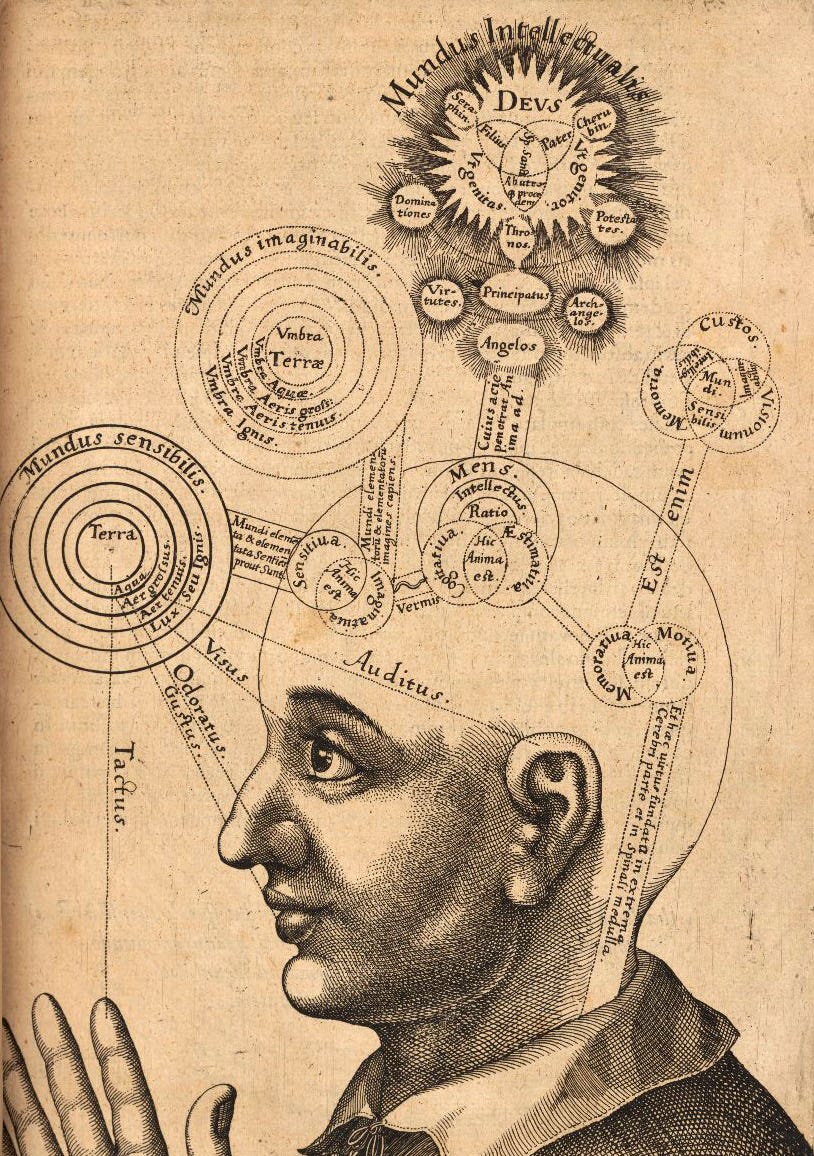
Sense is that which upholds all of reality. Without it, life would seem like a shadow which is ever-present but which can never be seen. The moon is only revealed to us thanks to the sun’s light, and likewise, existence as such is revealed to us only in our perception of it; however, also like the moon, we only see one face of this perceived reality. What, in general then, is sense—or rather, senses? Sense is a representation, or intuition, of the world as seen through the light of experience. What we perceive with our five senses is nothing more than the world made manifest to us through our interactions within it.
It would be nice if materialism were correct in a metaphysical or ontological sense, but so long as the human mind conjures up abstractions that make what is not there seem there, we shall forever be in the dark about the noumena of the world. The world best resembles a dream that shall fade as soon as we wake from it.
If man hadn’t discovered his own apperception (self-consciousness), it wouldn’t be necessary to ruminate upon sense; much like the brutes of nature, man would find himself only concerned with, and therefore intellectually limited to, that which is immediate—his present concerns, which range between hunger, fear, boredom, self-preservation, and the urge to procreate. Aside from language and reason (which Aristotle thought was the primary trait that separated man from beast), the greatest aspect of man that distinguishes him from his other mammal counterparts is his self-awareness, his apperception. Without this, we really would be no different from our chimpanzee or bonobo cousins.
There is a debate currently around what constitutes self-consciousness, but to me it’s a semantic argument rather than a real philosophical quandary—leave something like that to the philologists and lexicographers. Consciousness is merely self-awareness combined with a capacity to reason about said awareness. When an animal of sufficient intellect looks at itself in a mirror, it pauses momentarily before attacking or running away from its image. This, I would assume, is because it doesn’t recognize its image as itself, but rather as another member of its species. As my father would say, “Animals have no time.” I don’t think he realized how profound he was being with that statement. What he was getting at was the idea that animals (barring Homo sapiens) are incapable of abstractions—they have no framework by which to organize or understand existence in abstracto, stemming from the mind and our wonder at the capacity in the first place. Animals, even the most intelligent among them, can only ever see the world in the immediate, and those who have a simulacrum of forethought, or planning for the future—such as crows, ravens, magpies, gorillas, octopuses, ants, etc.—are never able to generalize this to abstractions in animus (in the mind), but rather always only in concreto rei (in the concrete of things). Animals have no concept of the I; they have no subjectivity to their existence—to them, all reality is as it appears and will always be as it is. There is no reflexivity in any other animal, to our current knowledge, aside from man.
This subjective capacity to see beyond the mere material substrate of experience, and to plunge into the depths of that which lay behind present phenomenology, is where personality and character as such spring, and where the conception of the single individual first appears—and in that conception of the single individual, that is, the singular man striving to advance beyond nature, which limits his capacity mightily at every step, is where the truth of man is revealed.
In the concept of the I, which is within man, is instantly the antipode of man: the Not-I. From this dialectic of the I—Not-I, man turns into himself and beholds himself, not merely as another member of his species, but as a particular individual—worthy of immense love and self-respect for his own existence—within a vast genus; in that beholding is the totality of spirit—that which man utilizes for his upliftment; it is only in that very dialectic, however, that man can gradually develop the courage to become his being as such, that is, to become that which he feels himself born for. However, this “born for” idea within man is ever-changing, like the ocean tides, and so, as a result, it is incumbent upon the individual to take their life upon themselves and carry that burden with diligence and fortitude.
Life is an ever-boiling cauldron which bubbles over every now and then, and in that bubbling requires the self to continuously die and be resurrected if it is to continue at all. Man is the mystery of all mysteries; even God finds man mysterious, for He made him not for labor but for reflection and love—self-love and grace, charity and repose in Him. To have self-confidence is almost a sort of deification, for how could you ever manage the confidence to have enough love to think yourself worthy of love? Oh, how immense is man, and yet how feeble and decrepit he is when compared with God, or in comparison with his entire species. Awe is not so surprising in the presence of God, but in relation to his entire species? Yes, perhaps even more so, for while God’s love is infinite, man’s nature is all-too-familiar to him, for man is man, and among his fellow men he knows all that potentially is in him, the good and the evil.
From one individual to another—dear God, what a thought. To think two infinities could collide like that and still speak of it all in the finite alone. What is great in man is that he is a dialectic and not a colloquialism. Dialectic is that which recognizes the common as stupendously uncommon, and vice versa. It sees beyond mere perception and allows man to transcend all material barriers for his capacity to live. To be a dialectic is to be content with your contradictory nature. Man, for the longest time in human history, has been seen merely as a colloquialism—as a common thing, as a thing made in the image of its maker, but which deserves nothing further. The spiritual within man is that which manifests in his abstractions beyond mere experience; the materialist labels this experience a mere excitation of the brain, a nerve impulse, a chemical reaction, an influx and outflux of sodium and potassium—in short, as strictly a physical phenomenon, and thus always just a phenomenon; but they take this experience too far in the literal. To them, reality is merely what it is made of, and thus they have extremely simplistic notions when it comes to experience as such (phenomenologically speaking), because they believe that by being able to ascribe an effect to its cause, and in doing so place a label on it, they have discovered the Ding an sich (thing-in-itself); but in truth, they are not one step closer to any “true” reality than the man who claims in a past life he was God and created the universe as it appears now. What we have is a difference of perspective not only on the sacredness of the single individual, but on what ontologically constitutes the subject—man as such.
So I ask again, what is man? Man is the great dialectic, the eternal dialectic, the dialectic which must constantly rewrite itself so long as he persists. What is shocking is not that man exists, but that the I exists—that is, the sense of being different, of being unique, of being yourself in your own skin: that is the greatest terror on Earth. If one were forced to live like Robinson Crusoe or Ḥayy ibn Yaqẓān from birth, the subjective impulse within man would never appear, for there would be no other, like yourself, by which to contrast yourself subjectively; there would only be experience of the external world, which would force the mind to see everything from an objective stance, and hence you would really only be an intelligent beast—the most intelligent, for sure, but still a beast nonetheless. The smartest termite means nothing to even the dumbest man, and likewise is man’s relationship with God and with others; it’s a false comparison from the start, for there is no comparing great with the greatest (in God), and there is no difference among equals in spirit (in man).
Men throughout history have loved using naturalistic fallacies in arguing for their “superiority” over other men, who are in truth just like them: from being stronger in arms or physical abilities, or in intelligence, or in the development of racism as a “scientific” concept which proved the “superiority” of one race over another. Quid tum? Seriously—what then? What is to follow from that? Where are you going with that? Why even think that? Why the obsession with placing yourself atop another, when in reality all men are subject to the same external reality and suffer under the same doubts and uncertainties regarding themselves? The dialectic demands that all which is not inherently subjective becomes made so. As Kierkegaard—my predecessor—rightly said in his book Concluding Unscientific Postscript to Philosophical Fragments: “Subjectivity is truth; subjectivity is reality.” (Subjektiviteten er Sandheden; Subjektiviteten er Virkeligheden.) This capacity to view all things from a subjective lens is precisely at the heart of the dialectic. The dialectic exists in order to work through and synthesize all things which are not first immediately subjective. This does not mean that truth is subjective, for that is a nonsensical concept in the first place—one of Kant’s antinomies for sure! Truth is nihilistic. Truth has no power; only POWER has power, which, depending on your temperament and interest, can be classified as one of many things: God, spirit, knowledge, wisdom, love, art, wit, humor, tragedy, poetry, literature, music, sports, kids, animals, etc. The varieties of human experience are ineffable, and in that ineffableness—a complete and total incomprehensibility—the dialectic shines brightly, and its piercing rays cut through every paradox and antinomy the mind presents itself with when thinking merely logically, rationally, coherently, in fear and trembling at contradiction. Hasn’t it been established already: life has no why. There is no reason or power behind any idea we encounter except that which we choose to believe in for the sake of our own empowerment and upliftment! Reason is dead, and in its place we install a far greater power than it could ever be: the dialectic—the master of reason, the master of knowledge, indeed, the master of ALL! In the end, Carl Jung will ultimately be proved correct: God is that which is your highest value.
How many millions had to perish in order for man to have a memory—to recall, to remain subject to the past, to forgo impulse, and to leave POWER to languish and die? It would seem man was fated to be the sole inheritor of a brain sufficient enough to cognize about external reality, and while cognizing, have cognizance of it. It is the single greatest thing about being human, in my view. Oh, how terrible it would be if man were without sense. If one were without sense, reality would be nothing. Since there is sense, reality appears as something. What this something is, however, has never received a satisfactory answer in all of intellectual history—and it would be folly to assume myself as finally coming upon a breakthrough with respect to this question; in fact, the question itself, like all truly great questions in philosophy, is itself unanswerable. To ask, “What is sense?” is really to ask, “What is it like to experience the world?” The question, like the question of ultimate truth or objective (noumenal) reality, is tautological, because in order to ask the question, you have to first have the capacity to sense, which presupposes sense ceteris paribus (all other things being equal) is that which you really sense—that is, that the world you sense is really the world as it appears to you in your senses. Every great philosophical question has no answer because they’re all paradoxes, deepities, Kantian antinomies—problems which on the surface appear deep but are at bottom merely vague; they’re false word games played for our own amusement. Hence the shadow of the dialectic appears everywhere, and rears its magnificent head around the corner once more to encourage us.
It’s impossible to confront life in any serious way without first comprehending it through sense experience. Is that true? Let’s assume it is. What then? Well, what followed in history—like all ideas which appear at first self-evident—was the creation of dogmatic philosophical schools of thought, all of which eventually hardened into a kind of debasing rigidity, until some maverick appeared and questioned its foundations, from which we get a series of new “discoveries” that follow decades or centuries henceforth. What I have just described, in very summarized form, is the history of intellectual development, and it should come as a surprise to no one that even in the realm of thought, man loves to subject himself to the rule of one rather than to himself—it’s always been easier to adopt a system of thought rather than to create your own; but I am of the race that founds philosophical systems. But what is the point of grand philosophical systems? What has philosophy ever been to man, and in what way did he use it or derive some use from it? Every philosopher has always started out either affirming or rejecting sense experience as the only “true” knowledge possible in the world. Those who say it was became our rationalists; those who claimed it wasn’t became our idealists; and those who affirmed neither became our dialecticians (pragmatic maieutics).
What I have just done here is divide all of philosophy into three categories from which all other schools of thought derive, and luckily enough for me, I can represent each of these schools of thought with their founders—all of whom are essentially responsible for the current frameworks by which we contemplate philosophy today.
In the first place, we have Socrates, who represents the interrogative, uncertain, dialectical, maieutic side of philosophy—from whom we get the following schools of thought: Cynicism, Cyrenaicism, Megarianism, Stoicism, Epicureanism, Skepticism, Pragmatism, and Existentialism.
Next, we have Plato, who represents the idealistic, transcendental, intuitive (irrational), mythopoetic side of philosophy—from whom we get the following schools of thought: the Academics (students of Plato’s Academy), Neoplatonism, Christian Platonism (St. Augustine), Mysticism, Esotericism, Spiritualism, Syncretism, Romanticism, German Idealism, Transcendentalism, Hegelianism, Marxism, Theosophy, and Continental philosophy as such.
And lastly, we have Aristotle, who represents the rational, logical, empirical, deductive side of philosophy—from whom we get the following schools of thought: the Peripatetics (students of Aristotle’s Lyceum), Falsafa (Arab–Islamic Peripatetic School), Scholasticism, Empiricism, Rationalism, Positivism, Logical Positivism, and Analytic philosophy as such.
In the Western tradition, these three men’s philosophical approaches represent a particular temperament, or way of thinking, which everyone who has come after them has been drawn toward or influenced by in one way or another, whether they were aware of it or not. In that sense, Nietzsche was absolutely right when he said in Beyond Good and Evil:
I have gradually come to understand what every great philosophy until now has been: the confession of its author and a kind of involuntarily unconscious memoir.
And William James, only seven years after Nietzsche’s death, said in his book Pragmatism: A New Name for Some Old Ways of Thinking:
The history of philosophy is to a great extent that of a certain clash of human temperaments.
…
Of whatever temperament a professional philosopher is, he tries when philosophizing to sink the fact of his temperament. Temperament is no conventionally recognized reason, so he urges impersonal reasons only for his conclusions. Yet his temperament really gives him a stronger bias than any of his more strictly objective premises. It loads the evidence for him one way or the other, making for a more sentimental or a more hard-hearted view of the universe, just as this fact or that principle would. He trusts his temperament. Wanting a universe that suits it, he believes in any representation of the universe that does suit it. He feels men of opposite temper to be out of key with the world’s character, and in his heart considers them incompetent and “not in it,” in the philosophic business, even though they may far excel him in dialectical ability.
Yet in the forum he can make no claim, on the bare ground of his temperament, to superior discernment or authority. There arises thus a certain insincerity in our philosophic discussions: the potentest of all our premises is never mentioned.
It really is amazing how the whole of intellectual history was effectively made on a dare, on a caprice, by wise old men who thought the greatest thing about man was his capacity to inquire into the nature of reality, existence, and his place within it. Metaphysics, in that sense, could only arrive after sense was given to man, and well after man’s mind had matured enough to be able to appreciate his self-conscious experience as such.
So, with all this laid out, what philosophical school do I belong to? What is my temperament, in essence? If it isn’t already obvious from everything I’ve said thus far, I have no idea how I could make it simpler than by affirming the following: I am an existentialist! And I use my unique method of philosophizing—dialectical pragmatism!—to make sense of the whole world before me, of everything and everyone in it, as they all appear in my life. In that sense, I belong to the tradition of thinkers who were most influenced by Socrates. In fact, I would go so far as to say that all philosophical ideas after Socrates were only ever falsifications of reality. What Plato and Aristotle (and everyone after them) got hung up on was the metaphysics of truth: that is to say, the belief that reality has objective content within it. It is the idea that there is an aspect of reality that is noumenal: real, objective, independent of the mortal minds striving to comprehend it. Both Plato and Aristotle affirmed that there was an aspect of reality that was objective—a world beyond the world perceived by the five senses—they merely disagreed on how that world could be known ultimately: for Plato, that objectivity was found in the world of perfect Forms, embodied within eternal Ideas; while for Aristotle, objectivity lay in logic—specifically in the way in which we objectify reality by describing it (in analytical statements, that is, statements that are deduced from self-evident premises).
What Socrates did was affirm neither approach; in fact, he rejected the premise of the question entirely. Socrates thought nothing was certain, not even those things which were self-evident; and even when he hit upon a logical deduction which rationally followed, he would end it by saying, “Even that thing is uncertain to me.” That is why Socrates was the first dialectician, and why he is the father of every system of philosophy which does not ultimately affirm an absolute metaphysics. If anything, the only absolute in reality is this: so long as man lives with the sensual apparatus he has, he will forever have to say along with Socrates, Ἓν οἶδα ὅτι οὐδὲν οἶδα (I know that I know nothing). And such is why Socrates ultimately said in Plato’s Apology, 38a: Ὁ δὲ ἀνεξέταστος βίος οὐ βιωτὸς ἀνθρώπῳ. (If you forbid me from questioning the world, you might as well kill me, because a life without questioning is not a human life.)
It is in questioning life that true life is found, not in affirming some belief in some objective world which you’re forever uncertain of. Philosophy as dialectic, as thinking, as moving, as doubting, as continuously affirming and rejecting—in short, as life itself: that is what it ultimately means to make sense in the world.
Γνῶθι σεαυτόν—Know thyself.
That is always best which gives me to myself. The sublime is excited in me by the great stoical doctrine, Obey thyself. That which shows God in me fortifies me. That which shows God out of me makes me a wart and a wen. There is no longer a necessary reason for my being. Already the long shadows of untimely oblivion creep over me, and I shall decease forever.
The divine bards are the friends of my virtue, of my intellect, of my strength. They admonish me that the gleams which flash across my mind are not mine, but God’s; that they had the like, and were not disobedient to the heavenly vision. So I love them. Noble provocations go out from them, inviting me to resist evil, to subdue the world, and to Be. And thus, by his holy thoughts, Jesus serves us, and thus only. To aim to convert a man by miracles is a profanation of the soul. A true conversion, a true Christ, is now, as always, to be made by the reception of beautiful sentiments. It is true that a great and rich soul, like his, falling among the simple, does so preponderate that, as his did, it names the world. The world seems to them to exist for him, and they have not yet drunk so deeply of his sense as to see that only by coming again to themselves, or to God in themselves, can they grow forevermore. It is a low benefit to give me something; it is a high benefit to enable me to do somewhat of myself. The time is coming when all men will see that the gift of God to the soul is not a vaunting, overpowering, excluding sanctity, but a sweet, natural goodness—a goodness like thine and mine—and that so invites thine and mine to be and to grow.
—The Divinity School Address, Ralph Waldo Emerson.