
Sign and Symbol
50th installment to my philosophical system.

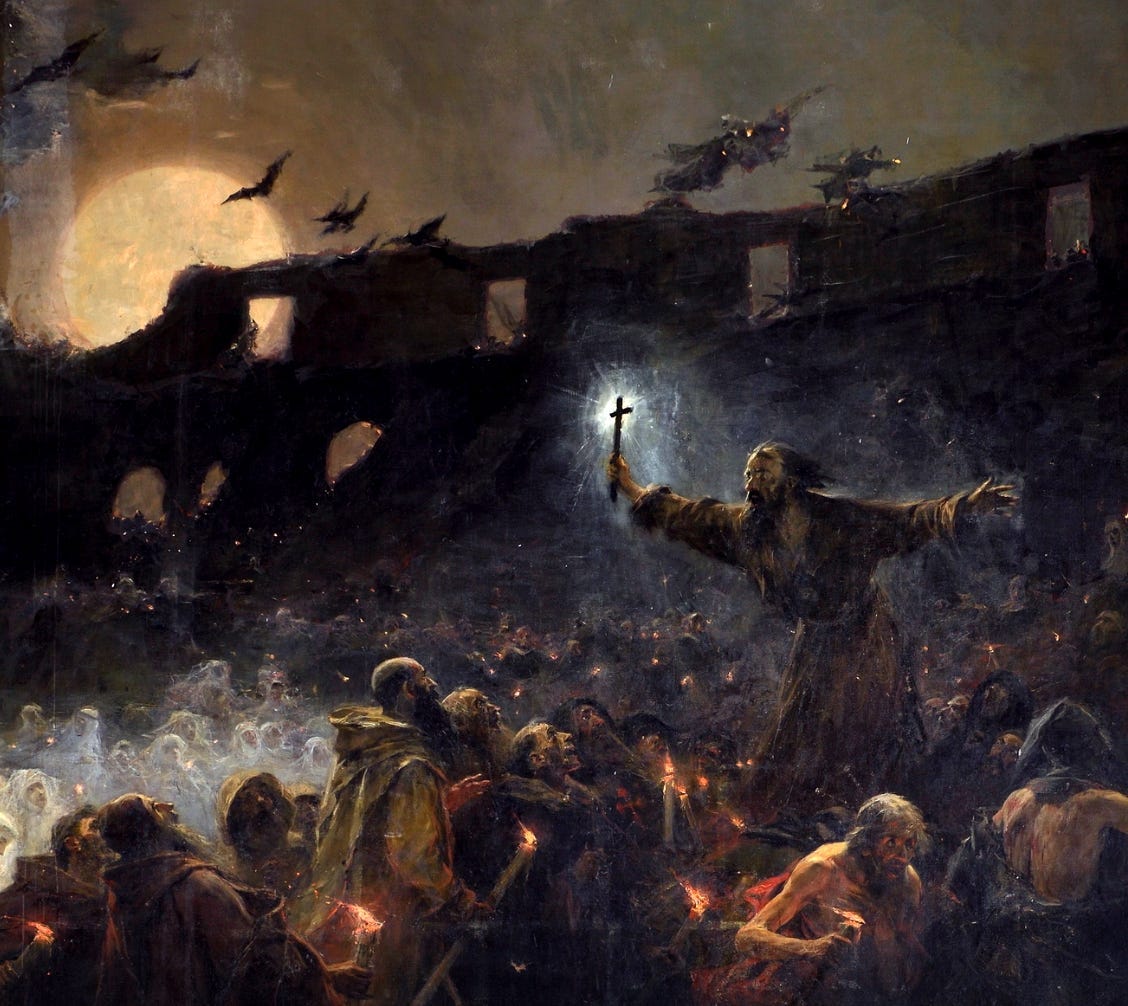
There is in life a kind of emptiness so formidable it would turn the boldest man in history into the most tepid and wretched creature this world has ever seen. At bottom, there seems to be something so tragic in existence that there rests below life itself an unutterable evil one dare not speak of, lest it come to get them and annihilate them. This evil, without question, is doubt; and like all true doubters—those who really question life—an undeniable melancholy consumes them completely, and so makes everything they bring to the forefront of their mind an exercise in futility, an opportunity to make suffering even greater—supreme, in fact—and reduces the whole of being to a momentary aspect, only to be followed by a silence so loud it deafens anyone near it.
As if reality weren’t bad enough, there are also a multitude of signs and symbols which we are subject to, and which now act as the greatest inculcators of decadence imaginable. Distractions and idiotic misadventures are commonplace, and what the majority does with their free time—supposing they have any after sleep and work—honestly surpasses my comprehension, especially when you realize how empty, boring, bankrupt, and infantile it really is. I would take death over whatever most people have consigned their existences to today.
There’s very little in the way of independent thought, and education is so shallow and insipid that anybody with a pencil can qualify as a scholar. True thoughts are those ideas which are not subject to the contemporary signs and symbols; whatever is considered unique today intellectually is really a reformulation of something old and already explicated far beyond what is necessary for practical use. It really requires a sort of genius to look past the veil of ignorance which so many people are covered with, and to interpret an old idea in such a novel way that it actually addresses the zeitgeist directly.
The true movers and shakers in the world of ideas are those who can speak to the problems of not only every institution but to every individual as well. When ideas are typically constructed, they follow a very rigid line of reasoning that was acquired from some book or some old interpretation that vaguely applies to today; but the problem with that approach is that it makes the scholar subject to the opinions of others, and scarcely allows for an honest engagement with the ideas as they are developed independently of any other material. That is why scholarly papers are so mind-numbing to read: aside from the very prolix and boring style, every other sentence has a footnote—as if that somehow indicated due diligence, or made you a real philosopher. Ideas gathered from others are as useful to intellectual development as opening a book in a language you can’t read. It’s almost farcical.
Men love to be surrounded by books, but few actually love to read them. It would be helpful if a mere proximity to books allowed one to also acquire their content, but since this is not the case, and because most people would rather die than think for themselves, it so happens that we have a world run on narratives—signs and symbols!—that do not answer in the slightest any of the concerns of people. The everyday man has been tossed aside and made to sort out the world on his own, but because he lacks the intellectual ambition, the time, or the energy by which to make any of it comprehensible, he is forced to pick and choose his signs and symbols carefully. But, with all this said, what exactly do I mean by signs and symbols?
Anyone even slightly aware of the concept of a sign or symbol will almost certainly have heard it in the context of Lacanian psychoanalysis, but this is not where it originates. Should you, dear reader, be slightly familiar with the intellectual history of this topic, you will probably be led to believe that the idea of the sign and symbol has its roots in Saussure’s linguistics; and while that is an honest start, you may be surprised (as I was) to find that it actually originates in the American pragmatist tradition: Charles Sanders Peirce, as it turns out, was the first to give us the idea of semiotics—the study of signs and symbols proper.
Now, to explain what signs and symbols were to Peirce—for I think the historical development of this is crucial for understanding why I speak so abstractly about it—one must understand that for Peirce, meaning was never a static property, but a dynamic, three-way event. He proposed a triadic model where a Sign (the representation) and its Object (the reality) are linked only through an Interpretant—the specific mental effect or realization triggered in the mind of the observer. In this view, meaning is not buried within an object like a hidden treasure; it is a relationship that happens only when a mind translates the world into thought. To navigate this translation, Peirce identified three distinct ways a sign relates to its object. The first is the Icon, which represents its subject through sheer resemblance, such as a portrait or a map. The second is the Index, which functions through a direct physical connection or trace—think of smoke pointing to a fire, or a pulse indicating a beating heart. Finally, there is the Symbol, the most sophisticated mode, which relies entirely on social convention and learned rules. Words like “justice” or “rebellion” are symbols; they have no physical likeness to their objects, yet they govern the very architecture of our shared intellectual life.
With that said, I feel I must explain now how Saussure differed from Peirce regarding the sign and symbol. While Peirce viewed the sign as an open, three-part relationship with the external world, Saussure looked inward, stripping the sign down to a purely mental, two-part structure. He discarded the “Object” entirely, arguing instead that a sign consists only of a Signifier (the sound or image) and a Signified (the mental concept). To Saussure, language is not a tool for pointing at reality, but a closed system of psychological associations. The most radical departure lies in Saussure’s principle of arbitrariness. While Peirce allowed for “Icons” that resemble their objects or “Indexes” that are physically tied to them, Saussure argued that the link between a word and its meaning is purely conventional. There is no natural reason why the sound “dog” represents the animal; it only has meaning because a society agrees it does and, crucially, because it is different from other sounds like “cat” or “log.” Meaning is thus defined not by a connection to the world, but by a network of internal oppositions. Ultimately, where Peirce’s theory is one of discovery and interpretation of the world, Saussure’s is one of structure and constraint. He suggests that we do not so much speak language as language speaks through us, providing a structured architecture that dictates the boundaries of our thought.
Regarding Lacan now—definitely the most famous of the three—he took Saussure’s linguistic framework and made it psychoanalytic, that is, applied it to the human psyche; and from that developed concepts of such profundity and complexity that there are dictionaries dedicated to Lacanian Psychoanalysis—focusing on the terms and ideas alone, as if the actual content of the sentences weren’t enough. For Saussure, the sign was a balanced, organic unity—a sheet of paper where the Signifier (the sound-image) and the Signified (the concept) were inseparable sides of a single whole. While the relationship between “word” and “thing” was arbitrary, it remained functionally stable, allowing language to serve as a reliable map for human communication. Lacan, however, shattered this symmetry by introducing a fundamental “bar” between the two elements. In his formula, S/s, the Signifier is elevated to a position of dominance, separated from the Signified by an impenetrable horizon of resistance. To Lacan, the Signified “slides” perpetually beneath the Signifier; meaning is never fully captured but is instead deferred along an endless chain of words. Where Saussure saw a tool for a conscious speaker to navigate reality, Lacan saw a structure that precedes and creates the speaker. If the unconscious is “structured like a language,” then we do not possess language; we are possessed by it. The clarity Saussure sought in the logic of the sign is replaced in Lacan by the “lack” of the subject, for whom every word is a failed attempt to bridge the distance between desire and the Real.
There is in Lacan an obvious recognition of the impossibility of language to truly capture what we as subjects desire. This is why, to me, he is the superior to Freud, and why his ideas are so important: he understands the existential aspect of man’s psyche; the indebtedness to everything which man is subject to makes it extremely difficult to grasp what we as subjects truly mean when we say anything at all. I myself wrestled with this exact thing in my essay Why I Repeat Myself, and am in fact wrestling with it right now.
What lies between what we as subjects mean with our words, and what we experience in the world which gives rise to them in the first place, is an infinite gap of uncertainty, undecidability—an impossible apprehension which no mind, no matter how genius, can ever truly know. As I mentioned at the start of this essay, man is perpetually in a state of tragic anxiety, not only because his situation in the world is rather demanding, difficult, repetitive, uninspiring, stultifying, soulless, lifeless, and materially stagnant, but because man cannot understand his own interiority with respect to all these difficulties; there’s no way for man today to internalize his own external poverty—everything which is presented to him barely gets noticed, and if it does, it is only because he feels it is no threat to him mentally. The instant man feels he is unable to comprehend a thing, he runs from it in fear, for the greatest fear of all is fear of the unknown. There are no words to put to this poverty, and even if there were, it would only signify the gap that exists between our desires and our reality.
Life is too much to take in all at once. Such is why reduction and simplification are rampant today; nobody wishes to think existentially, for if people were actually forced to confront their ego, they would find a little homunculus of lust and desire—indomitable and insatiable in its avarice for everything which comes to its mind. The lack within our own subjectivity is found in our inability to properly overcome our doubt regarding what we observe and what we feel regarding it; there aren’t enough words in all the languages throughout history to properly express just what we mean.
This infinite doubt—a doubt so strong Pascal thought suicide reasonable in the face of it (assuming God does not exist to remove it)—is something which everyone must face, and must do so knowing that no man has ever been able to overcome it; even if God existed, it would still not remove this sense of angst which we always feel regarding it. Regarding what? Life, existence, and our inability to capture any semblance of meaning within it.
Every action in life can be considered arbitrary when you remove free will from the equation, and furthermore, when you eliminate the possibility of teleology in the universe. If such is the case, why not say along with Ibn Khaldun: “This entire world is trifling and futile. It ends in death and annihilation.” It is for this reason that man still clings to his fables and narratives; the sign of life is symbolized in the stories of Abraham’s descendants. The exile does not choose its Babylon. And so it is with man: a scared, ignorant creature, separated from his subjectivity, and afraid of what he might find should he gather the courage to actually look for it.
Everything happens too late in life, and all too often do our laments resemble the sighs of children rather than the weeping of wounded animals—which, were we actually informed about our true state, I think they would resemble more closely. If it were possible to truly represent yourself to yourself, would you wish to do so? I, for one, would like to think my true self is my current self, for if I was false to myself, I would be a lot more optimistic than I actually am about my future. My future is death, as is everyone else’s, but I don’t wish for it to come soon; I still have many things to consider, and I still plan on writing a lot more than I already have, despite, in my view, writing more than anyone else my age probably in all of history—only Pico della Mirandola is my rival in this regard.
This gap between sign and symbol, again, is the purest form of subjectivity—for if there were no gap there would be no doubt regarding anything that relates to us existentially. Doubt is really a synonym for the dialectic, and this is because the role negation plays with respect to our self-consciousness is born in the uncertainties that arise in our minds as the inexorable flux of time moves along; man can never truthfully think through a concept, for all concepts require mediation via other concepts: the discontinuity between what we attempt to signify and what we are as signifiers in the moment of objectifying (signifying) reality with our concepts is just another vain play of words.
What we desire is the desire to not desire, but in desiring this desire we find ourselves trapped in a cage of our own creation, where every desire really negates its former desire, until desire itself is tired of desiring, and in turn desires nothing but the end of all desire: this gap, you see, is circular, and only devolves from here into a superstructure of avoidance, in which the original desire is deferred to a slightly less domineering desire—a desire that is controllable, and as a result made not into a desire but a mental crutch, a reliable comfort that degrades the more it is used, but never loses its utility, for the superior desire is still imposing enough to not dare free yourself from this lesser desire.
At once you see how ideology is born, and how the human mind is captured by a variety of ideas which were not its own—for, again, to be your own is to wrestle with your subjectivity enough to overcome the signifier/signified divide—but rather were designed by others, a kind of Big Other, which we fragile and scared people use as a surrogate to our own individuality. This kind of ideological capture is complete when the ideology itself becomes the person’s individuality—something which they identify as in order to, again, bypass the fear found in the doubt regarding ourselves (who and what we are as human beings).
We doubt when we begin to feel unsure regarding things that relate to us personally. The existential doubt of another may be empathized with, but it can never be understood in its totality, for the gap must always remain between what we label with words and what we as objectifying subjects feel with respect to our labels.
I’ve said before, and I’ll say again: words fail and remain forever poor translators of our true intentions; that is why action is infinitely superior to mere contemplation, because it actually allows the subject to identify with themselves as they oscillate between doing and merely being. That is also why I say no amount of erudition will get you closer to the meaning of life, because life is not meant to have a static ontology, but rather a dynamic one which, in the process of doing and not doing, one finds a part of themselves in the action itself, and almost never in the thinking alone.
To my knowledge, only Buddha was able to achieve enlightenment through meditation alone. We are not the Buddha, though, and we should not strive to sit under a Bodhi Tree and have the universe give us answers—for most of us, our subjectivity is not built for that kind of intensity, and none of us are truly worthy of the idols we venerate; such is why in Christianity and Islam you are made subject to God, rather than feeling equal with God—we may be one with him, and made after his image, but we are not equal to him; in fact, Isaiah 64:6 says: “But we are all as an unclean thing, and all our righteousnesses are as filthy rags; and we all do fade as a leaf; and our iniquities, like the wind, have taken us away.” So we are, poor dejected creatures, forced into a life of darkness, all to return to darkness in due time.
The sign and the symbol play the same role the subject and object do in the philosophy of Schopenhauer; it doesn’t make sense to consider one without the other, and it’s beyond absurd to assume that one can exist without the other—like saying a coin only has one side.
The main point of all philosophy, in my view, is to find a method for reconnecting the subject with their subjectivity—that is, an existential reckoning of sorts that allows the human being to feel their own. If a man cannot sit alone with himself in a room, then he definitely cannot sit amongst a crowd in a foreign land and hope to discover himself there—that is, unless it was a deliberate action by him to escape his room and venture out into the world deliberately, so as to suck the marrow out of life. These varying temperaments, which the dialectic of every situation is bound to inflame and inform, are our personal sign and symbol—they’re us and we live through them, and without them, there is nothing but despair created in the heights of our own ignorance regarding the infinite gap which transcends us and our conceptions of it.