
Temperance
82nd installment to my philosophical system.

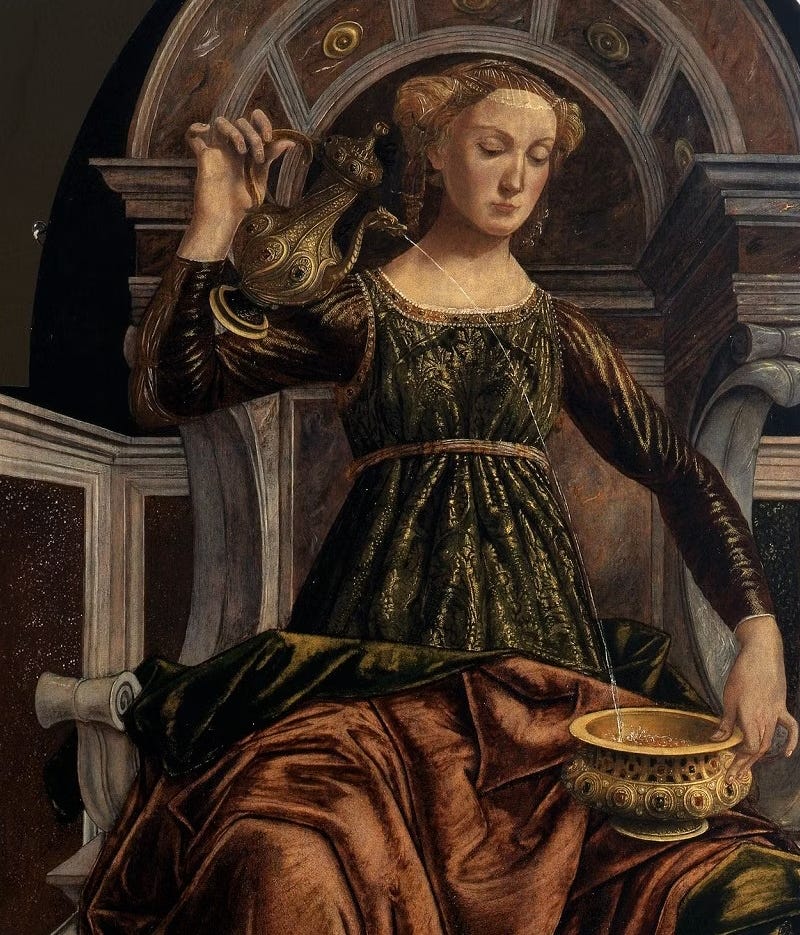
Temperance:
Eat not to dullness; drink not to elevation.
—The 1st of Benjamin Franklin’s 13 Virtues.
It behooves a man to find temperance. Without it there is no constancy of mind—and without that, within the multitudinous affairs of life, a man is more often than not swept up into the most trifling nonsenses conceivable, of no benefit to his life; and on that account does he waste his time, and thus send to oblivion all that which is necessary for his well-being and happiness.
My love for literature was actually spurred on by my recognition of the very sad fact that, in the modern world, most people do not have temperance; and I found that on this account most are made to live very wretched lives. Lacking the constitution of mind necessary to withstand the blows which life dishes out on them, and having no clear understanding of the importance of consistency or promptitude, a man today more often forgoes all these existential considerations by relying on his conscientiousness alone—believing, like an ox, that the world will unfold before him so long as he is steadfast in his labors towards it.
It has to be remembered, however, that a man may have much conscientiousness but no proper outlet for it, and as a result, he leaps into the abyss of life not understanding what is and is not for him—that is, not understanding those things which are conducive to his happiness, like, in this context, acquiring temperance.
Seeing all this, I took it upon myself to become the first true moralist of the 21st century. I wanted to provide a new path to an old destination which most today have totally forgotten about—a path of serenity to a destination worthy of all our attention and effort: peace and contentment in life.
And so my writing objective was formed, forged in the flames of my desire to provide the modern world a set of old values with a new moral substantiation for them—to provide an outlook perfectly corresponding with our own times so as to make everyone today more life-affirming; only to be achieved by those free spirits who were fortunate enough to stumble across my writings, and through my words come to slowly agree with all I said, not on account of its veracity, but on the honesty of its delivery and the prescience of its existential outlook.
And so I found myself at the very beginning of my writing career, very much in demand by no one but, for myself, wanting to supply the world with what I wished was actually in demand by everyone—writings of the highest existential content. I wanted to create in the minds of my readers a new awakening. I wanted to rouse them from their slothful, life-denying slumbers—caught in the grips of a vicious morality not their own—and provide them a new way of thinking, a new method for evaluating life, so as to only affirm those things which are important to them and them alone.
Personally, if a writing is not uplifting for the spirit or upbuilding for the soul, then it can hardly be called a writing at all; for writing, as I understand it, is meant to promote only that which is good for man, and done for his benefit alone.
Writers love to write things that are only of interest to them, and so they capture niche audiences but gain no wide recognition—and as a result are stuck writing only to that one audience; whereas, as I see it, a writer must be encyclopedic, and must strive to be life-affirming in all they say, for without that there is no true communication between the author and the reader.
Indeed, if the ideas are well written but do not connect with the hearts of the readers, then the writing will fail in its intentions—again, there is no true writing unless it is done from the heart, and so the best prose falls flat if it only talks of things factually; I would take Paul Valéry over Henri Bergson any day of the week, in the same way I would take Schopenhauer and Nietzsche over Spinoza and Descartes. If there is no musicality in the prose, no spirit implicit in any syllable, then that writing as a whole deserves to be lost to time, just like all those ancient declamatory exercises from the Greek and Roman orators.
I do not lose an ounce of sleep wondering what the lost speeches of Demosthenes or Cato the Elder might have read like, in the same way I do not busy myself with the scribblers of today—for writers are vain and ambitious, as they have always been, but unlike in the past, we of today lack the skill or tact to actually say anything worth remembering into tomorrow; rather, most today write as if they were speaking of yesterday, as if their ideas were already dead and fossilized. Do these people not know that time destroys all things, and no matter how exalted and genius a man may be considered today, he will find himself mixed with the soil soon enough?
And to think, most actually fear death; when, as I see it, that is the greatest aspect of life—to no longer be is such a blessing when you consider how temporary our consciousness really is. We take ourselves into the market of the world and strive to collect as many commodities as we can in the short amount of time we have; and in doing this we lose sight of what is important in life—that we will ultimately die—and that all our ambitions only serve to aid us in forgetting what life truly is. This I despise, and is precisely what I am at war against in all my writings. A human being must be in the now, and act according to their own understanding. All else is folly. Live, damn it. Live your life. Become what you were meant to be.
Take hold of yourself. Understand where you come from spiritually and intellectually, and in doing this you will have gone through all your moral assumptions, and have rooted out every bad, life-denying one; and in the process of doing this, you will have reconstituted yourself, fashioned after your own image, and will have thus become who you were meant to be.
But all this is very difficult for a person to conceive of today, for, again, most have no temperance, and have minds too occupied with the “real” affairs of the world to be able to see beyond it. It is a sad but true fact that most cannot think outside of their decadent material frameworks; and as a result, they construct whole castles of insanity in order to live in—all in an attempt to silence the constant clamoring of worldly affairs which they cannot detach themselves from. I have made this point before, but it has to be made again.
Everyone identifies with their material conditions, and as a result they make themselves a ready slave on the market of an occupation, destroying their souls in the process, and acquiring a peculiar hate for life which they can never seem to find the origin of—not realizing it all stems from their own life-denying morality, their evaluations of what “the life” should be, which is always some crude, picturesque vision of material luxury and moral debauchery, which serves only to drive them into deeper despair and misery regarding life. This is the present age, and this is what I fight against every time I sit at my desk to write.
I am in a constant war against the whole contemporary morality, and I seek to lay waste to every false value in existence, in order that the only values that remain for mankind to believe in are to their benefit and profit, and nothing besides.
This age is anything but moral. I look around me and see people confused, stumbling through life, knowing in their hearts what they want but finding no way to acquire it. This disconnect is the result of our evaluations. A man who lives falsely in the world lives falsely to himself; he represses his true inner shadow, and as a result gets lost in a sea of identities which he cannot reconcile or play the part to perfectly at all times. This is the schismatic aspect of inner life for man today: a beast on the one end and a god on the other, but unable to affirm either representation with serious moral confidence.
In such an instance, a man either conforms to the world, as most do, or he rejects the world and struggles as he must for the sake of saving himself from life. In my view, I find the second option infinitely more rewarding, more life-affirming, more important spiritually and existentially. In short, I view the latter choice as the only one a reasonable person can make, if they have the right set of moral (existential) intuitions, that is.
Everyone says my goal is noble, my intentions correct, my heart in the right place, and my mind capable of achieving it, but at the end of all this warm praise, they ultimately turn a cold eye to my endeavors; and this is because they know deep down themselves that I am right, but do not want to admit to it, for to do so would mean validating my criticisms of their barren, boring, empty, lifeless, life-denying values with respect to their own life. They do not want to admit that they live not for themselves but for another. This deeply hurts them, but that is not my fault. Life is too great to not live it dangerously.
That is the essence of my philosophy: amor fati, Selbstüberwindung, the infinitude of the private man made manifest in words. You must live life, and in doing so find what you want out of it. In my case, I found my calling in writing—for I found no other human activity which perfectly encapsulates the implicitly dialectical nature of it all; the sheer immensity of life is enough to make a contemplator like myself dizzy at the thought of it, and, in fact, enough to scare me from ever wanting to live it.
I had to overcome this fear, however, by giving myself a duty: a duty of doing what no man before me has ever been able to properly achieve—a truly genuine life, lived after my own understanding, in which every action I take is the result of my own will, and not compelled by circumstance or material necessity. That is, as I understand it, the truest life a human being can possibly accomplish.
My truth does violence to the moral assumptions of most people, and as a result my fate is already sealed—always to be writing, never to be read, in my own lifetime at least, just as it was for Kierkegaard and Nietzsche. A man who strives to improve the morality of a people by writing is like a man who strives to see the moon through a microscope; nay worse, like a man who talks to the furniture because he believes they are listening to him. Honesty has never been a popular policy, not really—for so long as narratives have been around, people have always preferred the pleasing lie over the hard truth.
The truth hurts, and this is because most people are unable to stand hearing that which differs from their own thinking, not in the least because, chances are high, their thoughts are not their own, but rather someone else’s which they have clung to out of tradition, and maintain on dogma.
If only I could change the moral precepts and evaluations of people without having to write; then again, if everyone in the world suddenly became life-affirmers, affirming only the strongest morality, living after the manner they best see fit, that would leave me without a reason to live anymore—I would find myself like Proust after finishing In Search of Lost Time, feeling as if I accomplished what I was put on Earth to do. But perhaps I would not mind that, for that would mean the world is living honestly, as it should be, thus making all moralists and legislators of values totally redundant.
Now that I’m thinking about it, I suppose I could write anyway, but only on different themes: I might write about how good the world is, as some foolishly optimistic people do today; yes, that would suit me, I think. I am a natural optimist after all. If I were not, I would see no point in writing, for again, writing not done for the improvement of the reader is vain verbosity, mere scribbles on a page without a larger conception of what is important in life: totally worthless!
The most popular books have always been moral in some sense, at least in the English tradition. Not counting the Bible, the letters of Saint Augustine, along with the philosophical tracts of Thomas Aquinas, were among the most popular books for centuries. This is to say nothing of Thomas à Kempis’s The Imitation of Christ, or the essays of Francis Bacon, or the sermons of John Bunyan. When the general public started to become literate around the 17th century, the most popular writings were periodicals.
Newspapers like The Tatler and The Spectator were extremely popular, and had many monthly subscriptions; and though the articles themselves covered things we would consider mundane and boring today, I would consider them among the most important in all the world—for they touched on nothing short of morality, the most important of all subjects in my understanding.
Men like Joseph Addison, Richard Steele, Samuel Johnson, and Benjamin Franklin all wrote with the intention of improving the morals of their readers, and nothing less; and it was from these essayists that I took my own inspiration in order to begin writing in the first place, and to make my own foray into the world of letters; and I think at this point I have earned myself the title of Dictator litterarum (dictator of letters), for I am the most prolific writer who has ever lived, and will continue to be so long as I live in a world as corrupted and in need of saving as this one. That is the truth.
As I said at the start, the utter dearth of existential material, which was once the norm in the world, has led many to go astray in their morals, and has made many the worse for not having a clear path to temperance; and so, most strut about ignorant of the whole world which moves beneath them, and, to add insult to injury, find it all quite easy, and think their ignorance the clearest sign of their humility and piety. If their doubt were as strong as their faith, they may actually live lives worth emulating, but so long as they continue on in the world ignorant of everything, they merely persist and nothing more.
It is an insult to mankind to merely work but not to uplift. Those who do not uplift others existentially are mere machines—existing for the sake of keeping the whole cog in motion, but never willing to reflect on the movement of the cog itself; and because man is incapable of taking things from the existential perspective, that motion is forever blind to him, just like how the shape of the planets’ orbits was obscure to the ancient Greeks.
Temperance—in all its glory—is a virtue open only to those who are capable of taking things by the day, as they come, very slowly, only fit, really, for those unwilling to jump into the flux of life—that constant commotion which so often confronts us and drains us of all our vital powers. Self-restraint, which comprises the whole of temperance, is itself in large part self-reliance, and in that sense is one of the most crucial aspects of existentialism. A person who cannot find within themselves the power to resist the temptations and vices of this world is unwilling to make themselves orderly, refined, delicate, gentle, and simple.
A simple life always corresponds with a temperate life, and so the two are seldom seen apart from each other. A man in anger is no clever dissembler; and neither is the man who is without temperance, for they live their whole lives as if headless, and always adopt the most degrading and life-denying values possible. Let a man start with temperance, and the rest of his values will likely change therefrom.