
the telegram regrets
inspired by Kierkegaard!!!

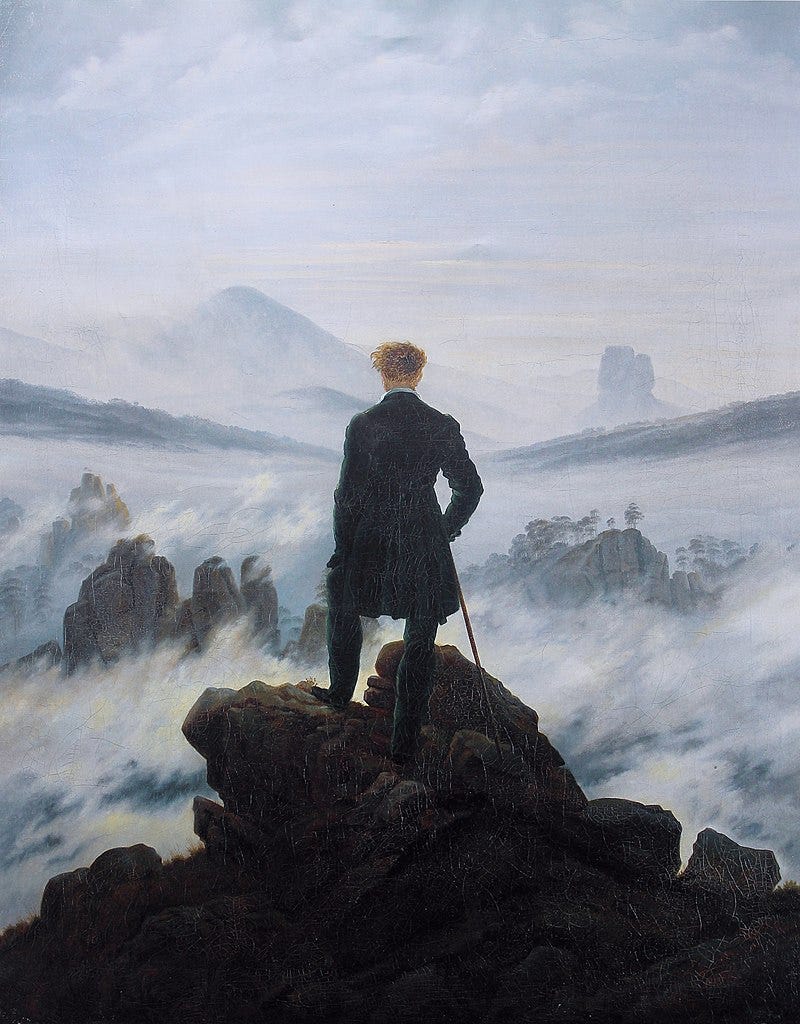
Often do I come across a phrase or sentence in Kierkegaard that strikes me with such ferocity that my only line of defense is to throw up my white flag of surrender and hang my head in abject shame. I commune with myself—it is as if every word was something I penned but did not pen, for I lack such command of language, such imagery, such contrast. The unrelenting force of life vivifies me; his diction is so much like Emerson's, but it’s more playful, more colorful. While Emerson was the great transcendentalist, the hymn writer of nature, singing to the choir, with every word writ to Mother Earth for the purposes of acting like a panegyric, Kierkegaard was the true poet of existence.
Though he was born ten years after Emerson, his age was not proportionate with his wisdom—indeed, it far excelled it, excelled the wisdom of possibly anyone his age. Never before have I been greeted by such a person so obviously troubled, yet so clearly striving after the solution. I find a man wanting to solve the mysteries not just of nature, or philosophy, or politics, or literature, or art, but a man who seeks to find the solution to life itself. To him, it wasn't a game—it was better. Life is a complex poem whose meaning eludes you, and the more you attempt to read into it, the more confused you become.
The writing is carefree but deliberate, elegant yet not overly pedantic or poetic, never striving to confuse, but never wanting to be boring—the hardest balance the universe has ever striven to devise. It’s not merely on a knife’s edge, not even a hair’s breadth, but on a trillionth of an inch—its centroid totters back and forth and may, at the slightest misuse of prose, come tumbling down like the Great Stone Face of New Hampshire. How devastating must it be to write so much, only for a single misused phrase to completely destroy the syntactical integrity of it all? I know life hangs in the balance, but words too? Yes, for words describe life, and nothing is more precious than they.
How many times do I nonchalantly glance at an upcoming sentence, only for the present sentence to be so full of intrigue and life that I reread it hundreds, possibly even thousands, of times, seeking to become drunk off the ambrosia that so obviously emanates from it? I mean, the words are so powerful a haze of smoke from burnt candle wax and pine cone incense manifests before me as I open a page. "A little learning is a dangerous thing," said Pope, but more dangerous is a man who speaks only in the language of truth—not of post-truth, or fake news, or meta-truth, but real truth; truth that is subjective, for the objective does not correspond to reality. Only subjectivity speaks to the soul.
Nobody is moved to change their way of being by a display of genius alone; only when genius is made tangible to the soul of the individual does it become present, attenuative, and obviously self-fulfilling. Action must only be taken, and be in accordance with, the heart of every person. One cannot succeed in life without first finding for themselves what it is they want out of it. This is why these existentialists are so powerful and popular today: they address problems that are more salient, more conscious and conceivable to my generation than they were in the authors' own lifetimes.
As society becomes more homogeneous and interconnected, decadence and ennui become ever more prevalent, festering and spreading faster than we can detect; and by the time we acknowledge them, entire subcultures and popular movements are infected with these various memes and stultifying, deprecatory mind viruses, which serve no greater purpose than to become like parasites, living freely within our minds, unconsciously influencing us to become the most depraved and ugly aspects of ourselves. All such issues are addressed in full by these thinkers of life, these enjoyers of speculation, whose words ring true to us because they speak to that side of us that we know is within and yet cannot call upon freely.
It was made evident by all of them that the main problem that faces the individual is not the demands life puts upon us, nor even the fact that we exist at all, but the fact that we find so many possible avenues by which to take in life that—to the intellectual who ponders upon any of these considerations with due seriousness—is faced with the interminable problem of choice.
Choice, yes, endless choice, determined by our interests, which be manifold and ever-changing: at one moment, I wish to become a musician, the next a surgeon, maybe a lawyer, an engineer (I do like math). Maybe I'll get into politics and change the world for the better. Maybe I'll become a pimp and run around making money off of the curves of women and the lusts of men. I am free to become anything—too free, in fact, for it is the fact that I can do anything that makes me seek nothing.
The world is omnivorous and cares little what we do ultimately with ourselves. What are we to this massive rock hurling through space? We be but one person only, and this one life is the only one we know we'll get. With that in mind, the question ultimately becomes: what truly matters in life, and how do we go about deciding what we're to do? How shall we live in a world that is indifferent to any decision we make? I don't know, and I'm frightened because of it.
Emerson sought answers: Kierkegaard, Nietzsche, Goethe, Grotius, Erasmus, Shakespeare, Milton, Galileo—the whole omnibus of human genius collating for the purposes of assembling into a super-being, a god amongst mankind, who shall provide us answers at last? No! A mere fantasy creation. Like unicorns and leprechauns. There is no super-being, unless you would hope that future generations bring forth Nietzsche's Übermensch—a thing I scarce think possible, for a single individual to adopt a will to power so strong as to command billions would far exceed anything any empire or prophet ever founded upon this world.
We are not meant to become the new beings; we are meant to be the king of our own beings! When the Messiah comes from heaven, it is said that "He shall judge among the nations, and shall rebuke many people: and they shall beat their swords into plowshares, and their spears into pruning hooks: nation shall not lift up sword against nation, neither shall they learn war any more." And shall we not be, to the future generations, that individual who decided to follow in the footsteps of their very heart—the person who saw the good and saw the evil and decided to go beyond both of them?
Not to think of good or evil as mere subjective preferences to obey or disobey in accordance with how they impose themselves upon our will, but as the individual who becomes aware of all that is proper and just to his nature and satisfaction. The pursuit of happiness is not merely a platitude but a goal to strive towards in a life that is unrelenting to those that are slothful. And now a storm approaches, vicious and whipping, tearing the bark off trees, razing the ground from the foundations of the soil, and dispersing all the nutrients of the hardy dirt haphazardly upon the surface of the sphere.
There is much to fear in life, much more fear and trembling than one will be willing to accept. Life is more terrifying than we are wont to admit. It offers us no guidance. We must become like beacons to ourselves and to others if we are to get through it all together. I may be plunged into darkness for the sake of my iniquities, and if so, then so be it—I fear no man, nor anything born out of nature; my only desire is more comprehension of the ineffable. I know I talk and prattle about, striving to write elegantly in an increasingly verbose and prosaic manner—no doubt the result of my tiredness—and I make varying suggestions in a haphazard manner without tying it all back together, but that is the nature of the beast: the lion is known by its claws alone. I extemporize and provide only my opinion and feeling, but my love is faithful towards that approach to ideas. Aphorisms (which are the approach to ideas I refer to) are like sweet nectar, slowly accumulated over time through unconscious thought until they become manifest in our brief moments of inspiration. Thoughts compounded in as few words as possible are best, for comprehension is more attainable in less time, and it becomes more enjoyable to read as a result of the rapid progress one feels, which makes them wish to read more.
There was, I found in Kierkegaard—who was responsible for me writing all this to begin with—a very obvious attention to every word. Nothing is without its proper place, and never does he fear becoming too sentimental or dramatic; he demands a careful reading, a deliberate reading, a very accommodating patience, and a mind tuned towards the infinite. He seamlessly travels through the groves of his mind: stopping at once in the lilies' field, then under a bridge which drips with cold raindrops from the previous night's storm, then, occasionally, along a lake to gaze upon a log covered with moss, finally, to the damp grotto which held the great spirits of previous poets—the Ossians and Stesichoruses loom very heavily in these places. He had no fear speaking his truth, that truth which is true for all—for truth is merely the embodiment of actions that move us forward in our goals. Pragmatism pervades throughout, and one feels themselves becoming more loving and feeling at the hearing of his grand proclamations.
I read him, I pick up my pen inspired by him, I attempt to write like him, and then... I realize I can't write like him. I become distraught and think myself a failure for my inability to live up to the standards of someone I admire, but quickly do I return to my senses, saying to myself, "Would he want followers, or would he want people to become their own inspirations through his words? Nietzsche detested the thought of people striving to follow his path; he wanted to inspire people to become their own person, not some mere sycophant who holds onto his words and opinions as if they were the final writ to ever be had."
Mankind becomes more progressive the harsher times become. The increase in despotic tendencies leads one to become weary of whatever their leader says. Once you see leaders beginning to say things like, "There's no wrong so long as it's done for the good," or "We're going back to how things used to be," be very concerned; often are these idiotic statements followed by a showing of power, which resembles more the mad dog raving about at the slightest instigation than a person of competence. I become weak at the thought that everything I studied for the sake of my advancement in the intellectual realm will be for naught, for my freedom shall, like Nietzsche, become known only after my lifetime. When I am long gone and nothing but bones, only in my grave shall I receive the laurel wreath.
Humanity is worthy of more than what it is sinking to, and I shall not stand by idly and watch it destroy itself. I love introspecting and viewing my experiences in a completely detached manner, as if I were an alien species, and coming to my own conclusions about the thoughts that I bring up to myself. I realize that this is very useful on an individual level, being very empowering and necessary even in most people's lives—but I also realize that some problems, problems that go beyond the mere self, are not solvable with this approach. A wise carpenter always has his pencil and tape measure at hand, and a geometrician is never without his compass and straightedge, and so too must mankind be as a whole. When the established order that has maintained itself for centuries suddenly faces an internal attack that seeks to dismantle it completely, it becomes imperative for the populace—the real power holders in a democracy—to uphold what was initially founded, not for the sake of tradition or convenience, but because its longevity is proof enough of its value.
I seek to bring awareness to the whole human race—not on behalf of some benevolence, not even for the sake of being praised for my foresight or excellent style (although, I would like to be considered a good writer—a writer with thorough purpose)—but because I want to see the human race flourish; I want mankind to be better off for my having existed in it. I can't pass through life without contributing to the world in some way. People think that having kids is the greatest thing; I think the greatest thing is leaving behind a work of genius so true, good, and useful that millennia from now—long after your lineage has become extinct, just like the Habsburgs—you shall be remembered for your work. I don't get how not having kids could be considered selfish—as if trying to approach life in a way that brings enjoyment and fulfillment without contributing to the gene pool is a bad thing. Do these people forget that Plato, Jesus, Kant, Nietzsche, Kierkegaard, Selden, Schopenhauer, Da Vinci, and Michelangelo were all childless?
Often is solitude a necessary component of genius, and even more so is silence from all the bustle of humanity. The chatter and clamor that one invites into their life as soon as they enter society is enough to have me on the verge of tears. I personally can't handle stupidity on such a large scale and would quickly fly from the crowd, retreat into my inner citadel of books—like Montaigne's tower—and become refreshed and enlivened by the words of the wise. At once am I restored, and quickly do I regain my confidence to enter the arena, battle-scarred and all, once more.
Praise life, for it is a good thing. Cherish what is precious, for it is ephemeral. Study what you love, become what your heart desires, know thyself, obey thyself, become thyself—the spirit which moves over the face of the deep is not mere air alone. Become poetic, and find grandeur in the small—approach this by taking on new perspectives which allow you nothing but beauty and happiness. Dare to become different for the sake of yourself. Water, as vast as it is, is short-lived and evaporates as quickly as it condensates. Don't merely build castles in the sky, but construct towers that lead to the clouds.
Let the thoughts be spontaneous, active, imaginative, creative, elegant, brief, simple, contained, agreeable—whatever it takes, it doesn't matter. Contradict yourself, don't contradict yourself. Marry or don't marry; either way, you'll regret it. Find peace in misery, or misery in happiness—let both be starting points to your creative will. Become Napoleon or Diogenes; either path shall have benefits and insights necessary for life. Follow Christ or rebel like Satan—Satan is human (all too human). Become Satan if you seek earthly rewards and pleasures, Jesus only if you're worthy to love him more than yourself. Renounce your life and desire only death; rejoice at the thought of your demise and continue on living—either way, you'll find yourself wishing you had done the opposite of what you ultimately choose for any of these scenarios.
I can't stop writing this nonsense, like a delirious rambler who seeks to pass out by speaking to the point of asphyxiation. In my case, I write, and a weak vocabulary it is. I'm my own best critic, and I realize I'm not worthy of a Melville or Whitman; I'm merely the errand boy, not the master. But compared to my contemporaries, however, I feel myself superior in every way. My fastidious readings in the classics have given me a kind of omnipotence when compared to the cretins I'm forced to be a coeval with. What a generation.
What an age. I once thought my unpopularity was the result of my own lack of power or skill in writing; I now realize that it's because I speak not to this age directly, but to all ages that are to follow. If Nietzsche and Kierkegaard were obscure and mostly unread in their lifetimes, then my fate is already sealed: no one shall utter the name Joseph Diaz with praise until after I'm long buried. It doesn't frighten me, though, because I know my destiny—it is to write until old age prevents me. When I lie sick and dying on my bed and reflect on this exact moment presently, will I say I have spent my time well? The answer that resounds back will be a thundering: "Yes!" This, I have no doubt about, because I structured my life—thus far, anyway—in such a way as to always give me the greatest freedom to become what I will, not to follow what I must for the sake of survival or some stupid livelihood, but to become more human than any human before or since. O, how I love Kierkegaard for making me write so; how I could not live without the examples of Cicero, Cardano, Cioran, Nietzsche, Emerson, Dr. Johnson, Hazlitt, Montaigne, and all the other existentialists and life-affirmers. Let me affirm life, let me breathe, take in the air, expel it back out, and continue the cyclical process worthy of life itself. I shall not be flung about to pieces, but shall make grand ripples in the tapestry of time. My fate is not to become more than human, but to find contentment in being merely human. No more with this pomposity, no more with the lying to myself; from here on, let my words serve only as tools to fight for what is right and proper for the human spirit—nothing but yes-saying and joyous appreciation for whatever my genius creates, even if it be the most repetitive, innocuous trash ever. My will alone from henceforth is only satisfied when I write things that are true to me and the rest of mankind. Onwards forevermore.