
the temperamental sage
A Brief Biography of Thomas Carlyle

Prelude
Among the reactionary canon, few figures are as elusive and difficult to categorize as Thomas Carlyle. Part theologian, part scholar, part journalist, and part man of society, Carlyle stands as a paradox: famous for his acerbic temper, yet equally renowned for his wit and humor. A celebrated man of his era, Carlyle remained an outsider, never fully integrated into the intellectual cliques of his time. Tireless in his work, uncompromising in his critiques, he left behind writings that continue to perplex and challenge scholars with their incisive, often troubling observations on humanity and history.
The Young Man's Journey Begins
On a day likely as cold and unyielding as the rugged Scottish countryside that surrounded it, Thomas Carlyle was born on December 4, 1795, in the village of Ecclefechan, Dumfries and Galloway. His father, James Carlyle, was a skilled stonemason whose success in his trade allowed him to provide Thomas with a solid education, spanning from childhood to early adulthood. His mother, Margaret Carlyle, remains a shadowy figure in history, with little written about her beyond what can be gleaned from her son's reverent memories.
Carlyle's early schooling began at Annan Academy, where he endured relentless bullying, leading him to leave after three years. This period of his life remains sparsely documented, with few firsthand accounts. Biographers, writing decades later during the Victorian era, have reconstructed a narrative from fragments and anecdotes. What emerges most clearly is the profound influence of his Calvinist upbringing. From his father, Carlyle inherited an unwavering belief in the sanctity of hard work—a principle he would champion throughout his life. Perhaps no other writer has so passionately defended the Protestant work ethic.
Both of Carlyle's parents aspired for him to enter the clergy, a common ambition for families of modest means. To this end, they sent him to the University of Edinburgh in 1810 at the tender age of 15. The move was transformative. Edinburgh, then the beating heart of the Scottish Enlightenment, was alive with intellectual fervor. For over two centuries, the city had been a hub of learning, fueled by the wealth of merchants and landowners, and inspired by the achievements of figures like David Hume, Adam Smith, and James Boswell.
Carlyle arrived in a city that had already reshaped the intellectual landscape of Europe. Hume’s empiricism had revolutionized philosophy, Adam Smith’s Wealth of Nations had birthed modern economics, and Macpherson’s Ossian poems had ignited the Romantic movement, captivating Goethe himself—a figure who would later deeply influence Carlyle. Edinburgh also boasted advancements in mathematics and linguistics, led by scholars such as Lord Monboddo and John Leslie. For a young man from a rural village, the city offered an overwhelming wealth of ideas and opportunities.
Despite his immersion in divinity studies, Carlyle's interests began to shift. He was drawn increasingly to mathematics and later to German literature, a passion that would shape his career. Though he completed his degree in divinity three years later, he had by then lost his Christian faith. Carlyle did not become an atheist; rather, he evolved into a skeptic, unable to commit to any established system of worship. He retained the moral rigor and ethical framework of Calvinism but became, perhaps, a deist in the style of Enlightenment thinkers like Monboddo. During this period, he formed a lifelong friendship with Edward Irving, founder of the Catholic Apostolic Church, through whom he would later meet his wife.
Despite veering from the clergy, Carlyle maintained an enduring admiration for his parents, particularly their ethical grounding and industrious spirit. He considered himself a rural man at heart, who, like his father, had elevated his status through relentless effort. This respect for hard work and humble beginnings would later manifest in his personal charity: Carlyle often sheltered or supported the destitute in London, moved by appeals to his sense of justice and empathy. His mother, in particular, held a sacred place in his memory, and her influence would haunt the emotional coda of his life.
After completing his studies, Carlyle returned to Annan Academy—not as a student, but as a mathematics teacher. He later taught at a grammar school in Kirkcaldy, where he demonstrated his intellectual prowess by solving a mathematical problem posed by the physicist John Leslie. To this day, the Carlyle Circle—a solution to certain quadratic problems—bears his name. However, mathematics soon gave way to a new passion: German literature. He learned the language with remarkable speed and became deeply engrossed in the works of Schiller, Goethe, and others.
In 1823 and 1824, Carlyle serialized a biography of Friedrich Schiller in the London Magazine. This marked the beginning of his career as a writer. His expertise in German literature became widely recognized, and he published translations that introduced Scottish and English audiences to German Romanticism. By 1824, Carlyle had emerged as Scotland's foremost authority on German letters, and arguably England’s as well. His essays and translations found a ready audience among Scotland’s vibrant network of intellectual periodicals, which were disseminated via subscription posts that connected even the most remote parts of the country.
Carlyle’s growing literary reputation coincided with a profound spiritual transformation. He experienced what he later described as a clearing away of doubts about the universe’s benevolent design. This “semi-mystical” revelation convinced him that honest effort and striving would not be thwarted by what he called the “Everlasting No”—his term for the spirit of unbelief. It was a rejection of nihilism and despair, a leap of faith that prefigured Kierkegaard’s own explorations of doubt and conviction.
By this time, Carlyle had committed fully to the life of a writer. He earned a modest living contributing essays and articles to magazines, often defending conservative and anti-reformist positions. Though his work aligned him with the Tory intelligentsia, he was never a blind partisan. His admiration for German idealism and Romanticism set him apart from many of his contemporaries, and his writings would soon take on a singular voice that defied easy categorization.
Thus, the Carlyle we know today began to emerge: a man of deep intellect and profound contradictions, whose works continue to provoke admiration and debate. His early years, marked by hardship and relentless self-discipline, had prepared him for a life of enduring influence. From the Calvinist ethics of his upbringing to the Romantic ideals he would later champion, Carlyle’s journey was one of ceaseless inquiry and uncompromising conviction.
A Tale For Two
Jane Baillie Welsh was born in Haddington, Scotland, in July of 1801. By the standards of her time—and even by those of the present—she was remarkably well-educated. Known for her voracious reading, she had already written a novel by the age of thirteen and completed a five-act drama not long after. Her intellect and literary inclinations brought her into contact with Edward Irving, a prominent theologian and one of her tutors. It was through Irving that she first encountered Thomas Carlyle. Their initial meetings in 1821 were far from remarkable; Jane found Carlyle brooding and awkward. She even doubted his intellectual worth. When Carlyle attempted to be personable or romantic, his rural origins betrayed him, and he appeared every bit the “awkward country boy” he sought to transcend.
Jane, by contrast, was slender, elegant, and cosmopolitan despite her provincial roots. A noted beauty with delicate features, she was also fiery and assertive, her Scotch temper leading her to resolve disputes with an energy that could border on violence. Carlyle, captivated by her forceful intellect, quickly fell in love. Their courtship, shrouded in mystery, was marked by Jane’s mother’s skepticism. Mrs. Welsh believed Carlyle to be her daughter’s inferior in both social standing and intellect. Nevertheless, the two married in 1826. Jane was 25, Carlyle 31.
Though Jane Carlyle published nothing during her lifetime, she left behind a treasure trove of letters and diaries, many of which have been posthumously published with commentary. Her writings reveal a literary talent that rivaled her husband’s. Why she chose not to publish remains unclear, but her influence on Carlyle’s work and her sharp, witty correspondence with friends and intellectuals attest to her remarkable skill.
The couple began their married life at Craigenputtock, Jane’s modest agricultural estate. Carlyle found the seclusion conducive to his work, famously writing, “It is certain that, for living and thinking in, I have never since found in the world a place so favorable.” At Craigenputtock, Carlyle composed some of his most celebrated essays, including his famous piece on Dr. Francia, the dictator of Paraguay. Most notably, it was here that he wrote Sartor Resartus (Latin for The Tailor Retailored), the novel that established his fame.
Sartor Resartus exemplifies Carlyle’s unique blend of humor and philosophy. It is, in part, a satire of German idealism and academic pretension, but it also contains profound reflections on spirituality and the human condition. The work adopts a Fichtean perspective on religious conversion, depicting it as an explicit rejection of evil by the free soul. Despite its philosophical density, the novel enjoyed success both in Britain and abroad. It resonated deeply with American intellectuals like Emerson, Thoreau, and Melville, who saw in it a precursor to existentialism and even glimmers of postmodernism and magical realism.
Carlyle’s reflections on the intellectual and mechanical efforts of human progress are particularly striking. He wrote:
"He who first shortened the labour of copyists by devising movable types was disbanding hired armies and cashiering most kings and senates, and creating a whole new democratic world: he had invented the art of printing."
Walt Whitman later remarked that without Carlyle and Sartor Resartus, British letters of the 19th century would have been “like an army with no artillery.” Indeed, the novel was a literary cannonade fired from quiet Craigenputtock into the bustling heart of literary London.
By 1837, the Carlyles moved to Chelsea, where they would reside for the rest of their lives. London offered intellectual opportunities, and Carlyle quickly befriended luminaries like essayist Leigh Hunt and philosopher John Stuart Mill. Yet the city was ill-suited to Carlyle’s temperament. Suffering from chronic digestive ailments that caused him constant pain, Carlyle found the urban environment intolerable. The cacophony of street vendors, organ grinders, preachers, and traffic grated on his nerves, disrupting his meditative nature. In an effort to escape the noise, he spent a fortune soundproofing the highest room of their house, only to discover that the modifications amplified the din rather than silencing it.
Compounding Carlyle’s urban misery was the growing tension in his marriage. Jane’s diaries reveal her candid admission that she had married Carlyle without ever truly loving him; her heart had belonged to Edward Irving. Their relationship was marked by frequent and bitter quarrels over seemingly trivial matters. Yet, unlike the tumultuous marriages of contemporaries like Dickens or Ruskin, the Carlyles never separated. They remained committed, if unhappily so.
Jane’s frustrations often spilled over into her treatment of household staff. Over two decades, she hired and dismissed 37 maids, clashing with them over her tendency to demonstrate “how real work was done.” Despite her intellectual gifts, Jane found satisfaction in the physical labor of housework, though it added to the chaos of their domestic life.
Both Carlyles formed close relationships outside their marriage, fueling further discord. Jane became enamored with the exiled Italian revolutionary Giuseppe Mazzini, which left Carlyle seething with jealousy. Meanwhile, Carlyle struck up an affectionate friendship with Lady Harriet Montague, a glamorous socialite. Though Carlyle likely never harbored physical desires for Lady Montague, Jane viewed her as a threat and chastised her husband mercilessly for spending time in the baroness’s company.
Perhaps the most peculiar aspect of their union was its probable lack of physical intimacy. Biographers have speculated that Carlyle may have been impotent, but more likely, the couple simply derived no pleasure from each other in that regard. Despite this, they maintained an intimate domestic arrangement, living and sleeping together until Jane’s death. Samuel Butler’s quip about their marriage encapsulates its dynamic:
"It was very good of God to let Mr. and Mrs. Carlyle marry so as to make two people miserable instead of four."
The Sage of Chelsea
In 1837, Thomas Carlyle made his definitive step into the London intelligentsia with the undertaking of his monumental three-volume work, The French Revolution: A History. Famously, the story goes that as his friend J.S. Mill reviewed the draft of the first volume, Mill's illiterate maid mistook it for scrap paper and cast it into the fire. Mill, distraught and pale as a sheet, arrived at Carlyle's door to deliver the tragic news. Carlyle accepted the calamity with stoic composure, declining Mill’s offer of £100 as compensation.
One might question the plausibility of this tale. Mill’s household, bustling with literary activity, would likely have been strewn with manuscripts. Even an illiterate maid might distinguish a bound draft from mere scraps. Yet, as history has passed it down, the narrative endures. Undaunted, Carlyle rewrote the first volume largely from memory, completing it alongside the second and third volumes.
The work was an extraordinary success, characterized by a fervent pace and a style far removed from the analytical narratives of his contemporaries. Carlyle's prose carried a novelistic intensity, capturing the admiration of Charles Dickens, who modeled A Tale of Two Cities in part on Carlyle’s history. Dickens reportedly carried the entire three-volume set wherever he went, quoting it often.
Carlyle followed this success with On Heroes, Hero-Worship, and the Heroic in History. Originally delivered as lectures, this work launched the "Great Man" theory of history. Carlyle examined a pantheon of figures—religious, artistic, and political—asserting that history is shaped by heroic individuals. Yet, he acknowledged the flawed humanity of such figures, deriding critics for what he termed “valetism,” the reduction of great men to their mundane qualities, as if viewing them through the eyes of a servant performing menial tasks.
Subsequently, Carlyle distanced himself from the reformist tide with Past and Present. Here, he attacked the moral condition of industrial England, arguing that genuine liberation lay in labor. England, though prosperous, was riddled with poverty and idleness. Carlyle idealized the medieval monastic tradition, which offered both spiritual and material aid to society’s unfortunates—a sentiment later echoed in the writings of G.K. Chesterton.
Carlyle’s views became more controversial following the 1865 Jamaican uprising, where Governor John Eyre suppressed unrest with harsh measures, executing revolutionary leaders and imposing martial law. This event divided British intellectuals. Mill's Jamaica Committee sought to prosecute Eyre, while Carlyle joined the Eyre Defence Committee, supported by figures such as Lord Tennyson and Charles Dickens. Carlyle’s alignment with the conservative faction alienated many former allies, including Mill.
It was during this period that Carlyle penned Occasional Discourse on the Negro Question, a polemic that stirred considerable outrage. His fictional narrator argued that the emancipated West Indian population, unprepared for freedom, languished in idleness. While Carlyle did not advocate for a return to chattel slavery, he contended that productive labor was preferable to squalid inertia.
By the late 1860s, Carlyle’s disdain for reformers extended to Britain’s political landscape. He decried universal suffrage, likening it to placing a ship’s command at the mercy of the crew. His trenchant critiques isolated him from polite society, even as his fame and financial success grew.
Amid this storm, Carlyle embarked on his most ambitious project, a biography of Frederick the Great. The task consumed thirteen years, involving meticulous research across German battlefields and archives. Carlyle sought to portray Frederick as a heroic force imposing order upon chaos, embodying a spiritual resistance to the Enlightenment’s liberalism.
The Life of Frederick the Great stretched to six volumes, but the effort exacted a heavy toll. Carlyle endured marital strife, debilitating physical ailments, and mixed critical reception. The "Sage of Chelsea," beleaguered and worn, came to regard the work as his "thirteen years’ war" with Frederick, seldom speaking of it. Yet, through it all, Carlyle’s prose and vision remained a testament to his enduring belief in the power of heroism to shape history.
The Later Years of Carlyle
Carlyle’s life grew increasingly arduous in his later years. His fame brought recognition, including a nomination as the Lord Rector of Edinburgh University. At the inaugural ceremony, he seized the moment to admonish the students on the virtues of hard work. Just three weeks later, Jane, his wife, passed away after a long illness. Despite the fractious and often cold nature of their marriage, Carlyle was devastated by her death. Stricken with grief, he discovered her letters and diaries, which led him to pen a deeply self-critical memoir of their life together. In it, he lamented his poor treatment of her and wished fervently for the chance to beg her forgiveness. This memoir was published posthumously by J.A. Froude, Carlyle’s biographer.
His final years were spent yearning for a return to his family estate at Craigenputtock, though he would never leave London again. By 1874, Carlyle was celebrated as Britain’s preeminent man of letters. Queen Victoria and her prime minister, Benjamin Disraeli, proposed awarding him the Order of the Bath along with a pension, partly to address the imbalance of honors favoring scientists over literary figures. Disraeli’s support startled many, including Carlyle himself, who confided to John Ruskin:
“Disraeli—a conscious juggler, a superlative Hebrew conjurer! He is the one man I never spoke of except with contempt, and yet here he comes with a pan of hot coals for my guilty head.”
Though Carlyle declined the honor, his official response was gracious:
“Titles of honor are out of keeping with the tenor of my poor life. As for money, after years of rigorous and frugal—though never degrading—poverty, it has become abundant, even superabundant. Nevertheless, the proposal is magnanimous and noble, without example in the history of governing persons with men of letters.”
Despite his gratitude, Carlyle later remarked bitterly on Disraeli’s final ministry, calling him “a cursed old Jew, not worth his weight in cold bacon.”
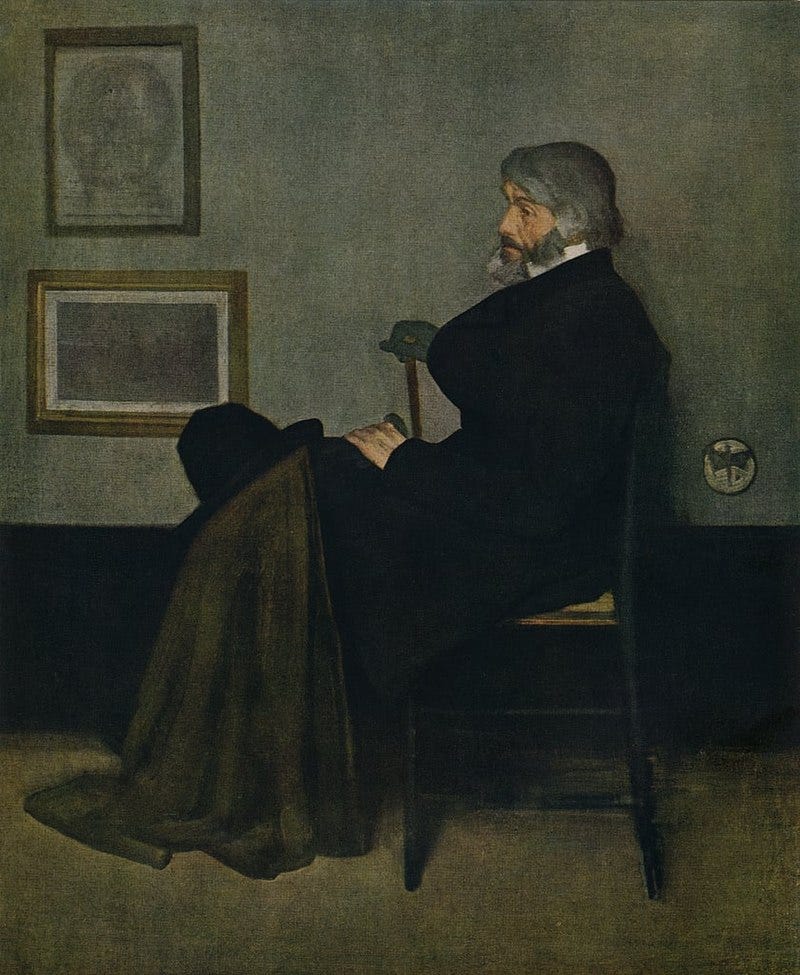
Late in life, Carlyle sat for Arrangement in Grey and Black, No. 2 by American artist James McNeill Whistler. He admired Whistler’s earlier work, Arrangement in Grey and Black: Portrait of the Artist’s Mother, for its austere simplicity and profile composition. Carlyle sat for Whistler from late 1872 through the summer of 1873, his melancholy deepening throughout the process. Witnesses, including artist Hugh Cameron, noted the contrast between Carlyle’s motionless, sage-like demeanor and Whistler’s frenetic energy. Carlyle later wrote:
“More and more dreary, barren, base, and ugly seem to me all the aspects of this poor diminishing quack world.”
As a staunch reactionary, Carlyle grew ever more despondent, seeing the triumph of the democratic forces he had long opposed.
Thomas Carlyle passed away on February 5, 1881. Though offered burial in Westminster Abbey, he chose instead to rest alongside his parents in the remote solitude of Ecclefechan. His reported final words, whispered weakly, were: “My mother.” Only a year later, J.A. Froude’s authorized biography appeared, revealing intimate details of Carlyle’s troubled marriage. These revelations, shocking to late Victorian society, illustrated the hidden struggles of ostensibly devout and respectable unions.
Carlyle stands as a towering figure, chronicling and critiquing the peaks and troughs of the 19th century. From the Regency Romantics to the late Victorian Realists, he bore witness to an era of immense change. Though often ignored in his own time, his work has been read and analyzed ever since—a distinction few reactionary writers achieve. Carlyle influenced both the left and the right, his prose marked by incisive wit and indelible substance.
To the modern reader, Carlyle’s works remain invaluable. His style will captivate; his probity and wit will challenge. You will laugh, yet find yourself unsettled, your beliefs affirmed and yet shaken. To paraphrase the man himself: “In books lies the soul of the whole past time—the articulate, audible voice of the past—when the body and material substance of it has altogether vanished like a dream.” Seek his works, not on a screen, but on the printed page. There, Carlyle endures.