
The Writer’s Tragedy
Between Divine Inspiration and the Tyranny of the Empty Page

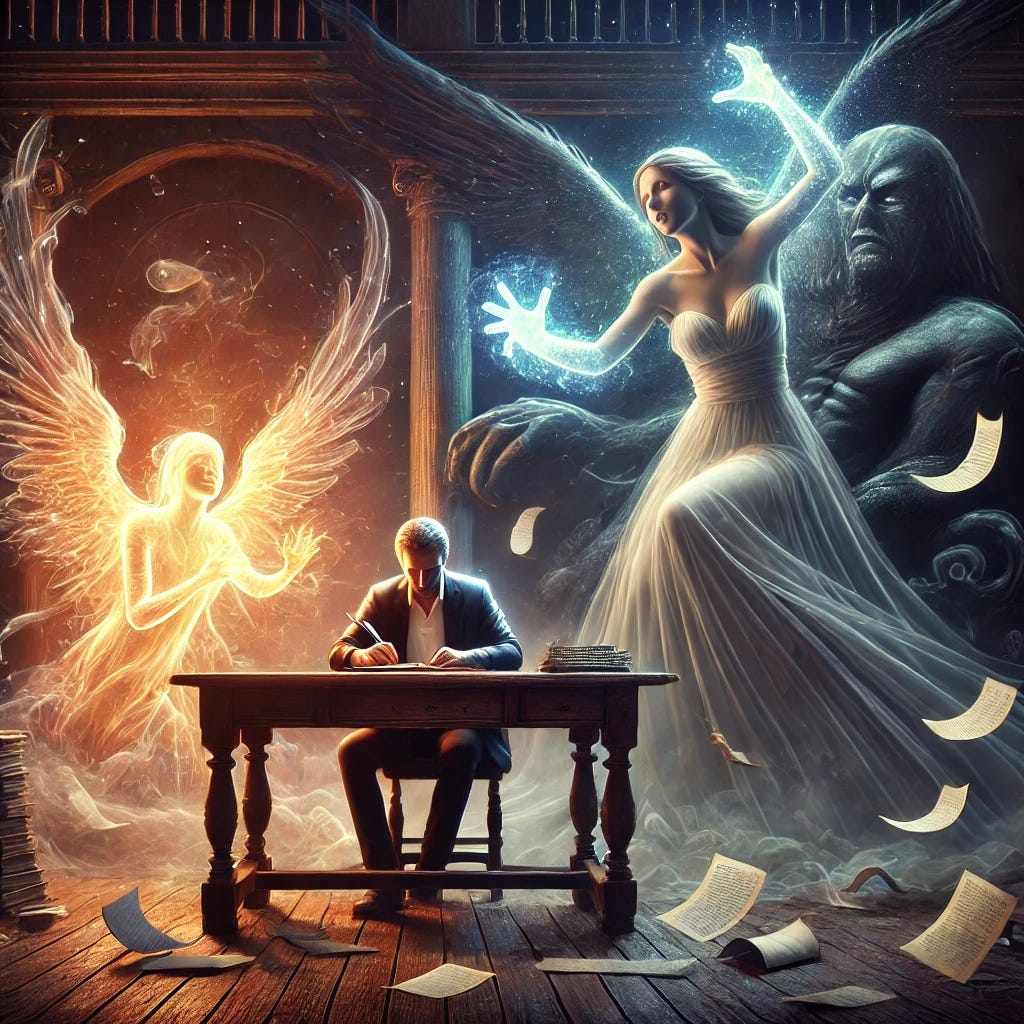
The greatness of a writer is their ability to hit upon an idea that strikes them with such ferocity that they are, more or less, able to continue merely off the momentum of that single idea.
It is only after flagellating myself for the entire day and, at many a moment of despondency and self-hatred for not having written anything down—despite claiming myself a writer—am I struck, at moments of complete indifference to anything to do with writing, with said powerful ideas.
This concept, I feel, I will never be able to overcome, or get over, or stop writing about. This idea of where ideas come from—idea genesis, if you like—should be of immense importance to all writers. If you have the forthrightness and brash demeanor necessary to pick up your pen and write with the hope that others will read you, then you should also have with you a natural inquisitiveness that pertains to where your art is born.
Does it not trouble you that you may wake up some day—any day, it doesn’t matter—and find yourself completely bereft of ideas, an utter dearth of necessary images and connections, the products of which are so necessary that without them you cannot even begin to orient yourself within the realm of your own mind?
How baffling and depressing is it—dear God, I know this feeling all too often; I experienced it today, actually—that you find yourself one day scribbling phrases and paragraphs of utter gold, but the next day, unable to capture or replicate what it was that necessarily led to such immense and beautiful literary output?
Perhaps it is a mistaken belief that all writers have: that they will be consistent consistently, that they will always have ideas by which to draw from—"What could be easier than thinking and putting to paper those exact thoughts?" they presume so boldly—that they will always hit upon the right idea at the exact time they need it, that they will never suffer writer’s block, that they will never suffer burnout, that they know themselves too well to be held back by lack of motivation or stimulus, that new experiences will always present themselves to them without conscious effort, that writing will always be effortless, that their ideas will always carry with them immense power, and finally, that what they write will always be worth reading—in a sense, eternal, never to grow old—as if they were Shakespeare or Goethe.
These are the vanities amongst vanities, I say, for any writer that thinks themselves immune to any of these caprices and false presuppositions is either delusional or mad—maybe both. In all my experience of writing, which is rather limited, if I may be fair to myself, I have found that my best works have always come about in moments in which I was not thinking in the slightest about writing. It’s almost as if the idea of the writer who wakes up, sits at their desk, thinks real hard, and scribbles out a book, or beautiful poem, or life-changing aphorism is a myth.
No human being—unless they be in direct contact with the Muses or in a transcendent flow state—is able to scribble out some masterpiece willy-nilly. That doesn’t happen in the real world. What we see when we look at works of utter genius, works so tremendous and powerful that they literally changed the world—the Qur’an, Bible, U.S. Constitution, Faust, Thus Spoke Zarathustra, Tristram Shandy, Don Quixote, Crime and Punishment, Self-Reliance (by Emerson), Walden, Pride and Prejudice, Leaves of Grass, The Divine Comedy, The Papers and Journals of Kierkegaard, etc.—is the result of many days, months, even years, of effort put on display in a single volume. This gives the reader, I feel, a very wrong impression. They think such works by these geniuses were written, collated, and organized in a demure, disengaged manner when, in truth, it was the exact opposite. In truth, what makes these works otherworldly isn’t necessarily their literary qualities—it isn’t even necessarily the greatness of their diction and organization—but rather the fact that these authors endured every sling and arrow that was tossed their way, without their consent, in the construction of such masterpieces.
If every writer could embody the mind of God while they wrote—or, more accurately, embody every free spirit, inspiration, and idol they hold as the greatest to ever do it—they would not hesitate, for the simple fact that that would make the creative process that much easier. If writing were easy, everyone would do it; and, more truthfully, if it were easy to master—like walking or learning your native tongue—the most illiterate among us would rival all those works mentioned in their worst moments. No one has control over their ideas, over what is and isn’t to be an influence upon their mind at the moment they write, and this is precisely what makes writing the hardest thing a person could do.
It’s difficult enough to find an idea, but it is infinitely more difficult to present said idea in such a way that it becomes universally accepted by all mankind as a work of utter genius—a work that the most decadent bibliophile would stand aghast at, in awe of its obvious profundity. I myself am more attracted to the first difficulty. Ideas are my bane. I wrestle with myself and hate myself endlessly for being unable to give the world what I think—and this is because I’m actually foolish enough to believe, with my youthful vigor and awareness of my talents, that what I have to say not only has importance but genuine capability in impacting the lives of others in a positive way.
It’s so difficult that even when I write in a flow state, I tremble before the prospect of actually putting it on paper with self-assurance that what is put down is a reliable representation of the heart. But perhaps I am met again with an eternal contradiction in writing. Just as I struggled before with the notion of writing with brevity while at the same time being elegant and poetic in prose (the solution to which, I found, was to combine both and not care whether my poetic prose made me extend the idea further than necessary), I now struggle with this notion of either writing when an idea hits me or writing without inspiration until an idea is formed in the act of writing.
What do I prefer now seems to be the question.
From my experience, I can say with certainty that the second form of writing leads to more profundity—and that’s because only writing when an idea hits you lends itself very well to aphorisms; it also helps that I focused my craft mainly on composing aphorisms, no doubt inspired by my readings of Nietzsche, Bacon, Emerson, Pascal, La Rochefoucauld, La Bruyère, and Goethe. The second style is natural to me—but, just as the man who suddenly finds himself rich desires more wealth and power, the more I mastered my craft of aphorism, the more I found myself desiring to write more, to become more greedy, more obsessed with my own wisdom, thoughts, and ideas. I had, and still have (which is why I struggle immensely so), a tremendous desire to write every profound thought, or what I presume to be a profound thought, that pops into my head. I have nothing but time and freedom at present, and so I feel like every second I do not write is a sin against the great fortune and youth I have currently—who’s to say when I get a job these passions will still burn in me, or who’s to say when I get into my thirties and forties I will have the same vigor and energy to write as I do now? Like Goethe, I desire all but am constrained by all—my passions burn endlessly, but there aren’t enough embers spreading fast enough to engulf all my domains of interest. This is why the first style, that of writing until an idea hits you, seems like the more efficient option. Can paltry scribbles for the sake of eventually hitting upon something grand be matched by simply waiting for the grandeur to come to you?
The second-oldest adage in writing—quality over quantity—hits me like a ton of bricks when I argue these two points in a dialectical manner. It may be better to write terribly at first if it means writing better down the road, and writing more overall, all things considered. Isn’t that what I ultimately want anyway: to not only write, but to write a lot, and to have it all be written very engagingly, in a prose style becoming of a man who read the classics and adores Emerson, Nietzsche, Goethe, and Shakespeare? Ah, but then again, what’s the point of writing for writing’s sake? Why do you assume that you will so easily hit upon some idea when you set out to write with an empty head? Surely you know this exercise may take hours—grueling hours, utter delirium.
You place yourself in a hard spot, Joe: for, on the one hand, you wish only to write elegantly and in a manner worthy of your idols—who seemingly only wrote gold, yet you ignore all their obvious imperfections and edits and all-too-human habits; not to mention the mistakes, contradictions, redundancies, puzzling emphases, etc.—and on the other, you seemingly wish to maximize your word count, as if you were actively trying to rival Dumas or Goethe, trying your hardest to capitalize on your present good fortune and youthful energies. Is it not the saddest youth who cannot discharge his passions, who walks around the world constantly with a muzzle on, a restraint to his will to power, neutered like some wretched dog who had his masculinity taken away?
Why do you torture yourself so, in so debilitating a manner? Of what use is this? Who benefits from your anguishes? Well, perhaps the world will. The world will know me as that idle rambler who wrote everything down because it was in his nature to do so—and maybe that is why you feel such a tension: you have your feet in both styles. On the one hand, you only wish to write with the greatest quality, yet on the other, you only desire to write for its own sake, with complete disregard for quality because you seek only to maximize your time in the most efficient manner possible. O, this is impossible to overcome—no man in history has ever come out of an either-or scenario such as this one unscathed, that is to say, with both his integrity and happiness intact.
I suppose it now becomes a question of which one I value more, just as it was for the last dilemma I faced. Well, whenever I’m presented with such a situation, I find the best answers have always been those which come from the heart—although it should be noted that such an answer is very uncertain, for the heart changes perpetually as the emotions do. With such an answer, it would make sense to simply say, “perform both,” and be done with it. What’s the need for all this introspection?
I introspect because it helps organize my thoughts, which are naturally scattered and sporadic in their occurrence—sometimes I think enough in one day to keep me occupied for three in writing it all down, as it was for Leibniz; other times, like today, for instance, I go seventeen hours without a single good thought passing through my mind, and utter something along the lines of: Dear Lord, I write, what most would presume, exceedingly well currently, but they know not how many hours of utter incapacity I was in, not thinking in the slightest about any of this, and then—WHAM!—like a thunderbolt heralded by Zeus himself, I am awakened to the cosmos of my surroundings, I become synced with all that I inhabit, and at once do I feel myself capable of extolling all the virtues of every idea ever thought. In these moments, I have command of all my faculties, all my knowledge, all my experience—and I use them with complete precision as a surgeon does their scalpel.
This seems to me the greatest self-discourse on writing I’ve ever composed. I am nothing but a poetic Hegelian in this sense. Yes, I want to write endlessly, but at the same time, I only want to write what is necessary and good—the two cannot be mended completely. In fact, they’re not meant to; they’re two different approaches to this great craft we call writing. To demand one and not the other is folly, but to demand that you perform both equally well at all times is also folly. Man is not only the measure of all things but must become the balancer of all things—the path between the golden ratio and disreputable ratio is extremely narrow, too narrow for any mortal to balance, I feel.
That is why I suggest to all writers who know my current pain to simply adopt one of the two styles—whichever is most appropriate given their present conditions.
That is perhaps all I need to say. Follow your heart in the moment, and all should come out okay in the end.