
Thomas Browne
An aphorism on his life

Thomas Browne, that luminary of the English tongue, has long been recognized as one of the most singular figures in the annals of our literature, though it is an ambivalence that marks his place in the history of ideas, for he remains both celebrated and misunderstood. What is there to say of this man whose mind, so finely attuned to the great harmonies of the world, found resonance in the quiet mysteries of the natural and the supernatural alike? The ingenuity of his intellect was not merely a wellspring from which his words flowed with an effortless freshness, but it was a key that unlocked deeper realms of thought, where the sacred and the scientific entwined in a dance of paradox. Though his style, often draped in ornate and Latinate flourishes, at times ascended to majestic peaks of eloquence, it was also a labyrinthine journey through allusions to Biblical texts, classical philosophy, and esoteric lore — a richness that may have confounded his contemporaries as much as it delights the modern reader.
In his day, Browne was a figure of contradictions: a devout Christian, a champion of the inductive sciences, and an adherent to the ancient arcana of knowledge, which sought to probe into realms that transcended the rational. Thus, one critic aptly described him as “an instance of scientific reason lit up by mysticism in the Church of England.” This complexity, however, has rendered him obscure, his work little-read and often misunderstood, for the very qualities that lend depth to his thought—his densely woven prose, his relentless pursuit of knowledge in all its forms, and his unyielding exploration of the hidden dimensions of life—are what distance him from the comfortable conventions of plainness and simplicity.
As a neologist, a master of words, Browne's contributions to the English lexicon are considerable. Among his 784 coined terms, some of the most notable include ‘electricity,’ ‘hallucination,’ and ‘suicide.’ His first usages of words number in the thousands, from the familiar ‘analogous’ and ‘ascetic’ to the more arcane ‘retromingent,’ which for all its inventiveness did not quite survive the tides of time. His words, many of which bear the stamp of scientific and medical inquiry, form a legacy that is as much a testament to his intellectual fecundity as to his daring vision of a world in which language itself becomes a tool for discovery.
Yet, it is in the broader sweep of literary history that Browne’s influence truly resounds. His words reached through the centuries, compelling the attention of Romantic writers like De Quincey, Coleridge, and Lamb, each of whom found in him a kindred spirit whose style had the power to arrest and transport. Even the composer William Alwyn, in 1973, was moved to pen a symphony inspired by the rhythms of Browne's Hydriotaphia, Urn Burial, while Jorge Luis Borges, ever the master of literary homage, called him “the best prose writer in the English language.” For Borges, as for so many others, Browne’s prose stood as an epitome of the grand style — a rich, intricate, almost orchestral mode of writing that sought to elevate the intellect to realms of grandeur.
In that struggle between plainness and grandeur, which runs like a thread through the history of English prose, Browne stands as a towering figure, a standard-bearer for the mandarin style. His was a prose that gleamed with the luminescence of ambition, woven with learned allusions and stately metaphors, a prose that soared and swirled around the heights of philosophical inquiry, untouched by the plainness of the age in which he lived. He lived apart from the intellectual center of London, in the marshy seclusion of Norwich, yet through his words, he spoke to the great thinkers of his time, leaving an indelible mark on English prose that would be felt for centuries to come.
Though Browne’s life may not have been one of dramatic external events—save for the quiet sorrow of losing six of his eleven children—his mind, through the years, brooded over the mysteries of life and death with a philosophical curiosity that few could match. His personal life was marked by the melancholy that characterized the age, yet his works, in their ponderous grandeur, suggested that it was not the trivialities of the world that mattered, but the ceaseless quest for meaning in a universe that so often resists understanding. He was no revolutionary, no fierce partisan of the age’s political strife; he was a man who turned inward, who sought knowledge in the quiet spaces where science and faith, reason and mysticism, could meet.
And yet, despite the grandeur of his vision, there is a certain irony in his legacy, one that speaks to the complexity of his time. For even as he advanced scientific thought and contributed words to the language that remain in common usage today, Browne himself was not exempt from the superstitions of his age. He believed in witches, and it was he who testified at the trial of two elderly women, convicted of witchcraft, in 1662. This fact, this blemish upon his record, casts a shadow over his otherwise distinguished life, and yet it remains a testament to the contradictions that so often inhabit the finest minds.
Thus, Browne is a figure who continues to provoke both admiration and ambivalence. His legacy, as much as it is a triumph of language, is a reminder of the complexities of thought and belief that shaped the world of the 17th century. And yet, in our own time, we are fortunate to look back upon his work—not merely as a relic of the past, but as a beacon for those who seek, as he did, to reconcile the realms of science and religion, to probe the mysteries of the universe with humility, and to understand the contradictions that lie at the heart of the human experience. For in Browne’s prose, with its grandiloquent flourishes and its deep, almost ineffable wisdom, there lies a mirror in which we might glimpse our own contradictions, our own endless search for meaning in the labyrinth of life.
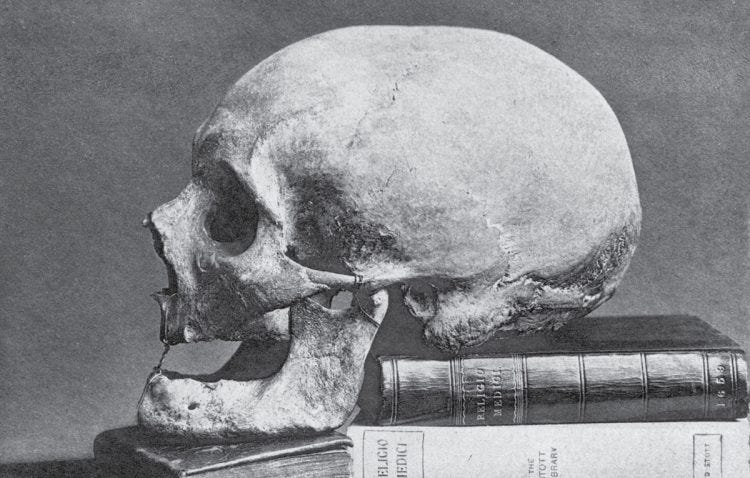
Aldersey-Williams, in his tireless search for a life to match the grandeur of Browne’s literary legacy, finds himself compelled to create a narrative arc, to fashion something of a shape where there is, in truth, little more than the quiet shadow of existence. He ventures to the site of Browne’s former residence, now replaced by a humble Pret a Manger, as if to grasp at some tangible remnant of the past, yet finds only the sterile presence of modernity, an unyielding silence in place of history. From there, he pedals his bicycle—anachronistic as the very journey he imagines—over the same route Browne once traversed after offering his testimony in the witch trial of 1662. With every turn of the wheel, Williams, caught in the fervor of speculative thought, wonders what those three centuries between their footsteps have wrought upon the mind of this singular man. He gazes upon the plaster cast of Browne’s skull, a relic that seems to laugh at the futility of time itself, and contemplates the weight of mortality in a Norwich graveyard, where the shoppers pass unmoved, their senses dulled by the sterile pursuit of retail.
Williams, in this search for the man beneath the words, lets his fancy stray to flights of whimsy: a statue of Browne springs to life, descending from its pedestal to stroll beside him, engaging in a conversation on faith and skepticism—an imagined dialogue that, while earnest, falters beneath the weight of its own grandiloquence. "So, is this some kind of bromance?" the resurrected Browne asks, a phrase of such dissonance with the solemnity of his thought that it jars, evoking the strange and alien qualities of the man whose spirit the author attempts to summon.
And yet, amid this attempt at resurrection, Browne’s own words, bound in the pages of his writing, offer a deeper insight into the complex heart of the man—more intricate, more fragile, than the sum of his historical pursuits. Williams evokes Browne’s great contradictions: a man on the threshold of modern science, yet utterly entranced by the ancient mysteries. Here, in his pages, we glimpse the truth of Browne’s nature—not as a titan of intellect, but as one whose curiosity swayed in whimsical gusts, pulling him toward isolated marvels, away from any coherent system of thought. It is said, with no small degree of tenderness, that his scientific inquiries were meandering rather than revolutionary. He was not Newton, nor Hobbes—men of towering intellect who shaped the course of thought for centuries to come. But there is something undeniably captivating about Browne’s wandering curiosity, his peculiar blend of open-mindedness and willful misjudgment. "He is a contradiction, as we all are," Williams writes, and it is here, in this contradiction, that the author finds his most profound fascination.
But this admiration cannot escape the shadow of Browne’s actions in the witch trial—a dark chapter in his life that stains the golden sheen of his philosophical pursuits. His belief in witches, Williams contends, was rooted in his theological necessity—a necessity born of his steadfast belief in both the Devil and God. For Browne, this belief was no quaint superstition, but rather a necessary pillar of the edifice of faith. It was the same fideism that gripped Montaigne and John Updike, a faith grounded not in reason, but in the very acknowledgment of human fallibility. And yet, how strange it is that this man, so enraptured by the mysteries of nature, should find himself complicit in such a cruel ritual of superstition. His testimony, offered with great authority at the 1662 trial, sealed the fate of two elderly women, who, despite their innocence, met a gruesome end at the gallows. In this, Browne’s failure to transcend his era’s superstitions stands in stark contrast to the unnamed "ingenious person"—the true hero of the trial—who, with quiet reason, suggested that the children at the heart of the accusation might simply have been faking their symptoms. The proto-scientific inquiry that followed pointed to the women’s innocence, but the air was thick with superstition, and the women were hanged nonetheless.
Thus, in the quiet corners of history, Browne’s tale reveals itself not in the brilliance of his intellectual achievements, but in the tragic consequences of his own contradictions. Four hundred years have passed since his birth, and it is not his metaphysical speculations or his forays into early science that have endured, but rather his unflinching toleration, his capacity to exist between the worlds of faith and reason. He remains, in the eyes of many, an embodiment of an age torn between the old and the new. The youngest son of a prosperous merchant, Browne entered the world in the year of the Gunpowder Plot, a moment pregnant with the fear of a world on the cusp of profound change. His early life was one of promise and privilege, and yet, even as he traveled the learned paths of Oxford, Montpellier, and Padua, he was never quite of the world of London’s great intellectuals. Instead, he found his place in the quiet streets of Norwich, where his inquiries were pursued in solitude, away from the noise of history’s great revolutions.
And yet, despite the relative obscurity of his life, Browne’s literary voice remains a landmark of the English language. His writings—wrought with precision, but also fraught with paradox—speak of a man who stood at the crossroads of science and mysticism, a man whose works reflect a ceaseless curiosity, a profound engagement with the world, even as his beliefs often led him astray. In this, we are reminded of our own contradictions, of the fragility of reason, and of the quiet grandeur of a life lived between two worlds.
Though he found himself ensconced in the solitude of Shibden Dale, surrounded by the great silence of the Yorkshire hills, cut off from books and the literary worlds of the time, Thomas Browne began, in those early years of seclusion, the work that would secure his place in the annals of intellectual history—Religio Medici. Here, he confesses in the most serene and contemplative manner, a doctor’s deepest thoughts, those meditations born from the quiet hum of a solitary life. As he wrote, there was no sense of the bustling modern world that would come to shape so much of thought and controversy; rather, there was a stillness, an almost otherworldly reflection on life, its mysteries, and the paradoxes that clung so stubbornly to the human soul.
"I cannot divide myselfe from any man upon the difference of an opinion," he writes, as if the words themselves are not mere expressions of thought but extensions of the delicate and complex machinery of the soul—those inner recesses where the mind continually flits between contradiction and coherence. How curious it is, this passage, where one who has become a touchstone of reason and rationality confesses, almost disarmingly, the paradox of the mind that cannot hold fast to a single truth, the mind that shifts its loyalties, for it is ever in flux, ever open to the wind of contradiction. Browne’s thoughts—there is something so intimate in them, as if they are overheard in a private chamber, beneath a lamp’s gentle glow, and yet, they are thoughts that echo with the wisdom of the ages, the humility that marks those who dare to question.
He muses on the human frame, that very organ that houses the soul, and its mystery, one that refuses to yield up its secrets. "Amongst all those rare discoveries and curious pieces I find in the Fabrick of Man," he writes, "there is no Organ or Instrument for the rational Soul." There is something tender in the way Browne addresses this, as if the answer is just beyond the grasp of the mind's eye, but remains veiled in obscurity. How can one look upon the brain and find it "no more than I can discover in the crany of a beast"? The simplicity of the statement is laced with a deeper, more unsettling thought: that the very nature of the soul itself is beyond the reach of material examination, something intangible and ever elusive, an enigma that remains despite all the knowledge man has accumulated.
The conflict between reason and faith, between the demands of the spirit and the powers of the mind, is no new struggle. It echoes across centuries and centuries of human thought. To read Browne is to hear, beneath the calmness of his prose, a battle between two forces that he, like all men, is unwilling to resolve completely. As he writes, the philosophical and theological are not in opposition, as they appear to be in the hearts of so many men. No, for him, "a moderate and peaceable discretion may so state and order the matter, that they may bee all Kings, and yet make one Monarchy, every one exercising his Sovereignty and Prerogative in a due time and place, according to the restraint and limit of circumstance." This is the very essence of Browne—his ability to weave the seeming contradictions of thought into a harmonious whole, even if that harmony is a fragile one, and despite the perennial dissatisfaction with which he regards human understanding.
Browne's religious views, though shaped by the controversies of his time, stand in opposition to the fervent sectarianism that divided men. He writes of the unity of faith and the simplicity of charity, as if to suggest that it is the human heart, untainted by division, that holds the key to all understanding. "I cannot fall out or contemme a man for errour, or conceive why a difference in opinion should divide an affection," he writes with quiet grace. For him, charity is not merely a moral action, but the very heart of human existence—"He that giveth to the poor, lendeth to the Lord." These words, simple in their truth, shine with an almost metaphysical glow, suggesting that faith itself, when purified of dispute, becomes a form of love—a love not only for the divine, but for all that lives.
It is in this spirit that Browne, the man whose life was dedicated to the pursuit of knowledge, examined the affairs of the world, especially those dark and foreboding occurrences that, even in the realm of reason, seemed to defy explanation. The trial of Amy Duny and Rose Cullender in 1664, where Browne lent his weighty opinion, remains a source of scholarly discomfort. But Browne was a man whose judgments, though flawed, were sincere. In the context of his time, his conclusions on the witch trial are hardly surprising. "I believe that all that use sorceries, incantations, and spells, are not Witches," he writes, confiding that what may appear as superstition to one may be but the remnants of a time when the boundaries between the mystical and the scientific were far less distinct. How fascinating, then, that Browne, the man who combated common errors in his Pseudoxia Epidemica, might himself fall prey to a belief in the irrational when weighed against the backdrop of his era's darker inclinations.
Yet, it would be unfair to judge him harshly. For even in these areas where his wisdom faltered, he remained, as always, a man caught between the worlds of reason and faith, of science and mystery, whose gaze ever sought to reconcile the strange, the contradictory, and the unknowable. It is this paradox that defines Browne—not the certainty of his answers, but the beauty of his questions. In this, he stands not only as a medical man or a man of science but as one whose life and work embody the human search for meaning in a world where answers are always just beyond reach.
His two books, published in 1658, find themselves in the peculiar position of being misnamed—an error, one might say, born of a certain inadvertent grace. Hydriotaphia or Urne Burial and The Garden of Cyrus bear titles that betray their essence, for little do they concern themselves with archaeology or horticulture. One is a meditation, a thoughtful turning of the mind upon mortality, upon time’s fleeting and eternal nature; the other, an obsession with the geometrical quincunx, a design of five elements arranged with four in the corners and one at the center. In Urne Burial, in its final chapter, Browne lays bare the profound melancholy of existence, eloquent and dignified, a passage to which the English language has few equals:
Time which antiquates Antiquities, hath an art to make dust of all things... the iniquity of oblivion blindly scattereth her poppy, and deals with the memory of men without distinction to merit of perpetuity.
But there is, in this very passage, a redeeming light—a recompense found not in the things of the world, but in the imagination, that sanctuary of the mind:
Life is a pure flame, and we live by an invisible Sun within us. A small fire sufficeth for life.
Yet, how much more we insist upon our miseries, those self-inflicted wounds, like the constant erosion of time:
If the nearnesse of our last necessity, brought a nearer conformity into it, there were a happiness in hoary hairs, and no calamity in half senses. But the long habit of living indisposeth us for dying; when avarice makes us the sport of death; when even David grew politically cruel; and Solomon could hardly be said to be the wisest of men. But many are too early old, and before the date of age. Adversity stretcheth our days, misery makes Alcmena's nights, and time hath no wings to it.
Not all his works saw the light of day before his passing, a certain irony attached to this fact, as he departed from life in 1682, on his birthday—a subtle twist of fate, as if the universe itself had whispered a rueful, ironic remark at his departure. He had written of such a coincidence in his Letter to a Friend:
But in Persons who out-live many Years, and when there are no less than three hundred and sixty-five days to determine their Lives in every year; that the first day an Advantage of their should make the last, that the Tail of the Snake should return into its Mouth, precisely at that time, and they should wind up upon the day of their Nativity, is indeed a remarkable Coincidence, which tho Astrology had taken witty pains to salve, yet hath it been very wary in making Prediction of it.
Even in death, the poet’s wit did not abandon him.
The Christian Morals, which only appeared in 1716, confirmed the depth of his learning, extending beyond the reflections of Religio Medici to show that Browne, far from resting upon his laurels, continued to probe the arcane recesses of thought throughout his life:
Value the Judicious, and let not mere acquests in minor parts of Learning gain thy pre-existimation... They do most by Books, who could do much without them, and he that chiefly owes himself unto himself, is the substantial Man.
The scholar Samuel Johnson, in his 'Life', preserved the voice of one who had known Sir Thomas in his own time, John Whitefoot, a man who, as the Rector of Higham, had observed Browne's quiet gravitas:
He was never seen to be transported with mirth or dejected with sadness; always cheerful but rarely merry, at any sensible rate; seldom heard to break a jest, and when he did he would be apt to blush at the levity of it. His gravity was natural, without affectation.
Indeed, Browne knew himself, and thus it is that, in the Religio Medici, he speaks of his nature with uncanny clarity:
I have a touch of the Leaden Planet in me. I am no way facetious, nor disposed for the mirth and galliardize of company; yet in one dream I can compose a whole Comedy, behold the action, apprehend the jests, and laugh myself awake at the conceits thereof.
Johnson, ever the wit, would add his own: "What is much read will be much criticised," and, in a humorous recounting of Sir Kenelm Digby’s hasty judgment of Religio Medici, he noted the knight’s rapid review of the work, completed in twenty-four hours, the majority of which time, we are told, was spent in the procurement of the book itself. And in his witty reflections on the reciprocal civility of authors, Johnson added, with memorable irony:
[Browne's] style is, indeed, a tissue of many languages; a mixture of heterogeneous words, brought together from distant regions, with terms originally appropriated to one art, and drawn by violence into the service of another. He must, however, be confessed to have augmented our philosophical diction; and in defence of his uncommon words and expressions we must consider, that he had uncommon sentiments, and was not content to express in many words that idea for which any language could supply a single term. But the innovations are sometimes pleasing, and his temerities happy; he has many 'verba ardentia', forcible expressions, which he would never have found, but by venturing to the utmost verge of propriety; and flights which would never have been reached, but by one who had very little fear of the shame of failing.
The otherwise acerbic Lytton Strachey could find no harsh word for Browne, and even expressed admiration for his style—its studied pomp, its wealth of allusions, and its love for antithesis. He, too, found whimsy in Browne’s peculiarities, and imagined reading him in a far-off land, in places where the very air seemed steeped in antiquity, as though the author himself belonged to those long-vanished eras of learning and repose.
In England, the most fitting background for his strange ornament must surely be some habitation consecrated to learning, some university which still smells of antiquity, and has learned the habit of repose.
It is thus that the spirit of Sir Thomas Browne is forever bound to the curiosities of the mind, a blend of recondite thoughts and elegant phrases that invite the reader not merely to ponder but to revel in the peculiarities of existence itself.