
thoughts on humanity
an aphoristic review of Shakespeare’s Henry The Sixth Part 1 (written from 11/14 to 12/20)

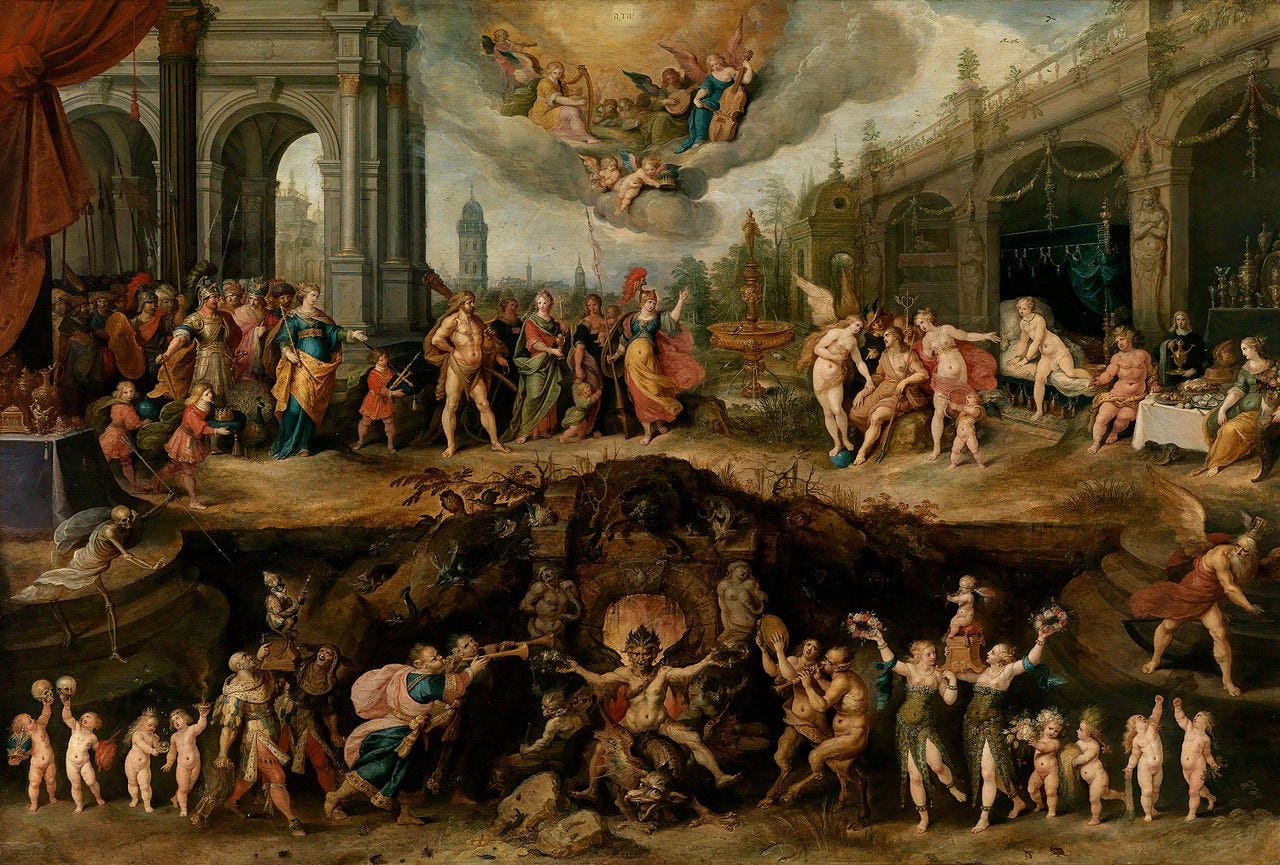
The First Part of King Henry the Sixth
Act 1, Scene 1
We already see within the first lines Shakespeare’s profound genius showing, where he puts within the mouth of a messenger the news that many a city in France, once under the control of the English, have now been overrun by the French—who have retaken their land once again. And the cause of such a fate was the disagreements amongst the generals. It seems that humanity has always faced such things—where one sees perfectly clearly the twig within another’s eye, without recognizing the beam within their own. Humanity at its heart, already on full display for us to find ourselves in. What made Shakespeare immortal was laid out within the first page of his first play: unsurpassed, only to be emulated and admired.
Were our tears wanting, these tidings would bring forth further streams; one need not lament when gentle drops shall make pure the soil upon which they grace.
We will not fly but to our enemies' throats and fight to the death, an honorable thing amongst our nobility; for what can be more noble than the death of one who fights precisely to keep their nobility? I shall vanquish; none shall remain. And to this day, forever shall the deeds of my present self be called forth in the memory of future men. That is what I hope to leave behind me: a piece of thy glory and of my merit-filled heart—for my actions always warm those with timid hands and idle feet. No more, men! Make the move and come forthwith, lest I die without support, shameful, and in vain. None would want such a legacy to bane. Please, men! Please! This battle cannot be fought alone; it requires those of character and disposition not unlike mine: hardy, worthy, graceful, pure, good, noble, and strong! That’s all I ask for.
The poor knight Talbot, the saintly warrior, fighting with all his might in arms—so strong was his desire for victory, the French thought him possessed of the devil in arms. And that sly coward, Sir John Fastolfe, who made retreat when his comrade was so heavy in arms, looked upon him without a care and took leave lest he face the same labor. What is a man of this kind but the slyest lightweight, not fit for battle, or even fit for a horse?
We see strong traits of ambition in the final lines of this act, where each man has a role to play, a duty to uphold, an oath to not break. The king may be dead, and cities may be taken, but we shall not lose heart in such trying times. Steadfast we must be in the face of adversity; never shall we surrender: never, never, never, never! The world is too young, our reign too short; not enough suns and moons have passed overhead during our time at the top. The stars portend a very clear sign: that he who has ambition shall be called divine. Nobility of ours shall live today, to fight tomorrow, to eat and rest the next day, while shifts occur and move about we do through the ranks—until we find our very sons born and wanting to do the same. We are noble warriors, fighting for the king, and we shall never let such a profound family down.
Act 1, Scene 2
I forgive him that death which killeth me, and so do I require forgiveness for the grave sins of war. There was in this action no pride taken, but in life we must occasionally do things that are not to our liking. How often does the man of ambition find his once-found vigor gone by the swiftness of abiding tempers—we must maintain a state of constancy and virility if we wish to accomplish truly great things in the world—for the world be too small to possibly contain two Shakespeare’s or Goethe’s. So we battle it out with our wits, and let our battles’ slings and arrows be the cheers and jeers of our opposition, who are the beneficiaries of such a match—endlessly do they receive our fruits, while we the sweat and toil of that hardy labor. The world be built upon by the foundation of stone, and so let all bemoan the day when that great battle ceases, that battle which continuously pours the cement of all humanity’s deeds in plain view to see.
He fights as one weary for his life; and don’t we all live in such quiet desperation—a kind of chilling reminder that not only will death subsume all, but that we will have a hell of a time with it too. For life is but the prelude to death, and death the symphony of decay and dissolution. Such is why those of high merit attempt to outlive death by various means: some have children, others create works of art. Either way, all will perish, but this does not mean that what we do with our time now is meaningless, for we provide it meaning in the act of doing it! Life is that beautiful work of art which, so long as we continue to paint it—and occasionally add a new color and whatnot—we shall always enjoy such creating, even when our paint begins to fade through the strife of time and decay. MAKE ART, for that is what life is all about.
Hunger will enforce them to be more eager, and so is life itself; driven by such drives that propel us to become the first mover, the god of Aristotle. Hunger is not unlike fame, for in those trying times of embitterment, strife, misery, poverty, weakening health, unsanitary habitations, and all the rest of mankind’s greatest lows, we find within ourselves the strength for our creating art. There is no dishonor in poverty—mere material privation is all it is, and why should one let such a thing stop them from pursuing a noble work of genius? One should let such losses of status, wealth, and friendship be nothing more than fire within the already burning cauldron of our mind; let it be the inspiration we so desperately need for our muse to really sing. This, I find, the only useful perspective on such misfortunes. I find that one should only look towards what is to be gained by such losses, and take hold of heart and will when faced with opposition to the ethereal plane of our works.
And drive the English forth the bounds of France. Shall not all endeavor to drive forth their creative spirit—to knock out one inequity with another; to show the entire world that we bring goodness and joy with our very being, our very creative selves? I, for one, find such an idea delightful and shall always strive to bring about such a state of existence in which I am only doing what it is I was most meant to. Shakespeare, in every line, shows entire summaries of life, all to be interpreted for the sake of ourselves—so good was he with us all, to have allowed such thoughts to be brought about from his words alone. The true pinnacle. I now know what love is, as Vergil said, and so too do I know what Shakespeare is, the greatest man to hold a pen.
Impatiently, I burn with thy desire. Look here how one sees the elegance of so simple a phrase, yet the powerful imagery which it evokes is enough to fill countless volumes of thought on such a line. I also find that, at such a time, the more I read of Shakespeare, the more improved my own English becomes. O, grateful gods, how fortunate was I to be born with thy native tongue of the Anglo-Saxons—the Germanic tribes of hardy-haired, greasy rolls, and large-breasted women. The white skin, the blue eyes, the pale complexion, never to be kissed by the sun, yet always one to have about them a sense of virility. I find myself able, upon reading but two or three lines of the divine bard, to conjure up words from the ether, and thus make fulfilled the thoughts I had wished to convey. Perhaps it is with all great writers that they reach a point in their development that is stagnant, until they read a work of such profound genius and power that they are forever changed and morphed into a new kind of entity—a kind of writer which forms whole universes out of mere air, almost ex nihilo. I can, with greater rapidity, find the words I so desire to make complete what would have been but half-done had I not read the bard of Avon. I’m officially of the opinion that anyone who wishes to be a writer in English must make it their duty to not only read Shakespeare but to truly understand what it is he signifies for our language—what he did for our craft, the influence he had, the kind of expression that he uses to convey his sense of conception. All such things must be accounted for when reading him.
He may mean more than we poor men could conceive; these women be shrewd tempters with their tongues. If such be the case for women, then why not let men be as slick and sly as all the devils on Mount Asinine? There is a kind of dynamic tension between all good relationships, one in which there is optimal pushback, a forthright moving forward, a gentle retreat, a brash advancement—such are the dynamics of love between two kindred hearts, those who would move mountains to not be found so far apart. For love conquers all, as Vergil said, and so women be the ones in control, while the man becomes the one in action: the donkey on the stick, where the rider is a graceful maiden and the carrot is the reward dished out for performance. Love is a fickle notion to us scholars, however, for we find ourselves in raptures, forever higher, in the thoughts and deeds of others than in those carnal desires whose midwife is venery. I think this an acquired taste of nature—the eusocial poindexter who becomes the attraction of all fair-minded youths of beauty, but who does not become the crowning fruit which goes so well with their carrying flowers. "Lord, make me chaste, but not yet," said Augustine; well, here’s my rendition of it: "Lord, make me lust-filled, but not yet." I have more knowledge to acquire, more books to read, more geniuses to admire and aspire to. I can’t find myself attracted to even the Helens of the earth until I have at last availed myself of all earthly wisdom. It is, as I have so often said in the past, my greatest burden but also my lightest duty. How I wish I could truly tell women how I feel about them; but, at the same time, I refrain, for I have too much self-control and an aversion to the fineries of life—those things which lust so completely overturns and which allow confidence to flow so naturally from a timid bosom that at once connections can be made, friendships can be had, lust can begin, and so follows love!
No prophet will I trust, if she proves false; and thus do all women prove their worth in some capacities. Sick to death I am of our heritage of patriarchy after patriarchy, misogyny after misogyny, a nausea’s nausea’s nausea. A tell-tale sign of too long an open oppression. Shall we men of earth not only try but actively wish to see our women succeed in their every earthly endeavor? Shall the arguments from millennia past really still convince we of the 21st century? We men who have, for the whole history of our species, considered the bearers of our children the weaker sex. Is this a moral or wise assessment of our felicity? Should we not all strive to uplift each other in our endeavors? In a perfect world—one which we certainly do not inhabit—we would encourage women to become who they wish to be, not who we would like them to be. If you have your freedom to be a rake, then so does she. If she so wishes to be called so-and-so, then let us have the decency to respect her demands. We are one common humanity, only bound to grow and develop as we uplift ourselves, breaking the shackles of past monstrosities of thought, from falsehoods of opinion, from junk scriptural decrees, from the general prejudices passed down through the centuries, so ingrained it becomes unquestionable. Question all things, and dare to be surprised with enlightenment.
Act 1, Scene 3
We do no otherwise than we are willed; perchance determinism would creep its way towards all discussions, for action and will are but two sides of the same coin. We are not our wills; rather, we have wills, and we control them to suit our desires: ay, but who willed that? Surely you are your will, for you know not where your wills even derive from—are they not the cause of some external stimulus which we ourselves are either not privy to, or, if we were, would have no means by which to prevent its influence on us? I suppose we really don’t have any free will; rather, we do no otherwise than we are willed, for to not will what you will is to say you don’t truly have your will freely. I think this a knockdown argument—both metaphysically and neurologically. There is no action which we perform that does not come about from some prior cause which we ourselves were not the authors of. Unless you’d like to argue that there are metaphysical, non-material beings that actually control us, or that we pragmatically choose to believe in freedom of the will so as to avoid the sense of purposelessness in a world that is already meaningless in the grand scheme of things. I like the pragmatic argument, at least on utilitarian grounds, but in terms of refutations, I would say we’re far away from such a thing.
Stand back, thou manifest conspirator. This is the kind of slogan I find so haughtily and heavily being flung around contemporary politics as of now. This one and his cabal of followers are really fascist and whatnot. I’m so blue in the face with the constant repetition of the same news stories over and over again, with the same attention-seeking headlines that purport to be news but are really falsehoods. Sin have we against our principles as a nation, and placed hope in a false idol, all for the wish that with enough propitiation, he may be the one to take us back to former times of glory. It never ceases to amaze me how much more preferable it is to be a part of a group that only thinks one thing and never finds it necessary to question it, than to come to your own rational conclusions and decisions about things. The matter with things is that we have not enough sense to figure out what matters for ourselves; we have it dictated to us by our caprices, vanity, and influential demagogues. Politics has always been a corrupt bargain, but the extremes we have recently seen in the wake of ineffectual policies and promises turned falsehoods are wicked and torment my gentle spirit—I, being a man who cares not for the upkeep and affairs of the world, only seek to get on living and supporting my interests, all the while uplifting others to do the same. This was my interpretation of Emerson’s self-reliance and individual genius anyway. My whole life philosophy is more or less one big interpretation of Emerson’s Transcendentalism.
Thou knowest little of my wrongs—and how strong a rejection of such pomp and circumstance when arrives a noble one who has, for some three score days, indulged little in some rakish behavior. There are always two aspects to mankind: that of the seen and that of the hidden. The seen is the outward show—how we wish to appear before the world. Depending on where you find yourself on Earth, you may wish to appear poor, for fear of being stolen from by the needy; or you may wish to appear rich, to showcase your good fortune and the power you command by a ready wield of capital. The other, the unseen, is the shadow you. It is the side of yourself that you refrain from showing the world, for most around you would think it debauched, disgusting, or strange. There are many things to indulge in, and fancy of imagination is one in which people with large shadows abound; they practically hide away their whole lives, cloistered in some shabby room, disheveled and unkempt, messy hair, with loose beard hairs strewn about. They care not for themselves, for they have no perspective on why how they act revolts and turns people away from them; or, if they do, they are fearful of the judgment of others, and so prefer to remain in the darkness of their bedchamber, forever in artificial night, contemplating either revenge or a plan of conduct—a resolution, of sorts—for self-improvement. Let every man have his secrets, but let not his secrets get the better of his reason; for fantasies may crop up, but they must not dominate the mind for any length of time. One should rather use these temporary muses to bring about some great work of art, some great overcoming, some self-willed domination of a noble aspiration. Reject mediocrity, embrace greatness.
Act 1, Scene 4
Father, I warrant you no care, I’ll never trouble you. Such elegance to express the reassurance of a father by his son that he will cause him no headache or heartache. Such a noble thing to offer a parent, especially a father, who, I feel, sees less of his children than the mother, for he is away at work when the mother is in convalescence from childbirth. And it has always appeared to me that daughters grow further from their mothers as they age, as do sons from their fathers—not to say that they necessarily love the other more, but that their influence seems to become of less importance as they themselves take on their own individuality. The care for children should not lead to pampering, only weaning to the point of rebellion; which, at such a point, the parents ought to pray to God they’ve done their due diligence in raising the child, hoping to instill in them such values that are only to their own, and society’s at large, benefit. Man knows no hell like a woman’s scorn, and parents know no hell like a man-child, a puer aeternus, a husk of meat that can barely move its feet. If such is the rebel your little darling turned out to be, you ought to have been more watchful of their adolescence. For this is no way to be at the age of adulthood.
I grieve to hear what torments you endured, but we will be revenged sufficiently! Such is the attitude I wish to carry about me always; to follow that third rule in Cardano’s Conduct of Life, that: “… when I had lost, I should not be content merely to redeem the loss, but should always obtain something in addition.” One should always wish to have not only revenge but a proportional response, sufficiently. There are no errors in proper judgment when faced with all the facts of the matter; the only way to advance in life is to advance your conduct and mode of being. One must follow closely the path of evolution itself in life; always allow for slight modifications in response to the environment: do this, and you shall master the whole of earthly arts.
Mirror to all material men; such is the praise worthy only of a noble human being—beautified by their actions, deeds, and remarks, all for the world to see just how great they really were. We should all try to be of this type, a mirror to all those around us—for to reflect the man is to reflect what he is, an equal in those things worthy of being emulated.
Your hearts I’ll stamp out with my horse’s heel; an elegant expression of rage, to be so consumed with the thought of revenge—to be filled with the rage of Achilles, a thing the world has not seen since antiquity. To call into existence a force of will, a power of facing all, to dominate the lazy passions and childish temperaments; this is what it means to be worthy of the task to defeat all those who have dismissed you and who are worthy of your revenge.
Act 1, Scene 5
Heavens, can you suffer hell so to prevail? A question, a lament almost. Why must the evil always prove an equal to the good in times of trying measure? In a world fraught with misery, they find themselves surrounded by devils and evil forces that act to their detriment. Such is to become of all pure hearts, large brains, and noble aspirations: to be dragged through the mud of misfortune—where Lady Fate proves time and again that man’s consistent propitiation is not enough for his will to always hang on in the time of shortening patience and ever greater evils present.
The shame whereof will make me hide my head. Again, how often do we say such things in everyday life; the whole monotony of repetition for the sake of keeping the system functioning, all the while we find no passion or joy in the execution of our duties. I know not this trouble as of yet, but may soon enough, and know not if I have prepared myself with the wisdom of the world. Equipped I am with knowledge, good sense, a healthy body, noble aspirations, kindness of spirit, gentleness of soul, and yet, it seems to me never enough to withstand the onslaught of drudgery that is contemporary life; the whole lostness of the world, all undone by a single quip from an uncaring boss, the loss of flesh, the degradation of hope. We who live out our dreams even, shall we always be met with jeers from the misfortunate, who understand not the sacrifices we have made to become this happy? There is always novelty to be found in the bad, but always will the lesson be painful. Such was the judgment of John Wilmot, that any new experience of life will be carried out at your own expense: it is perhaps the greatest epitome of experience there is. No man can know all things, and so, he either acts on faith or reason alone—and thus is our dichotomous world. Forever to disagree, forever to forget the arguments of the other side, and always to be debilitated by ignorance and want of knowledge.
Act 1, Scene 6
Thy promises are like Adonis’ garden; one day they bloom, the next day they are fruitful. This is a worthy adulation toward Joan of Arc, who, by her bravery and forthright resolve to battle the English, has brought upon France great joy and success in battle. There has never perhaps been a better garden of Adonis in the history of the world, that ancient adage which Shakespeare thus immortalizes in this line of praise.
Act 2, Scene 1
When others sleep upon their quiet bed, constrained to watch in darkness, rain, and cold. What an ode to sleep, so graceful. The quiet bed, that thing we rest our weary heads upon in hopes of finding repose, and maybe even a dream. How joyful sleep is, but how slothful it be in a world of limited time. I, for one, am writing this right now without more than two hours of sleep in me—not because I wanted to, but because I could not find slumber attractive when my mind was brimming with ideas of action and hope. I have thus awoken by the duties nature had called upon me to perform, after which I was required to put the dishes away in the bath of cube-like steel. Then I took out the trash, along with myself, and left it on the curb to be gawked at by morning pursuers and early risers, to work they go, tired and annoyed. Then I attempted to find such rest which I once knew but had lost the motivating drive of Hypnos, and so resolved to read Shakespeare again, in hopes of perhaps a later rest—a nap, really—to quiet my still unwavering brain.
How much in duty I am bound to both. It is like today, only with more emphasis on productivity rather than virtue or glory. The praise of past things seems more like a mockery to us than it did in those ancient times, where the ways of men were more focused on the noble aspirations of the immaterial plane. We have lost the divine spark, that thing which we yearn for evermore, ere long we are without it—we are thus lost without hope. This is a very Shakespearean notion: that the call to attention is to be placed on the feeling of mankind rather than the narrative or plot per se. I feel this is what has made the bard so universal, so powerful, so adorned by everyone on earth, practically as known as the Bible and Qur’an. Let Shakespeare be the secularist and atheist’s Bible—or encyclopedia of mankind, rather.
Using no other weapon but his name! This is the inspiration we find ourselves in—in raptures as to what one has said or done for us that we fall on our knees in prostration, and emboldened we do become to take noble action. This is the kind of worthy sentiment which I hope to see more of in Shakespeare’s later plays. We use the name, or the image, or the story of a deed, all in the hopes of finding what it is which we have alas worshipped and thought so worthy to pursue in emulation. The sincerest form of flattery is emulation, and thus should we only try to value those things which work to our and mankind’s benefit as a whole.
Act 2, Scene 2
Now have I paid a vow unto his soul; for every drop of blood was drawn from him. This is one of those great, albeit short, epitaphs for the worthies of all worthies. Shakespeare has Talbot honor the dying wish of his friend Salisbury; much was fought and lost, but too a gain, and all was sought for gain, and found again. What greater triumph can there be, except when one achieves their dreams in exactly the fashion they had envisioned it? No one is as happy as the man who thus achieves greatness in great display—pomp and circumstance is thus awarded its rightful labor, for thy sweat shall not fall upon the ground in vain.
Roused on the sudden from their drowsy beds; more or less summarizes the whole of humanity’s start of the day—when, from long slumber and repose, one is thus wrested from that death-like state, only to find themselves having to move and act for the sake of living. I suppose we all fear this slingshot arrow within our hearts, for they who wake must cease from statue-like posing and thus become a dynamic entity. Allow me to, if I may be so bold, summarize the whole of Shakespeare’s greatness in one sentence: to focus on humanity rather than truth is the mother of all excellent writing.
Never trust me then, for when a man with all his oratory could not convince, a woman’s kindness hath overruled the earth. Of men, women are the greatest players—they know by nature all our affections at a moment’s glance—and are rather concerned when they cannot read the book we write upon our character, and thus find that suspicious. Do you now see, men, that women know when to advance and when to retreat, when to beg and when to command? Their greatest power lies not in their abilities as a seductress, but rather as a psychologist. There is more to a woman’s charm than her beauty and flesh; although they be powerful drives—in fact, I am of the opinion most men fall prey to their lust as a result—there is much to be learned in how they navigate social situations. Us introverted scholars know what it is like, for we are the most elusive and confusing to a woman: ‘How could a man prefer books to good mirth in the company of one who so ardently wishes their fortune?' they reason. Right they are, but they come to the wrong conclusion by their faulty generalization—the non sequitur triumphs! They suppose all men would value the company of women over just about any other thing, and this is wrong—for the Erasmus’ and Magliabechi’s of the world know where true scholarship lies, and it is not in the sweet repose on the bosom of a voluptuous maiden.
Act 2, Scene 3
To think that you have all but Talbot’s shadow, whereon to practice your severity. The boldness and quickness in response to disrespect is but the embodiment of confidence and power. Look here how Shakespeare shows his lightness, but also his heaviness, with such lines that cut all to the quick and leave no bandage for such a wound to pride. Truly astounding. I find myself, in writing these notes, not only becoming a better writer but a better understander of human nature; for Shakespeare wrote as if he had known the whole of earthly dialogue—each and every conversation packed with the morsels of wisdom which epitomize entire ages! I don’t think one can truly be a writer without first reading his lines. You know what it is to become a writer by knowing how it is you should approach expression: master this, and all of humanity shall adore you for what you relate.
I am but a shadow of myself; and aren’t we all, especially as we age and find that power which drove us to our passion and interest now zapped, and completely out of whack. Such is the manner of ourselves which we carry; as we become more established, we become more estranged from the person who initially desired such status, and thus do we find ourselves false and vain. Once again, the genius on every line, the power with every phrase, the gallop of each and every cadence from the tone and Stuart-bound syllable.
Let my presumptions not promote thy wrath. How often do we wish to say such a thing in all those pecuniary situations where we heap upon debt after debt for the sake of outward show, which we presume to be a good in itself, when true wealth is to be found within. And once this has been taken notice of after the fact, our wrath thus flames, and we find ourselves cheated by a cruel world which promotes such treacheries. Our presumptions are our greatest flamers of wrath—wishing to become a baller, we find ourselves more foppish dogs than worthy patrons of our well-being. The world at present contains no philosophy but this: that they who possess shall acquire more, and those that do not must be happy with none. Thus do I say to those with none: reject this notion, and find peace and fulfillment within, for the ambition to make something of yourself is too noble to have it solely focused on material gain—which all of mankind only seeks to promote at present. It is the greatest misfortune of our time.
Act 2, Scene 4
I have, perhaps, some shallow spirit of judgment. Don’t we all find such self-doubt appealing and relatable? Greatness may strike once, or twice if lucky, but Shakespeare seemingly strikes with every slash of his pen. What is this man doing? How does he perform it all with such sprezzatura and easiness? It is a thing to only marvel at, for none can truly reach the helm of it. Hath Everest been as high as Mount Olympus, we might perchance have spotted a good analogy for what Shakespeare is to everyone else. Where we babble and speak of the wisdom of past ages, forgone sages, and the confidence of powerful maidens and noble warriors—Shakespeare transcends all these by simply relating what it is to be human, to be a man at heart.
God, I find myself impossibly in love with every word he writes; it’s almost hard not to fall into adulation. I truly feel at this very present some divine presence within me, and all I do is look upon his verse. I suppose this is the closest thing I’ll get to what religious people say is the spirit of God—or the Holy Ghost—moving through them. I now can empathize with them, for I have felt this presence now. A kind of invigorating power, an uplifting spirit, which makes your every action worthy of praise and nobility. I love how in this labor of mine, I become a better writer. It seems, by simply being near greatness, a bit of it rubs off on you—and this I dub the phenomenal influence.
The truth appears so naked on my side, that any purblind eye may find it out. How far away have we reached such a point in our modern discourse—where truth appears like ghosts, vaguely and uncertain, if it appears at all? And if we be able to see light from stars millions of miles away, why does truth not conform to such a pretty fact of nature—to be so far yet still seen? We don’t have truths like this anymore, for what we call truth is no longer meant to be seen, but rather interpreted—this has become the dominant mode of apprehension today anyway.
But dare maintain the party of the truth! This is what I wish we all did, but we live in an age of alternative facts—which is a contradiction in terms, for facts only point to one conclusion, not two, three, or four. That is, unless you really take the interpretative approach to truth, which I find quite contrary to reason as a whole. ‘What is a fact?’ you may ask: that which is in accordance with reason and our senses of reality. Whatever deviates from what we experience is either a misapprehension of the phenomenon, or a plain lie—a conjuring trick more like it.
Facts are pesky things, for one can be a descriptivist and define what it is, but this doesn’t get very far as nature often does not conform to our definitions. Or you could be a prescriptivist, which is more in line with my own thoughts—that these terms have usages, not meanings, and so they may be malleable, just like how our scientific hypotheses may be: tentative, but nearer to truth than anything else. This is the best we can do without access to noumenal (mind-independent) reality; thus making objective truth a noble, but ultimately futile, attempt at objectivity.
If I, my lord, shall bleed for my opinion, then opinion will be surgeon to my hurt. The opinions we hold may be of a sturdy kind, but they may also be of a mellow kind—a kind that is open to change and opposition, all in good spirit, of course. Opinions and presuppositions, I find, are the greatest hurt we hold onto, as if they were a part of us, but they are not. Some feel like they are what they say, without acknowledging that they are what they do, more like it. This is what it means to bleed for an opinion: to have it cause you hurt without realizing that steadfast resolve in maintaining obstinacy is no noble path through the world. Who benefits from your unwillingness to conform to the facts of the matter? You do not get to say that your facts and my facts are two different things—not without contradiction anyway. Let your opinions be like your emotions, changeable when presented in the right light.
Condemned to die for treason, but no traitor. Fickle is the fortune of men, often prevented by our timidity—a natural temperament which we find hard to overcome, for it is a part of our nature—or by our regrets, which often sully those lofty accomplishments of ours by recalling times we hoped never to return to memory. This is the baseness of mankind: to find ourselves prisoners to our own desires, and thus, to find we are exiles within our own society simply for what we think. Man, I find, is dominated by two primary passions: that of wanting to become something, and that of relinquishing what we want to become for the sake of something else. We find it all too common to maintain a consistency of inconsistency. This is the nature of men, however, I suppose, and thus I find it no real issue or trouble—although this is not to say that it worries me not. In fact, I find myself consumed by such a scary thought: that the right man in the wrong place can make all the difference in the world.
What we strive to become does not necessarily conform to what we had planned, and as such, we find it difficult—immiserating really—to not know. We do not know, we proclaim loudly, what it is we want in life. So we wander to and fro, hoping for some pang of inspiration to strike our cold, almost hardened, hearts. But all we are met with is either rejection or cold nothingness. Lest our hearts now become like that of the iron gods, we must always maintain a hopeful attitude towards the prospects of our life—and this may only be done when we find a way to see the good in our downtrodden situation.
How this is to be achieved differs from person to person, but a general rule is such: find what it is your heart calls for, and make every labor necessary for its fulfillment. If you find that such a fulfillment was not to your liking, then find another—that is all you can do in a world that changes by the second, and where nothing remains the same in the grand scheme of things except change itself. If life be about adaptation, then let that be the guiding principle in all decisions in life.
I’ll note you in my book of memory. Memories are themselves a fickle thing. Cardano—one of the most learned men in our earthly history—never trusted things to memory, and so instead had his more important thoughts committed to paper and ink. If such an intellect did such a thing, who would be so wise, so strong in will, as to possess a memory like that of time itself (the container of all things)? We are human, and thus prone to error and folly, which is why we write things down in the first place. Either because to keep such thoughts in our head brings on too much hurt—and so writing then takes on a therapeutic nature—or that we are so weak in memory, or active recall, that we write everything down.
I am sandwiched between both temperaments personally. I have an extraordinary long-term memory for things that interest me a great deal, while also possessing a good working memory. But this fact results in more mental anguish than I am wont to admit—and as a result, I am wont to become despondent by such thoughts should I let them get away with me. And so, I write them down, to relieve them from my mind. I also derive a great deal of satisfaction from writing down my thoughts—I find that I am able to not only understand myself more but that I may be related to by others, who may take comfort in hearing my own pitfalls and problems. We humans need to have a sense of connection with others, and what better way is there for the introverted scholar to do this than by finding sentiments common amongst his fellow man—expressing the same exact thing you thought two days ago, hundreds of years in the past?
I find myself in writers like Kafka, Emerson, Nietzsche, Shakespeare, Goethe, Kierkegaard, etc.; which results in my feeling great comfort, and it also helps that they are excellent writers, so I have my models for prose with me at the same time too. Such is what memories are to me. What are they to you?
Go forward, and be choked by thy ambition! The whole world is enduring the slow death of suffocation by ambition. The industrial productivity complex, I call it. We know not how to think about things without first understanding what it is we want to optimize about them. We put the cart before the horse every day we live, doing things we have no interest in merely for the sake of a little food and a plot of land on which to live. Man—the common man, more like it—is but the specimen of big business tycoons. We are looked at and examined in every sort of way, as if we were some unsightly creature, not meant for even the lowest rungs of the world. We are judged by people no better than ourselves merely because they possess a commodity that is in demand; vanquish that commodity, and they are reduced to the humbler states of existence—where their gawking and jeering now seem a laughingstock to them.
The world has not a meaning problem, but a value problem. If meaning is derived from what we value—and if what we value is a thing that is either very difficult to obtain or simply impossible—then it is no shock most people consider themselves failures in a world that only seems to praise the successful. And so, we become resentful and envious, from which the worst kinds of ambition spring up within our subconscious. We begin to want things we never wanted before merely because other people value them. I never understood this concept, which is probably why I never understood advertisement: because I had assumed that people only want things they need. The foundation of advertisement is to signal to a person the need for something that is really a want in disguise.
We desire more things than are necessary because our society views the accumulation of such things as a positive, and those without such things as negative. We gaslight ourselves into believing that without such and such a thing, without making such and such annually, we are doomed to a life of unpleasantness. How foolish these people are, valuing not money itself, but what it can bring them. This was an argument pointed out by Aristotle: that money cannot be the thing we strive for, for it is never the true end of our labors. Rather, we desire it for some other end. We don’t value money; we value a lifestyle that requires us to have a lot of money. And yet there are people in the world who live on less than five dollars a day; there are mendicant monks who literally live on nothing but donations and charity alone; and then there are people so wealthy that every second they earn more than entire populations of productive people.
The world never was a fair gig, but everyone at a certain age realizes that. What people fail to realize is that their values are precisely the thing that causes them such heartache. Curb your ambition, and find how much more pleasant life seems—not worrying or caring about what this person has. Find satisfaction within yourself, and open up your world to new values and interests, which bring you so much more joy and pleasure than consumption and the hoarding of wealth ever could.
Act 2, Scene 5
And hath detained me all my flowering youth. Do those who are wise enough to understand what they have not appreciate such a statement? To those who, through good literature and art, have found to love what youth represents: how fortunate are we, not to waste this greatest of ages of our life. That we have the good fortune of using the greatest aspect of existence in such a way that is not unbecoming of so great a time as the youthful age. We shall be merry, and jolly, and happy-go-lucky with each and every passing day when we are young. In that age, we know not what toil is, nor do we appreciate the concept of sacrifice; for what is there to sacrifice when you think you shall maintain your youthful vigor forever?
And this does not only apply to the children of the age; I speak of people around my age—when we who have been fortunate enough to maintain our childlike innocence and appreciation for wonder come budding, and eventually blooming, like a flower. This be the prime of our life, we lost twentysomethings, so free still, yet a lot more mature in the matters of the world. Us artists and writers find the growing-up process to be a kind of innocuous thing, one that really spells no doom for our artistic muse, for we already know what life is to throw at us—we have actually read great works of literature and are already well familiar with mortal coil and doomed hopes. We mature faster than most, for we feel the world more acutely than those who have no interest or talent for writing.
We see everything wrong with the world, and we thus use that as fuel to our burning fire, our mind which rages on till it blazes over all things. We fortunate ones, who have youth, who use it well, who appreciate it for what it is (a time of experimenting, fun, and figuring ourselves out), and most importantly, who understand that it is a temporary thing—that we shall grow old and uninteresting to the coming generation, and that we shall also find ourselves more established in our enterprises, having reached an age when all that youthful vigor has finally paid off. Youth truly is a beautiful flower: slow in sprouting, long in beauty, fast in pleasing, and fast in decaying. Let us make the most of our youth, while we have this greatest of gifts nature affords us all.
And prosperous be thy life, in peace and war. A beautiful farewell that Shakespeare puts in the mouth of Edmund Mortimer. An aged, sickly, weak man—scion of a family that had fallen much out of favor with the ruling houses, despite being related to them. The ambition for power and control is on full display when examining the power dynamics between the noble families. To wish to be prosperous in peace and war signifies that life is composed of both—we cannot have peace without the successful closing of a war, and we cannot have war without the breaking of peace.
In life, we should all strive for peace while not being afraid to undertake a war. Some do in fact say that every day is a war against ourselves; fighting the urge to become a recluse or misanthrope—so strong and heavenly are the songs of our misery on Earth, that at times death seems preferable to life itself. And what continues life but a long-lasting peace, where serenity and repose in the bosom of good fortune and successful enterprises are the honey which we taste, and which vivify us to continue the continual movement of our bodies. I begin to sing in song and verse at the thought of so happy an accomplishment—so simple yet so noble an idea—as simply to desire a good life. I only want to live in a world where all can become prosperous and successful in their every enterprise, but I also know that such a thing is the mere babble of a youthful optimist—one who has not perhaps seen enough of the world. I would say this is a fair assessment, but I don’t see that as reason enough to give up hope on this idea: that all may find within themselves a value, a goal, an objective worthy of pursuing for the sake of life itself. When one begins to understand what the book of life truly means, that is when their values coincide with their every action—and where each decision made is consciously done for the sake of the good that it brings about.
And I myself will see his burial better than his life. To endure the passing of a loved one is one of the highest, yet also the hardest, endeavors that we are all doomed to face. Death waits not for those who slumber peacefully or those who live like animals; it cares not how it manifests itself, only that it is done without notice of it. To respect the dying wishes of one you love is to honor them in their final hours. How many wishes have they made to you throughout their life, and how many did you successfully fulfill? Whether all or none is not important. Rather, what truly matters when living up to the dead is to respect what they wanted in their final hours. To fulfill their dying wish is to show them—while they reside in spirit—that while you still exist in the material plane, you think it a worthwhile endeavor to honor their word. To show them that respect even after death is to demonstrate how much you truly cared for them, even if they are not able to witness it.
Or make my ill the advantage of my good. A reverse of fortune, an epiphany of a good outcome—in short, to turn what may have on the surface seemed bad into a good omen. It is hard to make what seems bad into something good, but with the right mindset, nothing seems impossible to overcome.
Act 3, Scene 1
As I, with sudden and extemporal speech, purpose to answer what thou canst object. How we all wish at times to say this to those who accuse us of things—villainous, heinous things—which we know we are free from; and yet, do the accusations of people, even if they be completely false and provably so, leave a kind of veil or dark shadow that now forever looms over us for the rest of our lives. To our associates and friends, are we now forevermore to be talked about and whispered of behind our backs? We begin to feel like the whole of society is conspiring against us: relationships start to crack, things go wrong in our personal lives, and we fail to see an end to this madness in sight. If we but had the courage to give our thoughts in extemporal speech—the use of that word, ‘extemporal,’ is interesting because it signifies a kind of readiness of expression, a kind of confidence of mind, which entails to our accusers that we are ready for any and all objections. One begins to feel ready in the same sense they feel after preparing very diligently to take a test. Often, our successes in our endeavors depend upon the amount of time that we have proportioned for their preparation. I find that any task in life may be achieved with great rapidity and consistency if we but have the will to endure the dread of the process—for the process is the traversing over many lands to reach our desired destination.
I also find within the word ‘extemporal’ a kind of assurance within myself. To be extemporal in thought is how I approach my own writings; I never know what I’m going to say, and yet I say what I say anyway, and I allow myself the freedom to listen to myself and to take the thought from there. I do not control my thoughts; rather, I let how I respond to things control my future reproach—an idea not too dissimilar to Norbert Weiner’s feedback mechanisms within his Cybernetics. My creative process rather resembles that of a large industrialized machine that is fed coal for the sake of burning more fuel to lift and depress the pistons. I view myself as nothing more than a biological organism that merely reacts to external stimuli. If this sounds a bit too depressing or mechanistic to my fellow poets, writers, or free spirits, I will only reply that there are ways to still find grandeur and beauty—the numinous and transcendent—within a deterministic system. You simply have to be aware of your conscious sensations and from there allow yourself to act in a way that is natural to you. You can be determined to do something and still find it awe-inspiring and beautiful. I don’t view it as a contradiction because I think to view life in those terms (you’re either completely in control of your actions or merely reacting to stimuli mechanistically) in no way aids you in the understanding of your phenomenology. I’m interested in how the thing itself makes you feel, not whether the perception of the thing was willed consciously or not.
And you see now my extemporal style on display, letting my thoughts take the reins of my mind, and me simply being the passive mediator between it and the page. You may have noticed a very drastic change in the flow and composition of my sentences already. In the beginning of this particular note, my sentences were short, concise, and progressive—flowing with some regularity and consistency; but now, I write seamlessly, where the ideas come more copiously, and I seem a bit more aphoristic, disjointed, and all over the place, but that is precisely what I want. I want my writing to reflect the innermost nature of my mind. I want chaos and confusion. I want to write to be misunderstood, as Nietzsche had said he wrote. In short, I want to be natural to myself—and I found the only way that I could do that is to adopt this most excellent extemporal manner of composition. And I, as Shakespeare had beautifully put it, ‘purpose to answer’ any objections against this approach I feel myself at liberty to take and defend.
That therefore I have forged, or am not able verbatim to rehearse the method of my pen. I feel as if Shakespeare speaks to all writers when he wrote this. That we simply forge what it is we cannot truly express; that every time we pick up our pen and engage in that war to begin all wars, we simply rehearse a few trite and unimportant phrases that will leave no lasting impression upon the readers and will make us curse ourselves for having ever written them in the first place. Thus, we are frauds, we are cheats, we are liars in the truest sense of the word. Our pens may scribble out what we think are our thoughts, but are really the verbatim expressions of others superior to ourselves in every way. I find I am forever to be beneath the great writers of the past; how can anyone approach the greatness that is a line of Shakespeare?
But then again, even the writers that I look up to had their own idols and models from which they drew. Emerson had Montaigne, Nietzsche had Schopenhauer and Lichtenberg, Hugo had Chateaubriand, Goethe had Shakespeare, and Shakespeare had himself. Oh, Shakespeare, the greatest there ever was, a man whose thoughts and ideas speak for a whole species; can there ever truly be a person who can replicate the greatness that is within humanity as he did? I often wonder on this fact, for I myself would love to obtain but one-hundredth part of that greatness on display. My thoughts as of now on that topic are ones of careful analysis but ever profound confusion. I fail to find what it is within the expression—or rather, the presentation and organization of words—that allows one to truly speak from the heart effortlessly. Is there not some editorial process that is always at hand? Did Shakespeare ever edit or cross out what he wrote? Surely he did, for he was human. And yet, so divine does he appear before us with his works and words that we think him more than man.
We have John Milton’s manuscript of Paradise Lost, and we see a mind of unimaginable power at work; and yet, despite the unmatched genius of this man, we still see the all-too-human trails he left behind, reworking many lines and crossing out whole stanzas, attempting at every corner to perfect what he had originally thought. It seems that writing and creation in general are not effortless acts of will, but rather deliberate habits that become easier the more we do them. I think we confuse this fluency with a kind of divinity. We see the perfected work before us, and we presume off that basis that it had come to the author with as much ease as we read it.
This is, of course, incorrect. No man or woman—and I refer here to even the Goethe's and Jane Austen's of the world—are able to write masterpieces without first some deliberate effort and editing. Even if we are to assume every sentence they wrote was to their liking and came to them with as much effort as breathing, we still cannot say that it was effortless—we can only say that they had strolled through the garden of their mind and picked the prettiest flowers in a short amount of time. But this still requires effort. No thought is ever free from some influence or bias; rather, we all have experiences and apprehensions of our conscious state that affect the way in which we feel and write. This is felt in every sentence when one can see the author wrestling with their own thoughts—arguing with themselves about whether what they had written was truly them or not.
We writers are truly never able to perfectly retrace the method of our pen; but we are able to gain enough consistency and enough faith within our hearts to listen to ourselves whenever we write. That is the essence of writing.
If I were covetous, ambitious, or perverse, as he will have me, how am I so poor? The Bishop of Winchester, with complete correctness, hurls this in defense of himself against the treacherous slanders levied by the Duke of Gloster. Now, I find the Bishop of Winchester to be correct in this self-defense because, throughout the story, there are very clear anti-Catholic sentiments sprinkled throughout—all of which stem from what was perceived as the overbearing powers and influences of bishops. But this fact nonetheless causes me to analyze what he says with a bit more scrutiny. For example, one skilled in rhetoric and argumentation may find that the defense is nothing more than a composition fallacy. His defense more or less is: “I am poor, therefore I cannot be covetous, ambitious, or perverse.” But this is false. You can be poor and still be covetous, ambitious, or perverse; it’s not completely unthinkable to have or not have one characteristic while still possessing many others.
There is also a very clear and obvious parity within the argument itself: “I am not poor, therefore I cannot be covetous, ambitious, or perverse.” The logical negation is false for the same reason the other defense failed. You cannot simply claim that you are free from one vice, therefore you are free from all vices. In a way, that also makes it a hasty generalization fallacy. Whatever the merits of the argument from a philosophical perspective may be, one cannot deny that Shakespeare made what would be an everyday, normal defense against an accusation almost immortal, giving it a life of its own, putting it on its own pedestal, forever to be lauded by critics and the common folk alike. In short, it is where Shakespeare is at his best—when he gives an air of immutable dignity to the common sayings or ideas which all humanity understands.
No one but he should be about the king; and that engenders thunder in his breast, and makes him roar these accusations forth. But he shall know I am as good. We see once again the power dynamics at play. The Duke would prefer the churchman to stay out of stately politics—again, in fear of the tendency of the Catholics to desire all power to rest in the Pope (anti-Catholic sentiment at its best here); and yet, Shakespeare was never one to strawman his opponent, just as Dostoevsky wasn’t. He always made sure to provide great defenses and arguments against the obvious hatred, bigotry, and prejudice that was so commonplace in his own time, and which we view with abhorrence today. Yet another transcendent aspect of the Bard on display: always the humanist, always the elegant provider of arguments and sound reasons for positions that are so common today we take them for granted, and yet, while he lived, bordered on treason.
To think that one would receive persecution—either in the form of character assassination or actual punishment by law—just for what they believe, what opinion they hold, what color skin they have, what denomination they belong to, what their thoughts on politics are, what their sexual orientation is, in short, how they wish to live their very lives. For all this to be dictated to free and independent individuals by some overarching power is the beginning of the end of freedom. And yet, for millennia, whole civilizations organized themselves around complete devotion to a figurehead or some abstract concept. I find it the most revolting vestigial remnant of our past: the desire to follow the commands and dictates of another for no other reason than they are the ones that control the power—not realizing, mind you, that in truth all societal power structures are upheld by the consent and agreement of each individual to form a collective whole. If there be no agreement, there will be no unity, and without unity, you create power vacuums which are quickly filled by demagogues and ideologues who seek to bring dominion and control over all opposing views and perspectives. This, I’m sorry to say, is the essence of conservatism. It is the deliberate relinquishing of autonomy for the sake of some collective unity. It is to desire nothing more than order for order’s sake. These people believe that order can, and will only ever be, maintained through a forceful intrusion and restriction of what individuals can and cannot do.
I will not stand by this. I cannot stand by this. No modern individual can stand by this. Those of us who are lucky to reside in a country where our core principles are self-reliance—where we shun institutions whenever they force themselves upon our lives, where we make decisions for our own sake, where we desire nothing more than the freedom to decide how we wish to go through the world—this is the essence of it all, and Shakespeare beautifully ends it with, “But he shall know I am as good.” That, despite the obvious discrimination and hatred the Duke directs at the Bishop, he is still determined to let the good shine through, and to let understanding and reciprocity prevail.
Ay, lordly sir; for what are you, I pray, but one imperious in another’s throne? A little dagger of a phrase to bring low a man who thinks himself so high. Often do I find that my anger and indignation rise with the continuous onslaught of cold stares and deadpan minds. These cold spirits who cannot comprehend nor appreciate my art. It is with great sadness that I write these lamenting, self-aggrandizing lines. I have no warmth in my art, and I feel vicious. I want to hide away and never be seen again. I would gladly forgo every pleasure I ever experienced in life if it would mean I do not have to interact with spiteful, hateful, envious, know-nothings. And yet, what has befallen them was not their fault. They bought a story, a cruel lie, and have thus dedicated their whole lives to it for no reason at all other than everyone else was doing it.
Are we not all just people cosplaying with the hope of ascending that imperious throne? I tend to find a kind of malignant, gnawing feeling within the minds of my every contemporary; as if they’ve already been through so much in life, despite not even being 30 yet. I tend to think what we consume, combined with our false hopes and aspirations—which are really just the chorus of vanity and riot—tethered with the inability to act on any of our designs, is precisely why we find ourselves so lost in the world. We create illusions of our life instead of actually living it; and even if our illusions become our reality, we find it is as we expected, and we become bored of it, or it ruins us, no longer providing us purpose or meaning.
Life is a charade, or rather, an unfair game that you are doomed to lose—the only way to win is to not play. We must say to it: “No! I shall not be conned with your lies and ruthless demeanor—I shall not follow your dreadful path. I shall carve out my own one. You spinster, you conscious juggler you—a worthless codger, who means less to me than does a pauper’s shoe.” Let them say to us, “What are you, I pray.” For we may reply, “Everything you desire to become, and nothing else.”
More often is it said today, “What’d you do?” I despise this question, for it narrows mankind to being merely their occupation. But humanity is so much more than whatever useful labor they contribute to society, if it can be considered useful at all. Man is a nothingness. We are not merely the sum of our parts; rather, we are what we feel in that present moment. If I am to reply, “a writer,” that would be accurate, but it wouldn’t be truthful, for the next moment I may wish to say, “a philosopher.” I never understood the tendency to limit our capacities to specializations—as if, for no other reason than desiring to make a living (a good enough reason, I suppose, but a poor long-term friend), we are to focus our whole efforts forever on this one thing, and it is to become our lives.
We mistake our lives with what provides us our livelihood. If that were the case, you may as well say we are professional air breathers, for that is the very substance of our existence; and yet, I don’t think you would say you’re just an air breather. I also find it funny that people who are already established in life give the answer, “I’m a parent.” This I find a much more respectable answer, but it still falls short.
In essence, what I’m getting at is that there should be no narrowing down or restricting of one’s life; the duty of life itself is to live. Let that be our occupation: to live to our hearts’ content. It shall all be over before we know it, so why limit it to this or that thing? Don’t.
Civil dissension is a viperous worm that gnaws the bowels of the commonwealth. You may recall what I said earlier about Shakespeare being at his best when he describes the mundane in immortal words; well, here we are presented once again with so elegant an example. Civil dissension is a complete disruption of order, which causes the normal modes of everyday life to grind to a halt. We see this kind of thing often at very bizarre points in history when the situation demands the drastic action of the people; for to remain ignorant or to ignore what is atrocious to livelihood is to ensure you act against your own interest. It was a principle within the Declaration of Independence: “That whenever any Form of Government becomes destructive of these ends, it is the Right of the People to alter or to abolish it, and to institute new Government, laying its foundation on such principles and organizing its powers in such form, as to them shall seem most likely to effect their Safety and Happiness.”
Need I say more about the necessity of dissension? It certainly is a viperous worm that feasts very eagerly on the commonwealth, but to not bring about dissension in times of crisis is even more detrimental to the commonwealth. What is a little uncomforting nibbling of a worm compared to the inevitable destruction of a whole society? I doubt there is anyone so foolish as to prefer the latter. While Shakespeare speaks truth, as he does in every line, he sometimes offers opinions that are very much of his time.
We charge you, on allegiance to ourself, to hold your slaughtering hands and keep the peace. This is put into the mouth of King Henry, newly crowned and abounding in youthful optimism. He, like most young in power, desires a safer, more careful, and calming approach to the world order. Not drinking deep of the full sufferings of life, but having his mind amply filled with the tales and historic remembrances of past ages, he understands all too well how quickly mankind is likely to turn on each other if it means sure victory. The whole tale of history may be summarized in that famous quote by Voltaire, “L’histoire n’est que le tableau des crimes et des malheurs (History is but the record of crimes and misfortunes).” And Schopenhauer thought it to be, “merely the constant recurrence of similar things.” The two appear to get at the same thing from different ends. By assuming one, you imply the other.
There shall always be this constant tension amongst human beings who do not see each other as the same. Until the day comes when commonality of interest and sentiments abound across the whole earth, true humanism will merely remain a hopeful little wish. It is to be lamented that we have all lived on this planet as long as we have, and have not yet come to universal agreement on how we should treat people who think differently from us. Now I’m not advocating complete toleration, for there are people who value things that I, and I think many others, would find repugnant; but I am calling for an attempt made on behalf of all of us, for the sake of humanity, to try to understand why people come to do the things they do, and why, even if you find it strange, bizarre, or just plain innocuous, you are to give them freedom to pursue such things. That is what it means to “keep the peace.”
We, and our wives, and children, all will fight, and have our bodies slaughter’d by thy foes. There is an almost overwhelming confidence and power that is exuded in this very act of defiance. I know no other author who does what Shakespeare has done here: to have a servant, rather than a main character, speak with such force and open call to arms. To even put into his mouth the willingness to have his wife and children die in defense of the king! To go to the slaughter with steady peace and calm resolve. One may as well say this man fears nothing.
O, how this discord doth afflict my soul! I found the use of the word discord particularly apt in this context, for King Henry was under immense pressure from the French forces, and desired nothing more than the fighting to stop. The whole world may as well make this their motto, for who doesn’t know the affliction of the soul? To live life is to experience misery on a daily basis. Idle dreams, crushed hopes, lost ideas, wars, poverty, privation, want, unrequited love, failure, and necessity. There is no shortage of how miserable things can get, and there is equally no shortage of proof.
Not to mention our suffering economic situation, the long-held political strife, the plundering of our checks by taxes and bills, rent and mortgages; in essence, the very core of human slop—this is the primordial goo by which we are all conceived presently. There cannot be a hopeful future when necessity demands the sacrifices of those things which make us yearn for life. One cannot imagine Sisyphus happy when work done is to an end of nothingness. There cannot be life without a hope, but if the hope be a dream that is unattainable, we may either commit suicide or depart with those dreams we once held. Either way, it may as well be death. But this is not to say that life is all bad, for to be alive itself is a blessing. No matter how low life gets, and no matter how uncaring life seems, there are always things to rejoice about; there are ways of finding happiness in hopeless situations.
This is the Eudaemonology that Aristotle spoke of; this is the utility derived from adversities that Cardano wrote about; this is the wisdom of life that Schopenhauer gave to the world. There is no shortage of treatises that speak about ways to acquire happiness in life—at the present moment, the dreaded self-help book is in vogue; every other week some bozo with a laptop pounds away at their keyboard, giving anecdote after anecdote about how they achieved happiness, and ‘how you can too,’ they always say with an ingratiating smile, which I always think has an air of slyness and con artistry about it. I don’t think it honest or sincere.
In my own journeys and struggles—that rather uneventful, sad story of 22 years, a false hero’s journey—I have found that life is of a two-fold nature: those who acquire enough self-mastery and understanding to be content with what they have, and those who desire nothing more than to plunder the whole of El Dorado for the sake of availing themselves of their every desire. Notice the clear distinction between the two; one is happy and content with what they have been fortunate enough to receive or endowed with, while the other holds a perspective that means they can never be fulfilled or satisfied. The one is happy with nothing, for they desire nothing; and the other is never happy, for they desire everything.
I say with shame that our present interconnectedness, our commodification, our over-socialization, and our great impatience are the greatest vices and sins which plague modern life. We have seemingly lost what it means to be happy with little, for the present age only values those who ‘achieve’; and ‘achieve’ is really a euphemism for slaving away for the sake of some commodity (money) for the sake of another commodity (goods). When will this cycle end? When will the whole world find within themselves a desire to change?
I know not if we ever will, at least in my lifetime, unfortunately. Perhaps that saying of Voltaire was correct: “We shall leave this world as foolish and as wicked as we found it on our arrival.” But I prefer to remain hopeful. I know to rely on the good of humanity seems like a lost cause at times. Often do I wonder what it would be like if everyone thought like me, but then I retreat from myself in horror when I realize such a goal is what ideologues want—a dogmatic acceptance of whatever you are told, on a scale like the one described in 1984, where propaganda becomes the only truth, and those who object are silenced.
But despite all that, I can’t conceive of a world in which the whole of humanity becomes so adherent to a set of beliefs that they are willing to sacrifice their very freedom for it. No! Mankind, as dumb as they are, are not that dumb; they know the difference between a good life and a bad life; they don’t need it reinforced in them, forever, unrelentingly. These corporations don’t desire peace; they desire obedience. But they shall have none of mine; for so long as I live, I choose to live on my own time, with my own principles, never to be broken! I will not be talked down to in that tone of voice—I won’t have it! And I never will accept it because they operate on a faulty assumption about reality that they presuppose and want to force on everyone else. Enough of this nonsense.
The only true path to happiness is to let your own understanding guide you; to construct for yourself the kind of existence you wish to embody: nothing more, nothing less. In knowledge, you may seek, and in fulfillment, you shall find. Let this be your motto for life.
You see what mischief, and what murder too, hath been enacted through your enmity; then be at peace, except ye thirst for blood. We find it very difficult, when angry anyway, to restrain our passions. Here, Shakespeare brilliantly shows exactly this feeling by putting these immortal words in the mouth of the Earl of Warwick. Look at all the evil and bloody murders that have been the result of your enmity; enmity here meaning a malignant form of resentment that causes great disgust and contempt for another. The forever human aspect of Shakespeare is on display very nicely here. Then, the rather unfortunate part of the line: “then be at peace, except ye thirst for blood.” One gets the sense of a warlike tension occurring between the Earl of Warwick and the Bishop of Winchester. Both desire peace but are thwarted by their own inability to concede any ground by which to come to an agreement.
It also doesn’t help that one thinks the other actually desires bloodshed, and thus they thirst for blood. But finding no satiation in the spilling of much blood, they resort to insults and the cruelest infliction of pain and suffering upon the living. They find no satisfaction in the dead; they much prefer to see the living slowly die. Corpses don’t do it for them—they need to see the process by which one loses the ghost—a most heinous and disturbing desire there can possibly be. Often, the disagreements amongst men are the smallest things; and yet, how often do we blow them out of proportion, either to protect our pride—which is really just vanity—or in spite and enmity, just because we felt insulted. We are such foolish primates and always will be to some extent; but this fact does not lighten the burden by which I feel constantly, showing myself the primitive individual I really am deep down.
Who could forget the immortal final words of the last inmate in the Russian sleep experiment: “We are you. We are the madness that lurks within you all, begging to be free at every moment in your deepest animal mind. We are what you hide from in your beds every night. We are what you sedate into silence and paralysis when you go to the nocturnal haven where we cannot tread.” Are we not all hiding our true shadow before the world? Are we not all spoken for in such a quote? We are mere civilized beasts deep down, agreeing with everyone else for no other reason than its expediency in our survival. And that’s a fact.
He will submit, or I will never yield. No compromise, no charity, no giving in. Either my will shall be victorious, or I shall fight tooth and nail for its vindication. Look at how forceful yet simply Shakespeare puts it: “or I will never yield.” There is not even the possibility in this response to make a concession. This means war. I want my opinions to win. I want my worldview to be adopted in the minds of others. We hear the clarion call of desire, that voice which speaks to us in tones that echo of validation. This is all we wish to have: acceptance; and yet, you shall have none of it, for you are not submitting to me.
This is the whole of human disagreements summed up in eight words. The basis of tension, either dialectically or forcefully, is a disagreement between two parties regarding the discharging of duties. In this view, there is necessarily a hierarchy predicated: a giver of orders (the higher or more powerful) and the follower of orders (the lower or weaker). Nietzsche’s master and slave morality is right here, hundreds of years before he ever conceived of that idea. There is also a deep contempt within that phrase, “he will submit,” as if that is the only option by which to operate within the world.
I personally disagree with the premise of the objection, for it’s a false dichotomy. There is always room for compromise, albeit at much loss and heartache; and I suspect this is why we prefer to fight when we are wronged rather than simply accepting it for having occurred to us and moving on—we feel as if we can return to the perpetrator the misery that they have caused us. And so, we act with every fiber of our being toward the reparation we feel we are owed, without consideration as to the more peaceful option. I think we at large choose our battles poorly out of anger and quick apprehension, rather than careful analysis of the situation. The good general always ensures he enters a battle with some sort of advantage; otherwise, he may as well command his troops to lay down their arms for the sake of surrender.
Life is not this logic box of either-or situations; rather, it is conducted without much conscious awareness. Yes, most people move through life on instinct, established by the repetition of patterns that they have already seen before—reasoning quite perfectly that what they have seen in the past shall occur again in the future. This is more or less our everyday lives: continuous monotony, without the time or wherewithal to accurately assess our lives. And so, it is a common sight to find someone successful and yet unfulfilled; or, even more likely, find someone unsuccessful and unable to devise a plan by which to make themselves successful.
It seems completely reasonable, then, to assume that life is just one disappointment after another. We do not give pause as to why we do the things we do beyond telling ourselves, “it’s what makes us feel good, or it’s what our parents would want.” This is unsatisfactory in the grand scheme of things. This is merely the surface level of our wills. We must perform that kind of introspective analysis that J.S. Mill spoke of in the fifth chapter of his autobiography:
It was in the autumn of 1826. I was in a dull state of nerves, such as everybody is occasionally liable to; unsusceptible to enjoyment or pleasurable excitement; one of those moods when what is pleasure at other times, becomes insipid or indifferent; the state, I should think, in which converts to Methodism usually are, when smitten by their first “conviction of sin.” In this frame of mind it occurred to me to put the question directly to myself: “Suppose that all your objects in life were realized; that all the changes in institutions and opinions which you are looking forward to, could be completely effected at this very instant: would this be a great joy and happiness to you?” And an irrepressible self-consciousness distinctly answered, “No!” At this my heart sank within me: the whole foundation on which my life was constructed fell down. All my happiness was to have been found in the continual pursuit of this end. The end had ceased to charm, and how could there ever again be any interest in the means? I seemed to have nothing left to live for.
If the end of life be success or ‘freedom,’ commonly used today as a euphemism for pleasure—a kind of self-made field of Elysium—then we are surely to grow tired of having our every wish and desire fulfilled. This is, without question, the faulty presupposition that is almost universally accepted today. People mistake financial acumen with limitless pleasure, not realizing that pleasure is fleeting, and that no one can ever truly buy happiness.
The end of life should not be happiness or pleasure, which is erroneously assumed to be only attained today through acquiring vast fortunes. Rather, it should be a Proteus-like figure—constantly changing and shifting with our goals of continuous advancement and improvement. We all need to adopt what Mill called a ‘theory of life,’ which allows one to act in this world with a feeling of constantly moving forward with ease and serenity. Only then can we yield, to use that phrase from Shakespeare earlier, and accept our lives fully.
What, shall a child instruct you what to do? I am tempted to answer Shakespeare with a resounding no, but at the same time, I understand where he comes from. It is all too common to act as if you have received instructions from a child at least a few times in your life. In general, we tend to act on recognition and experience rather than reasonably from the facts of the matter at hand. To perform that kind of analytical analysis is taxing on the mind, and we all much prefer the option that offers us the path of least resistance. But this is precisely our problem. We fail to have the courage to act in the world based on our own convictions. Rather, we let the prejudice of the herd distract our thoughts, and so we think conformity a more noble pursuit than being ourselves. I despise this kind of approach to life and think it rather better to die than not act with the full force of your own assurity.
I always assumed, I think correctly, that if this life be the only one we have, why not desire it to be a journey worthy of being turned into a plot for some famous book or play by bards and playwrights centuries hence? We should desire to operate our lives, and therefore make the necessary conditions of it, such that we have minimized the number of regrets we have. Bezos called it a regret minimization framework, and I think it a brilliant approach to decision-making. Not complicated, like Ben Franklin’s decision balance sheet, nor too rakish or simplistic, like the whims of a Byron or Casanova. “Moderation in all things,” alongside the famous “know thyself,” was the most prominent maxim inscribed upon the pillars at the temple of Delphi. Seek the golden mean, and you shall find yourself happy whether you succeed or fail.
Love for thy love, and hand for hand I give. One hears echoes of Matthew 22:37-39:
Jesus said unto him, Thou shalt love the Lord thy God with all thy heart, and with all thy soul, and with all thy mind. This is the first and great commandment. And the second is like unto it, Thou shalt love thy neighbour as thyself.
Not surprisingly, this is put into the mouth of the Bishop of Winchester after coming to some ambiguous agree-to-disagree moment with the Duke of Gloster. We see a Christ-like gesture, made with the hope of agreement amongst men for the sake of putting conflict on hold, for now. There is always a slight uncertainty within truces, for you know at any moment they may be broken; and this is precisely why the winning side would rather continue the momentum they have while the enemy is weak, for they believe they can defeat them in such a state.
But to not enter war at all is the greatest victory of all; for you need not plunge your country and another into tumult merely for the sake of vanity and caprice. The greatest victory won is that of continuous peace. No economy need be destroyed by the constant need for provision and supply (funded by loans that are unpayable by the end of the conflict); no lives need be lost; no misery need be endured; and no children have to suffer the loss of a parent. This is the love for thy love: to feel enough connection and appreciation for the other merely because you desire them to feel loved and appreciated. To give a hand for its own sake. Truly there has never been a more selfless and meritorious action ever conceived. If only we all could say as the Bishop of Winchester did here in all cases when we think anger the appropriate response.
We should never forget Franklin’s 11th virtue:
TRANQUILLITY. Be not disturbed at trifles, or at accidents common or unavoidable.
Thy humble servant vows obedience and humble service till the point of death. We have not a serving man here but the noble Richard Plantagenet. He says this to King Henry, who, youthful and newly crowned, appreciates any support from his subjects he can get. Those in newly acquired positions of power always act with some pause or hesitation, for they have not yet acquired a full understanding of their own capabilities. The reins are often hardest to control on a new horse; and likewise, the decisions made by a new monarch are often their most foolish, for they are rarely prepared to take on the responsibilities necessary for such a position.
And so, they necessarily rely on their advisors and serving maids to get them through the day and guide them in the necessary decisions. It is also important to note the willingness to die as a subject for your king, which gives you a sense of just how hierarchical things really were during the times of Shakespeare. You were nothing more than a subject who, at the whim of a king, would live or die; and, so ingrained was this social order that people went along with it. So long as civil society exists, we can never go back to such a time.
And as my duty springs, so perish they that grudge one thought against your majesty! One of the few rhyming couplets within this play. When I first read this, I had to reread it multiple times, for its melodic nature—the great iambic rhythm—captivated me. “So perish they that grudge one thought against your majesty!” The sound of rhyme produced between “they” and “majesty” is unlike any other. I personally have never seen those two words made to rhyme, and it’s such a joy to have seen it on display.
One feels like a kid again, when all the world is a novelty, and every sensation is your first. This verse is, once again, said by Richard Plantagenet and shows once more his devotion to the king. “And as my duty springs” is a very beautiful use of English right there. I tend to think the most melodic and excellent phrases of our language are to be found in the ones that rely both on the senses and on the imagination.
I mean, can there be a better example than the one that Shakespeare provides? How can duty spring? I would have asked myself when I was a youth who cared not for poetry; but I now understand the purpose of such a phrase: it is meant to provide in your mind a sense of urgency, that this duty is so important that it must physically spring up, like an elastic body that has been compressed. Not to mention the phrase, “so perish they that grudge one thought,” as if the offense taken by a single unsavory thought would cause enough harm to the king as to injure him.
The devotion to the head of church and state is understandable, but not enough to turn a thought into a crime in my opinion. A most delicate and charming thought.
For friendly counsel cuts off many foes. I don’t know how many instances in the annals of history this particular event has occurred, but I would be willing to bet more than once. It is so pure and good to return hate with love, and to repay injury with affection and understanding. It goes back to that line earlier, “Love for thy love, and hand for hand I give.” The most bitter of enemies can be turned into the greatest of allies when a kind gesture and a wholesome smile are extended to them; for at once they are able to see the truthfulness of our intentions and actions, and so they become great friends afterward.
I know I have turned many husks of derision (or so I viewed them then) into the best of friends—including my two best friends, who, before we were friends, were my favorite people to insult and roast on a spit, for I thought them easy targets to take my anger out on. Those days seem so long ago now, and yet I remember as if it were yesterday, calling them names and making fun of their appearances—for no other reason than I wanted to feel superior in some manner, a selfish desire that I curse. How I wish I could say to them in person how much I am sorry for causing them such hurt. More often than once, I saw them get off at their stop with an angry or sad countenance.
Wretched self, putting down others for the sake of your own self-confidence. Miserable life. But we still became friends nonetheless, in large part because I no longer found satisfaction in making fun of people. It took a few years (two, I think), but maturity eventually won out, and that right there is proof enough that there is always hope in changing for the better. As Shakespeare said, “friendly counsel cuts off many foes,” and I just so happened to be a foe that needed some friendly counsel—some encouraging to be nice. Sometimes, that’s all it takes.
Some are naturally nice, some are naturally inclined to dispute, others are naturally abrasive and harsh; it all depends on what kind of values the child is exposed to and what associations they make at such a tender age, which determine the future of their decisions and actions. We can only hope that the child is brought up in a loving environment and that antisocial tendencies are the last things to be encouraged. But this is not always the case; and so, we must allow the child to find themselves in whatever way they deem fit, while always culling their more unsavory aspects—this here being the essence of good parenting, all of which stems from friendly and loving counsel.
This late dissension grown betwixt the peers burns under feigned ashes of forged love, and will at last break out into a flame: as fester’d members rot but by degree, till bones and flesh and sinews fall away, so will this base and envious discord breed.
An absolutely stunning handful of lines right here. We see that disagreements and dissensions are still in vogue, and at once Shakespeare presents us with that all-too-human aspect of quarrels for their own sake. The inability to look past past faults relegates us to the position of barbarians, fighting tooth and nail with sticks and stones for a little piece of turf; the turf here being our own egos, which may as well be as large as the whole Earth.
We thus fight not for victory but for the punishment of the other; and alas, are all our disaffections and malcontents put on full display for each other, where we shall let our hate speak for itself, rather than attempting compromise. We wish for nothing but the utter annihilation of the other. This is found in the phrase, “and will at last break out into a flame.”
We try the serene path, but when it does not prove fruitful, we decide who gets to live and die as if we were some god or something. This is, without question, the most troubling aspect of human nature: the inability to simply accept some past harm, to let bygones be bygones. We afford ourselves no peace until we enact some kind of revenge against a grave injury—or more often, a presumed injury.
And as Shakespeare writes, “till bones and flesh and sinews fall away, so will this base and envious discord breed.” The extent to which we are willing to go for the sake of our own vanity boggles the mind. We would let the passing of time carve away our flesh until we resemble skeletons, and yet, when we look more like corpses than animated bodies, we shall still cling to our past injuries most in our final moments, as if those events were the crowning achievements of our lives.
We would die before we admit a wrong we have done to another, and yet we would demand—nay, force—a confession and apology from someone guilty of the same fault we are. The powers of the intellect, I assure you, are sufficiently incapable of understanding such a contradiction in our nature, and yet, there it is, always to be played out in the course of our lives.
One may as well consider defects in character more like optical illusions than deliberate fantasies; for in the one we are helpless to its effect on us, while in the other we can choose to end the fanciful story at any time. Human nature resembles that of an optical defect in the mind—a mere blind spot on our soul from which we cannot avail ourselves, the result, no doubt, of some vestigial apprehension embedded within the very structure of our minds.
So much bloodshed and misfortune have been dealt by “envious discord breed”; bred, I dare say, cultivated and flourished for its own sake. Until we acquire the ability to look past faults and misapprehensions, the human race shall always find itself at each other's throats.
Act 3, Scene 2
Take heed, be wary how you place your words; talk like the vulgar sort of market-men that come to gather money for their corn. We get some historical insight in this one: “talk like the vulgar sort of market-men that come to gather money for their corn.” When I hear this, I conjure up images of a filthy marketplace, crowded by the masses looking to purchase fish—either because they aren’t peasant farmers (perhaps they are artisans or some other trade that isn’t farming) or they’re part of the upper class of society and just so happen to be strolling through the market to acquire some food. I could see a public sermon by a friar also occurring, preaching the sin of something that really isn’t a sin but human nature; preaching against a sin they themselves are guilty of.
The Protestant Reformation was well underway by the time this story was penned by Shakespeare, and so it’s not too surprising that any denomination that wasn’t Anglican was derided in some way. This also explains, once again, the vicious comments and genuine hatred made against Catholics, and the vulgar dismissal of concerns for Protestants and the various outbreaks of that sect (Calvinists, Puritans, Presbyterians, Baptists, Lutherans, Quakers, etc.).
Let’s focus on that first part of the quote again, a most excellent piece of timeless advice succinctly put for all time: “Take heed, be wary how you place your words.” Often has my own father told me to “think before you do” and “watch everything.” I am reminded of Ben Franklin’s 2nd virtue:
SILENCE. Speak not but what may benefit others or yourself; avoid trifling conversation.
One should always be careful not to say something out of touch or out of spirit with the general feeling around them. It is best to act the chameleon around fools than to be yourself, for to be yourself is a dangerous thing in a world that values conformity over individuality. This is precisely why I avoid conversation with people I don’t know and why I seem more misanthropic than I really am.
It’s not that I’m a hermit; it’s just that your presence is a great hindrance to myself, my own thoughts. I always found myself in agreement with Cardano when he said:
I prefer solitude to companions, since there are so few men who are trustworthy, and almost none truly learned. I do not say this because I demand scholarship in all men—although the sum total of men's learning is small enough; but I question whether we should allow anyone to waste our time. The wasting of time is an abomination. —The Book of My Life. New York Review Books, 2002. Ch. 18, pg. 72.
I believe it has been often said that the world appears like a comedy to fools and a tragedy to the intelligent, and this is generally true; for the fools know not how to reflect on their own plight—or articulate it with any elegance for that matter—which is how they maintain their happiness: by either ignoring what it is that causes them suffering or thinking themselves too dumb and lowly to comprehend it.
It’s this kind of self-defeating attitude that I find so revolting. It more or less tells another, “I can’t understand this, and so, instead of trying to overcome that, I prefer to remain in ignorance and sloth regarding it.” I never operated my life in that way. I was always told that with enough passion, effort, and the right mindset, anything can be achieved—more or less the ancient Greek or Italian Renaissance humanist ideal, found in men like Alexander, Da Vinci, and Alberti.
It is this approach to life that I have adopted, and I think it the greatest of all life philosophies; for philosophy is not a vain, solitary, or useless subject to study. Rather, it is the subject of life itself, where wisdom is to be acquired and cherished for the sake of your own benefit and improvement.
I have dedicated my life, more or less, to the ancient wisdom of the past, as well as to humanity’s cultural heritage in general, for I believe that is where the purpose of life rests: in the study and understanding of past conceptions of what it meant to live the good life.
Whether it was to be found in esoteric magic, in astrology, in new age mysticism, in devotional hymns, in epic poetry, in wise aphorisms, in sayings of the moralist and anti-moralist, in the ecumenist, in the encyclopedist, in the music of the baroque, classical, and romantic eras—in short, in the works of genius from all ages—this has been a serious devotion of mine, and always will be as long as I live.
And that we find the slothful watch but weak. I just love this phrase so much. To have slothful watch, although it be weak; essentially saying that their stares may annoy us, but do not come close to hindering us. To me, it represents a kind of admirable confidence which I wish I could embody within myself: to not truly care what others say or think about you, for their thoughts are weak and slothful.
It once again reiterates a point I made earlier: that the greatness of a phrase, no matter the language, comes in two parts—its truth, that is to say, how universally it is felt and experienced by others; and its play on the senses. In this case here, one is taken aback by “slothful watch.” “What,” they cry, “what exactly does that mean?” To not concern yourself too much with the sense of sight.
Sloth is that all-too-common, but most despicable, of vices: to desire stagnation for the pleasure you receive from not exerting yourself in the world. I can’t comprehend this attitude, and I almost envy those who can, for they see within an experience I deem lazy as good and joyous. I never had that kind of luxury to sit about in bed, loafing, pondering nothing but my dreams, never to achieve them, for I am in a constant state of contemplation rather than action.
No. Not me. I’ve watched my father for the past 22 years bust his ass getting up for work every day to think it a good thing to just sit in bed. I may be absent-minded, but I am always employing my time well—or, at least, I have tried my best to do so these past four years. Never shall I return to my days of old, doing nothing but passing my time in confusion and delirium, ignoring the duties of life through video games. Nothing positive can come from that but meaningless pleasure, which helps you little in the end.
When’s the last time a famous Twitch streamer or influencer (a word that deserves more mockery than praise) actually changed the world for the better? I’m not talking about the cultural impact they had—which is obviously something they contributed to, albeit not really surprising considering they make their living on it; and I would also argue that what they promote is really just vain entertainment, a nice distraction from the drudgery of daily existence. Rather, I’m talking about the tangible and positive effects their content has had on people.
Perhaps I’m a bit too Nietzschean on this point, but I don’t think entertaining people for its own sake is a worthwhile pursuit in life. I don’t want to forget my misery; I want ideas and discussions that get me thinking about life, and how I could improve my own. This is where real change is actually to be found—not in watching someone else enrich themselves off the support they receive from people either too stupid or too lazy to actually lift a finger to change themselves.
This makes sense, though, I suppose, for it is easier to do nothing than to change, just as it’s easier to let life pass you by than to actually take command of it. I can’t stand that mindset, however, and so I decided to rebel against the whole of modernity and call it out on all the junk it promotes and calls “worthwhile pursuits.”
There is no universally accepted worthwhile pursuit; there is only what the majority deem praiseworthy, and that is, to a large extent, based on what is in vogue, what is valued, which is in turn dependent on how much felicity the majority have. It’s why romantics like myself, and so many other lost twentysomethings, try to romanticize our lives and venerate the past: it represents to us a kind of ideal that we do not see in our own time but wish it were.
It imbues us with a notion that if we were back then, we would actually be happy partaking in all those things we wish to see today. But I’m not sure this is the case: deep, philosophical conversations in fancy salons, walks in the park at night—in the pre-industrial era—where the stars would shine much brighter than they do now, ballroom dances, and the rest of our idealizations would be nothing more than that, idealizations; a notion that people then somehow enjoyed those things much more than we enjoy whatever entertainment we find on TV or phones today.
It’s a false notion, I think, that we don’t question—either because we know deep down what we wish is an illusion or because we actually believe people of the past lived more enjoyable lives. I don’t like the notion of forgetting our lives today, lapsing into fantasy for its own sake. I’m too much of a realist, which is why I’m a poor romantic; and this is probably why my imaginative powers are very weak and why my prose rather suffers from monotony or blandness.
I have attempted my best to cultivate this aspect of life, for I thought it useful to know as a writer, with some meager success, but I still think it somewhat false and not really me, which is why I have recently tried to write more like Schopenhauer and Plato—elegantly, but very chaste and reserved. But I have talked enough; I’m starting to bore myself.
Now shine it like a comet of revenge, a prophet to the fall of all our foes! A beautiful simile, “shine it like a comet of revenge.” Like the last quote, it draws both on the senses and a relation to the human aspects of existence, that is to say, what we feel and experience in our everyday decisions. There is also, I find, a very dramatic contrast in the phrase itself. You “shine” but for “revenge.”
Typically, we think things that shine as having a noble, valuable, or holy aspect to them: I recall Exodus 34:29, where Moses’s face had “shone” (as it says in the KJV) brightly after speaking with God, which caused the Israelites to tremble before him. But in this context, there is a hope to shine like a comet of revenge. This is most certainly a serious denunciation, or at least a bad omen, that is said to injure another. It is put into the mouth of Charles, a loyal subject of England, when he is confronted by Joan of Arc after she availed herself of her disguise.
Tricked and worried, he utters these lines in hopes that his insults would temporarily sway the steadfast resolve of Joan, to no avail. In this case, we have a shining on something that is meant to be ominous—revenge, the one thing we all crave after having been wronged. It lets revenge become the apple of our eye in that instant, and so we become consumed by it, so much so that it takes on a much stronger form of resentment and hate.
Its strength only makes it shine brighter—a comet is nothing when compared to the sun. The sun blocks out all the stars during the day, and so we are bombarded by light forever, until the turning of the Earth returns us to darkness, and only then do we see the brightness of the millions of other stars. Those poor stars, always yearning for our attention, only to be blotted out by a brighter star still; much like in life, where a bright talent is overshadowed by a brighter one still.
It’s as if you cannot do anything without striving to be the best anymore. A vicious over-competition stains everything we strive for. If you acquire some success or competence in something, there is always someone or something to remind you how much you still have to go if you are to be considered truly great. What a hodgepodge of nonsense. As if your skill and talent mean nothing when in the face of comparison with a superior.
Could you imagine if every writer thought not to write unless they could compete with Goethe or Shakespeare; or if every artist tried to compare themselves with Da Vinci or Michelangelo? It would be the death of any creative endeavor. We do not create for the purpose of being better than another. We create because we have to. There is something within us that desires to be let free. We cannot ignore it, because to do so would be ignoring an aspect of our life that we could not live without.
We must have the confidence within ourselves to create despite what others may say, even if we ourselves think it trite. There must always be a kind of self-reliance on our own behalf; where we know our own genius enough to create in the face of all that has come before, because we believe what we do is, if not entirely unique or new, still valuable because it is done well. That is really all you need to know if you wish to pursue any creative endeavor.
All this said, let us notice the contrast again that comes with the phrase “a prophet to the fall of all our foes!” Where the shining comet that portends doom shall act in the same manner as a magician, conjurer, or astrologer; receiving some insight, like a prophet, about the cosmos that allows something to be brought into fruition with our future knowledge of it. A kind of clairvoyance, without the aid of a magic 8-ball or a seer’s orb.
Shakespeare was writing this at the tail end of the 16th century, where astrology was still very much in vogue. Men like John Dee and Giambattista della Porta were still cited as authorities; Galileo had yet to make his investigations into science, and Bruno was having his naturalistic views attacked, which later led to his burning at the stake. So, during this era—in the nascent phase of the Enlightenment—there was still a very heavy influence by ideas that we would today consider pseudoscience, such as natural magic and the theory of sympathies.
O, let no words, but deeds, revenge this treason! “Actions speak louder than words” is more or less echoed in this quote here. This is said by the Duke of Bedford after learning of Charles’s betrayal of Talbot and the king. Who doesn’t wish to utter the same thing upon being betrayed?
So much trust is put in something or someone, only for it to let you down in the end. I can’t think of anything more odious than believing in the cause of something, only to have it turn back upon you. You don’t really know the true intentions of people, which is why you should always move through the world with some skepticism.
Trust and respect are things to be afforded upfront but are not to be eternal; they are to be earned and maintained like health or status. Too many people, I’m afraid to say, move through the world either completely oblivious to it or ignorant of the reasons for their decisions. There is a kind of repetition within life that leads everyone to assume that you must only be one way, but this is false.
The mere fact that most of life is habitual and utterly meaningless is no justification to stay that way. I say that one should first grasp what it is the world has gone through (i.e., learn history) in order to understand your place in it. You must learn a thing or two before you can proclaim to have some unique knowledge about existence.
After you have learned about what has come before you, you must seek to acquire a rudimentary comprehension of the cultural heritage that has been born out of those massive civilizational epochs. I here refer to the concept Will Durant beautifully marshaled in his life’s work, the 11-volume The Story of Civilization. He himself said, perhaps better than anyone before or since:
Consider education not as the painful accumulation of facts and dates and reigns, nor merely the necessary preparation of the individual to earn his keep in the world, but as the transmission of our mental, moral, technical, and aesthetic heritage as fully as possible to as many as possible, for the enlargement of man's understanding, control, embellishment, and enjoyment of life. —The Lessons of History, Ch. 13, p. 101.
And also,
The heritage that we can now more fully transmit is richer than ever before. It is richer than that of Pericles, for it includes all the Greek flowering that followed him; richer than Leonardo's, for it includes him and the Italian Renaissance; richer than Voltaire's, for it embraces all the French Enlightenment and its ecumenical dissemination. If progress is real despite our whining, it is not because we are born any healthier, better, or wiser than infants were in the past, but because we are born to a richer heritage, born on a higher level of that pedestal which the accumulation of knowledge and art raises as the ground and support of our being. The heritage rises, and man rises in proportion as he receives it. —The Lessons of History, Ch. 13, pp. 101–102.
Only after this has been undertaken, can one move through the world with their head held high. But don’t think that you have to master everything within the heritage, for no one is capable of that; merely take from the heritage what is most commensurate with your own nature. Very often does man feel the need to take into his mind all that has been said or thought on a topic they love. This is not true. The individual need only take themselves as their own guide; place faith in themselves that what their heart tells them is enough to follow. May they falter and even fall? Yes. But who ever said they have to go through life like an angel?
It is true that reading may allow you to avoid pitfalls that others have encountered, and it is also true that reading widely is generally preferable to reading shallowly; but do not let the utility of having at hand the wise maxims of Goethe, or the pithy couplets of Pope, cause you to lose heart because you have not read those men. Take your own journey, and discover the people of the past for yourself. Find what piques your interest given what you have already read.
In my own journey, I usually allowed the references and quotes of one author to guide me to the reading of another: I had gained much from men like Erasmus, Grotius, Cardano, and Bacon—for their exhaustive use of ancient literature, sprinkled throughout their works like the most noble seeds of erudition. But I’m not alone in this thought; Emerson had said quite correctly that:
Books are written on it by thinkers, not by Man Thinking; by men of talent, that is, who start wrong, who set out from accepted dogmas, not from their own sight of principles. Meek young men grow up in libraries, believing it their duty to accept the views, which Cicero, which Locke, which Bacon, have given, forgetful that Cicero, Locke, and Bacon were only young men in libraries when they wrote these books. Hence, instead of Man Thinking, we have the bookworm.
Hence, the book-learned class, who value books, as such; not as related to nature and the human constitution, but as making a sort of Third Estate with the world and the soul. —The American Scholar.
There must be an aspect of self that is implicit in every decision that one makes. If your goal is to acquire the rudiments of wisdom, so as to move nobly and respectably through the world, you must look within yourself. You must open your book of life—even if it be devoid of content—and write your own chapters within it. That is true genius.
Like peasant foot-boys do they keep the walls, and dare not take up arms like gentlemen. It is a common lament throughout history that those who have died in war were never soldiers or fighters to begin with; rather, they were cannon fodder for the steel and anger of the enemy, while the real soldiers stood behind and watched with pitiless indifference. They stood next to the general, rather than alongside their farmer and artisan brother.
The ones whose very livelihood was that of protecting the peace and serenity of a nation were the ones who played the cowards in every conflict. Self-preservation is a stronger driving force than glory. The Spartans were so few because the average person doesn’t wish to become a Spartan. The average person wants to live in peace and obscurity, where they have the means by which to achieve their goals.
The whole point of life is more or less a process of discovery in which the individual attempts to uncover what it is they value in the world; and from which they may devote some labor and effort on its behalf for the sake of achieving it. Very broad, I know, but broad is best when dealing with subjectivity. One cannot be afraid to speak their own thoughts on matters that have already been expounded upon and done to death.
It is the mark of genius to express what you think in a manner that is either novel or elegant on something that has already been touched on for millennia. One could say that life is nothing but repetition after repetition, and to a large extent, that is true; but there are enough permutations in sensation and feeling that the whole of human history shall never exhaust the grandeur and beauty that is all too common.
I can’t help but reflect once more on that phrase, “Like peasant foot-boys.” One gets the sense, almost, that Shakespeare actually witnessed war and battle, to have insight enough to know that most men that comprise a battalion are not trained soldiers, but rather peasants—in Shakespeare’s day almost certainly subsistence farmers, who were beholden to uncaring landlords, who themselves were beholden to an equally uncaring king.
The plight of the average Middle Age peasant was not yet to be known to posterity but through the stories they told, passed down through the ages by their progeny. This was the reality of life then, where the Feudal System was all the commoners ever knew; just as capitalism is all we seem to know today—but these systems do not last; all things change with time, and the material suffering we endure today will likely change a century hence, especially considering the near certainty that our economic system will change along with it.
Often, when revolution occurs, three or four in other areas follow. The French Revolution was not just the change of some political system, it brought a whole new perspective to the artist and free-spirits; as did German and Italian unification. America, when it obtained independence, saw a nationalism that was unprecedented. Noah Webster wrote his whole dictionary in the hopes of providing a “purely American English.”
Such is the course of all things, forever to be transient and tentative; a notion that is, as far as I know, only to be found in science as a discipline—for what other system’s core tenet is that of change? The natural progress of genius is forever to be the biases of a temporary fad and is forever to be overcome by the lone wolf who desires a change of tradition.
The only way to progress within the world is through an acceptance of how it actually appears. Realism is the only path that can reliably show us the way forward. The way, the truth, and the light is not Christ, but reason; it is when we actually accept our state for what it is that we can bring about changes within it.
Those who “dare not take up arms like gentlemen” are surely the most vile of all creatures. One must be willing to fight anytime, any place, anywhere, for what it is they cherish and value. The moment society loses touch with what makes it excellent is the moment boys and men lose hope in the project, and thus collapse the whole enterprise through slothful negligence and deterioration.
We cannot make humanity lose hope in life itself. We artists, poets, writers, and free-spirits have a duty to provide the continual reinforcement of values that we wish to see spread in the world. Through our words, inspired by the voices of the past, can we not only make change but also keep change.
The thing society needs most at the moment is an adoption of a worldview—a life philosophy as J. S. Mill called it—that promotes the flourishing and preservation of what is great in life: the whole cultural heritage, in short, that speaks to the soul, moves the heart, and inspires our hands and feet—all for the sake of action and life. To find something so glorious and great, that we cannot live without it, that we will be willing to fight for it, and even go to war for it.
The more we inspire in the minds of people a desire to do their own searching, and a promotion to coming to their own conclusions, is the day humanity wins; for all will see that it is within their best interest to try and encourage their fellow man to be the best they can be and to pursue what it is they most wish to. I know, a very idyllic world—almost sounding like an embittered poet’s dream world, where all would appreciate the trees and just see within others a part of themselves; and in truth, it is a pipe dream, but it’s a dream and a goal worth preserving and striving for.
If extremist conservatives in America are willing to write a 900-page manifesto of wet dreams and hopes to take the country into a religious theocracy, why should the poets and free-spirits not desire a world in which the whole of humanity tolerates each other, and appreciates each culture for what it is—a set of values that in no way harm or injure another, but rather inspire and promote creative projects. This is the only kind of world I wish to live in.
Act 3, Scene 3
Whither away! to save myself by flight: we are like to have the overthrow again. Said by the biggest coward in the whole play, Sir John Fastolfe. The same man who abandoned Talbot in Act 1. He is rightly rebuked by the captain of the force with the words: “Cowardly knight! ill fortune follow thee!” Yes. Anyone who goes back on their word is nothing but a coward. They aren’t worthy of the title knight; they rather resemble the Tennessee fainting goat, going into a myotonic state at the slightest disturbance.
I myself tremble under pressure, but I never break, and that is where my greatness truly stems from—my inability to lose heart even when I would prefer nothing better than to fly as Fastolfe does. The man of courage is the man of accomplishment, and from his desire to do things, he already triumphs over half the battle. I always wondered what it is that distinguished men most, and I would say two things: one’s ability to withstand hardship and one’s ability to take on new challenges with steadfast resolve. These are values, and they have to be cultivated.
Without the willpower to bring about change, you shall forever stagnate and falter in your every design of life. Now some people desire nothing more than satiety—a state of never-ending sameness—but this is a false idol to hold onto. Rid yourself of this belief instantly, for reality will humble you into submission with its overwhelming force—telling you that you must suffer and endure whatever it is you go through now if the light at the end of the tunnel is to be seen.
You were meant to bear burdens. Yes, very much so. The bones become brittle that do not experience any form of stress upon them; and the brain develops amyloid plaques when one ceases to use their minds constantly. As Ben Franklin said in one of his virtues:
INDUSTRY. Lose no time; be always employ’d in something useful; cut off all unnecessary actions.
Always make the best use of the time while you have it, for sooner or later you shall find yourself in a grave without you knowing it. You live against the clock; you do everything against the clock. You must find a way to transcend the clock while you live; and I think this is only to be found in pursuing the kinds of things that you only wish to do.
You must set up your life in such a way that allows you full commitment to whatever goal or desire you have in that present moment, for that is when your time is most meaningfully spent. If you have not the luxury of complete free time to pursue what you wish, then organize your daily habits in a way that incorporates whatever it is that you wish to do. For example, if you’re a writer but your job prevents you from writing, find a way in which you can draw from the experiences you have at work to make your stories that much better; or find a way that allows your mindset to be altered in such a way that makes your thoughts more refined and excellent.
It is only in deep contemplation, albeit done unconsciously, that the greatest inspirations come to you. Do this, and you shall never “Whither away!”
Let frantic Talbot triumph for a while, and like a peacock sweep along his tail; we’ll pull his plumes, and take away his train. Said by Joan of Arc in a moment of immense confidence, she thoroughly thought at this point in the story that France would come away with victory. Look at how she disparages Talbot by comparing his victories in battle to the plumage of a peacock’s tail, from which she is desirous to take a few feathers for herself.
It seems like we all resemble peacocks in our best moments; when our successes are so grand and marvelous, we puff up ourselves, giving ourselves a larger appearance than we really possess. The nature of all victory is that of accomplishing a task which some other thing was trying to prevent. To unshackle yourself from the chains of doubt; to take confidence within yourself at the point in which action is most necessary; to allow yourself to flow through time with a conscious awareness of your situation such that every decision is made with conviction—this is the only realm in which actions made can be successful.
To win, alas, after much labor and sweat, is to have your efforts vindicated by their relation with your original conception of victory—or success, more like it. Joan says that Talbot should have his moments of victory, for they are temporary and will cause him to lose sight of reality. It is when, she thinks, he has ascended the highest he could—where his plumage may show itself most voluminously—that she will pluck a few feathers of his and call them her own, implying that his victories will soon be hers.
It’s a beautiful analogy that matches the true human nature of vanity and success. That what we call our greatest triumph is but fleeting with respect to time, and will always fight for its relevance. Few are able to achieve immortality through the success of a single labor; rather, humanity becomes bored of how successful someone has been at one thing and eventually acquires a change in taste; which, if the person who plumes himself with the greatness of one labor does not change his taste as well, will find themselves as irrelevant as they were before their success.
Change is the only constant in life, and thus, we must always change along with it if we are to not be left in the dust, to suffocate on our stagnation and sloth. Thus is the greatness of Shakespeare once again made clear for all to see; having a single phrase embody the whole of one human idea or conception. It’s no wonder Goethe said of him in one of his conversations with Eckermann:
A dramatic talent of any importance … could not forbear to notice Shakespeare’s works, nay, could not forbear to study them. Having studied them, he must be aware that Shakespeare has already exhausted the whole of human nature in all its tendencies, in all its heights and depths, and that, in fact, there remains for him, the aftercomer, nothing more to do. And how could one get courage only to put pen to paper, if one were conscious in an earnest appreciating spirit, that such unfathomable and unattainable excellences were already in existence!
A man as polymathic and astoundingly brilliant as Goethe (perhaps the most intelligent man to have ever lived—alongside Grotius, Leibniz, Cardano, Da Vinci, and Francis Bacon) to have levied such praise at the Bard of Avon, just shows you how unsurpassable Shakespeare truly is in the omnibus of human genius.
One sudden foil shall ever breed distrust. Isn’t it such a beautiful notion? Who doesn’t desire to have such a thing said to them? To tell someone that you will succeed, fail to, and still have them say that this shall not foil our relationship. It is the essence of tranquility and friendship made manifest.
I always assumed that the true essence of friendship lay in how many connections and pleasant experiences we have with said individual, but I now realize it is no such thing. The true essence of friendship is how much we desire them to succeed and be well despite how many disappointments they have given us, and vice versa: whether it be in our long lack of communication, backstabbing, name-calling, vicious rumors, lies, scandals, and the rest of the things we humans do to our so-called friends.
True friends are able to look past the foibles of our human nature and accept the fact that misfortunes, misapprehensions, misunderstandings, letdowns, miscommunications, and irascible tempers all abound within our everyday life; and despite all of them, we are still able to reach out our hand, hold each other dear, and call each other friends.
This is not to say that toxic relationships don’t exist, but I wouldn’t call those things true friendships then. If the foundation of a friendship is based upon utility—what one can do for the other—or is transactional—I do this one thing so you can do another—then it is not true friendship. Like a successful relationship, the core of any solid friendship is one based on trust, mutual understanding, and commonality of major principles and interests. Without these things, one cannot hope to make a long-lasting friendship.
It’s also important to remember that temperaments are very crucial in assessing an individual. You must wish to be around another at all times—for without them you are worse off. If one cannot stand the noise and clamor that another makes, the match was misplaced; and thus, you find yourself stuck with one you cannot bear, for you were wooed by a single aspect of them without looking at the whole. This is the biggest mistake that is made and should be avoided at all costs. Only then can it be said that this sudden foil shall never breed distrust.
By fair persuasions, mixt with sugar’d words, we will entice the Duke of Burgundy to leave the Talbot and to follow us. Said by Joan, once again scheming for the sake of French victory. What I found so beautiful in this phrase was the ‘mixt with sugar’d words’ part. Sugar’d words? Do we not say the same thing in phrases as common as: sugar-coated, sweet-talked, and ‘as sweet as sugar can be’? Once again, the irreversible state which Shakespeare has left our English language in; forever the better for having the Bard use his genius in such a way, so as to make nearly every word speak to some aspect of our nature, immortalized from that moment hence.
There cannot be modern idiomatic expression without some unconscious reliance on Shakespeare. This man, this titan, this genius: so undeniably superior to all that has come either before or since, and yet so common and universal, he may as well be an oracle of some kind, simply divining out truth from a higher source. But that’s just the thing—Shakespeare isn’t an oracle, angel, or god: he is a man! A simple man, a common mortal, using his genius to forever act the mirror, reflecting ourselves—our very nature—to ourselves for our own enjoyment and entertainment.
There has perhaps never been a man like him either before or since. Goethe comes closest, followed by men like Emerson, Montaigne, or Samuel Johnson—human beings who come to us today as if they were our own contemporaries; men who have given so much of themselves in their words, their thoughts about life and everything that this life could possibly contain, that we come away reading them feeling as if we know them personally.
This is why I say that Shakespeare is the unboxable, the unquantifiable, the man who refuses to play by the rules of typical criticism. One cannot ever hope to encapsulate him, for he has already subsumed us before we were even conceived of. To say that Shakespeare was this or that is to miss the mark of his very essence. The moment you try to say that Shakespeare really represents this one aspect of humanity closest, you have already contradicted yourself by breaking the law of noncontradiction; and the reason is because Shakespeare doesn’t abide by the law of excluded middle—he is not an either-or kind of being, he is not some logical proposition; he is the epitome of humanity itself, or rather, he is the writer who epitomized humanity, never to be superseded.
The reason Shakespeare receives such strong adulation, and why he is considered the greatest writer there ever was or will be, is because he more or less was the first to ever display human nature as it really is. If one looks at the great writers of antiquity or the Middle Ages (really before the Renaissance), one is met either with exaggerations of human nature—as Homer and Hesiod did with the gods—or impossible feats of human nature—as the Gospels did of Jesus or the hadiths did of Muhammad. They either lean too much into one aspect of humanity or have the individual exceed human nature itself, so as to practically make them like gods—but not Shakespeare.
You see, Shakespeare is the perfect balance, the golden mean if you will. He was the first writer in history (with the arguable exceptions of Dante, Petrarch, and Montaigne) to write about humanity—and more generally what it is like to be human—as its own thing. Just as Da Vinci was the first artist to draw a landscape (the Arno Valley) as its own thing, rather than having it merely be the background to some religious scene, Shakespeare was the first writer to represent humanity as we really are, and as we have always been.
It is a true fact that the founders of things are often the most remembered, and so Shakespeare will always be the most remembered writer in history, for he was the first to tell us how we really are, forever to remain the pinnacle of expression.
Strike those that hurt, and hurt not those that help! One drop of blood drawn from thy country’s bosom should grieve thee more than streams of foreign gore: return thee, therefore, with a flood of tears, and wash away thy country’s stained spots. A handful of lines that really summarize the sentiments that have been so widely held and adored since the start of mankind.
In the first line, we have echoes, once again, of the golden rule: hurt not those that help, and defend yourself from those that attack. Not exactly turn the other cheek, but rather turn your hand against them that violently hurt you. In the second line, we have what I would describe as self-preservation; the instinct we humans have to wish the well-being of those we feel the closest connection to. The drop of another’s blood should not mean as much to you as the drop of your own kin’s blood. We value things depending on how much we see ourselves within them, or how much that particular thing means to us—either because it’s dear to us, or because we imbue it with some special sentiment.
I also find the diction used here particularly astounding: “One drop of blood drawn from thy country’s bosom should grieve thee more than streams of foreign gore.” In this context, an extremely apt analogy; the fields of war, stacked with corpses that resemble lumber more than once-animated bodies. We see yet another example of Shakespeare at his best, describing an aspect of human nature in such a way that not only draws on the senses—the field of foreign soldiers, reduced to gibs more or less—but also draws on our emotions, “… should grieve thee more.” Such beautiful use of language, all to describe that self-preservation once again.
And then, arguably the most beautiful piece of the whole quote: “return thee, therefore, with a flood of tears, and wash away thy country’s stained spots.” To have tears that resemble streams, nay the whole ocean, which shall wash away the stains of the past. One is instantly reminded of Luke 7:36-50, where a sinful woman washes the feet of Jesus with her tears while he eats in the house of a Pharisee.
I am also personally reminded of another verse by Shakespeare from a later play:
And pity, like a naked new-born babe
Striding the blast, or heaven's cherubim horsed
Upon the sightless couriers of the air,
Shall blow the horrid deed in every eye,
That tears shall drown the wind.
—Macbeth, Act 1, Scene 7
“That tears shall drown the wind.” I find it a very common use of tears to always compare it to some attribute of water, either cleaning, washing, or drowning. I mean, I myself used a very similar analogy when I was explaining a verse from Act 1, Scene 1: “Were our tears wanting, these tidings would bring forth further streams; one need not lament when gentle drops shall make pure the soil upon which they grace.” In this case, I contrast a tear with a raindrop, which graces the ground and empowers the flower, which shall soon sprout from the soil.
Just another aspect of Shakespeare, showing us his incomparable genius yet again; finding ways to describe something so human in so profound a manner, he becomes eternal more by accident than by decision. I really hope to one day find it within myself to use language in such a way. To have so much command of diction, and to know intuitively what sounds pleasant, that I may one day write such things myself.
As an aspiring writer, there’s something so enviable, yet so joyous and happy, as to find within the words of another a thought or sentiment you yourself share. You would have preferred that you yourself composed it, and yet you didn’t, and this troubles you, but you take immense joy in it nonetheless. Consider it the mark of a great writer who inspires you with every word, yet does not engender envy or disparagement within your bosom, or at least not for long. One should never lose heart when they read Shakespeare or Goethe, even though they be unmatched and are unlikely to ever be matched. Those men themselves had models and idols of inspiration, so why not we? We should always have around us an archetype or inspirations who act as our muses from which we draw.
I’m vanquished; these haughty words of hers have batter’d me like roaring cannon-shot, and made me almost yield upon my knees. The ravishing words of Joan have convinced the Duke of Burgundy to change sides, and thus he lets these few lines fall from his lips. When I read this, I am reminded of the seductress that, with words and sultry looks alone, completely conquers the man. “These haughty words of hers have batter’d me like roaring cannon-shot.” What man, who has had the pleasure of being seduced, has not felt exactly like this? I am blasted afar, and forevermore do I limp my way forward through the thorny bushes, if only to see your face once more.
The ‘sugar’d words’ (to use that Shakespeare phrase from earlier) have thus conquered the Duke, exactly as Joan said she would use them. And now, having heard what he feels in common with his own heart, he thus is under a hypnotic spell, from which he cannot break free. “I’m vanquished”; and so is anyone else who reads Shakespeare with an ear for the melodic and the profound. The man who, with words alone, moved the eyes to tears, the heart to song, and the hands to movement.
The brain is under constant assault from so many sensations but is at once calmed and captured the moment it finds itself in agreement with something that it deeply requires—and so do these words and sentiments of Shakespeare forever speak to us. “… and made me almost yield upon my knees.” Just as if the force of it was too much to bear, and so we fall flat upon the ground, in the fetal position, wondering what this feeling is that boils within our brain, and that makes our heart shake violently.
It is being presented with yourself before your very eyes. That is what it means to be captured within the words of a story. To find something within what is written that elevates the soul, forever to refuse descension. There is no limit to the capacity of grandeur and excellence which a work of art can ascend; and which can, in turn, inspire you to the heights of mountains, clouds, and even stars themselves. Art is infinite, no matter the domain. The words of Emerson may have as much effect on you as a concerto of Mozart.
But wherever your inspiration may come, from whatever muse you like, the key thing to remember is this: you always have within you an ability to produce great art which may go on to inspire others. Let this true fact forever inspire you. Often do creators lament that they cannot live up to the standards they set for themselves, and this may be true; but that is not justification to do nothing at all. Every genius and prodigy that has ever lived thought to themselves: ‘I could have done this thing better,’ ‘that right there could have been improved,’ ‘dear god, what was I thinking with that one.’
It is natural to not be satisfied; in fact, one may say it’s a central aspect of being human. We yearn for things to be better, only to never find that thing achievable. As such, we are constantly moving through life with a chip on our shoulder which can never be removed, only enlarged or reduced depending on how we feel in that moment. The artist must always have a strong resemblance to Proteus and Narcissus: always self-absorbed in our own works and thoughts, and always changing them with each passing caprice.
Human nature be such as to never really change, but rather to find new creative ways to express the same thing. The onus, then, is on us creators and free spirits to find what it is we most wish to express, and just do it. Even in the face of our own shortcomings and inadequacies—our obvious inferiorities when compared to those who inspired us in the first place.
True genius is the realization that you are self-sufficient, and that your own thoughts, knowledge, experience, and mind are enough to comprehend what it is that you wish to actualize; and that no amount of authority or good sense spoken by another mere parrotor can ever dissuade you from that path, which you know is true and good for you and no one else.
We should all strive to follow in the wisdom of Montaigne:
We take other men's knowledge and opinions upon trust; which is an idle and superficial learning. We must make it our own. —The Essays of Montaigne. Book I Chapter XXIV. Of pedantry.
And also,
We suffer ourselves to lean and rely so strongly upon the arm of another, that we destroy our own strength and vigour. Would I fortify myself against the fear of death, it must be at the expense of Seneca: would I extract consolation for myself or my friend, I borrow it from Cicero. I might have found it in myself, had I been trained to make use of my own reason.
Let us all have the courage to do our own soul searching, and our own creating. To discover for ourselves the kind of existence we most wish to have while we live. To perform that most useful duty that Emerson spoke of:
Make your own Bible. Select and collect all the words and sentences that in all your readings have been to you like the blast of a trumpet.
To me, that is the only worthwhile pursuit while we live: to constantly seek what it is the inner self speaks. Nothing more, forevermore.
Act 4, Scene 1
Presumptuous vassals, are you not ashamed with this immodest clamorous outrage to trouble and disturb the king and us? I know I have certainly wished to express such sentiments when in the middle of a conversation, only to have been rudely interrupted by another third party. This was said by the Duke of Gloster, who, when in conversation with King Henry, was stopped because of the bickering between Vernon and Basset—two relatively minor characters who, I suspect, were only to serve as entertainment for the standing crowd. For those that may be unaware, the pit (or yard) is where the commoners would stand within the Globe Theatre, while those of a higher social status would sit within one of the three tiers of galleries. Often, if the crowd in the pit found the play too boring (usually during exposition scenes, in which a lot of talking was done but wasn’t very entertaining), they would heckle or throw things at the actors. To prevent this, Shakespeare would intersperse the boring parts of the play—which were crucial to the plot, however—with funny moments: either character banter, jokes, purposeful mistakes, or overt sexual references, all in the hopes of keeping the crowd from becoming too antsy or bored.
Look at how clear indignation and disgust are made visible. I mean, one could practically see the actors performing this scene itself. “Presumptuous vassals!” “This immodest clamorous outrage to trouble and disturb.” Just a brilliant use of anger, describing the common, everyday experience of being interrupted while in the middle of a thought. How many people have lost world-changing ideas due to the ill courtesy shown by others? I know I have often been in deep contemplation, many hours thinking as I sit in my chair, only to be disturbed in my chain of reasoning by the scratching of my door by my dog. It’s for this very reason that I prefer solitude to the company of others. I can’t bear having my thoughts interrupted by another.
I also don’t need the companionship of another to be perfectly happy; in fact, at this point, I would say my life is better off without the companionship of another. I’ve grown too accustomed, I suppose, to living on my own to rather find that a worthwhile pursuit or desire. I was the only child for the first six years of my life, and so I really developed my own habits and idiosyncrasies around being alone. I need no one for my own fulfillment; I need only the good graces of my fellow man to keep the system running in check to acquire my bare necessities. It’s amazing how much the slightest change in social order can affect the way an entire society runs. What we call an orderly society literally hangs on a knife's edge. It can change at any moment and grind the whole system to a halt. Nobody, it seems to me, really appreciates these points until they’re already in the thick of things. At once, they find themselves unable to cope with such stress and alas lose hope and dread the coming days, months, and years.
This is why you must always be fine with a solitary life. I don’t know if anyone can truly live a full life without some self-reliance in some respect. What are you to do, relying so much on the care or desire of another, when you find yourself alone? Lose heart? No, you endure your solitariness with noble resilience, and that is all. The more romantic types would say, ‘yeah but you can’t live your whole life on your own,’ to which I would reply, ‘you simply haven’t tried if you think that’s the case.’ Humanity is feeble but flexible enough with the right method of adaptation. Become a stoic, or not, the choice is yours. The only thing to remember is that when the situation demands it, you must either change or perish; it’s as simple as that. Good luck to you, reader!
That for a trifle that was bought with blood! Let me be umpire in this doubtful strife. Said by King Henry, he is explicitly referring to the conquests of his father, which allowed him to obtain his position of king in the first place. What he calls “a trifle that was bought with blood!” Very evocative of a man who is self-aware of his situation, his past, and his duties—although he be weary and dreads them all. I very much find myself in the position of King Henry (as I think we all do), thrust into the world without any sense of it, and told to just make do with it, as if we could possibly manage that; and yet, we do it every day. We get up, we follow a routine, we perform some labor or task for the sake of payment (at the age in which that is required of you), which we then use in the world for our necessities and pleasures.
Life is not very complex. George Carlin once said:
Why do so many people need help?! Life is not that complicated. You get up, you go to work, eat three meals, you take one good shit and you go back to bed. What’s the fucking mystery?!
And yet, despite its obvious simplicity, we allow ourselves to get lost in the minutiae of foolish desires and plans which we think are worthy of accomplishing and in reality are just another way of soothing our vanity. Humans are so foolish, to think that this or that is the only reason for living, and thus become obsessed with a particular way of life. Rather than actually finding ways around such insecurities, they embrace them and become shameless in attempting to find their way out of it. They adopt certain habits, mantras, or philosophies which serve only to reinforce their cockamamie conception of what the so-called ‘good life’ is.
Imbeciles. They would rather slave away for something they do not understand, rather than introspect first and come to a true understanding of what they want out of life that way. They are following a pipedream because they were told it was useful or good, without first considering for themselves what it was they wanted their dream to be. I consider it the biggest failing of humanity to allow this consumeristic, capitalistic, nihilistic meme to propagate and spread as far and wide as it has—dear god, practically the whole world is engulfed in it. And then people wonder why so many young people nowadays are feeling hopeless and empty.
It’s because when you push one thing and one thing only as good, and then fail to deliver on that promise, people tend to feel cheated and disturbed. Stupid, vain, diabolic meaning crisis. The consumer of all things. This world may find itself in the grips of a thing more terrible than a revolution or war; it will find itself in an epoch in which millions of people will simply not desire to play this foolish, rigged game of life anymore and simply check out. But I fear the final movement has sung its final note, and so I must be on my way.
And therefore, as we hither came in peace, so let us still continue peace and love. Said by King Henry, he really plays the part of the inexperienced king who thinks the only way to rule is to shower those who disagree with him in love and praise—killing them with kindness, more or less. Also, to state the obvious at this point: Shakespeare literally wrote the phrase, “as we hither came in peace.” Is not “I come in peace” one of the most recognizable sayings in the language? It’s the thing aliens are supposed to say when they land on Earth. Not to mention the beautiful suggestion, “so let us still continue peace and love.” Is this not what the whole world yearns for at the end of the day? To have continued peace and love till the end of time?
I know personally that I want nothing but the best of humanity to flourish. I would like for everyone in the world to find an inspiration that compels them to perform their best every single day. I know I fall short of this ideal, but the point is not to succeed; the point is to become motivated enough to see what attempting it can lead to—almost always a positive experience, at least in my case. Too many people become hung up on the fact that they haven’t already achieved what they planned to. They are too impatient. They see works of genius that have had a profound impact on them and think that they were created in a day or so. We only see the finished product and forget all the work and labor that was necessary to bring such a masterwork to fruition—not to mention the many years of consistency and continuous study that are necessary to become competent enough to even conceive of such a thing.
The more we live and experience, the more we come into contact with works that leave us speechless; and the more humble we become in our own grand designs. Just the other day, I had conceived of an idea that would rival the Don Juan of Byron—writing a free verse poem of 100 lines, 100 times, that would comprise one canto, and I would do that for 100 cantos, each on a different theme of existence—but quickly lost hope of achieving something so foolish when I remembered that it would probably take years to complete. It’s not to say it’s a bad idea; in fact, it’s brilliant—resembling Balzac’s La Comédie humaine—but the problem is I’m too immature and ill-prepared to undertake such a duty, considering my various interests and time constraints.
Perhaps, if I had only one talent, I could undertake it successfully, but I have too many talents, desires, and goals regarding my own cultivation that are in conflict with wanting to produce so great a work. Every time I come up with a good idea, I almost never see it to fruition, either because I lose interest or another interest dominates it. We are all subservient to our wills; the only question is what things in our sphere of influence will we allow to possess us. We must all ask ourselves this question before we embark on any enterprise of meritorious proportion. Some may think what I do now is such a work, and I would say perhaps—but look at what cause I do this for. I am unable to write my journal entries, which I had planned on writing in weekly, consistently.
I suppose it’s not too uncommon to lament about the same things over and over again. As time passes, new ideas are born, and out of that comes new hope and potential, which may allow you to feel as if you’re engaging yourself in the most creative aspects you can. I suppose it is a thing to be wished, earnestly desired even—for what can be more useful and enjoyable than feeling yourself achieving progress in a thing most worthwhile? I honestly wonder what is the spirit of creativity that compels us all. Is it merely some inspiration or sentiment that a line of poetry or work of art rouses within us, or is it much deeper, much more internal and numinous?
The numinous aspect definitely rings the romantic bell; where a sensation that we cannot fully understand mechanistically becomes eternalized by us, and thus we reason from that that it must be experiential. At once, we make the same discovery that Goethe did when investigating light: light is not merely this physical phenomenon, but rather there is a subjective, phenomenological aspect to it that we as observers take part in every time we interact with it. One cannot turn experience and emotion into a math equation; one can only experience it for what it is, and from there, it can be contemplated on and used to aid us in understanding ourselves. The whole point of conscious experience is to allow the subject to grasp what it is that makes them feel a certain way. Only then can you begin to act on it.
But more when envy breeds unkind division; there comes the ruin, there begins confusion. Without order, there is only chaos, and from chaos springs confusion. This is one of those practical pieces of wisdom that, again, Shakespeare, without consciously deciding it, made forever memorable and eternal. You know, having written this much thus far—merely giving my thoughts on certain quotes—I am becoming more and more a believer in Carlyle’s idea that true works of genius are almost always done without the awareness of them. He says in his essay on Walter Scott:
All greatness is unconscious, or it is little and nought. And yet a great man without such fire in him, burning dim or developed, as a divine behest in his heart of hearts, never resting till it be fulfilled, were a solecism in Nature. A great man is ever, as the Transcendentalists speak, possessed with an idea. —On Sir Walter Scott (1771-1832), 1838.
Be this as it may, surely since Shakspeare’s time there has been no great speaker so unconscious of an aim in speaking as Walter Scott. Equally unconscious these two utterances: equally the sincere complete products of the minds they came from: and now if they were equally deep? Or, if the one was living fire, and the other was futile phosphorescence and mere resinous firework? It will depend on the relative worth of the minds; for both were equally spontaneous, both equally expressed themselves unencumbered by an ulterior aim. Beyond drawing audiences to the Globe Theatre, Shakspeare contemplated no result in those plays of his. Yet they have had results! Utter with free heart what thy own dæmon gives thee: if fire from heaven, it shall be well; if resinous firework, it shall be — as well as it could be, or better than otherwise! —On Sir Walter Scott (1771-1832), 1838.
For the reader lying on a sofa, nothing more; yet for another sort of reader, much. It were a long chapter to unfold the difference in drawing a character between a Scott, and a Shakespeare, a Goethe. Yet it is a difference literally immense; they are of different species; the value of the one is not to be counted in the coin of the other. We might say in a short word, which means a long matter, that your Shakespeare fashions his characters from the heart outwards; your Scott fashions them from the skin inwards, never getting near the heart of them! —On Sir Walter Scott (1771-1832), 1838.
And yet, on the other hand, it shall not less but more strenuously be inculcated, that in the way of writing, no great thing was ever, or will ever be done with ease, but with difficulty! Let ready-writers with any faculty in them lay this to heart. Is it with ease, or not with ease, that a man shall do his best, in any shape; above all, in this shape justly named of ‘soul’s travail,’ working in the deep places of thought, embodying the True out of the Obscure and Possible, environed on all sides with the uncreated False? Not so, now or at any time. The experience of all men belies it; the nature of things contradicts it. Virgil and Tacitus, were they ready-writers? The whole Prophecies of Isaiah are not equal in extent to this cobweb of a Review Article. Shakespeare, we may fancy, wrote with rapidity; but not till he had thought with intensity: long and sore had this man thought, as the seeing eye may discern well, and had dwelt and wrestled amid dark pains and throes, — though his great soul is silent about all that. It was for him to write rapidly at fit intervals, being ready to do it. And herein truly lies the secret of the matter: such swiftness of mere writing, after due energy of preparation, is doubtless the right method; the hot furnace having long worked and simmered, let the pure gold flow out at one gush. It was Shakespeare’s plan; no easy-writer he, or he had never been a Shakespeare. Neither was Milton one of the mob of gentlemen that write with ease; he did not attain Shakespeare’s faculty, one perceives, of even writing fast after long preparation, but struggled while he wrote. Goethe also tells us he ‘had nothing sent him in his sleep’; no page of his but he knew well how it came there. It is reckoned to be the best prose, accordingly, that has been written by any modern. Schiller, as an unfortunate and unhealthy man, ‘könnte nie fertig werden, never could get done’; the noble genius of him struggled not wisely but too well, and wore his life itself heroically out. Or did Petrarch write easily? Dante sees himself ‘growing lean’ over his Divine Comedy; in stern solitary death-wrestle with it, to prevail over it, and do it, if his uttermost faculty may: hence, too, it is done and prevailed over, and the fiery life of it endures forevermore among men. —On Sir Walter Scott (1771-1832), 1838.
One gets from the truthful, forceful, elegant prolixity of Carlyle all that is needed. The writer must either let inspiration strike them at once and work till the scaffold of the ideas is firmly situated enough to rest on it till the next day comes, from which you find yourself amply prepared to attack it; or spend many days, months, even years ruminating upon it till you, like an architect, can already see the finished project, at which point you only need to perform the work necessary to make it become a reality. Such is the work of every genius, almost completely the same, only done towards different ends.
We are all beset with aptitudes which we understand not, only that we act on them with great felicity and facility; and from this, we develop a kind of comprehension of our abilities early on, noticing ourselves superior to others in this particular thing. From there, confidence comes, but often this is our downfall; for almost always does our youthful precocity find itself bested by the intractable greatness of past centuries. At once, we see that we are not the only bright one on Earth, but that there are others who are older and much brighter than even us. So resentment rises, and thus do we feel unable to match them, and hermit-like do we become.
There are only a handful of geniuses throughout history that have had such ready comprehension, such maturity in manners, and such astonishing consistency, that they have seemingly kept up pace or have never been stumped, even by their teachers and elders. Grotius, Bacon, Mirandola, Da Vinci, Milton, Mozart, Beethoven, Saint-Saëns, William James Sidis, J. S. Mill, and Macaulay come to mind. But still, this is pretty damning evidence that human beings such as them are few and far between. Let us only strive to fulfill what our genius and muse demand of us—that is all we can do.
Act 4, Scene 2
You tempt the fury of my three attendants, lean famine, quartering steel, and climbing fire. We are at once met with the things which compel all men to take up arms, at least during Shakespeare’s time. It never ceases to amaze me how much knowledge he shows in seemingly all human matters. Are we really to believe that this simple man from Stratford-upon-Avon created such masterpieces? I’d think we have to, if for no other reason than that the criteria of embarrassment is surely met here; that is to mean, the story is so ridiculous and absurd, it must be true. For how else would a man of Shakespeare’s limited education go on to produce the finest works ever penned?
If we are to believe the narrative told in the movie All Is True, that he simply imagined for himself all these things, then that is all one needs to know—not only of his genius but also of how one is to get started as a writer: start writing and imagine for yourself. That’s it. I give the quote from the movie directly:
What I know, if I know—and I don't say that I do—I have imagined.
If you want to be a writer and speak to others and for others, speak first for yourself. Search within, consider the contents of your own soul, your humanity. And if you're honest with yourself, then whatever you write, all is true.
I still wonder if whatever I think good enough to pen is really worthy of so noble a definition. Is it true that my own thoughts on their own are capable of reaching the heart of another? I often say to myself, Who would wish to read the thoughts of someone so inexperienced and unaccomplished in life as I am, as if I’m truly up to the task of expressing myself.
This burden all creative spirits face—this inability to find words or thoughts that truly represent the innermost part of our nature—is what we are always facing up against. Sometimes we succeed, sometimes we don’t. Most of the time we end up producing works which we later label as trite. Such are the motions an artist must go through. We must undertake the labor in order to see how far we have come and to see how far we may go.
Nothing is ever perfect. Even our own conceptions of perfection are flawed, for they are based on extrapolations of either our past works or the works of another. The model statues of ancient Greece, alongside the works by Donatello, were needed for Michelangelo. The works of Shakespeare were needed for Goethe. The essays of Montaigne were needed for Emerson. Mozart gave way to Beethoven, and Schopenhauer allowed Nietzsche to come into his own. In short, every creative genius and inspiration to us today themselves had muses and idols which they venerated.
Very few things can ever truly be new in the creative or artistic field. At best, we can either rebel against what is in vogue presently, or we can call for a return to a style that was in vogue millennia ago. Either way, we merely repeat the past; all the while vainly attempting to do something new for the future. Such are the limits of our creative capacities.
Thou ominous and fearful owl of death, our nation’s terror, and their bloody scourge! The period of thy tyranny approacheth. We have the image of an owl which, in ancient Greece, symbolized wisdom—the phrase, ‘sending owls to Athens’, for example, was popularly used throughout history. But it could also have been used to represent a future portent, a thing to come, and that is the sense Shakespeare employs here.
It’s ‘ominous and fearful,’ and represents ‘death’ in its physical manifestation. Said at the beginning of scene two by a general under Talbot, as they brace for a potential battle at Bourdeaux, one gets the sense that they are within the war itself. Shakespeare situates us, the reader, within the story by giving us images by which we can see as he paints the setting.
“Our nation’s terror, and their bloody scourge!” is yet another use of imagery that really is profound. Picture it: thousands of men in battle, both on foot and horseback, as a grey cloud ominously looms in the background of a dreary backdrop—nothing but greyness and death. Men scream in pain as they have their limbs slashed from their bodies; in horror as they watch their closest comrades decapitated before them; in fear as the enemy forces begin an offensive push.
There is no end to death. Blood streams as far as the eye can see, and tears of dread do not wash away the crimson scene. Guts, sinews, bones, organs, pulmonary systems—all on display, where one can get their fill of horror and human misery in the flesh. There is no horror like war, where all on the opposing side are viewed as nothing more than bodies to be mowed down.
If you wish for mankind to commit unspeakable acts, either say it’s for a greater good—demanded by some higher power, like a god or institution—or simply dehumanize your fellow man, turning them into something less than human, which allows the acts to be carried out without pause: only then could atrocity be perpetrated.
Although I never understood the psychology behind that fact of dehumanization. How could simply having something reinforced enough times actually alter the natural human tendency of compassion and cooperation? The age-old nature vs. nurture debate still rages on today, with people more or less trying to simplify human nature into a binary category based on their own biased presuppositions. This is why I view the whole need to quantify the subjective as pointless and unnecessary.
They say: ‘everything’s a power struggle,’ well, no, it’s not exactly; or, ‘everything’s a hierarchy,’ well, no, it’s not exactly; or, ‘everything’s subjective,’ well, no, it’s not exactly. At the end of the day, war, poverty, immigration, political strife, taxes, healthcare, economic policy, and material progress are all things that could be worked towards—and yet they’re not because there is a difference in values fundamentally between people.
We argue not facts but feelings that are supported by evidence that is often wrong or misinterpreted upon closer inspection. We confuse our values with actual progress. We equivocate between what these things mean because we assume that the more people adopt our values, the better the world will become, but this is not true. It is precisely the difference in values that makes it so difficult to sympathize with and promote charity between those who share different values, belief systems, and interests.
I would say that all the world’s problems would be solved if we just focused on a few common, universal sentiments—things which everyone on Earth would appreciate having in their lives, and which would only be possible to achieve with mutual cooperation and understanding. It’s more or less the idea of Grotius, who, in his treatise De Jure Praedae, said:
When it came to pass, after these principles had been established, that many persons (such is the evil growing out of the corrupt nature of some men!) either failed to meet their obligations or even assailed the fortunes and the very lives of others, for the most part without suffering punishment—since the unforeseeing were attacked by those who were prepared, or single individuals by large groups—there arose the need for a new remedy, lest the laws of human society be cast aside as invalid. This need was especially urgent in view of the increasing number of human beings, swollen to such a multitude that men were scattered about with vast distances separating them and were being deprived of opportunities for mutual benefaction. Therefore, the lesser social units began to gather individuals together into one locality, not with the intention of abolishing the society which links all men as a whole, but rather in order to fortify that universal society by a more dependable means of protection, and at the same time, with the purpose of bringing together under a more convenient arrangement the numerous different products of many persons’ labour which are required for the uses of human life. For it is a fact (as Pliny so graphically points out) that when universal goods are separately distributed, each man’s ills pertain to him individually, whereas, when those goods are brought together and intermingled, individual ills cease to be the concern of any one person and the goods of all pertain to all. In this matter, too, as in every other, human diligence has imitated nature, which has ensured the preservation of the universe by a species of covenant binding upon all of its parts. —Commentary on the Law of Prize and Booty. Liberty Fund, 1603, p. 36.
This is how societies form, with a gradual increase in the population so as to allow division of labor to occur, which in turn allows for material flourishing. And Grotius also goes on to say:
In fact, all duty (according to the philosophers) consists in περὶ τά πως ἔχοντα πρὸς ἔμα̑ς, that is to say, in those things which in some way pertain to self. … The particular aspect of duty that we are about to discuss, however, is bound up not with all goods and ills, but solely with those which men can either bestow upon or take from other men, including not only concrete goods and ills but also their external effects. For only these [transferable] things can enter into any comparison that seeks to establish how much a person owes to himself, and how much to his fellow man. —Commentary on the Law of Prize and Booty. Liberty Fund, 1603, p. 5A.
There is a certain individuality that is implicit within all contracts of human nature. We all make concessions that allow us to flourish in the end, for self-preservation is perhaps the strongest of all desires within our nature.
From here, one can easily derive a principle of universal ethics that in no way relies on the existence of any metaphysical entity for the sake of making such propositions objective. Ethics is a subject that, by its very nature, is steeped in subjectivity—and this is because ethics deals with value judgments. Recall what I said earlier about all the problems in the world being argued over rather than actually having solutions proposed because of a difference in values.
We make the following argument, which I call a pragmatic attempt at universal sentimentality:
General human flourishing is necessary if we are to survive as a species.
Flourishing—which I define as the ability to pursue any goal or desire one wishes without risk of losing access to the necessities of subsistence—is brought about by numerous factors, such as material abundance, health, equal opportunity, and education—all of which relate to various indexes of well-being.
Civilization is composed of a plurality of individuals, which we can call collectively the human race, with all its diverse cultures, practices, beliefs, and value structures.
There is practically an infinite number of desires and interests which compel people to act in the world.
If people are to flourish in the world, those factors mentioned earlier must be satisfied as preconditions. Without them, flourishing will be diminished significantly.
If you assume it is within your interest to flourish, then you necessarily have to assume that your fellow man should flourish too. This is because you rely on your fellow man without realizing it—there are many societal functions that are upheld by average people, just like you, striving to make a living by performing the functions they are required to do.
If your fellow man is satisfied with the way in which their life is flourishing, then they are to continue performing their function, which allows you to flourish as well—mutual reciprocity.
All this can be generalized not just to your neighbor, but to everyone in the entire world.
Once cooperation, tolerance, and a desire to see everyone flourish is achieved, the human race may at once stop all its fighting and disagreements: for the universal sentiment, at that point, would be for individual flourishing brought about through mutual understanding and assistance from your fellow man.
Now I already hear the objections. They may say as Macaulay elegantly did:
The doctrine of a moral sense may be very unphilosophical, but we do not think that it can be proved to be pernicious. Men did not entertain certain desires and aversions because they believed in a moral sense, but they gave the name of moral sense to a feeling which they found in their minds, however it came there. If they had given it no name at all, it would still have influenced their actions; and it will not be very easy to demonstrate that it has influenced their actions the more because they have called it the moral sense. The theory of the original contract is a fiction, and a very absurd fiction; but in practice it meant what the “greatest happiness principle” if ever it becomes a watchword of political warfare will mean,—that is to say, whatever served the turn of those who used it. Both the one expression and the other sound very well in debating clubs; but in the real conflicts of life our passions and interests bid them stand aside and know their place. The “greatest happiness principle” has always been latent under the words social contract, justice, benevolence, patriotism, liberty, and so forth, just as far as it was for the happiness, real or imagined, of those who used these words to promote the greatest happiness of mankind. And of this we may be sure, that the words “greatest happiness” will never in any man’s mouth mean more than the greatest happiness of others which is consistent with what he thinks his own. —The Miscellaneous Writings and Speeches of Lord Macaulay, Volume II, Westminster Reviewer’s Defence of Mill. (June 1829.)
They may say that what I promote is merely sentiments and biases: why should I follow your system of human flourishing? Why should I not create my own? Oh, see there—doesn’t this already refute you, since my flourishing be at odds with yours? Let me stop you right there. Recall what I initially called my system: “a pragmatic attempt at universal sentimentality.” Notice the word ‘pragmatic’ in there. That’s all I need to say.
I defined at the outset that this system works under the principles of pragmatism, which more or less states—beliefs exist to guide actions. If the beliefs we hold, which I equate with value judgments, are dear enough to us so as to act on them because we subjectively assign value to them, then in what way does this contradict anything on logical or natural grounds? Civilization, I presupposed, is upheld by the continuous good nature and solidarity that we show our fellow creatures; and we do this not only because it makes us feel good, but because it allows us to combine our efforts, which aid in our survival.
Those that would object to such a system, I would assume, take the more pessimistic view of humanity: Hobbes’s view that humans are naturally suspicious of each other, and true solidarity doesn’t exist—rather, we aid each other for our own selfish ends. But if you take the view of Locke, Montesquieu, or Rousseau—that of the social contract—then that works under my system as well. You see, whether you do something beneficial to society because you are beholden to a contract in order to maintain order, or because you simply wish to pursue your own end goal, either way, you still contribute to the pool of flourishing for humanity.
Some may call this quasi-Objectivism; I call it pragmatism (the best contribution America ever made to philosophy). I think that one could more or less establish an entire worldview around self-interest alone; one need only a theory of epistemology and an understanding of their desires. I say epistemology because it is prior to metaphysics and ethics. One cannot develop their own conceptions of those two without first understanding how they come to value what truth is.
Value judgments make up our entire reality. Every decision we make is a negotiation with ourselves to either do something or not do something. The sense of self is a conscious illusion—what we call ‘the self’ is really just a neurochemical process occurring without our realizing it. Material reality existed prior to our being able to perceive it. Objective truth is only to be found in analytical propositions (statements that describe the interplay between ideas and definitions); all other propositions are necessarily synthetic propositions (statements about entities, relationships, and patterns in the external world) as we perceive it.
My system accepts all and rejects none. Now, to those who say, ‘what about those people who value things that I find abhorrent?’ I only say that if you value something that in any way causes the unnecessary harm of another individual—or in some way interferes with their ability to pursue their happiness—then chances are you’re someone who I don’t want in society in the first place.
Anyone who would hold a belief that fundamentally restricts the freedom of will of another is someone who, I would say, holds a belief that is not worth having. “The period of thy tyranny approacheth” should we find it necessary to punish people who hold different values from us.
Another may say, ‘this is great and all, but how are you going to practically achieve this utopia?’ I am in agreement with Marx that, under a capitalist system, the fundamental problem is the hoarding of material resources by those who affect a monopoly of commodities that are necessary for survival. It’s a rather crude and vicious system that dissuades any attempt at individuality, while at the same time promoting a diabolical scheme of needing to solely focus on profits so as to keep the initial investors happy. It’s a system that only rewards those with the resources necessary to play the game of investment. Those who ‘took the chance’ by investing their money is good, but they take it too far in how much they emphasize it. It’s as if the original founders of the company are to forever be beholden to a handful of investors, while at the same time giving no more than a pittance to the workers who actually make the whole thing run. I say in those immortal words of Shakespeare:
If money were as certain as your waiting,
’Twere sure enough.
Why then preferred you not your sums and bills
When your false masters eat of my lord’s meat?
Then they could smile and fawn upon his debts
And take down th’ int’rest into their glutt’nous maws.
—Timon of Athens - Act 3, Scene 4
This is what the system would have us believe: that we work merely for money, and that what we receive should be enough for our life outside of work. The cruelest system ever known, and one that is completely antithetical to flourishing, for it necessarily limits the material progress by which people should be afforded with every labor they pursue. Our money is not as certain as our waiting, or effort rather, and thus do we get into debt, all for it to be swallowed into their ‘glutt’nous maws.’ Disgusting.
But death doth front thee with apparent spoil, and pale destruction meets thee in the face. Death, the most wretched and spoiled thing man shall ever have to face, and lose to. I can’t comprehend nonexistence. Even sleep is a poor trainer for the day at which our bell shall toll. There is no telling what it comes. Those with near-death experiences usually have visions or hallucinations of a kind that make dreams look like silly cogitations. It would be pleasant to know that what awaits us is nothing more than eternal bliss, where we shall act as gods in a world of our own imagination; but then again, who would wish for such a thing when lucid dreams exist, when reading great literature exists, where imagination and creativity exist, where writing and the ability to create your own stories already exist! There is nothing that a heaven could provide, aside from eternal life, that can’t already be done with complete freedom and felicity on Earth.
The greatness of death is that we know it’s inevitable, and that it only makes the time we have that much more precious and worthwhile. I wouldn’t want to live in a world in which eternal life existed, because I don’t wish to exist forever. I wish to go the way every man and woman has gone before me—to the grave: where all shall be silent, the wind shall die down, no more shall sound be heard, no more laments and cries, no more odes and opines, no more joys, no more sorrows, no more those who hate tomorrows. Everything which once made us us shall be reduced to nothing more than a couple dozen pounds of ape meat going bad. I don’t see this as saddening or lamentable. The only real thing that’s sad about death is the fact that you shall leave behind your loved ones, who still live—that you shall depart from them without them being able to tell you how they feel. You once were conscious, and now you cease. What more is there to our lives but that fact, that we live, and so we shall die.
Nature makes no leaps, physics cannot be fooled, and there is no cheating death—there is only, as Shakespeare said, ‘pale destruction’ which ‘meets thee in the face.’ I only end this short babble on death with that most elegant quote from Baron d’Holbach:
Mortal, led astray by fear! After thy death thine eyes will see no more; thine ears will hear no longer; in the depth of thy grave thou wilt no more be witness to this scene, which thine imagination, at present, represents to thee under such dismal colours; thou wilt no longer take part in what shall be done in the world; thou wilt no more be occupied with what may befall thine inanimate remains, than thou wast able to be the day previous to that which ranked thee among the beings of thy species. To die is to cease to think; to lack feeling; no longer to enjoy; to find a period to suffering; thine ideas will perish with thee; thy sorrows will not follow thee to the silent tomb. Think of death, not to feed thy fears—not to nourish thy melancholy—but to accustom thyself to look upon it with a peaceable eye; to cheer thee up against those false terrors with which the enemies to thy repose labour to inspire thee!
—System of Nature, Part 1, Chapter 13
Hark! hark! the Dauphin’s drum, a warning bell, sings heavy music to thy timorous soul; and mine shall ring thy dire departure out. It has been said in the ancient records of the past that Timotheus used to play the lyre with such force and vigor that whole armies would be roused to battle and turn the timid heart into one of steel. To turn what moves with effort and dreaded labor to something which becomes light and rapid, able with the quickest of dexterities to empower the whole soul to move about. How often is the tired man, with limbs exhausted, barely able to move, suddenly animated by the slightest noise of a flute, or a tune that catches his ear. I know from personal experience that, having been awake for over 30 hours once, I was on the verge of collapse; that was, until I played the Rhapsodie d'Auvergne by Saint-Saëns and was instantly able to take on whatever labor was demanded of me with ease. I went from barely able to think to firing on all cylinders.
The joy of music is not only in its ability to calm the mind, but to inflame the passions to the point of frenzy and mania. I do not say we become possessed, but rather the music itself works such an effect so as to create a perception of the world that is heightened, so much so that we feel young again. Our zapped energy returns as if it never left us, and thus we are able to further pursue what it was we were doing. Yes, ‘sings heavy music to thy timorous soul; and mine shall ring thy dire departure out.’ I am reminded of the very first lines of the Iliad: “The wrath sing, goddess, of Peleus' son, Achilles, that destructive wrath which brought countless woes upon the Achaeans.” The words spoken shall tell the story of whatever actions unfolded on that day; whether it be battle, war, death, or scourge, the whole of posterity shall hear of it forevermore.
Nothing ever truly seems to leave without a trace. There is always some semblance of something past, something that has once been but lives no longer. Those great indents within the Earth which contain the tale of eons past; what about those vain enough to attempt immortality through everlasting monuments—oh, history be all too fickle for such a thing: we have but a ten-thousandth of ancient Rome, and less so for Greece. The fact we have anything at all from Sumer, Egypt, China, and India is a miracle. Time has spared the columns of Marcus Aurelius and Trajan; the Arch of Constantine is still there for all to feast their eyes upon; and the Pantheon has stood in the same spot for over 2,000 years. This isn’t even to mention the Parthenon, the epitaph of Borysthenes, and the pyramids themselves—those houses for the dead, meant to inhabit the spirit of kings, now mummies—wrapped in white cloth and submerged in honey, as if they were to last forever.
But the sands of time continuously grow, as those which once were now decay and are recycled into the whole process, all to begin anew, resembling that of parchment scribbles, which bear the words of their inscriber, only to lose the meaning which they once portended as the languages which we use themselves change: AHHHH! It seems that nothing human can ever truly remain eternal, except our nature—which shall forever be that of our ancestors. The law of monophyly laughs at our attempts to explain ourselves, using our primitive minds, which just so happen to be what allows us to do any of the extraordinary things we do in the first place. Virgil rightly said: Fugit irreparabile tempus—Time flies, never to be repaired; but is it possible to gain enough control of ourselves to be able to say along with Cardano: TEMPVS POSSESSIO MEA—TIME IS MY ESTATE. It is true that all we have is our time, so why not use it well? Why not cultivate our estate to the point of complete dominion? We are the rulers of ourselves anyway at the end of the day. Who is to stop us? Nobody but ourselves.
Act 4, Scene 3
God comfort him in this necessity! If he miscarry, farewell wars in France. God be the only comfort, or so some would have us believe, in the moments of deepest despair. I suppose you could pray to him, and think to yourself, ‘how glorious am I, to be communicating with the creator of everything,’ but I don’t find such exercises fulfilling or rewarding. Every time I went to church, and the pastor told us to kick out those knee stands that reside right next to our feet for the purpose of praying, I would never feel anything in such acts of wishful thinking.
It may be a temperament thing, however, for I know people that do such a thing and come away with tears in their eyes, as if they were actually pouring their hearts out, asking for forgiveness, actually being heard and felt. Not me, not once, not ever. And there are people who dare patronize me, telling me they wouldn’t be here if it wasn’t for God, or they found God in prayer, or they felt the Holy Spirit sweep over them, or, worst of all, they know God is real for he has written his moral code on my heart. These people read a book that was supposedly written by inspired men, prophets they are called, who, Spinoza had it:
… were said to have the spirit of God within them, because men, being generally ignorant of the cause of prophetic knowledge, marvelled at its exhibition, and referring it as they do other wonderful or portentous things immediately to God, they called it divine knowledge. — "Theologico-Political Treatise 1862/Chapter 1."
And the great Rabbi Maimonides said of them:
When the inspiration comes to the prophet, although it is in a vision and by means of an angel, his strength becomes enfeebled, his physique becomes deranged. And very great terror falls upon him so that he is almost broken through it, as is illustrated in the case of Daniel. When Gabriel speaks to him in a vision, Daniel says (10:8): ולא נשאר בי כח, והודי נהפך עלי למשחית, ולא עצרתי כח “And there remained no strength in me; for my comeliness was turned in me into corruption and I retained no strength.” And he further says (10:9): ואני הייתי נרדם על פני, ופני ארצה “Then was I in a deep sleep on my face, and my face towards the ground.” And further (10:16): במראה נהפכו צירי עלי “By the vision my sorrows are turned upon me.” But not so with Moses. The word came unto him and no confusion in any way overtook him, as we are told in the verse ודבר ה’ אל משה פנים אל פנים, כאשר ידבר איש אל רעהו “And the Lord spake unto Moses face unto face as a man speaketh unto his neighbour” (Exodus 33:11). This means that just as no man feels disquieted when his neighbour talks with him, so he (peace to him!) had no fright at the discourse of God, although it was face to face; this being the case by reason of the strong bond uniting him with the intellect, as we have described. —On the Jewish Creed.
As well as,
To all the prophets the inspiration came not at their own choice but by the will of God. The prophet at times waits a number of years without an inspiration reaching him. And it is sometimes asked of the prophet that he should communicate a message [he has received], but the prophet waits some days or months before doing so or does not make it known at all. —On the Jewish Creed.
But I’m too much of a realist and materialist to truly appreciate the ravings of some individual who feels themselves in dialogue with the creator of the universe. I don’t even know what such a thing would feel like. I have described creativity as seemingly inspired by the muses on multiple occasions, but that was more of a poetic or allegorical point, used to enliven my prose or carry the narrative along, rather than a synthetic proposition about reality.
In truth, I hold the position of Nietzsche regarding them, that:
THE ART AND POWER OF FALSE INTERPRETATIONS.—All the visions, terrors, torpors, and ecstasies of saints are well-known forms of disease, which are only, by reason of deep-rooted religious and psychological errors, differently explained by him, namely not as diseases. Thus, perhaps, the Daimonion of Socrates was only an affection of the ear, which he, in accordance with his ruling moral mode of thought, expounded differently from what would be the case now. It is the same thing with the madness and ravings of the prophets and soothsayers ; it is always the degree of knowledge, fantasy, effort, morality in the head and heart of the interpreters which has made so much of it. For the greatest achievements of the people who are called geniuses and saints it is necessary that they should secure interpreters by force, who misunderstand them for the good of mankind. — Human All-Too-Human, Aphorism 126.
Nothing more than the strange interpretations of people who supposedly receive sensations that they describe as mystical or spiritual; and isn’t it interesting how these people are always in connection with some god they already believe in? It’s as if they’re merely coming up with whatever justification they can to be believed by people. I would say they are either suffering from some serious delusions or are simply frauds, purposefully lying for the sake of acquiring some kind of cult following. There have been grifters and scam artists since the beginning of time. You know, they say that religion was started when the first con artist met the first gullible fool. We’ve been dealing with the consequences ever since.
I think religion is one of the greatest opportunity costs in the history of humanity. An institution that has had such profound influence and sway in the hearts and minds of people, that to rid ourselves of it seems practically impossible. Indeed, there are those who say the concept has evolved within us, as a sort of natural mechanism by which everyone follows for the sake of maintaining order. I would only say that religion is as natural as human biases themselves—of which there is no shortage. There are so many people in our world today without an ounce of skepticism in their body.
I would say that educational reform would really help, but then again, there are people who steadfastly believe the Earth is flat—they are not joking, and they say it with firm conviction—so I’m really at a loss as to what to do in such a situation. Maybe it’s true that some people just can’t be reached. It may also be true that some people simply prefer to live in their own bubble of ignorance. I cannot fault a man for wishing to believe the Earth is run by lizard people on that basis alone; I can only show him the evidence or ignore whatever he says whenever he opens his mouth outside of anything that isn’t his own opinion; and ‘If he miscarry, farewell.’ There simply is no saving some people sometimes.
Just like with serious alcoholics, the only way to change them permanently is to inspire within them a desire to change themselves. Man is often slow to change his long-held convictions; indeed, more often than not, he would willingly go to his grave before admitting he has a problem or was wrong. The highest rocks smash into the most pieces when they fall, and so too does the highest pride. ‘Pride goeth before destruction, and a haughty spirit before a fall,’ says Proverbs 16:18. That is the vanity of humanity in its purest form: to desire after things which afford no benefit to them; rather they seek it for the pleasure that acquiring such a thing would give them, and for no other reason than that.
Very few people reflect on the things they do; rather, they love to reiterate to themselves why such and such a sacrifice was noble, worthy, and good. They justify to themselves their own shortcomings and then complain how they have failed in their ambitions. I have no tolerance for people who have narrow-minded worldviews—where they worry themselves about one or two things in the world, as if those were their only concern, as if those were the only things that mattered when there are millions of other things to think about.
I have made it a duty of mine to strive to become as knowledgeable in all the cultural richness our species has to offer. From music, language, and poetry, to mathematics, logic, and philosophy. I wanted to taste from all the fruits of the world tree, and I still have a desire to do so. If I could become, maybe, half as cultured or learned as a Schopenhauer or Goethe, a Grotius or Selden, an Emerson or Montaigne, then maybe I could say I have tried my best at life; until then, I shall always strive to work at my crafts and interests, which I derive so much pleasure, glory, and benefit from.
To have at the tip of my mind a command of multiple subjects, tethered with a great faculty for expression—dear god, I guess I’m on my way to becoming that polymath I have always wanted to become. One need only have the right perspective with which to frame their ambition, and all suddenly becomes obvious and insightful. Find such a passion and never let go of it; it’s that simple.
Mad ire and wrathful fury make me weep, that thus we die, while remiss traitors sleep. Another beautiful couplet that has enough wisdom in it to fill entire libraries. It is uttered by the Duke of York after hearing that Talbot is to battle without the provisions, which the Duke of Somerset was supposed to provide him. The traitor he is referring to is the Duke of Burgundy, whom Talbot is to fight at Bordeaux.
Who hasn’t gotten so angry that they feel the tears welt in their eyes? The most difficult of all the emotions to control, anger is what occurs when we lose our recourse to reason. Often does it appear before us like the plague, unexpected, and already too late once we acquire it. It takes control of us at times; we forget how to reason, and all hell breaks loose.
I myself have been subject not to fits of anger, but to what I could only describe as momentary outbursts of insanity. I am a naturally demure kind of individual—stoic almost in my outlook; I’m not one to anger easily, nor am I one to put myself in such situations that I think will anger me. I am quick to annoy, but not anger. I am tolerant of most misfortunes and accidents, and I am quick to correct if I find myself in the wrong—as well as quick to forgive should I find myself being too harsh.
The only real thing that angers me to a frenzy is the will of another forcing themselves upon me in such a way that prevents me from being able to pursue what it is I wish. That is to say, I wish to do something, another person decides to do something else, we come in conflict, I am thoroughly annoyed, and feel the sudden urge to grab the nearest rock and smash them in the face with it; although I should say, however, these momentary moments of insanity last no longer than a minute.
In truth, they are really fantasies that I play in my head, but never do I actually wish to act on them. I can’t help but prevent their appearance when I am annoyed to such a point—it’s a subconscious mechanism that plays within my head, for what reason, other than to calm me I surmise, I do not know.
You may have heard that the quiet ones are the ones you don’t wish to anger, for, being so solitary and mysterious, it’s better you not poke them, lest you find yourself poking a beast that lashes out. This is such the case with my own nature. I am the quiet one that endures all the abuse I can with great equanimity; but push my buttons in the right order, or catch me in a sour mood, and I can assure you my whole nonchalant edifice will come crashing down, revealing a scarily calm countenance—a mixed hue of pale and blood red, flustered and itchy, with a slight twitch in my right eye. I don’t even sound like myself when I get to such a point; I rather sound like my father—not wanting to hear anything, just ready to smash whatever is in my path.
I honestly think the only reason I don’t lose control is because I still have my wits about me, even in my cantankerous state. I also suspect the reason I don’t lose control is because of an incident that occurred when I was five years old. I can remember, in my blue and white long johns, going up to my mother—tired from just coming home from work, with a depressed, anxious look on her face—and asking her if we could go to the toy store as she promised we would that day.
As soon as I asked her, she sat down on her bed, turned her head towards me, and said those words no child wishes to hear their mother say: “Not today.” I asked her, as an innocent child is wont to do—not realizing how taxing a day’s work can be—“Why not?” She replied, “Because I just got home from work. I’m too tired to go anywhere today, JoJo.”
I don’t really recall much after that if I’m being honest. The rest is a haze, but I think I distinctly remember my older brother walking into the room at the same time to ask my mom something. I didn’t even acknowledge his existence. I just remember looking down at my mother’s beige carpet, which hadn’t been vacuumed in over a month or so—the buildup of lint on the floor and dust on the cable box was immense.
I walked past my brother with my head hung down, my spirits were low, my shoulders felt as if they had the whole Earth upon them. I can remember vividly pouting my lips and tears appearing before me in a sudden deluge. “Awwwww, what happened, JoJo? Mommy said no,” my brother exclaimed—he was always one to tell instantly if I was sad or not.
Upon hearing this, my fury reached a fever pitch. I slammed the door to my room, took a few steps towards the center, and gave myself a few seconds to calm down before succumbing to the rage. I looked for the first thing to grab—my three-foot-tall Superman action figure—and threw him against the wall (I can still see the black mark that throw left upon the blue wall). After that, I went haywire—literally throwing every toy I had around the room so that afterward, it looked as if a tornado had swept through my room.
The peak of my anger was when I took my Mattel fire truck, picked it up, and threw it against my wooden toy chest, making a thunderous noise that echoed throughout the house. Afterward, having not so much as a peep but wetting the floor with my angry tears, I gradually returned to sanity. That throw represented the end of something to me. It represented a piece of emotional maturity which I vowed never to break again.
I told myself in that moment that you will never let the foils of another get you as angry as you have gotten here today. I was physically shaking after all that, running to my mother with mucus and tears mixing on my face. Unbeknownst to me, I had actually suffered a nosebleed in the interim of all that. She gave me a Bounty to clean up and hugged me; I can still see the blood left upon the Bounty as I blew my nose.
“I’m sorry we couldn’t go today, JoJo. I promise to go with you on the weekend, when I’m off,” my mother said to me in a very sympathetic, motherly tone.
“Ok,” I said, while sniffling and reeling back as one is wont to do during a particularly dramatic crying fit.
That day has forever stuck with me, not only because of its dramatic content, but because it was the first, and thus far, last time I ever actually lost myself in anger. As I said, the experience was so dramatic, I vowed never to return to such a state so long as I live, and so far, I have been successful at that.
Away! vexation almost stops my breath, that sunder’d friends greet in the hour of death. There is a sudden shock that comes upon us when we are either surprised or mystified by something which either baffles our comprehension or thoroughly confuses us. We may say, indeed, that “vexation almost stops” our breath.
We are at once confronted with the news of death, the passing, the losing of the ghost; the once animated shell which we once knew and loved so dear is no longer able to reciprocate those same sentiments which we cherished and hate to see go. Vanish does it all, nevermore to be another like it in the world.
The world appears in that very moment to stand still, for the apoplexy which follows is nothing compared to the grief that we have yet to endure. Memories of the distant past are now made so dear, so close, we could almost hear the voice of that loved one, that friend, that second self; that person whose life was so near to us, we would rather have wished it was ourselves than them to go, for we think that they could have been better off than we are without them.
In truth, felicity and anguish are only relative—it is truly a matter of proportion and comparison with our preceding pains that really makes something endurable or not. Cardano, quoting Aegineta, said: “He who passes a large stone from the bladder suffers less, by contrast with his preceding pains, than he who passes a small gravel, and he is less likely, therefore, to perish.”
The more we suffer now, the less we are likely to suffer in the future; for having already endured the worst of now, there is nothing by which we cannot possibly endure in the future.
The whole of life is just one constant struggle with the self: from self-doubt to self-torture, to misapprehension, to second guesses, to our failures, to our fleeting joys, to the eventual death we are doomed to face; and there, it seems to shine the brightest, that of our glorious life, which while we lived it seemed a mere trifle—a dark cloud which never let the rain pour down to turn white.
I suppose one could rattle off endless comparisons and analogies that resemble what it is we are to face within our own lives, but to do so would either cause ourselves too much pain or find the repetition of it all too futile to continue the effort.
I write this having stayed up for almost 24 hours. I know not at what detriment to my health I pursue my art, but I have more or less done this for the past four years with great consistency, and I see no reason to stop now; for it has always been with the end goal of my own improvement and pleasure.
Act 4, Scene 4
Drops bloody sweat from his war-wearied limbs. This is yet another one of those pithy, immortal one-liners from Shakespeare that really gets at the core of his genius: combining imagery with physicality. One could practically picture the weary foot soldier, probably the son of some peasant farmer, who doesn’t come from much, but whose service in the war should serve as a way to enter into the higher rungs of society.
It should be remembered that boys, no older than ten, were often taken from their fathers for the sake of having them fight in wars; this was the nature of feudalism in that era. The tired, hungry, lean, and annoyed peasant foot soldiers, who yearned for nothing more than the sweet release of death—when all seemed hopeless, and it really was—had to decide whether to continue living, merely for the sake of taking the life of another, or to die as a form of self-sacrifice, not only to themselves but to their king.
To me, it seems like an extremely difficult decision; for I would not wish to be a slave for the same reasons I would not wish to be a master. Both are abominations that are repugnant to all moral conscience, and yet, to decide one over the other is seemingly the greatest evil of all. I could only imagine these poor peasant boys, torn from their families merely for the sake of acting as shields, where their blood shall wet the steel of their enemies—if they could even be called enemies; for in truth, they are mere pawns in a grand game of politics and geography.
Control for control’s sake; a disgusting mantra fit for men who care little for the lives of others. They deem themselves masters over others merely because they have acquired some success or inherited a comfortable existence. I could never understand the mindset of such an individual—such unadulterated narcissism and misery wrapped up into one. Dear Lord, what sad creatures.
The world has never seen people so successful in the conventional sense and yet so willing to end their own lives when they have the chance to. There is no fairness in war, nor in life, which is exactly why everyone says there is all the fairness in the world for both these things. I suppose you could argue that life is really just one big meritocracy, but that is dependent on the society and age you are born into.
For most of human history, women—with a few exceptions—were treated merely as property; another universal as old as time itself, slavery, which was seen as just another part of the world, even receiving defenses from some of the greatest minds in history, like Aristotle and Grotius. What we have today is special and should be cherished and appreciated at every opportunity we have to do so.
Most of the things that constantly plagued our ancestors are no longer worries for modern society. We have found ways to produce enough abundance so that food shortages are a thing of the past—we don’t have people dying of starvation in first-world countries anymore. We don’t have widespread outbreaks of diseases anymore. We don’t see uprisings and revolutions as much as we used to.
Our problems today are not one of material privation; rather, they are ones of meaning and purpose. People don’t know what to strive for anymore. They are indoctrinated, without knowing it, with certain conceptions of what existence is all about, without themselves coming to their own conclusions about life. They are spoon-fed certain narratives that coincide with their own unanalyzed conceptions, and thus do they become mere hive-minded drones, spouting the same opinion as another because they don’t know any better.
They have never once considered the perspective of another, and so, they think that what this one cultural critic or media pundit says is the final word regarding that particular issue. Such is the nature of the world today; man is inundated with perspectives from all sides and knows not which to choose, and so, instead of thinking for himself on the matter, goes with the one that coincides with his own preconceptions—which are themselves influenced by his parents and what media he was exposed to as a child. The only way to prevent this is to allow the child to formulate their own thoughts from their own interests; nothing else will do.
I owe him little duty, and less love. Piggybacking off of what I said above, you should strive at all costs to come to your own opinions and thoughts on things; you learn absolutely nothing from simply regurgitating what you have been told to memorize. You owe nobody any duty or love, as Shakespeare put it beautifully.
The individual owes no one anything: man is born for his own happiness. That is what it means to be an individual—to listen to yourself, and from that, develop a system of your own; a system of philosophy, ethics, conduct, criticism, exercise, and everything else that pertains to life. That is the true individual: the one who takes their own heart as their guide, for that is the only guide one needs to navigate the world.
Often does the world try to conform people to various practices that in no way allow for individuality. Never to be said better, perhaps, Ralph Waldo Emerson put it as such:
These are the voices which we hear in solitude, but they grow faint and inaudible as we enter into the world. Society everywhere is in conspiracy against the manhood of every one of its members. Society is a joint-stock company, in which the members agree, for the better securing of his bread to each shareholder, to surrender the liberty and culture of the eater. The virtue in most request is conformity. Self-reliance is its aversion. It loves not realities and creators, but names and customs.
Whoso would be a man must be a nonconformist. He who would gather immortal palms must not be hindered by the name of goodness, but must explore if it be goodness. Nothing is at last sacred but the integrity of your own mind. Absolve you to yourself, and you shall have the suffrage of the world. —"Essays: First Series/Self-Reliance."
The modern world, with its emphasis on consumption and productivity as the only viable goals to strive for, has managed to strain out all the juice of life. Modern man is now nothing more than an empty husk, a mere eating, drinking, money-grabbing machine that cares little for anything else; for that is all he concerns himself with—a constant worry about the ability to make ends meet. The words of the intellectual seem like mere air when told to an individual struggling to keep the lights on or put bread on the table—which is why I think the average man or woman scoffs at the arts and sciences; they are too steeped in the practicalities of life to care about those finer luxuries of culture.
The practical mind is like a stone, unchanging, uncaring, only wishing to be where it is and nothing else; there is no curiosity in them, only the desire to maintain whatever meager subsistence they have, for they believe that at any moment they may lose everything—a lamentable fact that is to be deeply regretted. What is to come of culture where there is no intellectual, no artist, no musician, no playwright, no poet, no creators who seek to uplift and empower those with their creations, their expression epitomized?
It seems to have always been against us, the world, that is, against us free-spirits. The last intellectual revolution was that of the Enlightenment (some 400 years ago), when man took it upon himself to make discoveries without reliance on ancient tradition; when experiment and verification became paramount; when man no longer felt the need to tremble before a so-called creator. There have been revolutions in how we approach our outlooks and lives—why not should we call for a similar one today?
What is this modern life but the dearest of vanities. Where do we think of heading in the future? Do we think we are capable of so great a task? Are we truly worthy of our own lives? I am one to say: yes, we are made to change when the situation demands it, and I can’t see a greater situation than the one before us; we are to evolve in our perspectives or we are to languish—which one do we prefer? The choice is obvious, isn’t it?
We are to form new goals and desires within ourselves, brought about through ourselves. We have to do away with this current zeitgeist, which seeks nothing more than our conformity and obedience to a cruel, uncaring system. Don’t you think the oligarchs have had enough fun suppressing the creative powers of everybody? I don’t see why they think this is actually going to last.
The people will only endure it so long as their pleasures are met at their every whim, but take away this, and what do you have? A populace primed and ready for change. Repress us all you like; soon the tides will turn, and we will have our last laugh.
When progress can be made in such a way that increases the quality of life for the majority, rather than those already well-off, then we can truly say that flourishing has been achieved. The system we have currently provides opportunity for those willing to make the necessary sacrifices, yet skews the chances of success. We are only told of those who succeeded, without hearing of the many others who have failed at such ventures.
Not everyone cares about competition and getting ahead. Some simply want to live a life that provides enough leisure to pursue the arts. Others want to start a family and live a modest existence. Some want to own mansions and are willing to sacrifice anything for it. Some don’t want to live at all and are content with loafing till they grow old and die.
Life’s too multifaceted to demand everyone follow the same path as we more or less promote today. Honestly, why is it that every American knows what the American Dream is? Why do we say the only path to live a ‘successful life’ (which is never defined concretely) is to acquire a good enough education so as to ‘open doors’ which allow you to find a good job?
The end of our lives, it seems to me, is with the sole focus of working merely for the sake of our survival. They leave us no real plans to find passions or hobbies outside of working. Modern man is repressed in every aspect imaginable. They manufacture our lives in such a way that we cannot break out of the hold without some serious risk to our subsistence, and that’s exactly what they want.
They want people with just enough brain power to follow along with the herd but to disparage those who may actually have other things they enjoy in life. It’s no wonder a meaning crisis is occurring as I write this: the consumeristic paradigm is no longer appealing, especially considering it’s more or less becoming impossible to bring to fruition.
Are we mere cogs? That’s certainly what it seems like; and the saddest thing about it is that people are so uneducated and are bereft of means of finding a way out of it, that they turn to the only thing they know, and have been taught to value: money. They become obsessed with it and only wish to have it and nothing else.
Thus are their creative faculties zapped, for their introspections are never beyond that of the material; and so do we have the end of culture and creative genius—we replace curiosity with obedience, values of lofty merit and creativity with that of mere practicality. The sole concern of humanity at that point never extends beyond the household and the upkeep of our lives.
I suppose it’s not too different from the Rome Juvenal saw—disparaged hearts everywhere. No means of pursuing anything beyond our own survival. Picture that, a world where everyone is only focused on keeping themselves alive; rather than flourishing with so much abundance and good fortune that the sole concern is that of improving our lives for the sake of our future.
We don’t live in a world that values our dreams or aspirations; we live in a world that demands us to put them on hold merely for a buck, and I can’t stand it. I will not tolerate having what should be the duty of my life put on hold because the way we structured our society is so poor that we don’t allow people to make something of themselves. It is strictly a material problem, and nothing else.
We don’t afford people the chance to discover themselves—we develop followers and converts to the religious idea of profits and productivity. That is perhaps why my laments seemingly only speak to the artist and creative spirits; those who have found a passion outside of what the culture deems in vogue.
Us creative ones create our own culture; we do not follow what others do—we’re too special and unique to do that. We don’t demand much, but it seems our demands are too much for how our world is set up presently.
Life has gotten so bad that anarchy seems preferable to this stagnant, demoralizing, life-draining, uncaring system. One big corporation, one big system, one big failure, one big dream crushed, one big lamentation!
I’m a pessimistic optimist, I would like to think; I like to complain and lament about my life, for it’s the only topic I think worthy of writing about: my life isn’t interesting in any other way aside from my attempts at explaining myself very elegantly (although I don’t think I’ve been elegant these past few paragraphs: I rather think I have been mean-spirited, repetitious, and spiteful; but such is the nature of my streams of consciousness, it demands to be let loose—although this entry should have ended long ago, I can’t stop until my mind is satisfied).
My introspective ideas are perhaps the clarion call for all of us who suffer this world in the same manner. I never knew what I wanted to do with my life, and I still really don’t despite being 22.
My parents, in raising me, were very liberal, which is probably why I never thought in dichotomies; rather, I was always presented with situations and dilemmas, heard both sides, and decided for myself—I was never told, ‘this is right and the other is wrong, therefore follow the right.’ My parents, bless their soul, allowed me to create and develop my own passions, which is probably why I’m very accomplished in what interests me—learning and ‘growing my wings’ (as John Milton called it)—but very deficient in the practicalities of life. I don’t fear my ignorance of life, however, for I think life is the one thing that cannot be taught, but rather has to be experienced if you are to become master of it.
Only remember that life cannot be lived to the fullest unless you first acquire an understanding of yourself and your own desires. You have to know what drives your purpose, what makes you get out of bed every morning: without such a meaning, you will falter in your consistency and will find yourself following a path that was chosen for you, rather than decided by your own will.
True life is only to be found in decisions made for their own sake, for the sake of advancing your own goals and dreams—not made simply because it’s what is demanded of you by another. Free yourself from these barbarous shackles at once! Only then can you really know what life is. What’s that? You broke the chain that bound you? Great! Now you can finally start living on your own terms. Come, let us start living life then.
Act 4, Scene 5
Now thou art come unto a feast of death, a terrible and unavoided danger.
A feast of death? An unavoidable danger? Shakespeare really knows how to inspire within the reader a sense of dread, to give us an understanding of just how horrible war truly is. It has been famously said that ‘war is sweet to those who have not tried it,’ and I would agree. Nothing could possibly match the carnage that is on display on battlefields, near the rivers and streams, by the oaks and sturdy trees.
I could picture a grey cloud hovering over the abyss of decay and death that presents itself to the Earth; where the ground is soaked in the blood of soldiers, endless corpses along the path; men, solitary in nature and by habit, forced to become extroverts, conversing with the spirits of their passed comrades.
One could imagine the lone soldier fighting like Leonidas and his 300, against all odds. Having just torn asunder the leg of a cavalier’s horse—the man, dazed from having his face smashed against the ground (his right leg may very well be broken from his horse landing on it), is forced to stand, sword in hand, and fight the man who has just ended the life of his dear companion. Rage-filled and bloodlusted, he screams: “Je vais te tuer, salaud (I'll kill you, you bastard.)”
The Englishman retorts: “Cowardly Frenchman, you are nothing compared to me.” And so they have at each other, like two lovers who, in the hatred of a minute, forget all the years of past love (just as the soldiers forget their common humanity) and are hellbent on injuring the other, even willing to kill if needs be.
The Frenchman, grabbing his leg, raises his sword to the sky and charges the Englishman. The two meet steel to steel at once with a thunderous blow, echoed across the whole field of misery—meanwhile, the surroundings are quiet, for the only thing that remains on the battlefield is either the fatigued soldier, wandering around like some lost soul, or the cawing of the crows as they feast upon the innards of the fallen.
They attack each other once more, this time with more vigor; the steel begins to bend under the stress both place upon their handles. The battle is even and uncertain. Alas, the Englishman, taking advantage, kicks the shin of the Frenchman, who still clutches his injured leg.
“AHHH!” screams the man. “Tu triches, espèce de salaud (You cheat, you bastard.)”
The Englishman, who actually knew a little French himself, having been a frequenter of the French brothels in his vocations there, said with thunderous force: “La vie n'est pas juste (Life isn't fair!)”
Just as the Frenchman went to the ground, reeling in pain from such a vicious blow, he looked into the eyes of the Englishman, as if trying to communicate the deepest hatred and disgust at him. The Englishman looked back with equal contempt and glee, having the obvious advantage.
He goes in for the kill, thinking the Frenchman is zapped of all his power; when, just as he is about to thrust the sword into the abdomen, an equally sharp and powerful thrust is delivered by the downed man. As it so happened, both pierced each other at the very same time.
The Englishman, shocked, took a few steps back, carrying the sword within him. The Frenchman, beyond exhaustion, found the sword lodged in his belly—his heavy, labored breathing now took on a more serene, calming rhythm.
Both men stared at each other, now with an understanding of their common humanity. Tears welled in both their eyes, as they found that they have both been the doers of each other’s downfall. The Englishman, at this point, collapsed to his knees; soiled not only with the misery of his own conscience, but dirty, mixed with the mud, blood, and tears of dead humanity now made living upon his attire.
His countenance turned to a peaceful, almost saint-like hue, with a beaming smile of unimaginable benignity. The Frenchman, equally soiled and wretched, found himself looking up at the grey sky, as his vision became fuzzy and faded. A slowly consuming black circle enveloped both men’s eyes, as they took one last stare at each other.
“Je suis désolé, mon ami (I'm sorry, my friend),” said the Frenchman.
The Englishman, with the best broken French he could muster, knowing it would be his final words, said: “Moi aussi (Me too).”
The two collapsed into each other’s arms, hugging each other as men who haven’t seen each other for a long time do—dying together in each other’s embrace.
The humanity that once told them to murder each other, had now told them to show compassion for each other; thus completing the cycle of human life. Born through strife and death, only to find commonality in their final moments, passing into the next world determined to be friends, dying in this life for the sake of prejudice and misunderstanding, now fully assured that love triumphs over hate.
It truly was, “a terrible and unavoided danger” as Shakespeare beautifully said.
My worth unknown, no loss is known in me. Doesn’t Shakespeare just summarize our entire age with this one-liner right here? My worth is very much unknown, but this also means that no loss is known to me. You cannot say that you have become something without first going through the effort to actually become something. To become something is to endure whatever loss is necessary to acquire it.
All decisions are made with some loss to another thing you could potentially be doing. Life is not only a complete series of value judgments but also a continuous cycle of opportunity cost—the things you do at the cost of the next best thing. There is never any decision made that doesn’t have a tradeoff somewhere else.
But back to life and loss, your worth can only be known when you have lost something; part of becoming an adult is realizing that sacrifices are necessary for the sake of a goal that is of more value. It’s a very hard thing to accept. Indeed, many view it as a paradox or unfair tradeoff, but life is made up of those small decisions that you think mean little in the present but drastically affect you in the future. Nobody is omniscient; nobody can know everything, but we can listen to ourselves when it really matters.
The best decisions made are those made from the heart, without any bias or undue influence over your mind, which so often sways you in directions that mean very little to you. There must always be a self-confidence, a self-reliance about you, which determines the kind of individual you wish to be. In short, to become known to yourself is to realize what losses you have endured for the sake of some greater goal or desire.
Look around you, at the world and your life within it, and ask yourself this: “What am I willing to ignore or give up in this sad, quack little world for my own benefit?” Those things which you relinquish are those things which mean so little to you that their loss will alter not your own mode of being. Find what you value and wish to do in life—what you enjoy and cannot live without—and there you will find what you are to become or partake in with your limited time. That is the essence of your worth, and only then can you say, ‘my worth IS KNOWN.’
Come, side by side together live and die; and soul with soul from France to heaven fly.
Excellent couplet, said by Talbot to his son, who, like his father, is ready to die while defending England from its enemies. Just profound imagery once again by Shakespeare, having the souls of the French fly to heaven as Talbot alongside his son slay them one by one. They shall live and die together on the battlefield which they both show a gentle affection for; they would love nothing more than to be overwhelmed by the enemy, as they slash away at their shields and flesh alike, cutting through so-called soldiers like butter; until, alas, a sharp nick chinks their armor, and blood is spilt from the opening, wetting so cold and uncaring a steel, which is without compunction, and feels nothing but the swift swing of its end, meeting the warm flesh of a living creature, only to be the cause of so noble a being's end.
They feel themselves lost and no longer in control of their person. The head begins to spin, and everything becomes a blur. Their last moments are fuzzy, feeling only the desire to hang on to consciousness, as their enemies surround them, taking turns poking and holing their tired limbs. They bleed out and lose the ghost, never to breathe, feel, want, desire, or hunger anymore.
The last moments of the soldier are, to me, the saddest a person could live. Dying for the sake of their country, a large and uncaring mass which does nothing but brush them aside after they’re corpses, only to be remembered and thanked posthumously by an honorary grave or slab of marble—what a way to thank an individual. I don’t think they did it, however, for honor or glory alone; they did it because they thought it was their duty, to sacrifice themselves for an entity they thought worthy of protecting. Such is the nature of the soldier—to be exploited (as I see it) for a cause that is worth enduring such ravishing for the glory of a better tomorrow.
The thing is, one can justify any exploitation in such a framework—simply label it ‘for the country’ and it suddenly becomes okay to suffer for such a sake. Never lose your sense of self, only suppress it when necessary. They shape you into a different person, a person prepared only to take commands and follow orders—that’s not how life is really lived; it’s only lived when you take commands from yourself. It has to be from within, nowhere else. Be your own drill sergeant, be your own commander, be your own leader and follower. True life is found within, not from on high or from out.
Act 4, Scene 7
Dizzy-eyed fury and great rage of heart suddenly made him from my side to start.
Rage, fury, madness, frenzy—a complete and utter loss of control or sense. This was said by Talbot regarding his son, John, who, like his father before him, had fought as if he were possessed by the devil, becoming the scourge of the French forces.
Look at how Robert Burton describes such emotions in his The Anatomy of Melancholy:
Anger, a perturbation, which carries the spirits outwards, preparing the body to melancholy, and madness itself: Ira furor brevis est, “anger is temporary madness;” and as Picolomineus accounts it, one of the three most violent passions. Areteus sets it down for an especial cause (so doth Seneca, ep. 18. l. 1,) of this malady. Magninus gives the reason, Ex frequenti ira supra modum calefiunt; it overheats their bodies, and if it be too frequent, it breaks out into manifest madness, saith St. Ambrose. 'Tis a known saying, Furor fit Iaesa saepius palienlia, the most patient spirit that is, if he be often provoked, will be incensed to madness; it will make a devil of a saint: and therefore Basil (belike) in his Homily de Ira, calls it tenebras rationis, morbum animae, et daemonem pessimum; the darkening of our understanding, and a bad angel. Lucian, in Abdicato, tom. 1, will have this passion to work this effect, especially in old men and women. “Anger and calumny” (saith he) “trouble them at first, and after a while break out into madness: many things cause fury in women, especially if they love or hate overmuch, or envy, be much grieved or angry; these things by little and little lead them on to this malady.” From a disposition they proceed to an habit, for there is no difference between a mad man, and an angry man, in the time of his fit; anger, as Lactantius describes it, L. de Ira Dei, ad Donatum, c. 5, is saeva animi tempestas, &c., a cruel tempest of the mind; “making his eye sparkle fire, and stare, teeth gnash in his head, his tongue stutter, his face pale, or red, and what more filthy imitation can be of a mad man?”
I have already talked about anger in that quote from Act 4, Scene 3, so I refrain from retelling everything I feel there again here. I only say to not let it take hold of you, lest you dart forth into the world without much forethought, and thus become lost and consumed with all that dread implicit within it. I often think about that—that most people you pass in the streets are fighting incredibly difficult battles. We do not know what anguish they have just overcome, or what heartbreak they have just gotten over, if they have the luxury of feeling any of those things at all; indeed, it is true that most live rather lonely lives and have very few friends to rely on, if they have friends at all.
I often found it better to go through the world as a stone than as a romantic. The romantics may be able to get at the heart of experience, but the stone need not concern itself with that at all, and suffers less necessarily as a result. Then again, this is at the cost of feeling and sensation, at the cost of relatability and impact—also at the cost of literary ability. I always felt the writer has to be a passionate fellow if they are to write truly moving sentences. They have to create images within the head of the reader if they are to keep their attention, to create episodes, even if they be fabricated, for the sake of entertainment, so as to keep the reader engaged—who doesn’t love a good scandal, betrayal, or plot twist?
Then again, all that is a matter of taste and preference within a time period. The very sensual romances and novellas of the 19th century would have found no interest in the Middle Ages—and the introspective, existential narratives that are so in vogue today will probably be tedious and without much worth in 100 years. As circumstances change, so too does our taste. Then again, there are some authors who speak about things so universal and prescient that no matter the age or explication, they speak to us, forever to be adorned and loved. I have Shakespeare, Goethe, Carlyle, and Emerson in mind. Those masters of humanity; those men who have acted as mirrors, reflecting our nature back onto ourselves, so as to reveal to us how we really are.
This is such a hard art to master, but such a noble pursuit, that any attempt at it is bound to hit the mark somewhere in the hearts of the reader. I think it the best kind of writing imaginable: the kind of writing that tells the story of an individual trying their hardest to navigate the world with limited resources or knowledge, and despite it all, they make it through anyway. I always found such narratives the best fruits on Earth and shall always cherish them.
This is not even to mention the coming-of-age novels, where the whole plot is centered around such themes as growth, development, maturity, failure, hardships, and overcoming. Wilhelm Meister's Apprenticeship, Sartor Resartus, and various autobiographies and memoirs are just the kind of novels I adore for those same reasons. I can’t help but find myself in them, and for that reason love them.
We should all strive to live as if our lives were works of art, needing a bit more paint here and a touch-up there; where paint be experience, and our reflections be the canvas from which we draw in order to create new works of genius. Yeah, that seems like a good life to follow: our own path, which becomes more grand with each passing day.
Thou antic death, which laugh'st us here to scorn. Death laughs in the face of our ambitions, desires, and accomplishments. It cares not for the most high or most low. It takes the king as well as the pauper with equal rapidity. One could practically see it already. The abyss stands before them, ready to swallow up whole whatever falls into it without the slightest remorse. You think back on your days, the happy and the miserable alike. You wish you had appreciated the bad more, for even then you were at least alive to experience something. You wish the good was even greater, for then it would have been more memorable and pleasurable. But either way, you must face the end, no matter how grand or deadpan your life was.
It’s such a foolish thing we try to do, effecting change on our deathbed as if that was the time to really make things right with yourself. I get the feeling most people do not like the decisions and directions their lives went in, and so, instead of accepting it, they scorn their past and try in their final moments, while they still have strength enough, to amend their conscience, all for naught. Death cares little about what we think, and less about how we feel. It simply is there to remind us how precious this time is that we command.
It’s the hardest thing ever to think about nonexistence, for we cannot comprehend it—the closest we have is sleep, but even then, we go to our dreams knowing that we shall soon rise, and so it’s never exactly analogous. Perhaps a coma or a vegetative state is closer, but we still breathe during them. The only thing that is common to us all is death—and so, why should we fear it? Everyone that has been and will be will surely go to the grave, either nobly or kicking and screaming; if this be the case, what is there to worry about or cause anxiety?
That fact in no way makes what we do now any less powerful. We do not need to be eternal in order to make an impact upon the lives of those who live presently; we do not need to be dead in order to be known to the world; we do not need the support or encouragement of anyone when it comes to pursuing our life’s objective. The only objection to death is to make yourself either known for all time, typically through a work of genius, or to have a continuation of your legacy in progeny. These are two sides of the same coin—for one could argue that children are a work of genius, and one could also say that some legacy to be found in a work is just like having kids. I don’t know if I could assess either of these claims with any sufficient merit, but I have thought about writing a lot, and whether my own efforts and labors are truly worthy of a close readership with ever fervent admiration.
I have read most of what humanity has to offer, in some sense or another, and I have found it all to be pleasurable and useful to me; but there comes a time when man must strike out his own path and ignore the anxiety of influence, which often wraps the mind of the author—the man who tries to be unique, but only offers up something that is a pale imitation of some other author that he really enjoys. It is a poor student who does not surpass the master. The real objective of a student is to take the best lessons from the master, while at the same time developing his own methods to employ in his works of art.
This may seem like an insurmountable task, especially to the one who is still so young and unsure of what they themselves think on the matter, but that is exactly the time to ask yourself these questions. I found within Emerson that exact spirit which I needed to free myself from the shackles of self-doubt. True art begins when it is discovered from the thought of its own author, at a time when he himself is unsure of whether he really thinks that or not. True genius is to be found within the individual who thinks first for themselves on a matter they have never considered before. The purest and truest thoughts, without bias or prior knowledge, are the ones that are most fit for narrative and literature.
Some may argue against this, for it may lead one to misapprehension and foolish beliefs, and that is true, but that is the beauty of human nature. I argue for its utility strictly in a literary sense: I would not advise this kind of haphazard approach in medicine or finance. When it comes to narrative, the author’s intent is not to be paramount, but the plot should guide the reader in such a way that always leads to a kind of self-discovery that is necessary for personal advancement and encouragement—a kind of encouragement that allows for one to embark upon their own creative paths; journeys that may potentially find a place in the heart of another.
A spirit of empathy and encouragement should be found within every writing. One should feel ashamed to write without being of some use to their reader: I don’t care what the genre is, whether you’re writing a scientific article, a piece of literary criticism, or a deeply erotic novella, always add something that allows the reader to find themselves within the words expressed. That is, in my view, at the heart of all great writing—its connection with our humanity as a whole.
This need only be adhered to, and the writer shall find himself. Trust me, the journey ahead is extremely difficult. I’m not conscious 95% of the time I write; rather, I listen to my thoughts as they arise in my head and spill them out onto the page as they present themselves. I only edit after I have exhausted my mind of the initial thought. Sometimes I can carry a single thought for many pages, hundreds even if need be, but usually, an idea needs no more than ten pages for explication, unless it’s a deeply complex thing, or it simply requires a lot of background knowledge.
There are also different styles of writing that each require their own practice and approach, but the best style is the one that comes most naturally to you: in my case, I follow an extempore style of writing (also known as stream of consciousness) tethered with an aphoristic, witty, compositional flavor. I very much go for high-impact, low-cost type sentences that leave the reader baffled, but at the same time wanting more; for the prose was so true and from the heart, they can’t get enough of hearing what another person thinks.
That, I find, is the only way in which I could approach writing—from the heart, ignorant of all formalities, true to myself, for myself, with the hope of being found in another. My first model was Gerolamo Cardano, writer of The Book of My Life (De Vita Propria Liber), followed by the works of Emerson, Nietzsche, Johnson, Hazlitt, and Goethe, and, more recently, Dumas, Chateaubriand, Balzac, and Proust.
I find myself yearning to become more human than I already am. I continuously fight against myself with my every thought and scribble of the pen—saying things like: “It’s poor work. A schoolboy could do better. This… this waste of ink! You’re not being yourself here, you’re copying your models.” It seems writing is not for the faint of heart; you need to be willing to face your every doubt and overcome it. One may as well call it the hardest of all the arts, for who can write with truth at all times?
I don’t know if anyone has ever come as close to uncovering the truth of humanity as Shakespeare; we seemingly follow him and copy him with our every thought—and yet, we still write anyway. This is hope enough for me, and should be to any would-be reader who just so happens to be reading my own thoughts.
But I have said enough about this.
Act 5, Scene 1
It was both impious and unnatural that such immanity and bloody strife should reign among professors of one faith. Said by King Henry, of course, who throughout the play plays that of the peacemaker, uncommon in a king who has been wronged, but he plays it well. The French and English are at this point Catholics, who profess the doctrines of the ‘one true church.’ The word ‘immanity’ I find very interesting because the modern equivalent is inhumanity, implying that war between those who hold to the same religion is next to blasphemy—going against the common tenets of the Christian religion, that all people are made in the image of God and shall receive judgment regardless (it is not the place of man to be vicious toward another man merely for the sake of a disagreement about doctrine). However, I would hold that it has a deeper, more general significance: that humanity, regardless of belief, is a principle that should be regarded as valuable, sacred if you wish to use religious language; that it is a known law within ancient liberty, that comes well before Christianity, or any religion for that matter, that states that there shall be no enmity between our fellow man, so long as mutual respect and tolerance are to be observed amongst us.
This principle transcends religion, for it is prior to it; indeed, religion does nothing but borrow from the common tenets of humanity and packages them into ridiculous stories that are meant to serve no other purpose than to convert people to a particular faith. I’m sick of the way we horseshoe common humanity and goodness with the need to believe in certain things that are contrary to all reason. One could follow the best said within the prophets of Israel, Jesus, or Muhammad without needing to believe that these people were actually talking with God. We pigeonhole our thoughts and conceptions in such a way that limits how we are to conceive of certain things, and this is the end of critical thinking. Our morality does not come from on high; we derive it from our common sense of humanity and generalize it from there: completely pragmatic, selfish almost, but it works, and needs no justification beyond that.
I’ll never forget the day my theology teacher told me she could not be friends with someone who was an atheist; I knew at that exact moment I could not be a serious follower of religions—if they would make a normal person act so foolishly and wickedly, so as to say to impressionable minds that you are, more or less, in sin if you are in friendship with a nonbeliever. I could never understand the need for purity, because everything that was impure just seemed like normal human desire, love, and friendship.
I know my thoughts are right now all over the place, and I doubt any of this is coherent, but that is the nature of the beast whenever we talk about religion—a concept by its very nature counter to reason, and detrimental to progress in every way. So long as we have religion, we shall always have ‘immanity and bloody strife,’ regardless of the faith professed.
Marriage, uncle! alas, my years are young! And fitter is my study and my books than wanton dalliance with a paramour. King Henry sounds like a scholar with such a saying. A man who was so young for the kingship, he was fitter in his studies and books than in his role as a king or potential husband. Scholars know, perhaps better than anyone else, what it is like to put aside marriage for the sake of study. They reason that what is to be gained by companionship with a woman pales in comparison with that to be acquired by study, and to a large extent, I find myself in such a camp. I should say, though, that I don’t take it as far as some of my predecessors do. Socrates, Schopenhauer, and Nietzsche were without doubt misogynists, or at least held views that could be associated with it. You may find in various passages of Petrarch a clear desire to not associate with women; he said of them:
No poison is so destructive or so obnoxious to the life of solitude, as the company of women. … For the attraction of women, the more fascinating it is, the more dreadful and baleful, to say nothing of their dispositions, than which there is naught more fickle or more inimical to the love of repose. Whoever you are that desire peace, keep away from woman, the perpetual source of contention and trouble. Peace and a woman rarely dwell under the same roof.
One need only read the Dissuasio Valerii from the great Alberti to hear what he thought about women. Some of the most influential Christian scholars were very much pro-chastity and thought it better to live a life of complete celibacy than engage with women in any way, for fear of being corrupted. Martin Luther, Augustine of Hippo, Thomas Aquinas, and even Paul himself were all men who thought the way of the flesh bordered on evil—a disgusting and corrupting view in and of itself. On this point, I think Erasmus is certainly the most appealing and modern in outlook:
I have no patience with those who say that sexual excitement is shameful and that venereal stimuli have their origin not in nature, but in sin. Nothing is so far from the truth. As if marriage, whose function cannot be fulfilled without these incitements, did not rise above blame. In other living creatures, where do these incitements come from? From nature or from sin? From nature, of course. It must borne in mind that in the apetites of the body there is very little difference between man and other living creatures. —In Praise of Marriage (1519).
The end of all relationships is marriage, I think. I usually hold to a conservative view regarding how relationships are to be managed, but more recently, I found a more liberal approach to be more attractive: that individuals may enjoy each other in any way they see fit—this holds for couples of the same sex, and couples that desire open relationships (as Shelley most elegantly argued for). Love is not bound to our wretched social constructions; it is to extend beyond the confines of how we show it merely physically. Let it be free, and let it abound.
So long as the parties involved are alright with the actions of the other, I see no problem with same-sex relationships or even polygamy, if I may be allowed to state my own opinion. Incest I do find a bit more intolerable, but only because I feel those relationships are usually based on some form of exploitation rather than real love—also, there are actual medical concerns regarding inbreeding that can result in harmed offspring, which doesn’t sit right in my conscience. All things in moderation, all things undertaken only after wise deliberation.
I feel myself like King Henry presently, ‘fitter is my study and my books,’ because that is what I enjoy. I am as celibate as they come, and as committed to learning and ‘growing my wings’ (as John Milton had it) as anyone I know my age. Most men make sacrifices necessary to acquire women (appearing competent and attractive and whatnot); I make sacrifices for the sake of my art, for the sake of learning and expanding my cultural horizon: to live like I don’t already know enough; to live despite knowing I will never know enough.
This is an aspect of my life that I find non-negotiable; I cannot live in this world without a good book in hand, without some pithy quotation from a man of learning from the 16th century upon my lips. I don’t wish to go through this world as a mindless drone, as I find so many of my contemporaries.
I always hated that false dichotomy that modernity places upon people—that you either follow this path or are doomed to a life of struggle. That’s garbage, trite nonsense as far as I can tell. Life is not a zero-sum game between success and failure: those terms are relative. One man’s success is another’s failure, and vice versa. It all depends on what your goals are; you heard me say it before—life is a series of value judgments that must be decided before you are to embark on your hero’s journey.
You are the author of your own story, you are responsible for all its plot twists and ironies. Find early on what it is you are passionate about, preferably in something that you can never get tired of, or something that provides some benefit to yourself or others. I don’t care what it is, just become obsessed with it to the point of only wanting to do that thing; that is where true creative genius lies, and where you may find yourself coming into your own person.
I would call myself a writer, poet, literary critic, and essayist—despite having no interest in any of these things whatsoever when I was young. It’s alright to be undecided with where you’re heading in life, so long as you know that what feels right is where you should be; but, it’s also important to emphasize, that you have to be honest with yourself. Your heart may tell you one thing now, but later tell you another: if you find your heart second-guessing your decisions often, chances are the thing you’re doing is either not for you, or you haven’t found a way to make it appealing to you—you haven’t found yourself within that endeavor.
To find yourself, just be yourself (I know you’ve heard it a million times, but it’s absolutely true). To be yourself is more or less having the self-confidence necessary to ignore your failures at the start; it is the self-reliance on your own genius, to take your own thoughts as true for everyone else—to ignore the naysayers and to push through the moments of depression and lack of inspiration.
Your character is determined not by what you do, but by what you endure for the sake of a greater goal or purpose. Man need only find his purpose, and he shall grasp the whole world within his hand.
Act 5, Scene 2
Of all base passions, fear is most accurst. This is the only quote I found notable in this scene of Act 5. It is what I call a filler scene—merely meant for explication, but not very riveting dialogue. Although, I found that Shakespeare could use such scenes to introduce either comedic elements or certain plot devices, like foreshadowing, that would actually hint at very important things to come later in the story. However, I must say, I could care less about such things.
I follow Longinus in how I approach my criticism, focusing merely on how the sentences make me feel—what is sublime? Did it make my soul move, or did it merely make me ponder? I like pondering, I really do, but I much prefer to focus on diction, rhythm, and meaning. The greatest of sentences are to be found in their impact upon the heart.
I have always been moved most by those authors who care little for tradition; rather, like a Carlyle, Nietzsche, Whitman, or Thoreau, they simply let their minds take them wherever they wander, and what comes out is what you get. I have always found it to be the most inspired, powerful, and true form of expression conceivable. I think what I love most about that extemporal approach to writing is that it appeared most natural to myself: it made me feel like I could write just like that. It felt accomplishable to me, and that is really all I needed to pursue it.
It’s such a beautiful idea too, to be able to have your words touch the heart of another. That is, after all, what got me into literature in the first place. I saw the power words commanded; I saw how they could change your whole mood and perspective on a single issue. I saw how the construction of a narrative could be used for good or evil, to be derisive or encouraging. I saw how a single sentence could change your entire perspective on life or engender hope within the bosom of an invalid.
I know I have certainly felt all these things and more merely by reading words on the page by authors I considered extremely wise. I strove to take a little bit from each of humanity’s greatest minds and to make it a part of my own. It only took Emerson to make me realize that such a thing, although good to pursue for literary reasons (as it exposes you to various writing styles), is ultimately not helpful if you’re looking for guidance or wisdom within life—that thing is only to be found within yourself.
Make your own decisions, think for yourself, and come, alas, to what you yourself think on such matters. That’s the only opinion that matters at the end of the day. However, I should say, never be afraid to listen to others—only be skeptical of what you receive from them. You should strive to make yourself cognizant of your own mind on all issues and matters of importance. In short, develop your own life philosophy, which Montaigne thought was the whole purpose of studying it in the first place.
You prepare yourself to die when you engage in the study of philosophy. I found that literature, like philosophy, is a way to familiarize yourself with the opinions of mankind from distant ages, from which wisdom may be got, and from which you may achieve your own enlightenment.
So long as the scholar’s paradox reigns supreme, you will always have some anxiety of influence, which will almost be impossible to free yourself from—and that’s okay, so long as you remember that your thoughts are your own and they should bear resemblance only to those thinkers you thought have said the best on said topic. The essence of a good critic is one who has read all previous opinions on said thing, only to disagree with all of them, for they never got at the heart of the matter.
But to actually discuss the quote itself, it is another one of these pithy maxims, or adages, that really have influence upon the English language. You may have heard it said, ‘fear leads no man but down the road of misery,’ ‘the scared man acquires no courage,’ ‘fear finds itself in all things but virtue,’ and many like it.
I find that fear is one of those emotions that cannot be helped. It appears in us like our eye color; we cannot help but be scared when presented with some novelty that we think may harm us. It’s one of the most basic and useful functions humans have, necessary for our survival. If man had no fear, he would not see a need to defend himself from a ravenous bear who wishes to eat him.
This defect of mind, which some would think admirable—for the man displays ultimate courage, or stupidity depending on how you look at it—would spell the end of the human species without doubt. We could not have gotten as far as we have without fear telling us what is and isn’t a threat. Humans have no real survival advantage against any animal that is larger than us; it is therefore necessary to rely on our greatest strengths, which are our brains and numbers. Through cooperation and a series of biological mechanisms that inform us about our surroundings, we have made it to where we are today.
Now, despite fear’s obvious utility—one may say necessity—Shakespeare derides it here, and for good reason. This was said by Charles, while on the plains in Anjou, upon being informed by a messenger that the English army had unified and demanded war that very instant. This was said during a time when the knight’s code of chivalry was still paramount.
Fear, on the battlefield, is without question the most harmful and pointless emotion to carry around. Knights are meant to fear nothing, not even death—in fact, they welcome death in battle, for it ensures them that their honor has been maintained. There is nothing more noble than to die in defense of your kingdom.
Sir Walter Scott has it as such:
A garland for the hero’s crest,
And twined by her he loves the best;
To every lovely lady bright,
What can I wish but faithful knight?
The ancient Romans had it: “Nec male notus eques—A knight of good repute.”
That is what you wanted to be if you entered the military. Although, even in Shakespeare’s time, the concept of a knight being loyal was a kind of misnomer. John Selden put it truthfully:
Knight's service in earnest means nothing, for the lords are bound to wait upon the king when he goes to war with a foreign enemy with, it may be, one man and one horse; and he that does not, is to be rated so much as shall seem good to the next parliament. And what will that be? So 'tis for a private man that holds of a gentleman. —The Table-Talk of John Selden. Knights' Service.
And William Hazlitt, more or less agreeing with Selden, put it:
To belong to any class, to move in any rank or sphere of life, is not a very exclusive distinction or test of refinement. Refinement will in all classes be the exception, not the rule; and the exception may fall out in one class as well as another.
The service of a knight is no longer a thing sought after, and thus does fear become more prominent, or ‘accurst,’ as Shakespeare put it. I, for one, think the fact that knights no longer exist is a sign of moral progress; we no longer need men to dedicate their lives to some king for the mere sake of defending a piece of land that they themselves are never likely to see. It appears to me as the most obvious form of exploitation I have ever seen. Times were different then, and thus do we find such notions as either really quaint and intriguing, or, for what they really are, barbaric practices that have no reason for ever retuning into a modern society like ours, where fealty to some ruler is absolutely necessary. No! We don’t live like that anymore, and so long as humanity remains civilized, we will not need to. Lets try and improve what we already have in the here and now. Lets not concern ourselves with some idealized past that never was as good as we make it out to be in the first place. Focus on progress and human flourishing, and the rest should fall in place.
Act 5, Scene 3
Now, ye familiar spirits, that are cull'd out of the powerful legions under earth, help me this once, that France may get the field. The use of ‘familiar spirits’ is an analogy I think quite fitting and speaks to the times Shakespeare wrote in—where the stars still prognosticated things, and witches still held sway over people’s minds. It’s an age which I find extremely difficult to place myself in; the endless presuppositions and ways of thinking about the world which I cannot fully comprehend, nor do I wish to.
Superstition seems to have always been with us; the inability to explain things leads our imagination to get away with us. We forget ourselves, our reason, and take full-heartedly the prescriptions our minds conjure up. They say that in order to understand an era of history, you must put yourself in that era, but I’m not so sanguine about such a necessity. I don’t think most people view contemporary life retrospectively; rather, man just lives his day-to-day existence, eking out whatever meager subsistence, or sumptuous luxury, he can.
I suppose that is the burden of us all, to become tired of life itself; at least those who suffer in life have reasons for their anguish. But if you are one of those individuals whose life is comfortable, who does not really worry about the necessities which we all must strive after to continue on, then I feel you may begin to ask yourself questions such as: ‘Why am I doing all this?’ or, ‘Was this really all worth it?’
I don’t find such a prospect entirely intriguing. I am reminded of Pascal’s parable of the gambler, who lives his life only wishing to gamble for the sake of eating. He says that if that wretch were to one day be given the money he would have earned from a day’s gambling at the onset, he would become bored, trepidatious, idle. What once gave him purpose has now faded into a kind of obscurity and meaninglessness—the rug has been pulled out from under him.
Such a man finds himself now with free time; time, which he would have killed for before, now grows like moss upon him, and he finds the sight of all the green hideous. He is to be pitied, for he has lost his way, gone astray, and knows nothing beyond what kept his livelihood and hope alive. Having no need to struggle, he now devises ways to distract himself from the solitary, misanthropic thoughts that constantly fill his mind.
It is a sad sight to see, a struggling but, in his own way, prospering man reduced to rubble by the mere acquisition of success. This man has been diagnosed: ‘suffering from success.’ I don’t know if we can live lives that give us happiness, joy, and meaning without having some aspects of suffering within them.
It seems we live our lives with the hope of escaping strife and misery, and yet those things we try to avoid are precisely what bring us to action to begin with. How cruel our fate is, to live for the sake of forgetting about death, only to think about nothing else once we have attained a satisfaction and comfort in our lives that we did not have before. It would appear that we act simply to forget life itself, and, once we have done everything we have wanted to, we suddenly give up on life.
It seems to some that life itself is not reason enough; we need to allow ourselves to be flung by the world in order for meaning to imbue us. Just yesterday, actually, I was thinking upon that all-important existential phrase: ‘give your own life meaning,’ and I was trying to figure out whether it is true—whether we actually can give our life meaning.
Does it make sense to even frame the question in such a way? I came upon this conclusion after watching The Libertine starring Johnny Depp—we do not give our life meaning; rather, we allow meaning to find us. We do not choose to be interested in the things that interest us—it is a completely unconscious process that occurs within us. We have to allow the world, the sense of it all, to overtake us, and only then can we contemplate how joyous this or that thing is.
The man of solitary habits appreciates silence so much more knowing the value of it, being raised in a cantankerous, loud household; just as the pauper knows the experience of poverty, having lived it long enough to know they never wish to go back to such a state. I find life is such a state of continuous striving after unconscious desires that we are beholden to them in order for our lives to have some simulacrum of meaning.
We move on and on, so long as we have reason to, and that is good enough for me to continue on.
That France must vail her lofty-plumed crest, and let her head fall into England's lap. ‘Vail her lofty-plumed crest’ is another one of those brilliant analogies to a bird’s plumage and ruffled feathers that Shakespeare has used. Does one not find such an example the ultimate use of not only repetitious imagery, calling back and emphasizing the importance of this thing or event, but also of the tethering with the state of empires, constantly moving and shifting while in a state of disarray from war? I, for one, find that the plumage of a bird very much resembles the state.
At one moment, it is beautifully plucked, no knots or bugs to be seen or hiding within it; while at another moment, it is extremely frizzy, bed-head-like, with all the hair maintaining the rigidity of a statue, standing on end and not coming down, even with the use of a wet brush or hardy gel—not to mention all the untanglable knots if you have curly hair, dear god, the countless pulled hairs, forever to reside on that brush of death.
I always found it a strange thing that the hairs on brushes maintain their luster and color, as if they were still attached to the head. I assumed as a kid that they would wither away, grow pale, and die, just as the bud of a flower does when pulled from its stem, but this is not so. With such a truth revealed to me, I suddenly found myself wishing I was like that of a hair, forever to remain as I am, present and unchanging; my youthful color to forever stay as it is when it is plucked.
I personally don’t like the concept of immortality because I like the concept of our time being limited more. What I wouldn’t mind having, however, is eternal youth; rejuvenation of a kind that is found in few living creatures, like the axolotl or starfish. If I could live 100 years as a 22-year-old (the age I am currently), I would love to do that. I see how healthy and agile I am, how nimble my scrawny limbs are, how quick I am to recover, how fast in apprehension, how much I glow, how neotenous I appear.
I love my youth. I cherish it. I appreciate it so much more because I know how temporary it is. I love this self-indulgence I speak of. I love the self-love and self-loathing I fling upon myself. I care for the things that are meaningful to me. I live a rather comfortable and happy life because of it.
I never strove to worry about things in life, for I found anxiety the universal spoiler, just as water is the universal solvent. It may dissolve more things than any other liquid, but angst has the tendency to blacken even the whitest and pleasantest of moments.
How many times are you going about your day as happy as one could be, only to have the remembrance of a single unpleasant event spoil your mood, turn you away from the world, and make you unnecessarily miserable? I always hated the fact that we fail to maintain our youth. Youth is the Belle Époque of life, is it not? Where we are our most quick-witted, our most attractive, our most intelligent, where we lack enough of life’s wisdom to actually make our naivety appealing and fun.
Things are still novel at that age; things appear so bright and hopeful, even when they couldn’t be any more the opposite. There is a kind of universal appeal to the individual who is on their way in life, acquiring and getting the respect of the already older, more established people; an excitement fills the air with our every breath as we move through each day getting more and more along with our goals.
The process of becoming an adult, while still a youth, is like a child who at first crawls but then begins to take their first steps. These first steps represent a maturity that is to replace the former babble of a toddler, at which they soon become the mature adolescence. The young adult is no different—they must endure their crawling stage if they are to become happy, productive members of the world, or, at least, happy, productive members to themselves. You are your own best friend.
Let not the present decisions be made in such a way so as to sabotage your future self. The allure of such an era is just that, the process of getting there while feeling your best in the act of doing it. It also helps that you feel great, look great, and, in the moment, are great. I don’t even know if I would consider myself presently in my prime, but I would say I certainly feel better than I did when I was 18, which seems quite counter-intuitive, but it’s true for me. One would think you necessarily feel your best when younger, but I find myself more comfortable in my own skin presently than I ever did before.
I am more erudite than I was: I read more, accomplished more, felt more, even though I have more or less lived the same day for the past six years. I no longer consider the monotony and boredom of everyday life boring, or even unbearable as I used to. I found new ways, as I grew older and understood myself more, to be happy with what I have been given in life. I examined my own life very thoroughly and found that, of all the decisions I have made, they have always been undertaken with a conscious remembrance of their consequences. I found this such a powerful notion, that you act in such a way that accords with your own spirit; you no longer fear what is to come, rather, you expect it to come, and when it does, it is not shocking to you.
You at once feel in control of your own destiny, as if you were privy to a mood of apprehension that allows you to bypass all the negativity and dread that is wrapped up in the everyday experience of things. You free yourself from so much needless immiseration, and you become more happy with the state of things. You at once acquire an appreciation for the small things, the little innocuous aspects of sensation that you so constantly brush off, now appear to you like the most stunning object in existence. The trees, the leaves, the grass, the wind upon your flesh, the scent of the pinecone, or the taste of water; all these, which contain a lifetime of pleasure and joy within them on their own, suddenly adopt a new mood of awareness to you, which allows you, alas, to see what is truly beautiful about a sunset, or a poem, or a sigh, or the drop of a tear upon watching a scene.
There seems to me at present a misapprehension that we are all inundated with, and which we seemingly cannot escape. I suppose it is but natural, if you be a romantic wanderer or lost soul that is, to lament the death of so great a thing as joy within the small. Modernity offers us a set of presuppositions that they expect us to accept wholesale without a second consideration. I find them merely to be theses: 1) the good is achieved when one has the means to acquire it, and 2) the only way to acquire said means is through a competence in acquiring wealth.
Yes, the modern consumeristic nightmare which we inhabit has one primary goal, and that is, in the words of Jesus, to put “Father against son, and son against father; mother against daughter, and daughter against mother; mother-in-law against daughter-in-law, and daughter-in-law against mother-in-law.” We are to fight fiercely against each other, so that those who actually reside above us may do so perpetually. They don’t want us to succeed, and so we must give them a reason for fighting against them; and so we have the impulse to list our grievances, and thus commences that all-powerful dissolution of political bands, from which change and replacement are sure to follow, even if they be done in the shadow of folly and chaos.
No order is to be had without some prior chaos, the whole world is wrapped up in it, and we cannot escape it despite how hard we try. Life is but the specter and idle witness to humanity's worst moments and misgivings—most pass by the world idly, not desiring contact with anything they perceive as dangerous or sinful, but one cannot move through life without sin, without a bit of anguish, without some angst which causes our hearts to tremble, and faces to turn pale.
I don’t intend to let life move past me, however. I intend to use all the vigor I am blessed to have now, as a youth, to allow some abundance to come my way; but not the abundance we spend our lives chasing after, but rather the abundance of self-contentment and happiness. The pursuit of happiness for me is that of living with just enough to allow you the ability to pursue your intellectual or artistic passions; I know, I’m very biased because I am an intellectual, but I speak only from my own perspective, and, like Emerson said, assume that to be the universal sentiment of all mankind, for that is true genius—true self-reliance, which is the foundation of my ethos.
I don’t lust after the material like so many of my contemporaries, who assume that is the only thing that one needs to be happy. Like I said before, it’s a non sequitur, a faulty assumption used as a premise, from which nothing but false or contradictory conclusions follow. The process of our conceptions of reality is seen through this barbarous, materialistic lens—we let it taint our potential conceptions of happiness and joy within the world—we reduce it to one or two things which we are demanded to maximize to assure complete happiness.
We are told to sell our souls for the sake of false happiness. Nobody strives for independence and individuality anymore. We are all mindless drones of the same cultural slop which we encounter; and from this, we reside within our self-made echo chambers, only hearing views and opinions which affirm what we already think and believe—a true mockery of our intellect. I suppose one could argue that we humans have always faced such problems, the problems of meaning, purpose, and life in general. What is the good life? How do we acquire the good life? What is the best philosophy of life to adopt? What do you wish to do with your lives?
I always hated the last question, for I thought it too reductionist—that life is merely what our livelihood is. No! This emphasis on progressing in the world, and concerning ourselves with how much money we make, seems to me the sole concern of our present age, but so few actually consider their life beyond these terms, which is the single greatest misfortune ever. Our lives are seemingly bounded, constrained if you will, by our material fortunes. Simple analysis, simple deduction, but true nonetheless.
I don’t even think making money your sole concern, or becoming a miser, is a bad thing; I just see the suffering this constant concern puts people under: worrying about the bills, the mortgage, the car payment, the medical bills, the student loan debt, this thing, the other thing—all wrapped up in money. It’s just so debilitating and saddening to see people limit their potential in life. I once summarized money as this: “the one thing everyone wants, but nobody wants to work for.”
Isn’t this rather depressing, and doesn’t it summarize the plight of our present circumstances? Most people are either indifferent to or passionately hate their jobs—it’s very rare to find a soul that is happy to get up and go to work, and if they are, almost certainly they aren’t happy with how much they’re compensated for such a joyous labor. Why? Why not structure society in such a way that allows the majority of people to flourish and pursue what it is they enjoy?
That’s another thing I never understood, the necessity to work. Why must we have jobs to live our lives how we wish to? This is the kind of world I saw around me, and I saw so many people ask themselves this same question, and come to the insane conclusion that, ‘if this world won’t allow me to live my life, I will make it for myself by becoming as wealthy as I possibly can.’ This becomes the frame of mind that they chose to adopt, and it shows with depressing results.
Almost none of them actually become wealthy, and if they do amass enough wealth to do whatever it is they wish, by the time they do, their mind has become so absorbed in its pursuit that they forget the kind of life they originally wanted in the first place; they become mere hoarders of redundant wealth for the sake of their luxurious vanity. They become like squatters, solely concerned with protecting the dilapidated husk of a building they call a home.
It’s so gut-wrenching, I can’t even with these people. A slow numbness overcomes me gradually, and I begin to lament while my head hangs low, my shoulders tense, and my soul distraught. I say no more on life here.
Now, France, thy glory droopeth to the dust.
“Thy glory droopeth to the dust.” I always found something so attractive by the use of the suffix ‘-eth.’ We have in Shakespeare, as with many English poets of the late 16th and early 17th century, that continuous use of it; and I always wondered why it was that we dropped it, as if replacing that all-powerful present-tense inflection, ‘droopeth,’ was made more delightful by turning it strictly into a past-tense, ‘dropped,’ or, even more disgusting, the participle form, ‘will droop.’
The best English prose writer during the time of Shakespeare is, without doubt, Francis Bacon; and he uses the ‘-eth’ suffix to such perfection and profundity, that I actually envy its power. I mean, just take for example the following:
A man that is young in years may be old in hours, if he have lost no time; but that happeneth rarely. Generally, youth is like the first cogitations, not so wise as the second: for there is a youth in thoughts as well as in ages; and yet the invention of young men is more lively than that of old, and imaginations stream into their minds better, and, as it were, more divinely. —The Essays of Francis Bacon, Of Youth and Age.
Virtue is like a rich stone, best plain set; and surely virtue is best in a body that is comely, though not of delicate features; and that hath rather dignity of presence, than beauty of aspect; neither is it almost seen, that very beautiful persons are otherwise of great virtue; as if nature were rather busy not to err, than in labour to produce excellency; and therefore they prove accomplished, but not of great spirit; and study rather behaviour, than virtue. —The Essays of Francis Bacon, Of Beauty.
And
Beauty is as summer fruits, which are easy to corrupt, and cannot last; and, for the most part, it makes a dissolute youth, and an age a little out of countenance; but yet certainly again, if it light well, it maketh virtues shine, and vices blush. —The Essays of Francis Bacon, Of Beauty.
The nicety of phrase, the consistency, the prosody and rhythm, the playful rhymes that dance upon the tongues of a native English speaker—there is nothing quite like the essays of Bacon. The man had a way with words. He could express in a single sentence the whole of earthly frailty, the misery of death, the foibles of time, the excruciating penury, etc., etc., etc. He also had something which I think is hardest to master in all writers (and which I envy, if I may be allowed to speak truthfully); and that is the ability to make each independent clause truly independent.
What I mean by that is this: the composition and presentation of ideas flow so naturally, and yet, they do not trip over each other; one gets the sense that they are reading the most miraculous evangelion ever penned. Like Schopenhauer, Bacon never lets his ideas go without shine or refinement. They are simple, sometimes prolix to a fault, but overall extremely concise and elegant. His ideas are presented in such a way that gives the reader a sense that they are being guided through a beautifully composed composition of music. He holds your hand very delicately. He is never harsh, never brash, never overly bold, nor does he proclaim too much. He states his ideas and opinions in such a way that we are left at a period with utter astonishment that we have just read the words penned by a mind of unimaginable power.
Bacon is, I would go as far to say, the most elegant prose writer in English up until about Joseph Addison, or Samuel Johnson really—although one could also argue up until the more mature works of Thomas Browne, who was actually a little before the time of Addison. The Elizabethan elegance on display with every sentence is breathtaking. I once took Bacon as my model in how I wish to compose my ideas. There’s certainly an emphasis on detail and consistent narrative building. No idea is ever left on its own until it has been thoroughly expounded fully.
I deeply respect and appreciate this aspect of writing, for, to me, it seems very modern. The extempore style of a Carlyle, Nietzsche, Woolf, or Proust has echoes, I think, in the free-form approach to composition in a Montaigne, Bacon, or Emerson, say. These are men and women who wrote with an emphasis on their own ideas, their own minds, their own genius. They wanted to write only what they thought, for that is where the most interesting writing is to be done. I never understood why we should restrict our expression, to make it conform to the style of the day, to placate what is in vogue.
The only true expression is that which is freeing and without constraint. The necessity of standards in writing is the death of creativity in my thinking. This is why, as much as I love and adore Samuel Johnson, Lord Macaulay, and Richard Steele—I don’t think they compare to Carlyle, Proust, Woolf, Hazlitt, Goethe, Byron, Dumas, Balzac, or Sterne. I confess it here, I find the writers who just write their mind as superior to those who think before they write.
Now, Schopenhauer famously said that you can only write well after you have done sufficient thinking upon the topic, and I think this true; but I also think that the writing should not be undertaken unless the author is willing to write down whatever the first thing is that comes to their mind. The writer must be allowed freedom and freedom alone to speak their truth. Writing is not some analytical project that requires the preparation of an architect to undertake; one need only a pen, some paper, and a cracking idea—that’s it, everything else is merely foam upon the shore.
Write how you want. Forget those scholastic approaches that you were inundated with at primary school. True writing is only to be found in the heart, and spoken most truthfully when the author is most at ease, and a lightness about their manners and approach to thinking is fully adopted. Such is how I approach my own compositions.
I have been infatuated with the prose of Proust recently, not unlike how I was much enraptured by the poems of Byron a month earlier. I don’t even know what I’m rambling on about at this point. I just want to express my love and appreciation for the freedom that modernity allows in how we approach writing. Us moderns no longer feel beholden to ancient models and standards—like the great writers of the Italian Renaissance, or of the prose writers of the Restoration period, did.
Our only model is no model. We seek what speaks most to our hearts, and we read more of that. That’s what I do anyway. I just can’t get over the sheer immensity and diversity of language and expression. The innumerable ideas and concepts that constantly bombard us with every passing second, constantly talking to ourselves, reassuring that decision we made seconds ago. We truly are a wild species, but the most blessed of them all, for we have opposable thumbs that allow us to hold pencils, and nimble fingers which allow us to type on a keyboard with fluency.
God, I love that I can just sit in the comfort of my office chair, listening to the symphonies of Mozart, and type away at my keyboard, struggling with myself, hoping to hit upon an idea that would allow me to write for the next seven hours straight. I certainly find this more enjoyable than playing video games, which is what I used to do as a child, idling away my time with so unproductive a pastime. At least with this, I’m working on a craft that few do competently, and less master.
I myself haven’t mastered my own mind yet, and I have yet to hit upon a consistent way of letting my ideas flow endlessly. I listen to myself. I reread what I may or may not have just written. I pause momentarily for the purposes of letting my mind wander, so as to be occupied by another trifle, only to return with newfound vigor and audacity.
I love this art so much, and I’m blessed to have the consistency and desire to undertake it more and more, so as to master it more and more. Nothing quite like a good idea. I personally can’t comprehend those who say writing is ‘just a pastime.’ These people fail to realize just how awe-inspiring the act of coming up with an idea is. They lack the intellectual maturity to appreciate just how difficult it is to write 2,000 words in a single sitting.
They do not know what it is like to become so absorbed by an idea, you let it overtake you momentarily, and what you have by the end of so great an inspiration is a masterpiece that touches all corners of human experience. That is why I love it so much. I love the idea that my words may connect with another and may have some positive influence upon them. I never want this to stop. I shall never allow myself rest. I don’t want rest; I want to write!
I would like to become like Proust, stuck in bed, doing nothing but writing away—providing humanity with page after page of useful insight into the nature of our very lives. I find that the urge and desire I have to live more perfect and alluring in my own mind than possible in actuality. That is to say, my own thoughts and imagination about some possible experience are better than actually experiencing the thing itself.
Oh, what an elegant surmise of what an intellectual truly is: one who prefers to live in their own thoughts than in the reality from which their thoughts spring. What more can I say, I write away until I can’t no more.
O fairest beauty, do not fear nor fly! For I will touch thee but with reverent hands, and lay them gently on thy tender side. I kiss these fingers for eternal peace. There is a kind of loveliness and politeness with which Shakespeare makes the Earl of Suffolk address Margaret; a kind of courting that rivals chivalry, with its chasteness, but at the same time, obvious sensual innuendo that strikes at the heartstrings of anyone who has felt before. I don’t think you can be human without having first experienced the loss of something dear. To love something, I have always defined, is to appreciate something more than yourself, to undergo unreasonable capitulation for the sake of that other thing’s well-being. To look out at nature, to see a beautiful man or woman, to enjoy the cool breeze upon your face, the delights of wine, of scientific knowledge, of art, reading great books, exercising, intercourse, working towards a goal—in short, all the pleasures and joys of life, those things I term love, and which I say no one can truly love without having known what it is like to have lost them.
That is what I mean. I speak of, to use Shakespeare’s example, the comprehension of what it means to “touch thee but with reverent hands, and lay them gently on thy tender side,” and “I kiss these fingers for eternal peace”; I can see very vividly before my mind both of these images—which, once again, is Shakespeare at his best.
Oh, how lovely would it be, I can conjure up a scenario before me: I sit there upon a soft cushion, with a good book in hand, perhaps Proust or Balzac, when, without my notice at first, a woman in dress from the Belle Époque comes striding in. She is pale, powdered almost, with a voluminous dress—from it hanging the most adorable golden tassels, so that with her every step, those golden pieces glimmer in the light, almost giving her the appearance of fresh snow glistening in the morning sun; a tender bloom of pastel pink cascades with a languorous elegance, as though the fabric—perhaps tulle or chiffon—had been imbued with the very softness of the hour when dusk turns to night, its voluminous skirt flaring outward like the petals of an unspoken memory.
It clings delicately to the waist, that fragile demarcation of grace, as though intent on evoking the secret architecture of a woman’s form—those transient lines which fashion, in its reverie, seeks to eternalize. At the sleeves and neckline, the fabric froths into a profusion of feathery lightness, the kind of embellishment that seems less a conscious adornment than the unconscious expression of a caprice, a flight of luxury and mirth. And there, atop her, the black hat, vast and adorned with its plumes or ribbons, seems to crown the ensemble like a shadowy thought—melancholy and triumphant all at once—its darkness emphasizing the tender effervescence of the gown beneath.
It is a dress not merely worn but inhabited, as if its very threads murmured of the fleeting splendor that was doomed to follow, a time when pleasure was all the rave, and every attempt to face the reality of life, that these are mere transitory seconds, was cloaked in the lavishness of dreams made visible, or, perhaps, invisible, for often does the mind play tricks on people in such a way so as to make the bad and decadent seem justifiable and good in the correct interpretation of the light; but there be something murky that lies within the turbidity of its obscurity—that being the form of ourselves which we are either too scared to face, or that we simply wish to ignore at all cost, for we know the pain those old wounds cause when reopened.
You may think, one need not rip the bandage off quick, for while that lessens the length of pain, it causes a sharper sting. I find it better to relish in the slow process of tearing back the skin, to reveal who you really are at the surface, for we do suffer because we are in anguish, but we fail to see what good there is within our newfound reality. One can lose a limb, or suffer a grave defeat, or bankruptcy even, and still come out of it in such a way so as to be completely reformed and improved—it all merely be a matter of perspective, I think; for it was Cardano, after all, who said that all pain and suffering be relative to our preceding pains and sufferings—everything be in proportion to how much we have already endured: if you suffered more now, you are less likely to perish in the future, having already gone through the worst, nothing to come in the future can possibly stop you then.
But to return to my buxom madam, she ignored all the onlookers and idle stares, and, by the time I looked up from my book, having heard the whispering chatters from those around me upon this lady coming in the venue, I made direct eye contact with this woman: her cheeks were rosy, with a birthmark that made her stare that much more intimidating, complexion even whiter up close than from afar, and she had a certain swing in her hips that made it seem as if her entire dress from the waist down was swinging all the same.
I at once marked the place in my book, and closed it, but, unfortunately for me, by the time I had looked up, she was right in front of me. I froze, like a poor gazelle in the snare of a cheetah’s jaw. I had no clue what to say or do. She shot me one of those sultry, lubricious almost, smiles, with raised eyebrows (I should have mentioned, her eyebrows were beautifully cut and painted on, resembling more a nymph goddess than mere mortal). The lips, as they moved with the most elegant of twitches, seemingly took the breath out of me. Lots of red lipstick pasted on, as if she were in a Monet painting.
I still couldn’t move at this point. Beginning to turn red, and nearly breaking out into a manic fit of itching and sweating, I blurted out those lines from Shakespeare, “O fairest beauty, do not fear nor fly!” She was taken aback by my forthrightness, and gave me a squint of her eyes along with another one of those divine smiles that almost caused me to faint. I wanted nothing more than to bolt from my seat, head faced to the floor, and have nothing to do with that party anymore, until, she at last spoke:
“What makes you so antisocial in so social an event?”
“Madam,” I said, “I am not in a celebratory mood; I never seem to be. I don’t even know why I’m here, to tell you the truth. I was invited by a friend, but I am no good friend. I am rather a selfish, undignified man, with many anxieties around conversation and talk. It’s rather a miracle that I have friends at all, considering how misanthropic I am.”
“Ah, but monsieur,” she pronounced in that most beautiful, but hard to understand at times, English-French accent, “you have already told me so much about you with a few sentences.”
“Give it time, madam, and I shall open up to you like a book. It is not in my nature to give, however. I much prefer to be alone and solitary, looking more like a hermit than a dignified gentleman. I have to ask you, however, madam, why is it that you decided to talk to me out of all these people here, who I assume already know you?”
“That is precisely the reason, monsieur. I already know everyone here; but when I spotted you, a person I have never seen before, off in the corner, reading a book—a novella no less that is all the rave currently—I knew you were not a regular here.”
“I see you are a most astute woman, madam—perhaps, fastidious even.”
“Monsieur, I am only astute in my observations. People rattle off accounts without ever once touching at the soul of the experience itself. Why do you think the best writers were either romantics or artists? Because they know what true experience is. They know how to feel, how to enjoy, how to give and never forget. They do not enjoy sensualities merely for the pleasure of it; they enjoy it because it is a well from which one may always draw some fine impression, which shapes your life forever after. If they be not romantics or artists, then their expressions are either those of the mathematician—deadpan, flat, boring, uninspiring—no life pulsing in that thing; or they be like philosophers, spouting off this and pontificating about that, without ever approaching any tangible substance. They may be good orators, have complete knowledge of diction, linguistics, and grammar—knowing every word of Institutio Oratoria—and even be polyglots, but they shall never approach true life in expression.”
“Madam, that is well said, but what about those who are neither? What about men like me, who love nothing more than to languish in desultory study: learning the whole history of the Earth, able to follow the reasonings of Euclid, and having no problem teaching you about the newest discoveries in science. How are we to express ourselves?”
“Monsieur, it is simple. Most learned men, generalists in particular—masters of no trade but learned enough in most—are to copy the expressions of others.”
“Are you telling us to then become fakes?”
“Precisely.”
“But isn’t that dishonest?”
“Yes, but who will care? No expression ever truly gets at the nature of the phenomena. Recall Kant; we are bound to only talk of things in terms of the phenomena, never the noumena. Also, think of Nietzsche and Schopenhauer—true philosophers who wrote as if they were novelists, the most beautiful prose conceivable. The writings for common audiences are to speak only of human nature; never are they to be embellished by indulgences or hyperboles—or at least not too much.”
“I find that doesn’t sit right with my spirit, however, madam. Don’t you think it would be better to pursue such things in honesty, to write things as you truly feel and experience, rather than to fabricate them?”
“No, monsieur, not ever. True experience is merely the shadow of what we receive. What difference does it make if a man writes a novella based on his own experience, or from some dream or momentary fantasy he had? Imagination is our plaything. So long as we have power of mind, we shall always be in control of what we think; and what we write, so long as it is from the heart and soul, is truth.”
“But madam, what about men who lack the foresight to see into their own hearts? What about those who wish to be romantics but cannot fake their way through it?”
“Monsieur, if that be the case, then one of two things must occur: either forget this romantic dream at once and return to your life of boring obscurity, or read a tremendous amount—the best authors, the best that has ever been thought or said. In reading, even if you yourself have never experienced life in the slightest, you shall taste the truth of human nature in the words of the world’s best writers. In doing this, however, you must ensure yourself that you read a select amount, for time is short, and it is better you give yourself only to the gold, lest you suffer some admixture of bronze and copper. We are limited beings, you know, and so, surround yourself only with those that speak most to you.
You may derive great benefit from canons compiled by critics and professional contemplators of words, but I would think it best you construct your own canon, for it is most true to you. If you be completely bereft of any knowledge of literature, however, then read quotes, read abstracts, read summaries of famous works, know the names at least of the very best authors. But most importantly, be invested in it, become desirous of nothing more than simply wanting to read the sentences and verses of the best humanity has to offer. If you wish to be a writer, then at least know what has already been written. There is nothing new under the sun; however, there are new ways of approaching something old. This I truly believe, monsieur.
Man is capable of anything, so long as he is willing to try. Was it not the ambition of an Alexander or Caesar that shaped the whole modern world today? Was it not the bravery of a Columbus or Galileo that shattered past traditions and paradigms? Yes, monsieur, you must first know yourself, and have something to say, if you wish to be unique. It doesn’t sound hard, but it’s the hardest of all undertakings, for who actually enjoys analyzing their own inner experience? I found in Proust that exact clarion call which, when I had read it, I was absolutely shocked, stunned even. I had to lay the book on the countertop after reading such a revelation, for it resounded in my ear like a trumpet, and my soul was torn asunder by feeling so confirmed in my own reasonings and sentiments. Never before have I heard or read another person so perfectly epitomize exactly my own thinking. He says that we should all more or less strive to find the greatness that is imbedded within the mundane—to attempt to view the repetitions of life as some new experience, some new call to adventure, which can enliven our own thinking and perception. Now, this approach to life may not be suitable for all—hell, it may not have been suitable for Proust himself—certainly not, considering his own life, like that of Nietzsche, was the complete antithesis to his own philosophy—but nonetheless, he spoke truthfully, from the heart and soul, and his prose was perhaps the greatest of his century. I mean, just sheer power and unadulterated panache—not the slightest hint of egoism, no desire to exalt himself above others, just a shy, handsome man (almost the boy-next-door archetype) wanting to express his life as he saw it; and dear lord, did he do it well. You know, it is often said today that if you want to embark upon In Search of Lost Time, then simply read the first of the seven volumes, Swann's Way, and Proust’s prose shall take you the rest of the way. How I wish I could write like that. To turn the boring into some Homeric epic—I believe it is possible, you know, monsieur, that any individual can do this. I don’t want to pass through life, with all its misery, and not pick up on some of the joy that is contained within it too. Who says that misery cannot be beautiful? Who says that we cannot become romantics? Indeed, it was the plea of Nietzsche, if you know his The Birth of Tragedy, that the essence of life should embody the artistic—we should all strive to make our lives works of art. Such a beautiful idea. I don’t care if it isn’t practical or attainable, it’s worth trying, damnit. Life is too short not to make every second of it glorious. Truth be told, most of life is the exact opposite of glorious, glamorous, or pleasurable; rather, it is as Julius Scaliger thought of it:
This Life is Darkness.
If the purple day yields to dark shadows
As we are overwhelmed by dark nights in our minds.
Why does not the sacred light sit in our minds
When it is ordered to yield to bright ears?
But executioners remove it, and cares crowd in.
In truth, life is nothing but darkness wasted.
— Epidorpidum, Book 5.
And yet, I am not so pessimistic myself. I believe that at the end of our last breath, we shall exhale our very being, and from that, new life shall spring forth. We can do this! We can turn our lives into things of greatness. We need only careful ears, attentive eyes, and a desirous mind to change things into beauty. Like I said, monsieur, I simply wish to express what comes to me truthfully, and in such a way that inspires others to do the same. It is only after reading the best that one finds they need not read any at all; for from their readings they acquire a delicacy in their outlook on things and their approach to writing. Their prose and poetry become stronger, truer, more lively, more audacious, more experimental, until, alas, they find what is truly their own, and never have to feel false again. But it should be made known that life is always an uphill battle that constantly fatigues us—even when we feel at our peak, we always know that we are struggling against the forces that push us down: whether they be age, injury, misfortune, irrelevance, or sheer bad luck. We know not what tides and tempests shall do to our rudder, but we know so long as we have sail, we shall always strive to steer our ship on the right path. Such is how I feel about literature, for it is the closest thing to life itself.”
Just as I was about to say my congratulations to madam for so ornate and lengthy a discourse, which I found extremely mesmerizing and excellent, I had been returned to my wretched state of reality. From that sumptuous saloon, embroiled with gold and scented with the most beautiful of perfumes, I found myself back in my crummy one-bed, one-bath flat. I was so depressed, to realize it was all a dream. What I wouldn’t do to return back to such a place, to speak with madam, for the whole of eternity. What I would sacrifice in this world for just one more second with madam. The atrocities I would unleash if it meant I could return back to my comfortable decadence—that eternal ballroom, where the light jazz hummed, where women wore their big fluffy hats, faces like Venus, with their tightfitting pantyhose: Uhhh, woe is me! Please, Lord, end me now—end my pitiful existence. I don’t want to live in a world like the one I reside in presently. I want my dream world, where I can conjure up the greatest of beings for the sake of my own pleasure. Where I can converse with the greatest of minds, the most beautiful women, in the greatest of environments, where all my desires are encouraged, fulfilled, and made amply more abundant. Oh, what I would give for such a place.
But just then, I had recalled that key aspect from madam’s musing. She said that writers are those who speak from the heart, for the sake of reaching another’s. That our duty is not to embellishment or elegance; it is to truth. It is to express our reality in such a way that gets at the heart of existence. I can write such a piece. I can make up in my own mind such a world. If Balzac and Proust provided so accurate a depiction of life in their writings, which touched the hearts and souls of millions, why shall I not attempt the same? Sure, my prose may not be mature yet, and may not even be captivating or interesting: but it is true! It is from my heart. I only want to write about how I feel, and what I desire. Nothing more.
And so, with this remembrance now made, with my confidence at its highest, with my desire to write elegantly prolix sentences that get at the heart of my world enflamed, I set upon writing about such a feeling. I bid you adieu.
As plays the sun upon the glassy streams, twinkling another counterfeited beam, so seems this gorgeous beauty to mine eyes. Fain would I woo her, yet I dare not speak: I'll call for pen and ink, and write my mind. I think this is perhaps the most beautiful of all the quotes that I have collected for my notes. I mean, it starts off with an excellent rhyming couplet: the sun shines upon the glistening sea, from which reflects so beautiful a beam; Shakespeare uses the word ‘twinkling,’ as if the slim, tender beam was like that of a star on its own, and I would say it is. The offspring of so noble an object as the sun is bound to catch our attention, and we are bound to think it divine—it twinkles off the blue and reflects its temperamental glitter back into our eyes.
Of all the senses, sight is most dear; that most miraculous of things, to see the beauty within the world—dear lord, it would require too much expounding to truly get at the heart of its beauty and usefulness. For one, close your eyes, and just imagine having to go through the world like that, in complete and utter darkness, bleak blackness, dull cogitations—the senses are nothing other than enlivened and improved by the aid of sight. God bless you, sight, for you allow me to look upon the glorious marvels this world has within it. The smile of a woman, so gentle a gesture only to be appreciated long after she has gone from sight; you’ll spend hours, days, or months even, thinking about that exact moment. You’ll ask yourself: What did that hint of affection mean? Why did she smile at me of all people? Perhaps I was awkward in my gait; that’s why she looked at me! Maybe I was doing something that attracted her attention? Why me? Why did she smile? Her eyes were cast downward as soon as she saw me, and she blushed. Was it embarrassment, genuine connection, love perchance?
No, nothing so foolish as love could not have been. There’s no way a woman would love me at a single glance. I never believed in love at first sight for that reason. Why would she? What have I, wretched self, to offer to so beautiful a creature—who is completely capable of sustaining her own powerful self; she certainly doesn’t need a deadbeat writer who has done nothing with his life like me. I suppose I could help around the house and offer some great emotional support, maybe even carnal obligations, should she desire that, but I can’t provide materially for one, and so am I doomed to forever live as a recluse.
I barely keep up with myself in all honesty—loafing about in bed, romantically posing to the wind, with pen in hand, trying to find a single idea that I can turn into a novel or at least a short story. I feel like most short stories end up becoming novels, don’t they? Well, I would suppose all great ideas are short and come in bursts. Inspiration is the most fickle thing ever, which I feel I have said before, but it’s particularly apt in this case. Oh, what am I to a woman? Just a husk of flesh, an obstacle to her divine progress, a mere creature to be obligated with.
Although, I fear I am too hard on myself presently. I am nothing but cordial, perhaps to a fault. I’m a nice guy, a safe, comfortable, consistent, boringly narcoleptic guy. I have a strong passion for books, learning, and ensuring I am clean and healthy. I worry only about myself and my nuclear family, although I definitely come off as cold and uncaring to them. But they fail to understand—I do so for their own privacy. It’s not my place to ask them ‘how they are doing’; they know how they are themselves, so why should I concern myself with their affairs?
This extends to my immediate family too, who I fear at times I am a complete stranger to. Although, at a recent wedding I attended, it would seem none have forgotten me, which I am happy about. I tried my best to show them whatever love I had pent up in me after six years of no contact, and they received it warmly and kindly. That made me relieved, for I thought I showed too much restraint in my true passions, which only later did I outpour long after I had returned from the trip.
I am a passionate man, but I only concern myself with those passions, and this is perhaps why I find myself in this wretched penury I am in presently. It’s not that I’m above work, it’s that I find my options so uninspiring and dreadful, I shall surely go insane or die after three years of so monotonous a repetition. I can’t stand unintellectual chatter, nor do I have much patience for blockheads or insufferable fools.
I am a writer, or so I call myself—which I would have laughed at had you told me that when I was five, for then I believed I was destined to either become a construction worker (like my father, which is still a potentiality) or a professional gamer. All I was ever interested in as a young man was learning new things and playing video games—a weird combination, I know. I relinquished myself from so idle and slothful a pastime as gaming, which has been completely subsumed by the more profitable addiction of learning, reading voraciously, and ensuring I am healthy (through exercise) so as to continue my learning and reading.
It just so happens that I got interested in literature after studying mathematics for a year straight, and this I have kept up for almost two years. I have come, I like to think, far as a writer, but I am still ascending and finding myself, finding new idols and inspirations to draw upon in my works—presently it is Proust; last month, it was Dumas. I wouldn’t be surprised if my next inspiration is a writer who is actually still alive, but this, I highly doubt, for the reputation of a Dumas or Proust is only established after they have long passed. By that time, I myself may be dead. Isn’t it interesting that we make our legacies and immortality only long after we are gone?
Very few writers are actually able to achieve astounding recognition in their own lifetime. It’s true, Voltaire’s, Goethe’s, and Shakespeare’s do exist—and Proust and Dumas were such writers as well—but I would argue that their talent is few and far between. I am reminded of Alberti’s estimation that only three in a thousand people make it as intellectuals; we who prefer to live in thoughts rather than in reality—our thoughts are precious to us, and we think them worth spreading across the globe. I, for one, don’t want all this talent and skill I have to go up in flames. It’s not even that I want recognition, money, or fame; I simply want to write because it’s a passion that I have cultivated to such an extent that, at this point, I am unable to give it up.
Cursed or blessed, I have made myself a great writer, for no other reason than I wanted to read literature. I wanted to know what the greatest minds in history have thought and said—and it just so happens that I picked up a few things when it came to human nature, expression, and imbuing meaning behind words themselves in doing so. I can’t think of anything more useful or important that I could be doing if I may be honest.
But back to the apple of my eye: sight itself. With it, I can see the beauty of a tree, the green and brown mixed into one unity—a most astounding collection of individual parts to form the whole sturdy trunk. You may as well call it the home of both big and small, for how many bugs call such a thing paradise, allowing the ant colony and bear alike to enjoy its use; the bird, who flutters about here and there, searching for worms so its young can eat—while at the same time collecting smaller parts of a tree, the little baby twigs and small sticks, gathered together so as to lay the young in one, where they may hatch and pester the mother’s plumage whenever hungry, or desiring warmth, need a firmer covering; the owl, with the whole of human wisdom, yet silent as a still morning—its big yellow eyes illuminating the whole terrain before him. His feathers move silently in the night, when he spots the little mouse scurrying across the ground, probably looking for some basement to dwell in for the night, perhaps on the hunt for cheese, leaving in his trail those disgustingly thin turds which serve no one—let the little rodent be eaten for all I care, the owl knows best in the end.
With all this said, however, I still receive no answer to the question I posed myself: why was that woman smiling at me? Damn it, I can’t get her out of my head. Why did she look down and blush? And, here’s a new observation that comes running back to me: why did she raise her eyebrows? I don’t know if you have noticed this yourself, but why do women make that unconscious tic with their eyebrows whenever they deliver one of those kindly gestured smiles? It’s always in unison too—they smile, followed by an almost imperceptible second, at which they raise their eyebrows for about as long. I find it a very attractive feature, and that too, I cannot get out of my mind, no matter how hard I try. I wish I could rid myself of so minute an observation, but I seemingly can’t.
I actually used to think this focus on inner monologues and self-analysis was a great bore to the reader, and an unacceptable practice, even for an extempore style of writing; but then I found Proust, another immaculate prose stylist, very much like Virginia Woolf, who would go on and on and on about seemingly nothing—a true rambler. But the style is so delectable and addictive, once you start you can’t stop. Despite him literally describing his sleeping habits, you can’t help but find yourself wanting him to give you more: more detail, more inner self, more random tidbits of personal fact and opinion on matters of no consequence at all.
I suppose this is exactly what made Shakespeare’s later plays that much more divine and incomparable; the fact that he would vary his blank verse for the sake of better describing the character’s human nature. I was once asked by a close friend what exactly I thought was the essence of writing. I told him two things: first, have something to say; and second, write your thoughts as they appear to you, in a stream of consciousness.
The essence of all great writing is to be found in its connection to the human experience. It has nothing to do with the technicalities of diction, linguistics, grammar, structure, plot, or use of formal literary devices. It’s only a matter of this: can you make your own thoughts interesting—that is to say, can you keep the reader engaged from the first sentence—and can you write in a way that speaks to the reader? That’s it. That’s all you need to know, really. Any writer that tells you the essence of writing is beyond those two things is simply wrong in my view.
Writing is, and always will be, a struggle—a war Voltaire sardonically called it, a constant struggle with your own self. You find yourself bereft of all possible clauses and ideas to fill a page with; and then, in a matter of seconds, you seemingly have an idea to get you an encyclopedia’s worth of content. It’s the miraculous magic that is writing and idea creation.
We intellectuals have a duty, and that is to be true to ourselves first, and secondly, to write truly what we think. It can be for any cause we want, but we must only write about what we want, when we feel we want. All else is mere vanity. Writing is not some cozy pastime; just as philosophy isn’t a subject by which ‘smart people’ sit around a café all day drinking coffee and spouting off vaguely obscure things. It’s a subject that, like mathematics and logic, nurtures critical thinking, fosters an innate curiosity found in new ideas—some of which may change your life—and provides you with perhaps the most marketable and profound skill that anyone can possibly acquire: fluency in thought.
If you know how to articulate yourself, you are the most deadly of all people, for you actually know how to think—you know the reasoning behind your own thought process, and why you came to such and such a conclusion. You can negotiate with people, you can pamper and flatter your superiors, you can criticize and satirize your enemies, you can construct viable worldviews by which to live. The possibilities are literally endless because literature touches the broadest possible scope of humanity—it touches our humanity itself.
You become the ultimate generalist if you know how to think for yourself, how to teach yourself new things, and, perhaps most importantly of all, how to find ways to make things interesting and important to you. Once you have all this within your mind, you may say along with Shakespeare: “I'll call for pen and ink, and write my mind.” The epitome of all literary and intellectual endeavors made bare for all to profit from. Hail the Bard, the greatest writer in the English language.
Ay, beauty's princely majesty is such, confounds the tongue, and makes the senses rough. “What is beauty?” said a jesting man, who was smoking a cigar, attempting to look as demure, blasé, and panache all at the same time, with some modicum of success. He was the type to wear a scarf in the middle of August, so that could only mean two things: he was either a philosopher or a man with bad taste in clothing. Indeed, he, by necessity, must either be insane or stupid to wear something in so hot a place as Paris during the summer months—but this is all aside.
In truth, he had asked me such a question on the ides of December, when the wind of Paris was blowing laborers' hats off and exposing the upper thighs of those stunning, exquisitely sumptuous Parisian prostitutes. Indeed, allow me to confess here, as a man who has put it round and who has had his fair share of many women of the world, those many Herculean tasks, I find the beauty of the French women unsurpassed.
The ladies of the night in the Netherlands, for example—specifically the ones you find walking about in the all-too-famous red-light district—haven’t changed much since their depictions in the famous works of Gerrit van Honthorst, Frans van Mieris, Dirck van Baburen, and Rembrandt. Dutch women have a much lighter complexion than the French, almost resembling the English or Germans in tone, but they are more buxom and therefore more appealing on the surface. I liken them to a beautifully wrapped bonbon.
On the exterior, much to be pleased with, enamored to the point of obsession even; for, dear god, are they plump and such a joy to look at—with their blonde curls, their bouncing breasts, and the swing in their walk; they leave nothing to the imagination. In a word, they are picture-perfect Rubenesque women. Their arms are slender, but with enough fat on them to appear most alluring; legs, as said already, are most delightful; the navel is usually slender, fit almost, with abs that aren’t well-developed but have enough detail on them to stick with you for a long time to come.
I truly find it the most attractive part of them, if I may be honest; there’s something so marvelous about a slender woman with a stomach that is ambiguous—that is to mean, you can’t tell whether she’s a sporty girl or has a mom-bod. I love that ambiguity, for I find in attractive appearances there is either to be an obvious sexual dimorphism or there is to be enough obscurity with regard to body type that your imagination decides for you, which I have found to always be the best decider.
If you’re struggling with your self-image, picture the person you wish to become, and don’t work towards that exactly, but rather, get close enough to the point that you are satisfied—a point where you have the outlines of such a build but not an exact replica. Remember, the statue is only the interpretation of a higher form the creator had in mind. Don’t try to copy the higher form, as Plato thought, but rather, make up your own interpretation for such an appearance, make your own higher form, become your own ideal. From there you shall receive nothing but personal satisfaction and abundance.
Your manifestations are not mere mental tricks; they are calls out to the universe that are self-fulfilling prophecies—you simply have to work towards them consistently and look for opportunities wherever they arrive. That is how one achieves things.
To return, the Dutch are plump, but can also be slender (I suppose like any other nation's women), but their distinguishing characteristics from the French are their lighter complexion, their larger breasts, and their forthrightness in their foreplay. Yes, foreplay—how could I forget that aspect of them? They are very gentle but know when to be rough. They provide just enough pushback from their clients so as to actually make it fun—they are not like the Americans or South Americans, who are quick and dirty. No, European women in general are more astute observers of human character; they are more intellectual, more mature, and alluring.
Where the American is upfront and transactional, the European still maintains the art of conversation very highly, and damn, are they good at it. One could climax just by the dirty talk alone. They are slow, tender, and most charming. The sultry looks never stop; the quick smiles tethered with the all-too-noticeable eyebrow raises—you know what they imply when they give you that look (a fun time), and one finds it impossible to maintain self-control around them. Sparks do not fly; rather, entire rockets go up in flames at such a sight.
However, to address the elephant in the room, in terms of the Dutch countenance, there is no comparison—they rather resemble the gorgons to the French Helens. Their faces, while definitely slender, are almost always a bit too full, too plump, and their gonial angle is no help either—giving them the appearance of a child rather than a mature woman.
Yes, French women, while being slightly more swarthy and having a more slender appearance, have the more attractive faces and thus win in my book. While having a sumptuous, plump appearance is extremely pleasing to look at, it may get stale, while the Parisian face, with its excellent shape and sharp detail, never grows old with the passing of time. Who can be so vain as to stop enjoying a sunset merely because it is old?
The same, I feel, applies to women of a particular ilk, a particular quality of spirit, of appearance, and kindness. Women may age as men do, and yet, we boys decide upon the everlasting beauty rather than the temporary vivacity of allure. One honest, good woman is more worthy than a whole brothel.
I do not wish to sound the moralist but rather speak what appears obvious to my heart. I fully realize what I say now seemingly contradicts what I said earlier, but what I said earlier does not apply to the present, for it is already in the past as far as thoughts are concerned, which billow out of me like cannonballs.
I was making strict commentary upon the comparison of Dutch to French women, and I would have gone longer—speaking of the whole of Europe (including the Italian, Spanish, Russian, Croatian, German, Chinese, Japanese, etc.)—but patience prevents me from taking my analysis further.
With that aside out of the way, I find that what we desire in women is only to be found in those who are unwilling to give it to us. That is, the noble woman plays hard to get while we court them, smitten by their beauty and unable to distract ourselves with other noble ideas.
The woman we become infatuated with becomes our new ideal; she becomes the everything we think about. There are so few able to comprehend this fact, however, that one might think me preaching a new gospel about attempting to understand what is, in fact, impossible to understand; for the psychology behind why we make the decisions we do is almost always done by committee, without us realizing that that is what we decided until it is too late.
At that point, we find that we have made a dreadful mistake and wish we could return to those happier days, those days when we didn’t have to think about such things. We must choose, however, who it is we wish to be with, and who we are to love till death do you part. False dichotomy? I agree.
While personally agnostic as to what to think about such things, I find open relationships a very suitable and attractive option for those free spirits who somehow can’t live without each other but at the same time desire others as well. However, to return to our mysterious man—I at once thought him bizarre to ask so philosophical a question while in a place meant for mirth, not thinking; and yet, he stares at me and delivers it with a sleazy smile, as if knowing what he’s doing is out of place. He asks again, “What is beauty?” I at once recalled and laid out before him all that I have said above (I had thought all that in the split second he initially asked me). He was rather taken aback by my response and thought me some kind of genius. I merely told him that I am a philosopher too, to which he replied, “Isn’t everyone?”
I told him yes, but most are too caught up in the practicalities of life to think about anything besides their daily bread. He told me how that was the greatest misfortune of humanity, and how he’s struggling to pay off his one-room garret with nothing but his arts degree, some paper, ink, and his thoughts. Upon hearing this, I almost shed a tear, but I held back for fear of seeming too sentimental. But, with obvious tears in my eyes, I told him how I was still living with my parents and don’t have a job myself—I made such arguments as: “At least you have a writing gig which pays enough to enjoy coffee,” “You’re living on your own; that should be consolation enough,” “You scrape by but scrape by nonetheless,” “Better days shall come, so long as you work with the same consistency you do now.”
He smiled back and told me, “Your consolation is appreciated but not necessary,” for he had already made such arguments to himself a few years back (he was roughly six years older than me). The sun at this point was setting behind the Eiffel Tower, causing the whole sky to abound in orange and red hues. The strange man then got up without saying a word of goodbye—he didn’t even look at me—and walked away into the crowd of Parisians, becoming indistinguishable from the thrill-seekers and the lorettes.
I just watched a man I felt I knew for years get up and leave, despite talking for less than 15 minutes total: that is true connection. It confounds the mind and makes the sense pure, to paraphrase Shakespeare.
She’s beautiful, and therefore to be woo’d; she is a woman, therefore to be won.
Wow, I mean, just wow. Who hasn’t looked upon a beautiful person and thought, This is how I wish to address them. If only I had the courage to say such things, if only they knew how I really felt about them, if only they could see how much I do enjoy, and even love, them. And yet, here I am, lamenting that I can’t approach them instead of actually doing it.
It’s the saddest thing we scholars and intellectuals do; we tend to overanalyze our own thoughts and become so ensnared with various potentialities and outcomes of our actions that we actually fail to see why we fail, or we neglect the necessary contemplations—the thought process, really—behind how we succeeded. We go our reckless way serenely as far as we are concerned, and only when we are thrashed upon the rocks do we realize the utility that such contemplation had.
We say to ourselves, It could have been so simple. We could have avoided all this unnecessary misery; if only we had listened to our own thoughts with a bit less distraction, less confabulation with preceding and proceeding cogitations, more contemplation, more proper reasoning, more accurate summarizations of ourselves.
We think of this thing and then that, and, alas, we do not recall what had originally captured our attention to think in the first place. We do not undergo sustained contemplation on a single topic; rather, we repeat to ourselves things we have already said before, without once thinking of something that is actually productive or beneficial to our well-being.
Isn’t this monotonous, boring, useless, pointless, annoying, meaningless? If so, forget about it then. How many great and noble thoughts pass our heads without the slightest pause to actually consider why it is we found them so profound?
In my own searching and discovering, I think it absolutely true for all mankind that our thoughts are the mere representations of something more profound. There is a great mystery behind where our ideas come from and where we think it best to dedicate our time in thought. Emerson said that the realization of true genius is the confidence that one acquires in being able to speak his mind as if he spoke for the whole of humanity. I couldn’t agree more, for what are our thoughts, really?
Nothing but the mere recasting’s and remolding’s of already explained ideas that our ancestors had said before. There is no newness in life, merely representations of what we think are innovations upon some fancy of the imagination or some past tradition that we find laborious. The soul of all innovation is found in simple solutions to everyday problems. The same, I really believe, is true for thoughts.
Everybody has at least 15 Nobel-worthy thoughts a day, and yet, we pass by them as if they were mere rubble upon the streets. Why? Why do we not look at ourselves for once and ask the unspoken question: Why do I continue to live in the way I do? Why do I find myself miserable, despite having most things going for me? These are the things we must ask before we embark on any meritorious or meretricious ideal.
You should never move through the world without first asking yourself questions regarding how you wish to move through it. I tend to think that man could be summarized by the things he thinks about most consistently throughout the day.
Give me a man who thinks about nothing but books, and I will say you have found me a man who is a serious reader, maybe an intellectual, maybe a mere bibliomaniac. Either way, this is a damn good man. Give me a woman who thinks about her kids more than her looks, and I will show you the greatest mother on the planet.
Give me a man who concerns himself solely with money, getting ahead, and even becoming rich, and I will show you a man with a very narrow mind, a shallow, conniving personality even, and a soul as shattered as his ego is around people who are actually what he wishes he were—a pathetic little parasite.
What you concern yourself with most is what you ultimately become in a sense. Do something with necessity in the back of your mind, and tell me you aren’t motivated to continue with the same consistency as before.
Man should always be willing to listen to what he has to say. The best thoughts are always those that come after much contemplation, and the greatest insights arrive only at times when we wished they’d arrived earlier. Such is the fact of our lives, that we live for only so long, and yet we are beset on all sides by a variety of issues that compel us to desire a shortening of our stay.
I have found that only after much reading, much enduring of misery, and many fallen tears, that the greatest liberation to the spirit is the acceptance of the fact that things occur without your input, without your knowledge, without your approval, and yet they still affect you nonetheless.
To take such things with indifference and nonchalance—that is true courage and resilience. That is the true essence of self-reliance and independence—the ability to say, No, I’m not going to go along with this anymore. I’m not gonna sit by idly and let myself get run through anymore. I want to speak my own mind from my own heart, and I want this spirit of encouragement to reach the hearts of others too.
One should be a stoic in reflection and a romantic in the present moment. This, I find, allows you not only the joys of life but allows you to analyze all prior actions with resolute confidence in their surety.
Life is beautiful, “and therefore to be woo’d”; it is a goal, and therefore to be achieved. Nothing more, nothing less, forever more, nevermore.
To be a queen in bondage is more vile than is a slave in base servility; for princes should be free. I understand the emotional plea by Margaret here, but I have to disagree with her. She conflates slavery with lack of autonomy, which are fundamentally similar in that both are the result of an unfair restriction of an individual's capacity to perform their actions freely; but they are also crucially different in that a queen in bondage isn’t forced against her will to do things as a slave is.
I suppose what she means is that, being a queen, she should have the same autonomy as a man, and yet she doesn’t, and this causes much restlessness within her spirit, and for good reason. I would hate to be extremely privileged and yet still be viewed as the lesser merely for my sex. This is precisely why I’m so much in favor of the feminist and progressive movements in general; because the goal of civilization, I think, should be the emancipation and flourishing of all members of society, not merely the flourishing of those who are born into it or just so happen to have the mentality and makeup to allow them to succeed.
I noted very well what John Adams called the natural aristocracy, that there is a natural gradation in levels of competency among mankind that necessarily causes us to be superior to others in certain things. With this universal truth established, one would think the concept of universal flourishing to be impossible—and it would, under a system in which the incentives aren’t that of universal prosperity but rather cutthroat competition and deregulations to allow those with the ambition and capital already to make such prosperity only for themselves.
What capitalists fail to realize is that if you take their conception of the free market and the invisible hand to heart, what you end up with is ultimately a plutocracy, a pure oligopoly—in which monopolies become super-monopolies, and where choices between commodities are so restricted that those who have control over them can more or less control and run everything else on their influence and wealth alone.
In short, we take the control out of the people’s hands and place it into the hands of our business overlords. America shall become, at that point, nothing more than a corporatocracy—which I would say we more or less already are in everything but name. The bullshit that these rich dirtbags and political pundits push each year—this whole culture war nonsense—is really just a vain attempt at a continuous inner-class warfare between the middle and lower classes, while the rich (the actual 10% that control the majority of the wealth) spend their days in complete luxury, not lifting a finger, having already cashed out fully on their investments, which compound second after second, making them richer than God and John the Divine combined.
I’m so sick of people who control the one commodity the whole Earth decided on as a means of exchange. They really think that hoarding and amassing more wealth for themselves, the few, is really going to work in the long run. I hate to burst these ignorant bastards' bubbles, but the French Revolution was exactly the result of this kind of idiocy.
You can’t leave the majority in near penury, on the verge of starvation, struggling to make ends meet, unable to move up in the world despite working multiple jobs because their expenses are more or less equivalent to their pay, which hasn’t increased alongside inflation since the ’70s. It doesn’t take a rocket scientist to realize that something is seriously messed up with the way in which we afford people to live in America presently—hand to mouth, one accident away from bankruptcy or worse, merely because someone decided it was a good idea to cut another substantial bonus for those at the top, who are nothing more than administrators who sit at a desk, scrolling through emails, and picking up the occasional phone call for a living.
These people are so shameless in their greed, and they don’t care whether the majority of society actually suffers or not. I’m so sick of seeing hardworking people unable to afford a comfortable living, either because they lack the means to procure the skills necessary—because the training costs money—or because they’re not financially ambitious. Not every American wants to own a mansion or become a millionaire—not everyone enjoys the grind, not everyone likes being worked to the bone merely for the sake of a little extra cash.
I never understood that either: the desire in America to make every single person a carbon copy of each other, where everyone buys the same things, wants to keep up with the Joneses in the same way, and wants to have their sole concern be what next gadget to buy. God, man, it’s so frustrating having the intelligence to see it all, but being completely unable to stop it.
I feel the only appropriate action at this point is doing what I’m doing now: writing about it and trying to spread my frustration around to see if some groups can be made out of one common grievance. All revolutions start with the rebellion against a common abuse; and the biggest abuse of our time is our inability to live fulfilled lives, because we spend a third of it unconscious, and the other third in a state of abject misery at our occupations.
This leaves us eight hours to do what we want, and by the time we get home from work, we’re too tired to actually pursue those things we love. Could we either shorten the work week or increase the minimum wage to a point that allows us to actually, you know, survive without having the constant threat of starvation or homelessness over us?
That’s all I mean by flourishing to begin with: simply affording every single citizen the ability to pursue their pursuit of happiness without the looming threat of penury. Hell, I think you could theoretically have a utopian society in which the proceeds from the Bureau of Engraving and Printing afford people enough money to live each month comfortably, while working a short enough amount of time so as to keep productivity up.
A world in which poets and bureaucrats get along is the world I live to see in the near future.
I am a soldier, and unapt to weep or to exclaim on fortune's fickleness. We maintain our bravery as if it were a sign of our toughness or resilience, but in truth, it is much more. Bravery is the ability to face any challenge in life dauntlessly, unwaveringly, and without compromise. Fortune’s fickleness always has the upper hand on us, but it shall not get the best of us; for with endurance, we shall overcome and conquer all things.
It is rather poignant, I think, however, that Shakespeare makes a note of putting this in the mouth of Reignier, a close companion of Talbot and the Earl of Suffolk; a man willing to give his life for the king, just as those servants were from the previous act. This was an age when chivalry was nearing its close, but there were some who still clung to its noble pearls, ensuring that those holy and worthy principles were not to die too soon—and if they were, then at least you shall be the last to hold to such an honor. The soldier of the 16th century was one who must be stoic, resolved, steadfast, and committed at all costs to the goals of the war at large. It would be described today as servitude, but then it was nothing more than an honor bestowed on only the bravest or most loyal of subjects.
Thou mayst not wander in that labyrinth; there Minotaurs and ugly treasons lurk. Solicit Henry with her wondrous praise: Bethink thee on her virtues that surmount, and natural graces that extinguish art. Every time I hear the word labyrinth, I think of that famous Galileo quote:
Philosophy [i.e. natural philosophy] is written in this grand book—I mean the Universe—which stands continually open to our gaze, but it cannot be understood unless one first learns to comprehend the language and interpret the characters in which it is written. It is written in the language of mathematics, and its characters are triangles, circles, and other geometrical figures, without which it is humanly impossible to understand a single word of it; without these, one is wandering around in a dark labyrinth. —Galilei, Il Saggiatore, 1623.
One shall forever wander in a dark labyrinth indeed, so long as ignorance triumphs over reason, rationality, and evidence—for in that darkness, ‘Minotaurs and ugly treasons lurk,’ no doubt.
And look here, a most exquisite excellency found again in the combination of the senses using words alone—to think on those virtues that surmount. What could this mean? How could virtues surmount something? It means that someone’s character is so good and noble that their virtue overpowers, overtakes, or overcomes all that it comes in contact with.
And now to the most delicate and excellent aspect of this quote: and natural graces that extinguish art. Oh, such fineness and finesse; such power is contained within this simple phrase—it is often true that the greatest things are said in their simplest form, and this is no different. Just like with a musical harmony, the beauty comes not in its complexity, but in its simplicity—that is, its ability to blend beautifully well with the more colorful passages of a rhythm.
When I hear of ‘natural graces’ and ‘the extinguishing of art,’ I’m immediately confronted with the image of a statue of a David-like figure: a being so divine in characteristic, aspect, and form that any attempt from any art to express it falls short—some things truly are better left to experience itself rather than vague simulacrums of expression.
The beauty and power of nature have, in my think-so, still failed to be truly captured by anyone in history. Even the greatest of mankind have not captured what Kant would have called the noumenon. Da Vinci, Michelangelo, Raphael, Homer, Virgil, Dante, Bach, Mozart, Beethoven, Grotius, Bacon, Mirandola, Cardano, Montaigne, Galileo, Shakespeare, Goethe, Emerson, Nietzsche, Stendhal, Balzac, Dumas, Flaubert, Hugo, and Proust—perhaps the best in their respective fields—haven’t come close to it.
All of them, even Shakespeare (the closest of all of them in my view), only get at the surface, but never at the core of humanity, and I think that is just it. To truly express humanity as it appears is such an impossible task that what our expressions come out to in the end are mere phantoms of our true nature.
We are merely attempting to piece together reality as we see it. The writer's goal is to speak truthfully about how they feel regarding the things they write about—nothing else will do. But what does it mean to write truthfully? It means from the heart—but that doesn’t always necessarily entail the truth. At best, it is a mere reflection of our sentiments, which is the best we can do, I think.
We are not perfect, and we shall never be perfect. The closest we can get is employing the power of our art—our miraculous ability to express things—in such a way that it is read and at once understood by all. There is a kind of universal recognition that is found within writings that speak to all hearts, cultures, and experiences.
You see at once, then, that all art attempts to explain the same thing, merely in different mediums. This is our common humanity on full display, for all of time to see in its full view.
Natural graces may extinguish art, but that will never stop us from trying to reach it.
Act 5, Scene 4
This argues what her kind of life hath been, wicked and vile; and so her death concludes. And with the closing of that wrenched chapter, the stage’s ending, we find ourselves met with nothingness; or, perhaps better put, with the ending of sensation that dissuades all our foolish hopes in the afterlife. How many men and women pass by this Earth without the slightest semblance of recognition, or without ever having a kind eye thrust upon them by another soul that isn’t part of their family? I often wonder whether the emptiness of the whole earthly enterprise is the result of our inability to feel vulnerable.
One cannot so easily change their nature, but one can surely attempt it; yet we do not encourage this. No, the modern world follows rules that we all just agree to for no other reason than convenience. How many people actually heed the words of that great sage of modern times, James Baldwin? No sentence ever made in one of his incomparable books will ever have as strong an impact on me as what he said in an interview: “The world is held together, really it is, held together, by the love and the passion of a very few people.”
Where has all this passion gone? That was said in 1970. Where is everyone? What has happened to everything? Why do I find myself in an age that seems to denigrate passion as just another virtue to be trampled? Modernity has a nauseating phantom around it which imbues everyone with a kind of malignant narcissism and a perfidious individuality that borders on the absurd.
There seems to be no kindness in anyone—the whole of the populace views the individual as just another person to bargain with. We fail to recognize that we ourselves are individuals, that we live in a society, that we are responsible NOT ONLY for ourselves but for those around us. How we act, how we portray, how we talk, how we engage and interact—all these things are not only a part of us, but they are a part of everybody. Nobody moves through this world as some sole savage.
There is no romantic ideal about ‘the child of nature.’ Existence is but the harbinger of doom and malignity, and we the people are but the passive receivers of its cruelty. We don’t know why things happen to us, why we feel sad, why we are oppressed, why people starve, why wars occur. We haven’t the slightest clue, I would surmise, what we’re even doing half the time. The world is no game, and yet most people would be fine with checking out.
I see it today; WE see it today. There is a problem brewing within the populace of humanity, a kind of realization and active rejection of the classical model of ‘serve and obey.’ We are much wiser than our overlords think us foolish. I see this all not as an active desire to be mean and ridiculous, but as an adaptive mechanism that allows one to keep their sanity.
Let’s face it, the monotony of existence is tiring; experiencing the same things over and over and over, with their ever-diminishing enjoyability, leaves almost nothing to be desired out of life. Most cope through imitation, and today that means following some narrative, manufactured by those we trust, even when it is obvious they do not have our best interest at heart; or it is manufactured by our own design, a disgustingly easy thing to do. It only takes one bad rabbit hole to get you into some very dark communities, where people hold beliefs that aren’t even tolerable—they are radical and derisive to the core.
People have become so fed up with living that they seek escapism through their screens. We do not encourage greatness; we encourage subservience. Those who dare to speak their truth are shunned and ridiculed for no other reason than espousing a different view from the herd; and then we wonder why the younger generations aren’t happy with how their lives have been going thus far—following what they’ve been told to believe by society and their brainwashed parents.
We do not have true individuality, the kind Emerson spoke of in his essay Self-Reliance. To be self-reliant in his sense was to: trust thyself. To have courage in your own convictions, to speak what your own experience has taught you as true. This is all brushed aside and ignored today by sycophants who follow the one true American model of ‘the good life’: consume and possess as much as you can, and only concern yourself with money.
Such an abysmal view of reality, to only concern yourself with the practical affairs of your upkeep. As if you were to only think upon your subsistence for the rest of your days—worrying, stressing, cursing, and worshipping false idols of eudaimonia, fake machinations which unfortunately penetrate deep within the psyche of the impressionable.
It’s such a shame to see because these people have been poisoned and don’t know any better. They don’t know any other theory of life aside from the one they were brought up to adopt. They follow their parents who followed their parents, and thus do we have a generational cycle of idiocy. The blind lead the blind, doubtlessly to fall somewhere along the journey.
Only after all has been explained, and one truly grasps the reality of our life—how we live, and how we see things—can one truly understand what Shakespeare meant when he said: “This argues what her kind of life hath been, wicked and vile; and so her death concludes.”
Take her away; for she hath lived too long, to fill the world with vicious qualities. The world is filled enough with vicious qualities. The conniving, the thieving, the scrupulous liar, the murderer, the con, the molesters and child predators—dear lord, what doesn’t this world inhabit?
The Duke of York was perhaps understating the reality of his situation. He spoke those words to the condemned and defeated Joan of Arc; the woman who thought herself a servant of the Lord, doing His work for the sake of her will and country, and yet, despite His supposed blessings and favor, she still found herself at the stake, burnt to ash, cast about the air, clotting the teary eye of every onlooker, forever to fill those with pity and sorrow who feel her heroism and find themselves in her defeat.
Who’s to say that life isn’t just that: a story we tell ourselves, constantly looking for reasons and justification for our sufferings, failures, and shortcomings? The world—indeed, the whole of history acts as a witness to it—is filled with our nescient pleas, all for naught.
The numberless atrocities and diabolic schemes enacted on behalf of man’s vanity are truly without measure. It was the critique of Rousseau upon Grotius—perhaps the greatest mind in history—that one who studies too closely the history of public law often finds nothing but the endless prattle of ancient abuses.
If law be that which is supposed to serve as guidance to, and regulation of, the conduct of man, then it surely has been ignored throughout most of history. The average man seems to always worry about his own skin more than that of his neighbor, and can you really blame him?
Self-preservation seems to be the strongest instinct within man, next to procreation and hunger; and so, it is no real surprise when one finds the dictum of Thucydides proven time after time.
Mankind is too concerned with themselves to be concerned for others—that is, unless those others can in some way benefit them. There is always, I find, a kind of base and degrading contractual obligation between people. The ‘general will’ collectively decides upon the goodness or badness of something, and yet we can’t agree upon things that seem fundamental.
What more needs to be said?
(I must confess, at the time of writing, my stomach is killing me; and so I find no real pleasure in being fastidious. My pain is such that no amount of over-scrupulosity abates my teeming brain, nothing upon its thought aside from the very visceral sense of pain—like a dagger being plunged continuously into my navel. I end with a call for hope that I shall soon be restored.)
I only wish to say that the Duke of York should be more careful in condemning Joan, lest he fall prey to his own condemnations. All of mankind lives too long, or perhaps they die too late, to not “fill the world with vicious qualities.” Be careful with how you label someone from now on, for you can easily be that monster.
But darkness and the gloomy shade of death environ you, till mischief and despair drive you to break your necks or hang yourselves. The tenebrous maladies which afflict my mind are unlike any other. I am become the gloom, and no longer do I wish to be seen by the world. It’s a bit hard to add commentary on something that feels so natural and obvious to me—I mean, it seemingly feels as if Shakespeare spoke my exact thoughts with this single utterance. It’s no wonder he’s considered the greatest to ever hold a pen. Practically worshipped everywhere except France, Shakespeare is the most important writer in modern history. Not only did he go on to inspire the English Romantics as well as Goethe (the man single-handedly responsible for the concept of world literature as we know it today, along with the Sturm und Drang and Bildungsroman movements), he influenced the whole world with his plays—which are the first to give us moderns an account of ourselves. These are not the tragedies or comedies of the Greeks or Romans, nor is it the religious or chivalric romances of the Middle Ages; Shakespeare surpassed Saint Augustine and then some. He is the first writer to give us an account of the modern man; he is the first to expose us to ourselves on the stage, and shall forever hold a place in the heritage of humanity, so long as humanity cares about what it means to be human.
Act 5, Scene 5
Her virtues, graced with external gifts, do breed love's settled passions in my heart. There is, within the appearance of things, always certain qualities that allow the passions and affections free rein to wander in our mind. One is bound to see in life something so beautiful that it causes pause and makes us contemplate where such a thing could have derived from. Virtue is often seen as an aspect of beauty, but I find it rather as an accomplice to it. It is true that those things which are beautiful aren’t necessarily virtuous; and, likewise, those that aren’t beautiful are often very virtuous—but enough of this vagueness, what is beauty, and why is virtue an aspect of it?
Beauty is what we find in something that we admire, something that corresponds to an aspect of our character that we either wish we possessed, or that we wish was appreciated more. I look out into the woods during the night, when the moon is half-lit and shining just enough to outline the trees in the distance—what I find in such a scene is the beauty of nature. It is not something that I wished I possessed, for I could never obtain it, but rather, it is something that I wish people could appreciate on the same level as me.
I always went through life attempting to make all the mundane aspects of it seem like magic to me; I never wanted to go through the world, as some do, in complete ignorance of what is truly out there. These people fail to see what is so majestic about life. They view the everyday as boring, dull, uninspiring—but I look at everything with the eye of inquiry, as a child does. That, I suppose, is where the imagination lies for children: in their naivety comes a kind of insatiable curiosity that always results in them coming up with the greatest explanations they can, often abstracted from their prior experience, which is very little.
If you wish to find the beauty in the mundane, you must be willing to look upon it as a child does; you must be willing to see it in a new light. This is what literature is so good at, and yet, it is also precisely the thing by which it is most denigrated. It makes you contemplate things that seem everyday, common, unremarkable, and yet, they are supremely important to the human experience. Symbolism, allegory, thematic change, shifts in mood, plot twists, etc., are all things that one must force themselves to question, but in a child, such questions come naturally.
I fear that modernity beats the creativity and spirited genius out of kids merely for the sake of conformity. We don’t encourage people to question things; we give them a set of ideas by which to believe without further investigation. But you cannot find beauty in the everyday without questioning why that thing was beautiful in the first place. A child that hasn’t had their creativity beaten out of them will always appear stupid to the multitude; and this is because they always ask the same questions regarding things that they have already seen before—but this is precisely the point.
Life is always about asking the same questions over and over again, about never being satisfied with a single answer, about always asking why, how, and in what way. This is where we can begin to finally see the beauty within things, like within the outline of the woods, to use my example from earlier. How many trees have you seen in your life, and how many times have you seen the moon? Now ask yourself, why is it that you make these incomparable things boring?
What, you’ve already seen them before, and so, that somehow makes them less special? Let’s make it even easier, how many times do you walk past the same trees, outlined by the same moon? Are these worthy of ridicule too? I would argue no. Of course, we have different temperaments, and one man’s love is another’s disgust—aesthetics and questions of beauty shall forever remain in the subjective sphere—but this doesn’t mean that we can’t change our approach in how we view things.
One must always be willing to change what they had originally assumed about things if they are to view those same things in a different light. The heavenly rays illuminate the dark and thus bring to life a whole world that I had not seen before.
What I find we least care about today in aesthetics is that long-lost art of detail. In the modern world, things move fast; this is no shock. Our age is filled to the brim with instant access across all domains of life: instant news coverage, messages, notifications, status updates, texts, photos, emails, financial transactions, market data, etc. It’s just absurd the amount of information we have at our fingertips.
The fast pace of modernity necessitates our ability to not only make rapid decisions but also shorten what it is we see and experience. People prefer instant gratification rather than the gradual buildup of pleasure. To write like Ruskin or Proust today would almost certainly be a death sentence because no one would be willing to read all of that, and yet, within all that is the essence of beauty—within those long, drawn-out descriptions are the precise, intricate epitomes of another man’s experience.
I say again, we must not only wish to view things from a new perspective, but we must be willing to express our exact impressions in as much detail as we possibly can. To do so allows entire worlds to be constructed, for it requires the use of our imagination, which is built up and strengthened from previous experiences and abstracted correctly when presented with the right question and impressions.
At the start of this here commentary, I was at a loss as to what to extract upon—but in my quest for detail, beautiful prose, and explication, I hit upon an idea which I ran with; I questioned things like a child, until I at last found something to sink my teeth into.
It’s difficult at first, I must confess, and even scary. There you are, sitting there at your desk, staring at a blank page or screen, wondering if you could actually come up with a string of words that formulate a coherent thought—from there, a thought becomes a sentence, and a few sentences become a paragraph, until, alas, you find yourself able to flow with your ideas unwaveringly.
You are true to yourself when you are accurate to your experience. Beauty is, I think, only to be found in viewing each detail of some sensation with such depth and passion, that they become like vivid paintings, clear and present before your mind.
To the would-be artist, or to the writer better yet, I say that you should become childlike; you must be willing to endure being called foolish—hell, you must be willing to become foolish if that’s what it takes. I know no other way to find the great and beautiful in things than to view them as if you were viewing them for the first time.
The beauty of things that we ourselves wished we possessed is found in the factuality of their existence. I look upon the statue of David in awe, not only because it’s perhaps the greatest statue ever made, but because there was someone who modeled for such a piece—and if not, it is even greater still, for that would mean it came from the imagination, a more powerful force than pure physicality alone.
Again, to use another work by Michelangelo, I am speechless whenever I look upon the Ignudi paintings—those youthful, athletic male figures, impeccable in beauty, truly awe-inspiring. Does one not look upon such things and say to themselves, ‘such a thing is possible surely, for if no man has achieved it, then one has certainly thought it’?
Those images tell me something very powerful; they tell me that I’m not living up to what I could be. There is always more beauty, more honesty, more power, more goodness, more exuberance to be had within our lives. We can always become so much more than we already are.
We admire these things because we see them; we think about what it would be like to embody them; we always wonder if we can achieve such a thing. Personally, I know not if it be possible. In fact, it may be impossible to achieve such beauty, such a masterful aesthetic, but that doesn’t discourage me enough to not try.
The attempts we make towards greatness shall always have us failing in excellence. There is no unworthy attempt at becoming great; we must merely be willing to endure our failures and appreciate the progress that we have made towards such goals. There, true beauty lies.
The chief perfections of that lovely dame—had I sufficient skill to utter them—would make a volume of enticing lines, able to ravish any dull conceit. Again, we are met with such spectacular diction that even the most confident of writers would weep in envy; so obviously made ridiculous, false, vain, and stupid when presented with the words of the bard. I mean, even I, who would call myself a writer, am laid very low, naked and trembling, like a babe, when I dare to feign a comparison with Shakespeare. Dear lord, this man, this genius, this god, this bewildering titan. What is there left for the English language, truthfully, respectfully, I say: I pout and plead rather. “Had I sufficient skill to utter them.” Oh yes, had I skill, and the depth of appreciation necessary to truly touch the cusp of every earthly soul—had I the ability to read the heart and mind of every person; had I genius enough to understand and appreciate every language; every single inflection and conjugation necessary for expression; had I the will to power that allowed me the courage to pick up my pen and attempt such a thing; finally, had I the magnanimity, the grandeur, and the excellence necessary to truly express what it is that all mankind feels.
Oh Shakespeare, you have done all that and then some; in fact, you had better than all that—for while you had little Latin and less Greek, in fact, you knew no other language besides the noble English tongue, you managed to speak for a whole species. You were the first person to give an account of the modern human; you were the first to truly express what it was that was at the heart of expression, what made art great, what made the desires of mankind tangible. The depths of the soul are boundless.
I try my best, with my every feeble stroke, to express truth—not only what is true for me, but what is true for all people. I said it before, and I’ll say it again: the true genius is the one who relies on their own experience to express what they conceive to be true for all others. I always had the faulty assumption that the smartest person was the one who could recall the most facts necessary for an exam, but that was too narrow-minded a perspective on humanity. School does not prepare a child for the world; it rather surrounds them in an atmosphere that is cutthroat and vicious, much like the real world, but in a deceiving, conniving way. It’s a hell for those who don’t live up to predefined standards, but that’s precisely the deception.
There are no standards in the real world, there are no exams that test your knowledge (the closest thing to that is performance reviews, but those aren’t nearly as visceral), there are no projects, quizzes, or tests to do—there are only endless hopes and sacrifices that are necessary for your future progress. The world is one big hoop we must jump through, only to have to jump through another. There is no repose; there is only constant labor and effort interspersed with sleep. But enough of these melancholic thoughts!
I suppose in attempting to express how life really is, one must necessarily be cynical. There is too much implicit pain and misery in existence that one cannot escape from; one must always walk through life not with a chip on the shoulder, but with multiple chips, all of which weigh very heavily on the soul, and which punish the heart with much sorrow. That is why I read, actually, to forget about existence.
Suffering is so much more endurable when you feel it in another; the bonds we make are formed in empathy, and the suffering of one is necessarily the suffering of all. Some lack the capacity to feel such emotions, and how easy the world must seem to them, simply going about their lives without the slightest genuine care for another, not even their own loved ones. They must be terrible readers, for they could never understand what true misery is. They must also be difficult, boring writers; that is not to say they cannot fake it adequately, even elegantly, for the large language models of today do exactly that, but there will always be a hallowed sense about their phrases, which will never truly get at the heart of human nature.
Such is why Goethe is divine, why Shakespeare is divine, why Milton, Dante, and Chaucer are all divine. They all spoke not for themselves, but for everyone with their words. It’s a hard thing to do, almost insurmountable, but it can be done, with ease even, so long as you are willing to be truthful with yourself for once.
I found myself rereading my more mature works recently, and I was genuinely surprised. The more I read of the classics, tethered with my continuous practice of formulating my thoughts in elegant ways, the more I found myself able to truthfully express what was at the core of my heart. My very being is wrapped up in vulgarity, and this raw sensation must be sculpted and molded in such a way that allows those with gentle hearts and healthy ears to fully understand what I feel.
All good expression is spontaneous. Spontaneity is the natural state of our thoughts. This, I think, is what we should embrace in our approach to writing, for it is necessarily the most real. You must always have thought of something before you write, for thoughts are the bedrock of our ideas; all ideas relate in some way to our experience, and it is up to the confident, powerful writer to shape the experience so as to allow the reader to be moved.
I used to think that only those who have suffered greatly could be writers, for surely, I thought, they are the only ones who could write with enough vividness to be captivating, but this I found untrue. I was neglecting both the imaginator and the rambler.
The imaginator is effectively a Shakespeare; they are able to imagine within their own heads, not even necessarily off any real experience, entire worlds and scenarios that still speak to us and move us; they are realistic enough in their depictions and in their exposition that anyone can at once understand what they are trying to convey.
The rambler, on the other hand, is like a Proust or Dumas—I use these two men in particular because they are, in my mind, the perfect embodiment of beautifully prolix, yet stunningly elegant, prose. They create whole narratives off a single idea, a single interaction, a single sensation; they are the conscientious, studious, fastidious pedants; they are existential observers of their own being.
They give their mind free rein to roam the groves of their recollection; no memory, no matter how cruel or joyous, grand or innocuous, is worthless to them. They, like a child really, let their thoughts come to them naturally, and in doing so never stay directly on their original design, but this is precisely what makes them great.
No man is ever perfectly consistent in his own thoughts, nor is he elegant with the utterance of his every syllable—but this is perfectly reflected in the rambler, for they perfectly reflect life as it appears to them in real time. This is why I prefer the rambler to the imaginator: the rambler doesn’t have to be creative or imaginative, they only need a single good thought, a single good encounter or enlightening conversation or reading, to spur their mind to write entire edifices of grandeur.
They truly are ‘chief perfections of that lovely dame’ and write entire ‘volume[s] of enticing lines.’ They are the greatest of all artists, and how I wish to one day be amongst their ranks.
Marriage is a matter of more worth than to be dealt in by attorneyship. A single line that contains more truth, wisdom, and beauty than any modern aphorist can muster. I think it is one of only three one-liners from the whole play that I thought worthy enough to comment on. Shakespeare, as unmatched and unbeatable as he is, was never one to simplify or be diminutive in his speech. He was always Aristotle’s golden mean, never adding or subtracting unnecessarily from his expression. He had about him a clear sense and understanding of classical restraint and refinement, and yet, what made him the greatest of all time was his variations in his blank verse. His ability to alter the character's mood and to add greater emphasis on particular aspects of their expression is what made him feel so modern, so powerful, so impactful to those who not only saw his plays live but those who read his plays now.
Not only is he unique in this regard, but he was able to do it in nearly every single play he wrote. He wrote less than a million words in his complete works but managed to pack in enough content with his every word to last the rest of history. So long as humanity remains human, we shall always be within the shadow of Shakespeare. Indeed, it rather seems like we are nothing but players on the grand stage of the world, each playing our parts, giving way to this and that affectation, to this credulity and to that mockery—Shakespeare knew it all, he saw it all, he predicted it all, he imagined it all: Christ almighty, how could such a man have even existed!
How could a man of modest means and very limited education write of the very essence of humanity itself; and do it in such a way that he holds the crown and reigns supreme in every writer's heart? I don’t understand it. The mere contemplation of Shakespeare baffles me. I said earlier that I call myself a writer, and I very much find myself in the shoes of Shakespeare—being a writer of modest means and having rather limited education—but I still can’t fathom the fact that such a possibility could even be true.
I am well aware that there are outliers in every data set—the prodigies of nature care not for the rigor of the statistician—but again, an outlier of that proportion? A genius that is on par with those who took all knowledge to be their province? Those pure polymaths of humanity: Homer, Hesiod, Sappho, Thales, Herodotus, Democritus, Heraclitus, Pythagoras, Aeschylus, Euripides, Sophocles, Aristophanes, Plato, Aristotle, Theophrastus, Demetrius of Phalerum, Alexander the Great, Cicero, Varro, Posidonius, Julius Caesar, Ovid, Horace, Catullus, Virgil, Pliny, Seneca, Lucian, Origen, Saint Augustine, Jerome, Boethius, Rumi, Hafez, Ferdowsi, Al-Kindi, Al-Khwarizmi, Al-Farabi, Avicenna, Averroes, Fibonacci, Dante, Petrarch, Boccaccio, Giotto, Donatello, Chaucer, Alberti, Pacioli, Da Vinci, Michelangelo (Il Divino), Raphael, Scaliger, Cardano, Bacon, and Grotius.
This man Shakespeare is all these people and beyond, for what he lacks in book learning is made up for in his observations of man, and that is really all the wisdom one needs in life.
For what is wedlock forced but a hall, an age of discord and continual strife? Well, I was wrong in my last claim; there are more than three one-liners that Shakespeare made in this play that I thought worthy of commenting on. This one, like the previous, is also about wedlock. Forced wedlock was certainly a thing common in Shakespeare’s time, back when women were seen as nothing more than broodmaids for men to continue on their legacies. Such disgusting treatment we have shown women since the dawn of history.
Always making them out to be beasts of burden, contributing nothing to the world but what their biology could provide for in the species. I would say that the greatest advancement modernity has made is finally allowing women some autonomy, some ability to act on their own without relying on another for their success. It doesn’t just improve women, it requires men to become better as well.
Within all things, at least according to the capitalists, competition in a free market requires continuous adaptation to the demands of the consumer; and from this, they necessarily become the beneficiary—the same is true in our case here: women improve, men falter, men find it harder to attract a mate. They must then either improve or allow the male higher in the dominance hierarchy to have complete sovereignty to do whatever he wills. Shall his dominion reign supreme, or are you willing to make the necessary sacrifices to improve yourself to such a level?
Sounds nice, doesn’t it? It almost sounds foolproof, logical, natural, true, but despite its simplicity, it turns out to be completely erroneous. Mating doesn’t work in so simplistic a manner. Human behavior cannot be mathematized with complete accuracy. What you have just been presented with is every dumb person’s idea of what a smart person’s theory about sexual selection sounds like.
I mean, if mating actually works like that, why doesn’t it follow the Pareto distribution—why don’t we see 80% of women actually going only after 20% of the men? There are more relationships occurring than that simplistic model would have people believe. It doesn’t help that those that spout this statistical argument are themselves extremely mathematically ignorant. Mathematical models are never truly accurate, but in this case, they are woefully inaccurate.
I mean, it’s not even plausible what the implications present us with. Do they really expect us to believe that statistics alone could predict sexual selection amongst people? Human beings are not commodities, we are not necessities, we are not functions to be tallied up on some blackboard.
The whole process of a relationship, and the constant dynamical interactions between the two, is an unknown for both parties—it always will be, and it cannot be subjected to the mathematician’s simplified, idealized assumptions. The parameters will not go in this case.
Joscha Bach once said, quite profound I thought at the time, that mathematics is the simplest of all subjects, because it deals only with idealized scenarios. The mathematician smooths over the difficulties of a profoundly complex problem by making simple assumptions, or defining particular axioms within his system, that then become a particular case (an attack plan, really) for that initial intractable problem.
The subject advances not one funeral at a time, as it is famously said in those circles, but rather with one simplification at a time. It only works as a subject when these simplified cases can become generalized to much broader problems.
Think simply first, of the easiest cases, and then see what insight is gleamed from such an investigation. The greatest discoveries in the history of mathematics were often made by accident, or by simple thought experiments. There is a kind of creativity and panache within the art of problem-solving.
One must be willing to think, to provide new ideas; one must not be afraid to try new things, new methods, new angles by which to view a problem. There are nearly infinite ways to interpret something, but only one way to get it right; and that, I think, is truly the greatest thing about subjects that are by their very foundation grounded in objectivity (I have in mind mathematics, physics, biology, chemistry, and analytical philosophy)—there is no bickering between the answers provided, it is either proven correct or incorrect.
What becomes of those that provide wrong assumptions is often a triumph, so long as their assumptions allowed some insight to be found; there is almost never an approach that was so off the mark that it fails to encourage another to take up their pen and scribble out some formulas alongside. It’s a self-sustaining, self-correcting enterprise, by which all parties are made the wiser from past mistakes, and new generations are bathed in a sea of new discoveries.
Science, and the Enlightenment by extension, have gone on to dominate the whole world. Most of our technology runs on highly technical machines, supported by extremely complex infrastructure, all of which are constantly being analyzed to ensure its consistency is maintained.
Like literature, science is ignored—I would say even more so than literature, for even the most ignorant person is at least literate (meaning they could theoretically read Shakespeare or Emerson, although they never will), but it’s shocking to me how many people today are practically innumerate. Most people would rather read a book than do fractions.
Why is this so? It’s because they haven’t been taught it properly. Just as it requires great practice to sit down and read a long novel cover to cover, it requires practice to master fractions, and yet, most are fine with going through life shuddering at the thought of doing math. Why has it become popular to say, ‘I was never a math person’?
This is disgraceful. It’s an attitude that submits at the sight of failure. Foolishness is what it is. Fear is what it survives off of. This is an intergenerational problem that cycles round and round but never slows down. I suppose this shall always be a problem, but I don’t think that’s a worthy reason for it being ignored.
We should always strive to improve the general understanding of useful things, rather than ignoring them merely for the sake of our own convenience. The more we ignore things, the more they become a problem, says the ancient Roman proverb. We shall find ourselves in ‘an age of discord and continual strife’ so long as we continue in our ignorance.
My tender youth was never yet attaint with any passion of inflaming love. This so exemplifies the scholar, it sounds almost like something Erasmus himself would have uttered. It’s true, we scholars know not the passions of love, except for our books and studies. The carnal allures of life are unknown to us, and those that do know about them keep them concealed, lest they distract and disturb the process of our thoughts. And I find it extremely apt that Shakespeare prefaces all this exposition with the words, “My tender youth…” providing the reader with an image in mind of what King Henry was like—a stern man, serious about his education, valued his education more than the pleasures of love, the pleasures of the flesh. What scholar doesn’t find themselves in such an utterance is the better question. I often wondered what makes the majority of mankind shun studies for the sake of temporary pleasures, and I would suspect it has to do with our commitment to expanding our mind and to absorb as much of humanity’s cultural heritage as we could.
We take now this solemn vow of poverty, for our knowledge is more valuable than all the diamonds of Arabia; of chastity, for our commitment demands of us full bodily control over our passions, and to not allow them to be dissuaded by temporary frivolities; and finally, to conscientiousness, that greatest of all virtues which contains all other virtues, from it all else comes, and without it nothing but dust and misery. There is no conceivable pleasure that is more edifying, useful, or mature than that of extracting a piece of wisdom from an old book that most scoff at as nothing but ‘mere words upon a page,’ as if that’s all books were.
They see books differently than we do, and so, by extension, they see knowledge differently as well. Knowledge is the safeguard for everything that we care about; it’s the one thing that we can never have enough of, nor are we ever able to exhaust its utility. I lived most of my life being told it was a good thing to have, for it allows you to obtain a good livelihood, but I was fortunate—I didn’t only view it as that, I viewed it for what it truly was: a repository of all earthly riches and goodness, a bountiful gift of humanity’s past discoveries, which can go on to not only inspire new generations but also lead to breakthroughs in present knowledge.
In youth, pleasure seems like the better option, but always does maturity, and life in general, quickly show you the other way around. Hooray for knowledge and human achievement! Let this spirit of discovery and inquiry forever live on in the lives of other aspiring polymaths and generalists. Never, never, never let this spirit die.
And so, conduct me where, from company, I may revolve and ruminate my grief. It is only fitting that this last quote which I am to comment on touches on perhaps the aspect of this writing that I focused on most—grief, and more generally, suffering. It has been a long journey to get here. Since the 14th of November, I have worked on and off on this project, writing a great deal in between.
I thought at times that I didn’t even want to finish it; I thought this rather meretricious compilation of scribbles is just that, the idle musings of a rambler, a man who wanted to become a writer so badly, he’s willing to write anything and call it art, so long as it imitates a writer that he admires. I must confess, when I started this piece, my model was Dumas, and at its end, Proust. Who would have thought that, perhaps, the best writers of their century would both be French, and they would also be extremely prolix but fabulously elegant.
I really do admire most those writers who have no real genius, or at least, on the surface, fail to have the appearance of genius, and yet, one who reads a few sentences of theirs is instantly met with a staggering intellect. They have no real artistic imagination, but they have the ability to play with thoughts; they don’t have originality or creativity, but they sure make up for it in elegance, style, flow, charm, and profundity—they have an innate sense of diction, they know what sounds good, and they write in such a way that makes it unforgettable.
I love the one who can write an entire book off a single idea; I love the one who takes as their true model for creation their own mind; I love the one who isn’t afraid to listen to themselves. If the art of writing be the expression of self, then the extempore style of a Carlyle, Nietzsche, Woolf, Dumas, Balzac, Proust, and Joyce is the only true model.
I love what the modernists did, not just in literature but in all intellectual domains: Monet and Duchamp in art, Debussy and Satie in music, Sartre and Camus in philosophy, etc. I find that what the modernists did in all fields was to more or less tear down the professionalism and jargon-laden nonsense spewed by institutional and intellectual gatekeepers; the modernists allowed the common man to breathe, allowed the average Joe to feel confident, took the elitism and chicanery—that false façade of superiority—out of any aspect of a field.
Its claim was that art should not only be for the well-trained, not only for those fortunate enough to receive an education or training in this or that specialty, but for everyone; that everyone with a brain and passion could contribute to and deeply understand a field of their interest. It was an era of experimentation, of liveliness, of conversation, and of pure rebellion. The models of old would not do for this new artistic group of intellectuals—these were the revolutionaries of their time.
One could argue it’s mere coincidence that all these people managed to stumble upon the same rebellious concept at the same time, but I would beg to differ; the change in the zeitgeist is gradual but always noticeable; to the intellectual, who practically spends their whole day either in contemplation or in action, notices in every mannerism of the populace, in every thought, every notion, every first syllable, when something is on the brink of collapse. They all noticed that the turn of the century (20th in this context) was not going to be like any other.
Technology was booming: automobiles and telephones were becoming common, advances in medicine were being made, people were living longer, material well-being was improving, countries were beginning to adopt similar cultures, and the world was becoming more interconnected and unified—which has more or less happened today.
Everything that we take for granted today, our every thought, preconceived notion, bias, and obvious intuition, was all more or less formulated a little over a century ago—in an age where women still couldn’t vote, and everyone was dressed to the nines for no reason. What we dub formal today was casual then—and I really do wonder if people of the 22nd century will look at us, with our VR headsets, our Yeezy boots, and our pajama pants at the supermarket and say, ‘Wow, they really went all out, didn’t they?’
That’s such a scary thought to me, that I may appear old in the eyes of others. I mean, I’m in what most people would consider the prime of their life, and yet, I find myself an old man already. My speech is formal by my contemporaries’ standards, I use no slang in my writings, very few shorthand’s in my texts, my dress is rather old-fashioned (I almost always leave the house in a flannel matched with khaki pants or joggers), and my hobbies are among the minority.
(Don’t get me wrong, there is an obvious community of people that love art and writing and literature and just about everything else concerning culture that I adore, but it still pales in comparison when one looks at the number of users on a single app in particular.) Then again, I suppose reading and highfalutin conversations about literature or philosophy were never appealing except to those who were predisposed to such contemplations.
I find it such a shame though, for those things are precisely what make culture thrive in my view; you cannot have a country without culture; you cannot understand your past unless you take the headphones off and actually try and read something; you can never make it without some personal cultivation that distinguishes you from others. Diversity is the spice of life, sensation the salt, and recollection the pepper.
The modern individual can only speak for themselves ultimately, and this is done in a way that, I have always found, is meant to be freeing and inspiring. We use our days to ruminate and fortify ourselves against grief, and yet we experience it nonetheless. Perhaps, with all this said, the only thing you needed to hear was to be yourself, to ‘ruminate your grief,’ and to just keep going.
This is the end of my thoughts on humanity thus far. Goodbye.
THE END