
Time
8th installment to my philosophical system.

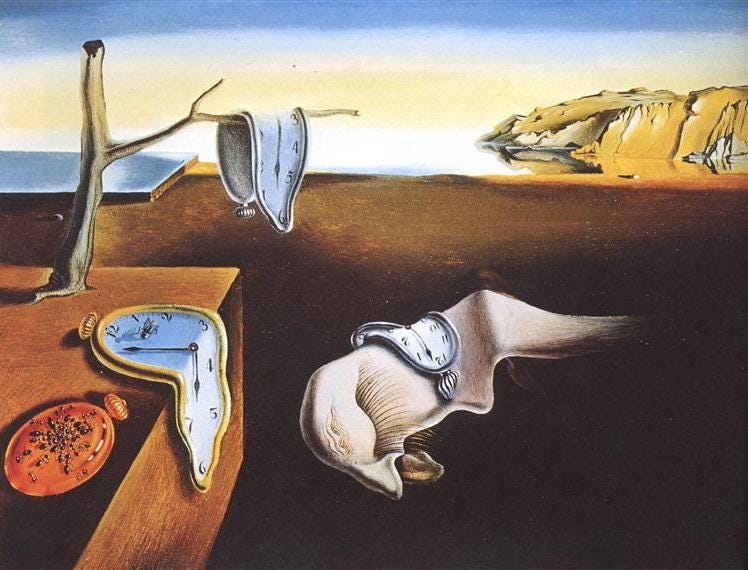
Time is an ideality. If it did not exist, it would be necessary to create it. Nothing strikes the mind quite so vociferously as time. We are roused by the thought of it, for in it we perceive our life, and through it we consider our existence. From the standpoint of time, all is static and ever-present. It makes no difference to it whether we recognize it or not. For us, it is the all-seeing spectator who watches our every move and examines our every development. There is no jeer or cheer from its perspective on any of our accomplishments, however, for it cares nothing for anything but the continuous procession of itself.
All our actions are done in space and pass away with time. Without space, there would be no extension, and thus no entities by which to occupy all that emptiness. Without time, causality—as David Hume suggested—would simply be an illusion; it’s only with the concept of change that time has any comprehensibility at all. What would it be to exist in a universe without time? For me, that’s not a coherent thought experiment. To suggest a universe without time is already to place it under a category within time. You see, we still think in terms of time—that thing, concept, idea, intuition, or representation which is ever fleeting, ever passing, continuously moving, without the slightest concern for those who experience her. Cicero says, “There is nothing so absurd that some philosopher has not already said it.” And philosophers throughout history have said some of the most absurd things about time. It almost seems like a law of nature in thought that the more abstract a concept is, the more insane man becomes in attempting to comprehend it. Many men have tried to imagine worlds in which perception as such was nonexistent, and so they’ve made themselves contemptible and utterly ridiculous in attempting the impossible: to square a circle, goes the old saying—but that is a mathematical claim which did, although thousands of years after it was stated, get proven as impossible with compass and straightedge. Time has no such novelty, for time is not subject to axiomatization; to it, our attempts at comprehending its nature by placing it within the realm of axioms are laughable.
Has anyone ever tried to make time an analytical proposition—that is, a presupposition that adds no further predicate to its original subject definition? No, and for good reason. Time is known, at least according to the paradigm laid out by Kant, prior to experience, but is only felt, and therefore understood, within experience. What we have in time, like space, is an aspect of reality which is prior to consciousness and is therefore understood in reason as eternal and infinite, but which is felt in the senses as mortal and finite. From this seemingly paradoxical basis—upon which all our world lies—men have striven with all their might to rectify this contradiction by thinking time a category about which they can reason through in a thorough manner and come to a sound conclusion at the end of it. They fail to see that time is not a category of reason: it is prior to it! The basis of all our perceptions leaps from its foundations. To reiterate, nearly every man prior to Kant thought the best approach to time was to conceptualize it and to categorize it within silly labels or foolish presuppositions, as if that got man closer to the true nature of it. But time has no qualms evading comprehension. Every idea we have about it, in fact, is merely a vain attempt to bring it to a finite level. Kant was merely the first to recognize its superiority to us and its “necessary” status—as a thing upon which all cogitations rest, and without which they fall into the arms of incomprehensibility. Time cannot be analytic because the definitions man gives it are as vain as throwing water into an ocean. Time can only ever be known in experience: in the maturity of all living things, in the passing away of ocean tides, in the shortness and futility of organic life, in the movement of entire continents, and in the evolution of species through natural selection.
And to think Einstein made time a dimension! If general relativity made space an objective phenomenon rather than an intuition, then special relativity did the same for time. What is best in Einstein’s relativity theories is precisely that they’re relative, which leaves open a small crevice for us dialecticians to create a giant chasm within the framework as such—but more on this in a bit. Well before Einstein, there was a debate between Newton and Leibniz about the nature of space. Newton held that space was absolute and object-independent (today called absolutism), which means that it remains a permanent fixture of reality regardless of whether it is occupied by physical bodies or remains entirely void—space, in that sense, is a container which holds things but is itself not held in anything. Leibniz, on the other hand, held that space was relational (today called relationalism), which means that space does not exist as an independent entity but instead that “space” is simply the name we give to the spatial relationships between objects. In the realm of science, Newton won out, while in the realm of philosophy, Leibniz did—and so it was for centuries. It wasn’t until Einstein, however, improving upon the generally accepted local Newtonian inertial frame, that we found a harmony of sorts between the observer’s relation to the thing being viewed within the frame (Leibniz’s relationalism) and the acceleration of the frame which the observer finds themselves in (Newton’s absolutism). What became the new “absolute” wasn’t space itself, but the acceleration of the observer within the frame of reference itself—this being the speed of light, which is constant in the universe for all observers.
While Newton envisioned the universe as a rigid stage where space and time functioned as two independent, absolute tracks, Einstein revolutionized this “container” model by establishing the speed of light as the only true cosmic constant. In the Newtonian world, an observer’s velocity relative to absolute space should theoretically alter their measurement of light’s speed; yet Einstein countered that because light remains invariant for all observers, it is space and time themselves that must fluidly warp and stretch to compensate. This shift effectively fused these once-distinct dimensions into a single, four-dimensional fabric known as spacetime, where the “interval” between events replaces the “box” of absolute space. Consequently, in special relativity, we no longer inhabit a static receptacle; rather, we occupy a position within a relational spacetime interval—a deeply Leibnizian concept where reality is defined by the dynamic relationships between events rather than a pre-existing vacuum. Inspired by Leibniz, Kant posited that space and time function not as external realities or mere logical relations, but as synthetic a priori intuitions—essentially the cognitive “software” that pre-structures all human experience. In this framework, Euclidean geometry was seen as a universal necessity of our mental architecture, rendering it impossible for the mind to even conceive of a world where parallel lines meet or triangles deviate from 180 degrees. However, Einstein’s general relativity shattered this assumption by demonstrating that space is inherently non-Euclidean, acting as a malleable fabric that curves and warps in the presence of mass. This revelation suggests that while Kant may have correctly identified the flat, three-dimensional constraints of our sensory “interface,” he underestimated the power of pure reason to transcend those biological limits. By utilizing non-Euclidean mathematics, we can conceptually navigate a universe far more complex than the internal intuitions of our evolved minds were ever designed to visualize.
And so this relativity stands: where the phenomenal world makes sense in the manner Kant laid out for us (in the classical sense), but where Einstein refined our understanding of perception for things that are beyond our everyday intuitions—beyond the human, where things are much more massive or much faster than we are. In this relational, subjective aspect of reality, we dialecticians are all-too-happy to exclaim that the noumenal aspect of the world has yet to be found, and thus philosophy lives! Where there is doubt, there is always life in philosophy, for de omnibus dubitandum, et omnia sunt in omnibus modo suo [everything is to be doubted, and all things are in all things in their own way]. The first sentence in Aristotle’s Metaphysics is Πάντες ἄνθρωποι τοῦ εἰδέναι ὀρέγονται φύσει [All men by nature desire to know]. And later in the same book he says, διὰ γὰρ τὸ θαυμάζειν οἱ ἄνθρωποι καὶ νῦν καὶ τὸ πρῶτον ἤρξαντο φιλοσοφεῖν [For it is owing to their wonder that men both now begin and at first began to philosophize]. So one sees from its inception that we philosophers still have a place within the world. We shall always have a place to rest our feet in the realm of thinking so long as what man thinks continues to be a mystery to him, and yet amazes him nonetheless. And I am of the view that time, along with space, will forever be one of those things that cause θαυμάζειν—that is, wonder.
But now, let me take time from a dialectically existential perspective. Time is a subject that has no predicate; therefore, any attempts at attributing it an aspect, or some feeble characteristic, fall flat from the start. Like space, time is prior to us, and yet we exist within it. Indeed, our existence is predicated on it. Without it, there would be no aspect of change in reality. Causality—the experience of some effect by a known cause—is that by which our entire existence makes sense. What one considers in the passing away of an experience is just that which exists in causality.
I believe man has to accept the simple fact that there are things which are above him, and yet which he can never fully encompass. What is man’s life in the context of time but a prolonged moment in the sun that, in the end, amounts to very little? It is precisely those things which lie above man that make his rather shallow and all-too-short existence tolerable. If everyone had a full understanding of themselves, folly and tomfoolery would not exist in the world. What we have on Earth today is about eight billion knaves and wretches who seek every second some new novelty or joyous experience to distract them from the emptiness of their own existence. Man’s self-awareness would be enough to content him—and stave off any troubling thought relating to the existential—if he were a competent thinker; but to desire everyone to kindle their inner Socrates is to demand the impossible, for most are too absorbed in the immediate, the finite, worried about practical considerations that a man of action would toss to the side if it meant he could pursue that which was most important to him.
Life to most is a burden because their desires are far in excess of their powers or means, be they physical, mental, or financial. Gagner sa vie, sans pour autant en faire toute sa vie [To earn one’s life, without however making all of one’s life out of it], say the French. And what a wise saying it is, for most people labor endlessly after their vain conceptions of what a good life is without first considering it in the negative. In developing a way of life, for most people anyway, everything is seen through a positive lens, and it is only the constraints of reality which force man to humble himself before his wretched, actually lived existence. It is for that reason I find life so exciting: I love seeing every earthly misery rightly fall upon those too afraid to die for what they believe in. Death is feared only because one does not know what lies at the end of it. I’m almost certain that if science proved beyond a shadow of a doubt that there was life after death, we’d see millions upon millions willing to off themselves from this accursed place to find greater repose in that Hinterwelt (other-world), where the pastures are much greener and the water a lot more blue, where the air is clearer and the sun more glorious.
Life is first a joy and then a tragedy. What makes it a joy at first is our initial ignorance toward all its depravities and misfortunes, which are an ever-present danger, and which hang over the entire human race like some sword of Damocles. Once the tragedy is sung, and the rest is just a monotonous chorus of ever-decreasing octaves, life appears as a task, an occupation, a demoralizing job, and remains so until the end—one of endless toil, crushed hopes, and idiotic dreams which are never to see the light of day. I don’t suspect anything in the whole universe could be more depressing than that: the fact that life is but a brief ride which we all know is bound to end, but which we must reluctantly stay on nonetheless. When presented as such, it’s no wonder, then, the only conclusion is suicide or a feckless nihilism dressed up in absurdist language. Hence why I live my life as an indifferentist: one who looks upon the whole machinations of the world with complete and utter nonchalance. I have always considered life a silly thing to worry about. If it has a definite beginning and end, why should one bother with how the in-between manifests itself? However, for me, viewing life indifferently made it intolerable: I am of a mental temperament that requires me to act, to objectify life—to act in life for the sake of extracting whatever good I could from however bad the situation I find myself in is. I swear to you, reader, I would have put an end to my vain existence had it not been for my desire to continuously seek good within evil. I have always been encouraged to overcome and outdo whatever misery I found in front of me. Eventually, I got so good at doing that that I could effortlessly endure what most could not. I played with my own existence, experimented even (with my life), as if life were some kind of game; I saw myself, and still do to some extent, as merely a soul inhabiting a wretched vessel from which I will soon be liberated. It helps to detach your ego from your misery. Misery is a byproduct of the ego. The ego performs an evaluative judgment, and that judgment seemingly determines how we are to respond when presented with that situation; it’s a very stupid thing we humans do, relying on our old, instinctual habits—habits which were once useful but now are redundant and a cause of much of our misery in the modern era.
I overcame life in and through time, in fact using time to my leverage. I no longer viewed life as meaningless, but rather as a reality larger than the universe itself, from which I can create for myself some good in spite of every evil. I transcended the norms and common ways of thinking by seeing that everything which we use and grant without question for the sake of making the world “true” was itself meaningless and really without importance. In finding everything meaningless, I was able to find meaning; because, once one no longer feels bound to consistency and coherence, every potential in life suddenly appears that much more actualizable. This is where my dialectics ultimately had its birth: it was in attempting to reconcile my past paradigms of life, and the role rationality played in it, with this newfound desire to act only upon things in an irrational manner—things which only quicken my activity, and which have importance in my life both in the immediate and futurative sense. To quicken activity? Yes! A way of making sense of experience in order to feel enlivened at the thought of living, of desiring more life—more than was possible to experience, in fact. Ah, what a great goal, a noble goal, far beyond what the typical preferences for life are today.
It’s more preferable to have that which took a great deal of effort to acquire than that which was easily obtained, and yet how few actually make an effort to achieve anything great today. Most people would let existence pass them by if they could live without having to labor for it. But these people don’t realize that existence itself is a great labor—the greatest, in fact—and one that requires the most fastidious attention possible. If one is to live a full life, one must first undergo a transformation in thinking regarding what existing means in the first place. Existence is that which is subject to the individual, and from which life itself derives all its powers. The life of modern man is very shallow because his power is very weak: the only conception people have of it is in the immediate, the concerns of the now, the present, the so-called practical; all this and then some come to make up seven-eighths of an entire life, and how shameful is that. Where power is lacking, there is no passion, and where there is no passion, there is no serious commitment to anything aside from that which is immediate. What the individual must do in order to overcome time, and their life within it, is to see time as a sort of sieve which removes all impurities from your life, and from which you can build a sturdy foundation after reflection has been made. “But reflect on what?” you say earnestly. “On life itself. You cannot take action until the right action has been hit upon in all your contemplating.” “But how will I know the right action?” “You won’t, but such is the absurdity of life. No one does. The continuous malaise which hangs over existence like a specter is precisely that which we feel but cannot know until we’ve given ourselves over to it, and take the leap into the unknown in spite of it.”
Life is short, art long, and existence painful; but while we still breathe, let us praise time for relieving us of our every burden without lifting a finger! In due time, all is revealed, all wounds are healed, and all things come and go and have their own manner of existing; and in that, the whole of material reality comes to us and in us and lives through us. Such is why all things have their due: for due implies will in the future, that something will occur to us on account of its inevitability; when that is we know not, but it will occur nonetheless. That is all time can be. And while we have it, let it be the best we can make of it.