
Tyranny
76th installment to my philosophical system.

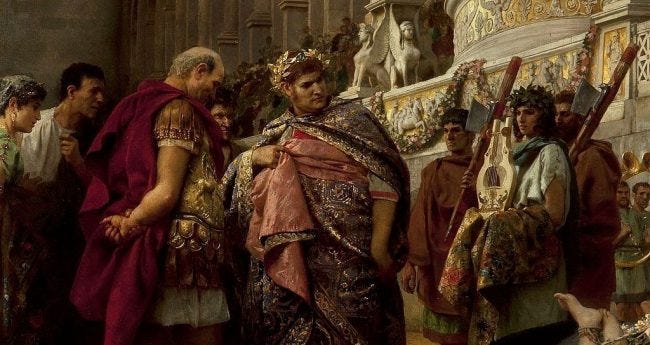
Man constantly finds himself faced against a tyranny, both from within and from without. What a man’s life consists of in the main is discovering for himself just how impregnable his own reality is, how indescribably complicated his existence is, and how incapable he is of making clarity within it.
All our days are spent in sleep, labor, and sloth—and this is very telling, for what it shows is that if we look at life in its threefold aspect, we will find that man is in one of three situations: unaware of life (sleeping)—cosplaying death, if you will—, working for life—laboring for his basic necessities—, or distracted by life—using his leisure time in the most unproductive manner possible.
Whichever poison a man picks, he will regret it: for in sleep you do not live, and thus miss out on the opportunity of experience itself; if you work you are not free to pursue your real interests—those activities which are more morally and spiritually uplifting—and thus atrophy your mind deliberately for the sake of conforming more readily to your work environment; and in your free time—where your time is actually yours—you have no real idea of what you want, because you’ve never asked yourself that thanks to the constant responsibilities life places on you for the sake of your survival, and so you resort to what is easiest to enjoy and hardest to overcome with diligence, and thus remain forever fastened to that slothful, ignorant, barbaric, unhelpful, totally useless line of pleasure which is called entertainment—as if anything shown on television or our phones were as compelling, interesting, or important as the activity that goes on inside our own minds.
I could never understand the impulse to endure what is intolerable. What habits of mind must one adopt for the sake of making injustice seem like a reasonable thing? As far as I see it, the sickening moral injunction of doing to others what you would like done to yourself only applies to those who know their power is great enough to not have to suffer on behalf of another’s insincerity. It has always been the case with man that the strong do what they wish and the weak suffer what they must; nobody in history has ever been able to transcend that maxim of Thucydides, for so long as man performs his life through action and force, he will forever be subject to power as the fundamental lynchpin which holds together his whole humanity as such.
Man is a moral creature first and foremost, and so the drives which he adopts are always with respect to his dominating passions, and hence subject to power. Power rules all, and those who do not wish to be subject to it ought to either place a yoke on their own desires or become master of their own drives to such an extent that no power can sway what their main impulse is. The powerful man doesn’t fear the power of another, and indeed thinks less of those who feel the need to constrain their power out of their own life-denying impulse—those who humble themselves before the world as if it were a living being. The forces of nature only matter to the extent that they influence our impulses, but like with everything else, the power of man is such that he can emancipate himself from all forms of tyranny.
Tyranny is, after all, nothing but the external and internal restraints which are placed upon our power. Power is the prime mover of all things, and so what is willed by man is commanded by the impulses, motivated by the drives, and performed through our will—a powerful will which transmutes abstractions into actions. The goal of life is the fulfilling of a goal which is forever needing to be accomplished again and again. Our passion is like a bucket with a small hole at the bottom which, so long as we fill it, will hold all the passion we put in it; but the longer we wait, the more passion we lose, and thus the death of all drive and ambition, the weakening of our power, and the eventual death of our very souls. This is the very tyranny we place upon ourselves so long as we live: endlessly striving, forever fulfilling and replacing passions with newer and newer drives of ambition, accomplished through power and made subject to the laws of motivation and inspiration. Power plays its own games with us, and we merely come out the end of it wondering if the present we suffer now can be made more glorious in the future.
Man tyrannizes himself with his own life. On account of all he wishes to do and achieve, he makes passion the sole drive of all things, gives in to his powerful impulses, overcomes his drives, and ends up burning himself out on his own successes. Even power cannot overcome itself, for the second it does it has a new impulse which it feels the need to overcome, that overcoming being itself; power wishes to overcome itself, and so life is caught in the crossfire of every ambition and every passion, and is made hostage to its own ability to exercise itself.
The restraints which man places on himself are more deleterious to him than the ones from outside him. Anything that limits a man’s capacity to act is, in effect, attempting to limit his expression of power, and in doing this preventing his action of any kind. This is harmful to him in the long run, for if he cannot act he cannot live, and so consigns himself to a wretched stasis, a motionless activity of pure contemplation—contemplation for its own sake, which only reveals his inner depths, if that, but never reveals the world as he sees it overall. Every man takes the limit of his sight to be the end of the world, and as such comes away from life with a very narrow view of it. Only those who have ventured out and seen the character of man as it is truly born in the world can claim to have seen it.
The person easiest to fool regarding existence is the self, and as a result it is necessary to always have a cautious aspect whenever viewing anything, for so long as man believes himself to be in control he will forever fall prey to false assumptions and vain conjectures that get him nowhere in the actual analysis of his soul. It can never be forgotten that man tyrannizes himself just as much as the world does.
A perspectival eye—a vision for beholding many lives—is necessary if you wish to move through the world with any semblance of consistency; for the constant interactions which life makes demand of you to fulfill will never become any easier the longer you put off seeing the world through eyes not your own. The most harrowing aspect of life is that it cannot be lived singularly in any true fashion, not anymore anyway; there’s too much dependency upon all that have come before—that endless chain of causation and contingency—to make any Thoreauvian life actually plausible. While self-reliance is a great ideal to live up to, and a great philosophical outlook for those who either despise the world or do not find themselves in it, it’s simply too difficult to live genuinely without falling into a kind of deliberate degeneracy of the human spirit.
The world is too much with man, and while it’s possible to live frugally and contentedly with only the necessities, it cannot be done without great personal sacrifice, not to mention the supreme loneliness that comes with living such a life—a life most are simply too far gone to truly understand. So much, in fact, has the world capitulated itself to capital that people cannot separate their identities from their productivity or material status. It’s the greatest tyranny which capitalism has pulled over the eyes of the majority—to make life resemble a busy airport terminal, constantly buzzing with life, movement, and lethargic eyes, annoyed faces, and tired expressions. My contempt for every value held in high esteem today knows no bounds. My anger towards everything is truly frightening, actually. I cannot help but make use of it, however, for I always find a way to add my subjectivity into whatever I see, and in such a fashion that leaves most awestruck by the honesty of it all.
Tyranny knows how to bend every value to its whim, and in doing this is really the most dominant form of manipulation mankind has ever devised. In its substance, tyranny makes all other values subordinate to a single value: order. Order has been seen as an implicit good in all forms of government, but none have ever been able to make it a consistent aspect without extreme authoritarian measures. Whether anyone can claim to have order in their own life, let alone in the government, is a stretch, for even the most consistent people have lapses in judgment or unexpected events come up which totally change how they are to approach life.
Tyranny is a violence to man insofar as it limits what is possible within his range of actions. If a man cannot act as he wishes, he does so either out of deference to the mores of his times, or rejects his own strong impulses for the sake of appearing like everyone else—a nonsensical love of inaction justified out of fear and reproduced via sloth. Man’s own tyranny is the one loved most by him, and for that reason is the most dangerous to him, for it’s very easy to justify old habits by making them appear moral. That labeling of morality, which is ascribed for appearances, eases the mind’s inability to grasp the unknowability of a habit by making it seem as if it were simply always done that way.
In that sense, the greatest tyranny of man is his moral impulses; though he would like to will them into action through an exertion of his power, he lacks the mental fortitude to withstand the power of his own impulses. Thus, he does everything he can to weaken himself, and in that way limits what he can do to only that which is not too straining on him. The tyranny of impulses shall always make itself felt in man so long as he feels disconnected from his power. If in any way he is unable to perform an action, it is always the result of a cowardice of some kind, or from the action itself being far beyond his powers to perform.
Ambition too has a role to play here, for often when a man attempts something beyond what he is capable of, it is solely from ambition that he overestimates his power in the first place. A man with too much power almost never acts with any consistency, for he sees too many things which he’s capable of doing, and thus divides his power across many ambitions, accomplishing none of them as a result. I tend to remember a few presidents who have felt the same, and as a result ended their terms doing nothing at all.
Charismatic leaders, in the context of government, are often responsible for rubber-stamping policies that can be seen as tyrannous. But it should be noted here: of all governments, tyranny is the shortest-lived, for tyrannical power wielded uncouthly often proves detrimental to all subjects. As a result, discontent and disaffection swell, and the leader, seeing this among his subjects, only furthers his megalomania, almost always ending with him overthrown or killed. The fate of all ambitious men is one of eventual collapse and failure, for they attempt what is beyond their power. The disavowal of their own tyranny (a restraining of their impulses) is actually what causes their downfall.
Tyranny must be seen from both directions at the same time, which is what makes it so hard to comprehend properly: you have to simultaneously limit yourself and overcome yourself—you must know when to act and when not to. Whichever action you choose is selected for you by your drives, but those same drives must be overridden when the action proves too much for your power. A wise man very rarely finds himself under the spell of his own tyranny, and this is because he knows his own drives intimately and has a strong enough command of his environment to know which impulses will arise within them in order not to fear them.
Often it is under the tyranny of another that a man finds himself subjected, but God forbid this same man places a yoke on himself—what then will he do? It is an unequivocal fact that most men do not know what they’ll do, and this is because they have never considered themselves worthy enough to think for themselves on any matter touching on life. As a result, they have a mind so constituted as to allow the “necessities” of modernity to take hold of them and never allow them the clarity of mind or the integrity of spirit to truly determine for themselves what is important. This is a modern practicality which for the individual is existentially suicidal; it’s nothing more than a type of pragmatism for the modern world, which deep down is a self-justifying tyranny which weakens the individual impulse and thus cuts short all potentially powerful drives and actions.
Man is not himself so long as he cannot act as he will, which is to say, act for the good of himself and those around him—all this stemming from his self-imposed repression, a vexing restraint which turns his every drive against himself. There is nothing noble in any of it, and yet man finds it easier to obey than to act on his own will—not like any of his drives were powerful enough to bring about something miraculous anyway, but the point still remains: man tyrannizes himself with his own life-denying impulse, the repression of his own feelings on matters concerning him and him alone for the sake of some drab consistency, a boring regularity, a totally worthless morality that values that which is weak specifically because it is weak.
When will the age come when man is not only himself but also a gentleman of the world? I suspect that day shall never come so long as man is made subject to repetition and rotation after rotation of the same sickening drives—the same morality, the same impulse to be nothing but what the world around him molds him to be.
Has there ever been a prodigy of benevolence for humanity? Perhaps Jesus Christ. But when will we all move past our Lord and Savior? When will we accept the fact that he died and is never returning? I suspect that will never come so long as we consider it a duty to accept him into our hearts rather than accepting ourselves into our own hearts.
The long tyranny of Christian morality has hung over us for over two thousand years, and this sickly recluse of a moral system has infected every facet of our thinking regarding the impulses, regarding power, regarding the things necessary to live. A man cannot free himself from the oppressive tyranny of a “popular” (herd-like) morality when everything that is powerful for him is viewed negatively against him and turned violently against him by the benign influence of social pressure—conformity made mandatory, designed to be virulently anti-life, and yet presented to him as a form of liberation.
It is coaxed in kindness in order to avoid seeing how violent it truly is against the self. Christianity has always been against the self, for it’s a fundamentally ascetic religion. As a result, it has some good precepts—though in no way unique—regarding how to treat others, but some of the most revolting suggestions about how to live personally in this world.
Jesus won by accident. In truth, if it wasn’t for Rome adopting it as the official religion in 380 CE—along with the message of Christianity being very accommodating and inspiring for the weak and downtrodden (which has always been the majority of mankind)—Christianity would be just another sect of Judaism, probably no bigger than what Zoroastrianism is today.
So long as man views himself as weak and in need of saving, Christianity will never die—for, in all honesty, its message is so seductive and so universal in its outlook, combined with being an extremely easy religion to adopt, that it will always serve as a moral rock by which the herd attach their chains. It is, in that sense, the greatest tyranny of all time, for it transcends the typical tyranny of a king or despot over his people by making the people tyrannize themselves.
It lures them in with the words of Jesus and the glorious life to come hereafter, but it never mentions all the talk of humility and denying this world for the sake of the one after. Every moral feeling today is almost always a reaction against or an affirmation of Christianity, making it, again, the most successful reevaluation of values in history.
But I feel it has run its course, and it’s time for humanity to embrace a new ethos, a new moral tyranny—a tyranny even greater than Christianity, for this new tyranny will be life-affirming and more honest than Jesus ever was.
Quotes for the reader on Tyranny from great minds throughout history:
ATHENIAN: When a man has health and wealth and a tyranny which lasts, and when he is pre-eminent in strength and courage, and has the gift of immortality, and none of the so-called evils which counter-balance these goods, but only the injustice and insolence of his own nature—of such an one you are, I suspect, unwilling to believe that he is miserable rather than happy. —Plato, Laws, Book II.
Let us then sum up in a word, I said, the character of the worst man: he is the waking reality of what we dreamed.
Most true.
And this is he who being by nature most of a tyrant bears rule, and the longer he lives the more of a tyrant he becomes.
That is certain, said Glaucon, taking his turn to answer.
And will not he who has been shown to be the wickedest, be also the most miserable? and he who has tyrannized longest and most, most continually and truly miserable; although this may not be the opinion of men in general?
Yes, he said, inevitably.
And must not the tyrannical man be like the tyrannical State, and the democratical man like the democratical State; and the same of the others?
Certainly.
And as State is to State in virtue and happiness, so is man in relation to man?
To be sure.
Then comparing our original city, which was under a king, and the city which is under a tyrant, how do they stand as to virtue?
They are the opposite extremes, he said, for one is the very best and the other is the very worst. —Plato, Republic, Book XI.
Now the corruptions attending each of these governments are these; a kingdom may degenerate into a tyranny, an aristocracy into an oligarchy, and a state into a democracy. Now a tyranny is a monarchy where the good of one man only is the object of government, an oligarchy considers only the rich, and a democracy only the poor; but neither of them have a common good in view. —Aristotle, Politics.
Probably what we have said may be true of some persons, but not of others; for some men are by nature formed to be under the government of a master; others, of a king; others, to be the citizens of a free state, just and useful; but a tyranny is not according to nature, nor the other perverted forms of government; for they are contrary to it. But it is evident from what has been said, that among equals it is neither advantageous nor [1288a] right that one person should be lord over all where there are no established laws, but his will is the law; or where there are; nor is it right that one who is good should have it over those who are good; or one who is not good over those who are not good; nor one who is superior to the rest in worth, except in a particular manner, which shall be described, though indeed it has been already mentioned. —Ibid.
Indeed an oligarchy and a tyranny are of all governments of the shortest duration. The tyranny of Orthagoras and his family at Sicyon, it is true, continued longer than any other: the reason for which was, that they used their power with moderation, and were in many particulars obedient to the laws; and, as Clisthenes was an able general, he never fell into contempt, and by the care he took that in many particulars his government should be popular. He is reported also to have presented a person with a crown who adjudged the victory to another; and some say that it is the statue of that judge which is placed in the forum. —Ibid.
A kingdom and a tyranny were, he opined, both of them forms of government, but forms which differed from one another, in his belief; a kingdom was a government over willing men in accordance with civil law, whereas a tyranny implied the government over unwilling subjects not according to law, but so as to suit the whims and wishes of the ruler.
There were, moreover, three forms of citizenship or polity; in the case where the magistrates were appointed from those who discharged the obligations prescribed by law, he held the polity to be an aristocracy (or rule of the best); (38) where the title to office depended on rateable property, it was a plutocracy (or rule of wealth); and lastly, where all the citizens without distinction held the reins of office, that was a democracy (or rule of the people). —Xenophon, The Memorabilia.
First: To cause the ruin of specially capable persons, even of a brother, is a tyrannical act. This is true unless it be for a just cause, as, for example, in the case of Romulus and Remus. For who can doubt that if any powerful person in a city creates disturbance or sedition he ought to be banished by any just judge? If then the cause be a just one the act is not that of a tyrant. Second, the same rule applies to the ruining of wise men, if the cause be just. Third, the destruction of study and education: I understand this to apply to such pursuits as are suited to the [given] community. If, however, a ruler breaks up such pursuits as are not adapted to the community, this is not the act of a tyrant. Fourth, that assemblies, even lawful ones, are not permitted: If an offence is once committed by them it is certainly right to dissolve them; for I have known persons to come together under a pretense of religion and straightway to throw the town into confusion. We must, therefore, judge by the kind of persons assembled whether it is the act of a tyrant to break up a lawful assembly. Fifth, the keeping of informers in a city: This may be the act of a just ruler if it be done for a lawful purpose. A good ruler may employ informers to punish crimes and other offences in the community; but a tyrant uses them against those who may injure his own position and therefore his act concerns only his own advantage. Sixth, that the tyrant strives to foment divisions in the city: This is a tyrannical act, seeing that it is a primary duty of a just ruler to keep the peace among the citizens. Seventh, deliberately keeping the people in poverty is plainly an act of tyranny; for the good ruler cannot properly take anything for himself nor afflict his subjects with burdens upon either their persons or their property. Eighth, that incitement to civil war is in itself (simplicite) a tyrannical act: Sometimes a civil war may be a just war, but an unjust war is an act of tyranny pure and simple. Ninth, maintaining a bodyguard of non-citizens may be a just measure; for a people may be so uncontrollable and so obstinate that the ruler, just though he be, cannot rely upon them. This is especially apt to occur in a newly recovered territory, even under a just master. For this reason emperors sometimes drove out the inhabitants of a city and settled them elsewhere.
All the above, then, are indications whereby a tyranny can be proved, and especially these two: the promoting of divisions in the community and the impoverishment of citizens and abusing them in their persons or in their property. All this has been abundantly shown in the preceding chapters. From what has there been said it is evident what a tyranny is. —Bartolus of Sassoferrato, On Tyranny, Ch 8.
§43. For this reason we must take into account that, just as an individual is seldom found who is free from all bodily defect, so it is a rare thing to find a government which is wholly devoted to the common good without any admixture of tyranny. It would be a divine rather than a human condition of things if rulers had no regard for their own interest and cared solely for the common (§44) welfare. We call that a good government and not a tyranny in which the common good prevails over the private interest of the rulers. This is laid down by Aegidius Romanus in his de regimine principum, 1. iii, c. 11, 2 7 and it ought specially to be borne in mind when we are considering how to prove whether a certain person is a tyrant. —Ibid., Ch 12.
Now, to come to the definition of a tyrant, I propose a text from St. Gregory, who, in the twelfth book of his commentary upon Job, expounding these words: “and the number of the years of his tyranny is uncertain” (Job, xv, 20) defines with divine accuracy not only the tyrant but also the various types of tyrant. He says: “Properly speaking a tyrant is one who rules a state without the forms of law [non jure], and then adds “but everyone who rules superbe [autocratically] exercises a tyranny of his own sort. Sometimes a person may practice this in a state through an office which he has received, another in a province, another in a city, another in his own house, and another through concealed malignity, within his own heart. God does not ask how much evil a man does, but how much he would like to do. If outward power be lacking he is a tyrant at heart whose inner viciousness governs him; for, although he cannot injure his neighbors outwardly he inwardly desires to have the power to injure them.” So far Gregory. —Coluccio Salutati, On the Tyrant, Ch 1.
It has thus, I think, been sufficiently demonstrated, that anyone who sets up a tyranny may lawfully be resisted, not merely by a party of the people, but by an individual, and that such a monster may be put down by force, even to the point of murder. And this not only at the beginning of his tyranny, but afterward, even though time has elapsed in which the forces needed to repel the tyrant may have been collected at his expense. This principle is most learnedly laid down by Ulpian in reference to private cases. He says: “It is lawful not only to resist in defence of one’s property, but, even if one be ejected therefrom, to eject the intruder, not after an interval but on the spot [ex continenti],” that is before he can turn to other matters. For Neratius interprets a “continuous action” as one in which some period of time [mo(vi)mentum naturae] may intervene. We have it also on the authority of Ulpian that, since it is lawful for a father, if he detects a daughter who is under his potestas in adultery in a house inhabited by him or by his son-in-law, to slay her on the spot [in continenti], he shall be held to have killed her on the spot even though some hours shall have intervened while she was being pursued and caught. Therefore it must be lawful to rise up against a usurper of civil power, and this not only at the moment of the usurpation but by continuous action and with preparations made, to go against him with armed forces. —Ibid., Ch 2.
But, presently, when sovereignty grew to be hereditary and no longer elective, hereditary sovereigns began to degenerate from their ancestors, and, quitting worthy courses, took up the notion that princes had nothing to do but to surpass the rest of the world in sumptuous display and wantonness, and whatever else ministers to pleasure so that the prince coming to be hated, and therefore to feel fear, and passing from fear to infliction of injuries, a tyranny soon sprang up. Forthwith there began movements to overthrow the prince, and plots and conspiracies against him undertaken not by those who were weak, or afraid for themselves, but by such as being conspicuous for their birth, courage, wealth, and station, could not tolerate the shameful life of the tyrant. The multitude, following the lead of these powerful men, took up arms against the prince and, he being got rid of, obeyed these others as their liberators; who, on their part, holding in hatred the name of sole ruler, formed themselves into a government and at first, while the recollection of past tyranny was still fresh, observed the laws they themselves made, and postponing personal advantage to the common welfare, administered affairs both publicly and privately with the utmost diligence and zeal. But this government passing, afterwards, to their descendants who, never having been taught in the school of Adversity, knew nothing of the vicissitudes of Fortune, these not choosing to rest content with mere civil equality, but abandoning themselves to avarice, ambition, and lust, converted, without respect to civil rights what had been a government of the best into a government of the few; and so very soon met with the same fate as the tyrant. —Niccolò Machiavelli, Discourses on the First Decade of Titus Livius.
Of all who are praised they are praised the most, who are the authors and founders of religions. After whom come the founders of kingdoms and commonwealths. Next to these, they have the greatest name who as commanders of armies have added to their own dominions or those of their country. After these, again, are ranked men of letters, who being of various shades of merit are celebrated each in his degree. To all others, whose number is infinite, is ascribed that measure of praise to which his profession or occupation entitles him. And, conversely, all who contribute to the overthrow of religion, or to the ruin of kingdoms and commonwealths, all who are foes to letters and to the arts which confer honour and benefit on the human race (among whom I reckon the impious, the cruel, the ignorant, the indolent, the base and the worthless), are held in infamy and detestation.
No one, whether he be wise or foolish, bad or good, if asked to choose between these two kinds of men, will ever be found to withhold praise from what deserves praise, or blame from what is to be blamed. And yet almost all, deceived by a false good and a false glory, allow themselves either ignorantly or wilfully to follow in the footsteps such as deserve blame rather than praise; and, have it in their power to establish, to their lasting renown, a commonwealth or kingdom, turn aside to create a tyranny without a thought how much they thereby lose in name, fame, security, tranquility, and peace of mind; and into how much infamy, scorn, danger, and disquiet they run. But were they to read history, and turn to profit the lessons of the past, it seems impossible that those living in a republic as private citizens, should not prefer, in their native city, to play the part of Scipio rather of Cæsar; or that those who by good fortune or merit have risen to be rulers, should not seek rather to resemble Agesilaus, Timoleon, and Dion, than to Nabis, Phalaris and Dionysius; since they would see how the latter are loaded with infamy, while the former have been extolled beyond bounds. —Ibid.
That a tyranny is not a diverse state from a legitimate monarchy.
But men, by reason of their passions, will very hardly be persuaded that a kingdom and tyranny are not diverse kinds of cities; who though they would rather have the city subject to one than many, yet do they not believe it to be well governed unless it accord with their judgments. But we must discover by reason, and not by passion, what the difference is between a king and a tyrant. But first, they differ not in this, that a tyrant hath the greater power; for greater than the supreme cannot be granted; nor in this, that one hath a limited power, the other not; for he whose authority is limited, is no king, but his subject that limits him. Lastly, neither differ they in their manner of acquisition; for if in a democratical or aristocratical government some one citizen 95should, by force, possess himself of the supreme power, if he gain the consent of all the citizens, he becomes a legitimate monarch; if not, he is an enemy, not a tyrant. They differ therefore in the sole exercise of their command, insomuch as he is said to be a king who governs well, and he a tyrant that doth otherwise. The case therefore is brought to this pass; that a king, legitimately constituted in his government, if he seem to his subjects to rule well and to their liking, they afford him the appellation of a king; if not, they count him a tyrant. Wherefore we see a kingdom and tyranny are not diverse forms of government, but one and the self-same monarch hath the name of a king given him in point of honour and reverence to him, and of a tyrant in way of contumely and reproach. But what we frequently find in books said against tyrants, took its original from Greek and Roman writers, whose government was partly democratical, and partly aristocratical, and therefore not tyrants only, but even kings were odious to them. —Thomas Hobbes, Philosophical Rudiments Concerning Government And Society.
Wherefore Lipsius and Charron, though they were far from being Timons and Manhaters, yet treated of this part of Politicks, lest their Works should have been imperfect. And the same Aristotle who never did anything uncorrect, when he wrote of Politicks and those Governments which were opposite to Monarchy, Aristocracy, and Democracy, which are Tyranny, Oligarchy and Ochlocracy, gives Precepts for the Faulty as well as the Legitimate. And in this he has been follow’d by St. Thomas Aquinas in his Commentaries; where having discommended Tyrannick Government, and dissuaded Persons from it by all the Reasons he could think of, yet nevertheless lays down Rules for the establishing of it, in case any one would be so wicked as to attempt it. And lest this should be doubted, here are his own Words to this purpose, in the Commentary upon the Fifth of the Politicks, Text the XIth, To preserve a Tyranny it is necessary to kill such Persons as excel in Power or Riches, because they by means of their Authority may be able to rise against the Tyrant. —Gabriel Naudé, Political Considerations upon Refin’d Politicks, and the Master-Strokes of State. CHAP. I, pg. 23-24.
There is another reason of no less importance to those nations, who tho they think fit to have kings, yet desire to preserve their liberty, which obliges them to set limits to the glory, power and riches of their kings; and that is, that they can no otherwise be kept within the rules of the law. Men are naturally propense to corruption; and if he whose will and interest it is to corrupt them, be furnished with the means, he will never fail to do it. Power, honors, riches, and the pleasures that attend them, are the baits by which men are drawn to prefer a personal interest before the publick good; and the number of those who covet them is so great, that he who abounds in them will be able to gain so many to his service as shall be sufficient to subdue the rest. ’Tis hard to find a tyranny in the world that has not been introduced this way; for no man by his own strength could ever subdue a multitude; none could ever bring many to be subservient to his ill designs, but by the rewards they received or hoped. By this means Caesar accomplished his work, and overthrew the liberty of his country, and with it all that was then good in the world. They who were corrupted in their minds, desired to put all the power and riches into his hands, that he might distribute them to such as served him. And he who was nothing less than covetous in his own nature, desired riches, that he might gain followers; and by the plunder of Gaul he corrupted those that betray’d Rome to him. —Algernon Sidney, Discourses Concerning Government.
Tho Marius was rigid in his nature, and cared neither for money nor sensual pleasures, yet he favour’d those vices in others, and is said to be the first that made use of them to his advantage. Catiline was one of the lewdest men in the world, and had no other way of compassing his designs than by rendering others as bad as himself: and Caesar set up his tyranny by spreading that corruption farther than the others had been able to do; and tho he, Caligula, and some others were slain, yet the best men found it as impossible to restore liberty to the city when it was corrupted, as the worst had done to set up a tyranny whilst the integrity of their manners did continue. Men have a strange propensity to run into all manner of excesses, when plenty of means invite, and that there is no power to deter; of which the succeeding emperors took advantage, and knowing that even their subsistence depended upon it, they thought themselves obliged by interest as well as inclination to make honours and preferments the rewards of vice: and tho it be not always true in the utmost extent that all men follow the example of the king; yet it is of very great efficacy: Tho some are so good that they will not be perverted, and others so bad that they will not be corrected; yet a great number does always follow the course that is favour’d and rewarded by those that govern. —Ibid.
In the heat of the contests between the patricians and plebeians, the latter insisted upon having fixt laws, to the end that the public judgements should no longer be the effects of capricious will or arbitrary power. The senate, after a great deal of resistance, acquiesced, and decemvirs were nominated to compose those laws. It was thought proper to grant them an extraordinary power, because they were to give laws to parties whose views and interests it was almost impossible to unite. The nomination of all magistrates was suspended; and the decemvirs were chosen in the comitia sole administrators of the republic. Thus they found themselves invested with the consular and with the tribunitian power. By one, they had the privilege of assembling the senate; by the other, that of convening the people: but they assembled neither senate nor people. Ten men only of the republic had the whole legislative, the whole executive, and the whole judiciary, power. Rome saw herself enslaved by as cruel a tyranny as that of Tarquin. When Tarquin trampled on the liberty of that city, she was seized with indignation at the power he had usurped; when the decemvirs exercised every act of oppression, she was astonished at the extraordinary power she had granted.
What a strange system of tyranny! A tyranny carried on by men who had obtained the political and military power merely from their knowledge in civil affairs; and who, at that very juncture, stood in need of the courage of those citizens to protect them abroad, who so tamely submitted to domestic oppression. —Montesquieu, The Spirit of Laws, Book XI, Chapter XV.
We have been formerly stunned with the big word prerogative, by those who contend for unlimited loyalty: Men, who while they reserve to themselves a right to be the most turbulent of all subjects, would make all others the tamest and the blindest of all slaves. But what prerogative do they mean? I know no prerogative in the crown, which is not at the same time a certain privilege of the people, for their sake granted, and for their sake to be exerted: And where a prerogative is claimed in opposition to the rights and interests of the people, so far a tyranny is claimed; tyranny being nothing else but the government of one man, or of a few men, over many, against their inclination and interest: And where prerogative is exercised more to the hurt than the good of the governed, it is no longer prerogative, but violence and usurpation; and therefore in England several prerogatives have from time to time been taken from the crown, because the crown had abused them. —Cato’s Letters, Letter 36. Written by Thomas Gordon.
Machiavel tells us, that no government can long subsist, but by recurring often to its first principles; but this can never be done while men live at ease and in luxury; for then they cannot be persuaded to see distant dangers, of which they feel no part. The conjunctures proper for such reformations, are when men are awakened by misfortunes, and frighted with the approach and near view of present evils; then they will wish for remedies, and their minds are prepared to receive them, to hear reasons, and to fall into measures proposed by wise men for their security.
The great authority just quoted informs us what measures and expedients are necessary to save a state under such exigencies: He tells us, that as a tyranny cannot be established but by destroying Brutus; so a free government is not to be preserved but by destroying Brutus’s sons. —Ibid., Letter 16. Written by Thomas Gordon.
“God help the nation where self-government, in its literal sense, exists, Hugh! The term is conventional, and, properly viewed, means a government in which the source of authority is the body of the nation, and does not come from any other sovereign. When a people that has been properly educated by experience calmly selects its agents, and coolly sets to work to adopt a set of principles to form its fundamental law or constitution, the machine is on the right track, and will work well enough so long as it is kept there; but this running off, and altering the fundamental principles every time a political faction has need of recruits, is introducing tyranny in its worst form—a tyranny that is just as dangerous to real liberty as hypocrisy is to religion!” —James Fenimore Cooper, The Chainbearer; Or, The Littlepage Manuscripts.
That which happened amongst the Greeks—namely, that every great thinker who believed himself to be in possession of the absolute truth became a tyrant, so that even the mental history of the Greeks acquired that violent, hasty and dangerous character shown by their political history,—this type of event was not therewith exhausted, much that is similar has happened even in more modern times, although gradually becoming rarer and now but seldom showing the pure, naïve conscience of the Greek philosophers. For on the whole, opposition doctrines and skepticism now speak too powerfully, too loudly. The period of mental tyranny is past. It is true that in the spheres of higher culture there must always be a supremacy, but henceforth this supremacy lies in the hands of the oligarchs of the mind. In spite of local and political separation they form a cohesive society, whose members recognize and acknowledge each other, whatever public opinion and the verdicts of review and newspaper writers who influence the masses may circulate in favor of or against them. Mental superiority, which formerly divided and embittered, nowadays generally unites; how could the separate individuals assert themselves and swim through life on their own course, against all currents, if they did not see others like them living here and there under similar conditions, and grasped their hands in the struggle as much against the ochlocratic character of the half mind and half culture as against the occasional attempts to establish a tyranny with the help of the masses? Oligarchs are necessary to each other, they are each other’s best joy, they understand their signs, but each is nevertheless free, he fights and conquers in his place and perishes rather than submit. Friedrich Nietzsche, Human, All Too Human, Section Five, Aphorism 261.