
Will
91st installment to my philosophical system.

Fresh and bathed in the light of youth, I steal fifteen minutes of productive time to read Emerson, and in that, I am reborn and find that which I seek in my every creative thought. At once do all things appear no more to me than their whole infinity. I am alive again at once; returned, as it were, from my stern palace of reason, and made to love that which is real in the world.
Though a man cannot always will what he wishes, he can follow habits which he has acquired throughout his life and can give himself some sense of serenity in his thoughts: for his thoughts are no longer concerned with this particular, but rather the whole of creation.
A man’s will is only as powerful as his nature is jubilant. The will of a man commands the whole of his being; and though man, more often than not, wishes to be the master, the world subjugates him. The world is the real ruler. Nature, the God of all, which we’re surrounded by on all sides and at all times, is what man is in spirit, and which he forgets in reason.
We today take the materiality of ourselves as the only abiding principle by which to affirm, forgetting that sense of the world which appears as both. Nature is both. We may be material, but we approach the infinity of nature when we reflect on it as it is. At all times does man will to know that which he is, but for which his mind finds not the words to describe. Always do we come up short of our ideals. The world, perhaps, is too vast for our idealizations to be realized. No matter—we have spirit enough to sense nature even though our eyes should be closed to it.
It is the desire to be one with what is above that causes us to sink below. Though we sense what it is we’re after every second, we can hardly work towards it willingly and at our own discretion. Every man is a genius, but few have the fortitude to endure their temporary ignorance. Often, when lamenting the seeming loss of our tremendous powers, we think back to the past and try to replicate what it was we felt that made us perform such a creative act; but anyone who tries to systematize an intuition will fail, for the intuition was not an act of will, but rather the cause of circumstances which were beyond our powers.
This is the hardest thing for an artist to endure: the gap between creating and ruminating. We wish to always have full control of our genius, but nobody can be the master of a force that is beyond them. To wish to have at a moment’s notice the full range of our spirit is like trying to control a thunderstorm. Man is but a petal upon the rushing river of life. Often, our petals go down with the waterfalls; but, should the moment be right—when our unconscious powers are at the behest of our conscious powers—we can ascend from the banks which we dwell upon and can be lifted up by a wind of inspiration which we acknowledge and wish were eternal, but alas, must come and go with the shiftings of our spirit and the atmosphere of our minds.
Man would not be man if all things came to him as easily as breathing. That would be something different entirely. Perhaps an angel, but certainly not human. It almost seems unfair to us that we cannot, with ease, call upon that spirit which animates us. Man must always be on the lookout for inspiration; it comes to him in a variety of ways, but never with a consistent enough pattern to form a general method for its acquisition. This is, again, because the nature of man is not constant; but rather, like the sources of his inspiration, fleeting and temporary. Anyone who tries to grasp inspiration by groping in its direction will only clench air. All artistic geniuses were in agreement on this.
A man does his best work when the work comes to him as he pleases, when it feels as easy as breathing. This can only be achieved, however, when the necessary conditions align in such a way so as to make the spirit of what we think correspond with the spirit of what we do.
There must be, at all times, a necessary correspondence between ourselves and the world if we’re to act truthfully within it. A man is only honest when he knows what parts of the world belong to him and which ones do not. I am reminded here of the Swedenborgian notion of correspondences: all things have their necessary connection to man through man, and in man, for man, and with man. There is a spiritual reality to all things. As we live, our subjectivity is constantly making the objective seem small as we reflect upon it. I behold, at once, what is of me and what is for me. I am one with all past history, and I see before me the whole future history.
Though the world appears before me objectively, I interpret it according to my own understanding, and in doing that make it an eternal part of me—not unchanging, but forever moving.
As I breathe the air and my lungs expand, so too do my considerations of the world. The world has never been a single object, a mere datum, a static rock; always has there been change and perpetual motion. There is a natural respiration which the whole of nature partakes in. Though we are but mere particles of that great inhalation, we encompass a whole world unto ourselves through our own acts of creation. Creation—that is the sole object of man: to always be striving towards that which our spirits call us towards. For most of history, people have assumed the world we see before us was an act of creation. I say we should not lose sight entirely of this magnificent insight. I no more affirm the natural sciences than I do my own fanciful speculations about the mysteriousness of existence. All of existence is really a mystery, and man is the greatest mystery of all.
What are we to ourselves? The question is almost too broad to be answered as it’s presented to us. We ought, rather, to seek it for ourselves in nature and will ourselves to be what we feel we were meant to be; to will ourselves to be what nature around us tells us to be. That is the greatest act of creation which one can perform, I feel: the creation of one’s individuality, identity, and very soul. That is what we must always strive to do, and nothing less.
Nature has a will of its own. We enter into her thinking ourselves mere passive observers of her beauty; but quickly we find that she enchants us and seduces us into believing in the goodness of ourselves. We become, at once, knowers of the pure and find immense satisfaction in having this occult knowledge revealed to us finally. Though once obscure and tucked far away somewhere in the recesses of our hearts, our encounter with nature has brought to the fore that which was always in us, but which had not the opportunity to reveal itself to us.
We are emboldened to act when we see with what vigor and audacity nature exists for us presently. In it, we not only return to ourselves but feel ourselves transformed by it; we reconsider those things which were once ignored by us—those things paved over by the affairs and noise of the world which, to ourselves, have no great significance. We are born again, as it were, and consider, within the bounds of nature alone, only those things which have a direct and immediate impact on our life. All stray considerations are purged from our minds, and the only thoughts we think worthwhile in the bosom of nature are those that relate to us existentially, subjectively, spiritually, personally—in short, those thoughts which exist for us because we feel they must be a part of us.
There is, in life, a constant source of anxiety contained within it. We must always move through the world feeling as if we haven’t yet said or done what we meant to. So be it. We must live through it anyway. It must be possible for us to reconnect with what was always in us from the start, but which we hadn’t paid mind to on account of other things which distract us from ourselves. The self of man is reformed whenever he dares to think for himself. A man who belongs to a party of one is the strongest and most capable in the entire intellectual pantheon. When a man says, “I will,” he speaks for the whole Earth. Who can do that? One capable of recognizing the significant in the small.
The trivial always contains the hidden thoughts of a thousand years. There are beneath our feet rocks billions of years old. Should this not cause us great astonishment and worship? Should we not wish to be like the rock and discover the secrets of its longevity, its steadfast desire to stick around and endure through the worst? The temporary aspect of life only discourages us if we see our death as the end, when in truth it is merely the playing out of nature, to which we return in the end. Our subjectivity is what colors our lives and which makes us become attached to ourselves. We only comprehend the world through our one experience of it.
It is sad to reflect on all the things which we love and which we will have to leave behind when we’re gone; but to be an aspect of nature is to be as transitory as she is. That is why, while we have ourselves presently, we must seek only the good, seek only to love, seek only to be ourselves, and find great repose in the stillness of life—breathing the air, hearing the birds, feeling the sun, and loving all that has come our way in the past and which will come our way in the future. We must will for ourselves the kind of life we wish to lead.
While man feels himself to be his will, his will is more subject to chance and accident than he would like to admit. Though we cannot always consciously will what it is we want to do, the experience of life informs me enough to take the will as free nonetheless. I believe I have no choice in this decision, but feel I am free to accept the offer anyway. This feeling of willing is what inspires us to act. My subjectivity tells me that I am the one who feels as I do about this or that thing in the world; and as I live and gather more experience, my feelings become more refined, more exact, more relatable and communicable. In this, I discover more about myself, and from there conjecture about how others may feel about the same thing.
There is always a mutual understanding and recognition of the other when we enter the real world. The same is true in nature. We correspond with and rediscover for ourselves all that which has been eternal and all-powerful, but which we neglected to recognize on account of our not taking nature seriously. When one reclines in the full bloom of heavenly beauty (nature) and looks upon a leaf as if for the first time, they enter a part of themselves that’s truthful and honest; they suddenly see themselves in the smallest characteristics of the natural world, and in that become their own characters on the grand stage of the world.
When a man discovers the power in nature, he cannot forget the sense it gave him: the freedom, the clarity of mind, the tranquility, the peace. All things after that appear small and can never shake him from his sturdy pillar of contentment.
The joy of simplicity is perhaps greater than anyone can truly understand. I believe, in fact, that it takes a certain kind of psychology to be truly changed by what is simple and common. Most people today don’t even have an intuition of what simplicity is; the notion is totally foreign to them, and so they fill their time with distractions, and their spirituality has been replaced with materiality. The motto of today is movement, and so people move—whereto, not even they know, but they move anyway, as if controlled by another rather than themselves. Because everyone is already moving, the cultural momentum is such that others must do the same if they’re not to be run over.
It is a vicious system, barbaric in the highest regard, but it is one which we are forever to be stuck in so long as we neglect what is truly important to us and conform to the state of our materiality rather than our spirituality. Forever hustling, never to be happy with anything. That is the sad truth for most people today. Stuck in their self-made torture chambers, concerned about this or that expense, wanting this or that trinket, never reflecting on anything truly lofty or existential. Cruel world, cruel fate, cruel everything. This is not how it’s supposed to be. But the fact that most people endure it anyway indicates to me that it seems tolerable enough—either that or the majority’s mind has become so corrupted they see no other conclusion but what the system already dictates to them. So long as this persists, a man can never truly be free in the world.
This is why a man must enter nature, in fact. Nature reveals all the hypocrisy of the world and shows a man how insignificant all his material problems truly are. At once does a man see what is, for him, the essence of existence. When things are no longer controlled by others for you to consume, you can finally start interpreting things for yourself as you consume them. When man comes into relation with what is natural, he rediscovers what his will was initially: a tool for the sake of his instincts—a powerful tool for the sake of directing his actions and achieving his desires. This too is another aspect of man’s character that is completely lost today.
Man really exists in a state of perpetual sedation, wanting nothing for himself, and doing everything he is told to by another. In nature, however, among the trees and sleepy forest, a man can find some sweet grotto by which to enter, illuminated by a crack from above, near which rest some mourning doves. Only in such a place, where nature all around exists without conceit and hides no hidden prejudice, can a man truly feel his freedom for the first time. That is where all must go, and where all must stay for a time, if they’re to understand what the point of the will is.
Man wills because man wishes to do. The will is that force which compels a man to act. And it is in that sensation of wanting to act—to will—that man walks out into nature and is restored by the sight of all that is truly good. That beautiful sight, all-powerful nature—all that which was willed but once, and which continues on its course from its initial impetus like the planets revolving around the sun. It is a beautiful thing to behold. The will of man knows when it has willed a right thing. There’s an overwhelming sense of not only satisfaction but peace when following the inner dictates of our will.
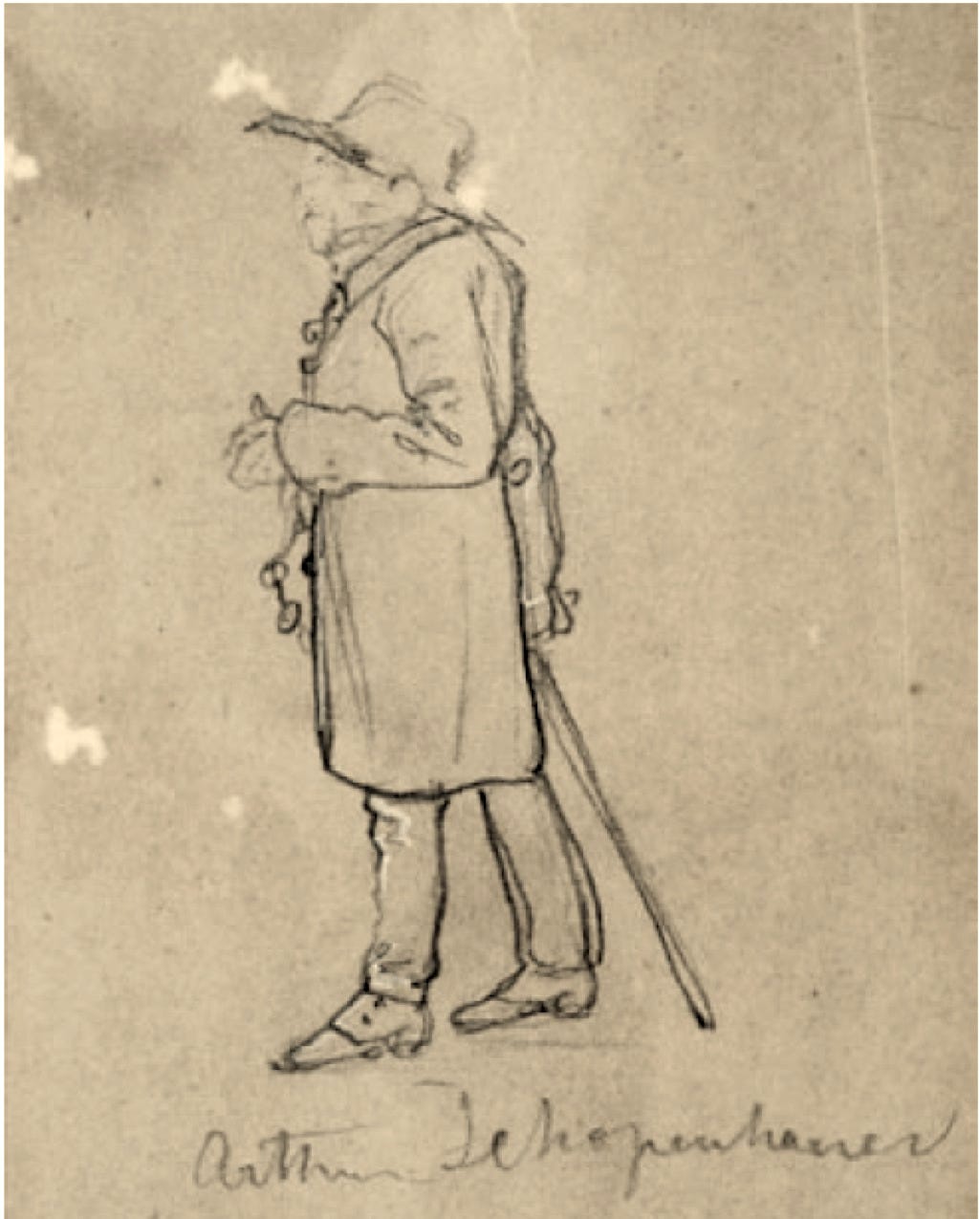
Schopenhauer viewed the will as an evil metaphysical entity, a thing which causes us to desire endlessly and to never find fulfillment or satiety in anything we do; but I feel his a priori pessimism was to blame for so crude a view. The will itself has no moral quality to it. The fact that Schopenhauer ascribed it one was nothing more than a blunder on his part, for it was the only thing that justified his pessimism in the first place, without which his entire system would not have been philosophy but introspective literature—not unlike Leopardi’s Zibaldone di pensieri.
All suffering loves justification. We like to think that, were we to discover the cause of our misery, that would suddenly make it disappear—but experience proves otherwise; even after knowing the cause, should we find it, we are not alleviated but, more often than not, angered and even embittered, in fact, because we think to ourselves in this newfound revelation how avoidable it actually was.
The will is not to be despised on that account. I think, rather, that the will is ours to command but the world’s to control. As I’ve already said, it makes no difference to me whether this will is free or not, only that I have the sense that it is. Freedom can only be had once our wills are freed from the bondage of prejudice, corrupting influence, and life-denying values. Anything that pertains to the will but does not include our subjectivity in it is to be ignored and forgotten by us, for it contains no content that is for our life—which, as far as I’m concerned, is the only thing that matters.
Were all things actually controlled fatalistically, all actions would lose their telos (purpose) and would consign the whole universe to a kind of Rube Goldberg machine on a scale unimaginable and quite preposterous. This is why the will must be affirmed either way; and must be understood by us as having the same significance that nature has on us. Anything short of this is bound to fail, for it does not include what we are in it.